The issue of water-boarding has become quite the political
flashpoint in recent weeks. First there was an uproar when Michael Mukasey, now
our Attorney General, stated his uncertainty as to whether or not this “interrogation”
technique constituted torture. Shamefully, he is not alone. Many officials in
our intelligence community insist that it does not. (Perhaps they should give
it a try.) Next, Congressional leaders urged that this and other special CIA
methods be banned for good, with predictable protests from the White House. Now
we learn that the CIA has destroyed secret videotapes of two high value
detainees being subjected to water-boarding. Jose A. Rodriguez Jr., who gave
the order, is a colleague of Terry Ward, who covered up my husband’s ongoing
torture and eventual murder in Guatemala years ago. There are too many historical ironies here.
To begin with, the sanitized and highly deceptive language
being used should itself be banned. Duping the American public is hardly the
proper solution to international charges of war crimes. Our intelligence
leaders tell us that water-boarding consists of placing a cloth over the
prisoner’s face, then pouring water over him until he "thinks he is going to
drown." This sounds like little more than a scare technique. The description is
so benign, in fact, that one wonders how the method could convince any prisoner
to talk.
A number of my friends survived water-boarding sessions in Latin America, and they give a rather different description. As my friend "O," a former POW in Guatemala tells me, his army
tormentors immersed him in a vat of water. He tried desperately to hold his
breath, but finally the water rushed into his head, causing terrible pain. He
remembers gagging and choking, and a mounting pressure that made him think his
eardrums would burst. He felt himself vomiting and going into convulsions. He
awoke on the floor to find his torturers administering CPR. We shared this
description with the United Nations Committee Against Torture last year. The
Committee members had no difficulty in declaring this technique a form of
torture, and banning it outright. Senator John McCain, himself a torture
survivor, has long said the same. Water-boarding is a slow and very painful
mock execution, in short, "exquisite torture."
Even more disturbing is the fact that many of these Latin
American prisoners were tortured with the guidance, payment and even presence
of CIA agents. In the case of "O," an American entered his secret cell,
observed his shocking condition, questioned him for some time, then simply
walked away. Ines Murillo was severely tortured in Honduras by members of Batallion
316. She endured "stress positions”"that permanently damaged her arms and
shoulders, and was water boarded until she lost consciousness. She has long
reported that an American came by often to ask questions, observe and advise.
The CIA brass, reluctantly, has admitted the man was one of their agents. These
cases were not rare. They were common.
If one listens to these testimonies, certain conclusions are
unavoidable. First, the methods in questions constitute clear and heinous forms
of torture. This is precisely why the CIA has destroyed the water-boarding
tapes. The American people would never stand for it. Second, techniques like
water-boarding, stress positions, frightening dogs, and temperature extremes,
are nothing new. They have been refined, used and taught by the CIA for
decades. The methods do not represent the sins of young, undisciplined
soldiers. Rather, they are planned and perfected techniques ordered by our
highest officials.
Perhaps most frightening, though, is the realization that
our intelligence officials have inflicted these forms of agony for decades
before the horrors of September 11, 2001. There were no security crises facing
the United States in Guatemala or Chile. What were we doing in bed
with the likes of Augusto Pinochet or Efrain Rios Montt, both charged with
systemic war crimes in international tribunals?
If Mr. Mukasey is uncertain as to the legality of
water-boarding, he should review our own criminal statute, 18 U.S.C. § 2340.
This law makes it a felony for any American officer to torture a prisoner
abroad. Torture is defined as any technique that would cause severe pain.
Mental torture includes mock executions. Both can result in a 20 year prison
sentence or even worse if the prisoner dies. Our international treaties, from
the Geneva Conventions to the Convention Against Torture, are equally clear. Before
we scoff at these long standing legal prohibitions as "naïve," we might
consider our own troops. If water boarding is legal, our young men and women
will be on the receiving end one day.
Does torture gain us any security? Historically it has never
worked. We need only recall the French in Algeria, the British in Northern Ireland, and our own experiences in Vietnam. The Israelis have used very harsh security measures since the first Intifada,
but the number of suicide bombers has increased. The Iraqis once tossed flowers
to our troops in Baghdad, but now toss bombs. Our "tough" measures seem to have backfired.
Does torture make people talk? It does. The problem is that
the victim will say anything at all to stop the pain. One detainee in Abu
Ghraib admitted under torture that he was Osama Ben Laden in disguise. Torture
gains us nothing but a flood of inaccurate information. Thus, despite our use
of torture, Osama himself remains at large after six long years. We hear
endlessly about the "ticking bomb," but this myth just doesn’t work. If a
powerful bomb was about to explode, and our agents seized and tortured the
wrong prisoner, he would invent an answer. We would then rush to the wrong
place and the bomb would still go off as planned. If we were to capture someone
who did know the location, his partners would have moved the bomb as soon as he
disappeared.
Clearly there are no easy solutions. But we might start with
some simple concepts; communication, mutual respect, and an emphasis on
humanitarian efforts, instead of a resort to brutality and terror ourselves.
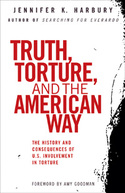
Jennifer Harbury is the author of Truth, Torture, and the American Way: The History and Consequences of U.S. Involvement in Torture. She has lived and worked with human rights activists, peasants, and Mayan villagers in Guatemala. Harbury also worked with members of the U.S. Congress and the Organization of American States to locate her husband and thirty-five other members of the Guatemalan resistance believed to be held by the military. She is the author of Searching for Everardo and Bridge of Courage.
 Beacon Broadside
Leave a comment