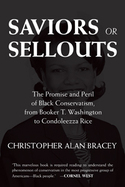
 During a recent promotional event for my book, Saviors or Sellouts:
The Promise and Peril of Black Conservatism, From Booker T. Washington to
Condoleezza Rice, a middle-aged African American woman asked me a question
that I’ve been hearing a lot these days. Although she agreed with much of what
conservatives past and present had to say about issues affecting the black
community, she refused to think of herself as a conservative because, in her
mind, conservatives (echoing Kanye
West’s criticism of the Bush Administration’s response to Hurricane Katrina)
“don’t really care about black
people.”
The problem, she elaborated, was one of tone. Black
conservatives, in her mind, were unduly hostile in their criticisms of the
blacks in general, and poor and urban blacks in particular. She simply couldn’t
bear to align herself – at least publicly – with these hostile voices. She was,
in her own mind, a black conservative masquerading as liberal – and suffering
within a deep political crisis as a consequence.
As the 2008 Presidential Campaign lurches forward, Americans
of all stripes will be called upon to contemplate and vote their politics. For
many African Americans, Barack Obama’s
pursuit of the Democratic nomination has, in some ways, reanimated a
conversation that has taken place quietly within the black community over the
past decade – a conversation about the increasingly conservative nature of
black politics.
To be sure, blacks are overwhelmingly registered Democrats. But
are blacks overwhelmingly liberal? In a season in which the dominant rhetoric
on both sides of the political aisle is one of “change,” what sort of change is
needed to best empower the African American community?

Condoleeza Rice
As I detail in the book, there is a growing perception that
conservatism within black America is gaining momentum. In 1972, fewer than ten percent
of blacks identified as conservative. Today, nearly thirty percent, or 11.2
Million, African Americans do. Fifty-six percent of black voters supported Virginia’s 2006 ban on
same-sex marriage. Other polling data reveal that the majority of blacks
support other conservative policies, such as privatization of social security,
school vouchers.
Do everyday blacks, who believe a more conservative pathway
is most attractive, dare to state these views publicly, particularly when the
Democratic nomination is at stake? More importantly, if, in the spirit of
public discourse, certain blacks declared themselves to be conservative, what
exactly does that mean? Is there a black conservative tradition, or multiple
traditions? And what obligation, if any, do liberals and progressives have to
engage this conservative tradition in a serious way?
In my view, liberals and progressives can no longer afford
to be dismissive of black conservatism. Indeed, the ability to secure
progressive change in American race relations will increasingly hinge upon the
depth of one’s understanding and engagement with the source of black
conservative ideals in general, and the black conservative perspective on
racial empowerment in particular. Although there is a richness and complexity
to conservative views held by blacks, there are five basic themes or tendencies
which most black conservatives share:
- Black conservatives tend to hold a strong belief
that blacks, through individual, self-directed achievement and in lieu of
government action and redress, can thrive in America because, at bottom, racism
is incompatible with American ideals of freedom, equality, and democracy. - Black conservatives tend to adopt a posture of
pragmatic optimism that emphasizes accomplishments in the face of great
obstacles and an anti-utopianism that focuses less on constructing an ideal
society and more on the struggle to make good in the society in which blacks
find themselves. - Black conservatives tend to subscribe to a middle
class morality that includes a commitment to respectability, proper deportment,
and having a productive and moralistic lifestyle. - Black conservatives tend to believe in the
powers of capitalism and that the best strategy for advancement is through the
large-scale multiplication of individual capitalist success stories. - Black conservatives tend to posses a strong conviction
that problems and obstacles faced by blacks can best be resolved by blacks themselves,
and that white racism lacks the power to define African Americans individually
or collectively.

Booker T. Washington
It is also important to understand that black conservatism
has been the dominant political philosophy for African Americans since the
founding of the Republic, and that conservatism has played an important, but
underappreciated, role in the struggle for racial equality. One can follow the
progression of black conservative thought, from its origins in the lived
experiences of its early proponents, including Reverend Jupiter Hammon, Richard
Allen, James Forten and Booker T. Washington, to its decrease in popularity
with the rise of W.E.B. Dubois and the NAACP, and its interwar manifestation in
unlikely spheres, including the Harlem Renaissance and the lifework of Marcus
Garvey. Many are surprised to learn how black conservatism’s precepts were
appropriated by the black nationalism and black power movements—and have today
found sources of nontraditional support among pundits, bloggers, and
entertainers, including Bill Cosby and Chris Rock.
By the close of the civil rights era, the majority of black
voters, encouraged by civil rights legislation and the sustained economic
relief brought about by President Johnson’s “The Great Society” initiatives,
supported the Democratic Party. Nevertheless, black conservatism, albeit in
decline and divided into fundamentalist and antigovernment camps, endured
quietly in a variety of political and cultural contexts until a new group of
black conservatives rose to public prominence in the late 1970s.
This new group of conservatives would prove markedly
different from the traditional conservatives of the past. Whereas traditional
black conservatism was “organic” in that the leaders emerged and were supported
from within the black community, many
modern black conservatives have emerged outside
the black community and as a result of the backing of white conservatives. Many
are surprised to learn that the origins of this black neo-conservatism lie in a
conference organized early in the Reagan administration to court and reward
black conservatives. A quick review of the personalities that would emerge – from
intellectuals such as Thomas Sowell, Glenn Loury, Shelby Steele, and John
McWhorter to public figures such as Condoleezza Rice and Clarence Thomas –
highlights a dramatic rightward shift away from traditional conservatism. Importantly,
it is a shift that has been nurtured and supported by an inorganic array of
political actors, think tanks and research institutes, and media outlets based
outside the black community. Through these inorganic support networks, black
neoconservatives were summarily legitimated through the bestowal of
governmental largess, private funding, and national public exposure.
Black conservatism, then, proves to be a remarkably rich,
complex, and even contradictory political philosophy. At the same time, it
should be understood as neither unqualifiedly good nor bad. There are strengths
as well as blindspots. The larger point, however, is that liberals and
progressives must begin to engage in serious, constructive dialogue across
ideological lines. If we are to fully understand why conservatism remains a
coherent and compelling alternative for many African Americans today – even if
our ultimate goal is to dissuade them from the joining the resurgent movement
and to champion liberal empowerment strategies – we owe it to ourselves and the
future of America to travel with them.
Christopher Alan Bracey is a professor
of law and of African
and African American Studies at Washington University in St. Louis. A
graduate of Harvard Law School, Bracey writes on the intersection of
race, law, and American politics, and he is the administrator and a regular contributor on www.blackprof.com. He lives in St. Louis, Missouri.
 Beacon Broadside
Leave a comment