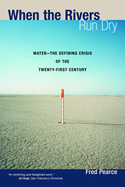
Fred Pearce is the author of When the Rivers Run Dry: Water the Defining Crisis of the Twenty-First Century, March 22nd is World Water Day, an initiative that grew out of the 1992 United Nations Conference on Environment and Development (UNCED) in Rio de Janeiro.
Water consumption has
tripled in the past 30 years and there’s a growing danger that disputes
over the most necessary of resources could erupt into violence
Water is rapidly becoming
one of the defining crises of the 21st century. Climate change is
making its availability increasingly uncertain. And we are using ever
more of the stuff. In the past three decades the human population has
doubled but human use of water has tripled — largely because,
ton-for-ton, modern ‘high-yielding’ crop varieties often need more
water than the old crops.
A typical Westerner
consumes, directly and through thirsty products like food, about a
hundred times their own weight in water every day. That is why some of
the great rivers of the world, such as the Nile, Indus, Yellow River
and Colorado, no longer reach the sea in any appreciable volume. All
their water is taken.
Many parts of the world,
notably the Middle East, are running out of water to feed themselves.
In response, a vast global trade is emerging. Not in water itself, but
in thirsty crops like grains and sugar and cotton. Europe is a major importer of thirsty crops. Meanwhile the US, along with a handful of other countries, like Australia, Argentina, Thailand and Canada, are major exporters.
Economists call this the ‘virtual water trade.’ Many countries would starve without it. But as
more and more countries run short of water, the trade will be
disrupted. And the threat of wars over water will grow.
Already water shortages
are at the heart of many injustices. Ever since Israel took control of
the West Bank in 1967, it has refused to let Palestinians sink new
boreholes there. It says this policy is necessary to protect the
underground water reserves, which are already being over-used. That is
true. But the reality is that Israel takes most of the water, and the
limits only apply to Palestinians.
Israel’s relations with
its other neighbours are poisoned by its insistence on controlling the
watershed of the River Jordan, its main source of water. According to
former prime minister Ariel Sharon’s memoirs, the 1967 Six Day War was
fought as much for control of the River Jordan as for land. Israel
today hangs onto the Golan Heights less for military reasons than
because it is where the river rises.
Scour the more serious
newspapers and you will see a constant drip-drip of stories about water
riots in Pakistan, Mexico, India, China, Indonesia and elsewhere. The
world is awash too with disputes over international rivers that
threaten to become full-blown wars as water shortages grow. As a
Briton, I am aware that many of these disputes are in former
British-run territories, and have their origins in colonial times.
The 1947 partitioning of
India split control of the River Indus. Now India and Pakistan are at
odds over a new Indian hydroelectric plant that, Pakistan claims,
threatens its British-built irrigation schemes, which supply most of
the country’s food. India’s control over the Ganges causes both floods
and droughts in downstream Bangladesh.
In Africa, Britain left
behind a Nile treaty that gives all the waters of a river that flows
through ten countries to the two most downstream: Egypt and Sudan.
Egypt now threatens to wage war on anyone upstream — such as Ethiopia — who takes so much as a pint pot of water from the river.
Other festering disputes
concern Chinese dams being built on the Mekong in Southeast Asia, and
complex conflicts in central Asia, where upstream hydroelectric dams
that keep the people of Tajikistan and Kyrgyzstan warm in winter
disrupt water supplies for the huge cotton plantations of downstream
Uzbekistan and Kazakhstan.
One of the first items on
the agenda of a future functioning Iraqi government will be to contest
Turkish dams upstream on the Tigris and Euphrates.
A major problem in many of
these disputes is that there are no internationally agreed ground rules
for how nations should cooperate over shared rivers. Back
in 1997 governments meeting at the UN agreed on the text of a
Watercourses Convention establishing such rules. And yet a decade
later, the treaty languishes without sufficient signatures from
national legislatures to enter into force.
Amid
the inevitable platitudes, it would be more valuable if, on World Water
Day this weekend, governments would pledge themselves to bringing this
vital agreement into force. It would be the first step to preventing future water wars.
Fred Pearce is a former news editor at New Scientist. Currently that magazine’s environment and development consultant, he has also written for Audubon, Popular Science, Time, the Boston Globe, and Natural History. His latest book is With Speed and Violence: Why Scientists Fear Tipping Points in Climate Change.
Elsewhere on Beacon Broadside: Fred Pearce on Al Gore, Tom Hallock on going green in independent bookselling and publishing, and David Gessner on migrations.

 Beacon Broadside
Leave a comment