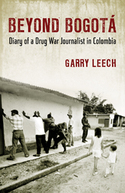
Garry Leech is an independent journalist and editor of Colombia Journal. In August of 2006, he was briefly held captive by the Revolutionary Armed Forces of Colombia (FARC), an experience that frames the narrative of his forthcoming book, Beyond Bogota: Diary of a Drug War Journalist in Colombia. After last week’s rescue of fifteen hostages, including former Colombian presidential candidate Ingrid Betancourt, from FARC custody, Beacon Broadside invited Leech to share his perspective with our readers.
 The news that the Colombian military had successfully rescued 15 hostages held by the Revolutionary Armed Forces of Colombia (FARC) spread quickly around the world. The story was deemed newsworthy by most mainstream media outlets because the leftist guerrilla group’s four most high-profile hostages—former presidential candidate and Colombian-French citizen Ingrid Betancourt, and three U.S. military contractors—were among those liberated. The liberation of the hostages has conveniently shifted media focus away from yet another political scandal in which the administration of Colombia’s President Alvaro Uribe finds itself mired.
In recent years, there have been many international efforts to negotiate a prisoner exchange between the FARC and the Colombian government. Envoys from the French government have repeatedly sought the release of Betancourt. The past eight months has seen Venezuelan President Hugo Chávez achieve the unilateral release of six hostages held by the FARC. The latter case is particularly interesting because the leftist Chávez’s success was beginning to prove embarrassing to Colombia’s right-wing president. Consequently, Uribe declared that Chávez was no longer authorized to negotiate with the FARC and within weeks successfully shifted the focus away from the plight of the hostages when he killed the FARC’s second-in-command, Raúl Reyes, in a cross border air strike into Ecuador that caused an international incident but sent his approval ratings skyward.
Two months later, when an investigation into links between pro-Uribe
lawmakers and right-wing paramilitary death squads began targeting some
of the president’s closest allies, including his cousin, the Colombian
leader suddenly extradited 14 paramilitary commanders
to the United States to stand trial on drug trafficking charges. The
extradition effectively terminated the investigation into what had
become known as the para-politics scandal because, as one investigator
noted, "They’ve taken away all the witnesses." Internationally, Uribe’s
decision to extradite the paramilitary commanders was mostly portrayed
by the media as a much-needed tough stance against the death squad
leaders and a victory in the war on drugs.
Interestingly, this week’s rescue of the 15 hostages has once again
allowed the Colombian president to shift the spotlight away from a
politically embarrassing scandal that has enveloped him. A week before
the rescue of the hostages, the Colombian Supreme Court ruled that high
government officials had bribed a lawmaker
to support a constitutional amendment that allowed Uribe to run for
re-election in 2006. The judges recommended a legal review of the 2006
vote. Rather than abide by the Supreme Court’s recommendation, Uribe
immediately attacked the court, claiming it was serving the interests
of terrorists and cocaine traffickers. He then declared that he would
hold a national referendum to determine the legitimacy of his re-election.
The president was besieged by criticism from, not only the opposition, but also from the country’s dominant media outlets.
Colombia’s leading weekly newsmagazine, Semana, portrayed Uribe as a
Roman emperor while the country’s largest daily, El Tiempo, claimed,
"The face-off between Uribe and the court has brought the country to
the brink of constitutional breakdown." And then, suddenly, the
Colombian military rescues the hostages and the media spotlight and
public opinion instantly shifts back in Uribe’s favor.
For most people, the killing of a high-ranking member of a
"terrorist" group, the extradition of drug traffickers and the rescue
of hostages are cause for joy. However, we must not forget that each of
these momentous events have over-shadowed recent revelations of much
deeper structural problems that plague Colombia’s so-called democratic
institutions. This is the tragedy behind the joy of the Uribe
government’s recent successes.
Further reading: Garry Leech’s post on the U.S.-Colombian Free Trade Agreement and his analysis, at Colombia Journal, of the potentially dangerous consequences of last week’s rescue.
 Beacon Broadside
Leave a comment