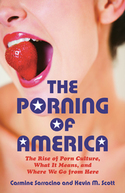
Today’s post, which we hope makes it through your spam filter, is from Carmine Sarracino, co-author of The Porning of America: The Rise of Porn Culture, What It Means, and Where We Go from Here. Sarracino is a professor of English and the author of three books of poetry. He has also published widely on Walt Whitman and was twice a Fulbright Scholar.
 I spent the better part of academic year 1989-90 in Kathmandu, Nepal, on a Fulbright research grant. My project was to explore connections between the poetry of Walt Whitman and ancient Vedic literature, especially on the topic of consciousness. I also agreed to supervise the doctoral dissertations of several students at Tribhuvan University, one of which was entitled, "Walt Whitman as a Tantrika Yogi."
Fascinating.
I knew little about tantra, which was then just beginning its faddish popularity in the United States, but I felt okay about supervising the dissertation. After all, Whitman’s sexuality—his own personal sexuality as well as his views of human sexuality—was so enormous and complexly layered a subject as to invite a myriad of approaches— the more unconventional the better. And I was in the perfect spot to learn about tantra, since many scholars regard Nepal as its historical home. So, working on the dissertation should be interesting.
Indeed, I came to see Whitman in a revealing new light. But beyond that, what I learned about tantra was often on my mind fifteen years later when my co-author, Kevin Scott, and I began work on The Porning of America. As we studied definitions of pornography, distinctions between porn and erotica, and so on, it became clear that porn in America has its roots in Puritanism. And that tantra provided an example of a completely different—and much healthier—orientation toward sexuality. The porn websites we surfed could have been written by characters right out of Hawthorne. Sex is "filthy," "nasty," "dirty." The women are "sluts," and "whores." Puritanism and porn share the same view of the human body and sexuality. The only difference is that porn transgressively revels in what the Puritans righteously ran away from.
A fundamental negativity—Puritanical guilt and anger—underlies what
is most objectionable in porn: humiliation and torture. In a lot of
porn, both Internet and DVD, we see a male need to dominate and
manipulate, often with an element—a tinge, at least—of humiliation. But
on some websites, the humiliation and physical abuse are extreme and
real—that is, there is no element of fantasy or consensual play. Women
are badly injured physically, emotionally, and psychologically. Bones
are broken. And, very likely, minds and spirits as well.
Is it possible to have a sexuality of uninhibited sensuality without
shame and anger, and all the attendant baggage, dragged in their wake?
Yes, it is possible. And tantra is one such example.
Tantra is a huge subject, but one that most readers here are probably at least somewhat familiar with.
The male plays the role of a powerful god, Lord Shiva, and the
female takes on the role of an equally powerful goddess, Uma (also
called Shakti). The rituals of body painting and scenting are
elaborate, accompanied by a recitation (often quite explicit and
graphic) of erotic praise of the other, as the "foreplay" of touching,
fondling, kissing, begins. But the main point I’d like to bring out
here is how playful, celebratory and joyful tantric sex is—as opposed
to the "sluts" engaged in the "dirt" of porn.
The Joy of Sex, edited by Alex Comfort, an immensely popular
sex manual of the early seventies, had much of the tantric flavor of
respect, play and celebration. And these qualities are not absent
altogether from contemporary porn. We find them most often in true
amateur porn—that is, porn created by non-professionals, usually in
front of a simple computer cam or digital camera on a tripod, and
posted as clips (ranging from less than a minute to as much as an hour)
online. It is not always the case (there are amateur sites called "Slut
Housewives" and the like) but often the partners seem affectionate, as
evidenced by exchanged smiles and eye gazing (rare in professional
porn), and are sometimes in committed relationships, given the clip
descriptions, "Me and my girlfriend" or even, "Me and my husband."
Why should this be important?
That is, why should affection, playfulness, and respect be important
in sexuality? Certainly, emotionless, "no strings" sex with total
strangers can be exciting. In fact, that is a very common sexual
fantasy for both men and women, and literally describes the widespread
practice of "hooking up."
The problem is that such sex sexualizes the other. Sexualization
means that someone is regarded as having no value—no value—except for
the sexual pleasure they can provide. Last year the American
Psychological Association released a landmark study of the sexualization of girls, which we refer to repeatedly in The Porning of America,
in which they documented in detail the attendant problems: depression,
low self-esteem, negative body image, a range of eating disorders,
academic failure. Although it was not part of their study, boys too are
increasingly sexualized in our culture—along with just about everyone
else. In our book we coin the term "universal sexualization."
Is it necessary to regard one’s sex partner as a god or goddess?
Probably not. But should we recognize and respect our partners as
people, as individuals like ourselves? Yes, because if they have no
value except for the sexual pleasure they can provide, it becomes
frighteningly easy—history is full of examples, as is some contemporary
porn—to do anything at all to "them."
And besides, sex is better with real people than with the polished
surfaces of the Paris Hilton ideal. Not many of us have the perfect
nineteen-year-old body. And even those who do, have them only on a
short –term loan. One of the things that is attractive about true
amateur porn is that the sex partners rarely look like porn stars, but
they are passionate, uninhibited, and enjoy great sex.
You might also want to read The Porning of America co-author Kevin Scott’s analysis of the Miley Cyrus Vanity Fair spread.
 Beacon Broadside
Leave a comment