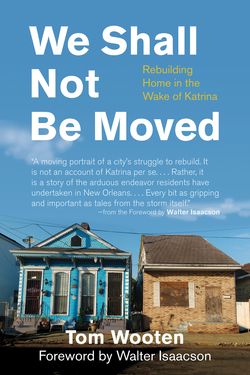
Our thoughts today are with those on the Gulf Coast threatened with flooding and storm surge as Hurricane Isaac brings its deluge ashore. It is seven years to the day since Hurricane Katrina hit this same area, and I had scheduled this blog post in honor of the anniversary weeks ago: an interview with Tom Wooten, author of We Shall Not Be Moved: Rebuilding Home in the Wake of Katrina. Wooten's book tells the story of the community leaders and neighborhood groups who led the recovery efforts in New Orleans. In running it today, we wish to honor the strength and resilience of this uniquely wonderful city. —Jessie Bennett, Blog Editor of Beacon Broadside
You were a student at Harvard when you decided to write this book. How did you come to be interested in the story of New Orleans' recovery?
I had a longstanding interest in disaster recovery as a
result of research project I was undertaking with my college roommate. That
project was about a flood that occurred in western India in 1979 that was the
deadliest dam collapse in human history. His mother's family survived the
disaster, and we wrote a comprehensive history of the events surrounding that
flood. One of the big questions that came out of our research in India was
related to ideas of community agency in the wake of a disaster. Many of the
people who survived that flood felt as if the government had been very
heavy-handed in coming in and dictated the way that the city that was destroyed
would be rebuilt. I became very interested in what a recovery would look like
that was being driven largely by neighborhoods themselves. It turned out that
in New Orleans, there were answers to many of my questions.
When I was a junior in college, I traveled to New Orleans
for the first time, and began to get a sense of the neighborhood-based nature
of the recovery taking place there. All levels of government—the city
government, the state government, and the federal government—had largely fallen
down on the job. As a result, often out of desperation, neighborhood groups
were stepping in to fill the void. They were doing things like opening their
own charter schools, passing self-taxing initiatives, running their own police
forces, providing very comprehensive social services to members of their
communities, in order to spur recovery. Many of these things are things we
expect larger nonprofits to do or expect city government to do, but
neighborhoods were doing this instead.
Do you think that there is something unique about this
particular disaster recovery? Is there something particular to the character of
the city of New Orleans that shaped this recovery?
New Orleans is a unique place. Among large cities in
America, New Orleans before Katrina had the lowest rate of people who were born
there leaving the city. People fall in love with New Orleans, and it is because
it is like nowhere else in the United States. And so people across the city
were incredibly invested in bringing the city back. The disaster was also
unprecedented because it was tremendously large—the biggest landscape scale
disaster to hit an American city. The destruction within New Orleans itself
stretches for more than twenty miles, from end to end of the city. Eighty
percent of the city was under water, and hundreds of thousands of people were
affected and still are today.
Another unique feature of the recovery in New Orleans is
that it has been largely driven by neighborhood groups. It is not a recovery
that is being led by the city government or the state government or the federal
government. Neighborhoods like Broadmoor, Lakeview, the Vietnamese community
New Orleans East, have really taken leadership in all aspects of their
recoveries. A number of New Orleans neighborhoods have made innovative
partnerships with larger nonprofits, with universities, with corporations, to
help resource those neighborhood based recovery efforts. A number of
organizations have partnered with groups in the Lower Ninth Ward, to rebuild
houses, to spearhead greening initiatives in the neighborhood, and many
residents have returned to the neighborhood as a result of those partnerships.
Similarly, Hollygrove has a tremendous partnership with the AARP which provided
a comprehensive set of consulting services for the neighborhood to help them
with crime prevention, education, health care, commercial development, and a number
of other issues facing the neighborhood.
We watched the government fail on many levels in the wake of
Katrina. Does this show that the government is a less effective actor in the
face of a disaster? Should we rely on private organizations and neighborhood groups to provide these
services?
Stories from the New Orleans recovery can be uplifting when
you consider what neighborhoods have managed to accomplish, both on their own
and through partnerships with private entities. That said, there are a number
of things that we can take from this disaster that show us ways to do recovery
better. A lot of that has to do with partnerships that should exist between
communities that are struggling to survive after a disaster and higher levels
of government. Neighborhoods in urban environments post-disaster should not
have to open schools on their own. They should not have to self-tax to fix
streets or provide extra police coverage. There are things that we expect
different levels of government to do, and whether you're liberal or conservative,
I believe that we all want government to work well at the tasks that we assign
it. We saw that this didn't work well in New Orleans.
In the future, there will
be more landscape-scale disasters of the type that we saw in New Orleans. We
have a number of coastal cities, and we have climate change that is raising sea
levels and changing weather patterns. We have cities that are in places that
are prone to wild fires; we have cities that are prone to tremendous
earthquakes. We don't want what happened in New Orleans to happen again in
another American city. And government reforms are key to making sure that we
respond better in the future.
Quite simply, there is tremendous potential for partnerships
between communities and neighborhoods on the one hand, and higher levels of
government on the other. We should work hard to make sure that potential is
reached.
One of the problems seems to be that FEMA is set up to help
during isolated incidents, to help small communities recover, but when
something happens that is this vast, it has a more difficult time responding.
Historically, FEMA has been set up to respond very well to
small disasters that are contained to an area–perhaps a tornado that destroys
300 homes. They can respond very quickly and very well to that. But we as a
nation have proven through the experience of New Orleans have proven that we
are not able to handle a landscape-scale disaster very effectively. In the
future, the federal government needs to think about what role it will play when
other landscape-scale disasters take place.
Who were some of the people and groups that you encountered
who were instrumental in New Orleans' recovery?
In Broadmoor, the neighborhood association president is
LaToya Cantrell, and she is a tremendously powerful individual. Even before the
storm, she could command a large crowd's attention just by her presence. She's
a good listener and empathetic, and she has an amazing and broad base of
support across the neighborhood.
Many of the leaders I've interviewed, including LaToya, have
put themselves on the line for their neighborhoods, have spent years upon years
working harder than any person should have to work to make their communities
come back. There's a lot of burnout that's taking place right now, but it's
exciting to see that as progress becomes clear, it's exciting to see some of
these leaders getting to kick back a little bit.
 Terry Miranda, who is from Lakeview, his contribution to the
book is that he is able to narrate New Orleans history and make sense of many
nonsensical things very well and even poetically. He always rides around the
city on a bike, and he'll give me insights into city history, neighborhood
history, and he seems to know everybody. Very often a Sunday afternoon bicycle
ride will involve dozens of conversations with people on porches and lots of
funny stories about the people and the city. [Photo at right, courtesy of Tom Wooten, is of one of those bike rides led by Terry Miranda.]
I love New Orleans, and many of the young people who have
come in since the storm have adopted the city as their own. It's a city that,
very rightly actually, is very skeptical of outsiders coming in. There have
been a number of outside agendas in the wake of Katrina that have not panned
out very well for the city. So if you come in with an idea of how things should
be and how you're going to fix things, you're probably not doing the city any
favors. If you come in open to how the city works and ready to contribute to
things that the residents are already undertaking, the city will really embrace
you.
 Beacon Broadside
Leave a comment