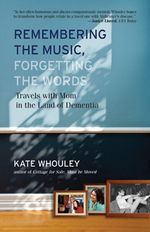
Last week, author Kate Whouley was honored by the New England Independent Booksellers Association (NEIBA) with the New England Book Award for Nonfiction for her memoir, Remembering the Music, Forgetting the Words: Travels with Mom in the Land of Dementia. Below is an adaptation of her acceptance speech, given before an audience of enthusiastic booksellers at last week's NEIBA Fall Conference in Providence.
 I have
always been a reader. I love to lose myself deep inside the pages—and the
worlds—of books.
Still—my
capacity for observation and my ability to imagine alternate realities has not
always served me well. In the first standardized test I was given, I performed
badly. I was asked to circle the image that should come next in a series of
illustrations. In every scenario, I could imagine too many possibilities. There’s
one I remember: a girl has dropped a bottle of milk on the floor. What would
happen next? Would she clean up the spill? Summon her mother for help? Enjoy
her after-school snack? It seemed to me so much would depend on the character
of that girl. And the plot line of her life. What if her mother wasn’t there
when she got home from school? Did she have a cat who might lap up the milk? Was
she easy-going or a worrier? Is it possible that she dropped the bottle on
purpose because she didn’t like the taste of milk?
You can see
why I had trouble with this test. My results made me a Cub, a member of the
lowest, slowest reading group. Within weeks, I was a Bluebird. And I have still
never forgiven that first grade teacher—her name was Mrs. Cunningham—for
telling the rest of the class—that my climb from Cub to Squirrel to Rabbit to
Bluebird was a result of hard work.
But no
matter, I kept on reading. Anything that was around the house—and there were
plenty of books. My mother was an English teacher and drama coach. I read books
that were not age-appropriate, and when I tired of the plays and novels on my
mother’s bookshelves, I read my way through my grandmother’s Book-of-the-Month
selections and her library of Reader’s Digest Condensed editions.
Reading, I
was in training to become a writer. It’s true I wrote along the way; in fact,
when I was in fourth-grade, Mrs. Cunningham retired, and I was asked to write
and recite a poem in her honor. It was my first unpublished fiction.
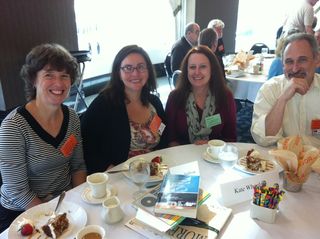
Vicky Titcomb (Titcomb's Bookshop), Lisa Sullivan (Bartleby's Books), Kate Whouley and Michael Herrmann (Gibson's Bookstore) at the NEIBA Awards Lunch.
In, junior
high, I was published in a magazine called, Insulators,
Crown Jewels of the Wire. I was too busy practicing my flute to do much
extra-curricular writing in high school or college. After graduation, I taught
flute lessons, waited tables, wrote greeting cards for Hallmark, and landed a
part-time job in a bookstore. As a bookseller—and later as a consultant to
booksellers—I wrote ad copy, radio commercials, blurbs for catalogues, features
and a column for American Bookseller.
I was
writing. But I was not—in my mind—a
writer.
Except in
my dreams. That’s where I met Woody Allen.
At the
time, I had seen just two Woody Allen movies—Crimes and Misdemeanors and Hannah
and Her Sisters. I did not love either one. Also—in case it is
relevant—this dream occurred before Mr. Allen began dating his sort-of
stepdaughter, now-wife of twenty years.
In the
dream, I am one of maybe ten or fifteen students in a classroom. The teacher is
Woody Allen. Then the scene changes; we’re walking in the park—just me and Mr.
Allen. It’s fall; the leaves have color: a few are on the ground. The
temperature is chilly enough for my companion to be wearing a light overcoat.
Woody Allen turns to me, and says, “You know,
we share the same interests—as writers.” He elaborates: “We’re both fascinated
by relationships. We write from character. We want to know what motivates
people. Also, we wonder why we’re here.”
I
cannot tell you why my subconscious chose Woody Allen as my writing mentor. (Why
can’t I have Tolstoy?)
I can tell you that when I woke up, I thought
about what Mr. Allen had called me: a writer.
And how he’d treated me as an equal. How quickly I’d advanced from back of the
classroom to walking by his side. And in some strange way, dream-Woody Allen
got me thinking that I might be able to move from writing to writer.
It
turns out that the man whose movies I had not yet seen was pretty much right-on
about my interests as a writer. I do write from character. That’s not so
typical in a nonfiction writer. In the case of Cottage for Sale: the characters who led me to write were the leading
men of my house-moving adventure—a lot of guys with tool belts and a bossy gray
cat named Egypt.
When
I started writing Remembering the Music,
I thought I was writing a book about all the intriguing personalities in the
community band I’ve played in for almost twenty years. But my mother—who is
what might be called, in writerly terms, a strong character—seemed to be
showing up on every page. I realized I wasn’t writing a book about the band
with some bits about my mother in it, but rather that I needed to write a book
about my mother with some bits about the band in it.
Remembering the Music is often mistaken
for a book about Alzheimer’s. In fact, it’s a book about all the things that
interest me as a writer: people, relationships, what motivates us, and why we
are here. It’s about choices we make, the journeys we take, and the families we
create from friends. It’s about learning to forgive, and most of all—about
finding the willingness to forget. It’s also about the bridge and consolation
we find in music. And it’s about the things my mother taught me—not only in her
vibrant youth, but in her debilitated and forgetful aging. Not the least of
which was to sit still, be present and know that every moment—remembered or
forgotten—matters to the person sitting next to us.
For
readers who prefer plot to theme: this is a book about two women, alone in the
world. Both of them just a bit eccentric, odd in their own ways. Both of them
fighters who don’t give up or give in. Though they aren’t so different, they
aren’t so much the same either. And they don’t really get along for most of
their lives. And then—well something horrible happens. Which makes something
miraculous occur.
After
all that character and theme and plot, if someone still insists that Remembering the Music is about Alzheimer’s—well,
it’s about the upside of Alzheimer’s. This
is not a book about an illness. It’s a book about a healing.
Some
have suggested writing this book must have been a cathartic process, but
catharsis was not my motivation or my practice. I wrote this book because I
realized that I had to. That my mother—the version of her showing up on every
page of that band book—wasn’t going away. That she wanted this book—and that
she knew I would learn something in the writing.
Because
we write for the same reasons that we read. To uncover the truth about
something; to learn. Sometimes as readers—and especially as writers—we need to
stand back from a story before we can understand its lessons. From the distance
of the writer, I can tell you what this story taught me: healing comes in most
mysterious ways; we grow through challenge and adversity; life is precious,
relationships—fragile, love—undiscriminating, and hope—never-ending.
 Beacon Broadside
Leave a comment