David Bacon is a writer and photographer. He is the author of Illegal People: How Globalization Creates Migration and Criminalizes Immigrants and the forthcoming The Right to Stay Home: Ending Forced Migration and the Criminalization of Immigrants. His photographs and stories can be found at http://dbacon.igc.org.
This post originally appeared at TruthOut.
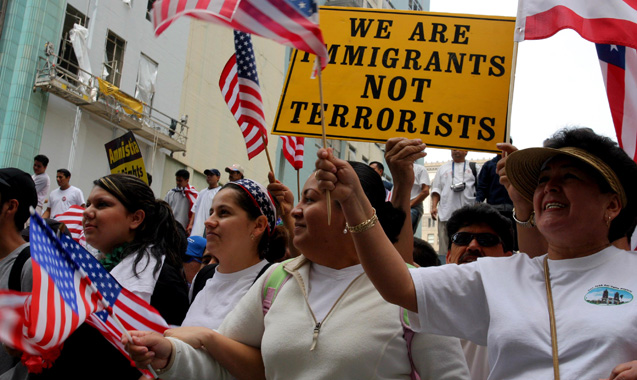
A scene from the million-person march in Los Angeles in 2006. (Photo: David Bacon)
We
need an immigration policy based on human, civil and labor rights, which looks
at the reasons why people come to the U.S., and how we can end the
criminalization of their status and work. While proposals from Congress and the
administration have started the debate over the need for change in our
immigration policy, they are not only too limited and ignore the global nature
of migration, but they will actually make the problem of criminalization much
worse. We need a better alternative.
This
alternative should start by looking at the roots of migration – the reasons why
people come to the U.S. in the first place. Movement and migration is a human
right. But we live in a world in which a lot of migration isn’t voluntary, but
is forced by poverty and so-called economic reforms.
Our trade policy, and the economic
measures we impose on countries like Mexico, El Salvador or the Philippines
make poverty worse. When people get poorer and their wages go down, it creates
opportunities for U.S. corporate investment. This is what drives our trade
policy. But the human cost is very high.
In El Salvador today, the U.S. Embassy
is telling the government to sell off its water, hospitals, schools and
highways to give U.S. investors a chance to make money. This policy is enabled
by the Central American Free Trade Agreement, whose purpose was increasing
opportunities in El Salvador for U.S. investors. It was imposed on the people
of that country in the face of fierce popular opposition.
Alex Gomez, a leader of Salvadoran
public sector unions, came to San Francisco in February to explain what the
consequences of this latest free trade initiative will be. He says if these
public resources are privatized, tens of thousands of workers will lose their
jobs, and their unions will be destroyed. They will then have to leave the
country to survive.
According to Gomez, four million have
already left El Salvador. Two million have come to the US, not because they
love it here, but because they can’t survive any longer at home. These migrants
come without papers, because there are no visas for two million people from
this small country.
The North American Free Trade Agreement
did even more damage than CAFTA. It let U.S. corporations dump corn in Mexico,
to take over the market there with imports from the U.S. Today one company,
Smithfield Foods, sells almost a third of all the pork consumed by Mexicans. Because
of this dumping and the market takeover, prices dropped so low that millions of
Mexican farmers couldn’t survive. They too had to leave home.
Mexico used to be self-sufficient in
corn and meat production. Corn cultivation started there in Oaxaca many
centuries ago. Now Mexico is a net corn and meat importer from the U.S.
During the years NAFTA has been in
effect, the number of people in the U.S. born in Mexico went from 4.5 million
to 12.67 million. Today about 11% of all Mexicans live in the U.S. About 5.7
million of those who came were able to get some kind of visa, but another 7
million couldn’t. There just aren’t that many visas. But they came anyway
because they had very little choice, if they wanted to survive or their
families to prosper.
Our immigration laws turn these people
into criminals. They say that if migrants without papers work here it’s a
crime. But how can people survive here if they don’t work? We need a different
kind of immigration policy – that stops putting such pressure on people to
leave, and that doesn’t treat them as criminals if they do.
What would it look like?
First, we should tell the truth, as the
labor-supported TRADE Act would have us do, which was introduced into Congress
by Mike Michaud from Maine. We should hold hearings as the bill says, about the
effects of NAFTA and CAFTA, and collect evidence about the way those agreements
have displaced people in the U.S. and other countries as well.
Then we need to renegotiate those
existing agreements to eliminate the causes of displacement. If we provide
compensation to communities that have suffered the effects of free trade and
corporate economic reforms, that were intended to benefit U.S. investors, it
would be more than simple justice. It might give people more resources and more
of a future at home.
It makes no sense to negotiate new
trade agreements that displace even more people or lower living standards. This
administration has negotiated three so far, with Peru, Panama and South Korea. It
is now negotiating a new one — the Trans Pacific Partnership. These are all
pro-corporate, people-displacing agreements. We should prohibit these and any
new ones like them. Instead, we need to make sure all future trade treaties
require adequate farm prices and income in farming communities, promote unions
and high wages, and don’t require the privatization of public services.
Increasingly these international
agreements, like Mode 4 of the World Trade Organization, treat displaced
migrants as a cheap and vulnerable labor force. Our trade negotiators call for
regulating their flow with guest worker programs. This is exactly the wrong
direction. We should ban the inclusion of guest workers in any future trade agreement
or treaty instead.
When diplomacy doesn’t work, U.S.
military intervention and aid programs are to support trade agreements,
structural adjustment policies or market economic reforms. This has been U.S.
policy in Honduras and Haiti, for instance. This also must stop. If the U.S.
Embassy is putting pressure on countries like El Salvador to adopt measures
that benefit corporate investors at the expense of workers and farmers, the
Ambassador should be recalled and the interference halted.
Finally, we should ratify the UN
Convention on the Rights of Migrant Workers and Their Families. This
international agreement would give us an alternative framework for recognizing
the rights of displaced migrants, and the responsibility of both sending and receiving
countries for their protection.
The failure of successive U.S.
administrations to even present this agreement to Congress for ratification
highlights the unpleasant truth about the real effect of our immigration
policy. When millions of migrants arrive here, they are criminalized because
they lack immigration status, especially when they go to work.
Labor and civil rights advocates often
fondly remember the 1986 Immigration Reform and Control Act because of it had
an amnesty, signed by President Ronald Reagan, which gave legal status
relatively quickly to almost four million people. But the law also contained
employer sanctions for the first time, which we often forget. That provision
says that employers will be fined and punished if they hire undocumented
workers.
This provision was promoted by those
who said that if work became illegal, then undocumented migration would end. This
clearly failed, since the number increased many-fold in the years that
followed. Compared to the pressure to leave home, criminalizing work was not a
deterrent to those who sought work here so that their families at home would
survive.
This provision sounded like a law
against employers, but it was not. It became an anti-worker law. No boss ever
went to jail for violating it. The fines were not great. When the government
agents seek to enforce it, employers who cooperate with them are forgiven. But
over the last four years alone, tens of thousands of workers have been fired
for not having papers. The true objects of punishment under this law have
always been workers, not employers.
Now Congress is talking about a new
reform, and we have to use this opportunity to push to repeal this law. Some
think that since a new legalization will hopefully give many undocumented
workers legal status, sanction won’t really affect anyone anymore.
But even the most positive predictions
about a new legalization still assume that millions of people will not quality
because of stringent qualifications, high fees and decades-long waiting
periods. Those people will still be subject to the sanctions law. And the day
after a new reform passes millions more people will come to the U.S. because of
the same pressures that caused past waves of migration. This is especially true
if a new immigration reform ignores the need to renegotiate trade agreements
and eliminate the huge displacement of people.
These future migrants are not
strangers. They are the husbands and wives, parents, and cousins of people
already here – people who are already part of our communities. They come from
the same towns, and are linked to neighborhoods here in the U.S. by the ties
that have been created by migration, work and family. They will work in our
workplaces, participate in our organizing drives, and belong to our unions. We
need to keep the sanctions law from being applied to them, making it a crime
for them to work. Unfortunately, however, Congress members aren’t talking about
getting rid of sanctions. In fact, they and the administration want to make the
current application even worse.
So let’s do a reality check. Let’s tell
the truth about how has this law been used.
One method for enforcing sanctions
happens when an employer uses it to screen people it is going to hire, using an
error-filled government database called E-verify. Congress and the
administration are calling for making it mandatory for all employers to use
this database, and refuse to hire anyone who it flags as undocumented.
For people who are currently working
now and have no papers, what it means is that if they lose their jobs, it will
be much hard to find others. That will make people fear taking any action that
offends their boss, like joining a union or complaining about illegal
conditions. That’s good for the boss, but bad for the workers.
Employers today not only use this
database to screen new hires – they also use it to reverify the immigration
status of people who are already working. This is a violation of the law. Once
it accepts the form filled out by a job seeker (called the I-9), along with
their ID, the employer can’t reverify it all over again at some point in the
future. But they do. Sometimes it’s convenient to get rid of workers who have
accumulated benefits and raises over years of service, and replace them with
new hires at lower wages.
Reverification just happened, for
instance, to three workers who belong to the International Longshore and
Warehouse Union at Waste Management, Inc. in San Leandro, California. The union
has gone to the Oakland City Council to protest these illegal firings, because
WMI operates under a city garbage contract.
Employers sometimes announce they
intend to begin using the E-Verify database when their workers start to
organize. That’s what managers announced at the Mi Pueblo supermarkets in
northern California. There E-Verify checks are being used to terrorize workers
to keep them from supporting a union, Local 5 of the United Food and Commercial
Workers.
Another method for enforcing sanctions
against workers is even more widespread. Immigration agents, working for the
Immigration and Customs Enforcement (ICE), go into the personnel records of an
employer. They then compare the information given by workers on the I-9 form to
the E-Verify database, looking for workers who don’t have legal immigration
status. ICE then makes a list of those workers and sends it to the company,
telling the employer to fire them.
This is what happened at Pacific Steel
Castings in Berkeley, California, last year. Two hundred and fourteen workers
were fired as a result. Some had worked in the foundry for over 20 years. Many
lost their homes, and their children’s dreams of going to college were
destroyed.
Over last four years, hundreds of
thousands of workers have lost their jobs in these enforcement actions, called
I-9 audits. Almost five hundred janitors in San Francisco, and over a thousand
in Minneapolis. Thousands of workers doing some of the hardest work imaginable
in meatpacking plants around the country. Farm workers. Construction workers. But
the employers all given reduced fines, and many immunity from punishment
entirely, if they cooperated in firing their own workers.
If unions and communities mount a fight
that exposes the terrible human cost of these firings, it is possible to stop
them. The young Dreamers showed that this is possible. These courageous young
people convinced the administration to stop deporting students brought to the
U.S. without papers as children. They forced the administration to change the
way it enforces immigration law. It can be done for workers too, if there’s a
fight.
But we must also change the sanctions
law. Otherwise, our experience over the 25 years since it passed shows that
immigration authorities will simply find another method for making working a
crime for people who don’t have papers.
The other unpleasant truth about
sanctions is that they are linked to the growth of guest worker programs. One
of the main purposes of making it a crime to work without papers is to force
people to come to the U.S. with visas that tie them to their employers and
recruiters. These workers are often more vulnerable than the undocumented,
since they get deported if they lose their jobs or get fired. Guest worker
programs have been called Close to Slavery by the Southern Poverty Law Center
and others who have documented their extreme exploitation. The sanctions law
functions as a way to pressure people into choosing that path to come to the
U.S. to work.
When employer sanctions are used to
make workers vulnerable to pressure, to break unions or to force people into
guest worker programs, their real effect is to force people into low wage jobs
with no rights. This is a subsidy for employers, and brings down wages for
everyone. The sanctions law makes it harder for all workers to organize to
improve conditions. This doesn’t just affect the workers who have no papers
themselves. When it becomes harder for one group to organize, other workers
have a harder time organizing too.
Some Washington lobbyists accept as a
fact of life that the sanctions law will continue, or even worse, that E-Verify
will become a mandatory national program for all employers. But for unions and
workers who have had to deal with its effects , it would be much better to
immediately repeal it, and dismantle the E-Verify database.
The use of the sanctions law against
workers and unions is what led the California Labor Federation to call for its
repeal as early as 1994, a position it continued to adopt in successive
conventions. Other unions joined it including the garment unions and service
employees. Finally labor councils in California and then around the country
passed resolutions making the same call, and sent them to the historic AFL-CIO
convention in Los Angeles in 1999. This led to an historic debate and the
adoption of a new, pro-immigrant policy. Delegates at that convention believed
that we have to stop enforcing immigration law in the workplace, because its
real effect is to make workers vulnerable to employers, and to make it harder
for all workers to organize to improve conditions.
In addition to repealing the national
sanctions law, we should also prohibit states from enacting copycat measures. These
laws have passed not just in Arizona or Alabama or Mississippi. California
passed a state employer sanctions law before the federal law took effect in
1986.
What would really help workers to raise
wages and improve conditions is much stricter enforcement of worker protection
and anti-discrimination laws, for everyone. Funding used for immigration
enforcement on the job should be given instead to the Department of Labor, the
Occupational Safety and Health Administration, the National Labor Relations
Board and other labor law enforcement agencies. It will be a good day for all
workers when ICE agents instead become wage and hour inspectors.
Threats by employers who use
immigration status to keep workers from organizing unions or protesting illegal
conditions should be a crime. That makes it necessary to overturn two Supreme
Court decisions, Hoffman and Sure-Tan. In these cases the court said that if
workers are fired for union activity and have no papers, the boss doesn’t have
to rehire them or pay them lost wages, because the sanctions law makes it
illegal to employ them to begin with. But when there’s no punishment for
violating labor rights, workers have no rights. This also hurts other workers
in the same workplace who want to organize a union, since it makes the
undocumented so vulnerable. Instead, we should increase workplace rights by
prohibiting immigration enforcement during labor disputes or against workers
who complain about illegal conditions.
To ensure that in the workplace we all
have the same rights we also have to eliminate the way undocumented people get
ripped off by funds like Social Security and unemployment. All workers
contribute to the Social Security fund, but because undocumented people are
working under bad numbers, they pay in but can never collect the benefits. This
will come back to haunt us when those workers need disability payments or get
too old to work – something that happens to us all. This is the reason we set
up the Social Security system to begin with – because we don’t want old people
eating dog food, regardless of where they were born.
Instead today the Social Security
number has become much more a means to check immigration status, harming
workers instead of providing them the benefits that were its original and true
purpose. There is a simple solution to this problem as well. Social Security
numbers should be made available for everyone, regardless of immigration
status. Everyone should pay into the system and everyone has a right to the
benefits those payments create. By the same token all workers should be able to
receive unemployment benefits regardless of status, since they and their
employers pay into the funds.
In the end, we need an immigration
policy that brings people together, instead of pitting workers against each
other, as our current system does. During a time of economic crisis especially
we need to reduce job competition, rather than stoking fears. In 2005
Congresswoman Sheila Jackson Lee of Houston made an innovative proposal that
would have set up job creation and training programs for unemployed workers at
the same time that it would have given legal status to workers without papers. This
proposal put unemployed workers and immigrants on the same side, giving them
both something to fight for whether they were out of work, or working without
immigration status.
This proposal, and the others made
here, are part of the Dignity Campaign, a plan for immigration reform based on
human, civil and labor rights. In the last three years, local unions and labor
councils in San Francisco, Silicon Valley and Alameda County adopted
resolutions supporting the Dignity Campaign, arguing that trade policy is
linked to the increasing vulnerability of immigrant workers because of the
sanctions law and guest worker progrsms. The Labor Council for Latin American
Advancement adopted a similar resolution.
An immigration policy that benefits
migrants, their home communities, and working people here in the U.S. has to
have a long term perspective. Instead of just trying to please interest groups
well-represented in Congress, we need to ask, where are we going? What will
actually solve the problems that we experience on our jobs and in our homes
with current laws and policies?
We need a system that produces
security, not insecurity. We need a commitment to equality and equal status –
getting rid of color and national lines instead of making them deeper. We need
to make it easier for workers to organize, by getting rid of what makes people
vulnerable — to end job competition we need full employment, and to gain
organizing rights we need labor law enforcement together with eliminating
sanctions and firings. It’s not likely that many corporations will support such
a program, so the politicians who represent us have to choose whose side they’re
on.
Working people in Mexico, El Salvador,
the Philippines, the US and other countries need the same things. Secure jobs
at a living wage. Rights in our workplaces and communities. The freedom to
travel and seek a future for our families, and the ability to stay home and
have a decent future there too. The borders between our countries, then, should
be common grounds that unite us, not lines that divide us.
Related articles


 Beacon Broadside
Leave a comment