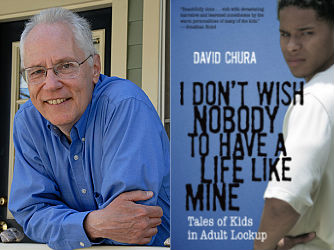
David Chura is the author of I Don't Wish Nobody to Have a Life Like Mine: Tales of Kids in Adult Lockup, and he has worked with at-risk teenagers for forty years. His writing has appeared in the New York Times and multiple literary journals and anthologies, and he is a frequent lecturer and advisor on incarcerated youth.
Over the last few months, Chura's blog, Kids in the System, has featured a series called "Teachers in Their Own Words." Chura invited "a variety of teachers from different educational settings to share their experiences, to talk about why they teach and who they teach, and to tell the stories that keep them in the classroom." It's made for enlightening, inspirational reading. We asked him a few questions about the series for Beacon Broadside.
David Chura will speak at the Association of Writers & Writing Programs (AWP) conference in Boston this Saturday, as part of Beacon's panel on Literary Nonfiction and Social Activism. See him—along with Courtney Martin, Michael Patrick MacDonald, Marianne Leone, and Beacon Director Helene Atwan—at 9am Saturday in Room 206, level 2. Get more information on AWP panels featuring Beacon authors, and be sure to visit us in the Bookfair at booth 1214 for author signings and a 35% discount on all books.
 What inspired you to ask other teachers to write about their
experiences?
The educational debate is lively, fierce at times, and filled with
voices—of economists, politicians, business executives, unions, academics,
educational experts. The one voice that is under represented, if not silent, is
that of classroom teachers, the folks on the front lines of education. But that
silence hasn’t been my experience. In my many conversations with teachers that
I know, and in my correspondence with those from across the country who have
reached out to me through the internet, teachers have a lot to say. Yes,
they’re concerned about the policies that are being made about curriculum,
about standardized testing, about teacher evaluation. But what they are really
talking about is what matters most to them: the everyday classroom and the kids
that they teach and nurture and care about, and about how they can do their
best for their students. The absence of teachers’ voices in the educational
debate has bothered and saddened me. In order to break that silence I began the
series, “Teachers in Their Own Words,” inviting teachers to write about what is
most on their minds.
Teaching is a demanding job under the best conditions. How do
teachers who have additional challenges—of teaching kids in lockup, overcoming
ESL difficulties, getting through to kids who have been abused—find the
strength to do what they do?
I think all teachers but especially those working
with special needs students ask themselves that question: how—and why—do I keep
doing this? The answer is pretty simple. They’re nourished by the steps—little steps, big steps, leaps and bounds, and sometimes a
mere eighth of an inch forward—that their students make, students for whom any
progress is a struggle of effort against some pretty hefty odds. Teachers
facing the extra challenge of special needs students learn to appreciate not
just the successes of their students (and there are many) but also to value the
effort that these kids put into their work. Why teach in challenging
classrooms? Galway Kinell put it nicely: “everything flowers, from
within, of self-blessing /though sometimes it is
necessary/to reteach a thing its loveliness.” Who wouldn’t show up day after
day for that?
Given that the educational system is always under heavy scrutiny
and budget pressure, do you think that teachers have to, in some way, be
activists?
Being a teacher, almost by definition, means being an activist.
And given the present economic and educational climate, teachers as agents of
change seem even more imperative. For a teacher, that change happens daily in
the classroom as he or she is alert to the needs of students: it may be for a
winter coat, a pair of eyeglasses to see the board, or a dental checkup; or it
may be a need for protection from bullies, from abusive treatment at home, from
danger in the streets on the way to school. Any teacher knows that these needs must
be attended to as soon as possible—there’s no time for the bickering of experts—in
order to ensure student safety and wellbeing. In turn, dealing with those needs
on the everyday level often has compelled teachers to become involved in the larger
national debate on such issues as economic disparity, gun control and health
care. The insights teachers bring to these issues comes from their knowledge and
experience of the whole child and their
firsthand awareness of the impact that these and other social issues have on
kids’ development and education. It’s a perspective only teachers can bring to our
national discourse about what is best for our children. It’s a voice we need to
listen to.
Related articles


 Beacon Broadside
Leave a comment