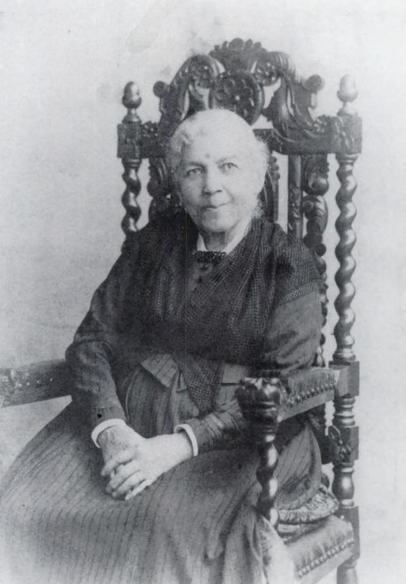
Harriet Jacobs was born into slavery in 1813 to Elijah and Delilah Jacobs. When Harriet’s mother died in 1819, she was sent to live with her mother’s owner
and mistress, Margaret Horniblow, and was welcomed into the family. But, Margaret died when Harriet was 11, and instead of being emancipated like she had hoped, she was bequeathed to her mistress’s three-year-old niece, Mary Matilda. Because of Mary’s young age, her father Dr. James Norcom became Harriet’s master.
After years of unwanted sexual advances and abuse at the hands of Dr. Norcom, Harriet went into hiding above her grandmother’s home. For nearly seven years she confined herself in a small crawlspace between the storeroom and the roof waiting for
her chance to escape, all the while listening to her children grow up in the
home underneath her. In 1842, with the help of a friend, Harriet finally
escaped. Harriet died in Washington, DC, on March 7, 1897, and was buried in
Mount Auburn Cemetery, in Cambridge, Massachusetts.
The following passages are taken from her autobiography Incidents in the Life of a Slave Girl, Written by Herself. It is one of the earliest works by an African American woman writer. Originally self-published in 1861 under the pen name Linda Brent, it was for generations thought to be a work of fiction until its
authenticity was verified in the 1980s.
In this section, Jacobs describes the small crawlspace in which she lived for nearly seven years.
“The garret was only nine feet long, and seven wide. The highest part was three feet
high, and sloped down abruptly to the loose board floor. There was no admission
for either light or air. My uncle Philip, who was a carpenter, had very
skillfully made a concealed trap door, which communicated with the storeroom.
He had been doing this while I was waiting in the swamp. The storeroom opened
upon a piazza. To this hole I was conveyed as soon as I entered the house. The
air was stifling; the darkness total. A bed had been spread on the floor. I
could sleep quite comfortably on one side; but the slope was so sudden that I
could not turn on the other without hitting the roof. The rats and mice ran
over my bed; but I was weary, and I slept such sleep as the wretched may, when
a tempest has passed over them. Morning came. I knew it only by the noises I
heard; for in my small den day and night were all the same. I suffered for air
even more than for light. But I was not comfortless. I heard the voices of my
children. There was joy and there was sadness in the sound. It made my tears
flow. How I longed to speak to them! I was eager to look on their faces; but
there was no hole, no crack, through which I could peep. This continued
darkness was oppressive. It seemed horrible to sit or lie in a cramped position
day after day, without one gleam of light. Yet I would have chosen this, rather
than my lot as a slave.”
Next, Jacobs explains how she spent her first Christmas in hiding.
“Even slave mothers try to gladden the hearts of their little ones on that occasion. Benny and Ellen had their Christmas stockings filled. Their imprisoned mother could not have the privilege of witnessing their surprise and joy. But I had the
pleasure of peeping at them as they went into the street with their new suits
on. I heard Benny ask a little playmate whether Santa Claus brought him any
thing. 'Yes,' replied the boy; 'but Santa Claus ain’t a real man. It’s the
children’s mothers that put things into the stockings.' 'No, that can’t be,' replied Benny, 'for Santa Claus brought Ellen and me these new clothes, and my
mother has been gone this long time.'"How I longed to
tell him that his mother made those garments, and that many a tear fell on them
while she worked!"On this
occasion, I was warned to keep extremely quiet, because two guests had been
invited. One was the town constable, and the other was a free colored man, who
tried to pass himself off for white, and who was always ready to do any mean work
for the sake of currying favor with white people. My grandmother had a motive
for inviting them. She managed to take them all over the house. All the rooms
on the lower floor were thrown open for them to pass in and out; and after
dinner, they were invited up stairs to look at a fine mocking bird my uncle had
just brought home. There, too, the rooms were all thrown open, that they might
look in. When I heard them talking on the piazza, my heart almost stood still.
I knew this colored man had spent many nights hunting for me. Every body knew
he had the blood of a slave father in his veins; but for the sake of passing
himself off for white, he was ready to kiss the slaveholders’ feet. How I
despised him! As for the constable, he wore no false colors. The duties of his
office were despicable, but he was superior to his companion, inasmuch as he
did not pretend to be what he was not. Any white man, who could raise money
enough to buy a slave, would have considered himself degraded by being a
constable; but the office enabled its possessor to exercise authority. If he
found any slave out after nine o’clock, he could whip him as much as he liked;
and that was a privilege to be coveted. When the guests were ready to depart,
my grandmother gave each of them some of her nice pudding, as a present for
their wives. Through my peep-hole I saw them go out of the gate, and I was glad
when it closed after them. So passed the first Christmas in my den.”
Finally, Jacobs
relates a critical moment in which she was able to briefly speak to the father
of her children, a newly elected congressman, and ask him to free their
children.
“The day before
his departure for Washington I made arrangements, towards evening, to get from
my hiding-place into the store room below. I found myself so stiff and clumsy
that it was with great difficulty I could hitch from one resting place to
another. When I reached the storeroom my ankles gave way under me, and I sank
exhausted on the floor. It seemed as if I could never use my limbs again. But
the purpose I had in view roused all the strength I had. I crawled on my hands
and knees to the window, and, screened behind a barrel, I waited for his
coming. The clock struck nine, and I knew the steamboat would leave between ten
and eleven. My hopes were failing. But presently I heard his voice, saying to
some one, 'Wait for me a moment. I wish to see aunt Martha.' When he came out,
as he passed the window, I said, 'Stop one moment, and let me speak for my
children.' He started, hesitated, and then passed on, and went out of the gate.
I closed the shutter I had partially opened, and sank down behind the barrel. I
had suffered much; but seldom had I experienced a leaner pang than I then felt.
Had my children, then, become of so little consequence to him? And had he so
little feeling for their wretched mother that he would not listen a moment
while she pleaded for them? Painful memories were so busy within me, that I
forgot I had not hooked the shutter, till I heard some one opening it. I looked
up. He had come back. 'Who called me?' said he, in a low tone. 'I did,' I
replied. 'Oh, Linda,' said he, 'I knew your voice; but I was afraid to answer,
lest my friend should hear me. Why do you come here? Is it possible you risk
yourself in this house? They are mad to allow it. I shall expect to hear that
you are all ruined.' I did not wish to implicate him, by letting him know my
place of concealment; so I merely said, 'I thought you would come to bid
grandmother good by, and so I came here to speak a few words to you about
emancipating my children. Many changes may take place during the six months you
are gone to Washington and it does not seem right for you to expose them to the
risk of such changes. I want nothing for myself; all I ask is, that you will
free my children, or authorize some friend to do it, before you go.'"He promised he
would do it, and also expressed a readiness to make any arrangements whereby I
could be purchased."
Read
an extended selection from Incidents in
the Life of a Slave Girl, Written by Herself featured in The Long Walk to Freedom: Runaway Slave Narratives.
Related articles


 Beacon Broadside
Leave a comment