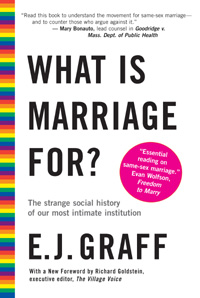
It is an historic day for marriage equality in the United States. The Supreme Court decision in US v. Windsor struck down the Defense of Marriage Act; and the more limited ruling in Hollingsworth v. Perry effectively moots Prop. 8 in California. Beacon has been publishing books that promote valuing all families, including but not only through marriage equality, for a long time. Take, for instance, What is Marriage For? by E. J. Graff, which we first published in 1999, and is considered by many "the bible of the same-sex marriage movement."
This excerpt from What is Marriage For? explores that public/private intersection of our definition of marriage. We hope that this book continues to inspire people to fight for LGBT equality across the country and around the world.
In honor of Pride, we're giving a special discount of 25% off What is Marriage For? and all other LGBT titles at Beacon.org on orders using the Promo Code PRIDE placed during the month of June.
 Inside Out or Outside In: Who Says You’re Married?
One of the most basic tensions in the history of marriage is between those two interlocking sides of marriage: marriage as a publicly policed institution and marriage as an inner experience.
Which one turns your bond into a marriage: a public authority or
your heart? Are you married when the two of you decide to care for
each other for life, a decision you live out day to day, a decision only
afterwards recognized by your community? Or is it the other way
around: does the family, or church, or state pronounce some words
over your head, write your names side by side in a registry, and bestow upon you a marriage, a license and legal obligation to carry
out the responsibilities of a¤ection and care? This may sound like
one of those faces/vases illusions, and for good reason: marriage
doesn’t exist unless both parts happen—two human beings behave as married, and everyone else treats them as such. But it does
matter which side you think counts more: the decisions made
about individual marriages will be quite different if you think marriage is a publicly conferred status or an immanent state. And each position’s internal contradictions can—and have—caused social
havoc when unchecked.
In history, this debate is almost inextricable from the debate
over which authority rules marriage. Who decides where the enforceable marriage is made—in your heart, or in a registry—and
why? That decision might be less complex if the only people who
have to recognize your marriage live within twenty-five miles,
when the people who see you two behaving as married are also the
ones who oversee the granting of the widow’s dower. And it might
be more complex in our world, in which each of our daily lives goes
beyond our circle of acquaintances to touch dozens of strangers
and anonymous entities, from the motor vehicles registry to our
children’s schools. The story of the public/private marriage line is
therefore also a story of how marriage has shifted, in comparative
legal scholar Mary Ann Glendon’s words, from custom to law.
Roman marriage was the immanent kind: when challenged in
court (over, say, whether a widow inherits or whether a child is legitimate), a marriage could not be proved by anything so simple as
a public registry. A judge had to investigate whether the two lived
together with affectio maritalis, ‘‘the intention of being married.’’
To be married, all a couple had to do was ‘‘regard each other as man
and wife and behave accordingly.’’ What does that mean, ‘‘behave
accordingly’’? The Romans may never have defined it, but (like
Americans and pornography) they knew it when they saw it. A
judge sized up the couple’s ‘‘marital intentions’’ by such signals
as whether she’d brought a dowry, or whether he openly called her
his wife. Augustine and his concubine, for instance, were living
together without affectio maritalis, since he was intending a later
power-marriage. But had the same pair intended to be married—with no change in their behavior—they would have been. Marriage
was a private affair: the state could police only the consequences,
not the act.
While the Jewish configuration changed over the millennia,
what remained central is marriage as a private act: only bride and
groom could say the magic words that turned them into husband
and wife. After many centuries the rabbis inserted themselves and their seven blessings into the ceremony, before the big feast, but
even they knew they were not essential: the pair made the marriage
within themselves. Which is why, in Jewish law, a court could neither ‘‘grant’’ nor refuse a divorce. If a husband’s inner willingness
to be married evaporated (sometimes hers counted but often it did
not), then the marriage itself had evaporated: the rabbinical court
or bet din could merely decide questions of fault and finances.
Christianity, as we know, wanted nothing to do with marriage
for centuries. When asked, some priests might come by and say a
blessing as a favor, just as they’d say a blessing over a child’s first
haircut. No one considered marriage sacred, as celibacy was: marriage was one of those secular and earthbound forms rendered
unto Caesar. But as centuries rolled by, an increasingly powerful
Church saw that marriage was central to ordering Europe’s civil
and political life—not so much those few called to sainthood, sacrifice, and martyrdom, but the many ordinary folk who needed to be
told how to behave.
And so the Church launched a battle for power over marriage’s
rules, a battle that lasted roughly a thousand years. Today we have
the peculiar impression that Catholicism has always had one vision of marriage, but for every marriage rule eventually imposed
on Europe, the Church’s own debates were abundant. It first formally ruled on marriage in 774, when one pope handed Charlemagne a set of writings that defined legitimate marriage and
condemned all deviations. After another five hundred years of
struggle, the Church came up with a marriage liturgy and imposed
its new and radical rules—the ballooning incest rules, the one-man-one-marriage rule, and most controversial, the girl-must-consent rule—on the powerful clans. ‘‘It is clear,’’ writes one historian, ‘‘that this attempt to impose order on matrimonial practice
was part of a more ambitious plan to reform the entire social order. . . . regulating the framework of lay society, from baptisms
to funerals,’’ the most intimate acts of most people’s lives. The
Church’s push to rule marriage was slow and uneven but very determined. Here and there it would issue a decree and struggle with
local nobles over whether it would be observed; now it would retract a bit to permit a lord to marry his dead wife’s sister or annul
his existing marriage; then it would push forward again.
It was not until 1215 that the Church finally decreed marriage a
sacrament—the least important one, but a sacrament nonetheless—and set up a systematic canon law of marriage, with a system
of ecclesiastical courts to enforce it—and had a fair amount
of people willing to observe those rules. By 1215, the year that
the Fourth Lateran Council issued its matrimonial decrees, the
Church had ‘‘broke[n] the back of aristocratic resistance . . . after
lengthy individual battles with the nobility, kings included.’’
And according to the Church, what turned two individuals into
a married couple? It was—drumroll, please—the couple’s private
vows.
Why a drumroll? Because the Church insisted that a private
promise was an unbreakable sacrament—that marriage was an immanent experience, a spiritual reality created by the pair’s free and
equal consent. That was practically a declaration of war against the
upper classes, a radical and subversive idea emphasizing the sacredness of the individual spirit. Marriage, the Church insisted,
was not just about land and power and wombs, but about human
feelings.
Read the rest of "Inside Out or Outside In: Who Says Your Married?" at SCRIBD.
What Is Marriage For?: The Strange Social History of Our Most Intimate Institution by EJ Graff by Beacon Press
 Beacon Broadside