James Baldwin (1924-1987) was a novelist, essayist, playwright, poet, and social critic, and one of America's foremost writers. His essays, such as "Notes of a Native Son" (1955), explore palpable yet unspoken intricacies of racial, sexual, and class distinctions in Western societies, most notably in mid-twentieth-century America. A Harlem, New York, native, he primarily made his home in the south of France.
His novels include Giovanni's Room (1956), about a white American expatriate who must come to terms with his homosexuality, and Another Country (1962), about racial and gay sexual tensions among New York intellectuals. His inclusion of gay themes resulted in much savage criticism from the black community. Going to Meet the Man (1965) and Tell Me How Long the Train's Been Gone (1968) provided powerful descriptions of American racism. As an openly gay man, he became increasingly outspoken in condemning discrimination against lesbian and gay people.
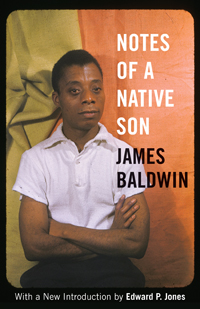
The following essay opens Notes of a Native Son, a collection considered by many his most influential work. We publish it here today in conjunction with an essay by Eboo Patel about the impact this essay had on his life and work.
 I was born in Harlem thirty-one years ago. I began plotting
novels at about the time I learned to read. The story of my
childhood is the usual bleak fantasy, and we can dismiss it
with the restrained observation that I certainly would not
consider living it again. In those days my mother was given
to the exasperating and mysterious habit of having babies. As
they were born, I took them over with one hand and held a
book with the other. The children probably suffered, though
they have since been kind enough to deny it, and in this way
I read Uncle Tom’s Cabin and A Tale of Two Cities over and
over and over again; in this way, in fact, I read just about
everything I could get my hands on—except the Bible, probably because it was the only book I was encouraged to read.
I must also confess that I wrote—a great deal—and my first
professional triumph, in any case, the first effort of mine to
be seen in print, occurred at the age of twelve or thereabouts,
when a short story I had written about the Spanish revolution
won some sort of prize in an extremely short-lived church
newspaper. I remember the story was censored by the lady
editor, though I don’t remember why, and I was outraged.
Also wrote plays, and songs, for one of which I received a
letter of congratulations from Mayor La Guardia, and poetry,
about which the less said, the better. My mother was delighted
by all these goings-on, but my father wasn’t; he wanted me to
be a preacher. When I was fourteen I became a preacher,
and when I was seventeen I stopped. Very shortly thereafter I left home. For God knows how long I struggled with
the world of commerce and industry—I guess they would say
they struggled with me—and when I was about twenty-one I
had enough done of a novel to get a Saxton Fellowship. When
I was twenty-two the fellowship was over, the novel turned
out to be unsalable, and I started waiting on tables in a Village restaurant and writing book reviews—mostly, as it turned
out, about the Negro problem, concerning which the color of
my skin made me automatically an expert. Did another book,
in company with photographer Theodore Pelatowski, about
the store-front churches in Harlem. This book met exactly
the same fate as my first—fellowship, but no sale. (It was a
Rosenwald Fellowship.) By the time I was twenty-four I had
decided to stop reviewing books about the Negro problem—
which, by this time, was only slightly less horrible in print
than it was in life—and I packed my bags and went to France,
where I finished, God knows how, Go Tell It on the Mountain.
Any writer, I suppose, feels that the world into which he
was born is nothing less than a conspiracy against the cultivation of his talent—which attitude certainly has a great deal
to support it. On the other hand, it is only because the world
looks on his talent with such a frightening indifference that
the artist is compelled to make his talent important. So that
any writer, looking back over even so short a span of time as
I am here forced to assess, finds that the things which hurt him and the things which helped him cannot be divorced
from each other; he could be helped in a certain way only
because he was hurt in a certain way; and his help is simply to
be enabled to move from one conundrum to the next—one is
tempted to say that he moves from one disaster to the next.
When one begins looking for influences one finds them by
the score. I haven’t thought much about my own, not enough
anyway; I hazard that the King James Bible, the rhetoric of
the store-front church, something ironic and violent and perpetually understated in Negro speech—and something of
Dickens’ love for bravura—have something to do with me today; but I wouldn’t stake my life on it. Likewise, innumerable
people have helped me in many ways; but finally, I suppose,
the most difficult (and most rewarding) thing in my life has
been the fact that I was born a Negro and was forced, therefore, to effect some kind of truce with this reality. (Truce, by
the way, is the best one can hope for.)
One of the difficulties about being a Negro writer (and
this is not special pleading, since I don’t mean to suggest
that he has it worse than anybody else) is that the Negro
problem is written about so widely. The bookshelves groan
under the weight of information, and everyone therefore
considers himself informed. And this information, furthermore, operates usually (generally, popularly) to reinforce
traditional attitudes. Of traditional attitudes there are only
two—For or Against—and I, personally, find it difficult to
say which attitude has caused me the most pain. I am speaking as a writer; from a social point of view I am perfectly
aware that the change from ill-will to good-will, however
motivated, however imperfect, however expressed, is better
than no change at all.
But it is part of the business of the writer—as I see it—
to examine attitudes, to go beneath the surface, to tap the
source. From this point of view the Negro problem is nearly
inaccessible. It is not only written about so widely; it is written about so badly. It is quite possible to say that the price
a Negro pays for becoming articulate is to find himself, at
length, with nothing to be articulate about. (“You taught
me language,” says Caliban to Prospero, “and my profit on’t
is I know how to curse.”) Consider: the tremendous social
activity that this problem generates imposes on whites and
Negroes alike the necessity of looking forward, of working
to bring about a better day. This is fine, it keeps the waters
troubled; it is all, indeed, that has made possible the Negro’s
progress. Nevertheless, social affairs are not generally speaking the writer’s prime concern, whether they ought to be or
not; it is absolutely necessary that he establish between himself and these affairs a distance which will allow, at least, for
clarity, so that before he can look forward in any meaningful
sense, he must first be allowed to take a long look back. In
the context of the Negro problem neither whites nor blacks,
for excellent reasons of their own, have the faintest desire to
look back; but I think that the past is all that makes the present coherent, and further, that the past will remain horrible
for exactly as long as we refuse to assess it honestly.
I know, in any case, that the most crucial time in my own
development came when I was forced to recognize that I was
a kind of bastard of the West; when I followed the line of my
past I did not find myself in Europe but in Africa. And this
meant that in some subtle way, in a really profound way, I
brought to Shakespeare, Bach, Rembrandt, to the stones of
Paris, to the cathedral at Chartres, and to the Empire State Building, a special attitude. These were not really my creations, they did not contain my history; I might search in them
in vain forever for any reflection of myself. I was an interloper;
this was not my heritage. At the same time I had no other
heritage which I could possibly hope to use—I had certainly
been unfitted for the jungle or the tribe. I would have to appropriate these white centuries, I would have to make them
mine—I would have to accept my special attitude, my special
place in this scheme—otherwise I would have no place in any
scheme. What was the most difficult was the fact that I was
forced to admit something I had always hidden from myself,
which the American Negro has had to hide from himself as
the price of his public progress; that I hated and feared white
people. This did not mean that I loved black people; on the
contrary, I despised them, possibly because they failed to
produce Rembrandt. In effect, I hated and feared the world.
And this meant, not only that I thus gave the world an altogether murderous power over me, but also that in such a self-
destroying limbo I could never hope to write.
One writes out of one thing only—one’s own experience.
Everything depends on how relentlessly one forces from this
experience the last drop, sweet or bitter, it can possibly give.
This is the only real concern of the artist, to recreate out
of the disorder of life that order which is art. The difficulty
then, for me, of being a Negro writer was the fact that I was,
in effect, prohibited from examining my own experience too
closely by the tremendous demands and the very real dangers of my social situation.
I don’t think the dilemma outlined above is uncommon. I
do think, since writers work in the disastrously explicit medium of language, that it goes a little way towards explaining why, out of the enormous resources of Negro speech and life,
and despite the example of Negro music, prose written by
Negroes has been generally speaking so pallid and so harsh.
I have not written about being a Negro at such length because I expect that to be my only subject, but only because
it was the gate I had to unlock before I could hope to write
about anything else. I don’t think that the Negro problem in
America can be even discussed coherently without bearing
in mind its context; its context being the history, traditions,
customs, the moral assumptions and preoccupations of the
country; in short, the general social fabric. Appearances to
the contrary, no one in America escapes its effects and everyone in America bears some responsibility for it. I believe this
the more firmly because it is the overwhelming tendency to
speak of this problem as though it were a thing apart. But in
the work of Faulkner, in the general attitude and certain specific passages in Robert Penn Warren, and, most significantly,
in the advent of Ralph Ellison, one sees the beginnings—at
least—of a more genuinely penetrating search. Mr. Ellison,
by the way, is the first Negro novelist I have ever read to
utilize in language, and brilliantly, some of the ambiguity and
irony of Negro life.
About my interests: I don’t know if I have any, unless the
morbid desire to own a sixteen-millimeter camera and make
experimental movies can be so classified. Otherwise, I love
to eat and drink—it’s my melancholy conviction that I’ve
scarcely ever had enough to eat (this is because it’s impossible
to eat enough if you’re worried about the next meal)—and I
love to argue with people who do not disagree with me too
profoundly, and I love to laugh. I do not like bohemia, or bohemians, I do not like people whose principal aim is pleasure, and I do not like people who are earnest about anything. I
don’t like people who like me because I’m a Negro; neither
do I like people who find in the same accident grounds for
contempt. I love America more than any other country in
the world, and, exactly for this reason, I insist on the right
to criticize her perpetually. I think all theories are suspect,
that the finest principles may have to be modified, or may
even be pulverized by the demands of life, and that one must
find, therefore, one’s own moral center and move through
the world hoping that this center will guide one aright. I consider that I have many responsibilities, but none greater than
this: to last, as Hemingway says, and get my work done.
I want to be an honest man and a good writer.
Read Eboo Patel's essay on "Autobiographical Notes"
Read Edward P. Jones's Introduction to Notes of a Native Son
Related articles


 Beacon Broadside