By David Chura. This post originally appeared on Esteem.
He was a big man, a presence to be reckoned with on any football
team. Dressed in a pressed shirt and colorful tie, he spread his arms
out and gestured around the room. “I’m a new teacher here. How do I do
this?” he asked.
I knew what “this” was—a room with only a few windows, thick-paned
and laced with heavy gauge wire, designed to keep what’s in, in; a
locked industrial metal door; the squawk of walkie-talkies in the
hallways. It was a classroom much like the one in the county jail where I
taught high school students for ten years. But this classroom was in
the Judge Connelly Center Education Program in the Greater Boston area, a
residential adolescent treatment program for adjudicated young
offenders, kids who had been in and out of the child welfare and justice
systems, some for much of their young lives. I was there to talk with
teachers and support staff about my own experiences working in
incarcerated education.
I could have answered by talking about curriculum and the importance
of choosing materials that were culturally relevant. As an English
teacher, I was always looking for readings with characters and situations
that the young guys I taught could identify with. I could have
explained how I pushed them to go beyond cultural relevance and to begin
to develop the critical skills they needed to tackle state mandated
tests.
Or I could have discussed the advantages and disadvantages of Common
Core, the limitations and short sightedness of “teaching to the test,”
or the damage that so many of our current educational reforms were doing
to at-risk students.
But, I sensed that that wasn’t what he was asking. He was going for
something more important, more basic. He was posing the question that
daily confronts every teacher who works with hard to reach students. “How do I not give up, not lose faith in what I’m doing? How do I do
this?”
His question stopped me in my tracks. And in that pause, I knew the only answer I could give him.
“Don’t take it personally.”
Too simple for that very complex organism, the classroom? Perhaps,
but it’s what has kept me teaching at-risk kids for over 25 years.
As any teacher knows, a classroom is a crowded place. It is not only
made up of individual students, but each in turn brings with her or him a
host of others—family members, care providers, neighbors, friends and
enemies, even the family pet along with the heroes and villains, real
and imagined, that make up the world of social media and pop culture
surrounding the student. All are factors in learning, all are
contributors to that day’s lesson, all are influences, good or bad, on a
learner’s success—and in turn, on a teacher’s success. Teachers
recognize these factors. Most education pundits don’t.
Too often the influences that shape at-risk kids’ lives are negative,
and consequently can shape teacher-student interactions negatively if
we let them. In my own experience teaching in both a community
alternative school and in a county prison, I learned to see (perhaps not
as quickly as I should have) that there were multiple layers of
experience between me and my students. Many of them had lived through
years of neglect and abandonment by family, school, neighborhood, and
church. They had survived physical and sexual abuse, the loss of family
and friends to AIDS, alcohol and drug addiction, gun violence, or just
plain despair. Success wasn’t in their vocabulary, only anger,
belligerence, mistrust, and disinterest. It’s a vocabulary that
teachers, by their nature, don’t share.
Yet success with disenfranchised students comes only when we can
translate that sullen, snarly, challenging indifference to us and to
what we have to offer into what it is really saying: I can’t do this;
I’m scared; I won’t try because I’ll only fail; I don’t believe that you
care about me.
With the increased demands placed on teachers these days it is too
easy to misinterpret a student’s oppositional behavior and get pulled
into a confrontation, or worse yet to write him or her off as not worth
the effort. The times when I’ve done that I could almost see the smug
look of dark satisfaction on a kid’s face, a look that says, “Gottcha,
teach! See, you’re just like all the rest.”
Certainly teachers can’t accept open disrespect or class disruption.
But how many situations could have been prevented from escalating if a
teacher “didn’t take it personally.” We all have our own personalities,
and so our own ways of intervening in those sticky circumstances. Humor.
Ignoring. A simple shift of focus. In my jailhouse classroom, I
sometimes was able to diffuse a potential face-off by first recognizing
and then commenting to a student that he seemed to having a bad day.
That simple gesture helped dampen the fuse of the power struggle I could
feel myself getting pulled into.
Of course, our best efforts don’t always work, but not taking it
personally—including our own inevitable failures—does. This outlook on
the teaching life helps us acknowledge all the forces that shape our
students, our classrooms, and ourselves, and allows us the resilience to
come back the next day ready to try again.
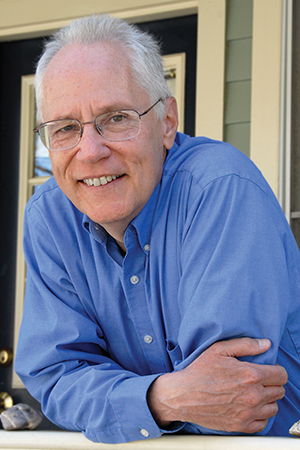 David Chura is the author of I Don’t Wish Nobody to Have a Life Like Mine: Tales of Kids in Adult Lockup,
which received a 2010 PASS Award from the National Council on Crime
& Delinquency. He has worked with at-risk teenagers for the past 40
years. For 26 of those years, he taught English and creative writing in
community based alternative schools and in a county penitentiary. His
writings have appeared in the New York Times and The Huffington Post, as well as other scholarly and literary journals. Visit his website, Kids in the System, to learn more about David and his work. (Photo by Ellen Augarten.)
 Beacon Broadside
Leave a comment