By Philip Warburg. This post originally appeared on his blog.
In the October 5th edition of the New York Times,
columnist Joe Nocera—a self-avowed fracking enthusiast—seeks to
allay environmental concerns about the greenhouse gas emissions from
natural gas fracking operations. He cites a study released last month
by a group of scientists at the University of Texas that found on-site
methane leakage at fracking wells to be lower than previous studies had
assumed. According to this study, only 0.42% of the gas produced by
fracking ends up in the air as "upstream" methane emissions—i.e. gas
releases at and around the wellhead.
As Nocera suggests in the title to his editorial, "A Fracking
Rorschach Test," proponents and opponents of fracking tend to
cherry-pick data to support their polarized positions. This is easy to
do in the midst of what may be America's last big fossil fuel bonanza,
in which many hundreds of companies are hustling for a piece of the
action—way ahead of thorough scientific surveys that can offer a
comprehensive look at the true impacts of this technology. But there's
something unsettling about a study funded by nine big oil and gas
companies including ExxonMobil, looking at a small, skewed sample of
the hundreds of thousands of fracking sites in America today. Only 489
wells and 27 fracking events were examined by David T. Allen and his
colleagues.
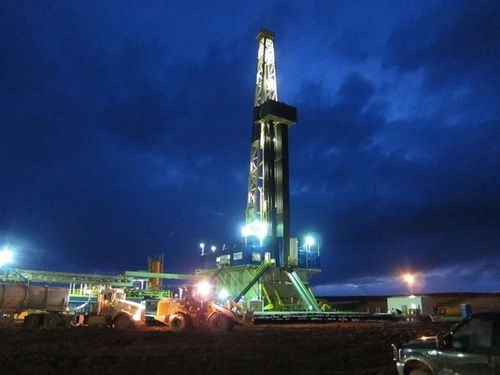
Nocera reassures readers that the companies cooperating with and
supporting the U. Texas study "in many cases were using the best
available well-completion technology" at the studied sites. Good for
them. But how representative are they of the half-a-million or more
fracking operations now stretching across dozens of states, often run by
small, independent companies with little effective government
oversight?
Physicians & Engineers for Healthy Energy, an independent group of professionals that formed in response to New York State's fracking boom, offers a useful critique of the micro-sampling methodology and other flaws in the U. Texas study. It's worth the read.
Also worth reading is a new report by the Conservation Law Foundation,
looking at the massive "downstream" leakage of methane through our
poorly maintained and under-monitored gas distribution network. In my
home state of Massachusetts alone, the report says 8 to 12 billion cubic
feet of methane are released into the atmosphere each year from leaky
distribution lines. As methane is 20 times more powerful than CO2 as a
greenhouse gas, this neglected infrastructure is not just wasting a
valuable fuel; it's a major contributor to global warming.
 Philip Warburg is the author of Harvest the Wind. His writings have appeared in numerous policy journals and newspapers including the New York Times, the Boston Globe, and the Washington Post. He lives and works in Newton, Massachusetts.
 Beacon Broadside
Leave a comment