A Q&A with Russell Cobb
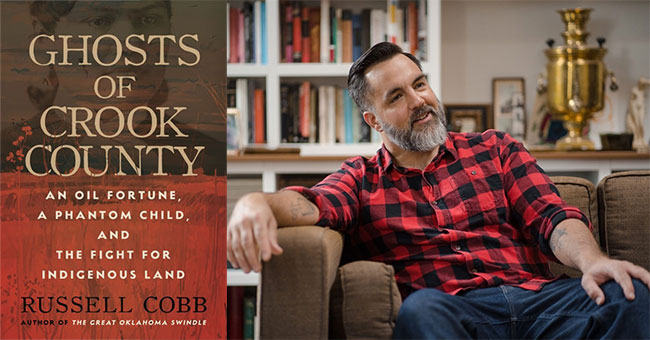
In the early 1900s, few knew the intoxicating power of greed better than white men on the forefront of the black gold rush. When oil was discovered in Oklahoma, these counterfeit tycoons impersonated, defrauded, and murdered Native property owners to snatch up hundreds of acres of oil-rich land. Writer and fourth-generation Oklahoman Russell Cobb sets the stage for one such oilman’s chicanery in Ghosts of Crook County: An Oil Fortune, a Phantom Child, and the Fight for Indigenous Land. Tulsa entrepreneur Charles Page launched a campaign for a young Muscogee boy’s land in Creek County. Problem was, “Tommy Atkins,” the boy in question, had died years prior—if he ever lived at all. Beacon Press senior publicist Bev Rivero caught up with Cobb to chat about it.
Bev Rivero: You write, “In Oklahoma, the natural resource curse might be deemed as an intergenerational retribution.” Can you explain what this means to you personally as well as provide some context?
Russell Cobb: The natural resource curse is what happens when a given society strikes it rich by extracting some resource and chases after that wealth as other parts of the economy decline. The race to make as much money as possible leads to corruption, inequality, violence, and environmental destruction. Economists and political scientists point to places like Nigeria, Russia, and Venezuela as object lessons in the natural resource curse, but many of those social ills also plague places like Oklahoma and Texas.
Now, Oklahoma is unique because the eastern half of the state, where the oil booms occurred, was—still is, actually—on federally recognized Indian Reservation land. Some Native American leaders in the early twentieth century stood to become immensely wealthy from oil but correctly predicted a catastrophe. Muscogee Chief Pleasant Porter thought the discovery of oil would lead to the end of sovereignty and he lamented the coming of this most modern of industries. The ruling white Petro-Christian class that came to dominate the state—it still dominates the state—tried to erase the records of widespread theft and exploitation that accompanied the rise of the oil and gas industry.
The first Russell Cobb was a well-connected white New Yorker who became quite wealthy during the 1920s oil boom. His son, Russell Cobb, II, turned that wealth into a fortune, but by the end of the 1960s, he was dead, and the money had evaporated. Growing up, I heard there was some sort of curse on the family, but I’ve come to see it not as a supernatural phenomenon, but as a result of a worldview that values wealth creation above all else.
BR: How did you meet your research partner and collaborator, Apollonia? How did you work together on this investigation?
RC: We met in 2018 over Facebook. I published a piece in Tulsa World about how this fancy, expensive park in Tulsa contained a hidden history of fraud and possible murder of an Indigenous man. She messaged me to say my facts were correct, but the perspective of a Mvskoke person was missing. I thought I was going to get cancelled! I wrote back, saying I agreed; the whole story needs to be informed by Muscogee history and culture. We found out we were asking the same questions, and despite being from opposite sides of the tracks in Tulsa (she’s from a working-class, Native American/Latino neighborhood and I’m from an upper-middle-class white neighborhood), we actually had a lot in common.
Most importantly, we share a sense for the absurdity of life and culture in Oklahoma and cope with its madness with a similar sense of humor. Jokes are very important to Okies of all backgrounds. Just watch Reservation Dogs (Sterlin Harjo lives in Tulsa) or the comedy of Bill Hader (he went to my high school!). Secondly, we’re both driven to investigate and tell the true story of this odd place, she from the perspective a Native American and Chicana scientist/artist, and me from the point of view of a writer with personal stakes in a place that continues to surprise me.
BR: One thing that readers might not know about but that has lasting impact is the connection you make between the Dawes commission and the Census. It’s really telling how these types of categorizations shaped data gathering. How does this fit into the story arc of Ghosts of Crook County and the history of Oklahoma and its surrounding regions?
RC: Until I started writing this book, I didn’t realize how arbitrary and socially constructed notions of race really were. I mean, we all know that race is a construct, but to see the ramifications of this construct on the ability to amass, control, and pass down wealth to particular individuals was really mind-blowing. For example, if Tommy Atkins was, as Charles Page contended, a “half-blood” Indian, he would have one set of restrictions on the sale of his land. If he was a Freedman (a person of African descent), there would be no restrictions on the sale of his land.
Furthermore, the race of one of Tommy’s three purported mothers, Nancy Atkins, shifted over her lifetime. She was listed as an “Indian by blood” in the Dawes Rolls, then as “mulatto” in an early Oklahoma census, and then, at the end of her life, she was simply “colored.” Despite the fact that Indian Territory was a triracial society, Oklahoma imposed a very Old South notion of identity along a White/Black binary with tragic consequences for those labeled as “colored.”
In a broader American context, this is quite interesting. We think of the Old South as being constrained by the slave-holding states, and then gradually relinquishing its hold on white supremacy as the federal government enforced Civil Rights. The story of Oklahoma turns that American myth upside down. It was a place of many races coexisting until 1907, at which point it took on the mold of a Jim Crow state. It went backwards, in other words. In many ways, it’s still going backwards in 2024.
BR: In the case of Tommy Atkins, as a figure that made the leap from clerical error to real person, we see how the concept of personhood can matter more than what we witness around us. How does the story of Tommy resonate today?
RC: If millions of dollars of oil wealth were not at stake, Tommy Atkins would still be an interesting case study in the arbitrary nature of the federal government to determine who is and is not an Indian, and indeed, who is a person.
That’s why the Dawes era is often referred to as “bureaucratic imperialism”: once the bureaucrat in the Department of Interior stamped Tommy’s enrollment card, it was exceedingly difficult to prove to a federal court that he did not exist.
That was in spite of the tribe, the Muscogee Nation, saying: We know all the people involved, and this Tommy here did not exist. He may have started as a census-taking error, but Charles Page and associates turned him into a very convincing person. The preponderance of evidence suggested Tommy was a fictional creation and that Minnie Atkins was pressured to fabricate a story that Page wanted to be true.
Here’s the contemporary tie-in: a lie that is backed by powerful people with lots of money to spend can create its own reality. That happens every day on social media, but in the case of Tommy Atkins, the lie became part of the foundation for an entire philanthro-capitalist operation that still exists—the Sand Springs Home. And the lie that started it all was completely swept under the rug. Until now.
BR: Finally, what is one thing that you’d like readers to take away from your book? What are some other works they might want to seek out to learn more?
RC: It’s hard to have one takeaway from a project that still has my head spinning around questions of identity, wealth, and belonging. I hope that readers who have no connection to Oklahoma, Indian Country, or the oil and gas industry, will still come away from the book questioning the assumptions embedded in the American Dream mythology. So much of what we think of as American freedom—the open road, the single-family home with a yard, material prosperity—is predicated upon some ugly truths, including treaty violations, legalized swindling, white supremacy, and environmental destruction. My goal is not to make the people who benefitted from oppression and destruction feel bad or guilty. On the contrary, I hope this book will make them want to know more, do better, and expand their horizons of what it means to be in relationship to others and the environment.
There are some wonderful films, podcasts, and books that cover similar ground as Ghosts of Crook County. Some works I always had at the top of my mind or close to my desk while writing the book are:
- Angie Debo’s And Still the Waters Run: The Betrayal of the Five Civilized Tribes
- In Trust, produced in part by my friend, Allison Herrera, and reported by Bloomberg journalist Rachel Adams-Heard
- Daniel Yergin’s The Prize: The Epic Quest for Oil, Money, and Power
As a soundtrack, I listened to a lot of J. J. Cale, as he captured the mood and sound of eastern Oklahoma like no one else. The guy wasn’t a flashy player, but he never played a wrong note.
About the Authors
Bev Rivero is senior publicist at Beacon Press. Before joining Beacon in 2021, Bev was the communications and marketing manager at the National Book Foundation, where she worked on the National Book Awards, promoted the Foundation’s public and educational programs, and led all social media and marketing campaigns. Prior to NBF, she was in publicity at the New Press for six years, where she worked with authors committed to social justice, including Paul Butler, Michelle Alexander, and many more. She has extensive experience promoting nonfiction and tailoring outreach campaigns that resonate with activists and change-makers. Bev is a NYC-based graduate of Johns Hopkins University, ardent supporter of indie presses, and a graphic designer.
Russell Cobb, a fourth-generation white Oklahoman, is professor in the Faculty of Arts at the University of Alberta and the author of The Great Oklahoma Swindle, which won the 2021 Director’s Award in the Oklahoma Book Awards. His journalism has appeared in the New York Times, The Guardian, Slate, The Nation, and on NPR. His reporting appearing on This American Life was turned into the film Come Sunday, distributed by Netflix. He is also the host of History X, a podcast about buried histories and nonfiction mysteries, broadcast on 88.5FM in Edmonton, Canada, and across all major podcast platforms.
 Beacon Broadside
Leave a comment