By Harrison Browne and Rachel Browne
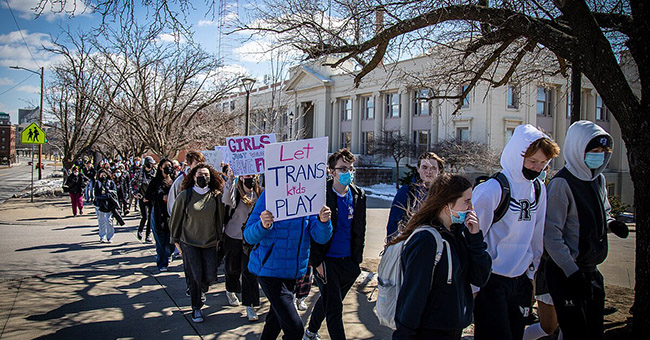
Editor’s Note: The cruelty is the point and the cruelty continues. School athletic programs should be accessible to all children, including trans children. Yet the Supreme Court has agreed to hear two cases, Little v. Hecox in Idaho and West Virgina v. B. P. J. in West Virginia, that ban trans kids from participating in local school and college sports. Not only do these cases violate Title IX, the federal law prohibiting sex discrimination in education programs, but they also put trans youth at various forms of irreparable harm on and off the field. With the stories of these two brave youngsters fighting against anti-trans bills, Harrison Browne and Rachel Browne show what’s at stake for them and their families in the following passage from Let Us Play: Winning the Battle for Gender Diverse Athletes.
***
The Story of Sunny
Sunny Bryant is a ten-year-old trans girl who lives with her family in the Houston area. She’s got bright blond, shoulder-length hair and a wide, infectious smile. She enjoys teasing her mom Rebekah and running around with her puppy. When you speak with Sunny, she’s immediately engaged in the conversation, and you can tell she’s deeply curious and inquisitive. She’s excited to share things about her life with you, and she’s open and full of energy and spunk. But, most importantly, she likes to brag about how fast she can run and that her middle name, Jet, fits her well. When Rebekah was pregnant with Sunny, one of her baby shower gifts was a stopwatch in order to time how fast her future child would be. Rebekah and her husband, Chet, love sports and play recreational softball, so it was the perfect gift for parents like them who want to pass down their love of sports to their children. You could say the stopwatch worked, as these days, Sunny is excelling at softball, but is eager to try rock climbing. But amid all the positivity and happiness that surrounds Sunny, there’s an undeniable hum of anti-trans sentiment in their home state of Texas, and what Sunny’s future, athletic and otherwise, looks like remains uncertain.
Even at such a young age, Sunny has become embroiled in the battle for trans inclusion in sports and a symbol for the ways in which harmful rhetoric and regulations impact kids like her. Just two years ago, when she was eight, Sunny and Rebekah testified before state legislators to halt proposed laws that would ban trans girls from participating on sports teams that aligned with their gender identity. Sunny and her family joined a growing number of trans youth and their allies who were standing up to the government in the name of equality and fairness. Throughout 2021, Rebekah went to the Capitol at least six times—at a personal financial cost of more than $3,000 for taking time off work—to advocate against the bills. Sunny herself testified against the sports bans twice. While testifying, she told congresspeople about her love of baseball, tennis, gymnastics, and soccer. None of her classmates cared that she was trans, she said. “Kids care about what’s in your heart,” Sunny continued. “Only old people can’t see that.” Even the Republicans chuckled at Sunny’s jab.
The second time that Sunny testified was after midnight, long past her bedtime. Up until this point, Sunny’s experience testifying had been relatively positive. She and her family had come away from these sessions feeling energized and supported in their advocacy efforts. But this time, things took a darker turn. Sunny left the session feeling dejected and discouraged. She broke down in tears to Rebekah when they returned to their hotel room. “Why do so many people not like me?” Sunny asked her mother. It was the first time she had expressed any pain or anguish toward this issue and this process. These are feelings that no child should have to endure, especially at such a young age. For the next little while, Sunny began to show signs of anxiety, though those eventually dissipated. It was a rude awakening for Sunny and her entire family. Rebekah hasn’t brought Sunny back to the Capitol since, seeing it as a potential trigger for her child, who only wants to be loved and accepted for who she is and be free to do the things she loves just like her cisgender classmates. They’re trying to live their lives in peace as best they can for now.
A parent will do anything to protect their children, and some outsiders viewing these sports bans from afar may question why parents of trans children stay in these hostile environments. Why not move away to a state or place that’s more welcoming and inclusive? Families like Sunny’s, who are being attacked at all angles, should not be driven out from their homes and forced to move away from a community they’ve built to protect their child from harm. “We built a life here and I love my job. I have a great career and position that I’ve worked really hard for,” Sunny’s mother, Rebekah, told us in the summer of 2023. “We have a great community. We live in a little bubble. They love their school. My husband likes his job. We have everything set up pretty comfortably.” Rebekah had never decorated a home before, and she recently did so for the first time with theirs, from top to bottom, with furniture accessories that she loves. “We’re sort of digging our heels in, and yeah, we know if we move to LA, we’re going to be in a tiny apartment. The cost of living is different even with good jobs. We’d like to keep it [our house] as much as possible,” Rebekah continued.
The Story of Libby
Before Sunny and her family took up the mantle of advocating for trans inclusion in sports in Texas, there was Libby Gonzales, who took on the state’s infamous bathroom bill years earlier. It’s jarring to think of the burden these young children must endure to achieve basic equality and dignity, but they are the ones who are being impacted and harmed the most. Libby was three years old when she began identifying as a girl. During a trip from their home in Texas to California, this became clear to Libby’s mom and dad, Rachel and Frank, when Libby expressed a strong desire to purchase a fairy costume with a pink skirt and matching wings from a toy store they stopped at along the way. Libby grew out her hair and felt her best when wearing clothing that was “girly.” By the time she turned six, Libby asked her mom whether Santa could make her a girl for Christmas. Rachel told Libby that she didn’t have to wait to get girl’s clothes. Over the following six months, she started wearing feminine clothes and eventually changed her name and pronouns. The transition for Libby, and the entire family, wouldn’t be without its challenges and learning curves, but seeing Libby live as her authentic self became a gift for the family. And it would help lay a positive foundation for Libby’s mental health going forward. A 2017 study in the Journal of the American Academy of Child and Adolescent Psychiatry found that parents who allow their transgender children to socially transition nearly eliminate the high risks of depression and feelings of low self-esteem they might otherwise experience.
By the time she was seven, Libby had become a warrior for trans rights in her home state. It was July 2017, years before the most recent attacks on trans rights and trans athletes, and Republican state legislators were trying to push a bill that would restrict trans people from accessing public restrooms that aligned with their gender identity. Libby, along with her mother and younger sister Cecilia, who was four, and her two-year-old brother Henry, joined hundreds of others at the Texas Capitol building to protest that bill and speak to legislators directly about the detrimental impacts of the proposed law. It was the third time in as many months that Libby and her family made the nearly four-hour trek to the Capitol to advocate against the bill and try to bring as many legislators as they could to their side. The last time the Gonzales family was there in April, they weren’t called to testify until 2 a.m., by which time Libby had fallen fast asleep and couldn’t give the speech she had spent hours preparing. So while she slept in her father Frank’s arms, he pleaded to legislators on her behalf to not force his daughter to use men’s bathrooms in public. “It would force her into a hostile environment to publicly out her every time she needed to use the restroom,” Frank urged.
The Gonzales family formed part of a burgeoning network of families of trans kids who decided, out of necessity, to become activists in the wake of the anti-trans bathroom legislation being pushed by Texas governor Greg Abbott, who remains in office as of this writing. This type of activism meant taking time from work, opening themselves up to harassment online and in real life, and speaking to Republican lawmakers, many of whom had already firmly made up their minds on the matter, and weren’t open to listening to their perspectives. That hot summer day in 2017, Libby finally had her turn to address the lawmakers who were trying to keep her from using the bathroom of her choice—a basic human right. “I love my school and my friends, and they love me, too,” Libby said. “I don’t want to be scared to go to the restroom in [public]. And I never ever want to use the boys’ bathroom. It would be so weird. Please keep me safe. Thank you.” Libby’s mother then took the mic, saying she was tired of having to defend her daughter and her rights. “Please, please keep in mind that we need to keep every single child in this state safe,” Rachel said. The Gonzales family left the room and Libby broke down crying. Her father embraced her and said he loved her.
A month later, the bathroom bill died after losing ground and support that summer. LGBTQ+ activists were obviously relieved and pleased with that outcome, but it would just be a few short years before they would be confronted with an even bigger fight. Today, trans rights and those of all LGBTQ+ people are under threat in Texas, perhaps more than any other state. The ironic part of the bathroom bill was that it lost ground largely as a result of sports governing bodies and large corporations putting their foot down against transphobia. Companies including IBM, Apple, American Airlines, Capital One, and Ben & Jerry’s, along with more than 650 business interest groups and chambers of commerce, staunchly opposed the law and threatened to boycott the state if it passed. They pointed to a similar, successful corporate initiative in North Carolina that in 2017 led to legislators rolling back a bathroom bill passed the year before. The state had suffered millions of dollars in losses as a result of the bill—with a projected $3.76 billion in total losses had the ban remained in place—through major event cancellations and boycotts, including the NCAA’s ban on holding championships there. In the end, sports leagues and organizations actually have the potential to protect trans kids like Libby from discriminatory measures. Now, five years later, sports are being weaponized against them, and have become one of the biggest threats to trans kids and their ability to live freely in the United States.
About the Authors
Harrison Browne is the first transgender athlete in professional hockey. He was part of the National Women’s Hockey League and played for the Metropolitan Riveters and the Buffalo Beauts (winning a championship with both teams). He helped form the first-ever transgender policy in professional sports to aid both transmen and transwomen in their participation. He is the appointed inclusion leader for the NWHL advisory board and special ambassador for the National Hockey League’s Hockey Is for Everyone initiative. Harrison has been featured in the New York Times, GQ Magazine, Players’ Tribune, The Olympic Channel, VICE News, ESPN and many more news outlets. He continues to participate in talks and panels throughout North America and internationally.
Rachel Browne is an award-winning investigative journalist and documentary producer whose work appears in VICE News, POLITICO, Global News, Maclean’s magazine, Discovery+, and elsewhere.
 Beacon Broadside
Leave a comment