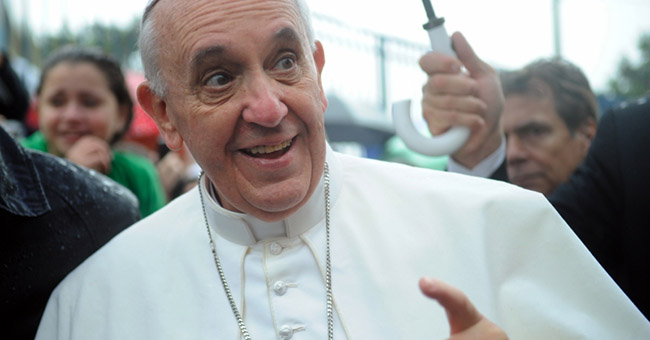
Editor’s Note: When Pope Francis died on April 21, 2025, we lost another environmental justice champion. He called for decisive action to guard against the climate crisis and condemned climate crisis denial in his encyclical on the environment, Laudato Si’. He also framed climate change as a moral issue for Christians to take to heart. This is, after all, the only planet we have. In this passage from Climate Courage: How Tackling Climate Change Can Build Community, Transform the Economy, and Bridge the Political Divide in America, Andreas Karelas explores what prompted such a strong stance from the pope.
***
In 2015 Pope Francis released a papal encyclical—an urgent message addressed to all Catholics—entitled Laudato Si’ [Praise Be to You]: On Care for Our Common Home. It caught the attention of people around the world because in it, the pope decried climate change, especially its effects on the poor. It was quickly dubbed The Encyclical on Climate Change and Inequality.
A papal encyclical is rare and therefore significant. Encyclicals are written when a pope feels a pressing need to clarify the Catholic Church’s teachings on a given subject: “They deal with complex social and moral issues and back up their claims with reference to the Bible and to Catholic tradition and doctrines.” Laudato Si’ was the first encyclical that directly addressed the environment and sustainability. The message Pope Francis sent to the 1.2 billion Catholics around the world by way of the Laudato Si’ is loud and clear: climate change is real, caused by humans, and we have to do something about it. But the encyclical also makes clear how one’s identity as a Christian relates to climate change: “The ecological crisis is also a summons to profound interior conversion. . . . Living our vocation to be protectors of God’s handiwork is essential to a life of virtue; it is not an optional or a secondary aspect of our Christian experience.”
What prompted this strong stance from the pope? To understand, it helps to have a sense of Pope Francis’s story. Born Jorge Mario Bergoglio in 1936, Pope Francis grew up in Argentina during tumultuous times. He saw firsthand the ills of inequality in a country where the wealthy lived in a bubble while many others lived in abject poverty. Jesuit priests, in the tradition of Saint Francis, are tasked with going to the frontier of poverty. Pope Francis, throughout his priesthood, would spend his time in the most impoverished neighborhoods of Buenos Aires serving and ministering to the poor. As a bishop, he never had a car, and he wouldn’t accept a ride. He always wanted to walk the streets or to take the subway or the bus. In the neighborhoods and on public transportation he talked with people and learned about their struggles. They referred to him as the Priest of the Villas and the Priest of the Slums. Even now as the pope, he chooses not to live in the papal residence but rather in the guest house, so he can live a more humble, simple life.
It’s no wonder, to me at least, that this pope, who is known for walking the streets and washing the feet of the poor, has used his seat of authority to call the world’s attention to climate change, which will disproportionately affect the poor. The pope describes the correlation this way in the encyclical:
We are faced not with two separate crises, one environmental and the other social, but rather with one complex crisis which is both social and environmental. Strategies for a solution demand an integrated approach to combating poverty, restoring dignity to the excluded and at the same time protecting nature.
One doesn’t have to be Catholic to find truth in that statement, nor in this:
If we approach nature and the environment without . . . openness to awe and wonder, if we no longer speak the language of fraternity and beauty in our relationship with the world, our attitude will be that of masters, consumers, ruthless exploiters, unable to set limits on their immediate needs. By contrast, if we feel intimately united with all that exists, then sobriety and care will well up spontaneously.
Wow.
I remember when the encyclical came out. It was free online, and I printed it out and carried it around with me, reading from it every chance I could get. A few weeks later, I had a meeting with former head of the EPA under George H. W. Bush, Bill Reilly. Bill is a fascinating guy. He’s a staunch Republican and yet a passionate environmentalist. It was largely because of him that President Bush supported environmental efforts like the Montreal Protocol, which limited ozone-depleting chemicals, and signed the United Nations Framework Convention on Climate Change at the Rio Earth Summit in 1992.
When I met with him, Bill had just come back from meeting with the pope. He showed me pictures and told a few stories. Bill was of the belief that the encyclical would have a tremendous impact on shifting Republican views on climate change. He told me to start carrying around a copy of it. I took out the copy I had in my bag, and we had a laugh.
Pope Francis used his pulpit to call to the attention of his spiritual followers the serious threat of climate change. Thankfully, he wasn’t the first.
About the Author
Andreas Karelas is the founder and executive director of RE-volv, a nonprofit organization that empowers people around the country to help nonprofits in their communities go solar and raise awareness about the benefits of clean energy. He is a dedicated clean-energy advocate with over 15 years of environmental and renewable energy experience. He is an Audubon TogetherGreen Conservation Leadership Fellow and an OpenIDEO Climate Innovator Fellow. He lives and works in San Francisco. Connect with him at re-volv.org.
 Beacon Broadside
Leave a comment