A Q&A with Breanne Fahs
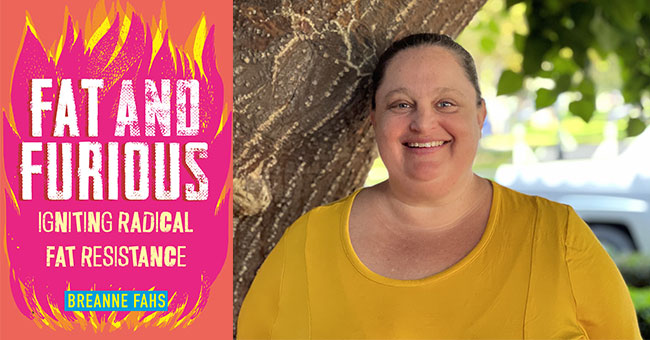
Anti-fatness and fat-shaming are used most often as a way to inspire fear in others about being or becoming fat. In Fat and Furious: Igniting Radical Fat Resistance, scholar and therapist Breanne Fahs breaks down how the dread of fatness is used to control and capitalize on women’s fears of their unruly bodies and demonstrates how rejecting shame and instead igniting feelings of anger can help us collectively move towards justice. Weaving together the voices of fat people and activists with damning psychological and sociological evidence, Fahs argues that rage, or fat fury, becomes the necessary antidote to the resignation and powerlessness that anti-fatness so often generates. We caught up with her for a two-part chat. This is part one of two. Read part two.
Beacon Press: What led you to write Fat and Furious?
Breanne Fahs: I had become distressed about the ratio of voices who were claiming that fat people should simply “love their bodies” compared to those who were talking more honestly about the complex feelings people have about their bodies. In particular, I always think that intrapsychic experiences collide with social and cultural experiences and stories, and fatness is particularly vulnerable to this. I have been particularly interested in what anger and rage look like when directed away from the self and toward those social and cultural stories that continue to oppress fat bodies and fat people. It’s easy to simply feel distress about one’s own body, but that doesn’t typically end there. We need to look at the larger stories of collective fury that fat people can cultivate. This book is an effort to both look at how bad things can be, but also what can be done about it, especially collectively, and especially harnessing the power of fury.
BP: Who is the book for? What type of readers will most benefit from the book’s message?
BF: This book is for so many different people. I want this book to speak to those who feel irritated and angry and upset about the way fat people are treated—either as allies or as fat people themselves—and who want a better language for why they feel that way and what to do about it. I hope this book can reach younger people, activists and budding activists, people who are tired of being treated poorly (and tired of watching others being treated poorly) for their weight. Fat people who have lived many of these things but who too often feel shame. Feminists and other politically progressive folks who want to “do better” about the topic of size and fatness. Parents who are struggling with how to think about their own body image and their kids’ body image issues. And more. I think it will benefit those who are angry but don’t know where to direct their anger or how to link it to a long history of other fat people and fat activists who are also angry.
BP: How does your background as a therapist inform the book?
BF: My therapy practice really prioritizes the collision between the individual/intrapsychic and the social/cultural. What happens to us individually—distress, suffering, sadness, anxiety, trauma, and more—connects quite deeply to bigger stories about gender, race, class, sexuality, size, age, and disability, among others. I think a lot with my clients about how to understand themselves within the (highly distressing) contexts in which they live. I’m working to bring that same energy to this book, particularly because fatness, and the suffering around fatness, is often experienced as intensely lonely and individualized. I want these feelings to instead become collectivized, at least to a point, and for people to feel that they are part of a bigger movement to make change within themselves and the world.
BP: What does “fat justice” mean, and why are the stakes so high for achieving it?
BF: Fat justice really centers on the idea that fat people deserve so many things they are currently often denied: access to rights; dignity; medical care; full and diverse lives; love and care from others; the ability to move through the world both literally and metaphorically; and more. Fat justice is about thinking about the fat body as a political body, as a body dialed into many experiences where power is at play. We can and must do better with fatness, particularly as we unpack the fear of fatness, the fear of becoming fat (or fatter), and all of the ways in which that terror governs us in unspeakably unjust ways.
BP: In what ways is anti-fatness more than just cultural bias? How has it been institutionalized and politicized?
BF: It’s an even more powerful cultural bias because it gets disguised as an individual experience. We think of it all too often as something individual people feel or think about with regard to their own bodies, but we far less often think about how ideas about fatness are informed by much bigger and more intense stories in the social and cultural spheres.
Sexism is seriously at play, particularly when we imagine the need for women to take up less space. Racism is seriously at play, particularly when we think about bigness as linked to Blackness and then denigrate it. Homophobia and heterosexism are at play, particularly when we think about fatness as an avenue for women to gain men’s approval, and so on. Ageism and ableism are at play, when we fantasize about an ever-more-narrow idea about “good” and “proper” and “sexual” and “lovable” bodies—all of which are quite thin. All of these ideologies get institutionalized through policy, representation, social and educational narratives, and more. Even at the material level, anti-fatness is institutionalized; it is harder to move through the world as a fat person, mostly because the world has decided not to accommodate fat bodies. Much like disability, fatness is seen as “othered” or “outside” of the norm, even when this is hardly the case.
BP: What are the consequences of having no legal protections for fat people in most institutions?
BF: Fat people can be fired or discriminated against without hesitation. They can be refused good medical care or seen as non-compliant or “difficult.” They have fewer avenues to legally challenge discrimination. We are in a period of time I hope we look back on with horror, where we basically allow fat people to be seen as “inferior” and for institutions to coalesce around this idea, thereby preventing fat people from accessing basic legal protections and equality.
BP: What are the limitations of mainstream body positivity movements? Or how has the body positivity movement been co-opted and why is it failing fat people?
BF: The body positivity movement certainly has a role in challenging anti-fatness. It’s good for people to think critically about why they dislike their bodies and to seek out ways to feel better about their bodies. I support that. That said, the story can’t end there.
It’s not enough for you or me to simply like our bodies. That’s not really about justice and systemic change. It’s also incredibly vulnerable to capitalism and corporate control of our bodies. There’s an easy slippery slope toward “buy this and you’ll feel better about your body.” Without a larger analysis of why we, especially women, hate their bodies so much and fear fatness so much, we lose the larger critique of sexism, racism, capitalism, and more. We need to think more about challenging anti-fatness in collective ways that aren’t as vulnerable to “shopping-as-cure,” which capitalism is happy to offer us all the time.
Read part two!
About the Author
Breanne Fahs is professor of women and gender studies at Arizona State University, where she specializes in studying women’s sexuality, critical embodiment studies, feminist histories, and political activism. She has authored many books, including most recently Unshaved, Burn It Down! Feminist Manifestos for the Revolution, and Fat and Furious. She is the founder and director of the Feminist Research on Gender and Sexuality Group at Arizona State University, and she also works as a clinical psychologist in private practice.
 Beacon Broadside
Leave a comment