• By Leigh Patel

    Summer Reading 2010 Scholastic Book Fair. Photo credit: Brownsburg Public Library

    Summer Reading 2010 Scholastic Book Fair. Photo credit: Brownsburg Public Library

    As child in elementary school, I distinctly remember being excited every time my teacher passed around the Scholastic Magazine. The paper of the magazine was thin, like newsprint. I’d fold the corners of the pages that had books I was interested in. Many times, I didn’t see anything and folded zero corners of the pages. It would be some time before I came to understand and question the power of a large corporation and its selection of what books it deemed worthy, in essence, to sell to young readers, teachers, and schools.

    In October, Scholastic issued a statement to its authors and illustrators, detailing the corporation’s decision to create a separate section of their book fairs where books that included characters and issues related to sexuality, gender, and race could be found. How a book is determined to include race as part of its content, and another doesn’t, eludes the fact that racism is a category created to deliver relative privilege and risk to human beings. In their statement to authors and illustrators, Scholastic framed their decision to segregate books as a way of supporting “an almost impossible dilemma: back away from these titles or risk making teachers, librarians, and volunteers vulnerable to being fired, sued, or prosecuted.” Also, in its initial October statement, Scholastic declared: “To continue offering these books, as well as even more high interest titles, we created an additional collection called Share Every Story, Celebrate Every Voice for our U.S. elementary school fairs.” It’s notable that Scholastic, after creating an ‘other’ category of books that reflected the laws and local district policies banning books that address race, history, sexuality and gender, stated quite plainly that the segregated books were being offered alongside “even more high interest titles.”

    There were not and are still not only two choices when it comes to banning books. The impossible dilemma that Scholastic names is one that serves and, in fact, reinforces local and state-level policies banning books that are written by people of color as well as books that include characters who are LGBTQIA2S. People live with multiple social opportunities and restrictions, including young readers are both Black and live with a disability as one example, but that recognition of intersectional realities is absent in Scholastic’s choice to, in essence, mark some books as diverse and segregate those books in its fairs. This is misinformed and, at worst, reckless in a time when book banning laws have been passed in 30 states

    With a net worth of $1.8 billion, Scholastic enjoyed a profit of $1.7 billion in 2023. That sizeable profit was an increase from the $1.65 billion in 2022. Along the same timeline, according to PEN America, the company has thirty-three different book magazines that are circulated through schools and book fairs to 13.5 million young readers. From the company’s home page, it proclaims its purpose as being a place and resource “[w]here kids choose the books they love and schools earn rewards.” When children are restricted from choice through the segregation of books and their authors and illustrators, what are they learning about love? What are they learning about their agency that is well beyond the parameters of what books they might be able to purchase?

    Huey P. Newton’s writings about power help to lift up the power dynamics in Scholastic’s decisions: “To us power is, first of all, the ability to define phenomena, and secondly the ability to make these phenomena act in a desired manner.” If a young reader is not presented with the option to read certain books that are deemed inherently controversial for addressing race, history, sexual identity, and gender, that phenomenon has been constructed for them and without them at the table. Further, becoming a literate subject of that state happens through books that are read in classrooms, in homes, in churches, under the blanket at night using a flashlight because the book is too good to stop reading. All of the instances are, in the current heat of book banning, socializing children, their caregivers, and their educators to act in accordance with the idea that it is acceptable to ban books simply because they do not center the stories of people who are white, cishet, not living with a disability, and disconnected from the legacy of the United States’ foundational sins of stolen labor on stolen land.

    And then Scholastic apologized.

    It matters a great deal that Scholastic, in a letter written by their senior vice president, Ellen Berger, apologized. That letter, dated October 24, apologized to the many people their policy had hurt and acknowledged that their actions had broken relationships. Scholastic, from Berger’s position, also pledged to “stand with you as we redouble our efforts to combat the laws that restrict children’s access to books.” Time will tell how this commitment manifests materially. We are in a protracted yet precedented time when binary ways of thinking predominate: this book is good because it portrays Thomas Jefferson as a hero; this book is bad because it tells Black girls that is okay to love their hair. Binaries are screamed vocally and through signs at school board meetings, political processes, and with families. It matters a great deal that Scholastic owned their unprincipled policy and committed to combatting restrictive laws and policies rather than providing an unnecessary ‘cover’ that, in essence, buckled to the monied pressure of a small yet vocal coalition seeking oversight over knowledge itself.

    Beyond Scholastic

    One of the easiest mistakes we could make at this moment is over-inflating Scholastic’s influence. A collective and ongoing movement called We Need Diverse Books has been, for years, creating spaces for books that have nuanced messages about race and history. Unsurprisingly, their website has featured toolkits for combatting book bans.

    And finally, there are pop-up libraries, collective meetings outside of schools, and many other ways that people are simply continuing to read. They are reading, engaging with each other. As people have always demonstrated, when laws exist to strip humanity of its promise, people find ways to, as Grace Lee Boggs has written, pursue being more human human beings.


    About the Author 

    Dr. Leigh Patel is an interdisciplinary researcher, an educator, a writer, and a professor at the University of Pittsburgh. She works extensively with societally marginalized youth and teacher activists. Patel is a recipient of the June Jordan Award for scholarly leadership and poetic bravery in social critique and is a national board member of Education for Liberation, a long-standing organization dedicated to transformative education for and by youth of color. She is the author of Youth Held at the BorderDecolonizing Educational Research, and No Study Without Struggle. Connect with her on Twitter at @lipatel.

  • By Jonathan Rosenblum

    UAW President Shawn Fain with Local 259 Reps & NYS Elected Officials at Teamsters Pre-Strike Rally, July 15, 2023. Photo credit: Informed Images

    UAW President Shawn Fain with Local 259 Reps & NYS Elected Officials at Teamsters Pre-Strike Rally, July 15, 2023. Photo credit: Informed Images

    This article appeared originally in The Nation.

    There’s a whole truckload of things to celebrate in the new tentative agreements won by the United Auto Workers (UAW) at Ford, Stellantis, and General Motors (GM). The deals were wrested from the Big Three companies after 46 days of expanding strike action—what new UAW President Shawn Fain dubbed the “Stand Up Strike,” in which workers incrementally extended picket lines to more plants, slowing turning the vise tighter on the companies. By the time the last holdout, GM, settled this past weekend, close to 50,000 of the UAW’s 146,000 autoworker members had walked off the job.

    Workers won pay raises of 25 percent over the next four and a half years—with bigger raises for many lower-paid workers—plus cost-of-living adjustments, much faster progression to the top of the wage scale, and a host of other economic gains. By mid-2028, top pay for production workers will reach $42.60 an hour, while starting hourly pay will rise from $18.05 today to $28. Crucially, the strikers also won organizing rights at the new Electric Vehicle battery plants coming online.

    “The gains are a testament to the UAW’s bold, aggressive strategy under its new leadership, which ramped up the strikes, at first slowly and then faster until the companies caved one by one. It was a master class in worker power,” wrote Dan DiMaggio in Labor Notes. You won’t have to search very far to find similar glowing accolades in left media, and even grudging recognition by the mainstream and business press that the autoworkers have accomplished something pretty remarkable.

    But there will be two juries that will render the ultimate verdicts on this historic strike. First up will be the union membership. Over the next few weeks, the autoworkers will pore over the new agreement, whose details have been shared as the bargaining process unfolded—a refreshing and welcome change from past closed-door UAW negotiations. And then they will vote.

    Labor observers may be agog to see the big raises that UAW members won, but expect a more sober analysis from the workers themselves. The new top rate of $35.70 an hour for production workers in 2023 is actually $6.40 per hour less—or more than $13,000 less per year—than the same top rate for UAW members in 2007, taking inflation into account. Under the new agreements, a UAW member at the top of the scale can afford to buy a typical home in Detroit or Louisville (barely), but not in Chicago or Kansas City.

    Progress? Yes indeed. But the agreements do not restore the wage rates and retirement benefits workers previously earned, nor do they claw back the countless billions that the bosses stole from workers in the intervening generation of concessions, enriching the CEOs and the billionaire shareholders while decimating working-class communities. Auto workers have not forgotten or forgiven this scandalous theft, and neither should we.

    The second jury is the future. Three strategic questions remain in play.

    First, will the strike be the launchpad for rebuilding worker power in the auto industry, inspiring workers in other industries to rise up as well? Or will it turn out to be a historical anomaly in labor’s steady generational decline?

    Today, the UAW represents about 15 percent of the 990,000 US automobile and parts manufacturing workers. That’s down from a peak of 1.5 million UAW members in 1979. Back then, the Big Three controlled 80 percent of the US market, so the UAW contracts drove industry standards. Today, the Big Three market share has fallen by nearly 50 percent as companies like Toyota, Nissan, Volkswagen, Subaru—and now Tesla—have scaled up US manufacturing, all of it nonunion. For years, UAW leaders gave lip service to organizing those plants. In the last decade, the union badly lost efforts to organize at a Nissan plant in Mississippi and a Volkswagen plant in Tennessee; Fain’s predecessor had almost entirely given up on auto organizing.

    Earlier this week, Fain—just elected in March following the union’s first genuinely democratic contest for top officers—declared that the 2023 strike “will go down as an inflection point for our union and our movement.” Let’s hope that is the case. Let’s work together to make sure that is the case.

    The UAW contract—longer than most at four and a half years—gives the union time to launch a massive organizing drive in the auto manufacturing sector. Rebuilding autoworker power will require herculean efforts by not just the UAW but the entire labor movement. Fain described a vision for the next bargaining round: “When we return to the bargaining table in 2028 it won’t just be with the Big Three, but with the Big Five or Big Six.”

    A powerful vision indeed; now the hard work begins. Already the bosses are girding for battle. Toyota wasted no time this week in announcing raises for workers at its five US manufacturing plants. We should expect similar firewalls to go up at all the nonunion companies as they mount their union-busting campaigns of intimidation and division.

    A second question to be answered in the coming years is what sort of union will now inhabit the factories of the Big Three. Will members draw from the riveting experiences of the last months and build militant shop floor unions? Or will they slide back into the bad habits of business unionism that characterized the UAW of the past—and far too many unions of the present?

    A union contract is a snapshot of the balance of power at the time it is negotiated, a truce in the class war. Only a fool would believe that auto executives will sit pat while UAW members implement the new contractual provisions. The bosses also have four and a half years—a lot of time—to find and exploit any weaknesses or ambiguities in the new agreements and push back against today’s gains. It will take relentless work by members to enforce their contract wins, especially those related to organizing workers at new plants, where company resistance is sure to materialize, notwithstanding the words on paper.

    Finally, the third question to be answered is what sort of working-class movement will emerge from the autoworkers’ win.

    In announcing that the UAW contracts will expire the day before May Day 2028, Fain laid down a challenge to all unions. May Day, he noted, is more than a day of commemorating worker struggles, “it is a call to action.”

    “We invite unions around the country to align your contract expirations with our own, so that together we can begin to flex our collective muscles. If we’re truly going to take on the billionaire class and rebuild the economy so that it starts to work for the many and not the few, then it’s important that we not only strike, but that we strike together,” he said.

    This is a powerful declaration of class struggle, truly remarkable to hear from a national union leader in the twenty-first century. Imagine not tens or hundreds of thousands but millions of workers uniting to strike together in 2028; imagine the bold demands that we could put forward. Imagine how hard the billionaire class and its politicians will fight to block us at every turn.

    Fain’s May Day call to action is simply an idea—for now. Nearly all his labor leadership counterparts—the presidents and officers of the national unions, the leaders and top staff at the AFL-CIO—are manifestly unsuited to answer this call. They are far too ensnared in the turbid swamps of Democratic Party politics and business-as-usual unionism to be capable of even supporting that fight, much less leading it.

    But Fain’s clarion call to action is certain to excite rank-and-file workers throughout the country who are struggling under the hammer blows of low wages, soaring rents, brutal bosses, crumbling public services, and a turbulent planet. Fain has issued us all a challenge. How ordinary workers respond, how they put their shoulders to the collective wheel in the coming months to organize autoworkers and other workers, how they challenge one another to act boldly and envision new horizons, will determine whether we look back in 2028 at Fain’s May Day call as a mere rhetorical flourish—or the start of something very big.


    About the Author  

    Jonathan Rosenblum is the author of Beyond $15: Immigrant Workers, Faith Activists, and the Revival of the Labor Movement (Beacon Press, 2017) and a member of the National Writers Union.

  • By Jonathan Rosenblum

    Solidarity With SEIU-UHW Kaiser Workers on Strike, October 5, 2023. Photo credit: UFCW: A Voice for Working California

    Solidarity With SEIU-UHW Kaiser Workers on Strike, October 5, 2023. Photo credit: UFCW: A Voice for Working California

    This article appeared originally in The Nation.

    It’s not just actors, writers, and autoworkers powering this year’s strike wave in the United States. Healthcare workers, too, are flexing their collective muscles in greater numbers. And for good reason.

    In just the last two months, 75,000 Kaiser workers in seven states and the District of Columbia struck, joining workers in other healthcare systems who marched on picket lines from New Jersey to Michigan to Los Angeles. Workers have had it with stagnating pay and soaring rent, fuel, and grocery bills. Inflation, while brutal on working-class pocketbooks, is good business for Wall Street, where CEOs have collected record profits.

    For healthcare workers, you can tack on to those injustices the sacrifices they made under Covid: grueling work hours, dangerous short staffing, and basic safety equipment shortages—especially in the first months of the health crisis. Add to that staff burnout and a virus that killed more than 3,600 healthcare workers in just the first year of the pandemic.

    As staff have been worked to the bone, they’re also outraged to see healthcare executives enrich themselves like never before. HCA Healthcare, the nation’s largest for-profit hospital system, reaped $5.64 billion in 2022 profits and paid CEO Sam Hazen $14.6 million—a 46 percent boost from 2018. Gregory Adams, CEO of Kaiser—technically a nonprofit—got $15.6 million richer the same year. The top five insurance companies reaped $40 billion in profits for their shareholders, while pharmaceutical companies like Pfizer executives celebrated 2022 as “a year in which we set all-time highs in several financial categories,” including a mind-boggling $31 billion in profits—more than triple its already obscene 2020 profit level.

    Thus far in 2023—with still two months to go—more than 102,000 healthcare workers have hit the pavement, over double the previous year’s number, according to the Labor Action Tracker maintained by Cornell University’s School of Industrial and Labor Relations.

    These strikes are much more than fights over wage and benefit levels; the source of the conflict lies in the fundamental problem of the for-profit healthcare system.

    Overwhelmingly, safe staffing is the central issue motivating healthcare workers to walk. And by exercising their labor power, they are achieving breakthroughs.

    In January, 7,000 nurses at New York City’s Montefiore Medical Center and Mount Sinai Hospital struck and won limits on patient-to-staff ratios. Enforceable “staffing ratios” are the Holy Grail for frontline caregivers, the most concrete way to ensure quality bedside care.

    The staffing ratio fight is the most acute site of conflict in the universal battle of patients versus profits. Ratios are an abomination to hospital executives because they act as a roadblock to their austerity business plans. For the last two decades, healthcare unions have fought relentlessly in state legislatures to win staffing ratio language—only to fall short as big business and political allies repeatedly have watered down and rejected one safe staffing law after another. Just earlier this year, lawmakers in Minnesota—where Democrats control the legislative and executive branches—caved to pressure from Mayo Clinic executives and rejected a safe staffing law. Today, only California and Oregon have comprehensive staffing ratio laws, with more limited regulations in New York and Massachusetts.

    In securing ratios in their contract, the Montefiore and Sinai nurses won through labor power what they and their compatriots largely have been unable to achieve in the political arena. “The fact that we have an enforceable limit on the number of patients to care for at once is 100 percent life-changing, literally and figuratively,” said Sinai nurse Erin Hogan. “I think I will actually be able to go home and sleep at night, knowing that I was able to provide quality care for my patients.

    “These hospitals totally underestimated us nurses. We called their bluff. We refused to back down and stood in solidarity on the picket lines,” she said.

    Just over the state line in New Jersey, safe staffing is the central issue at the longest healthcare strike on the US mainland this year, now entering its fourth month. In August 1,700 nurses at Robert Wood Johnson (RWJ) University Hospital, a 965-bed academic medical center associated with the medical school at Rutgers and a level-one trauma center, struck over unsafe staffing. “Sometimes I’d look at a patient’s face and know that I won’t be able to maybe help feed them when they need to be fed…or clean them when they need to be cleaned. It is distressing, and depressing for us,” nurse Sophia Moccio told Jacobin.

    The nurses, members of United Steelworkers Local 4-200, want staffing ratios. But hospital executives have dug in, spending more than a million dollars a day on strikebreakers, securing court injunctions to limit picketing, and cutting off the workers’ health insurance. Nurses appealed to state Democratic political leaders—only to discover that the hospital executives had beaten them to it.

    “When you say tightly connected, you can’t even put a credit card in between them,” Carol Tanzi, one of the nurse strike leaders, said of the relationship between state political leaders and RWJ hospital executives. “We didn’t understand what fight we were fighting. we didn’t understand the interconnected dealings. Our CEO, Mark Manigan, is apparently very close personal friends with Phil Murphy, our governor, who has been largely absent and silent on this matter. Claiming to be a union progressive governor is a joke at this point.”

    On October 27, Senator Bernie Sanders (I-Vt.) convened a field hearing in New Brunswick to give much-needed airtime to the striking nurses. Tellingly, no other members of his Senate Committee on Health, Education, Labor and Pensions—Democrat or Republican—chose to attend.

    Kaiser workers nationwide had greater success with their three-day strike last month spanning clinics and hospitals from coast to coast. The 75,000-worker strike—the largest healthcare walkout in US history—“was so large and the turnout was so immense because of the anger and frustration that’s built up among my coworkers over those three and a half, four years now of Covid and having to deal with short staffing and a lack of safety protocols,” said Ethan Ruskin, a 22-year health educator and a rank-and-file activist in his Service Employees International Union (SEIU) chapter at Kaiser San Jose Medical Center.

    Two of Ruskin’s SEIU coworkers at San Jose died from Covid, and Ruskin said that in making the rounds leading up to the bargaining, “folks were so fed up and frustrated. They were asking me when, not if, we were going to go on strike.”

    The same frustration was palpable in Colorado. Clinic nurse and SEIU activist Tonya Stoner said, “It was easy when we were talking to people to say, ‘Are you angry? What is going on in your department? What kind of care are these patients getting?’ And people said it’s unacceptable.” A few workers were scared to strike, but overall “they were angry.”

    In the last four years, staff left as Kaiser wages failed to account for the rising cost of living. While some healthcare employers reopened contracts to give pay raises during the pandemic, Kaiser did not.

    “We could make $10 to $20 an hour more at just about any other institution doing the exact same care that we’d be doing at Kaiser,” said Seattle outpatient surgery nurse and SEIU member Jessica Wolfe. Her coworker, environmental service worker Christine Muña, typically must work 96 hours every two weeks to pay her bills. Muña related how a coworker just left for a comparable job at a hospital one mile away. It paid $7 an hour more.

    In Colorado, Stoner noted that before the strike, one coworker, a mother of two children, was living out of her car, while another was staying overnight in a Kaiser parking lot.

    Nationally, Kaiser workers won substantial wage gains—21 percent over four years, with minimum wages going in the next two years to $25 an hour in California and $23 an hour in other states. Local agreements may add on to those economic packages. Workers also won stronger protections against subcontracting and outsourcing.

    But it would be a gross oversimplification to reduce Kaiser and other battles to contests over dollars alone. More money for workers means better, more stable staffing, and that translates into better care. The recent healthcare strikes are, at their core, contests over what kind of healthcare system we want in the United States—a profit-driven system that treats healthcare as a commodity, to be bought and sold, or a social good accessible to all.

    Covid brought this long-standing conflict into stark relief, along with a second factor: When progressive political leaders back-shelved the fight for universal healthcare, it took pressure off executives to hold back their worst impulses, according to several workers I heard from.

    “If our government had been working as it should and not be profit- and favor-driven, we would have had legislation 20 years ago for safe staffing ratios. I wouldn’t have to be fighting for it in my contract,” New Jersey strike leader Tanzi said.

    Philadelphia nurse Marty Harrison, vice president of the Temple University Hospital Nurses Association, recalled the electricity around Bernie Sanders’s 2020 run for president, and in particular the momentum his huge rallies brought to the Medicare for All fight. But when Sanders withdrew from the race in the spring, under pressure from Democratic Party leaders and as Covid surged, “I felt so abandoned by him,” Harrison told the podcast On Strike. “Once he did that, once he stopped running for president, nobody cared about what he said anymore.”

    As a candidate, Joe Biden disparaged Medicare for All, and progressives in Congress rejected grassroots calls to force the political establishment to take up the issue. By the time of the 2020 election, the core healthcare question—for profit, or for patients?—had disappeared from the political establishment’s radar.

    This year’s healthcare strikes are, in part, workers stepping up to fill that political vacuum. Future healthcare strikes are likely to continue to fill that space, because even solid victories won on the picket line are not going to resolve the fundamental struggle over the nature of healthcare in America. That will require a bigger battle, shaped and led by workers at the grassroots.

    Every strike alters the balance of power between workers and their bosses. For healthcare workers, the experience builds confidence that they can—and indeed must—fight for quality care at both the bedside and on the sidewalk. In doing so, it opens wider horizons for workers to see the power of exercising the strike weapon—for not just better union contracts but also the systemic change we so urgently need.


    About the Author 

    Jonathan Rosenblum is the author of Beyond $15: Immigrant Workers, Faith Activists, and the Revival of the Labor Movement (Beacon Press, 2017) and a member of the National Writers Union.

  • By Jess Zimmerman

    Medusa

    Image credit: emsalgado

    This Halloween, we’re looking at another kind of scary story. Rooted in Greek mythology, it’s the story of woman as monster the patriarchy has told throughout the ages. Editor and essayist Jess Zimmerman gets into the spooky details in this excerpt from Women and Other Monsters: Building a New Mythology.

    ***

    The first thing you saw when entering the Dangerous Beauty exhibit at the Metropolitan Museum of Art was a vintage dress from Versace’s 1992–1993 “Miss S&M” collection. Straps of quilted leather crisscrossed the throat and décolletage of a headless mannequin, each strap adorned with a dollar-sized brassy coin bearing the head of a howling Gorgon, a play on Versace’s usual logo of a placid Medusa face. The overall effect was oddly militaristic, a sort of four-star dominatrix look.

    The exhibit, subtitled “Medusa in Classical Art,” was tiny, tucked away in a single room in the mezzanine of the Greek and Roman art collection, next to the study gallery. So perhaps the dress was there to grab the attention of tourists who might accidentally have wandered up from the floor below, a broad indoor courtyard across which a young Hercules, lion-skin coat held meaningfully over his arm, stares impatiently at a statue of his older self. This is often the purpose, after all, of women’s bodies and the clothing that adorns them, especially clothing that highlights the body’s constraints. Clothing like this exists to catch the eye.

    In this case, though, gawkers lured by “Miss S&M” were deposited into a room full of artifacts depicting not only Medusa but a coven of other female creatures of antiquity. Gorgon faces—both horrible ancient ones, with tusks and beards, and later ones, whose placid classical symmetry is broken only by a few demure snakes at the temples—stared out from roof tiles, armor, cups, and cameos. A piece of pottery showed Scylla with her snake legs splayed, a pack of dog heads lunging out of her crotch. Sirens perched their bird bodies on plates and mirrors. On the side of one shallow goblet, a Sphinx was painted in loving miniature, crouching over a male victim who appeared to plead for his life. Chasing after the female torso in her chic bondage, in other words, landed you in a nest of monsters.

    The sixty pieces in the exhibit were intended to track the way Medusa and her counterparts became subject, despite their monstrousness, to principles of beauty. A gold pendant with a Gorgon’s face from 450 BCE showed a grimacing creature with sharp teeth, a protruding tongue, a creased brow, a knobby chin. An exquisite nineteenth-century cameo, displayed in the same case, showed a perfect, precise neoclassical profile— which is to say, she looked a bit like Graham Chapman, but that was the style at the time. Apart from a coil of snake at the crown of her head, like a fascinator, and another knotted scarflike beneath her chin, she had no visible markers of monstrousness. You’d easily mistake her for a proper young lady with Bohemian hair and odd taste in accessories—the youngest Downton Abbey daughter, maybe. A Siren on one oil vessel from the sixth century BCE sported a full beard, though Sirens were generally coded as female, and had no arms; its head sat atop an awkward, turkey-like bird body. Catty-corner was a 1910 French woodcut in which a Siren, despite having developed bear arms and a fish tail to go with her wings, was still depicted as a beautiful bare-breasted feminine figure with a crown of flowing hair. Creatures conceived as repulsive were gradually reimagined as appealing, even seductive—at least on the surface. The monstrosity remains, but it’s no longer visible.

    “In a society centered on the male citizen, the feminization of monsters served to demonize women,” writes curator Kiki Karoglou in an accompanying bulletin. The later monsters don’t just look more beautiful and more feminine; they look more human, underscoring the idea that monstrousness is somehow the human woman’s natural condition. As monsters became more pleasing to the eye, they were defanged—beauty being equated, in classical Greece, with moral goodness—and, paradoxically, made more dangerous. A Medusa with tusks, whiskers, and a grotesque distended tongue could be easily pegged as a threat; a human-looking Medusa could fly under the radar, until you tried to brush her hair. The resulting girl-faced beasts, read the exhibition text, foreshadow “the conceit of the seductive but threatening female that emerges in the late nineteenth century in reaction to women’s empowerment.” When a feminine face might belong to a secret Gorgon, any woman could be a monster. Perhaps every woman was.

    This is one of the legacies we’ve inherited from the classical era, which underpins so much of what Westerners see as “culture” and “civilization”: a suspicion of women in general, a feeling that every one of them may have claws and tails if you look below the waterline. The monsters massed together in this little room at the Met represented a series of cautionary tales. Women may look harmless on the face, they said, but look at their snake hair and dog crotches and claws. Look at them crouched over a male victim, ready to bite. Beware their ambition, their ugliness, their insatiable hunger, their ferocious rage.

    It was these cautionary tales that brought me to the Met, shortly before the exhibit closed in January 2019. I was writing about these same female monsters, and a few others from the same period—specifically how they’re used to represent qualities that women are supposed to tone down, lest we be seen as dangerous or grotesque. I wanted to look them in the face, all these Sphinxes and Gorgons. I wanted to be surrounded by them, and see if there was a place among them for me. Because my project was to rehabilitate these monsters—not externally, like the (male) artists who gradually made their forms more pleasing and symmetrical, but by showing how the traits we were told made them dangerous are actually their greatest strengths, and ours.

    All the stories about monstrous women, about creatures who are too gross, too angry, too devious, too grasping, too smart for their own good, are stories told by men. The versions of these myths, the ones that are most familiar, come from Ovid, Homer, Hesiod, Virgil, Sophocles. I came to the Met to wonder what stories the monsters themselves would tell. What would Medusa say about the ugliness she first experienced as an unjust punishment, and then learned to use as a weapon? What happens when we free the Sphinx from the drama of Oedipus, and let her exist as something more than an obstacle to a man? What was it like for the Sirens on their lonely rock, watching everyone who tried to love them drown?

    ~~~

    I’ve had a long-standing interest in female heroes, the women who have broken through gendered notions of who is allowed to embody valor and strength, and I was beginning to suspect that monsters, perhaps ironically, could offer a whole new approach to heroism for people (like me) who are often tripped up by feminine ideals. The qualities we hail as heroic in Western culture—courage and fortitude, selflessness and nobility, steadiness of mind and will—are not unique to men. Arguably, they’re not even characteristic. But in the male-dominated myth, folklore, and literature that defines our culture, they’ve been annexed as “masculine” traits. We’re still struggling to create or consume stories about valorous women, unless they also display the “feminine” virtues: passive sex appeal and fragility that requires rescue. In a hero, these are flaws. Thus, any heroine who tries to embody both contains the seeds of her own undoing.

    The female hero can hoist up the shackles of femininity and take them with her on adventures, but that’s not the same as breaking free. (Think of that internet video of a fluffy dog running around a restaurant inside his plastic cage, pushing it along with his nose at an astonishing clip as his owner tries to keep up. You can drag your cage around, but it’s still a cage.) In college, I was a particular fan of Edmund Spenser’s “martial maid” Britomart, who gets to wear armor and carry a spear and go on quests and even rescue maidens—but eventually, even Britomart gallops back into her role as a princess, a wife, and the mother of a race of noble Britons. Her whole mission, in general, has been to find the man she glimpsed in a magic mirror and fell in love with. The rescuing damsels part was just a side quest.

    Jumping ahead only a few centuries, Leeloo in the movie The Fifth Element is perhaps my favorite example of the heroine undone by her own femininity. She’s conceived as a perfect being with inhuman skills in both fighting and intellect, but she spends most of the movie in a little Borat swimsuit—and in the end, she needs to be both physically rescued by a man and given purpose by his sexual interest. (Her ability to save the universe is neutralized until Korben says he loves her, and let’s be honest, he’s not talking about their deep emotional connection. They barely know each other, and Leeloo speaks no human language! She’s very hot though.) We’re not in 1590 anymore, or even 1997, and things are improving for the female hero. But truly transcending the cultural expectations placed on a woman—to be attractive and sexually available (but not too available), to never outshine the male heroes, to let herself be transformed at the end into a prize—is so rare that when it happens, we often regard it with suspicion. What do you mean Furiosa and Mad Max never bone down? This is a movie!

    And if the heroine truly slips the constraints that her femininity is supposed to place on her, the very heroic virtues she embodies often mutate into monstrosity. In the Old English epic poem Beowulf, the eponymous male hero is described as an aglæca, a word for which we do not know the exact meaning but which is usually translated as something like “hero” or “warrior.” Beowulf’s antagonist, the monster Grendel, also gets described as an aglæca, which in his case is usually glossed as “demon” or “monster” or something similar. What the two have in common is the sense of being awe-inspiring or formidable, so that’s probably more or less what aglæca means. But the word has a feminine form, aglæcwif, and the ancient text contains an aglæcwif too: Grendel’s mother. There is no ambiguity to this word, not in the way it’s come down to us; aglæcwif is translated as “monster-woman,” “troll-lady,” “wretch,” or “hag.” In other contexts, “wif ” (which is also attached to other descriptors of Grendel’s mother) specifically denotes a human woman, and yet—like it’s not indignity enough that she’s always called “Grendel’s mother,” as if the bards were Grendel’s schoolmates who didn’t realize mothers had names—the aglæcwif is assumed to be subhuman and bestial. She’s just as much an aglæca as Beowulf, just as much a wif as the other human women to which that refers, but the combination inspires not awe but horror. The monstrousness of Grendel’s mother, the factor that makes her a hag or a troll or a wretch, comes from her stepping outside the slim strictures of womanhood into the realm of aglæca, of formidability and awe. In another world, she would have been a hero.


    About the Author 

    Jess Zimmerman is an editor at Quirk Books, a freelance writer of essays, and the author of Women and Other Monsters: Building a New Mythology. Her essays, fiction, opinion pieces, and prose poetry have appeared in publications including ViceSlateThe Cut, the Washington PostThe Guardian, and the New Republic. She lives in Philadelphia. Connect with her online at jesszimmerman.com and on Twitter (@j_zimms).

  • By Aviva Chomsky

    Central American migrants find quarter in southern Mexico. Photo credit: Peter Haden

    Central American migrants find quarter in southern Mexico. Photo credit: Peter Haden

    The Biden administration’s timing for authorizing the continuation of the border wall construction in Texas is an inhumane and racist flex. Right during the middle of Hispanic/Latinx Heritage Month. The new section of wall will extend another twenty miles. The Central American migrants and refugees the admin wants to prevent from crossing the border are fleeing conditions created by the US’s colonialist, neoliberal meddling in their countries. This history, which professor Aviva Chomsky covers in this excerpt from Central America’s Forgotten History: Revolution, Violence, and the Roots of Migration, goes as far back as the 1980s.

    ***

    Few predicted that the peace accords and neoliberal reforms of the 1990s would lead to a flood of out-migration in the following decades, as flight would increasingly become the last resort of people desperate to survive, and ties to the United States made it the obvious destination.

    Migration has been an inherent aspect of all human history, including Central American history. Pretty much every individual on the planet is located where they are because either they or multiple ancestors migrated voluntarily or by force over time. In the twentieth century, Central American migration was primarily internal, as the rural population lost lands and moved to colonize frontiers or to work in plantation agriculture or in the capital cities. During the wars of the 1980s, many more were displaced within their own countries, to other Central American countries, to Mexico, and increasingly, to the United States.

    Fleeing Home

    The Central American wars of the 1980s caused millions to flee their homes. Some became internal refugees, relocating with relatives, hiding in the mountains, or moving to the anonymity of the capital city or hastily established refugee camps. Others crossed borders to find refuge in camps or on their own in Costa Rica, Honduras, and Mexico. Some two hundred thousand Nicaraguans fled their country during the 1978–1979 insurrection, though many of these returned after the 1979 revolutionary victory. By the end of the 1980s, around 3 million Central Americans had fled from their countries of origin. Seven hundred and fifty thousand remained in Mexico, while a million crossed through Mexico into the United States. Some continued on to Canada.

    Working with the United Nations High Commissioner for Refugees (UNHCR), Mexico built camps along its southern border for forty-six thousand mostly Mayan Indigenous refugees from Guatemala. Another two hundred thousand Guatemalans, along with half a million Salvadorans, found their own way to seek a living, informally and unrecognized, in Mexico.

    In 1970, the US census counted 114,000 Central Americans. By 1980, this had risen to 350,000; by 1990, over a million. Instead of slowing as the wars ended, migration increased: in 2000, the census counted over 2 million Central American–born. In 2010, there were over 3 million, and in 2017, close to 3.5 million. (These numbers do not include the growing population of US-born children of Central American migrants who are not tallied among the “foreign-born” but reached about 1.2 million in 2015.)

    Using self-identification rather than birthplace, the Pew Research Center calculated a population of 2.3 million Salvadorans (57 percent foreign-born), 1.4 million Guatemalans (60 percent foreign-born), 940,000 Hondurans (62 percent foreign-born), and 464,000 Nicaraguans (55 percent foreign-born) in the United States as of 2017. The foreign-born percentage is of interest because it shows the recent nature of the immigration: Central Americans have a much higher proportion of foreign-born than do Hispanics as a whole, for whom 33 percent were foreign-born in 2017. Sixty percent of immigrants born in Honduras were undocumented, along with 56 percent of those from Guatemala and 51 percent of those from El Salvador. The real figures are likely higher than what’s recorded in the census, because immigrants, especially those who are undocumented, are notoriously undercounted.

    A much larger Mexican migration to the United States also grew rapidly during the same decades, with the Mexican-born population growing from well under a million in 1970 to close to 12 million in 2010. But Mexico’s migration slowed considerably after that, reaching “net zero” in 2011 and then reversing, so that the Mexican-born population shrank by some five hundred thousand by 2017. Mexicans continued to arrive—but even more were leaving.

    A smaller number of Central Americans—some eight hundred thousand—relocated elsewhere in Central America during the decade of the 1980s. About 10 percent of them received benefits as recognized refugees. Some others received aid from religious and humanitarian NGOs; most struggled to reconstruct their lives without organized aid. Many of those who had relocated inside Central America, whether in refugee camps or at the margins of the mainstream, returned home after the various peace accords of the 1990s.

    The Legal Landscape of the United States

    Contrary to the oft-repeated phrase that, in then president Barack Obama’s words, the United States has a “tradition of welcoming immigrants from around the world,” this is far from the case. It’s more accurate to say that, as a settler colonial nation, the United States has a tradition of welcoming white immigrants. This tradition began in its Declaration of Independence, which decried the British Crown’s restrictions on migration from Britain, and was reinforced with the new country’s first naturalization law in 1790 that offered entry and citizenship to “any Alien being a free white person,” and the post–Civil War naturalization law revision that extended its provisions to “Aliens of African nativity and to persons of African descent” (virtually none of whom at the time had the slightest desire or ability to migrate to the United States, a voyage that for Africans had historically meant enslavement, not freedom). The 1870 law explicitly excluded from welcome or naturalization those nonwhite immigrants who were actually arriving at that time: Chinese and Mexicans. Indeed, most of the world’s peoples, who were neither “white” nor “persons of African nativity,” were systematically refused entry to the United States on racial grounds until the mid-twentieth century.

    A special set of laws applied to Mexicans, whom Secretary of State James Buchanan termed “an inferior, indolent, mongrel race.” While they were racially “ineligible to citizenship,” Mexican workers were essential for the railroad, mining, and agricultural development of the western United States. So rather than exclude Mexicans physically, Congress left entry open, but designed a plethora of systems to ensure that Mexicans entered the country as temporary laborers, rather than potential settlers or citizens. Exploitative guest worker programs and spectacular mass deportations in the 1930s and 1950s confirmed that Mexicans were not among those immigrants who were “welcomed.”

    The 1965 immigration overhaul known as the Immigration and Nationality or Hart-Celler Act (INA) is generally hailed for removing, once and for all, racial quotas and restrictions on immigration. That perspective has some validity if we look at how the law affected Europeans, Africans, and Asians. But for Mexicans, the 1965 law just created a new kind of restriction: the first-ever immigration quota that turned many Mexican migrant workers into “illegal” immigrants. By 1980, there were some 1.5 million undocumented Mexicans in the United States; by 1986, this had grown to 3.2 million, due to a combination of Mexico’s debt crisis and a booming US labor market. “Illegality” was a new way to criminalize Mexicans and justify continued exploitation and exclusion. Meanwhile “wars” on drugs and crime did the same to other populations of color.

    Most Central Americans fleeing persecution or violence in the 1980s had no path to legal entry into the United States. Like so many Mexicans, they simply crossed the border “without inspection,” evading official crossing stations, and entered the underground world of undocumentedness.

    Popular and congressional concern about the growing undocumented population grew in the early 1980s, and in 1986 Congress passed the Immigration Reform and Control Act (IRCA). IRCA had three main components: employer sanctions, which penalized employers for hiring workers who were undocumented; increased border control, to prevent people from entering without documents; and legalization, which allowed a significant number of people without documents to regularize their status. IRCA sweetened its terms for agricultural employers who relied on Mexican workers, adding special provisions for their legalization and a new guest worker program.

    The first two components of IRCA—employer sanctions and increased border control—have been permanent and ongoing, and laid the basis for increasingly punitive anti-immigrant law and practice from the 1990s on. The third, legalization, was a onetime olive branch to immigrants themselves. Two of its parameters made it clear that it was Mexican migrant workers, rather than Central American refugees, that were its target.

    First, legalization was offered only to migrants who could prove that they had been in the United States continuously since January 1, 1982. That automatically excluded large numbers of Central Americans, whose numbers only started to grow significantly after 1980. Second, IRCA offered residency status to seasonal farmworkers, most of whom were Mexican. In the end, IRCA enabled 2.7 million immigrants to legalize their status, 70 percent of them Mexican.

    Still, almost three hundred thousand Central Americans were able to gain legal status through IRCA. Most (60 percent) were Salvadorans, followed by Guatemalans (25.4 percent) and Nicaraguans (6 percent). Smaller numbers from other Central American countries made up the difference.

    Asylum

    Since the vast majority of Central Americans who reached the United States in the 1980s were fleeing violence and persecution, one might imagine that US refugee law, newly updated under President Carter in 1980, would enable them to obtain legal status. The old law had applied primarily to refugees from communist countries. The new one adopted the United Nations definition that anyone with a “well-founded fear of persecution” based on membership in one of several defined categories (race, ethnicity, religion, etc.) should be eligible.

    Yet during the 1980s, immigration authorities approved only 1.8 percent of Guatemalans’ applications and 2.6 percent of Salvadorans.’ Nicaraguans fared somewhat better, with 25 percent of applications being approved. Denial of asylum to Guatemalans and Salvadorans was mostly a foreign policy decision. In order to keep US military aid flowing, the government needed to deny that those countries’ governments were committing atrocities, war crimes, and massacres. Granting asylum would have acknowledged that these human rights violations were, in fact, rampant.

    Canada, in contrast, accepted 80 percent of its much smaller number of Central American applicants. By 1996, there were forty thousand Salvadorans, thirteen thousand Guatemalans, and over eight thousand Nicaraguans in Canada. After the Central American wars ended, Canada’s policies turned against Central Americans, and migration there slowed considerably.

    It’s worth noting the difference between refugee status and asylum. Candidates must apply for refugee status from outside the United States. After what’s usually a lengthy screening process, a person who is approved is eligible for a host of benefits to aid their resettlement in the United States. Asylum is a different process, through which individuals arriving at the border, or already inside the country, can appeal for the right to stay based on criteria similar to those used for refugees—but without the welfare benefits. While there is an annual quota on the number of people granted refugee status, there is no limit on how many asylum applications can be approved.

    Both processes were stacked against Central Americans, though. There was no infrastructure in place for in-country processing for Central Americans. For those that applied from inside the United States, officials interpreted Carter’s new law narrowly, despite protests from international agencies, including the UNHCR, arguing that those fleeing violence should be granted refuge even if they fell outside the parameter of persecution based upon membership in a particular group.

    Many thousands of Central Americans never even got the chance to apply for asylum. Apprehended at the border, they were placed in detention centers, where mistreatment was rampant.


    About the Author 

    Aviva Chomsky is a professor of history and the coordinator of Latin American Studies at Salem State University. The author of several books including Undocumented and “They Take Our Jobs!”, Chomsky has been active in the Latin American solidarity and immigrants’ rights movements for over 30 years. She lives in Salem, Massachusetts.

  • A Q&A with Bill Ong Hing

    Author photo: University of San Francisco. Cover design: Carol Chu.

    Author photo: University of San Francisco. Cover design: Carol Chu.

    With fifty years of law practice and litigation, Bill Ong Hing has represented noncitizens caught up in what he calls the immigration and enforcement “meat grinder.” From gang members to asylum seekers fleeing violence, and from individuals in ICE detention to families at the US southern border seeking refuge, he has witnessed their trauma, arriving at this conclusion: migrants should have the right to free movement across borders—and the right to live free of harassment over immigration status. He illustrates the flagrant cruelty and bureaucracy faced by migrants navigating a system filled with a legacy of racism in his book Humanizing Immigration: How to Transform Our Racist and Unjust System. While ultimately arguing for the abolishment of ICE, Hing advocates for change now. Beacon Press senior publicist Bev Rivero caught up with him to chat about it.

    Bev Rivero: You are clear that the reckoning for the entire immigration system to address basic needs, the humanity of everyone involved, and function in a nonracist manner, is long overdue. You have a depth of experience. What can you share that has led you to advocate for the abolition of the immigration system altogether?

    Bill Ong Hing: I have seen children as young as two separated at the border from their families. When I interviewed these traumatized children in border patrol detention, I was ashamed of our what our nation does in the name of border enforcement. When I said goodbye to a fifty-year-old undocumented man at his home the night before he was deported, it was impossible for me to explain the rationale behind the removal of a twenty-five-year resident with no criminal problems to his US citizen children for whom he had served as soccer coach, homework tutor, insurance provider, driver to after-school programs, and loving father. When I see the government’s resistance to asylum claims by individuals who have been beaten, tortured, raped, and kidnapped, I realize that the callousness and heartlessness of many immigration judges and ICE attorneys is beyond repair. When backlogs for immigration visas grow longer and longer, while noncitizens arrested by ICE are predominantly Black and Latinx, it’s clear that the institutionalized racism of immigration laws and enforcement priorities is so deep, that the entire system must be revamped.

    BR: An interesting concept you explore in Humanizing Immigration is the idea of crimes and the people who commit them. It’s a common refrain that everyone should be allowed to move through the legal process towards US citizenship “except criminals.” However, you thoughtfully introduce people like Lundy and Kim Ho Ma, among others, who are caught up in the system as offenders, and quite often in circumstances that would be easily solved by law for those fortunate enough to be naturalized citizens. How might you convince people to let go of the idea that law-abiding is so easily achieved by everyone who comes here, and understand how deportation of offenders unnecessarily strains the system for everyone?

    BOH: Lawful immigrants and refugees who make one mistake that is classified as an aggravated felony are deported without the opportunity to apply for any relief; they face a zero-tolerance system. That system should be eliminated.

    1. Many things classified as aggravated felonies are not serious crimes, including misdemeanors where a sentence happens to be one year. Crimes like reckless driving and public urination have been classified as aggravated felonies.
    2. Prior to 1996, aggravated felons could seek a second chance before an immigration judge. Among other things, the judge assessed whether the person was rehabilitated and remorseful. I represented dozens of aggravated felons prior to 1996 who were given a second chance, and they all went on to lead productive, law-abiding lives. Their families remained intact. They never needed public assistance. Their children never faced family separation.
    3. The system today wreaks havoc on the stability of families. The children are permanently damaged psychologically and neurologically. The family faces economic hardship. The public welfare system is often accessed after one of the parents is deported. We need a system that recognizes the importance of affording deserving folks a second chance.
    4. The criminal justice system has already meted out justice for those convicted of aggravated felonies. The individuals have served their sentence. Society should be satisfied that the person has paid the price for the crime through the criminal justice system. We should not be adding the punishment of deportation. This is double punishment.

    BR: Unless you’ve gone through the process, the average person is likely unfamiliar with how much people need to prove, a shocking fact regarding a starting place for asylum seekers is that “The REAL ID Act also added provisions related to asylum-seeker credibility. First, asylum seekers are no longer presumed to be credible at the beginning of the hearing.” It’s clear that the legal system lacks the lens of humanity and, in many ways, has moved away from a more forgiving stance. Is there a way for policymakers to push for change in this area?

    BOH: Policymakers should push for change from a position of compassion and humanity. Just as in the criminal justice system, where decisions are a matter of life and death and there is a presumption of innocence, the asylum area is also a matter of life and death, so there should be a presumption of eligibility. Asylum should be granted unless the government can prove beyond a reasonable doubt that the applicant will not be persecuted. This comes from the Supreme Court decision that I co-counseled, INS v. Cardoza-Fonseca (1987), where the Court ruled that even a ten percent chance of persecution is sufficient to be granted asylum.

    BR: You write: “Immigration laws and enforcement policies are racist. In fact, those laws and policies are the quintessential examples of institutionalized racism.” Many people aren’t aware of the US history that you lay out throughout your book. What are some places that people can turn to learn more, beyond your book?

    BOH: I think the vast majority of Americans do not realize that immigration laws and enforcement policies are racist. Useful sources of information beyond my book include the website for the Black Alliance for Just Immigration (BAJI.org), books by Kelly Lytle Hernández (Migra! and Bad Mexicans); Kevin Johnson’s “Systemic Racism in the US Immigration Laws,” and legal cases such as Haitian Refugee Center v. Smith, 676 F.2d 1023 (5th Cir.1982), American Baptist Churches v. Thornburgh, 760 F. Supp. 796 (ND Cal. 1991), and one of my previous books, Defining America Through Immigration Policy.


    About Bill Ong Hing 

    Bill Ong Hing is Professor of Law and Migration Studies at the University of San Francisco, and Professor of Law and Asian American Studies Emeritus, at UC Davis. Previously on the law faculties at Stanford University and Golden Gate University, he founded the Immigrant Legal Resource Center in San Francisco and directs their Immigration & Deportation Defense Clinic. Professor Hing teaches Immigration Law & Policy, Migration Studies, Rebellious Lawyering, and Evidence, is the author of 6 books, including Humanizing Immigration: How to Transform Our Racist and Unjust System, and was co-counsel in the US Supreme Court asylum precedent-setting case INS v. Cardoza-Fonseca (1987).

  • By Jonathan Rosenblum

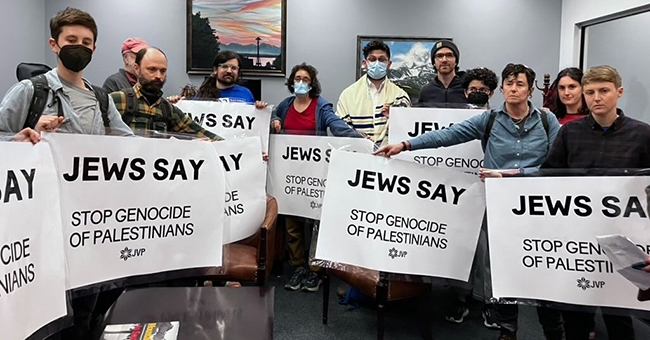
    Last Friday night six of us Jews occupied Sen. Patty Murray’s Seattle office, demanding to meet with her, while 100 other Jews and allies rallied outside the Federal Building. JEWISH VOICE FOR PEACE

    Last Friday night six of us Jews occupied Sen. Patty Murray’s Seattle office, demanding to meet with her, while 100 other Jews and allies rallied outside the Federal Building. JEWISH VOICE FOR PEACE

    This article appeared originally in The Stranger.

    “I have ordered a complete siege on the Gaza Strip. There will be no electricity, no food, no fuel. Everything is closed. We are fighting human animals, and we will act accordingly.”

    Those were the chilling words of Israeli Defense Minister Yoav Gallant in the wake of the murderous Hamas attack on Oct 7 that killed more than 1,400 Israeli civilians and soldiers. Since then, Gallant’s vengeful forces have dropped more than 6,000 bombs in Gaza, essentially an open-air prison for more than 2 million Palestinians. Schools, homes, and medical clinics have been destroyed. More than 2,670 Gazans have been killed, including at least 724 Palestinian children.

    Even while mourning the staggering loss of Jewish lives on Oct 7, many ordinary Israelis are outraged at their government’s call for Palestinian genocide. Israeli retaliation on the people of Gaza “never brings us better lives, it just brings us more and more terror,” said Noy Katsman, whose brother, Hayim—who has a connection to Seattle—was among those killed by Hamas. 

    Jews around the world are outraged, too, at the Israeli state’s ethnic cleansing campaign against the Palestinians. And they are taking action.

    That’s why last Friday night six of us Jews occupied Sen. Patty Murray’s Seattle office, demanding to meet with her, while 100 other Jews and allies rallied outside the building.

    We were there to tell Sen. Murray that our grief over the wanton slaughter of Israelis by Hamas in no way justifies the genocide of Palestinians. We were there to tell the senator to stop funding the Israeli war machine, and instead address the root causes of conflict—the Israeli occupation of Palestinian lands.

    Like the vast majority of politicians in both major political parties, Murray has been a longtime booster of US military aid to Israel, aid which is indispensable to the Israeli state’s subjugation of Palestinians. Like Democrats and Republicans across the political spectrum last week, Murray issued a fulsome statement declaring “unwavering” support for the Israeli state and pledging to support more military aid. That will only escalate and perpetuate the cycle of violence.

    Not surprisingly, Murray refused to meet us or talk with us on the phone. So, as 5 pm approached and the Federal Building officially closed, we told her staff and the federal police officers that we were not leaving, and we sat down.

    A growing number of American Jews have been advocating for Palestinian rights and freedom in recent years. We recognize that our freedom and security—whether here, in Israel/Palestine, or elsewhere around the world—are bound up inextricably with the freedom and security of the Palestinian people. Belatedly but increasingly, more Jewish Americans reject the occupation and the apartheid system that it has spawned.

    For many of us at Friday night’s protest, our motivation was also personal. Noy Katsman’s brother, Hayim Katsman, had been an active member of our Kadima Jewish Community here in Seattle while he was in graduate school at the University of Washington. Hayim was 32 and had dedicated his doctoral dissertation to “all life forms that exist between the Jordan River and the Mediterranean Sea.” Among other roles at Kadima, Hayim served as Hebrew teacher to my younger daughter and her peers as they prepared for their coming-into-adulthood b’nei mitzvah ceremonies.

    The Israeli military’s brutal blockade of Gaza and the ethnic cleansing and bombing now underway won’t bring Hayim back to us, nor will it bring comfort to Hayim’s family. On CNN, Noy pleaded that Hayim’s death not “be used to kill innocent people.”

    Yet that is exactly what is happening right now. The Israeli state’s brutal assault will only redouble the suffering and pain of Palestinians and assure us that there will be more people like Hayim killed in the future—both in Israel and in Gaza and the West Bank.

    That is why we were there Friday night, occupying Murray’s office, even as the federal police threatened to arrest us. We sang the blessing to welcome in the Jewish sabbath and chanted the mourner’s Kaddish to grieve over the Israelis and Palestinians who have been killed. And then, the police arrested us. 

    It’s heartening to see broad and growing worldwide rejection of the Israeli state’s brutality, with protests in dozens of cities worldwide, including New York, London, Amsterdam, Sydney, AustraliaSeattle, and Cape Town, South Africa. Students, faith communities, union members and unions, like my own National Writers Union, and many more groups and communities, are stepping up to oppose Israel’s war on the people of Gaza. 

    Much, much more resistance will be needed. We will need an international anti-war movement, led by working people, to stop the Israeli state’s war machine and the governments that abet it. Jewish people have an especially important role to play in standing with the Palestinian people, because the Israeli and US governments shamefully claim to be defending the security of Jews everywhere. They are not. Jewish people will enjoy true security only when the Palestinian people have full security and freedom themselves. That starts with an immediate cease fire, aid to help Gazans recover, an end to US military aid that supports the Israeli military assault, and the beginning of concrete measures to end the Israeli occupation. 


    About the Author

    Jonathan Rosenblum is a member of Kadima Reconstructionist (Jewish) Community, the author of Beyond $15: Immigrant Workers, Faith Activists, and the Revival of the Labor Movement (Beacon Press, 2017), and a community organizer in the Office of Councilmember Kshama Sawant. He wrote this article in a personal capacity.

  • By Rashid Khalidi

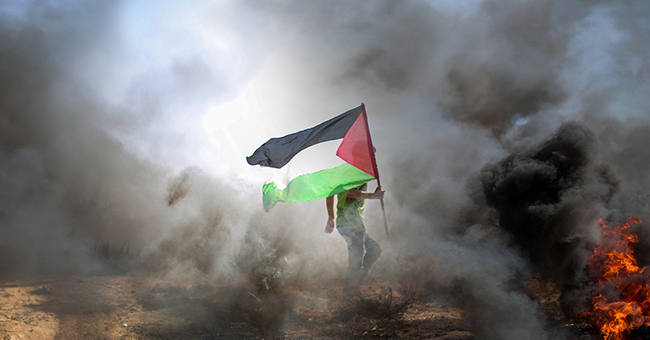
    Man with Palestinian flag

    Photo credit: Hosny Salah

    As the tragedies of the Israel-Gaza crisis unfold, we turn to historian Rashid Khalidi’s The Iron Cage: The Story of the Palestinian Struggle for Statehood to understand the roots of the conflict between the Palestinians and Israelis. It offers a much-needed perspective for anyone concerned about peace in the Middle East.

    ***

    This book examines the failure of the Palestinians to establish an independent state before 1948, the year of Israel’s founding and of the dissolution of Arab Palestine, and the impact of that failure in the years thereafter. Such a topic provokes a sequence of questions that relate to the present as much as to the past: What purpose is served by such a study when, nearly six decades after 1948, an independent Palestinian state—in any real sense of the word “independent”—still does not exist, and when its establishment continues to face formidable obstacles?

    The obstacles to independent Palestinian statehood only appeared to grow as violence escalated in the Gaza Strip and Lebanon during the summer of 2006. As these lines are written, in late July, Lebanon is the scene of hundreds of civilian deaths, enormous destruction, and fierce ground combat. Almost forgotten as a result of the carnage visited on Lebanon by Israel, and of Hizballah’s repeated rocket barrages against northern Israeli cities and towns, has been the suffering in Gaza caused by months of Israeli siege and bombardment. It is also forgotten that all of this started with Palestinian efforts to create a democratic structure of governance while still under Israeli occupation.

    Specifically, this latest escalation began with response by Israel and the United States to the elections for the Legislative Council of the Palestinian Authority (PA) in January 2006, which brought to power a Hamas-led government. Their campaign quickly moved from a crippling financial siege of the PA, with the aim of bringing down that government, to an escalation of Israeli assassinations of Palestinian militants, and to artillery and air attacks in Gaza that killed and wounded scores of civilians. Hamas had for eighteen months observed a cease-fire in the face of these and earlier provocations (other factions were not so restrained, firing rockets into Israel). However, after a major spike in Palestinian civilian deaths and the particularly provocative Israeli assassination of militant leader Jamal Abu Samhadana, whom the PA government had just named to a security post, Hamas finally took the bait and responded with the capture of one Israeli soldier and the killing of others. The predictably ferocious Israeli response—even more killings of civilians, more assassinations, and ground incursions in Gaza—finally provoked Hizballah (or perhaps gave Hizballah and its allies, Iran and Syria, the preemptive opportunity they had been searching for). The rest of this tragic scenario then unfolded with the grim, bloody, unthinking precision we have seen so many times before in the conflict between Israel and the Arabs.

    This book is not about that conflict but about its Palestinian component, specifically the effort of the Palestinians to achieve independence in their homeland. The ongoing war in Gaza and Lebanon illustrates once again how intimately this effort is intertwined with regional and international factors. It illustrates also the crucial importance of a careful reading of recent Palestinian history to attain an understanding of the Middle East conflict. The one-dimensional and ahistorical approach to the conflict through the prism of terrorism that is prevalent in the United States obscures thoroughly the specificity of Palestine, Israel, Lebanon, and other regional actors, like Syria and Iran, and how these relate to one another. The Palestinian quest for independence is only one of many elements that must be grasped in order to understand the causes of conflict in the Middle East. But because for nearly a century this quest has been so central to events there, willfully ignoring it leads to the kind of reductive, partial, and misguided American official thinking that has helped produce the profound problems that afflict the region. This book raises other questions as well: Is a historical study of why something occurred—or in this case did not occur—justified because it sheds light on apparent similarities with events that are currently taking place? Or are these two failures in state building—one in the past and the other ongoing—completely unrelated, and is any attempt to examine them in relation to one another an historical error, not to say an abuse of history?

    It might be asked why I describe this failure to achieve independent statehood as a Palestinian failure. Specifically, why should the focus be on the role of the Palestinians in their past defeats, when they were the weakest of all the parties engaged in the prolonged struggle to determine the fate of Palestine, which culminated in 1948? These parties include the British Empire, until World War II the greatest power of its day, which actively opposed Palestinian aspirations for statehood and independence, and other major states, among them the United States, the Soviet Union, and France, all of which supported Zionism and the partition of Palestine into an Arab and a Jewish state, but did nothing to prevent the abortion of the embryonic Arab state of Palestine in 1947–48. They include as well the Zionist movement, composed of a worldwide network of institutions capable of mobilizing extensive diplomatic, propaganda, and financial resources, and the highly motivated and well-organized yishuv (the pre-state Jewish community in Palestine). Both Britain and the Zionist movement always treated the prospect of an independent Arab state in Palestine as a grave threat. The Zionist movement saw such a prospect as a particular challenge to the Jews’ aspirations to exclusive sovereignty over what they considered Eretz Israel (the land of Israel). Finally, there were the seven newly independent Arab states, all of them relatively weak and heavily influenced by the Western powers; these states acted in ways that frequently excluded the interests of the Palestinians, and sometimes contradicted them.

    To rephrase the question in light of these facts, why concentrate on the failures or incapacities of the Palestinians to achieve independence before 1948, when the constellation of forces arrayed against them was so powerful, and in the end proved overwhelming? Why not focus on the external forces that played a predominant role in preventing the Palestinians from achieving self-determination? Others have countered that the Palestinians, or their leaders, should bear responsibility for their own failures, some going so far as to blame the victim entirely for the tragic history of the Palestinian people in the twentieth century and after. The benefits of blaming the victim, in light of the heavy responsibilities of various other parties in this story, are obvious, explaining the continuing vitality of this school of thought, although most of its core claims have long since been discredited. Others have argued that even if the Palestinians cannot be fully blamed for their own misfortunes, and even if the overwhelming balance of forces ranged against them must be taken into account, they nonetheless are accountable for their actions and decisions. Similar arguments can be heard today regarding Palestinian responsibility for the dire situation faced by the Palestinians after the collapse of the Oslo peace process of 1991–2000, the full reoccupation of the West Bank by Israel in 2001–6, and the election in January 2006 of a Palestinian Authority (PA) government headed by the radical Hamas movement.

    Needless to say, all of these questions will be colored by the recognition that to this day the Palestinians remain considerably less powerful by any measure than the forces that stand in the way of their achieving independent statehood. It seems clear that in the decades since 1948 the Palestinians have been plagued by some of the same problems that afflicted them before that date. It is an open question whether examining past failures might help to prevent future ones, on the theory that there is a link between those structures and forces, internal and external, that operated in the past to hinder Palestinian self-determination, and those at work today. Either way—whether external forces or internal Palestinian weaknesses (or a combination of both) have prevented the establishment of an independent Palestinian state—a final question remains: Is statehood the destined outcome for a people who, since the early part of the twentieth century had a clearly defined national identity but who have been unable to develop lasting, viable structural forms for it, or to control a national territory in which it can be exercised? Is it not possible that the Palestinian people will continue to exist indefinitely into the future, as they have since Ottoman hegemony ended in 1918, in a stateless limbo? Are we perhaps too obsessed with the very idea of the state, demonstrating the bias in favor of the state that Hegel found in historical discourse, in our attempts to place the state at the center of the historical narrative?

    ~~~

    The Palestinians in Their Own Right

    Why is the study of the failure to achieve Palestinian statehood important? It is important, first, because Palestinian history has significance in its own right. It is a hidden history, one that is obscured, at least in the West, by the riveting and tragic narrative of modern Jewish history. Where it is recognized at all, it tends to serve as an appendage or feeble counterpoint to that powerful story. Palestine is a small country—and the Palestinians even today number perhaps only 9 or 10 million people—and yet the people and the land of Palestine loom large in world affairs beyond all consideration of their size. Their drama has been a central one.

    Recognizing, and making restitution for, the harm done, primarily to the Palestinian people but also to others, as a result of that drama involves a major moral challenge to the international community, and particularly to the West, which bears a grave responsibility for helping to engender this conflict. Moreover, it has become clear in recent years that this is an issue that deeply moves major elements of international opinion, even if the bulk of public opinion in the United States appears indifferent to it. However, achieving any serious understanding of this poignant conflict, which has for decades rent the Middle East and has had such a wide-reaching political and moral impact outside it, requires a broad comprehension of Palestinian history in its own terms, and in its own context, which includes but cannot be subsumed by or subordinated to Jewish and Israeli history. Just as one cannot understand the history of France without taking into account its conflicts with Germany and Britain over the past three centuries, it would be unthinkable to reduce French history to these conflicts, or treat it as an addendum to the history of its erstwhile rivals.

    In a sense, this is what has happened to the history of the Palestinians, under the powerful impact of the painful and amply recounted story of the catastrophic fate of the Jews of Europe in the first half of the twentieth century (and of the less well told story of the tragic calamities that befell most of the well-established Jewish communities in the Arab world in the middle of the century). I hope that this book will remedy that situation, in however modest a way, and will explain a crucial set of issues in Palestinian history that have profound implications down to the present day.

    I hope secondly in this book to ascribe agency to the Palestinians. I thereby seek to avoid seeing them either as no more than helpless victims of forces far greater then themselves, or alternatively as driven solely by self-destructive tendencies and uncontrollable dissension, as do many analyses of their actions in the years leading up to 1948. This is not to say that the Palestinians were not facing an uphill struggle from the beginning of the British Mandate: we have already seen briefly how this was the case, and the pages to come will explore these long odds further. And Palestinian society and politics were most definitely divided and faction-ridden, in ways that gave hostile forces many cleavages to exploit. But the Palestinians had many assets, were far from helpless, and often faced a range of choices, some of which were better, or at least less bad, than others. In this way, I propose to put the Palestinians at the center of a critical phase of their own story.

    I hope thirdly to show that the unfortunate case of Palestine illustrates strikingly the long-term perils and pitfalls of great powers following shortsighted policies that are not based on their own professed principles, and are not consonant with international law and legitimacy. This was just as true during the many decades during which Britain dominated the Middle East, as it has been of the more than half a century since then, during which time the United States has been the preeminent power in that region. As we have seen, because of its commitment to Zionism, Great Britain constructed a mandatory regime for Palestine that was in important ways in contravention of the Covenant of the League of Nations and of its World War I pledges of independence to the Arabs. For decades, Britain twisted and turned between these two contradictory poles of respect for the principle of self-determination embodied in the Covenant, and faithfulness to its commitment to create a Jewish national home, embodied in the Balfour Declaration and reiterated in the Mandate for Palestine. There was, however, never any question that the commitment to Zionism was the stronger. In the process, Great Britain enabled the Zionists to create the springboard from which they were ultimately able to take over the entire country at the expense of its indigenous population. It thereby helped significantly to produce a conflict that only became more bitterly intractable as time went on.

    Similarly, the United States voted in the General Assembly for the creation of an Arab state in Palestine alongside a Jewish one, but acquiesced in the extinction of that Arab state before its birth by the combined efforts of the new state of Israel, Britain, Jordan, and other actors. Thereafter, the United States repeatedly sponsored or supported measures in the United Nations or on its own that might have alleviated the conflict. These ranged from General Assembly Resolution 194 of December 1948, which would have allowed the return of Palestinian refugees to their homes and compensated them for their losses, to the efforts of the Palestine Conciliation Commission of 1949, established by the U.N. General Assembly through Security Council Resolution 242, which laid down a basis ultimately agreed to by all the parties for resolution of the conflict, to a variety of essentially unilateral American initiatives toward peace. In all of these cases, however, the United States never unequivocally and in practice supported the self-determination and independent, viable statehood of the Palestinians, and often acted to undermine this and other universal principles of international law and legitimacy. Without these principles, needless to say, a just and lasting resolution of this problem is impossible.

    In making policy on Palestine over most of the past century, leaders in both Britain and the United States were driven primarily by powerful strategic and domestic political considerations, rather than by principle. The strategic considerations included the goals of dominating this crucial piece of territory, keeping it in friendly hands, and denying it to others. The political ones included cold calculations of the considerable domestic electoral and financial advantages to be obtained from supporting Zionism, as against the negligible domestic political costs. There also existed naive sympathy for Zionism among many British and American politicians, based on a particularly Protestant immersion in the Bible. This sympathy was often combined with a laudable desire to make amends for the persecution of the Jews in different parts of Europe (often combined with a less laudable, indeed reprehensible, desire to have the victims of persecution find haven somewhere other than Great Britain or the United States). The result of such attitudes, which necessarily ignored or downplayed vital realities on the ground in Palestine, has been an enduring tragedy.

    Revisiting History

    This is not a “revisionist” history, along the lines of those that have emerged from Israel in recent years. Revisionist history requires as a foil an established, authoritative master narrative that is fundamentally flawed in some way. In this sense, the “revisionist” works written by a number of Israeli historians and social scientists—Avi Shlaim, Ilan Pappé, Tom Segev, Benny Morris, and others—are fully within this tradition, for what they are arguing against is the nationalist mythology of the state of Israel as it has informed and shaped Israeli accounts of that country’s history. That mythology is additionally the backbone of the received version of the history of the conflict as it is perceived in the West.

    To revisit one of the most important of these myths about the infant state of Israel, the number of Arab armies that invaded Israel after its establishment is described in a range of standard accounts as ranging from five to seven. However, there were only seven independent Arab states in 1948 (some hardly independent, and some hardly states in any meaningful sense of the word), two of which, Saudi Arabia and Yemen, did not even have regular armies and no means of getting any armed forces they might have had to Palestine. Beyond this, of the five Arab regular armies, one (that of Lebanon) never crossed the international frontier with Palestine, two (those of Iraq and Transjordan) scrupulously refrained from crossing the frontiers of the Jewish state laid down in the United Nations partition plan as per secret Jordanian understandings with both Britain and the Zionist leadership and thus never “invaded” Israel, and one (that of Syria) made only minor inroads across the new Israeli state’s frontiers. The only serious and long-lasting incursion into the territory of the Jewish state as laid down under the partition plan was that of the Egyptian army. Meanwhile, the fiercest fighting during the 1948 war took place with the Jordanian army during multiple Israeli offensives into areas assigned by the U.N. to the Arab state, or into the U.N.-prescribed corpus separatum around Jerusalem. This story of an invasion by multiple, massive Arab armies, and other legends, is not just an important element of the Israeli myth of origin: it is a nearly universal myth, and in taking it on, the Israeli revisionist scholars, or “new historians,” as they are more often called in their own country, are shouldering a doubly daunting task.

    By contrast, there is no established, authoritative Palestinian master narrative, against which this work can be set, although there is a Palestinian nationalist narrative that includes its share of myth. This version is in any case virtually unknown outside the Arab world (and is in some respects contested within it), drowned out as it is by the Israeli national myth-epic, which substitutes for any kind of substantive, critical history in the minds of most Westerners. Moreover, as the Israeli new historians have been showing, many elements of the standard Palestinian narrative have in fact been borne out by archival research. These include the causes for the flight of the Palestinian refugees; the collusion between Israel and Jordan, and Britain and Jordan, against the Palestinians; and the absolute superiority of the Zionist and later the Israeli armed forces against those of their adversaries in the field throughout most stages of the 1947–49 conflict.

    This is not to say that there are not many myths worth debunking in the Palestinian version of events: there are indeed, particularly ideas relating to the Zionist movement and Israel and their connections with the Western powers, the relation of Zionism to the course of modern Jewish history, particularly the central place of the Holocaust in this history, and the reductionist view of Zionism as no more than a colonial enterprise. This enterprise was and is colonial in terms of its relationship to the indigenous Arab population of Palestine; Palestinians fail to understand, or refuse to recognize, however, that Zionism also served as the national movement of the nascent Israeli polity being constructed at their expense. There is no reason why both positions cannot be true: there are multiple examples of national movements, indeed nations, that were colonial in their origins, not least of them the United States. Deconstructing these ideas will be crucially important to an eventual reconciliation of the two peoples.


    About the Author 

    Rashid Khalidi is the author of 7 books about the Middle East, including Palestinian IdentityBrokers of DeceitResurrecting EmpireThe Iron Cage, and Sowing Crisis. His writing on Middle Eastern history and politics has appeared in the New York TimesBoston GlobeLos Angeles TimesChicago Tribune, and many journals. For his work on the Middle East, Professor Khalidi has received fellowships and grants from the John D. and Catherine T. MacArthur Foundation, the Ford Foundation, the Woodrow Wilson International Center for Scholars, the American Research Center in Egypt, and the Rockefeller Foundation, among others. He is the Edward Said Professor of Modern Arab Studies at Columbia University in New York and editor of the Journal of Palestine Studies.

  • By David Delmar Sentíes

    Coding

    Photo credit: StockSnap

    The way we access good tech jobs in this country is essentially a pay-to-play model: you need to spend a lot of money to make a lot of money. If you don’t have the opportunity to graduate from college, you’re shut out of many of those jobs. And that’s it. There die our hopes for an equitable tech workforce. There’s not a DEI workshop in the world that can change that, and we need to stop pretending that there is. Equity cannot be achieved by coloring inside the lines of a system that is inherently inequitable.

    Tech workers will have to rally around a shared vision, led by Black and Latinx perspectives, of what an equitable workforce would look like. We’ll need to work together to delineate a body of principles. And we need to realize that body of principles by organizing for their adoption throughout the industry.

    Access to jobs is a resource like any other. It’s like gold: valuable precisely because it is exclusionary. There is a class of people who benefit materially from the exclusion of another class of people. This is not an unfortunate byproduct of the model; it is the model.

    Equitable education is only part of the solution. In 2014, I launched Resilient Coders to this end. It’s a highly competitive free and stipended coding bootcamp for people of color. I led that organization for eight years, and we’ve connected hundreds of alumni with jobs paying salaries averaging in the mid-nineties. We’ll do more under the leadership of Ayanna Lott-Pollard. But let’s not mistake the tourniquet for a cure. We, as an entire field, are still in the business of marching against the wind. It's time to shift the direction of the wind.

    My own take boils down to four truths. They are not meant to be comprehensive or monolithic. It’s a framework, not a prescription.


    Wealth and race must cease to be factors in someone’s ability to launch, sustain, and advance a career in tech.

    Let's break that down into three example corollaries.

    We must level out the privilege of time. Some young adults are able to hang out at home, or in their dorm room between classes, rather than work. This affords them the time to self-teach, upskill, and build the side projects that will impress their interviewers. They can also hold out for their dream job and be a little picky rather than taking the first offer they get. For some folx, the need for income is too great to wait.

    Democratize the professional network. Young people from affluent families are more likely to be exposed to lucrative career opportunities, more likely to regard those career paths as accessible to them, more likely to receive the sort of informal mentorship and preparation that will give them a leg up over competitors, and more likely to know someone who knows someone who can connect them with a job. If we want race and wealth to cease being factors in someone's professional success, we must build recruitment efforts that counterbalance the privilege of network.

    No more demanding that candidates have a bachelor’s degree. We can't begin a conversation about equitable employment in tech until training is free to the student. This brings us to our second truth.


    The economically oppressed must have access to top-tier education that is radically free to them, relevant to industry, and conducive to high-paying careers. 

    The cost of tuition is ballooning out of control and creating a massive crisis of student loan debt in America. In the year 2000, we had, collectively, $200 billion in student loans. In 2020, we reached $1.7 trillion, with the average college student graduating with $32,000 of debt. This is wildly out of reach for the average American, who cannot produce $500 in a medical emergency. For the impoverished, this is not even remotely an option.

    It's also not a great filtering tool if you're trying to hire for talent. The wealth and socioeconomic status of a student’s parents are more important than her actual talent when it comes to graduating from college. If she has low test scores but her parents are among the top socioeconomic quartile, she has a 70% chance of graduating from college. If she has top test scores, but her parents are among the lower socioeconomic quartile, her chances of graduating from college are 30%, according to a study by Georgetown University's Center on Education and the Workforce. Talent matters; privilege matters more.

    The onus of paying for training cannot fall on the student. Unfortunately, subsidized education is unlikely to come from the government right now because we have elected to chronically underfund public education. A wave of conservatism swept through White America in the late seventies and early eighties, during which state budgets were slashed and public amenities defunded. State universities, once a model of economic mobility, became unaffordable to most students; particularly to Black people, whose parents and grandparents were not allowed to benefit from the postwar boom. The chasm is still widening today. There’s no reason to suspect or hope that this will end anytime soon, even though economic mobility is good for tax revenue and for business.

    We can't sit around and wait for education to become affordable again; rent's due at the end of the month, and it took Congress a week to elect a Speaker. We'll need to do it ourselves.

    For starters, we need to remove the bachelor’s degree requirement and conduct on-the-job training for all early-career engineers. Companies should be doing this anyway. Allow your new engineers to experiment, fail, learn, and grow. Be clear about expectations, and reasonable about timelines. Make sure they have the resources necessary to continue their journeys and feel like they're in a space in which it's safe to ask questions. Formalize this somehow, such that everyone understands what the expectations are. Too many first-time managers who don't know how to manage are bullying out their “non-traditional” hires by moving the goalposts. This allows them to neatly fire the employee that had been thrust upon them by their executive leadership and make the case that they need to hire someone with a more “traditional” background. This happens all the time.


    Companies have a civic responsibility to the cities that host them and to the people that live there. 

    Companies are importing their workforce from privileged communities, paying them lots of money, and essentially underwriting a skyrocketing cost of living as affluent newcomers pay an expensive game of musical chairs with each other for a diminishing number of available homes. Is there a role for companies to play in neutralizing their own contributions to the gentrification crisis? Can they—and should they—aspire to be “gentrification-neutral” by committing to hiring and training equitably?


    This is not charity. It's justice. 

    Workers need not be treated as requiring “help” or charity, which are dynamics that can lend themselves to inequitable power constructs. What we need is justice. As long as one person’s economic liberation is dependent on another person’s charity, they can never be equals. We need to need each other.

    I’ve written this piece for a specific reason. And such is also the case for my book. I grew tired at Resilient Coders of launching our graduates into the stratosphere just so they could land on the bottom rung of someone else’s ladder. We’ve grown tired of warning hardworking Black and Brown people that they might have to contort themselves into pretzels to fit into someone else’s space, culture, and expectations because the pay is good. There is a strong leftist counterculture within tech that needs to come up off the bench. This is a call to organize around a shared body of principles, based on the lived experiences of people of color in tech, of what equitable employment really means. There’s no cavalry coming. No one will fight for economic justice except for those who choose to do so.


    About the Author 

    David Delmar Sentíes is the founder and former executive director of Resilient Coders, a highly competitive, free, and stipended nonprofit coding bootcamp that trains people of color from low-income backgrounds for high-growth careers as software engineers. Resilient Coders was recognized by the White House in 2016 and has been featured in national media, including NPR and TechCrunch. He is the author of What We Build with Power: The Fight for Economic Justice in Tech.

  • By Christian Coleman

    Roxanne Dunbar-Ortiz and An Indigenous Peoples’ History of the United States

    Author photo: Judy McKie; Grace Image Photography. Cover art: Louis Roe

    So much has happened for Roxanne Dunbar-Ortiz’s An Indigenous Peoples’ History of the United States in the ten years since it was originally published. It won the American Book Award. It made the New York Times Best Sellers list in 2021. Filmmaker Raoul Peck used it as source material for his HBO docuseries Exterminate All the Brutes. The young adult version adapted by Jean Mendoza and Debbie Reese came out in 2019. Since then, the YA adaptation has earned the honor of becoming a banned book in Texas. With the momentum going strong, it was time to put out a new edition celebrating the ten years the book has been centering Indigenous voices and narratives to wig-snatch US foundation myths.

    For this occasion, the tenth-anniversary edition features new material. Raoul Peck himself wrote a foreword, telling us how, with his docuseries, his purpose was “to deconstruct the theological, political, and civilizational discourse the USA has been built on.” Dunbar-Ortiz’s book was necessary to reframe the legacy of European colonialism that trekked across the Atlantic to displace and destroy Native lives in the “New World” in the name of white supremacy. Today, we reject the mythos dressing up white supremacy as “discovery” because, as Peck noticed, her work “provide[s] the meticulous blow-by-blow testimony of this bloodiness, of this thoroughly planned, systematic elimination of the ‘natives,’ this country’s from-the-start open-book agenda for a conquest ‘from sea to shining sea.’”  

    In addition to Peck’s foreword, Dunbar-Ortiz wrote a new introduction. She takes stock of the transition from the Obama to the Trump administration. The despotic Cheeto years, in particular, prompted a nationwide soul-searching—you could call it an identity crisis—to ask how a supposedly post-racial country could ever vote for a former reality TV star/real estate magnate for president. “White nationalism and European/US colonialism are major themes in the book,” Dunbar-Ortiz writes, “but in my talks they had not been raised as much as other aspects until Trump openly expressed and celebrated white supremacy and armed white nationalist militias became normalized.” She has more than 400 years’ worth of receipts to show how a tyrant in chief could happen, to show the United States’ racist settler-colonial foundation for the bloody conquest that it is.

    The tenth-anniversary edition also calls for a tour! It’s already underway and continues through Native American Heritage Month. These are the hubs Dunbar-Ortiz is visiting, many of which are hosting virtual events. 

    Events

    If you aren’t able to attend in person, you can catch her online. She has new insights to share for our post-lockdown timeline and what radically reframing our history with Native American struggle and resistance means today.


    About the Author 

    Christian Coleman is the digital marketing manager at Beacon Press and editor of Beacon Broadside. Before joining Beacon, he worked in writing, copy editing, and marketing positions at Sustainable Silicon Valley and Trikone. He graduated from Boston College and the Clarion Science Fiction & Fantasy Writers’ Workshop. Follow him on Twitter at @coleman_II and on Bluesky at @colemanthe2nd.bsky.social.