• By Christian Coleman

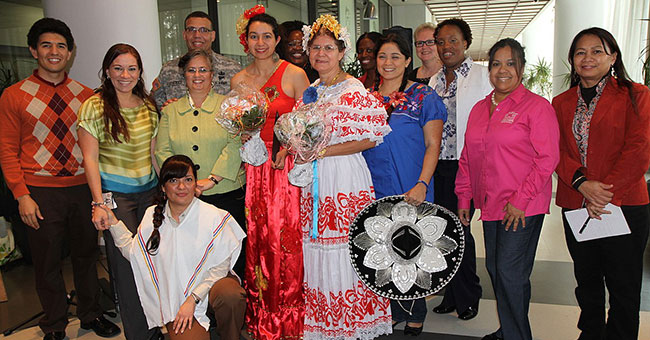
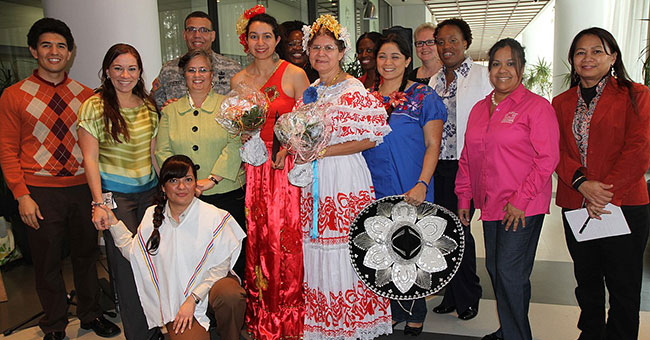
    Europe District’s Special Emphasis Program Committee celebrates Hispanic Heritage Month on October 15, 2013, at the Amelia Earhart Center in Wiesbaden, Germany. Photo credit: US Army Corps of Engineers.

    Europe District’s Special Emphasis Program Committee celebrates Hispanic Heritage Month on October 15, 2013, at the Amelia Earhart Center in Wiesbaden, Germany. Photo credit: US Army Corps of Engineers.

    When Latinx workers across the US came together for International Workers’ Day on May 1, 2006, their strike sent more than one message. As historian Paul Ortiz writes in An African American and Latinx History of the United States, they protested immigration restrictions that threatened their families, their livelihoods, and their dignity. The protested to pass national legislation for a living wage. Shutting down meat packing, garment manufacturing, port transportation, trucking and food services in many parts of the country was an act of resistance to neoliberalism, mass incarceration, militarism, and imperialism. Latinx workers from numerous cultures were all in. That’s the energy when we need again.

    This year’s theme for Hispanic/Latinx Heritage Month is United Communities—right on time to take on the culture wars over immigration, teaching US history as seen from marginalized communities, and more led by the Right. In this spirit, we recommend this handful of titles from our catalog, starting with Paul Ortiz’s.


    An African American and Latinx History of the United States

    An African American and Latinx History of the United States

    “On May 1, 2006, International Workers’ Day, Latinx workers initiated the largest general strike in the history of the Americas. Known as el gran paro Estadounidense, the Great American Strike, this mass action breathed new life into a labor movement that had been in disarray for decades. The general strike impacted every aspect of American life. Approximately 70 to 90 percent of students in Chicago skipped school to show the country what “a day without immigrants” looked like. . . . The strike lent momentum to the immigration rights movement and helped to birth a new effort to pass national legislation for a living wage.”
    —Paul Ortiz


    Boomerang

    Boomerang/Bumerán: Poetry/Poesía

    We spin, then come down in a spiral,
    a high flying twirl, a spiral, a straight line.
    If done justly, the flow lifts both wings,
    understanding, of course, that at least half the time
    we’ll each find a higher velocity
    and then a subtracting tip speed.

    /

    Giramos, luego descendemos en espiral,
    une giro elevade, une hélice, línea recte.
    Si se hace correctamente, le flujo levanta ambes alas,
    entendiendo, por supuesto, que a le menos le mitad de le tiempo
    cada une conseguirá une velocidad más alte
    y luego une velocidad de punta reste.
    —Achy Obejas, from “Boomerang”/de “Bumerán”


    A Cup of Water Under My Bed

    A Cup of Water Under My Bed: A Memoir

    “Our national language is Spanish and there are many kinds. Mostly it is the firecracker Spanish of my Cuban father and his friends. It smacks the air and the back of my head and the inside of my ears. There is also the Spanish of the Puertorriqueño Tía Rosa has married. His words mimic popcorn when it first begins popping. Finally, there is Colombian Spanish. My mother’s language does not crack or bounce. It stays close to the earth, to thick hands and the smooth sides of stones. English has a place here. It is the language of minorities, and you hear it every now and then, mostly from Mighty Mouse on television or the older kids on the block.”
    —Daisy Hernández


    Homeland of My Body

    Homeland of My Body: New and Selected Poems

    You named me big river, drew me—blue,
    thick to divide, to say: spic and Yankee,
    to say: wetback and gringo. You split me
    in two—half of me us, the rest them. But
    I wasn’t meant to drown children, hear
    mothers’ cries, never meant to be your
    geography: a line, a border, or murderer.

    I was meant for all things to meet:
    the mirrored clouds and sun’s tingle,
    birdsongs and the quiet moon, the wind
    and its dust, the rush of mountain rain—
    and us. Blood that runs in you is water
    flowing in me, both life, the truth we
    know we know as one in one another.
    —Richard Blanco, from “Complaint of El Río Grande”


    How Does It Feel to Be Unwanted

    How Does It Feel to Be Unwanted?: Stories of Resistance and Resilience from Mexicans Living in the United States

    “Veterans of the pro-immigrant movement, who are mostly of Mexican and Central American origin, would be wise to follow the example set by the Dreamers, who have learned how to forge alliances with other sectors of society, sharing information and creating joint strategies. As a result, over 70 percent of US citizens now support some form of legalization for these young people. Formulating strategies to educate and enlighten communities who have not traditionally fought for immigrants’ rights, but who have the ability to lobby and exert political influence, could be a good start.”
    —Eileen Truax


    An Incomplete List of Names

    An Incomplete List of Names: Poems

    Nothing in my life was crooked or broken.
    Or potholed. Not haggard or tired. Not poor
    And unfortunate. Nor merely lucky. No one’s
    Father returned from work with callused palms
    Every evening. No one got to where they were
    In life with the help of a new-to-the-area teacher,
    Who stopped at nothing until our dreams came
    To fruition. Please. Our parents paid for those
    University tours. On weekends, we went out
    Like families do. The zoo, science museums.
    —Michael Torres, from “Stop Looking at My Last Name Like That”


    Racial Innocence

    Racial Innocence: Unmasking Latino Anti-Black Bias and the Struggle for Equality

    “The racial bribe is not limited to instances in which Latinos consciously reject identifying with Blackness, but instead more broadly encompasses the overarching Latino exaltation of Whiteness. Yet, efforts to raise the concern in public discourse regarding the Latino proclivity for esteeming Whiteness to the detriment of Afro-descendants is frequently met with heated Latino outrage and denial. When articles were posted to the social media news outlets Huffington Post and Latino Rebels regarding the topic of White Latino privilege, Latino commentators vociferously disclaimed the existence of Latino Whiteness and Latino White privilege.”
    —Tanya Katerí Hernández

     

    Relinquenda

    Relinquenda: Poems

    I sense the shipwreck, my human body
    sloughed off, cast away, sunbleached
    & bonewhite driftwood on a beach
    where my children will gather around
    the wreckage as it singes & cracks,
    into the wind, ashes, everything I returned to,
    clung to, there & there & there,
    painting their faces, their empty hands,
    there, there.
    —Alexandra Lytton Regalado, from “Elegy with Wisdom Teeth” 


    The Vulnerable Observer 25th Anniversary

    The Vulnerable Observer: Anthropology That Breaks Your Heart

    “To write vulnerably is to open a Pandora’s box. Who can say what will come flying out? When I began, nine years ago, to make my emotions part of my ethnography, I had no idea where this work would take me or whether it would be accepted within anthropology and the academy. I began with a sense of urgency, a desire to embed a diary of my life within the accounts of the lives of others that I was being required to produce as an anthropologist. As a student I was taught to maintain the same strict boundary Malinowski had kept between his ethnography and his autobiography. But I’d reached a point where these forms of knowing were no longer so easily separated.”
    —Ruth Behar 
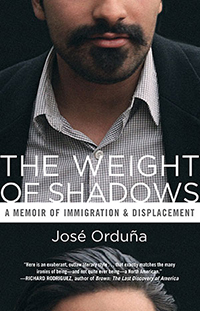
     

    The Weight of Shadows

    The Weight of Shadows: A Memoir of Immigration & Displacement

    “There are forty-­seven of us. I am one of three Mexican nationals. I open my white envelope. Inside is a small US flag made of thin vinyl. There are a few other papers inside that I don’t retrieve. Looking around, others have also pulled out their tiny flags, not knowing what we’re supposed to do with them. The Harmony Hawks begin “God Bless America” in the hammy barbershop style, which I can usually walk away from if ever confronted with it, but here I’m stuck. The singers smile between phrases, and when they’re done they look happily upon the crowd. But any hap­piness directed toward me, toward us, feels contingent on the fact that we’ve jumped through the correct hoops.”
    —José Orduña
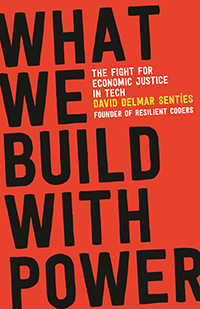
     

    What We Build with Power

    What We Build with Power: The Fight for Economic Justice in Tech

    “There are too few Latinxs in tech. And even among our small subset, most of us who’ve made it into good high-paying jobs tend to be White Latinxs, like me. I’ve been lucky in many ways. Most Latinxs in this country, especially those with African or Indigenous roots, live in a state of economic oppression, which was violently cultivated over centuries for the development of American industry. One of my frustrations with tech was, and remains, the tendency to decouple underrepresentation from a legacy of intentional economic oppression that persists today.”
    —David Delmar Sentíes
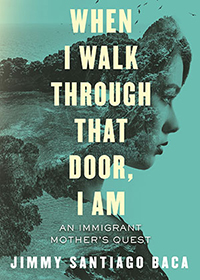
     

    When I Walk Through That Door

    When I Walk Through That Door, I Am: An Immigrant Mother’s Quest

    Tonal came to me last night
    in fragments of a dream:
    our life together once—
    me in the garden planting chili peppers,
    him cutting and nailing boards for the herbs,
    Joaquin jumping on the trampoline—
    illuminated red hot in my dream
    like jagged asteroids
    that flew through space
    in my sleep,
    warm tortillas
    that nourish my heart
    for the journey.
    —Jimmy Santiago Baca
    Europe-District’s-Special-Emphasis-Program-Committee-celebrates-Hispanic-Heritage-Month


    About the Author 

    Christian Coleman is the digital marketing manager at Beacon Press and editor of Beacon Broadside. Before joining Beacon, he worked in writing, copy editing, and marketing positions at Sustainable Silicon Valley and Trikone. He graduated from Boston College and the Clarion Science Fiction & Fantasy Writers’ Workshop. Follow him on Twitter at @coleman_II.
  • A Q&A with Amanda Montei

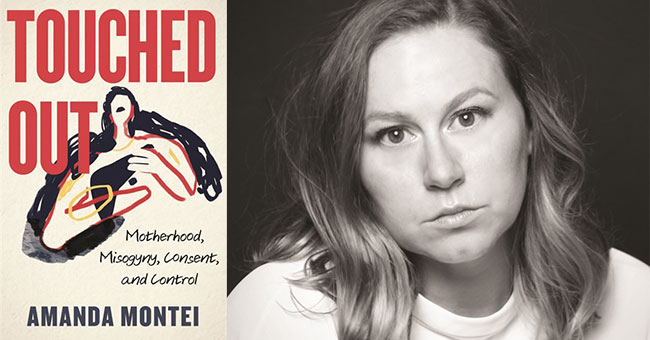
    Touched Out and Amanda Montei

    Cover art: Louis Roe. Author photo: Jon Rutzmoser

    When Amanda Montei became a parent, she struggled with the physicality of caring for children, but even more with the growing lack of autonomy she felt in her personal and professional life. The conditions of modern American parenthood—the lack of paid leave and affordable childcare, the isolation and alienation, the distribution of labor in her home, and the implicit demands of marriage—were not what she had expected. After #MeToo, she began to see a connection between how women were feeling in motherhood and the larger culture of assault in which she had grown up. In Touched Out: Motherhood, Misogyny, Consent, and Control, Montei examines the intersection between misogyny and motherhood, considering how caregivers can take back their bodies and pass on a language of consent to their children. Beacon Press’s associate director of publicity, Caitlin Meyer, caught up with her to chat about it.

    Caitlin Meyer: You’re a mother to two young kids as well as a busy working writer, a writing instructor, and a university lecturer. How hard was it to find the time to complete this book?

    Amanda Montei: It was very hard! I’ll say that in both creative and academic circles, the subject of motherhood is often seen as niche and unserious, and personal struggles with caregiving and domestic work are as well. I’ve experienced some pretty outright sexism over the years, but also so many subtle dismissals of my work and my intellect as a mother writing about motherhood, or even just “women’s issues.” Alongside the very real struggle of securing affordable childcare. 

    CM: Any advice for other mothers struggling to succeed in the creative or academic spaces?

    AM: My advice would be to insist on the importance of making issues of care work and housework visible, putting them in the context of other struggles for autonomy and against systems of power, educating others on how our professional and creative and educational institutions have been built around the erasure of such work, and seeing these issues as collective rather than personal problems.

    Both at home and in professional childcare settings, I also think it’s crucial we demand more men in childcare.

    CM: In the book, you unpack the experience of being a mother in the US today and the impact of growing up in a society that upholds misogyny and rape culture. Can you explain a little bit about the connection you make between the experiences of rape culture and motherhood?

    AM: Some of this connection is quite obvious when we start to think of these subjects together: within both rape culture and the institution of motherhood, women are expected to surrender their own desires, their bodily autonomy, their access to full personhood, to neutralize their voices and identities in service of others, and to endure a certain amount of suffering, as though it were part of the feminine condition.

    When it comes to abating this suffering, we also often place an undue burden on women’s speech and actions. Women are expected to know what they want unfailingly from a very young age to avoid violation and exploitation by men. When women demand better public policy to support parents and families, there’s also this retort on the Right that, “Well, you asked for it,” which is just a continuation of that victim-blaming mentality.

    All this, of course, stems from a broader ideology—the belief that women’s bodies are not only made to reproduce, but to serve male pleasure and power through sex and domestic work.

    CM: As a mom to two young kids myself, I found that reading your book sometimes stopped me in my tracks. It was overwhelming (in the best way!) to be confronted with such a profoundly honest and articulate exploration of how we grow from daughters to young women to mothers, and so often get lost along the way. What have you learned from this experience, and what are you hoping to pass along to your daughter and son?

    AM: I’m so glad you felt that. It’s incredibly hard to grow up trying to fulfill—or thwart—the many conflicting patriarchal expectations placed on girls and women. I grew up with a progressive mother who often looked not how a mother should and told me stories of women in our family who struggled with motherhood or had abortions. This gave me a certain sense of resistance very young. And yet, still I found myself constantly contorting myself into a sexual object and shaping my desires around what men seemed to want from me.

    As I write in the book, I looked to pregnancy and parenthood as a way to reconnect with my body, but of course, as I entered the institution of motherhood, I was flooded with a whole new set of contradictory expectations.

    This book really explores the question of how we refuse the stories that have, for better or worse, become central to the way we see the world and understand ourselves. How do we shake off these systems of power and domination that live within us and all around us, from the way we have sex, to the culture we consume, to how we are asked to care for one another?

    I’ve learned a lot through writing the book about the impossibility of settling on any one answer to that question. It’s much more complex than our current era of wellness and empowerment tends to allow. As far as what I want to pass on to my children—I want them to understand that body autonomy is the path from which all others diverge, and that they have a duty to care for others, just as much as for themselves. Of course, I want so many other things for them, too, but this is one grounding belief I always come back to as a parent.

    CM: What do you think about the recent influx of books that draw back the curtain on the stress and labor of motherhood? Is all this attention finally putting us on the precipice of real change? How do you hope Touched Out adds to the conversation currently unfolding?

    AM: There is such a rich new canon of writing on motherhood. I love it all. As someone trained in narrative and as a critic, I’d like to see even more of these stories to really diversify our understanding of parenting and caregiving and to counter both the idealized depictions of motherhood as martyrdom or pure sentimentality, and even to move us beyond the concept of maternal ambivalence, and those reactionary “hot mess” or “wine mom” or “I hate my children” tropes.

    To me, the most meaningful depictions of parenting, or really any subject, are aesthetic ones, by which I mean those that wrestle with inherited cultural stories and tropes and structures and identities.

    This book is as much a memoir as it is an exploration of feminist theory, and so while I hope that the claims and arguments made in this book make people think more deeply about the issues I explore, I also hope it provides a different kind of narrative about motherhood that others can see themselves in.


    About Amanda Montei 

    Amanda Montei has a PhD in English literature from SUNY at Buffalo and an MFA in Writing from California Institute of the Arts. She is also the author of Two Memoirs (Jaded Ibis). Her essays and criticism have appeared at SlateMother TongueVoxHuffPostElectric LiteratureThe BelieverThe RumpusMs. Magazine blog, American Book Review, and others. She teaches writing and lives in California with her husband and 2 children. Connect with her online at amandamontei.com and follower her on Twitter (@AmandaMontei) and Instagram (@amontei).

  • Ambrosino pic

    Welcome to our rebooted “Beacon Behind the Books” series! In these times when readers are responding to our books “more than ever,” when our authors—including Aubrey Gordon, Tanya Katerí Hernández, Robin D. G. Kelley, Angela Saini, Nora Neus, and Gayl Jones—are appearing in the media, their ideas going viral on social media, their voices being heard on so many platforms, we thought it would be good to take a break to focus on some of the staff who work hard to find, shape, edit, produce, and promote those works. Our blog series introduces to you a staff member and gives you a behind-the-scenes look, department by department, at what goes on at our office. And not only our staff, but our interns, too.

    This month, we introduce you to Salvatore Ambrosino, our digital and social media intern! 

    What drew you to publishing, Salvatore?

    Publishing has been my opportunity to participate in a cause which best puts to use the skills I acquired throughout college.

    What’s a typical day in the life of a digital and social media intern like?

    Platforming these books and making their messages accessible through social media has been my opportunity to help generate meaningful change. I’d imagine anywhere else a day in an office building wouldn’t feel so special—but at Beacon Press, surrounded by the manuscripts of some of the most forceful writers in US history, it’s hard not to feel astonished. I still pinch myself.

    What is one book on our list that has influenced your thinking on a particular issue?

    My brother and I went through high school reading James Baldwin’s Notes of a Native Son, relating it to our own lives. It was through Baldwin that for the first time I felt reached, and so I am grateful that now I may be able to reach others with the words of authors who write courageously.

  • By Mike Rose

    When the light goes on

    Image credit: Louis Roe

    Editor’s note: How do you dig through the discord and fragmentation of school politics and policy to reclaim the mind and heart of education? By remembering and reinforcing the fact that US education is built by and for people, not concepts. In his final work, When the Light Goes On, the late Mike Rose drives this point home with personal stories from people of all ages and backgrounds that illuminate how education added meaning and spark to their lives. By no means exhaustive or prescriptive, the guiding principles in this selection of his book emerge from those stories for the transformative experience of educators and students alike.

    ***

    Educational opportunity depends on more than what happens within the schoolhouse. Employment, housing, food security, healthcare, safe streets—these are the social and economic issues that significantly affect how children do in school. They are the core problems in the community where I grew up, and in the many communities in our country that bear resemblance to South Central Los Angeles. Addressing these problems will require a combination of resources, political will, an engaged public, and a social policy driven by generous beliefs about the purpose of education and about human ability and potential. Such a virtuous combination seems unlikely as I write in mid-2021, but it has occurred at times in our past and occurs now in local settings, typically at a community-based school enmeshed in a network of parents, activists, and social services, constructed of brick and mortar and a faith in the capacity of its students, an existence proof of possibility.

    What to do? As I hope is evident from all we’ve read, there is no simple checklist, no off-the-shelf program to make the light go on. But the stories do lead to some general observations about learning and teaching and the many needs students carry that can make them receptive to education. As well, the stories provide perspective on broader institutional issues and reforms and on key concepts—ability, achievement, potential—that inform institutional life. What we’ve learned doesn’t yield a checklist, but it does suggest for teachers, counselors, parents, and, yes, students themselves values and habits of mind and conditions that contribute to the light going on and enhance our receptivity once it does. Let me offer some principles and questions to guide us.

    Assume intelligence. Assume people think and derive satisfaction from thinking. People do not want to be bored, to stagnate, to feel dead upstairs. Seek intelligence. Where is intelligence displayed in the particulars of people’s lives? And where in all the nooks and crannies of their worlds do the invitations to be intelligent reside: In a school subject? In social interactions? In play? In sports? In the activities of family life? In an interest or hobby, from dance to the study of bugs? In the way people make their way through the day—their skill in living?

    Assume a desire for meaning. Assume that people want to find meaningful pursuits, to lead a meaningful life, to matter. What are the sources of meaning in their worlds, from relationships, to religion, to physical activity, to a school subject or trade? And given people’s characteristics and interests, what are they likely to find meaningful? Follow a hunch about what might appeal to someone, make an educated guess.

    Be alert to barriers to intelligence and meaning. In the school itself, in the curriculum, in its routines and protocols, in the school’s “culture”—its shared beliefs and attitudes. What barriers exist in peer groups, in the home, in people’s location in the social order? What barriers to using one’s mind and finding what matters does someone face because of race or gender or sexuality, because of social class and background, because of appearance or language? None of us can be expert in understanding all these social categories and forces, so we need to consult and confer with others who know the territory, who can guide us toward understanding experience that is not our own.

    Be vigilant for what people can do and precise in what they cannot do. Of special interest here is what people can do in circumstances where they are not doing so well in the central task before them, the main event. The boy scraping by in math who is obsessed with basketball statistics; the girl bored in her English class entering spoken-word competitions; the lackadaisical students who move with easy social grace among their peers. What skill, knowledge, finesse, or instinct do these people have that could be nurtured for itself, but also provide a pathway into school? Be vigilant for what people can do, but also be as keen-eyed and as precise as possible about those things that give them trouble. Pinpointing the difficulties someone has with grammar or mathematics or the use of a tool or execution of a physical movement is the first step to helping them do better.

    Knowledge is emotional and social as well as cognitive. Acquiring and using knowledge (from knowledge of history to knowledge of woodworking) can be vibrant with feeling: discovery, competence, pleasure, excitement. Knowledge can become a means of communication and connection between teachers and students, parents and children. Putting effort into conveying and explaining knowledge can be experienced as a sign of caring. Knowledge brings people together, the social glue of affiliations and friendships. Knowledge has the power to enlighten and the power to connect.

    There are many ways to care. Merriam-Webster defines care as “watchful or protective attention to help and protect,” and philosopher Nel Noddings has elaborated a comprehensive philosophy of care in education that emphasizes understanding and responding to students’ needs in ways that advance their welfare. In common usage, care tends to mean “affection for,” and, to be sure, it is good to have a helping and protective regard for anyone learning something new, in or out of school. But it is also important to remember that there are many manifestations of care: care is demonstrated by the effort one puts into helping others to learn; by the way a question is answered . . . and the question after that; through holding high expectations; through the way a teacher or parent responds when those expectations aren’t met; through response to error, blunders, bad behavior; by the way one handles one’s knowledge and one’s authority.

    Educating the whole child means educating the whole child. We are astoundingly complex creatures. To understand ourselves, we have a tendency, at least in the West, to reduce our complexity: We, for example, think of our brain and therefore our mind as an information-processing computer or as a “meat machine,” definable strictly in terms of its organic components. This is the reductive fallacy. It emerges in our schools with a pendulum-swing urgency to emphasize some aspect of ourselves that we believe we have neglected. Because we tend to separate cognition from emotion, we, at times, emphasize one over the other. But the cognitive and the social-emotional coexist in us in complex interplay. Learning is rich in emotional response, and subject matter can be a powerful vehicle for social connection. Similarly, social interaction and emotional sensitivity typically involve reflection and self-evaluation, which are profoundly cognitive acts. This interplay creates multiple and rich possibilities to find a meaningful connection to school—the emotion of a subject; the idea emerging in a caring exchange.

    Think of your school as a human system. Try this: For an hour, for a day, let buildings, hallways, yards, and landscape recede and foreground the movement, clustering, and gestures of human beings. See the campus as a hive, a ballet, a scrum. What are the patterns of interaction? Where are there opportunities for students to interact with teachers? With other students around a shared activity? Can you enhance and increase them? Do the routines of the school close down or open up the possibility of human contact? Do the normal and prescribed ways students are expected to interact with staff and teachers enable exploration of interests or discovery of new ones?

    Words matter. It doesn’t take much to spark or shut down engagement. An observation, a casual utterance, a quick, scribbled comment on a paper. The words have to be based on actual performance, not hyperbole, not groundless encouragement or fake egalitarianism. A few words have the power to change the way people see themselves, for good or ill. On a broader scale, what we say in school and how we say it matters immensely. We are affirming or disrupting a relationship by our bearing, our tone, the way we carry our authority. Our talk, even in reprimand, has a primary purpose: to help people grow.

    Listen. We’re surrounded by noise, animate and inanimate, by distraction, babble, casual cruelty, enticement. It is uncommon to have someone listen, to have someone try to hear us. “Everyone wants to be seen,” said one of the people I interviewed. And everyone wants to be heard. And it is an especially powerful experience to have someone hear what we can’t bring ourselves to say.

    Be receptive to surprise. We are predictable. We fall into patterns of behavior, routines, ways of being in the world. Others begin to define us by this predictability—and we likewise define ourselves. Change doesn’t come easy. But especially during times of development or new environments—though not only then or there—we see or hear or read something that reaches deep within us, or another human being helps us rethink who we are and what is possible for us, or something we ourselves don’t fully understand opens a portal out of melancholy or boredom or chaos. This change can happen in and through school. Be ready for it and be on the lookout for signs of it.

    No effort at decency is wasted. You might assume intelligence, and do your best to explain your subject, and make yourself available . . . and be met with silence, sullenness, even be rebuffed. Still, your decency registers and might be remembered years, decades later, recalled and valued in someone else’s classroom.


    About the Author 

    Mike Rose was an education scholar and author of 11 books. He was a research professor at the University of California-Los Angeles’ Graduate School of Education and Information Studies. A popular contributor to national media as well as commercial and academic literature, Rose has written approximately 125 opinion pieces, commentaries, and essays.

  • By Christian Coleman

    School chairs

    Photo credit: LaterJay Photography

    It’s back-to-school season, and the US is still upset by its own sense of identity. James Baldwin knew all about it. In his “Talk to Teachers,” he said that if we changed the curriculum in all schools so that Black students learned more about themselves and their real contributions to US culture, we’d not only be liberating Black people; we’d be “liberating white people who know nothing about their own history.” The side-eye for Florida, Texas, and other states is warranted and righteous, because they’re still hell-bent on suppressing Black history or completely whitewashing it. And not just Black history: Indigenous history. Queer history. Histories of other marginalized communities.

    We stand in solidarity with educators risking their careers and their safety to teach truth. Teaching as an act of resistance truly embodies the more beautiful and more terrible chapters of US history in real time. To that end, we join these educators by recommending these titles from our catalog. We can’t keep letting Uncle Jimmy down.

    To liberatory learning!


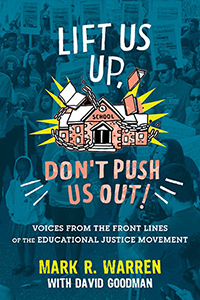
    Lift Us Up Don't Push Us Out

    Lift Us Up, Don’t Push Us Out!: Voices from the Front Lines of the Educational Justice Movement

    “Challenging racism in education requires challenging the entire system of white supremacy. The assaults on public education are part of larger assaults on black and brown communities, including gentrification that pushes people out of their homes and communities, and policing practices and deportation procedures that incarcerate black and brown people.”
    —Mark Warren 


    Mind Over Monsters

    Mind Over Monsters: Supporting Youth Mental Health with Compassionate Challenge

    “There is a common solution to both addressing the youth mental health crisis and remaining true to the educational mission of secondary and higher education—and that solution is creating living and learning environments characterized by both compassion and challenge. Our thought leaders battling about whether students need more challenge or more care have it wrong—our young people need both. This work will not be easy, and it will certainly not be accomplished by scolding students about how much they’ve been coddled or expecting them to be able to face their fears on their own, without support.”
    —Sarah Rose Cavanagh 


    No Study Without Struggle

    No Study Without Struggle: Confronting Settler Colonialism in Higher Education

    “Study and struggle for liberation requires that we unknow many falsehoods that are foundational to settler colonialism: categories of human and nonhuman, land as inert, health as a luxury for a few, the pillaging of the planet and its darker peoples as the ‘natural’ order of things.”
    —Leigh Patel 


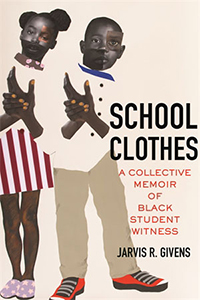
    School Clothes

    School Clothes: A Collective Memoir of Black Student Witness

    “The sartorial metaphor of school clothes is about the stories that cover black students, and how these coverings become resources as black students come to know who they are. Black students’ school clothes were more than attire demarcating some imitative performance of dominant society and its sartorial norms. Black students were covered by dreams, and stories, and promises of a world that had yet to exist, all of which could be taken up as resources in the journey toward building the new world they were searching for.”
    —Jarvis R. Givens 


    The Spirit of Our Work

    The Spirit of Our Work: Black Women Teachers (Re)member

    “In order to face adversity, oppression, and exclusion and remain steadfast in one’s right to exist and be, it is often the spiritual life that has supported and affirmed (and continues to support and affirm) culturally relevant and sustaining practices in educational spaces with Black students and their teachers.”
    —Cynthia B. Dillard 


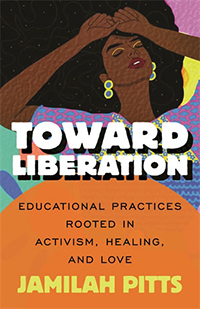
    Toward Liberation

    Toward Liberation: Educational Practices Rooted in Activism, Healing, and Love

    “Anyone dealing with the minds of young people, Baldwin suggests, must be willing to “go for broke.” For Baldwin, educators, particularly teachers, stood—and still stand—on dangerous and vulnerable front lines. The job of a teacher, each day, is to influence, shape, and mold the minds and hearts of students. Students who will become the human beings who affect society, craft policy, and work against (or perpetuate) harmful dominant narratives. Those who will stand against human rights crises and violations and cure diseases. Teachers are not solely in the business of curating learning spaces. Teachers are entrenched in an art form of interrupting, disrupting, encouraging, healing, and liberating.”
    —Jamilah Pitts 


    We Want to Do More Than Survive

    We Want to Do More Than Survive: Abolitionist Teaching and the Pursuit of Educational Freedom

    “Whiteness cannot enter spaces focused on abolitionist teaching. Whiteness is addicted to centering itself, addicted to attention, and making everyone feel guilty for working toward its elimination. Whiteness will never allow true solidarity to take place. Those who cling to their Whiteness cannot participate in abolitionist teaching because they are a distraction, are unproductive, and will undermine freedom at every step, sometimes in the name of social justice. Being an abolitionist means you are ready to lose something, you are ready to let go of your privilege, you are ready to be in solidarity with dark people by recognizing your Whiteness in dark spaces, recognizing how it can take up space if unchecked, using your Whiteness in White spaces to advocate for and with dark people.”
    —Bettina L. Love 


    When the Light Goes On

    When the Light Goes On: The Life-Changing Wonder of Learning in an Age of Metrics, Screens, and Diminished Human Condition

    “There is another kind of knowledge at play here—the knowledge that teachers and other educators gain from observing students and listening to them. Our era is understandably concerned about surveillance and dehumanizing scrutiny, but we need to keep in mind as well the importance of being seen, of being brought into focus—especially in social and institutional settings where not being visible and not being heard results in diminishment. We’re talking about a certain kind of seeing and listening attuned to ability, desire, and environment.”
    —Mike Rose 


    A Worthy Piece of Work

    A Worthy Piece of Work: The Untold Story of Madeline Morgan and the Fight for Black History in Schools

    “Another lesson that emerges from Morgan’s story is the recognition that curricular change is often brought about by what Derrick Bell first articulated as interest convergence. Changes to the curriculum often occur in political and social windows when (largely white) politicians and policy makers feel that their interests and the demands of racial justice advocates align. Superintendent William H. Johnson exemplified this reality when he adopted Morgan’s Supplementary Units, noting that “self-preservation exacts a oneness in motive and in deed.” . . . . Morgan, because of her intimate knowledge of the city and community in which she worked, was able to take hold of this national momentum and use it to bolster her own local efforts. Educators and activists today must recognize and take full advantage of the present convergence of interests to press for similar change because, as we have seen, these moments can be all too brief.”
    —Michael Hines 


    You Can't Fire the Bad Ones

    “You Can’t Fire the Bad Ones!”: And 18 Other Myths About Teachers, Teachers’ Unions, and Public Education

    “Activist teachers insist on the liberty of teaching and the right to think at all, and they show their students by example why it matters and how it’s done. The line between commitment, advocacy, and activism is a wobbly one at best. It’s a contested and explosive space, and it’s surely in play today—activist teachers uphold the right to talk to whomever you please, the right to read and to wonder, the right to pursue an argument into uncharted spaces, the right to challenge the state or the church or any other orthodoxy in the public square. The right to think at all.”
    —William Ayers, Crystal Laura, Rick Ayers 

    School chairs


    About the Author 

    Christian Coleman is the digital marketing manager at Beacon Press and editor of Beacon Broadside. Before joining Beacon, he worked in writing, copy editing, and marketing positions at Sustainable Silicon Valley and Trikone. He graduated from Boston College and the Clarion Science Fiction & Fantasy Writers’ Workshop. Follow him on Twitter at @coleman_II.

  • By Heidi Boghosian

    Child on laptop

    Image credit: N-region

    A new bill designed to strengthen kids’ privacy online might have the opposite effect. The Kids Online Safety Act of 2022 (KOSA) could expose users to heightened surveillance and data collection while also leading to digital content censorship. Increases in surveillance and content cutbacks will affect not just kids but adults as well.
    Introduced by Senators Richard Blumenthal (D-CT) and Marsha Blackburn (R-TN), the intent behind the law is to enhance kids’ data privacy and modernize the 1998 Children’s Online Privacy Protection Rule (COPPA). COPPA was designed to give parents control over the online collection, use, or disclosure of personal data from their children.

    Censorship through Digital Filtering

    KOSA is poised to become a high-octane censorship engine. It turns technology companies and parents into gatekeepers of young users’ online activities to prevent their seeing content the government defines as “not in their best interest.” One problem is that the law gives tech platforms discretion to interpret this overly broad term. They may err on the side of blocking benign information.

    That’s because the law creates a duty of care for platforms to prevent or mitigate certain dangers to teens in their design and operation of products. Platforms face the specter of legal challenges if teens come across content promoting “self-harm, suicide, eating disorders, substance abuse, and other matters that pose a risk to physical and mental health of a minor.”

    Censorship concerns aside, the law isn’t the way to keep kids safe. It could worsen certain tendencies. For instance, after Tumblr and Pinterest banned self-harm blogs, including those promoting anorexia, a study in Perspectives in Public Health found that these banned blogs created a more impenetrable wall between people with eating disorders and health professionals trying to help them. Blocking certain content would prevent teens from accessing information in areas they often wish to explore without their parents’ knowledge. That includes sexual health, gender identity, eating disorders, and substance abuse.

    KOSA would also allow individual state attorneys general to bring actions against platforms if they deem state residents are “threatened or adversely affected by the engagement of any person in a practice that violates this Act.” That provides wide latitude and political motivations to determine what topics might pose a risk to the mental or physical health of a minor. States with high rates of teen pregnancies like Arizona, Mississippi, Texas, Florida, and Arkansas, might consider reproductive rights information as harmful. Tech platforms could restrict access to such vital information, even if most parents—like the 93% reported in 2017—support comprehensive sex education in schools.

    Increased Tracking and Data Collection

    Platforms will face challenges trying to comply with KOSA. One dilemma is choosing to implement age verification systems or to simply block certain content for all users. If a fifteen-year-old user identifies falsely as an adult, the site could be held legally liable. The site is also liable if that same person truthfully identifies themselves. That’s because websites must “reasonably know” a user’s age.

    If platforms institute age-verification systems, all users must submit personal data. User tracking would increase across the board. That would add to an outsized problem of data aggregation, the industry that capitalizes on reselling private data and using it to create targeted advertisements. KOSA requires parental consent when kids create accounts. It requires providers to give parents the ability to toggle privacy settings on any service their child uses. This requires sharing the sites or online services they’re using. That’s a significant privacy violation.

    End-to-end encrypted messaging services like iMessage, Signal, and WhatsApp could potentially fall under KOSA’s definition of covered platforms. To avoid litigation, they may feel pressured to eliminate encryption in trying to interpret their duty to monitor minors' communications. Such a move would significantly undermine privacy for their vast user bases. It would also result in more data gathering from users who sought out channels for privacy.

    KOSA’s requirement that specific types of content be hidden, and to track and log other content using parental tools would force platforms to intensify surveillance on all user activities.

    Enforcing COPPA is a Better Approach

    Children’s rights advocacy groups have had success in pressuring the Federal Trade Commission (FTC) to hold two companies accountable for violations of the existing privacy law, COPPA.

    In 2018, a coalition spearheaded by Fairplay and the Center for Digital Democracy (CDD) alerted the FTC about COPPA by Google and YouTube. This led to a 2019 landmark settlement where the companies were fined a record $170 million. Their infraction was gathering personal data from children without obtaining parental consent.

    In August 2023, both groups again approached the FTC, filing a Request for Investigation. They alleged that Google and YouTube were breaching COPPA, their 2019 settlement agreement, and the FTC Act. Research conducted by Adalytics and Fairplay indicate that Google serves personalized ads on YouTube’s “made for kids” videos and transmits viewer data to data brokers and ad tech firms, while making misleading claims about targeting children, all in violation of COPPA. Joining Fairplay and CDD were Common Sense Media and the Electronic Privacy Information Center. They urged the Commission to investigate and to sanction Google for its violations of children’s privacy, suggesting that the FTC seek penalties up to tens of billions of dollars.

    Continued and consistent enforcement of COPPA offers a better approach than KOSA to protect children and teens from online surveillance. By avoiding increased surveillance and more data aggregation from new age-verification systems, and without the specter of pervasive content censorship, we can ensure a safer and freer online experience for everyone.


    About the Author 

    Heidi Boghosian is an attorney and co-host of Law & Disorder Radio. She is executive director of the A.J. Muste Institute, a charitable foundation supporting activist organizations. She was previously executive director of the National Lawyers Guild. Boghosian has written numerous articles and reports on policing and activism, and is the author of Spying on Democracy: Government Surveillance, Corporate Power, and Public Resistance. and “I Have Nothing to Hide”: And 20 Other Myths About Surveillance and Privacy. Connect with her online at heidiboghosian.com and on Twitter (@HeidiBoghosian).

  • By Charles Euchner

    Leaders of the March on Washington in front of the statue of Abraham Lincoln: (sitting L-R) Whitney Young, Cleveland Robinson, A. Philip Randolph, Martin Luther King Jr., and Roy Wilkins; (standing L-R) Mathew Ahmann, Joachim Prinz, John Lewis, Eugene Carson Blake, Floyd McKissick, and Walter Reuther.

    Leaders of the March on Washington in front of the statue of Abraham Lincoln: (sitting L-R) Whitney Young, Cleveland Robinson, A. Philip Randolph, Martin Luther King Jr., and Roy Wilkins; (standing L-R) Mathew Ahmann, Joachim Prinz, John Lewis, Eugene Carson Blake, Floyd McKissick, and Walter Reuther. Photo credit: Rowland Scherman

    On August 28, the anniversary of the 1963 March on Washington, we celebrate the power of words.

    On this day, Martin Luther King, Jr. delivered his immortal “I Have a Dream” oration before 400,000 souls at the National Mall. Dr. King was joined by countless others whose words should be remembered for the ages.

    Fred Shuttlesworth charged the throng to “walk together, stand together, sing together, moan together, groan together.”

    Roy Wilkins of the NAACP told the assembled to “remember Luke’s account of the warning that was given to us all. ‘No man,’ he writes, ‘having put his hand to the plough, and looking back, is fit for the Kingdom of God.’”

    From prison, James Farmer warned about the dangers of injustice in a nuclear age. John Lewis issued a blistering indictment of gradualism and complacency. Rabbi Joachim Prinz recalled the horrors of the Holocaust. Whitney Young highlighted the ills of inner cities.

    And they sang: Marion Anderson and Mahalia Jackson; Peter, Paul and Mary; and Joan Baez and Bob Dylan. Dylan’s “When the Ship Comes In” prophesied a day when the racists would be punished, and “Only a Pawn in their Game” lamented the exploitation of poor whites in the racist appeals of George Wallace and his ilk. Mahalia’s “I Been ’Buked and I Been Scorned,” a symphony in one voice, set the stage for Dr. King.

    Dr. King’s speech was the culmination of the day.

    His ringing words—about the uncashed promissory note, about creative suffering and redemption, about freedom’s ring, about gathering at a table of brotherhood, about transforming “the jangling discords of our nation into a beautiful symphony,” and, of course, about his dream—resound to this day.

    Why do those words, all these years later, still challenge us, emotionally and intellectually? Three things, I think: the deeds attached to the words, the honesty of the words, and the consistency of the words. In short: authenticity.

    First, deeds. The marchers’ words were connected to real-world experiences. Activists went into the most violent parts of the Deep South to sit in, enlist voters, teach classes, march, and confront their foes. In return, they suffered vicious verbal abuse, beatings, bombings, shootings. They were evicted from homes and fired from jobs. They were brought to court on trumped-up charges. They were slandered and ridiculed.

    In 1963, the Rev. Eugene Carson Blake discovered why his good words required making good trouble. That summer, Blake put himself on the line at the protests at the Gwynn Oaks Amusement Park in Baltimore. Only then did he understand the need to make a sacrifice to foment change. At the March, he confessed: “We come, and late we come, but we come to present ourselves this day, our souls and bodies to be a living sacrifice, holy and acceptable to God . . . a kind of tangible and visible sacrament [that] can manifest to a troubled world.”

    When words are connected to action, they carry extra heft. Because they came from the deepest parts of their minds and souls, those words have the power to move people to action.

    Second, honesty. The marchers never flinched from pointing to the bitter truths of American racism and violence. Uniquely among leaders, Dr. King told his people the plain, unvarnished truth about the struggles that they endured—and which awaited them still.

    “I am not unmindful that some of you have come here out of great trials and tribulations,” Dr. King said. “Some of you have come fresh from narrow jail cells. Some of you have come from areas where your quest for freedom left you battered by the storms of persecution and staggered by the winds of police brutality.”

    Rather than offering easy solutions, like a standard-issue politician, Dr. King told them they needed to suffer more. He exhorted them to “go back to Mississippi, go back to Alabama, go back to South Carolina, go back to Louisiana, go back to the slums and ghettos of or northern cities” to confront the brutal violence of segregation. Some, he acknowledged, would die in the struggle.

    Dr. King also pleaded with his followers to hold fast to the twin ideals of integration and nonviolence. The “young Jacobins,” as Jim Farmer called them, were impatient. Dr. King embraced their impatience but warned that the battle could be won only with disciplined action. Again and again, Dr. King and other speakers confronted their followers with uncomfortable truths, while avoiding the danger of despair.

    Third, consistency. The words of August 28, 1963, were part of a larger discourse about America’s sins and promise. To be sure, every idea expressed at the March was debatable. By acknowledging that, the marchers deepened their understanding—and found ways to express their truths to allies and adversaries alike.

    Civil rights activists contested the meanings of words like race, class, America, democracy, voting, law, education, protest, nonviolence, segregation, and revolution.

    As the afternoon program was about to begin, the March leaders battled over the speech of John Lewis, the new leader of the Student Nonviolent Coordinating Committee. Lewis riled the movement’s old-line establishment with his use of the words “revolution,” his depiction of the South as a “police state,” and his stark equation of America’s failure to offer “one man, one vote” with colonial struggles in Africa and Asia.

    At one point, angered by Lewis’s rhetoric, the Catholic cosponsors of the March threatened to pull out. And so, Lewis bargained with Dr. King and Roy Wilkins and Walter Reuther to find words that would speak their truths while holding together a vast coalition.

    Even the opponents of civil rights understood the need for consistency. The segregationist Strom Thurmond complained that civil rights would eventually extend to marriage rights and women’s rights. On that he was right—and would drive activism to new heights in the coming years.

    Finding the right words to inform, inspire, and move to action is hard work. You never get it “right,” once and for all. But when you struggle with passion and integrity, you make progress possible. Words are essential not just for understanding and expression, but also for learning and changing the world.

    Dr. King’s reverence for words made his life transcendent. Until the very end, he struggled to understand the world and then put his understanding into words and action. He thrust himself into the brutal challenges of injustice and the loving possibilities of redemption and change.

    Six decades later, Dr. King and his fellow activists offer a model for the rest of us—speaking out and acting up—as we struggle with many of the same dark forces.


    About the Author

    Charles Euchner, author of Nobody Turn Me Around: A People’s History of the 1963 March on Washington (Beacon Press, 2010), is the special projects editor at New America. He is writing a book about Woodrow Wilson’s 1919 campaign for the League of Nations.

  • By Naomi McDougall Jones

    Screenplay

    Image credit: Oli Lynch

    This summer, life in plastic on the big screen is fantastic! With Barbie, Greta Gerwig has become the first woman director to have a film earn $1 billion at the box office. It only took until 2023 for this to happen in film history. Let’s see if this leads to a Best Director Oscar nom, because so far, there have only been a grand total of seven women directors nominated. At the time Naomi McDougall Jones wrote the following passage from The Wrong Kind of Women: Inside Our Revolution to Dismantle the Gods of Hollywood, there were five nominated women directors. What hasn’t changed, though, is the trenchant sexism baked into the Hollywood system that bars women from succeeding behind the camera. McDougall Jones has the receipts.

    ***

    Because filmmaking is hard—for anyone, even in the best circumstances—I am well aware that there are still skeptics about whether there is discrimination against women in Hollywood at all. Thus far, I’ve built the case, I hope, for what is happening. But if you work long enough and hard enough at it, you could suggest reasons why discrimination wasn’t at the heart of each anecdote and career story I’ve provided. Let’s zoom out, then, to look at the wide shot of what is happening to women and their careers in Hollywood. Let’s look at the data.

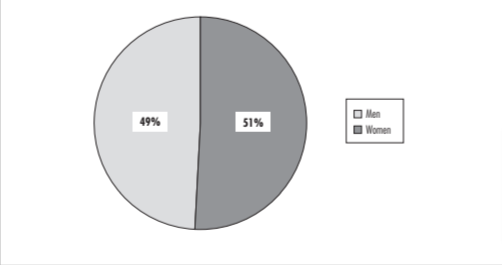
    Women are 51 percent of the US population, as the following chart illustrates.

    Chart 1

    In the following chart is the racial breakdown of the US population, according to the 2017 census.

    Chart 2

    As we look now at the statistics for women behind the camera, I am going to focus primarily on narrative feature films (fictional films, not documentaries) for the reason that they arguably have greater prestige and larger influence over our cultural narrative. Know that, in general, the percentages of women in documentary film are slightly higher than they are in narrative (though still nowhere close to parity), and I would argue that that’s because jobs in documentary filmmaking tend to be less well-paying and prestigious and the films less costly to make.

    I will also often talk about studies that look at “top-grossing” films in a given period. The reason that stratum of films is so often studied is because of the strong correlation between a film’s budget (production and marketing) and the amount it will ultimately gross. Looking at the top-grossing films, then, is an easy way to identify which films have been allocated the greatest amount of resources.

    A study by the University of Southern California’s Annenberg School for Communication and Journalism looked at the top-grossing narrative features from 2007 to 2016. For those 1,000 films, there were 1,114 directors, since some were co-directed by two people.

    Of the 1,114 narrative feature film directors, 1,069 were men and 45 were women, as the following graph indicates.

    Chart 3

    Of those directors, 57 were Black or African American, and 34 were Asian or Asian American. There was 1 Latina director. As the following graph indicates, all the rest—1,022—were white.

    Chart 4

    Of those 92 non-white directors, 7 were female (3 were black, 3 Asian, and 1 Latina). As the following graph shows, the rest were men.

    Chart 5

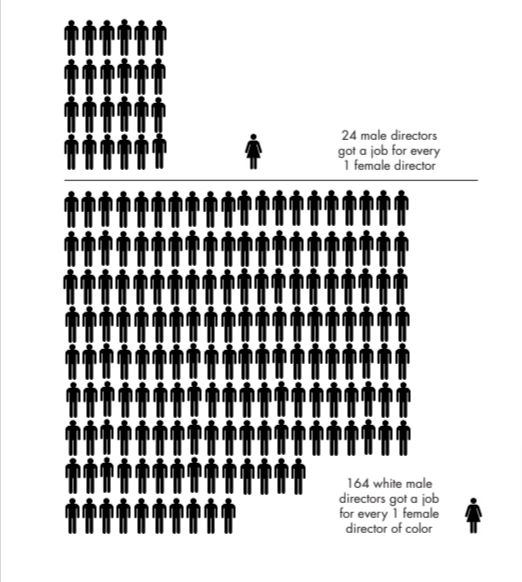
    The following graphs show what that means for the hiring of directors:

    Chart 6

    The following chart compares what proportional representation would look like against what is actually happening behind the camera in Hollywood.

    Chart 7

    What we see is this:

    • White male directors are grossly overrepresented, per their presence in the population.
    • All female directors are grossly underrepresented, per their presence in the population.
    • Asian men are represented almost at parity.
    • Black male directors should have had 14 more directors in their category, but are somewhat approaching parity.
    • Latino males and mixed race and Native populations of both genders are not represented at all.
    • Directors with visible disabilities and trans directors are not represented at all.


    Now let’s look at how the percentage of male versus female directors of studio films has fluctuated throughout the history of US cinema. It is virtually impossible to get accurate information on any of this prior to about 2010, both because it was much harder to track these numbers prior to the internet and because researchers weren’t studying the issue as they are now, but the following chart is the best picture I can piece together:

    Chart 8

    That chart has to represent such an enormously wide gap that it can be hard to read, so here is the percentage of female directors of studio films per decade:

    • 1940: 0.5%
    • 1950: 0.5%
    • 1960: 0.5%
    • 1970: 0.5%
    • 1980: 0.5%
    • 1990: 4%
    • 1995: 8%
    • 2010: 7%
    • 2016: 4%
    • 2017: 8%
    • 2018: 4%

    Ahhh, progress . . .

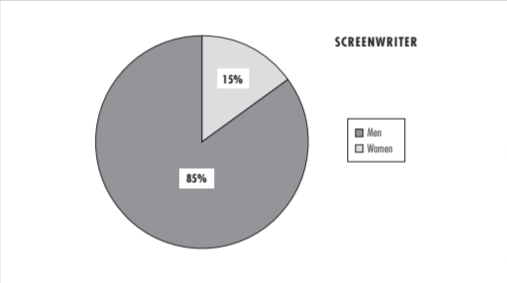
    You may be wondering if it’s better for women elsewhere behind the scenes in film. The following charts show the percentages of women in other key creative roles for the one hundred top-grossing films in 2018:

    Chart 9 Chart 10-12

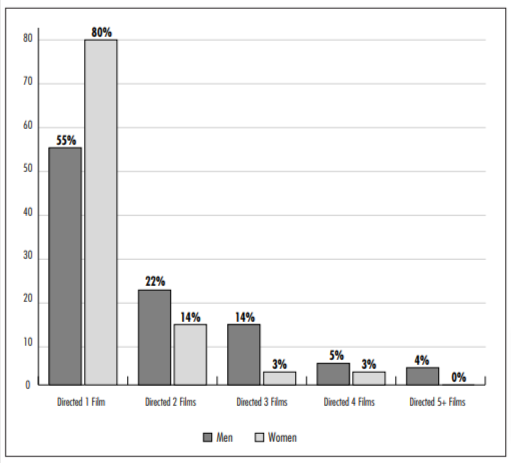
    Data from the one thousand top-grossing films between 2007 and 2016 also reveals that for women who do get to direct any films at all, they make fewer over their careers than their male peers. In fact, as the following chart indicates, the highly elite club of women who got to direct a film during those ten years, 80 percent only got to direct one movie.

    Chart 13

    These discrepancies are also reflected come awards season. Only five women have ever been nominated for a Best Director Award in the ninety years the Oscars have existed.

    • 1976: Lina Wertmüller
    • 1994: Jane Campion
    • 2004: Sofia Coppola
    • 2010: Kathryn Bigelow (the only woman to have actually won the award)
    • 2018: Greta Gerwig

    In addition to noting the paucity of female film directors nominated, it’s important to look more deeply at the commonalities between these lucky few, particularly those shared between the three most recent nominees—Sofia, Kathryn, and Greta—since they represent the contemporary film industry.

    All are white, able-bodied, and, as far as we know, cis and straight.

    The films for which Sofia and Kathryn were nominated center on male protagonists—Bill Murray in Lost in Translation and Jeremy Renner in The Hurt Locker. That Kathryn became the only woman in the history of the Oscars to win Best Director for a war movie with a male protagonist is conspicuous.

    Greta’s Ladybird centered on a female protagonist, though, notably her nomination for this immediately followed the Weinstein scandals and #MeToo, and it is likely that voters in the Academy of Motion Picture Arts and Sciences were more than usually aware of needing to make a good show of supporting female stories.

    But here’s the real kicker. Every one of these three most recent female nominees is either the daughter or the current or former life partner of a man who had previously been nominated for or won an Oscar himself.

    Sofia Coppola is the daughter of director Francis Ford Coppola, who has won five Oscars for his work.

    Kathryn Bigelow was married for two years to director James Cameron prior to winning her Oscar. He has three Oscars.

    Greta Gerwig is the longtime life partner of filmmaker Noah Baumbach, who was nominated for Best Screenplay for his 2006 film The Squid and the Whale.

    Here is what that means in the film industry today: in the last quarter century, if you are a woman, even a devastatingly talented, driven, capable woman, but you are not also white, able-bodied, cis, straight, and publicly connected to a male Oscar nominee/winner (preferably a living icon), and ideally making films about men, it has been literally impossible for you to grasp the brass ring of a film directing career.

    As some witty person on Twitter said after Alejandro G. Iñárritu won his second Best Director Award, for The Revenant, in 2015, “Alejandro has now personally won more Best Director Awards than . . . women.”

    These results are unsurprising given that the academy voters were, as of 2017, 72 percent male and 84 percent white.

    Things are only slightly less dire in the worlds of independent and lower-budget films.

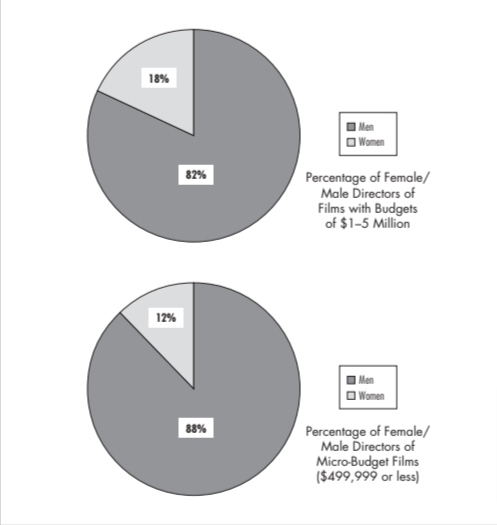
    Bruce Nash of The Numbers, one of the key databases tracking the box-office performance of films, conducted an analysis that looked at the gender of directors for all films released between 2011 and 2016, examining those that received any kind of distribution whatsoever, from the tiniest indie that got thrown up on a streaming platform all the way up to the big studio films.

    Nash’s study revealed the following:

    Chart 14-15

    The percentage of female directors in the independent film industry seems higher only because the percentage of women directing big studio films is so abysmal.

    Chart 16

    No matter if it’s an independent or studio film, the numbers don’t come anywhere close to matching the presence of 51 percent of women in the US population. They also don’t track with the number of women interested in becoming filmmakers, since close to 50 percent of film school graduates are female.

    As Manohla Dargis of the New York Times wrote, Hollywood’s “sexism isn’t in our imaginations. It isn’t a female fantasy or a ‘hysterical feminist myth.’”

    The incredible lack of women in positions behind the camera is, in fact, the result of nearly a century’s worth of illegal hiring discrimination against women, as the American Civil Liberties Union of Southern California concluded in 2015.

    There is a legal argument, with set precedent, used in the US courts called the “Inexorable Zero.” In layman’s terms, this says that if, in any given industry, profession, or educational system, there are zero members of a given demographic population (e.g., women), it can be assumed, ipso facto, that systemic discrimination is occurring.

    The ACLU of Southern California made use of this precedent when it wrote its report after a 2013–2015 investigation into the hiring practices of female directors in Hollywood. They concluded that the Inexorable Zero argument applies to Hollywood’s hiring of directors, since 4 percent of female directors at the studios qualifies as being close to zero.

    Melissa Goodman, the ACLU of Southern California’s director of advocacy and legal director, wrote at the end of the investigation: “Women directors aren’t working on an even playing field and aren’t getting a fair opportunity to succeed. . . . Gender discrimination is illegal. And, really, Hollywood doesn’t get this free pass when it comes to civil rights and gender discrimination.”

    At the end of the investigation, the ACLU recommended that the Equal Employment Opportunity Commission (EEOC) open its own investigation and pursue legal action against the studios for illegal hiring practices. That investigation is ongoing and its present findings are, therefore, confidential.

    As those wheels of government and the law turn slowly, however, we women working (or trying to work) in the film industry must continue flinging ourselves against the virtually impenetrable mechanisms of institutionalized and systemic sexism. Every day we persevere with the full knowledge that women, historically and currently, are systematically, and almost totally, being prevented from becoming directors, writers, producers, cinematographers, and almost any other cinematic job we might like to fill in Hollywood.

    There is rampant discrimination against women trying to work behind the camera in Hollywood, and the result is and has been our near total exclusion from positions of power within the film industry.

    That may be devastating, but it is a fact. It is “inexorable.”

    The far trickier accompanying question is “How is it happening?”

    There is something satisfying about imagining a cabal of white men sitting at the top of the power pile cackling maniacally and whispering to each other, “Let’s not hire any women. It’ll drive them craaazyyy.” And while I have no doubt that in certain corner offices that is precisely what’s happening, if not in so many words, the more complicated reality is that systems of oppression, particularly in the modern era, work in far subtler formats. In writing this book, I wanted to be able to point cleanly to one or three choke points and say, “Here’s where we’re losing the women. Here’s where they’re being kept out.” Then, I imagined, we could address those things and move on with our careers.

    I’m sorry to report that it isn’t that simple.

    As I listened to the stories of women’s careers—as long or short, as successful or middling as they were—over one hundred hours’ worth of interviews, I came to understand that we are losing a war of attrition as much as anything else.

    The power structures—patriarchal, racial, cultural, financial, all of which are at play here—are so very, very powerful and so very, very entrenched. We women are trying to succeed in a system that at a cellular level was not built for us. To transform that system away from promoting the elevation of white men to the exclusion of virtually everyone else would require a concerted, sustained, and radical effort to disrupt long-standing mechanisms. It would require visionary leadership to strongly, with courage and an intolerance for excuses, implement a new way forward.

    Without that, each woman, on an individual career level, must attempt to struggle up a mountain so slick with mud that there is no step made that is completely forward-moving.

    Screenplay


    About the Author 

    Naomi McDougall Jones is an award-winning actress, writer, and producer. Her TED Talk, “What It’s Like to Be a Woman in Hollywood,” ignited a global outpouring of support for the women in film movement. Naomi has written, produced, and acted in two award-winning independent feature films, Imagine I’m Beautiful (2014) and Bite Me (2019), and she is the author of The Wrong Kind of Women: Inside Our Revolution to Dismantle the Gods of Hollywood. Connect with her at naomimcdougalljones.com and on Twitter (@NaomiMcDougallJ).

  • Emily Spaulding at Shakespeare and Co.

    Emily Spaulding at Shakespeare and Co.

    Welcome to our rebooted “Beacon Behind the Books” series! In these times when readers are responding to our books “more than ever,” when our authors—including Aubrey Gordon, Tanya Katerí Hernández, Robin D. G. Kelley, Angela Saini, Nora Neus, and Gayl Jones—are appearing in the media, their ideas going viral on social media, their voices being heard on so many platforms, we thought it would be good to take a break to focus on some of the staff who work hard to find, shape, edit, produce, and promote those works. Our blog series introduces to you a staff member and gives you a behind-the-scenes look, department by department, at what goes on at our office.

    For the month of August, we introduce you to Emily Spaulding, our business operations assistant! 

    What drew you to publishing, Emily? How did you find your way to Beacon?

    In college, someone told me to think about the things I loved when I was younger, because those things would bring the most joy in my career. Books meant everything to me as a kid. Beacon was a great fit because of my political science degree and nonprofit internships in college. Also, I mostly read nonfiction.

    How much of what you learned in college have you found vital to your work?

    I love the connection between my political science major/economics minor and the Beacon list. I went to Wellesley and studied abroad for a year at the London School of Economics. Both schools assigned Beacon books, James Baldwin’s Notes of a Native Son and Karl Polanyi’s The Great Transformation respectively. Just for sheer joy, I took an English class at Wellesley called “American Literature and Social Justice.” That should have been a sign that I belonged at Beacon!

    What’s your advice to someone interested in entering the publishing field?

    Do your research on the different departments within a publishing house. Slush: A Publishing Podcast is a great place to start. And don’t be afraid to work outside editorial! My role is a mix of accounting and production, with plenty of opportunities to work with contracts, rights and permissions, and royalties. If you’re lucky enough to land at a small independent press, you can interface with various departments and learn more about the industry overall.

    What helps you focus when you’re working?

    The Pride and Prejudice (2005) soundtrack.

    What skills have you taken from previous jobs to help you do your work at Beacon?

    Prior to Beacon, I was a corporate paralegal and learned how to confidently read contracts. Now, I review our author contracts for special terms and maintain our rights and permissions database. In corporate law, I also learned how to manage up. In other words, ask what still needs to be done at 3PM so you can avoid getting an assignment at 8PM. Fortunately, at Beacon, we respect each other’s working hours!

    Favorite thing about Boston?

    It feels like home! People who live in Boston are so smart and genuinely care about their community. I also love weekend trips around New England and going to author talks in my “Camberville”—Cambridge and Somerville—neighborhood.

    Hobbies outside of work?

    Reading, cooking, baking, spin class, kayaking, hosting parties.

    Favorite albums?

    Joni Mitchell’s Blue, Lorde’s Solar Power, and Taylor Swift’s Evermore.

    In an alternate universe, what career would you have?

    In an alternate universe, I am a fictional character: Kathleen Kelly, the bookseller from Nora Ephron’s You’ve Got Mail.

    Name three things at your workstation that you can’t live without.

    Water, caffeine, and my cat.


    And a little more about Emily Spaulding

    Emily Spaulding received a BA in political science with a minor in economics from Wellesley College in 2021. She has previously worked as a Barnes & Noble bookseller and as a corporate paralegal at an international law firm. As a student, Emily interned at nonprofits including Girls Inc., Social Accountability International, and the Legal Services Center of Harvard Law School.

  • By Christian Coleman

    Bookworm Barbie

    Image credit: Erika Wittlieb

    Come on, Barbie! Let’s go party . . . in your library! You’re about to become Bookworm Barbie and read the days and nights away. Don’t worry about Ken. He’ll be fine because he’s just Ken. Now that you’re in your self-discovery era, you’ll have lots of questions. Like why you’re in a blockbuster summer movie and how the film industry works. We got you. And everything you want to know about empowerment for women and girls, beauty (and health) standards, life in plastic in the real world, the patriarchy, and all the badassery in women’s history is in these books from our catalog. Each sold separately!  


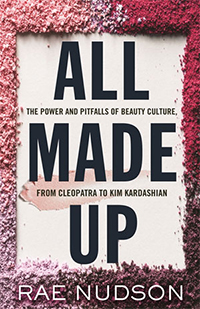
    All Made Up

    All Made Up: The Power and Pitfalls of Beauty Culture, from Cleopatra to Kim Kardashian

    To talk about makeup is to talk about power: who has it, who wants it, and who is trying to keep it . . . Trying to understand people’s use of makeup throughout history and the influence it has had on culture and social structures is a way to reflect on people’s humanity. People of all genders wear makeup because they are getting something out of it, and the benefit is worth the time, effort, and money they spend. Learning about why people wear makeup sheds light on how people live and how the world is constructed.
    —Rae Nudson 


    American Plastic

    American Plastic: Boob Jobs, Credit Cards, and Our Quest for Perfection

    World War II left a longing for large breasts in its wake, a longing that fed a growing practice in breast augmentation. Why Americans suddenly became obsessed with large breasts is an interesting question . . . Surely 1950s anxiety over producing a “normal” girl, which increasingly fed into young girls’ desires for large breasts, shaped this obsession with “the sweater girl.” The year 1959 proved to be a watershed year for cosmetic surgery, since that was when Barbie was introduced to the American toy market and an entire generation of young girls grew up worshiping a form impossible to achieve without surgical intervention.
    —Laurie Essig 


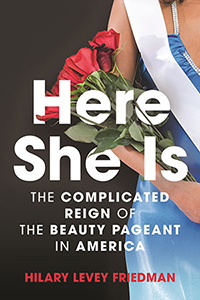
    Here She Is

    Here She Is: The Complicated Reign of the Beauty Pageant in America

    Fittingly the Barbie doll was born at the end of the 1950s, and it was seen by many as the symbol of female oppression. With her unrealistic figure she has endured many of the complaints about women’s body image issues. Barbie-like physical expectations found real world expression in events like debutante balls, sorority rush, prom preparation, cheerleading tryouts, and stewardess application restrictions. None of these events are pageants, but they are undoubtedly pageant adjacent, as women are evaluated and selected for activities based in large part on how they look. In most of these realms, the primary goal for women was matrimony, but women also wanted to be seen, and heard, in public.
    —Hilary Levey Friedman 


    The Patriarchs

    The Patriarchs: The Origins of Inequality

    If patriarchal ways of organizing society happen to look eerily similar at opposite ends of the globe now, this isn’t because societies magically (or biologically) landed on them at the same time, or because women everywhere rolled over and accepted subordination. It’s because power is inventive. Gendered oppression was cooked up and refined not only within societies; it was also deliberately exported to others for centuries, through proselytism and colonialism.
    —Angela Saini 


    The Seven Necessary Sins for Women and Girls

    The Seven Necessary Sins for Women and Girls

    If we are to save girls, wherever they live in the world, if we are to nurture the pilot light of anger that guides them to their true north, feminism must be as universal and commonplace as patriarchy. But it must be a feminism that terrifies patriarchy, a feminism fueled by rage as foundational to its strength. Anger is that bridge that carries feminism from idea to being, from the thought “How the fuck is this happening?” to “This must fucking stop.”
    —Mona Eltahawy 


    What We Don't Talk About When We Talk About Fat

    What We Don’t Talk About When We Talk About Fat

    Thinness takes so much from fat people too . . . It takes away our ability to describe our own bodies, replacing our own descriptions with something thin people can understand—something that makes them feel comfortable, less threatened, and less privileged. And when it takes away our descriptions of our own bodies, it also takes away our ability to describe our own experiences and know that they’ll be heard on their own terms. It takes away quiet, everyday activities too: eating, working out, buying groceries, and shopping for clothes all become seen as unspoken invitations to comment on our bodies, our practices, the weight loss in which we must be in hot pursuit.
    —Aubrey Gordon 


    Women and Other Monsters

    Women and Other Monsters: Building a New Mythology

    I’ve had a long-standing interest in female heroes, the women who have broken through gendered notions of who is allowed to embody valor and strength, and I was beginning to suspect that monsters, perhaps ironically, could offer a whole new approach to heroism for people (like me) who are often tripped up by feminine ideals. The qualities we hail as heroic in Western culture—courage and fortitude, selflessness and nobility, steadiness of mind and will—are not unique to men. Arguably, they’re not even characteristic. But in the male-dominated myth, folklore, and literature that defines our culture, they’ve been annexed as “masculine” traits. We’re still struggling to create or consume stories about valorous women, unless they also display the “feminine” virtues: passive sex appeal and fragility that requires rescue. In a hero, these are flaws.
    —Jess Zimmerman 


    Women Warriors

    Women Warriors: An Unexpected History

    In the case of women warriors, the tendency to erase women’s roles in history is complicated by the contested question of whether women should fight. Many people who cheer for the highly sexualized women warriors of popular culture are less comfortable when confronted with real-life images of camouflage-wearing women with shaved heads at boot camp or Ranger School. In fact, that contrast gets at the heart of much of the long-standing, cross-cultural social discomfort with women warriors—the fear that women who chose to fight will lose their femininity or, conversely, that their presence will “feminize” the army, thereby rendering it less effective, less aggressive, less serious, or just less.
    —Pamela D. Toler 


    The Wrong Kind of Women

    The Wrong Kind of Women: Inside Our Revolution to Dismantle the Gods of Hollywood

    In spite of the mountains of data demonstrating that films by and about women (and other non-white, non-cis, non-straight, non-able-bodied men) make more money, Hollywood persists in primarily telling stories about white men. In the few instances when the story is about somebody else, the stories are still being told by cis, straight, able-bodied, white men. Despite their continued near-total stranglehold on content creation, however, some men say they are feeling extremely oppressed just at present.
    —Naomi McDougall Jones 

    Bookworm Barbie


    About the Author 

    Christian Coleman is the digital marketing manager at Beacon Press and editor of Beacon Broadside. Before joining Beacon, he worked in writing, copy editing, and marketing positions at Sustainable Silicon Valley and Trikone. He graduated from Boston College and the Clarion Science Fiction & Fantasy Writers’ Workshop. Follow him on Twitter at @coleman_II.