• Cracked USA flag

    Image credit: Mediamodifier

    More sparks will be flying this Fourth of July, and not just the sparklers and fireworks variety. Since the orange-dusted despot took office for a second term, we have born witness to the dysfunction of the democracy machine in accelerated mode. Project 2025’s authoritarian agenda is the monkey wrench thrown in the works, causing said sparks. Given the circumstances and bearing in mind the US’s histories, does it make sense to give credence to the Fourth of July at all? And as we protest against the wannabe king, who and what is this holiday for? Some of our authors have a few words to say about it.
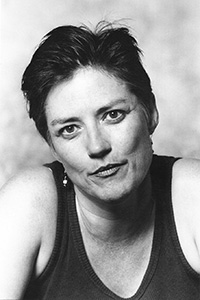
     

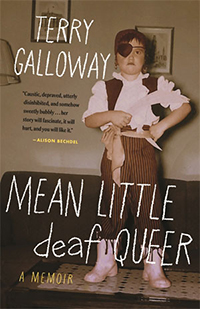
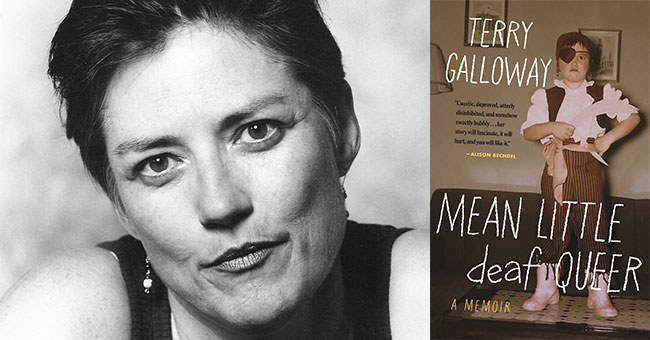
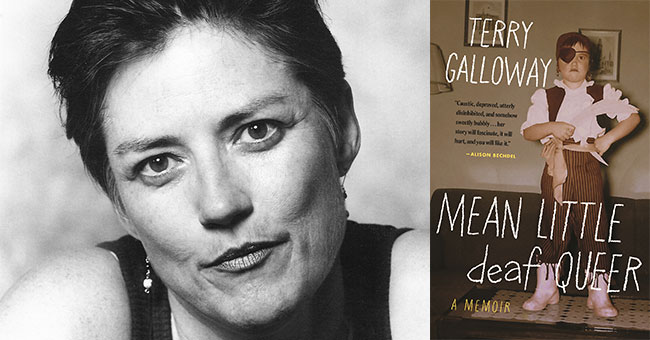
    Terry Galloway

    My Excessive Americanism

    What I love most about our national excessiveness on the Fourth of July—Parades on every street! Pinwhirling fireworks! Snapping displays of flags!—is that it reminds me of my own excessive desire to live.

    As a deaf woman in a society obsessed with physical perfection, I fight the assumption that my imperfect body not only isn’t useful but it’s ugly; and a body which is neither useful nor beautiful has no intrinsic value. So why don’t I just kill myself?

    As a childless, queer woman in a straight society that seems dedicated to procreation and the superiority of men, I fight the assumption that I am an inferior being, queered out of my biological value. So why not just kill myself?

    As an artist who struggles to find passion in life and translate that passion into performance, I fight the assumption that art should be a product like any other; and if I can’t create something easy, pleasurable, and fit for mass consumption, why not just kill myself?

    Now that I’m aging, I fight the assumption that my body can no longer muster up the energy to generate money in the marketplace. Therefore, I have no worth. I’m just taking up space, using up valuable resources. So why not just kill myself?

    So, you see, I’m fighting for my life when I fight the assumptions that have determined so much of my life from birth—that a deaf, unbeautiful, queered, female infant is not now and was never worth the baby talk it would take to keep her alive. So why should she persist in her “excessive” struggle to live?

    But that excessiveness is the most American thing about me: the determination that I SHOULD matter, that I WILL matter, that I WAS created equal. Fourth of July with its glittering displays honoring our Yankee Doodle rag-tag, less-than-equal beginnings serves as my reminder that if any entity of power should try to shut me down, put me in my place, take away the rights I know are mine, I can depend on my own inner excessiveness to stand up to them, call them out, shout them down, kick the bastard bullies out.
    —Terry Galloway, Mean Little deaf Queer: A Memoir 

     

    Antero Garcia

    In our recently released book, The Cost of Being Undocumented: One Woman’s Reckoning with America’s Inhumane Math, my coauthor, Alix Dick, recounts how loud sounds might trigger her anxiety:

    “By the time I was a teenager, I was like most of my neighbors: I had normalized my near-constant anxiety. I would jump at loud noises from the TV, at a car engine roaring down the street, at the clatter of pans in the kitchen.”

    Alix even connects the loud pops that filled her childhood skies to firework—for many, something that is part of a patriotic tradition during this time of year: “I’ve heard more shootings than I’ve seen fireworks. I’ve had to flatten myself on the floor of my Sunday school classroom as a debt was settled on the street outside.”

    Throughout this section of our book, Alix describes the normality of cartel-related violence in her hometown in Sinaloa, Mexico. It is precisely this kind of violence and its threat to Alix’s family that lead to her immigrating to the United States more than a decade ago. Now, ironically, this same fear is ever more present in the US right now.

    As I watch masked federal officers kidnap people of all ages and backgrounds on the streets right now—including the elderly, mothers, young children, and individuals who are US citizens—I cannot help but wonder: When it comes to US patriotism and the Fourth of July, what exactly are we celebrating in 2025?

    While fireworks displays are to celebrate moments of independence for a fledgling nation, we are seeing the cycles of nativism, colonialism, and white supremacy violently reshape the neighborhoods where work and live in California.

    As the sky fills with the sulfur-tinged smoke of patriotic bombast this July Fourth, do not turn away from the humanitarian crisis unfolding in every state of this nation right now. This is not a celebratory moment for many of us—all Americans—living in this country today.
    —Antero García, The Cost of Being Undocumented: One Woman’s Reckoning with America’s Inhumane Math 
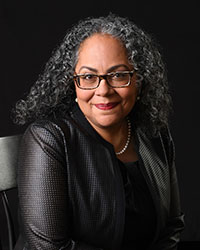
     

    Tanya Kateri Hernandez

    As an AfroLatina person of color born a US citizen, I have always had a complicated relationship with each July Fourth Independence Day celebration. The complication arises from wanting to celebrate the promise of our Declaration of Independence, assurance that “all [men] are created equal,” while living in a nation riddled with inequality. I am surely not alone in feeling this ambivalence, for as early as 1852, Frederick Douglass expressed the same dualism.

    What, to the American slave, is your 4th of July? I answer: a day that reveals to him, more than all other days in the year, the gross injustice and cruelty to which he is the constant victim. . . . Allow me to say, in conclusion . . . I do not despair of this country. There are forces in operation, which must inevitably, work the downfall of slavery. (Source: Oration, Delivered in Corinthian Hall, Rochester, by Frederick Douglass, July 5th, 1852 (Rochester: Lee, Mann & Co., 1852)).

    Douglass’s hope for the abolition of slavery did come true. And so as I watch the work of the many committed so social justice, I too continue to hope in the potential for our pursuit of equality imbued in the Declaration’s conclusion.

    “And for the support of this Declaration, with a firm reliance on the protection of divine Providence, we mutually pledge to each other our Lives, our Fortunes and our sacred Honor.”
    —Tanya Katerí Hernández, Racial Innocence: Unmasking Latino Anti-Black Bias and the Struggle for Equality 

     

    Laura A. Jacobs

    “As someone trans and genderqueer, I find it difficult to celebrate a nation actively working to force me and those in my community back into the closets, the showers, or worse.”
    —Laura A. Jacobs, LCSW-R, “You’re in the Wrong Bathroom!”: And 20 Other Myths and Misconceptions About Transgender and Gender Nonconforming People
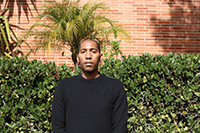
     

    Kyle T. Mays

    The Fourth of July is a fascinating holiday. In my family, it was a day to eat bbq hot dogs and hamburgers, run around the neighborhood with friends and family, and end the night with some fireworks. Never, and I mean never, did we even consider it a holiday celebrating Amerikkka.

    As an adult and now professor, I can’t stand this holiday. It’s basura. It represents Indigenous genocide and African enslavement masquerading as the promise of American ideals. It represents the colonial and racial fault lines that have shaped the contours of American democracy. At the same time, it represents the possibility of Black and Indigenous (and all oppressed peoples!) freedoms, because it is through our collective oppression where we can begin to imagine and put into practice the type of freedom we want, the freedom we desire. But kinship on the land is the way forward.
    —Kyle T. Mays, An Afro-Indigenous History of the United States 

     

    Kay Whitlock

    When I was a young kid growing up in a working-class (white) family in southern Colorado, the Fourth of July meant that my folks both had the day off; that neighbors would be out on their porches and yards; that we kids would take boxes of Diamond Kitchen Matches out to the sidewalk where we’d light up small black lumps of some chemical or other that would transform into long, curling strings of ash called “snakes” and wait for dark when moms supervised the waving of sparklers. The “real” fireworks—pinwheels nailed to trees, cone-shaped “fountains” that produced sparks, bottle rockets—would be set off by the dads. Our house always had an American flag flying from it, so the flying of flags on that day was nothing special.

    When I was in college, supporting civil rights and the labor organizing rights of farmworkers and protesting the American war in Vietnam, I began to view the American flag, and the Fourth of July, as celebrations of US imperialism and oppression. My father told me I was a traitor to the United States and should be shot. He wasn’t kidding. I wasn’t either. Independence, liberty, and freedom? Yeah, right. For a few. Not for most people in the US or around the world. I saw promises of equality and justice as worse than empty shells; as rhetoric and lies meant to promote racism and violence.

    Today, I dread the Fourth of July. It’s horrific for animals who are terrified by the cannon-like sounds and sights of fireworks and it’s a huge fire hazard in a time of global warming. Today, at the age of seventy-six, I am: still fighting for social and economic justice; still protesting US militarism and imperialism; still fighting the structural violence of policing and all forms of carceral brutality. Yet, I also found myself exhilarated by the waves of American flags carried by hundreds of thousands of people of good will participating in the “No Kings (since 1776)” marches and events on June 14, 2025. Not because the US doesn’t still stand for domination and imperialism; not because we’re not in a perilous, autocratic moment in which political violence wildly escalates. But because there is something good, I believe, in refusing to let the tyrants claim and define all of the nation’s symbols. And today, with all sorts of creative organizing underway to help people survive, I find reason to hope that the nation-state itself may one day—regrettably not in my lifetime—evolve into new community and civic formations in which celebrations of freedom, of justice, of peace finally—FINALLY!—mean something real. For everyone.
    —Kay Whitlock, Considering Hate: Violence, Goodness, and Justice in American Culture and Politics and Queer (In)Justice: The Criminalization of LGBT People in the United States 

    Cracked USA flag

  • By Kavita Das

    Sunset with Statue of Liberty_Sandeep Maurya

    Photo credit: Sandeep Maurya

    (In Homage to Frederick Douglass’s “The Meaning of July Fourth for the Negro”) 

    On July 5, 1852, brilliant orator, fierce abolitionist, and former slave Frederick Douglass gave an impassioned speech entitled “The Meaning of July Fourth for the Negro.” In his speech, Douglass interrogated and excoriated the hypocrisy of Americans to celebrate the seventy-sixth year of their independence while denying the independence and basic humanity of Black Americans through the continuation of American slavery.

    “I do not hesitate to declare,” Douglass stated, “with all my soul, that the character and conduct of the nation, never looked blacker to me than on this 4th of July! Whether we turn to the declarations of the past, or to the professions of the present, the conduct of the nation seems equally hideous and revolting. America is false to the past, false to the present, and solemnly binds herself to be false to the future.”

    Douglass goes on to ask his now famous indicting rhetorical question: “What, to the American slave, is the 4th of July?” and he offers a response to his own question, saying, “I answer: a day that reveals to him, more than all other days in the year, the gross injustice and cruelty to which he is the constant victim.”

    One hundred and seventy-three years later, the truth of Douglass’s indictment rings true yet again.

    Although “slavery-the great sin and shame of America” was abolished and civil rights were fought for and hard-won through the courage, determination, and sacrifice of Black Americans and their allies, in just the past six months since Donald Trump took office for the second time, so many civil and human rights have been eroded with the rollback of Diversity, Equity, and Inclusion (DEI) programs and policies across every sector.

    But probably the most “hideous and revolting” conduct by our current leadership has been around their inhumane and violent raids, detention, and deportation of immigrants at their workplaces and in their communities. We have seen footage of swarms of armed, masked men violently restraining individuals and families, forcing them into unmarked cars, and disappearing them to shadowy detention centers, where they languish or are deported without due process.

    This is happening everywhere despite our shock and outrage, and while community and mutual aid organizations have risen up to offer sanctuary and protection to immigrant communities, the very institutions that are supposed to protect the most vulnerable amongst us—churches, the courts, law enforcement—have been largely silent, or worse, complicit.

    Douglass noted how the American church establishment, rather than fighting against the moral depravity of slavery, had been complicit: “But the church of this country is not only indifferent to the wrongs of the slave, it actually takes sides with the oppressors . . . Many of its most eloquent Divines, who stand as the very lights of the church, have shamelessly given the sanction of religion and the Bible to the whole slave system.” Similarly, today, immigrants are being arrested on church grounds, and yet we do not hear the vociferous outcry against the cruel and immoral treatment of immigrants by the leaders of American religious establishments. This is particularly ironic given that Mary, Joseph, and baby Jesus were themselves migrants in search of sanctuary.

    Whereas the court of law is meant to be the bastion of ethics and due process, immigrants are being arrested and detained when showing up to their mandated appointments in immigration court. Recently, even Democratic mayoral candidate Brad Lander was violently subdued and detained while accompanying an immigrant to his mandated court appointment. And just days ago, the Supreme Court, the highest court in the land, ruled that the federal administration can continue deporting immigrants to proxy detention centers run by countries where they’ve never been.

    For his part, Douglass railed against morally bankrupt judges and a court system that upheld slavery, declaring, “Let it be thundered around the world that in tyrant-killing, king-hating, people-loving, democratic, Christian America the seats of justice are filled with judges who hold their offices under an open and palpable bribe, and are bound, in deciding the case of a man’s liberty, to hear only his accusers!”

    Despite his impassioned plea to his audience in Rochester, New York, that the inhumane and morally depraved system of slavery be struck down, Frederick Douglass ended his talk “with hope,” saying, “I do not despair of this country. There are forces in operation which must inevitably work the downfall of slavery.”

    Having witnessed our country’s lack of a true racial justice reckoning over the last several years, I’m deeply saddened but not shocked by how this white supremacist regime has gone about dismantling the building blocks of civil rights and civil society. But just as Douglass managed to find glimmers of hope and maintain faith in the “forces” at work, in this alarming moment, as we mark July Fourth, I’m finding hope in the fact that Zohran Mamdani, a young immigrant and Democratic Socialist has been able to pushback against the Democratic party establishment and corporate-controlled media machine, and win the Democratic mayoral primary in my hometown of New York City by inspiring a broad, diverse, multi-generational base of New Yorkers who support his vision for a more equitable and affordable city. Beyond this, Mamdani has provoked a crucial national conversation about the role of immigrants as not just laborers of this country but also as leaders.

    Ultimately, despite the harsh rhetoric and cruel policies of this current administration, I draw faith from Douglass’s own courage to speak truth to power at great peril to himself. I’m inspired by his unwavering conviction in the inevitability of progress given our evolution into an open society in an interconnected world, with immigration as a cornerstone to our democracy and immigrants as indelible to our country’s history, present, and future. “No nation can now shut itself up from the surrounding world and trot round in the same old path of its fathers without interference. The time was when such could be done. Long established customs of hurtful character could formerly fence themselves in, and do their evil work with social impunity. Knowledge was then confined and enjoyed by the privileged few, and the multitude walked on in mental darkness. But a change has now come over the affairs of mankind. Walled cities and empires have become unfashionable . . . Thoughts expressed on one side of the Atlantic are distinctly heard on the other.”


    About the Author 

    Kavita Das has taught nonfiction writing at the New School and Catapult and has written about social issues for ten years. Previously, she worked in the social change sector for fifteen years, addressing issues ranging from community and housing inequities to public health disparities and racial injustice. Das is also the author of Poignant Song: The Life and Music of Lakshmi Shankar and Craft and Conscience: How to Write About Social Issues. Connect with her online at kavitadas.com.

  • By Carlos Cueva Caro

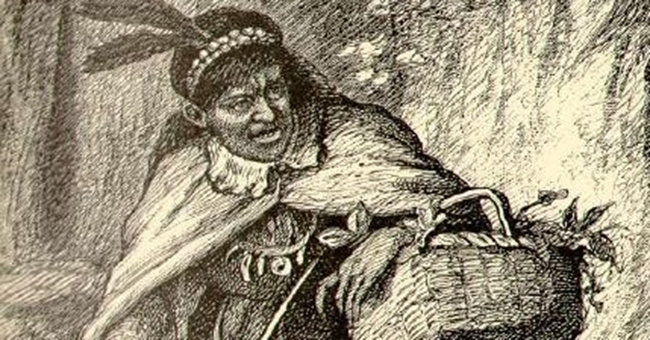
    Stereotypical illustration of Tituba by John W. Ehninger, 1902

    Stereotypical illustration of Tituba by John W. Ehninger, 1902

    One of my main interests throughout my four years as a history major was colonial history. As I researched different narratives of colonial America, it became evident that these stories tended to focus on the white male settlers as the protagonists, erasing other groups of people and stripping them of their agency. Hence, my interest turned to the stories left out, like those of the early inhabitants expelled by the European colonists and those forcibly brought here as slaves. This interest led me to take two classes on the history of Indigenous people of the Americas and the history of African Americans, respectively. Initially, I approached both subjects as separate categories of history. Yet, while studying the history of Native Americans, I couldn’t help but connect them with my knowledge of the history of African Americans. When looking at both groups’ struggles against the European colonial project, I could find commonalities between their experiences. Yet, it wasn’t until I read Kyle T. Mays’s An Afro-Indigenous History of the United States as an assignment for my class in Native American history that I could move beyond that exercise in comparison and start conceptualizing them under the larger category of Indigeneity. When talking about the Afro-Indigenous, Mays refers to individuals of mixed-race heritage who have to navigate their dual identities, and to both groups’ interconnected histories, shaped by the white colonialist project that formed this country.

    As a Salem resident and due to my aforementioned interest in colonial history, the Salem Witch Trials of 1692 was a topic of history that I felt compelled to tackle. By coincidence, I took a class on the Salem Witch Trials the same semester I read Mays’s book. While looking through documents and narratives about the Trials, I began looking at the records through the lens of the colonialist experience. The Salem Witch Trials have been used to examine themes like patriarchy, religious fundamentalism, and authoritarianism, but there is also a colonial component to the Trials. The beginning of the New England colonies was characterized by the doctrine of discovery, the belief that the Indigenous inhabitants’ perceived “savagery” justified European seizure of their lands. This belief led to an effort to eradicate the inhabitants of the region, be it through cultural and religious conversion, warfare, or enslavement. Native Americans, as a response to European aggression, retaliated through diplomatic and military means that led to a series of colonial Indian Wars. While the Native Americans saw the Europeans as invaders, the colonists’ belief in their right to the land made them see themselves as the injured party. The attacks against the civilian population left both sides deeply traumatized. For the deeply religious Puritan Salemites, the Indians represented an existential threat, agents of the devil sent to destroy their Christian utopia. It’s no coincidence, then, that when the first accusations in Salem Village were thrown out, one of the first people accused was Tituba, an enslaved Indian woman.

    The events in Salem Village that led to the witch hunt are well-known. A group of girls, including the Reverend Samuel Paris’s daughter and niece, experienced several seizures and strange behavior medicine couldn’t explain. When witchcraft was brought to the table, the girls first accused three outcast women: Sarah Good and Sarah Osbourne, both women of dubious moral character; and Tituba, Samuel Parris’s slave. While Good and Osbourne proclaimed their innocence, Tituba not only confessed but also implicated the other two women and wove a narrative about a conspiracy of witches that served as the basis of the witch hunt. Tituba’s role was so crucial that it’s almost impossible to erase from any narrative about Salem. Yet most narratives focus on the white settlers of Salem as the “protagonists,” relegating Tituba to a plot device rather than a character. White settlers’ self-indigenization, their view of themselves as the original inhabitants of America, turned Tituba into a foreigner. In later retellings, she was responsible for teaching the girls her exotic magic, which led to the girls’ afflictions, effectively becoming the indirect source of the witch hunt.

    Most academics today agree that Tituba was an Indigenous woman, based on court records that explicitly identified her as Indian. Yet the records also refer to Tituba as practicing “hoodoo,” implicitly acknowledging the encounter of Indigenous American and African cultures in the Caribbean. Though her specific ethnicity is hard to define, academics theorize, based on mentions of an enslaved Indian girl of a similar name, that Tituba was probably Arawak, kidnapped from the Spanish Main (today Venezuela) and taken to Barbados, where records show she was purchased by Samuel Parris, who took her to New England. By the end of the eighteenth century, Tituba was identified as a mixed-race woman. By the nineteenth century, she was understood as a Black woman, both erasing the realities of Indian enslavement and applying Black Caribbean stereotypes to Tituba. One of the main sources about the trials for many people, Arthur Miller’s The Crucible, cemented in popular culture Tituba’s identity as a Black woman.

    Maryse Condé’s I, Tituba, Black Witch of Salem, a fictionalized story of Tituba, transforms her into a mulatto woman, born in Barbados from an Ashanti mother and her white kidnapper. Yet Condé uses Tituba’s race to celebrate Caribbean identity as Black and Indigenous. Condé, an Afro-Caribbean author, understands her Caribbean identity as a mixture of Indigenous-American and African cultures, a product of the encounter of two continents forced together through the trauma of white colonialism, regardless of what specific race may have been imposed upon them by the white colonial establishment. Although the fictional Tituba’s history differs at several points from the historical record, the essence of her tale aligns with the real Tituba’s journey. Both the fictional and historical Tituba were Indigenous women forcibly removed from their homeland. It’s a story of an Indigenous immigrant forced out of her homeland by colonialist enterprises, forced into a position of outsider, trying to survive a hostile environment that rejects her despite forcing her to stay. Both women fought to retain contact with their roots while assimilating to the new realities of a strange land. When explaining Native American and African relations, Mays argues in favor of conceptualizing African Americans as also Indigenous. He argues that Africans brought to America as slaves fought to retain their links with their homelands despite colonialist efforts to erase their African identity. Under that definition, Condé’s Tituba becomes the story of an Indigenous woman. A central part of Tituba’s arc is her efforts to return to her homeland, Barbados, literally or metaphorically through her culture and religion.

    Most information about the historical Tituba comes from her deposition during the Trials. Although at first glance her deposition can be read as Tituba repeating the words forced upon her by her enslavers to fit a narrative of witchcraft, a closer reading offers hints of Tituba’s own agency during this ordeal. When explaining how she performed magic, she pulls from Afro-Indigenous religion and traditions regarding spirits rather than European traditions on witchcraft. When confessing, she made a point of playing into colonial expectations of her lack of agency, by showing herself as a victim of threats and trickery by the white witches, hence avoiding being accused of being the main corrupter in Salem (like later representations claim her to be). More importantly, rather than implicating just herself and the other two accused women, Tituba wove a narrative of a large conspiracy that subtly implicated high-ranking men of Massachusetts’s colonial society, going as far as to describe the devil with similar characteristics to her enslaver, Samuel Parris. As Mays explains, part of the Indigenous experience is their imposition of race by the white establishment and the struggle and negotiation of non-whites to retain their roots, connection to their homeland, and ensure their survival. In other words, Indigenous people like Tituba have to balance both playing with and defying white colonial narratives to ensure their survival.

    Yet, as Mays pointed out, nobody is immune to colonialist narratives. In I, Tituba, the only mention Tituba (and by extension Condé) makes of Native North Americans is when she calls them “wild barbarians who were set on scalping any head that came too close” (53). This statement goes unquestioned, something shocking since Condé’s Tituba constantly questions the Puritans’ stances on slavery, gender roles, and race relations. Condé’s Tituba internalized white settlers’ narratives about North American Indians in the same way many American Indians and Africans have internalized white colonial narratives about each other and themselves, consciously and subconsciously playing the white supremacist game with hopes of attaining advantageous results.

    Tituba was an outsider because of the color of her skin and because she was Indigenous. In 1692, New England was in the middle of an Indian war of resistance against the colonial enterprise. For the Puritans, the devil was “tawny.” For white settlers, both in 1692 and today, Indigeneity, understood as non-whites’ resistance to submit to European culture, was a threat. Many of the founding fathers were slave owners and they ensured to enshrine slavery in the Constitution. At the same time, Alexander Hamilton wrote that Indians were Americans’ “natural enemies.” In the nineteenth century, the American government pursued policies of eradication of Indigeneity through extermination and forced assimilation, continuing the old colonial narrative of demonizing Native Americans. At the same time, narratives about slavery and witchcraft became closely associated with Black people. Tituba’s presence in Salem as an enslaved Indian woman who practiced witchcraft became hard to explain. Yet Tituba was far too important to erase from the narrative; so instead, white authors and historians erased the Indian, turning her into a Black slave. In doing so, the “Indian problem” became the “Black problem” related to slavery and the role African Americans should play in white society.

    Although we aren’t entirely sure of Tituba’s race (she could have very well been mixed race), we can agree that it was colonial imposition, set in paper by the magistrates of Salem and then reshaped and transformed by later authors under the social construct of race. But her whole story, regardless of whether she was Native American or African, is that of an Indigenous woman experiencing a white colonial establishment. Giving Tituba a larger role in the Witch Trials’ narrative means discussing Salem within the larger context of colonialist ideology. Salem, then, becomes not only a story about religious intolerance or patriarchy, but also a story of white oppression over Indigenous people, understood, as Mays argues, as both Native American and African. In her foreword to the English translation of Condé’s book, Angela Y. Davis states that Salem is not Davis’s story until Tituba takes an active role in it. Davis also states that her race, either as Black or Indian, is irrelevant because her story is a reminder that “the doors of our suppressed cultural histories are still ajar” (Condé, xi). Tituba’s story is the story of an Indigenous (or Afro-Indigenous) woman’s encounter with colonialism and white supremacy. 


    Bibliography:

    Breslaw, Elaine G. Tituba, Reluctant Witch of Salem: Devilish Indians and Puritan Fantasies. New York: New York University Press, 1996.

    Condé, Maryse. I Tituba, Black Witch of Salem. Translated by Richard Philcox. New York: Ballantine Book, 1986.

    Hansen, Chadwick. “The metamorphosis of Tituba, or why American intellectuals can’t tell an Indian witch from a Negro.” The New England Quarterly Vol. 47, No. 1 (1974): 3-12.

    Lopez Oro, Paul Joseph. “A Love Letter to Indigenous Blackness.” NACLA-Report on the Americas 53, No. 3 (2021): 248-254.

    Mandell, Daniel R. Tribe, Race, History: Native Americans in Southern New England, 1780-1880. Baltimore: The John Hopkins University Press, 2011.

    Mays, Kyle T. An Afro-Indigenous History of the United States. Boston: Beacon Press, 2021.

    Pinnock, Winsome. “Reclaiming Tituba: The Real Story Behind Arthur Miller’s Character.” The Yale Review. December 6, 2022.


    About the Author 

    Carlos Cueva Caro is a public historian from Salem, Massachusetts. He graduated from Salem State University with a BA in history and is currently enrolled in the Cooperstown Graduate Program of Museum Studies. He interned for Historic Salem, Inc., Historic New England, and The Welcome Immigrant Center as an undergraduate. His honors thesis, “We’ve Come to Stay:” The Historic Preservation Movement and the Struggle for Place in New England,” is the culmination of his combined interest in colonial history, preservation, and the immigrant experience in the USA.  

  • By Marcos Gonsalez

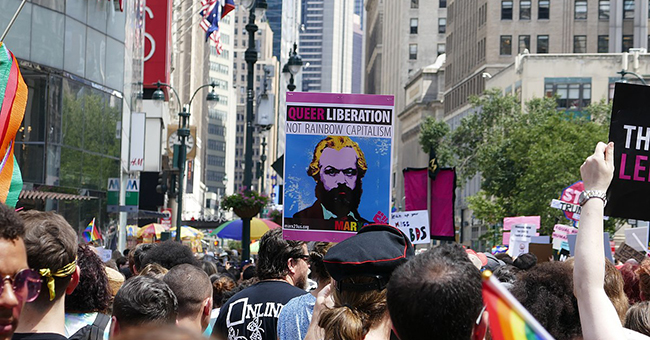
    Queer Liberation March 2019

    Queer Liberation, Not Rainbow Capitalism at the Queer Liberation March in New York City, 30 June 2019. Photo credit: FULBERT

    Editor’s note: Essayist and scholar Marcos Gonsalez found his greatest source of joy when he encountered queer theory in college. As he puts it, “queers and college go together like peanut butter and jelly,” and for him, this was especially true. Seeing himself reflected in the work José Esteban Muñoz was life-changing: Muñoz’s theory of disidentification empowered Gonsalez to reclaim his Latinx and queer identities—and inspired him to push back against the largely-white monolith of queer theory. In this selection from In Theory, Darling: Searching for José Esteban Muñoz and the Queer Imagination, Gonsalez looks back at Muñoz’s enduring influence on him and why corporate-sponsored Pride marches fall short of queer liberation. 

    ***

    Chanting, cackling, shouting, and frolicking up Manhattan’s Sixth Avenue, flaunting our booty shorts and glittered skin, we marched. It was June 2019, and thousands of us queers were having a grand old gay time at the first Queer Liberation March. The march was held the same day as the yearly Pride parade, in protest against that corporatized, sanitized bigger event. At the Liberation March were anti-capitalists, gender deviants, anarchists, kink-positive folks, Marxists, and all other stripes of queer radicals. This was the parade for me.

    People brought all kinds of posters to the march. Short, sweet signs with punchy messaging. Verbose signs that required extensive parsing. Signs that lambasted various local, national, and international political figures for their homophobia, transphobia, racism, classism, and sexism, rightfully so. There were many posters of Sylvia Rivera and Marsha P. Johnson, giving them recognition so well-deserved. Karl Marx made cameos among the signs, as did Michel Foucault—the marchers had Photoshopped the faces of these two thinkers into their own unique designs and messages. The posters were a sea—too many to take in, to be honest. Yet, out of the corner of my eye, I spotted him, deified, his head enshrouded in a globe of light, bobbing up and down, his papery two-dimensionality held up in the air by an unseen marcher. I couldn’t believe it! Here was Muñoz on Sixth Avenue, a queer icon among other icons. The marcher had used the photo of the turtlenecked Muñoz, staring seriously ahead, a wall of books behind him. Middle-aged Muñoz, Muñoz the seasoned theorist. I nudged my friend next to me, alerting him of this appearance. My friend—not an academic, not one to read the latest theory churned out by a university press—replied, “Oh cool. But who is he?”

    ~~~

    A year after that first Queer Liberation March, and a mere few months after the onset of the COVID-19 pandemic, Muñoz’s final monograph, The Sense of Brown, was posthumously published. I had first encountered excerpts of Muñoz’s unfinished project—originally titled Feeling Brown—in 2014, during my first semester of doctoral study. We were assigned two Muñoz articles that he’d written as part of this larger project on Latino identity: “Feeling Brown: Ethnicity and Affect in Ricardo Bracho’s The Sweetest Hangover (and Other STDs)” (2000) and “Feeling Brown, Feeling Down: Latina Affect, the Performativity of Race, and the Depressive Position” (2006). The 2000 article was later included in the posthumous publication, while the later one was not. In the articles, Muñoz formulates Latino affect as “off,” a failing of sorts in relation to affective US whiteness that constructs itself as minimal, underwhelming, and unmarked, “revolv[ing] around an understanding of the Latina/o as affective excess.” For Muñoz, the myriad social differences and complexities within Latinidad might be more generatively accounted for through the articulation of a racialized brownness, a “feeling like a problem, in commonality,” that enables a better sense of common struggle against hegemonic forces. Brownness, Muñoz suggests, conceptualized as a diversity of affective and performative utterances deriving from Latinonesss, is a potential unifier of Latino people.

    ~~~

    The Sense of Brown poignantly demonstrates how it is not just the responsibility of the performance or the performer to instantiate what Muñoz calls otherwiseness—“the production and performance of knowledge that does not conform to the mimetic coordinates assigned to both the designations ‘wise’ and ‘other.’” It is also the audience member and the analyst who must co-collaborate brownness into existence through their interpretations. However, this amorphousness of brownness raises questions as to who exactly constitutes and deploys its critical possibilities.

    Muñoz emphasizes, and repeatedly reminds us, that brownness is not reducible to Latino identity, and that Latino identity doesn’t automatically align with brownness. Latino, he asserts, is not a steady identity that coheres along lines of race, nationality, or language. Rather, it is, citing Norma Alarcón, an “identity-in-difference,” or how a group’s social difference from the dominant culture is precisely what gives it collective power. Muñoz, following W. E. B. Du Bois’s 1903 query in The Souls of Black Folk, “How does it feel to be a problem?,” postulates that the category of Latino and the possibility for Latinidades is better understood as a problem. We must not sidestep or alleviate the condition of being a problem, but rather dwell in and amplify it. He explains how “brownness is coexistent, affiliates, and intermeshes with Blackness, Asianness, Indigenousness, and other terms that manifest descriptive force to render the particularities of various modes of striving in the world.”

    ~~~

    In 2020, I received an early review copy of The Sense of Brown from Duke University Press. I read it while quarantined in my cramped apartment, no vaccine yet. Outside, my fellow New Yorkers were dying en masse. Ambulance sirens rang out at all hours of the day. I double-masked everywhere I went, fearful, bleaching down grocery bags because we weren’t yet sure if the virus could spread through surfaces. Death was everywhere, in the air itself. And so I read The Sense of Brown unable to stop thinking of death. Mine, potentially my friends’ and families’, Muñoz’s. This posthumous book was quite literally defined by death in all ways imaginable.

    After my review published, I was struck by how many people on social media—academics and lay readers alike—were reading the book, or were planning to. It was on most-anticipated reading lists with other trade nonfiction titles. In hopes of landing a wider audience, the book was being identified as an essay collection, not a scholarly monograph. I thought back to the poster of Muñoz at the Queer Liberation March, how he’d been there next to Foucault, Rivera, Johnson, Marx, and all those other queer icons. People were reading him, idolizing him. His words and ideas were circulating. He was roaming the world in ways that indicated, as he himself had once put it, “we cannot anticipate what comes next. The project of theorizing the queer social text is, by its very nature, unfinished.” He was no longer my unique obsession.

    Had Muñoz . . . made it?

    ~~~

    I have only been to the New York City Pride march twice. Once in 2011, when I first arrived in the city as an overeager eighteen-year-old queer, then again as a college senior in 2014. The first time felt like more than enough to get it out of my system, but I went the second time to confirm that I was really over it. I was. I was over the out-of-towners acting rude. The army of cops. The sanitized orderliness of the marching. The many, many corporations there to salute our queerness, to twirl and prance with us in their branded rainbow shirts and lanyards, while behind closed doors they funded anti-LGBTQ politicians and policies. They wanted our dollars but couldn’t care less about how the world treats us. These corporations want us to feel represented while shaking our ass on one of their sponsored floats, or while passing by their rainbow-decaled storefronts in June, but when things get tough, when we actually need them to show up for us, they don’t. Rainbow capitalism at its finest.

    The next Pride march I attended was in 2017, in Mexico City. Queers of all ages and types thronged the streets. There was more mayhem, fewer cops, less corporateness. More my style. Still, I realized yet again, all that distance from New York, that Pride marches aren’t for me. Maybe the biggest failing of Pride marches in the twenty-first century is the lack of protest in them. They feel defanged—no bark, no bite. They have no room for concentrated rage at the anti-queer state, no righteous critique of capitalism’s ilk. The only acceptable affect is uncritical, unradical bliss. But queers don’t get liberated by being nice.

    In 2015, trans Latina organizer, activist, and overall badass Jennicet Gutiérrez heckled Barack Obama at a Pride reception event at the White House. Obama was pontificating about his continued hope that LGBTQ people would attain full civil rights. It was a speech that now—on the heels of Trump’s presidency, in which he fanned the flames of white supremacy, anti-queerness, and transphobia, revealing all the hatred stewing in the US population and bulldozing the facade of neoliberal feel-goodism that Obama had built a career on—appears cynical and fraught. Gutiérrez shouted for Obama to end all detentions and deportations of LGBTQ immigrants. Obama responded, “You’re in my house,” to overwhelming applause. What most rattled me about the whole scene when I viewed it online was the way that the crowd jeered at Gutiérrez, shushed her aggressively for speaking up on behalf of a group that rarely gets attention in the public sphere. I could hear a resounding lisp in the shushes and knew that it was other queers—more than likely white gay men—who were so forcefully telling Gutiérrez to shut up.

    The shushing haunted me. The hostile response from Obama hadn’t been surprising. He was part of the political establishment that favors lip service and pandering over actual care for people’s well-being. But my fellow queers? I was caught off guard by the torrent of voices that were not on Gutiérrez’s side. These queers wanted nothing to do with queer and trans immigrants. They didn’t want to know about how queer life intersects with the militarized border and the booming business of detention centers. They didn’t want to hear about the plights of non-white queers. They wanted respectability, inclusion and tolerance, a seat at the imperial table.

    In the aftermath, social media only confirmed how many other queers out there felt the same way: Their posts condemned Gutiérrez, mocked her powerful dissent, praised Obama’s distasteful retort, became one with the audience that had shushed her. And, simultaneously, they were celebrating the Stonewall riots, the bricks in windows and the queers who’d fought back against cops, Sylvia Rivera and her electrifying indictments against the complicity of white cisgays. As long as queer resistance stayed strictly within the confines of history, they seemed to be saying, then it was okay. But disruption in the here and now was unacceptable.

    The shushing resounded the disconnect between us. Those shushing were not my people. Gutiérrez was my people. What she stood for, what she’d done. Heckled, protested, demanded, fought back. This was my Pride.


    About the Author 

    Marcos Gonsalez is an author, an essayist, a scholar, and assistant professor of English at Adelphi University. The author of Pedro’s Theory: Reimagining the Promised Land, his research on queer and trans Latinx aesthetics and cultural production has been supported by the Ford Foundation and Mellon Foundation. His essays, articles, and reviews have appeared or are forthcoming in Literary HubTransgender Studies QuarterlyInside Higher EducationPloughsharesCatapultLos Angeles Review of BooksThe New Inquiry, and elsewhere.

  • By Christian Coleman

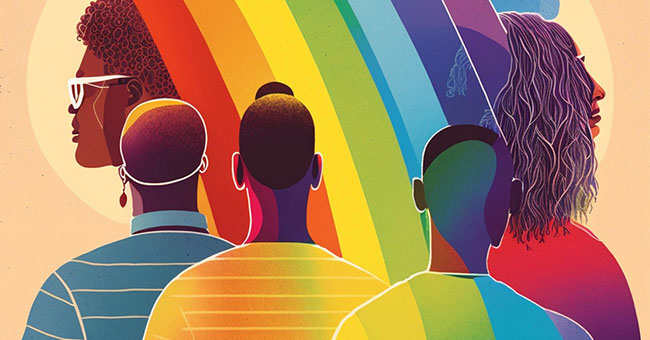
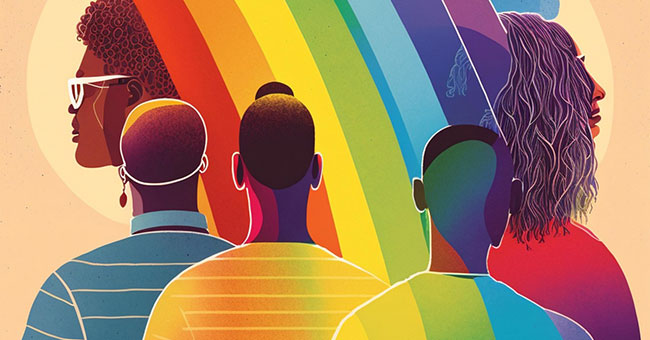
    With-the-rainbow_Simp1e123

    Image credit: Simp1e123

    Gasp! Google Calendar looks much less iridescent and fabulous this June. It’s giving a serious case of the blahs, and the face card is nothing but a 404 error. Where’s that righteous realness for human rights? Oh, that’s right. Google Calendar banished Pride Month into the cyber memory hole. Well, that’s on them. They’ll sashay away into the quicksand of queerphobia as we werk it to keep the party going nonstop.  

    The GLAAD Alert Desk’s report of anti-trans hate on the rise and the murder of actor Jonathan Joss, known for his role as John Redcorn on King of the Hill, are devastating reminders of why we march for Pride in the first place. This handful of titles from Beacon’s catalog honors this year’s theme of rising up in protest. These titles are also a shout-out to LGBTQ+ writers. Because writing is yet another form to protest.


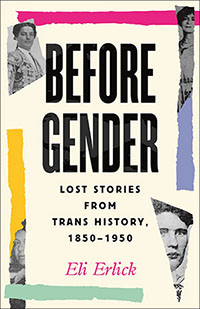
    Before Gender

    Before Gender: Lost Stories from Trans History, 1850-1950

    “What do we gain from the stories of trans people who have not been sufficiently studied? Trans narratives that were lost, forgotten, or destroyed can still describe breakthroughs, adventures, and influential moments in transgender history.  After years of research, it is clear we need to change our cultural appreciation of queer, trans, and gender history. We can use lost histories to foster this understanding—and change—for future trans generations.”
    —Eli Erlick 


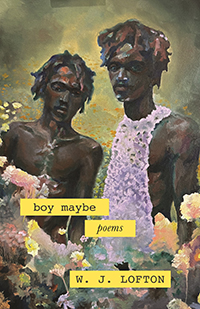
    Boy maybe

    boy maybe: poems

    “it is dangerous to love him
    to wipe tears from his eyes in a diner
    we could die
    for what sounds escape our mouths
    in the jungle I bare my teeth
    add extra edge to my eyes to protect
    our untouched futures
    each day we escape dying
    we danger dodge
    twisting open
    new doors”
    —W. J. Lofton, “danger dodge” 


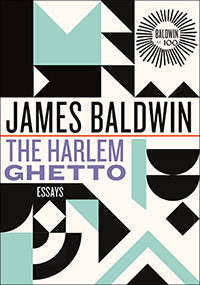
    The Harlem Ghetto

    The Harlem Ghetto: Essays

    “The day of my father’s funeral had also been my nineteenth birthday. As we drove him to the graveyard, the spoils of injustice, anarchy, discontent, and hatred were all around us. It seemed to me that God himself had devised, to mark my father’s end, the most sustained and brutally dissonant of codas. And it seemed to me, too, that the violence which rose all about us as my father left the world had been devised as a corrective for the pride of his eldest son. I had declined to believe in that apocalypse which had been central to my father’s vision; very well, life seemed to be saying, here is something that will certainly pass for an apocalypse until the real thing comes along.”
    —James Baldwin, “Notes of a Native Son” 


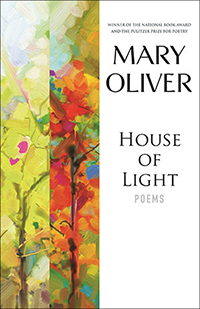
    House of Light reissue

    House of Light: Poems

    “No doubt in Holland,
    when van Gogh was a boy,
    there were swans drifting
    over the green sea
    of the meadows, and no doubt
    on some warm afternoon
    he lay down and watched them,
    and almost thought: this is everything.
    What drove him
    to get up and look further
    is what saves this world,
    even as it breaks
    the hearts of men.”
    —Mary Oliver, “Everything”


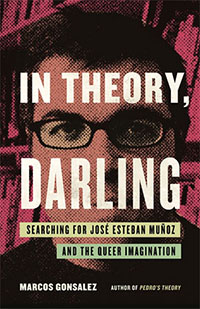
    In Theory Darling

    In Theory, Darling: Searching for José Esteban Muñoz and the Queer Imagination

    “Admittedly, it gets exhausting thinking about how to combat erasure. For queer people of color, erasure has defined our collective histories. We have had to fight tooth and nail to recover ourselves in historical narratives that have erased our queerness, or our color, or both at the same time. I think about it when I don’t necessarily even want to think about it. Sitting at home over dinner, or at a bar sipping a cocktail, stewing in queer rage over what was, or what could have been, pointing out pain and injustice on a Monday night or an early Friday evening, not exactly sure what to do with the feelings.”
    —Marcos Gonsalez 


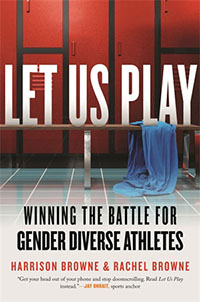
    Let Us Play

    Let Us Play: Winning the Battle for Gender Diverse Athletes

    “Today, gender-diverse people, athletes and non-athletes alike, are facing an unprecedented threat to their very existence. This includes their right to play sports on the team of their choice. And the worsening struggles of trans athletes is occurring while their access to proper healthcare is being eroded. We can’t talk about these two issues as if they’re separate. They are deeply connected. It’s never been more important to debunk the misinformation and misunderstanding regarding trans athletes in order to improve our society as a whole and pave a peaceful path for future athletes of all genders and sexual orientations.”
    —Harrison Browne and Rachel Browne 


    Mean Little deaf Queer

    Mean Little deaf Queer: A Memoir

    “I thought I’d try my usual trick of performing ‘disabled,’ but the world had progressed somewhat. My assigned counselor had exactly the same kind of deafness I did and saw right through the act. As it turned out Robyn, my counselor, was queer herself. (We are everywhere.) And Robyn had once used the small kind of mini shuttle hearing aids I had, and she was pushing hard for me to do as she had done and get a cochlear implant. I remained unimpressed by her arguments until in the middle of our conversation she reached over, rummaged in her purse, picked up her cell phone, and took a call. I was overcome by the white-hot flame of cell phone envy, which is way worse than penis envy because everyone has a cell phone.”
    —Terry Galloway 


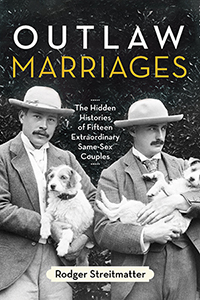
    Outlaw Marriages

    Outlaw Marriages: The Hidden Histories of Fifteen Extraordinary Same-Sex Couples

    “Shortly after [James Baldwin and Lucien Happersberger] became a couple, Happersberger expressed concern that Baldwin’s jittery nervousness meant he was on the verge of a mental breakdown. So the younger man took his new lover to Switzerland, where the pace was slower and the air was healthier than in Paris. They landed in the tiny village of Loèche-les-Bains, where the Happersberger family had a small chalet. ‘There was nothing else for Jimmy to do in that village,’ Happersberger later said, ‘but to work on his novel.’ The partners then went about pursuing their individual creative interests—Happersberger painting and Baldwin writing. For the latter, the words flew onto paper more quickly and more gracefully than ever before.”
    —Rodger Streitmatter 


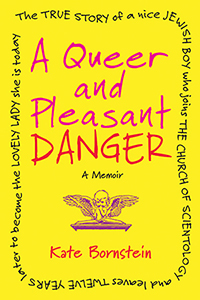
    A Queer and Pleasant Danger

    A Queer and Pleasant Danger: The true story of a nice Jewish boy who joins the Church of Scientology and leaves twelve years later to become the lovely lady she is today

    “My being skinny had a lot to do with how much I enjoyed sex. I liked the way I looked when I was skinny, and that’s a big deal— liking the way you look. I was still comparing my body to women’s bodies in magazines, but I’d moved beyond Sears catalogues and National Geographic. I was into Playboy, and not at all for the articles: I combed that magazine for women I could possibly become. But more than Playboy, there was tranny porn.”
    —Kate Bornstein 


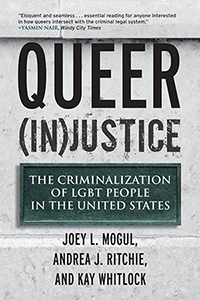
    Queer (In)Justice

    Queer (In)Justice: The Criminalization of LGBT People in the United States

    “[A]s LGBT movements have institutionalized, visions of queer liberation have been tamed into a narrow rhetoric of equality within existing systems rather than challenges to the systemic violence and oppression they produce. As Urvashi Vaid, a former National Gay and Lesbian Task Force (NGLTF) director, acknowledges, ‘The goal of winning mainstream tolerance . . . differs from the goal of winning liberation or changing social institutions in lasting, long-term ways.’ Within this frame, anyone who is perceived as not ‘respectable’ enough is seen to be undermining LGBT access to power, and therefore expendable. Ruthann Robson puts it bluntly: ‘LGBT rights’ agendas are premised on an understanding that ‘distance from criminality is a necessary condition of equality.’”
    —Joey L. Mogul, Andrea J. Ritchie, and Kay Whitlock 


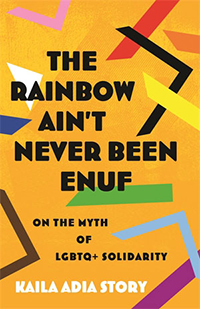
    The Rainbow Ain't Never Been Enuf

    The Rainbow Ain’t Never Been Enuf: On the Myth of LGBTQ+ Solidarity

    “Each color of the rainbow was intended to represent the diversity and solidarity of our communities, visually capturing our nuances, our differences and sameness, and our complex identities. The flag was created as a symbol to not only spread love and inclusivity but also to counter sexual and gendered regulation within mainstream society . . . However, throughout time, some of the most vulnerable yet resilient people within our communities have not found the rainbow marker to symbolize diversity, inclusion, or solidarity. For many, it has symbolized terror—racialized and gendered terror to be specific—causing many to disidentify from the flag’s symbolism, use, and consumption.”
    —Kaila Adia Story 


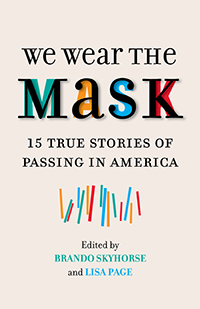
    We Wear the Mask

    We Wear the Mask: 15 True Stories of Passing in America
    edited by Brando Skyhorse and Lisa Page

    “When I finally came out as a queer transgender woman at 27 in Tallahassee, Florida, where I was doing my graduate degree, it saved me from committing suicide. It saved me—even as it meant losing something else. I had already decided, months before, that I would not return to Dominica until I could feel safe there as an openly transgender woman. Luckily, I was a dual citizen; all the same, Dominica was my home, and now I had lost it. My parents themselves told me not to return. I cried, many nights, at the things my mother said to me, things I knew mothers could say but never imagined mine would: that I would be disowned, that I should forget I had a mother, that I was a failure and an abomination against God, that she herself now felt suicidal. I still hear those words, sometimes, when the night is too quiet.”
    —Gabrielle Bellot, “Stepping on a Star”

    With-the-rainbow_Simp1e123


    About the Author 

    Christian Coleman is the digital marketing manager at Beacon Press and editor of Beacon Broadside. Before joining Beacon, he worked in writing, copy editing, and marketing positions at Sustainable Silicon Valley and Trikone. He graduated from Boston College and the Clarion Science Fiction & Fantasy Writers’ Workshop. Follow him on Twitter at @coleman_II and on Bluesky at @colemanthe2nd.bsky.social

  • A Q&A with Terry Galloway

    Terry-Galloway-and-Mean-Little-deaf-Queer

    Author photo: Alan Pogue. Cover design: Louis Roe

    The anniversary edition of Terry Galloway’s Mean Little deaf Queer is finally here! “Told with understandable rage, quirky humor, and extraordinary humanity” (Booklist), her memoir invites readers on her journey from “child-freak” to exuberant performance artist. With a new epilogue that covers her life over the last fifteen years, including her major decision to get cochlear implants, Mean Little deaf Queer is as fiercely original and laugh-out-loud funny as it was when it was first published in 2009. Beacon Broadside editor Christian Coleman caught up with her to chat about it. This is part two of two. Read part one.

    Christian Coleman: You wrote a new afterword about the life-changing decision of getting cochlear implants. Why was it important for you to tell this chapter of your story?

    Terry Galloway: Well, I was really pissed that most of the YouTube videos featuring babies getting cochlear implants show their little faces lighting up with joy when they first hear Mama cooing their names. Hah. Don’t believe it. A lot of those babies—me and a ton of others—scream bloody murder when those things are first turned on. Your brain can be so overwhelmed that you want the bang that implant right out of your head. I want to inspire more of those videos.

    But despite the violence of the transition, it was life changing and in some beautiful ways. Like every single other technological shift in my life, it had both enormous and absolutely negligible effects on my life. And because each time the technology shifted, I couldn’t imagine anything better. I thought, “Wow, that’s it! Nothing better than this.” But it’s like buying a new car after you’ve driven your old one into the ground—it’s a brand-new world you’re driving around in and a lot of buttons you’re scared to push. 

    But more than that, even though it isn’t a one-size-fits-all story, it is hopeful. Look at this continuing, historical push on the part of incredibly skillful people who have devoted their working lives to make life better for others. That the technology exists to do such a thing! Yes, there are drawbacks. But more and more, there are true miracles being wrought by humankind. And I got one. And it changed me. And for the better.

    CC: I was really struck by the part in the afterword where you write about forgetting what it meant to be deaf after getting the implants. As technologies for the Cure develop and become commonplace, do you think future deaf generations will worry about losing their connecting to the disability community?

    TG: I need to stress that many people in the Deaf world don’t think of Deafness as a disability. They regard it as their culture with its own language, its own social mores. Cochlear implants are still subjects for debate, but the talk of it being a form of genocide has died down a lot. The deeper implications of your question, though, are intriguing and scary to think about.

    The Deaf are not the only ones who might find their communities riven by cures wrought by genetic tinkering and technology. I think that is happening all over the disability spectrum. Maybe there will be a day when we can all be “fixed,” but that’s not happening any time soon. Cochlear implants aren’t for everyone. Gene therapy isn’t for everyone. Transplants fail, diseases still wreak havoc on some bodies and not others, and the best of care can go sideways. That’s why what worries me most is the ruthless capacity we humans have for forgetting. 

    There are churches—many which once preached the gospel of wealth—that are now preaching that a lack of empathy is a good thing. That’s how forgetting rears its nasty little head. Forgetting makes you cool to pain, suffering, the ugly part of life. That’s why models and the nastier rich have such haughty faces. They are projecting forgetting, uncaring. They inhabit their own perfectly beautiful universe and need nothing from the rest of us but that we sit back and admire.

    They don’t want to see or acknowledge anything that causes them pain. And remembering can be painful.

    I’ve talked with my neighbors and my buddies in our theater company, the Mickee Faust Club, who have disabilities different from mine. None of them have been “cured” in the way I have been—by the miracle of technology. But they’ve undergone their own changes, some in the realm of technology or medicine, such as having painful, useless eyeballs surgically plucked out. Yes, that is an actual example. And they’ve gone through the usual plain old life changes—marrying, divorcing, buying homes, having kids. But many still have to contend with isolation, poverty, superstition, and the wink-wink-nudge-nudge of people who think we’d be better off dead. Many of them grew up frightened and fighting for their right to live and to live the lives they wanted to live.

    We all agree that in today’s political climate we are back, once again, to being frightened and fighting for our lives. We don’t have the greatest resources for fighting back but fight back we do. We make phone calls to our representatives, always getting a fucking busy signal. We write to them and get AI-generated replies. We’re out there protesting if we are able. And we vote, vote, and vote again. And lose a lot. At least here in Florida. That’s why I’m so glad I wrote about doing activist theater like Mickee Faust. Because it is another way a bunch of us—and not just those of us with disabilities—are fighting back!

    We like to think it makes a difference to put our own voices out there in public. The same with the group of queers in Faust—we got a chorus of queer voices (lesbian, gay, trans, bi, as-yet-to-be-determined)—trying to make our voices heard. We may lose once again but we’ll go down screaming witty insults and choice invectives, trying to make the determinedly unconscious and unempathetic wake the hell up. We are fighting against people who lack empathy, who would rather we not exist, who want to disappear everyone who differs from their own golden mean, and who want, most of all, to forget. 

    I like to think my memoir is a way of fighting back. I reread it, and it fights back on every page by trying to explain, to show, to evoke, to remember. It doesn’t always win. But it fights.


    Read part one. 


    About the Authors 

    Known for her cross-dressing roles in Shakespeare and at Austin’s legendary Esther’s Follies, Terry Galloway has toured internationally as a solo artist and with P.S. 122’s Field Trips. As a giant rodent, she heads up Mickee Faust, a community theater for Tallahassee’s weird, queer, disability community. When not touring, she lives in Tallahassee with her wife, two cats, and a bevy of friends and family.

    Christian Coleman is the digital marketing manager at Beacon Press and editor of Beacon Broadside. Before joining Beacon, he worked in writing, copy editing, and marketing positions at Sustainable Silicon Valley and Trikone. He graduated from Boston College and the Clarion Science Fiction & Fantasy Writers’ Workshop. Follow him on Twitter at @coleman_II and on Bluesky at @colemanthe2nd.bsky.social

  • A Q&A with Terry Galloway

    Terry-Galloway-and-Mean-Little-deaf-Queer

    Author photo: Alan Pogue. Cover design: Louis Roe

    The anniversary edition of Terry Galloway’s Mean Little deaf Queer is finally here! “Told with understandable rage, quirky humor, and extraordinary humanity” (Booklist), her memoir invites readers on her journey from “child-freak” to exuberant performance artist. With a new epilogue that covers her life over the last fifteen years, including her major decision to get cochlear implants, Mean Little deaf Queer is as fiercely original and laugh-out-loud funny as it was when it was first published in 2009. Beacon Broadside editor Christian Coleman caught up with her to chat about it. This is part one of two. Read part two.

    Christian Coleman: Congratulations on the anniversary edition of Mean Little deaf Queer! What does the memoir mean to you fifteen years on? How has your relationship to it changed or evolved over time?

    Terry Galloway: Thank you. I’m so honored that Beacon has published this anniversary edition. They love writers at Beacon, and even though I’m a one-book writer, I’m glad to be caught up in their regard.

    As for rereading Mean Little deaf Queer—oh my god! I could see every flaw, every misstep, every mouthy sentence. And not just that. I was blithely writing about things I wouldn’t have admitted to a therapist (if I had one). I can’t believe my mother, Edna, read all of that about my sex life. My mother-in-law, Marion, kept encouraging me to change the title. Marion was kind of afraid to read it, so my sister-in-law, Kathy, read it and gave Marion a summary, leaving out the sex. A very good decision. 

    So, yeah, it has its flaws. But I love me for writing it. I was trying so hard to get at something, say something, share something that’s not just all about me and more about the grand teaming web of time and being I found myself caught up in. 

    My wife, Donna Marie, who taught Gender Studies as a professor at Florida State University, told me that in rereading Mean Little deaf Queer she was amazed by the strong trans narrative embedded there. She asked me if I were growing up now would I be trans or on the trans spectrum. And I had to think about it. Because I always wanted to be a boy-girl, like the e. e. cummings poem. I miss the boy body of my youth. I still have such disagreements with the kind of body I was born to, but so many of my trans friends had a determination to be who they felt themselves to be. They let nothing stop them. I don’t have that kind of determination to become a male, although I still have the desire to play the role.

    Of course, the huge change in this last decade was suddenly regaining my hearing. And in regaining my hearing, I also regained the crispness of my speech, its full intelligibility.

    CC: You narrated the audiobook for this edition of your memoir, too! Tell us a little about what that was like after having written it.

    TG: I didn’t get to narrate the first audiobook, probably because I was still profoundly deaf at the time and my speech wasn’t clear enough for an audiobook. Or so I imagined. 

    I didn’t exactly seethe with resentment but felt a burst of righteous glee when I was asked to read this latest one. I have a long, long love affair with sound and radio and all those things I couldn’t hear but imagined and romanticized. I thought doing an audiobook would be really sexy. And it was! My voice saying all those things I wrote into the ear of a stranger. I might as well have had my lips right over that open orifice. I developed a huge buddy-crush on Jeremy Bartlett, my sound engineer and editor. He has a beautiful voice, and we developed a teasing relationship—joking and swapping stories and histories back and forth while we were doing the work. It was perfect because I could imagine him being the one constant listener, the one I wanted to please. We both knew we wanted the voice to compel rather than demand attention.

    He was so patient. He told me that some writers get really bored with their own writing and equally bored with their own voices and that was something to guard against. I never thought that could happen to me, but at times it did. I’d hear myself in the earphones and think, “Oh, shut the hell up!” He would admonish me back on track. 

    The whole idea of it was thrilling, even though passages of my own writing did bug me. I had to stop myself from editing, changing, making a sentence more clever than it was. That part drove me nuts. Really, really hard not to do that. But there were times when I would just fall into the language, realize I meant every word, awkward or not. Jeremy and I worked hard so the listener could feel the memory, the story, the moment, bloom. It was an odd kind of conjuring. I love it. If I could do it for a living I would. Although I still worry that my brain will suddenly forget how to hear.

    One last thought. I sometimes wonder if I should have been allowed to do that first audiobook when I still had that touch of deaf-speak. Wouldn’t that have given a more authentic representation of who I was, how the words, the thoughts in my memoir should be heard?

    CC: How much of your experience as a stage performer did you use for narrating the audiobook? Did narrating it put you in a similar headspace and give you a similar thrill you get from performing on stage?

    TG: It’s not a totally different experience when you are up on stage. But there is this distinction for me. I was told that Shakespeare’s audiences went to hear a play more than to see a play. Before my cochlear implants, I loved Shakespeare but couldn’t completely hear the words. I had to feel them, the way my high school speech teacher taught me to feel them—as breath, as part of my breathing, as my body shaping air into meaning. But that also lead me to love slapstick—cartwheeling over a bench, bumping on my backside down a flight of stairs, getting used as a battering ram. 

    So, it was hard for me to settle down with just the words. And to hear the words as words and not just as indecipherable noise. I was afraid of the process at first but after I settled into it, I found it more fascinating than frightening. Now when I first started recording, I was worried about being too theatrical. I reigned myself in too much. I was leery of being too melodramatic and over the top. But I remembered a technique my high school speech teacher taught me. Think of each word individually and give each word its weight. So I did. Some words had more weight than others and I could feel that in them. It helped me shape the feeling in the sentences, the paragraphs, the chapters. And when I shaped it particularly well, I could feel it. So could Jeremy.

    Sometimes in the process, I’d freeze. My brain would get stage fright and forget how to hear.


    Read part two.


    About the Authors 

    Known for her cross-dressing roles in Shakespeare and at Austin’s legendary Esther’s Follies, Terry Galloway has toured internationally as a solo artist and with P.S. 122’s Field Trips. As a giant rodent, she heads up Mickee Faust, a community theater for Tallahassee’s weird, queer, disability community. When not touring, she lives in Tallahassee with her wife, two cats, and a bevy of friends and family.

    Christian Coleman is the digital marketing manager at Beacon Press and editor of Beacon Broadside. Before joining Beacon, he worked in writing, copy editing, and marketing positions at Sustainable Silicon Valley and Trikone. He graduated from Boston College and the Clarion Science Fiction & Fantasy Writers’ Workshop. Follow him on Twitter at @coleman_II and on Bluesky at @colemanthe2nd.bsky.social

  • A Q&A with Susan Swan

    Susan-Swan-and-Big-Girls-Don't-Cry

    Author photo: Mark Raynes Roberts

    Susan Swan has never fit inside the boxes that other people have made for her—the daughter box, the wife box, the mother box, the femininity box. Instead, throughout her richly lived, independent decades, she has carved her own path and lived with the consequences.

    In her revealing and revelatory memoir, Big Girls Don’t Cry, Swan shares the key moments of her life. As a child in a small Ontario town, she was defined by her size—attracting ridicule because she was six-foot-two by the age of twelve. She left her marriage to be a single mother and a fiction writer in the edgy, underground art scene of 1970s Toronto. In her 40s, she embraced the new freedom of the Aphrodite years. Despite the costs to her relationships, Swan kept searching for the place she fit, living in the literary circles of New York while seeking pleasure and spiritual wisdom in Greece, and culminating in the hard-won experience of true self-acceptance in her seventies. Beacon Press sales and marketing coordinator Frankie Karnedy caught up with Swan to chat about it and about taking up space.

    Frankie Karnedy: Big Girls Don’t Cry is your first memoir, but your novels have also drawn from your personal experiences. The Biggest Modern Woman of the World’s giantess Anna Swan is mentioned by name in your memoir, and The Wives of Bath is set in an all-girls boarding school much like the one you attended in your youth. Did it feel different writing directly about your own life and experiences?

    Susan Swan: With the exception of my novel about a fraudster like Canada’s Conrad Black, you’re correct to say I’ve drawn from my life experiences for my fiction. Maybe that’s why it didn’t feel strange to write a memoir, a form that distills and dramatizes like a novel. And I had to find a trajectory through my story the way I do when I’m writing a novel. After Margaret Atwood suggested I write about my height, I realized that I was just like my literary character in my first novel, the real-life Victorian giantess Anna Swan, who exhibited with P. T. Barnum. Anna spent her life looking for a home that would accommodate her extraordinary size and never found it, and I have spent my life as a woman and a writer looking for the place where I fit. My search was more rewarding than hers.

    FK: In the time since your childhood, tall girls have begun to “take up space”—as you may put it—in pop culture with movies such as Tall Girl, celebrities like Michelle Obama, and now memoirs like yours. What sort of takeaways do you think twelve-year-old you would have if she was growing up in this time period instead of in the 1950s?

    SS: When I was a girl, the cut-off point for acceptance seemed to be just below six feet. To be six-foot-two at twelve like me was considered unfortunate. Thanks to the popularity of supermodels, that’s not as true today, but I suspect if I grew to be six-three or six-four now, I would still get put-downs and still be called names. But I have the comebacks I wrote for my daughter when she grew to six feet, so I would be able to put anyone who insulted me in their place.

    Unfortunately, people often don’t realize (or don’t want to realize) that teasing others about their size can be hurtful. They see someone who is the same height, weight, and coloring as them every day, so they don’t understand that it’s a strange and lonely feeling if you don’t see anyone else in the world who looks like you.

    FK: Your friend Margaret Atwood wrote in her foreword for Big Girls Don’t Cry that she encouraged you to write this memoir. Are there any other women writers who encouraged the writing process for this book, or whom you drew inspiration from as you were writing?

    SS: It’s been a thrill to meet a number of impressive young women novelists and short story writers through my work on the Carol Shields Prize for Fiction, writers like Talia Kolluri, Daphne Palasi Andreades, Alexis Shotkin, and Fatimah Asghar. But, right now, I take my inspiration from women writers in Canada and the US like Sheila Heti, Claudia Dey, Miranda July, Maggie Nelson, Sarah Manguso, Nell Zink, and Rachel Kushner. They’re writing full out about their lives as women and writers and damn the consequences. I admire how free and brave they are in their work about subjects like selfishness, sexuality, and disillusionment with the conventional paths women are supposed to take. The fact that they’re able to do this so well and be celebrated for it tells me there’s a lot right about our literary culture at a time when our political culture leaves a lot to be desired.

    FK: The first part of your memoir is shaped by social and thematic “boxes,” such as the “dutiful daughter,” that you tried to fit yourself into or break out of. What is your advice to women who may feel trapped inside their own boxes on how they can try to break free?

    SS: Asking questions and coming up with answers is the key to getting out of boxes or frameworks that don’t fit who you are. Questions like, Why is this box holding me back? Why does it feel so uncomfortable? What is lacking for me in this framework in which I’m currently living? Once you name a problem, you can start to solve it.

    FK: What message do you hope readers will take away from your memoir?

    SS: Remember that making decisions that seem outrageous and even downright dangerous for you at the time may seem perfectly sensible and the right choice when you have become the person you set out to be.


    About the Authors 

    Susan Swan is a novelist and nonfiction writer, a professor emerita, and a recipient of the Order of Canada. Her books include The Wives of BathThe Biggest Modern Woman of the WorldWhat Casanova Told MeThe Western Light, and Stupid Boys Are Good to Relax With. She is also cofounder of the Carol Shields Prize for Fiction, the largest literary prize for women and nonbinary writers in Canada and the United States.

    Frankie Karnedy is the sales and marketing coordinator at Beacon Press. She joined Beacon in 2022 after graduating from Johns Hopkins University with a BA in Writing Seminars and English. Previously, she interned at a literary agency and worked with children and teens at her local library. When she’s not trying to get to the bottom of her endless TBR list, she enjoys taking dance classes and baking fun desserts.

  • A Q&A with C. Pierce Salguero

    C.-Pierce-Salguero-and-A-Lamp-Unto-Yourself

    Author photo: C. Pierce Salguero. Cover design: Carol Chu

    Asian spiritual practices, from yoga and tai chi to qigong and mindfulness meditations, permeate our culture. But these practices are often casually used in the West, and sometimes little understood. As informative as it is inviting, C. Pierce Salguero’s A Lamp unto Yourself introduces “spiritual explorers” of all experience levels to embodied Eastern spiritual practices. Employing decades of personal and professional experience with Asian spiritualities, Salguero explains the origins of key Asian spiritual practices. He grounds them in their historical and philosophical contexts and provides information on how the reader can begin and deepen their personal practices. In this self Q&A, he emphasizes the importance of exploring more than one practice and tradition to find the one or ones most aligned with your spiritual journey.

    What was your primary goal in writing A Lamp unto Yourself?

    My primary goal in writing the book was to honor the complexity and diversity of spiritual experiences. Too often, spiritual traditions try to establish a singular “truth” or path, which can be limiting and even dismissive of other valid perspectives. The book is meant to be inclusive, providing a way to map different kinds of spiritual experiences without privileging one over another. It’s also intentionally ontologically neutral—it doesn’t claim to describe ultimate reality but rather focuses on how people experience and interpret the world through different lenses.

    This model of spirituality fully acknowledges that, based on our unique dispositions, conditionings, and configurations, what gets activated and highlighted for each of us will vary widely. For some, the somatic energetic dimension may be central—the whole journey is experienced as a process of energy awakening. For others, non-dual glimpses of oneness and transcendence of self are the primary thread. Some may find heart-opening and ancestral healing to be interwoven into every aspect of their process, while others touch on it only minimally. The variations are endless.

    By shifting from a standardized, one-size-fits-all idea of spirituality to a pluralistic framework, we make space for the full range of human capacities to manifest and express themselves in infinitely diverse ways. We’re no longer holding everyone to the same template but encouraging each person to attune to the threads most alive and active in their own experience.

    How can spiritual communities honor the radical uniqueness of each person’s path while still providing meaningful guidance for the journey?

    One of the great gifts of our time is a sort of “spiritual biodiversity”—the extraordinary depth and richness of expressions, modalities, and revelations that are available in the modern spiritual ecosystem. We are blessed with an unprecedented abundance of resources, and the opportunity to weave together elements from different traditions to discover what most resonates and catalyzes our unique being.

    At the same time, this very proliferation can also foster a certain kind of confusion, overwhelm, and even spiritual materialism if not held in a proper context. In a world where the classical reference points and reality-checks are quickly dissolving, it can be all too easy to get lost in the spiritual supermarket, endlessly sampling exotic states and peak experiences without ever quite landing in an authentic awakening.

    As such, I feel that spiritual friends, mentors, and communities have a more important function than ever, but one that requires a certain kind of departure from the traditional “top-down” model. Lamp suggests a new form of relational spiritual praxis, one that honors the intrinsic sovereignty and independent trajectories of each practitioner while also providing meaningful orientation and reflection drawn from across the spiritual spectrum.

    This is the opposite of spiritual gatekeeping, when individuals or groups insist that their particular framework or thread is the ultimate truth and dismiss other perspectives. The book actively resists this by emphasizing ontological neutrality. It validates the relevance of multiple phenomenological experiences, each of which are the results of different kinds of practice. Rather than setting different perspectives or belief systems against each other, the book creates space for all of them to coexist. By doing so, it undermines the gatekeeping mentality and fosters an environment of mutual respect and openness.

    Lamp argues that each of the traditional spiritual frameworks has its strengths and limitations, and understanding what each is designed to address can help you navigate them all more skillfully. The key is to recognize that no single spiritual framework can address all aspects of human experience. Having a broader model can help you integrate insights from multiple frameworks without feeling constrained by any one of them. This approach allows you to draw from the strengths of each tradition while remaining true to your own unique path. Over time, developing your own inner authority will help you navigate dismissive environments with resilience and clarity.

    The book presents a framework that identifies multiple dimensions of spiritual experience, each representing a different way of engaging with and understanding reality. Different spiritual teachers or traditions might prioritize one of these aspects over others. What makes this book’s different approach significant is its refusal to impose a hierarchy or suggest that any one way is the “right” or “best” one. Instead, it’s designed to accommodate the wide variety of spiritual experiences people have. This openness is especially important in a world where many people draw from multiple traditions or have unique, individualized paths. It allows for a more comprehensive understanding of spirituality without the rigidity or exclusivity that often accompanies traditional frameworks.

    How can I discern the skillful way to navigate my process and get support and guidance along the way?

    There’s no singular answer, but the key starting point is to develop and trust your own inner sense of discernment and authority. Learn to check in with yourself regularly and sense what your own being is authentically calling for at each stage.

    For some, that authentic call is to work intimately with a specific teacher or dive deeply into a particular tradition or practice lineage for a time. For others, it’s to sample more eclectically from different streams, gathering perspectives and finding what resonates. And for some, a more independent “DIY” approach of radical self-reliance feels most aligned. The common thread is learning to trust your own embodied sense of rightness and letting it guide your choices.

    In general, I encourage seeking out teachings, practices, and environments that light you up and support the growth and aliveness of each of your key threads. Stay open and flexible, continually course-correcting based on your lived experience and shifts in your inner knowing. Find ways to keep accessing both the raw immediacy of your own embodied presence and reflections from the larger field of those walking a similar path. Let your understanding be informed by the wisdom in the traditions but not overly confined by it.

    The independent path can be incredibly empowering and revelatory. But it’s also important to beware of its pitfalls. It’s easy to get lost in ungroundedness, inflation, or lack of mirroring. We’re interdependent beings and most of us need reflections and external support structures to keep integrating and stabilizing. So, part of the ongoing discernment is tuning into where you authentically need more relational holding and active guidance and where you’re being asked to trust your own inner knowing.


    About the Author 

    C. Pierce Salguero is a historian of Buddhism and Asian medicine, and a long-time practitioner of several different forms of Asian spirituality. He has a PhD in the history of medicine from the Johns Hopkins School of Medicine (2010) and teaches Asian history, medicine, and religion at Penn State University’s Abington College, near Philadelphia. He is the author of many books on Buddhism and Asian medicine, including Buddhish: A Guide to the 20 Most Important Buddhist Ideas for the Curious and Skeptical. When he’s not working on a manuscript or teaching a class, you might find him traveling the world with his wife and kids, making huge batches of homemade Sichuan chili sauce or out on his back porch meditating on a cup of Tippy Yunnan.

  • Levi Chen

    Welcome to our rebooted “Beacon Behind the Books” series! In these times when readers are responding to our books “more than ever,” when our authors—including Gloria J. Browne-Marshall, David Pakman, James Baldwin, Viktor Frankl, Atef Abu Saif, and Percival Everett—are appearing in the media, their ideas going viral on social media, their voices being heard on so many platforms, we thought it would be good to take a break to focus on some of the staff who work hard to find, shape, edit, produce, and promote those works. Our blog series introduces to you a staff member and gives you a behind-the-scenes look, department by department, at what goes on at our office. And not only our staff, but our interns, too.

    This month, we introduce you to Levi Chen, our sales intern! 

    What drew you to publishing, Levi? How did you find your way to Beacon?

    I used to be a huge writer and reader when I was growing up and still really enjoy writing today. As a kid, I didn’t really understand how much work is done between an author writing a book and a reader purchasing it at a bookstore, and it’s always been a little curiosity of mine. When I found out that Beacon offered internships, I took the chance to learn more about an industry that has shaped so much of my childhood while furthering my career interests in marketing and sales.

    How much of what you learned in college have you found vital to your work?

    I’m an Architectural Studies major, which is a fancy label for an architectural history major. So, as a humanities major, there’s definitely a lot of overlap between reading journal articles and a book manuscript, and although copywriting is very different from a formal essay, the general writing experience is very handy. In the art/architectural history realm specifically, a lot of it revolves around comparing and contrasting buildings and art that appear completely disconnected from each other. Surprisingly, this has been very useful for marketing work, as it helps me find similar book titles and identify target audiences.

    Favorite thing about Boston?

    The built environment is so unlike anywhere else I’ve ever lived. It’s both a large metropolitan city yet feels so small and suburban at times. And why do we need so many Dunkin’ Donuts? I will never know.

    Favorite book ever?

    The Japanese manga Paradise Kiss by Ai Yazawa. It’s a coming-of-age story about a high school senior’s clashing desires for conformity and individualism accompanied by gorgeous drawings of high fashion clothing.