• With Ricky Tucker

    Ricky Tucker

    Author photo: Kareem Worrell

    As a writer who narrows in on very specific LGBTQ artists, collectives, media, embodied experiences, and sensibilities, I’m not the broadest or most Olympic-level reader. I read selectively, slowly, and with intent. And I absorb media like everything bears repeating.

    But people always ask me if I’ve heard of This Book by So-And-So on the Whatchamacallit’s Bestsellers list—something my work “reminds” them of—and I regularly stop them where they start. “Listen,” I say, “I read the same books by the same authors to an almost ritualistic degree, only annually letting in a mini-flood of approximately thirty newcomers in a two-month period due to my stints as literary award juror then closing off the category for the year. And rarely do any of those remain in the fold.” Maybe it’s how I maintain my voice? Call me chronically simple.

    Though my personal scope is narrow, my reading list is inclusive in context with the world. Here are some Black queer authors who are constantly bolstering my writing practice.


    Notes of a Native Son

    1. James Baldwin’s Notes of a Native Son 

    I reread this bombastic essay collection at least once a year, often in the depths of New York winter when the sun is at its most elusive and my personal worth or voice as a writer feel equally dim and out of reach. Baldwin’s frank but fiery prose reminds me that, as a Black gay American, my indignation cranked up to its fullest decibel is a key aspect of the democratic process. For the fiction version of this kind of queer audacity, see also Baldwin’s Another Country, and his short story “Sonny’s Blues,” which provides an impressionistic yet very specific answer to our plight. Spoiler: The answer is art.


    Butch Queens Up in Pumps

    2. Marlon Bailey’s Butch Queens Up in Pumps: Gender, Performance, and Ballroom Culture in Detroit 

    This detailed, thoughtful consideration of Detroit’s House/Ballroom culture gave me the foundational lexicon to talk about NYC’s iteration (albeit the founding one), without getting too bogged down by what voguing, or realness, or “Shade” even are—though I could and may still write an entire book on that last one. Not only this, but Mr. Bailey did me the honor of providing a blurb for my book about Ballroom. I very much stand on his shoulders.


    White Girls

    3. Hilton Als’s White Girls 

    In 2013, I interviewed New Yorker theater critic Hilton Als for the National Book Critic Circle Awards, and we talked even then about dance and Ballroom, but also about White Girls, his newest release at the time. The conversation was familiar in that way only two Black gay men in the city could facilitate, but more than anything, it reminded me of the odd, essentially symbiotic allyship we have with white women, and how that dynamic requires further inspection. I needed and still need to delve more into the ongoing commodification of Ball Culture by the likes of folks like Madonna, my infinite obsession with TV shows like Designing Women, and the notable omission of Black women in these co-dependencies, and public discourses around art and politics.


    Bad Feminist

    4. Roxane Gay’s Bad Feminist 

    And to that last point, Roxane Gay needs to be president, if only for her exacting eye, cloud-breaking voice, and insistence in this book on calling out the cracks in our culture (and her own thinking), and most importantly, creating her own joy. All Black women of all experiences deserve to lead with their joy. If you want to know what I mean, follow Ms. Gay on Instagram.  


    5. Beyond Books

    My fifth book isn’t a book, but some media that have lent to my practice.

    5a: Essex Hemphill’s poem within Marlon Riggs’s essay-film Tongues Untied about Black queer men, their mothers, and the importance of chosen family à la the House-Ballroom system.

    5b: Designing Women—and no, I don’t mean The Golden Girls. This TV show is not made by BIPOCs or LGBTQs but is so formative in building my voice as a Black queer southerner. See book selection #3 above if you need further clarification. Either way, ya welcome.

    5c: Adam Pendleton’s Whitney Biennial video piece, Ruby Nell Sales, focusing on the profound words and meditations of activist Ruby Sales. She is the national treasure you’ve never heard of.

    5d: Janet Jackson’s 1994 performance of “Throb” on SNL. If your gender expression is at all fem, you’ll live, and if you’re uptight, you’ll swoon. Have fun, stay safe, and never give up. Oh, and happy Pride! 

    Ricky Tucker


    About the Author 

    Ricky Tucker is a North Carolina native, a storyteller, an educator, a lead creative, and an art critic. His work explores the imprints of art and memory on narrative, and the absurdity of most fleeting moments. He has written for the Paris Review, the Tenth Magazine, and Public Seminar, among others, and has performed for reading series including the Moth Grand SLAM, Sister Spit, Born: Free, and Spark London. In 2017, he was chosen as a Lambda Literary Emerging Writer Fellow for creative nonfiction. He is the author of And the Category Is . . . : Inside New York’s Vogue, House, and Ballroom Community. Connect with him at thewriterrickytucker.com and on Instagram: @rictorscale.

  • A Q&A with Imani Perry

    Lorraine Hansberry

    Just in time for Pride Month! Our favorite playwright and civil rights activist, Lorraine Hansberry, has been immortalized with a statue unveiled on June 9 in Times Square. Created by sculptor Alison Saar under the auspices of the Lorraine Hansberry Initiative, the installation, To Sit Awhile, features a figure of Lorraine surrounded by five bronze chairs, each representing a different aspect of her life. It will tour several US cities, including Washington, DC, Atlanta, Detroit, and Philadelphia, until it takes up permanent residence in Chicago, Lorraine’s hometown. Is she finally getting her moment in the sun? Beacon Broadside editor Christian Coleman caught up with Imani Perry, author of the PEN and Lambda Award-winning biography, Looking for Lorraine, to chat about it.

    Christian Coleman: PBS’s documentary about Lorraine was released months before your biography on her was published. Looking for Lorraine swept up major awards and was even a clue on Jeopardy! And now there’s the installation. Do you feel she’s finally getting the long-overdue recognition she deserves?

    Imani Perry: I believe that Lorraine is having a well-deserved extended period of recognition. I am also thrilled that A Raisin in the Sun is reportedly returning to Broadway in the fall. But I’m still holding out hope that her other work, especially Les Blancs and The Sign in Sidney Brustein’s Window, will be produced more frequently. They’d also be incredible films. Part of what I tried to show in Looking for Lorraine is that she had a substantial body of excellent work and that remains elusive. But there’s a beautiful community of women who I think of as Lorraine’s daughters, and we are all doing the work of sustaining her legacy, and so I have to believe it will happen. 

    CC: What was your reaction when you found out that the installation was being sculpted in her memory?

    IP: I was deeply moved when I heard about the installation, and I’m grateful to have been in conversation with the Lorraine Hansberry Initiative. The sculptor is the great Alison Saar, and her sister, Lezley Saar, allowed me to use her art on another of my books, Vexy Thing. And of course their mother, Betye, is also an extraordinary artist. I think the Saar family, all of whom do work that rigorously interrogates the politics of race and gender, share common ground with Lorraine Hansberry, and so that makes it especially profound.

    CC: The installation features five chairs that represent different aspects of Lorraine’s life. Do they match up with or overlap with what you wrote in your biography? Do you see the installation as a piece in conversation with Looking for Lorraine?

    IP: I think what the sculpture captures is the way Lorraine’s life is an invitation to contemplate a range of key human issues, and that’s something I tried to capture, too. She was a brilliant artist and an intellectual but also a soulful feeling person with an identity at the crossroads. There’s something so viscerally satisfying about literally being invited to sit awhile with her. It makes the emotional experience of being in her life corporeal. I think she would have loved that. And, of course, when she was younger, Lorraine was a visual artist as well, and the lines of the sculpture are reminiscent of her print work, so it really is beautifully immersive. 

    CC: In our times today, amidst a pandemic, continued anti-Black violence, and pearl clutchers ranting about their phantasms of critical race theory, what do Lorraine’s legacy and your biography mean to you now?

    IP: At every turn, there are attacks in this society on everything Lorraine stood for as a radical leftist anti-imperialist Black lesbian feminist with a Black nationalist sensibility who loved the study of history in the service of freedom. I love when I hear that people are reading Looking for Lorraine because, to me, it is a sign that they are refusing the bigoted anti-intellectual forces of our time. I’m grateful to have written in the service of liberation and for Lorraine, who modeled how to do so, so beautifully.


    About Imani Perry 

    Imani Perry is the Hughes-Rogers Professor of African American Studies at Princeton University, where she also teaches in the Programs in Law and Public Affairs, and in Gender and Sexuality Studies. She is a native of Birmingham, Alabama, and spent much of her youth in Cambridge, Massachusetts, and Chicago. She is the author of several books, including Looking for Lorraine: The Radiant and Radical Life of Lorraine Hansberry.

  • By Eboo Patel

    Globe

    Image credit: Moritz320

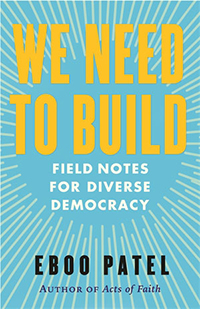
    In his latest book, We Need to Build: Field Notes for Diverse Democracy, Eboo Patel dedicates a full chapter to advise his sons on refounding the US as a just and inclusive democracy in their time. We’re sharing a selection of it in honor of Father’s Day.

    ***

    Do you remember the first demonstration that your mother and I took you to? It was the fifty-year commemoration of Martin Luther King Jr.’s march through the South Side neighborhood of Marquette Park. Do you know what King endured that day? Five thousand people lined the streets of the neighborhood to scream racist slurs and throw bottles and bricks at King and a few hundred peaceful marchers. A brick hit King in the head, he went down on a knee, wiped the blood away, stood up, and kept marching. At one point, King saw a pack of white teenagers screaming racist slurs on the sidewalk. Somehow, he escaped his security detail, approached the kids, and said something to the effect of, “You guys are so smart and good looking, why would you want to act this way?”

    Today, Marquette Park is one of the most ethnically diverse neighborhoods on the South Side. The demonstration we went to was organized by an organization called the Inner-City Muslim Action Network. As part of the commemoration, they erected the first permanent memorial to Martin Luther King Jr. in the city of Chicago. The memorial has quotes from Muslim and Jewish leaders who were looking to build the same kind of world that King was trying to build, a world where everybody thrives.

    Parenting is in no small part the process of praying that your kids get right the things you got wrong. So allow me this hope. You will acquire the radar screen to detect racism, the language to deconstruct it, the structural soundness to not be deformed by it, and the leadership skills to transform it without a detour down the road of rage. Instead, you will maintain the hopefulness of King, of Lincoln, of John Lewis, of Jane Addams. Because here’s the thing: if it was not for them, our family would not be in this country. It is precisely because they imagined a nation based on shared ideals rather than shared ethnicity, a nation where avowed racists could change, that new laws were passed in the 1960s that allowed your grandparents to immigrate to this nation. Those people paved a path for you: it is your job to pave a path for others. To paraphrase T. S. Eliot, We do not inherit traditions; we work to make ourselves worthy of them. You are Americans. The tradition of America is a glorious tradition, built by sweat and blood, and art and poetry. What will you do to make yourself worthy of it?

    ~~~

    We might have been navigating people’s unconscious racial bias, perhaps even a deeply rooted form of white supremacy, when we were selling our house, but just remember, we had a house to sell, and we were moving into one we liked better. Both of you have known nothing but nice houses, safe neighborhoods, and excellent schools. You think this is the way the whole world is. Khalil, I remember the time you saw a story on the local news about a shooting in Chicago. You turned to me and said, “Wait, Dad, people in Chicago get shot?”

    You and your friends talk about which college you want to go to, not whether you think you might go to college. That’s in part because virtually every one of their parents went to college, and just about all of them have plum positions in the knowledge economy. The data shows that three-quarters of their children—your friends—will earn college degrees by the time they are twenty-four. That’s not because they are more brilliant than the rest of the country and the world, that’s because they—and you—are more privileged.

    I say all this because one of the things that strikes me about the fancy colleges you both want to attend is that they are the ones that are most likely to teach you a language of criticism and deconstruction, a language that encourages you to think of yourself as oppressed.

    I think this is a useful pair of glasses to put on from time to time, but it’s a terrible idea to do permanent surgery on your eyes such that you only see the bad things that happen to you.

    First of all, you are not oppressed. To use that word in reference to yourself is to announce to the world that you utterly lack perspective. Most of the world would trade places with you in an instant.

    I learned this, as I learned many things, by the way of maximum embarrassment.

    I remember being in a taxi in Mumbai with my own father. I was on a break from graduate school at Oxford and reflecting out loud on how challenging I found the environment. “It’s a place that built the empire, and now it has to deal with the people it colonized returning as its students. It doesn’t know how to treat us as equals, and so it oppresses us through other means.”

    I was proud of my postcolonial analysis, especially given the backdrop of India. Not only was I challenging the empire; I was also expressing solidarity with my countrymen. My dad did not see it the same way. He pointed to a child on the street, probably eight years old, missing his right arm and with a horrible scar on the side of his face, his left hand extended toward our window, begging for money. I had not noticed him. There were so many others who looked similar that I had learned quickly to ignore them. “If you are oppressed, what word do you have for him?” my dad asked. “For all of them,” he said with emphasis, pointing to the many other leprous beggars on the streets.

    I didn’t have an answer. I still don’t.

    A few years later, I had something of a similar experience. I was complaining to an Islamic scholar from the Middle East about the policies of the Bush administration. Something about the way I was talking conveyed a kind of self-pity that apparently put him off.

    “Where will you sleep tonight?” he asked me.

    “In my bed,” I said, a little confused. “Why do you ask?”

    “Because I just want you to realize that if you were in my country and you said such things about its leader, you would not be sleeping in your bed tonight, you would be in jail being tortured. You Americans should have greater appreciation for your freedoms and spend more time doing things for other people rather than feeling sorry for yourselves.”

    The term “oppression,” if it means anything at all, cannot include both upper-middle-class brown kids in urban America and people who sleep on the filthy streets or in the torture chambers of developing world nations.

    Here is the bottom line: I do not want you to feel like the only story to tell about your brown skin, ethnic heritage, and Muslim faith is a story of marginalization, as if being Indian or Muslim are categories absent of content of their own, defined only by experiences of racism. I want you to realize how much progress has been made and to be grateful to all the people who did the work and made the sacrifices from which you benefit. The “we are even worse off now than we were during segregation or colonialism” narrative is not only a lie; it also dishonors the genuine heroes who fought, bled, and in some cases died to build a nation where most of us live better lives.

    I want you to have the radar screen to recognize racism and the tools to call it out and to also realize that such accusations are serious and ought not be made lightly. I don’t want you to go hunting for examples of racism and white supremacy. There is enough of it in the world already. Generally, I’d like you to give people the benefit of the doubt. For example, most ignorant questions about Islam are not examples of racism, but rather illustrations of being uninformed, and therefore are opportunities to do some good by providing a little education. By the way, you will undoubtedly say some uninformed things about other people’s identities, and you will appreciate when they gently correct your misunderstanding rather than zap you with an accusation.

    ~~~

    I have some counterintuitive advice for you: embrace your privilege. Not in a way that makes you self-satisfied (you did nothing to earn your privileges) or complacent, but in a “I have great potential, opportunity, and responsibility” manner. Whatever might be wrong with the world or challenging about your own life, I want your first instinct to be, “What can I do to be a better person, change agent, and leader?” That doesn’t mean that other people don’t need to change, it only means that if you are going to be the person leading that change, you need to be a better version of yourself. The first step toward that is understanding yourself as an agent and not a victim.

    One of my favorite mantras is from the field of community organizing: don’t do for people what they can do for themselves. The message is clear—people are infinitely powerful, and your job as a community organizer is to help them see their own power and then put that power into the world. Zayd and Khalil, I want you to apply that lesson to yourselves.

    This is a lesson you know really well because you both play sports. Every coach you’ve had has emphasized at every practice and in every game: focus on being a better person, player, and teammate. Don’t make excuses.

    Zayd, I remember coming early to pick you up from basketball practice one day and getting to watch the scrimmage. The point guard got his shot blocked and yelled, out of frustration, “I’m too short.”

    He’s right, I thought. He is short—a serious disadvantage in basketball.

    That’s not the way your coach saw it. He was furious. He yelled, “We never talk about the things we can’t do or the things we don’t have. We never make excuses. We work hard, we improve, we commit to excellence.” Your coach at the time, Renell, was a walking example of this. He was short himself, well under six feet. And yet he’d made it to the NBA D-League. How? He did what he could with what he had. Those are the highest values of athletics and of leadership in general.

    Remember when our flight to Arizona was delayed by ten hours and we were stuck at Midway Airport all day? The only consolation was that the people sitting next to us were players from an AAU school basketball team. I loved how you peppered those young men with questions about how they got to be elite athletes.

    I’ll never forget that conversation. The point guard on the team motioned over to a middle-aged Black man reading a newspaper. “That’s our coach,” the player said. “He makes us do drills over and over. He has us run every time we make a mistake. He doesn’t give out many compliments. He always says that he makes practices harder than games so that by the time we get there, we find the game easy.”

    The player looked directly at you two and said, “You prepare like that, and you become mentally tough enough to deal with anything.”

    You see similar themes in just about every sports-related commercial on television. Think about that Nike ad that features all those people with no hands and legs, kids from villages in developing nations and urban ghettoes—all of whom make it to the top of their field. Unfairness is at the center of the narrative. But the message is not to point out all the ways that the system (or in this case, the sport) is structured against you. The message is to adopt an attitude that overcomes disadvantage through your own excellence.

    Here’s my favorite part of that commercial: it’s narrated by Colin Kaepernick. Kaep, as you both well know, started the protest movement of kneeling during the national anthem that has now become a mainstay of athletic events. He narrated that Nike ad to send a message that unfair and oppressive systems are not going to prevent him from doing the work to achieve excellence. He’s still ready to play at the highest level.

    That’s the great wisdom of sports.

    The game is hard, your opponent is strong, you are disadvantaged—all of this is assumed. Away games are meant to be hostile territory, not safe spaces. Prepare for it. The other team will try to trigger you. Be mentally strong. Microaggressions? Laugh at them. And learn to channel your own macro-aggression into excellence. Work harder. Dig deeper.

    Just about every coach I’ve ever been around has preached some version of this message. It should not go unnoticed that people from marginalized populations thrive in these settings. Both the NBA and the NFL are approximately three-quarters African American. Major League Baseball is nearly 50 percent Latino. In the process of thriving, those Black and brown athletes changed entire sports. Basketball is a radically different and far more exciting game, from the style of play to fashion styles, now that Black players dominate rather than white players.

    This is not just a recipe for excellence in athletics. I remember sitting next to the great Black artist Kerry James Marshall at a dinner once. He spoke to me about the tragedy of so many vacant lots on the South and West Sides of Chicago. What do those vacant lots tell young Black people about their worth in the world?

    In so many ways, he told me, his art is a response to those vacant lots. Its goal is to show Black people as complex, beautiful, satisfied, complete. He paints Black hairdressers, Black magicians, Black lovers, Black siblings, Black painters, Black people vacationing on a boat. He is creating an entire Black universe standing on a foundation of its own strength. The color black in his paintings always stands on its own; it is never mixed in with any other colors.

    He makes it clear in a video called Mastry that he is not angry at the old masters for their white ways. That Rubens was painting fleshy naked blond women was his world and his era. Marshall’s view is some version of “Fine, whatever, that was how you saw things. It’s not worth my precious time to critique it.”

    Kerry James Marshall wants to spend all of his time on a different goal: to give Black Americans what they deserved by painting their world at the very highest level of excellence. And if he found himself unable to do that, Marshall was not going to blame Rubens or any other dead white man for that. “That’s my problem to solve,” he said. And if he could not find a solution, then what he had on his hands was a failure of imagination, not a reason to blame someone else.

    Kerry James Marshall was not going to let the limits of others limit him. Neither was Lori Lightfoot, the gay Black woman who grew up working class in a small town and rose to become mayor of Chicago. On the night of her election, Lightfoot was interviewed by Lisa Desjardins of PBS and asked what her mother said when she heard the good news. Here’s how the mayor-elect responded: “My mother basically said, ‘This is how I raised you. To be strong and fearless. To meet challenges, to take advantage of opportunities, to prepare yourself to be in charge.’”

    Imagine being a Black girl born when much of the United States was still segregated. Your parents work multiple jobs to make ends meet. You are slowly recognizing that your sexuality doesn’t fit the norm, but it’s not something you can share because of the homophobia deeply woven into the culture, especially in your small Midwestern town.

    And your mom tells you to be strong and fearless, to meet challenges, take advantage of opportunities, and prepare yourself to lead.

    You are fully aware of the race, gender, class, and sexuality advantages that other people have. You notice it in college at the University of Michigan, in law school at the University of Chicago, as a young lawyer in the district attorney’s office, as a more experienced attorney at the corporate law firm Mayer Brown, in your various appointed governmental positions. There are a whole bunch of people who, on account of their skin color, gender, family background, and so on seem as if they dropped from the sky onto third base, and when friends rig the system so they can saunter home, they act impressed with themselves.

    And here you are, smarter and more focused than all of them, just meeting challenges, taking advantage of opportunities, and preparing to be in charge.

    And now you are the mayor of Chicago. And you know who is not surprised? Your mother.

    ~~~

    Speaking of mothers, yours is remarkable. Easily the best thing that happened in my life was meeting and marrying her. If you want to talk about privileges, having a mom like yours tops the list.

    Right now, you mostly see her as someone who drives you places, helps you with homework, and says yes to about half your requests for sleepovers. But you should know a few other things too. Your mom was a civil rights attorney who handled mostly police misconduct cases. She argued fourteen cases in federal court and was the lead attorney on two appellate arguments.

    Police misconduct is a euphemism for when cops brutalize people. It’s been all in the news these last few years. Names like McDonald, Philando Castile, Michael Brown, Sandra Bland, Eric Garner, George Floyd, and way too many others have become part of the national discourse. Well, your mom cared about these issues long before they led the evening news. That’s because your mom cares about people—all people. That includes the people who hurt the clients she was defending. Yes, I mean the police.

    When your mom and I were dating and I was learning more about her work trying police misconduct cases (and falling in love with her at the same time), I made a disparaging remark about cops.

    She looked at me as if I’d said something profane. “I do what I do to return dignity to people who have been violated and to help police officers live up to the code they swear to: to serve and protect. Police officers have important and difficult jobs. If I do my work right, they do their jobs better, and that is good for everyone.”

    Here’s the thing, Zayd and Khalil: your mom doesn’t think in us/ them terms, even when so many people around her do. She’s on everybody’s side, all the time.

    I want you to be like that, looking to build things, not just tearing them down. I would be proud of you if after the killing of Michael Brown, you were in Ferguson protesting a racist criminal justice system. But I’d be prouder still if you were the ones taking responsibility to improve the police department in Ferguson. Doesn’t every community deserve a decent police department—or even better, alternatives that secure public safety and community thriving without any threat of violence? Isn’t that what the protestors are calling for? Somebody’s got to take charge of implementing the solution. Why not you?


    About the Author 

    Eboo Patel is founder and president of Interfaith America, the largest organization engaging religious diversity in the United States. He is the author of five books on diversity and democracy, including We Need to Build: Field Notes for Diverse Democracy, a regular contributor to the conversation on the role of religion in public life, and a frequent keynote speaker. He lives in Chicago with his wife Shehnaz and two sons. Follow him on Twitter (@EbooPatel).
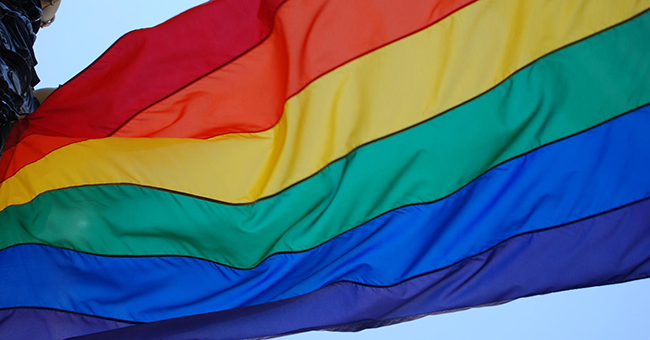
  • Pride flag

    Photo credit: Nancy Dowd

    It’s raining men, and not the ones The Weather Girls sang about. They’re raining on Pride parades with violent intent. A U-Haul truckful of members from the white supremacist group, Patriot Front, was arrested before they could disrupt a Pride event in Coeur d’Alene, Idaho. Proud Boys stormed a Drag Queen story hour at a library in San Lorenzo, CA. Baptist ministers in Idaho and Texas went viral for calling on the government to execute gay people. Cancel all the hallelujahs for them.

    In all seriousness, though, this is why Pride will always be a protest. Always has been. Because there will be haters who want queer communities snuffed out of existence. Bad news for the haters: the LGBTQ+ communities are not going anywhere. They have always been here to live life as their full authentic selves.

    So in the spirit of being queer to stay, here’s your (inexhaustive) reading guide for Pride.


    Ace

    Ace: What Asexuality Reveals About Desire, Society, and the Meaning of Sex

    The ace world today has become broad enough to include many types of people. There are many types of aces, for one, who describe ourselves as sex-repulsed, sex-indifferent, or sex-favorable depending on how averse we are to sexual material and sexual activity. The ace world also includes people who identify as gray-asexual, or gray-A, a more catchall phrase that encompasses experiences like only occasionally experiencing sexual attraction or not experiencing it very strongly.
    —Angela Chen 


    And-the-Category-Is

    And the Category Is . . . : Inside New York’s Vogue, House, and Ballroom Community

    Ballroom’s house system exists on a more personal and visceral level. Yes, Ballroom is a response to classism, racism, transphobia, and a list of other chronic cultural constructs, but at its core Ballroom is an answer to an act against nature: parents disowning their children . . . . Everyone in Ballroom has an origin story of how someone in the community took them in and/or under their wing, became their gay mother, father, sister, brother, aunt, or uncle.
    —Ricky Tucker


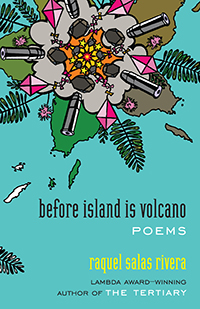
    Before island is volcano

    antes que isla es volcán/before island is volcano: poemas/poems

    me raptaste de mi hogar,
    castigándome por no llamarte míster.
    aprendí tus malas palabras,
    y te maldije en tu idioma
    para que entendieras.

    nunca entendiste.
    decías que mi acento era muy fuerte.

    //

    you stole me from my home,
    punished me for not calling you mister.
    i learned your bad words,
    cursed you in your language
    so you would understand.

    you never understood.
    you told me my accent was too thick.
    —Raquel Salas Rivera, de/from “calibán a próspero”/“caliban to prospero”


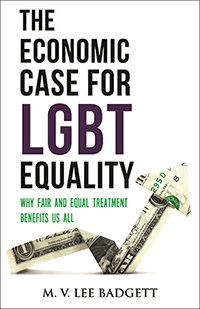
    The Economic Case for LGBT Equality

    The Economic Case for LGBT Equality: Why Fair and Equal Treatment Benefits Us All

    every LGBT person contributes something, whether they are teachers, cashiers, nurses, custodians, in the beauty industry, unpaid caregivers, and truck drivers or whether they are in the underground or informal economy. Their individual human losses from being unfairly targeted turn into our collective social losses as we miss out on the full benefit of their skills, experience, and creativity.
    —M. V. Lee Badgett


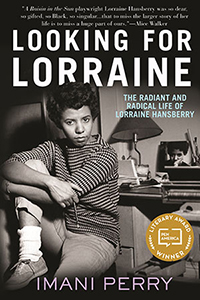
    Looking for Lorraine

    Looking for Lorraine: The Radiant and Radical Life of Lorraine Hansberry

    Apart from her pseudonymous fiction, Lorraine didn’t spend much time writing about women’s beauty. Maybe she worried that it would sound frivolous (or even too feminine) in comparison to the way many of her literary heroes wrote character descriptions. Perhaps she worried that her attentiveness to female beauty might be too revelatory. But in truth, these lush descriptions were in line with a tradition of Black women’s writing with which Lorraine was familiar, from Harlem Renaissance novelists Nella Larsen and Jessie Fauset to the Chicagoan Gwendolyn Brooks.
    —Imani Perry


    The Price of the Ticket

    The Price of the Ticket: Collected Nonfiction: 1948-1985

    The American idea of sexuality appears to be rooted in the American idea of masculinity. Idea may not be the precise word, for the idea of one’s sexuality can only with great violence be divorced or distanced from the idea of the self. Yet something resembling this rupture has certainly occurred (and is occurring) in American life, and violence has been the American daily bread since we have heard of America. This violence, furthermore, is not merely literal and actual but appears to be admired and lusted after, and the key to the American imagination.
    —James Baldwin, from “Here Be Dragons”


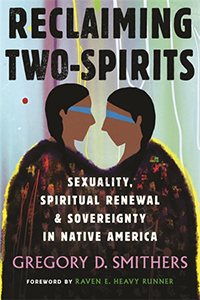
    Reclaiming Two-Spirits

    Reclaiming Two-Spirits: Sexuality, Spiritual Renewal & Sovereignty in Native America

    As we head toward the middle decades of the twenty-first century, Two-Spirit futures are focused on decolonizing gender identities and sexual expression—but not only on this. They’re about continuing the conversation about the type of language that best defines a fluid, blended sense of identity. They’re about reclaiming traditions and telling new stories. And they’re about playing a role in meeting the challenges confronting Native communities, including the continued struggle to decolonize virtually every facet of Indigenous life while also identifying ways to address the most pressing existential threat of our time: human-induced climate change.
    —Gregory D. Smithers


    Soul Serenade

    Soul Serenade: Rhythm, Blues & Coming of Age Through Vinyl

    Even as a child I gathered that Aretha’s music, especially her classic Atlantic recordings, was an extension of church. The air changed. A sense of reverence rained down as her voice soared from the speakers. I straightened up and listened. Coupling the sky-ripping strength of Aretha’s voice with Mama’s warrior-woman presence, I felt protected in Daddy’s absence.
    —Rashod Ollison


    Transgender Warriors

    Transgender Warriors: Making History from Joan of Arc to Marsha P. Johnson and Beyond

    Our histories have been erased and whitewashed. We are told that transness is new, that transition is unprecedented. We know this to be patently untrue, but anti-transness continues to find new ways to protect the binary (see the contemporary emergence of gender reveal parties). It remains up to us to track down and preserve our own histories for ourselves. Leslie’s work showed me that it was possible to make history—to find, create, and archive the histories of those who laid the groundwork for us, who showed us how to move beyond the gender binary, and who existed all throughout time as their most full, beautiful, and expansive selves.
    —Tourmaline, from the introduction of the twenty-fifth anniversary edition


    Vinegar Hill

    Vinegar Hill

    I wondered that December day
    What I would miss. December light:
    The air liquid and grey
    An hour before the ambiguous hour.

    Time when the mind’s half-filled with dreams.
    The gift of pure dazzling consciousness.
    Some books. And music, not to be heard again.
    The touch of flesh, your hand.
    —Colm Tóibín, from “December”

    Pride flag

  • By Christian Coleman

    Revolver

    Image credit: Autlyx

    Take a breath. The end of May and the start of June have been brutal. Ten Black citizens died in the white supremacist mass shooting in Buffalo, New York. Nineteen children and two teachers died in the Uvalde, Texas, elementary mass shooting. And despite the pandemic that has become a smoldering backdrop, the shootings have not stopped. We are already up to 233 this year.  It’s . . . a lot. So much grief. So much of the same rinse cycle when gun violence makes the headlines. Grieving. Handwringing. Pleading to our public officials to pass stricter gun laws. Forgetting . . .

    If we’re ever going to wake up from our gun control nightmare, we have to look head on at the facts, at the stories of the survivors and victims directly affected. That’s why Beacon Press is offering these three books below for free as eBooks through June 2022. Beacon is also offering more resources that speak truth to those with the power to influence gun legislation for the safety of all our communities. This page on our website lists organizations you can donate to and get involved with.

    It is still up to us to hold our policymakers accountable for ending gun violence in our country.


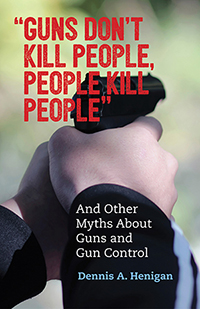
    Guns Don't Kill People People Kill People

    “The gun lobby’s mythology has lethal consequences. But it has those consequences only because the American people have yet to demand a different national discussion of guns and violence. They have yet to insist on more from their elected officials than rote repetition of empty slogans. Ultimately, if we continue to allow bumper-sticker mythology to dictate gun policy to deadly effect, we have ourselves to blame.”
    —Dennis A. Henigan, “Guns Don’t Kill People, People Kill People”: And Other Myths About Guns and Gun Control


    Bullets into Bells

    “It would be delusional to think that every congressman in this country would suddenly have a change of heart after reading this suite of poems, but it would also be delusional for writers of every color and creed to remain silent. The poetic instinct almost invariably sways toward the just. We have to speak up. Otherwise we are doomed. Silence, as Tahir Djaout says, equates to death. An untold poem would indeed be its own form of suffering.”
    —Colum McCann, from the introduction of Bullets into Bells: Poets & Citizens Respond to Gun Violence


    Talking About Death

    “The question is not whether children should receive education about death, but whether the education they are receiving is helpful and reliable. Understanding death is a life-long process that continues from childhood through old age.”
    —Earl A. Grollman, Talking about Death: A Dialogue Between Parent and Child

    Revolver


    About the Author 

    Christian Coleman is the digital marketing manager at Beacon Press and editor of Beacon Broadside. Before joining Beacon, he worked in writing, copy editing, and marketing positions at Sustainable Silicon Valley and Trikone. He graduated from Boston College and the Clarion Science Fiction & Fantasy Writers’ Workshop. Follow him on Twitter at @coleman_II.

  • By Philip C. Winslow

    Handgun

    Image credit: Andy Choinski

    Shortly after a teenage gunman murdered seventeen people and wounded seventeen others at Marjory Stoneman Douglas High School in Parkland, Florida, in 2018, I thought back over some American history and my own familiarity with guns, and wrote here on Beacon Broadside that

    “In 1970, historian Richard Hofstadter popularized the term ‘gun culture’ in writing about how Americans’ resolute possession of firearms dated back to colonial days, when farmer-settlers lived on a wild frontier, and the founders feared a standing army as an instrument of government tyranny. Political beliefs, he wrote, held that ‘The American answer to civic and military decadence, real or imagined, was the armed yeoman,’ in the militia system.

    “But, Hofstadter asked, two hundred years on and with the frontier long gone, ‘Why is the gun still so prevalent in a culture in which only about 4 per cent of the country’s workers now make their living from farming . . . Why did the United States alone among industrial societies cling to the idea that a substantially unregulated supply of guns among its city populations is a safe and acceptable thing?’”

    By 1989, nearly twenty years after his essay, gun violence was at “sustained, frightening levels,” I wrote, citing statistics and media coverage from that year.

    Now, more than half a century since Hofstadter’s searing analysis, the level of gun violence has mushroomed from frightening to terrifying: In 2020, more than 45,000 Americans died from firearms-related injuries. That year, gun injuries became the leading cause of death among children and adolescents.

    The public health crisis has gone way beyond the historical question of living on the frontier with a potentially tyrannical government waiting to suppress individual liberties.

    A number of Americans still do worry that government, almost surely a Democratic administration, is waiting to “take away our guns.” That is an overheated fantasy. It will not happen, no matter what government we have. Meanwhile, we arm up, buying more weapons by the year, encouraged by gun makers who realize that, because the weapons are well-made and durable, sales campaigns need to juice the people’s desire for more.

    Time and again, a judge will ask a trial participant, or a police officer will ask a suspect: “Why did you have a gun?” The usual sullen answer is: “It’s my right.” If anyone appears to stumble at the synapse between “why?” and “my right,” gun absolutists quickly respond the way this one did right after Parkland: “Whether some weapon increases or decreases average safety is irrelevant to its effectiveness as a self-defense tool.”

    There begins the infinite queasy-making loop, from which there is no ready escape. For adherents, the argument has expanded from “It’s my right” to “I’m American and I do what I damn well please and nobody tells me what to do.”

    At the core of what’s killing us is the question of how, or even whether, to balance individual liberty and public safety, two concepts that ought to work well together in a functioning democracy.

    Along with the Second Amendment and frequently waved like the bloody shirt is District of Columbia v. Heller, the US Supreme Court’s 2008 decision that enshrines the right of the individual to own a gun. But Heller added a caution, which is seldom mentioned publicly:

    “Like most rights, the Second Amendment right is not unlimited. It is not a right to keep and carry any weapon whatsoever in any manner whatsoever and for whatever purpose: For example, concealed weapons prohibitions have been upheld under the Amendment or state analogues. The Court’s opinion should not be taken to cast doubt on longstanding prohibitions on the possession of firearms by felons and the mentally ill, or laws forbidding the carrying of firearms in sensitive places such as schools and government buildings, or laws imposing conditions and qualifications on the commercial sale of arms.”

    Politicians, on guard against their own extremist flank, insist the focus should be on mental health and background checks—both desirable but of limited utility—and they promise to “harden targets,” such as schools and hospitals. When did schools, hospitals, and other public spaces become “targets” that need to be hardened? Quite some time ago, really, but that is wide of the point. Closer is the robotic perseverance of American gun manufacturers and the gun lobby, which together have badly distorted our ability to think clearly.

    Individual ownership and open carry of guns will not decrease in the near future. If it does happen it will not be because of government action. It will come from clear thinking and a spirit of compromise that’s hard for us stubborn, distrustful Americans.

    Despite predictions that our society may already be broken beyond repair, a return to common sense may still be possible.

    Not until we balance defending individual rights with protecting the public good can we abandon the assault-style rifles and battlefield ammunition and reduce the slaughter in our classrooms and grocery stores. That would be an unprecedented show of rugged togetherness.


    About the Author

    Philip C. Winslow has been a journalist and foreign correspondent for more than forty years; he has worked for the Christian Science Monitor, the Toronto StarMaclean’s Magazine, ABC Radio News, CTV News, and CBC Radio. He also served in two United Nations peacekeeping missions and spent nearly three years living in the West Bank. He is the author of Victory For Us Is to See You Suffer and Sowing the Dragon’s Teeth.

  • Bev Rivero

    After a season of hibernation, we are excited to reboot our “Beacon Behind the Books” series! In these times when readers are responding to our books “more than ever,” when our authors—including Colm Tóibín, Sheryll Cashin, Robin DiAngelo, Eboo Patel, and Gayl Jones—are appearing in the media, their ideas going viral on social media, their voices being heard on so many platforms, we thought it might be good to take a break to focus on some of the staff who work hard to find, shape, edit, produce, and promote those works. Our blog series introduces to you a member of our staff and gives you a behind-the-scenes look, department by department, at what goes on at our office.  

    For the month of June, we introduce you to our senior publicist, Bev Rivero! 

    What drew you to publishing, Bev? How did you find your way to Beacon?

    The timing of this Q&A is a nice bookend, as I joined Beacon last June! I saw this specific job retweeted by either POC in Publishing or Latinx in Publishing. I’ve been in publishing/the world of books in some way ever since I graduated college back in the aughts. After moving around a bit, I really found a sweet spot in working on progressive books, and publicity and marketing really suit my preference of crafting the messaging and helping to put out projects into the world that the author has spent so much time working on.

    What’s a typical day in the life of a senior publicist?

    I always start my day checking my inbox, seeing if there are replies from follow ups and checking any loose ends for interviews scheduled for authors—setting Zoom times and links—and then I check to see if I have meetings that day. The rest of my day is spent reaching out to media and venues for books that are currently out or coming out anywhere from three to six months from now. I also spend time communicating with authors, making sure they feel supported in their efforts between myself and marketing, and meeting virtually with my colleagues about our titles.

    This is my first time starting a fully remote role. When I left my last job, we were all working remotely during the pandemic, but I had started in-office. It’s been refreshing to see workplaces embrace the possibilities of remote work for the financial and mental well-being of their workers.

    What are some of the challenges of being a publicist? What do you find most rewarding?

    I mentioned that I have moved around a bit within books, and what I find most rewarding is working one on one with authors on their books to get their big ideas to their intended audiences. At my last job before Beacon, I worked on marketing and communications for the National Book Foundation. I learned a ton about marketing and working on the National Book Awards is an incredibly unique experience, but I really treasure building direct author relationships as part of my daily role.

    What is one book on our list that has influenced your thinking on a particular issue?

    One of my first projects when I joined Beacon was working with Sheryll Cashin on her latest book, White Space, Black Hood. Cashin is a veteran Beacon author, so I was excited to bring my connections and expertise to the table. I worked with a lot of authors writing in this area in my time at the New Press, so I’m no stranger to books on inequity. But the points that Cashin drives home about how engrained structural segregation is in American cities is something I find myself thinking about when reading about new construction projects, how government programs are run, and many more headlines.

    What current/upcoming projects are you excited about?

    I’m very much looking forward to Racial Innocence being part of the public dialogue about race, identity, and anti-Blackness. As a Latina, I’m looking forward to Tanya Hernández being part of that long-overdue conversation at a national level, especially as a legal scholar.

    What’s your advice to someone interested in entering the publishing field?

    Check out the different roles that exist at each point in a book’s lifecycle. There’s so much that happens after a book is signed and acquired! There are also options you can do, like working or volunteering at literary festivals, that are in-house publishing adjacent and will teach you a lot of helpful information about the field. If you work on programming for a literary festival, you will e-meet so many book publicists! Working in bookstores also teaches you about how books are sold in the marketplace. Interning for literary agents/authors/ghostwriters will pull back the curtain on certain processes. I’m sure I’m leaving out many other options, but there are definitely ways to learn (and get paid while doing it) beyond just doing in-house publishing internships.

    What other departments does your department interact/collaborate with? And how?

    I would say I work with marketing and editorial the most. I’m on the weekly web team meeting which, aside from necessary website and social items for our titles, is a bit of an ideas/brainstorming meeting about promoting our books online. As a staffer who has done social and marketing as well, I like being able to jump in and be part of this conversation. I’m in touch with editorial about authors on opinion pieces and, as we look toward the publication dates, about how we can get them to comment on current events as related to their work. I think this really brings everyone’s knowledge into one place: myself with the media landscape, editors who know the work the best, and the author as the expert.

    Favorite food?

    My two favorite cuisines are Peruvian and Korean. I am Peruvian so I might be biased but I really do think our food is delicious. If you like seafood, I highly recommend you try it! My favorite dishes are ceviche, jalea, and causa. I love spicy food, pickled things, and vegetables, so Korean food hits all my high points.

    Favorite book ever?

    I’m eternally a cheerleader for Free Food for Millionaires by Min Jin Lee. Pachinko is an excellent book as well. I’ve been really happy to see her work getting such amazing recognition in the past few years, as Free Food for Millionaires originally came out in 2007. I love that she was a lawyer before becoming an award-winning novelist—a career track that she has in common with a lot of authors I love, like Melissa Rivero (no relation, but she is Peruvian too!) and Charles Yu.

    Hobbies outside of work?

    I love museums and galleries. I know I’m lucky to live in one of the art centers of the world, and I always try to keep up with what shows are on. Locally, I love the Brooklyn Museum’s programming and I just saw a really great Faith Ringgold exhibit at the New Museum that you can catch if you head there before it closes on June 5. Outside of NYC, I love Dia Beacon, the American Visionary Art Museum in Baltimore, and MASS MoCA to name a few. Last month, I went and saw Guarding the Art at the Baltimore Museum of Art, which is a whole show curated by guest curators from the BMA’s Security department from the BMA collection. As the people who spend the most time with the art, it’s really cool to see them get to spotlight their favorite works, and I love any projects that show how art is for everyone.

    Do you still have a commute to work? If not, do you miss it? What do/did you like to do to pass the time?

    I don’t commute right now, and I really enjoy having that time back in my life, and being able to stay, get up and do a YouTube workout, or go for a long walk in Greenwood Cemetery after work during the summer months. And avoiding the subway during rain, snow, and extreme heat is an endless blessing.


    About Bev Rivero 

    Bev Rivero is senior publicist at Beacon Press. Before joining Beacon in 2021, Bev was the communications and marketing manager at the National Book Foundation, where she worked on the National Book Awards, promoted the Foundation’s public and educational programs, and led all social media and marketing campaigns. Prior to NBF, she was in publicity at the New Press for 6 years, where she worked with authors committed to social justice, including Paul Butler, Michelle Alexander, and many more. She has extensive experience promoting nonfiction and tailoring outreach campaigns that resonate with activists and change-makers. Bev is a NYC-based graduate of Johns Hopkins University, ardent supporter of indie presses, and a graphic designer. You can follow her on Twitter @LOLBev, where she mostly retweets content about books, pickles, and migrant justice.

  • By Brittany Wallace

    Breaking Bread picnic box

    Photo credits: Brittany Wallace

    I remember when I first heard about Breaking Bread. Contrary to what movies would have you think, the publishing process takes at least a year, sometimes two or three. When I started at Beacon in September 2021, we were already abuzz about our summer 2022 list—publishing speak for “forthcoming books.” Our director and the book’s in-house editor, Helene Atwan, brought Breaking Bread up in an all-staff meeting. She talked about how two years-long friends, Debra Spark and Deborah Joy Corey, gathered up to seventy essays from renowned and beloved food writers for the collection. Esteemed writers themselves, Spark and Corey edited the collection alongside Helene, and a beautiful, moving collection about food, hunger, and family was born. The first thing that came to my mind upon hearing about it was a tea towel. How perfect for the comfort-food vibe, right?

    Book marketers are always looking for creative ways to engage bookseIlers and readers. I was fresh out of grad school, where one of my final classes was about book marketing. My mind was awash with fantastical marketing swag, and the tea towel was just the latest wacky idea. But fast forward a few months, and I was officially the book’s marketer, which meant I could bring my foodie dreams to life.

    I spent two years in bookselling, so I knew a tote bag was out. Publishing is flooded with totes; after all, what’s better for carrying our book hauls than a literary bag? Booksellers didn’t need another one, though I must confess I toyed around with the idea of a market tote. I do love a good farmer’s market bag. I kept thinking about what would make the book stand out because I wanted to do it justice. I wanted booksellers to fall in love with it as I had. It was my job to get it out there, yes, but I also truly enjoyed it. When I first read the manuscript, I curled up on my couch with a mug of hot cocoa, and drank in the wisdom, love, and passion from the writers’ stories. I wanted booksellers to feel that, too.

    And so, the Breaking Bread bookstore tour was born.

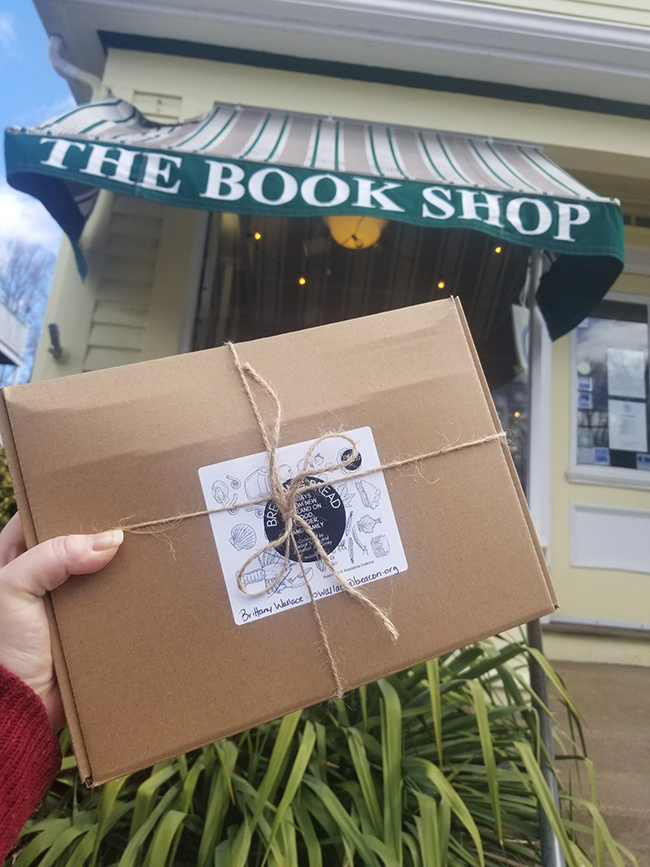
    I started with the idea of a “picnic box.” Deborah Joy Corey, founder of Blue Angel, graciously donated a box of Maine maple syrup—which pairs deliciously with coffee, by the way—and I ordered some Walkers shortbread cookies. I had our freelance designer, Liping Lin, create a gorgeous print of Wesley McNair’s poem featured in the book, “The Rhubarb Route.” I designed recipe cards around some of the contributors’ recipes, and yes, I even designed a tea towel. All of this, along with an advanced reader copy of the book, was packaged neatly in a box, ready to be hand delivered to bookstores across Massachusetts and Maine.

    I had a dedicated Breaking Bread corner of my apartment staged to prepare the boxes. My colleague, Avery, came over, armed with fresh donut holes from Union Square Donuts, and helped me put them together. Then came the fun part: planning visits to bookseller friends, new and old. I packed up my dog, Zora, who would keep me company on the drive and would be fawned over by all who met her and mapped out my mini-road trip.

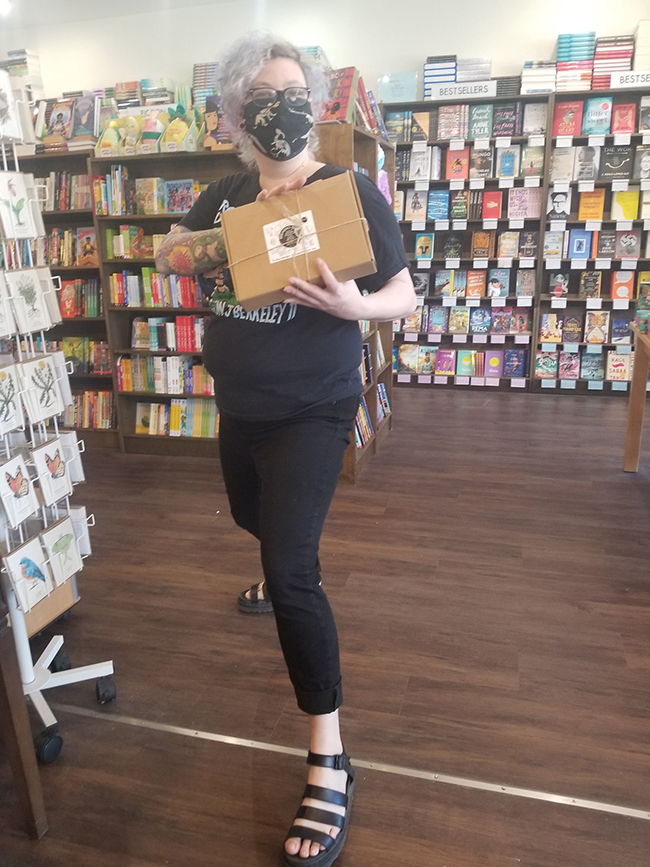
    The first stop was at Porter Square Books, Boston edition, where I dropped off a box to my friend and former colleague, Katherine. She later tweeted about it and talked about the book on our local radio station, WBUR. When we worked together, her specialty was (and still is) yelling about the best books she’s read, so it’s extra special to have her on board. After that, I was off to All She Wrote Books in Somerville, an intersectional feminist, queer bookstore owned by my good friend, Christina. Then I traveled to the Book Shop of Beverly Farms, where I delivered a box to Hannah Harlow and her team, and bought a copy of In Praise of Good Bookstores. (When in Rome . . . ) Next up was Copper Dog Books to meet my pals Meg and Vickie for the first time in person.

    Meg at Copper Dog

    Meg at Copper Dog

    Zora was thrilled to meet them and to snuggle with the plague nurse plush I bought on the car ride home later. And then, on an impulse truly unique to my brand, I drove the extra hour or so to Maine to drop in on my friends at Print: A Bookstore. As an aside: Please do yourself a favor and go buy their sweatshirt, which is worth every single penny; it’s the softest thing on the planet and is most definitely my favorite article of clothing.

    That was just day one.

    My next adventure took Zora and me to Wellesley Books, where she met a sweet poodle-mix friend and preened for the camera. They featured her as the “Dog of the Week” in their newsletter, and really, just look at that pose! I have a model on my hands.

    Zora at Newtonville

    Too adorbs! Zora at Newtonville.

    We popped into Newtonville Books and the Brookline Booksmith, the latter of which had been my local indie during grad school. I’ll admit that, at first, it was a bit strange being on the customer side of the desk, but it was amazing to reconnect—or, for some, connect for the first time—with booksellers in person. Everyone I spoke with, from Christina at All She Wrote to Lorna, Rebecca, and Peter at Wellesley Books, was excited for the book. Nick at Newtonville Books shared the sweetest (pun intended) post on Instagram, featuring the ARC and the syrup.

    After months of planning and designing, it was beyond fun to see these “picnic boxes” in booksellers’ hands. It was important to me that the contents would be useful, but also that those who received them would really see how special the book is.

    Delivering the picnic box to The Book Shop of Bev Farms

    Delivering the picnic box to The Book Shop of Bev Farms

    Royalties and net proceeds from the hardcover sales will be donated to Blue Angel to support the good work Deborah Joy and her team are doing in their community. And the book really is a balm for the soul, something I think we all need a healthy dose of after weeks, months, years of distressing news cycles.


    About the Author 

    Brittany Wallace is a sales and marketing assistant at Beacon Press. She joined Beacon in 2021 after completing her master’s in Publishing and Writing at Emerson College. Previously, she worked as a bookseller and magazine buyer at a Boston-based independent bookstore, and before that, she was at Barnes & Noble. She also has several years of experience editing at an online magazine, where she curated the fiction and nonfiction sections. When she’s not working, Brittany is likely hiking in the forest while listening to a true crime podcast telling her to stay out of the forest. You can find her yelling about books and her dog on Twitter @thebooseller.

  • Memorial candles

    Photo credit: Manfred Richter

    Our gun violence nightmare strikes again. We’re mourning the nineteen students and two teachers who died yesterday in the mass shooting at Robb Elementary School in Uvalde, Texas. Sixteen others were wounded. To honor their memory, we’re sharing these poems from Bullets into Bells. Edited by Brian Clements, Alexandra Teague, and Dean Rader, this collection is a powerful call to end American gun violence from celebrated poets and those most impacted.

    ***

    “Heal the Cracks in the Bell of the World”
    By Martín Espada

    For the community of Newtown, Connecticut,
    where twenty students and six educators lost their
    lives to a gunman at Sandy Hook Elementary School,
    December 14, 2012

    Now the bells speak with their tongues of bronze.
    Now the bells open their mouths of bronze to say:
    Listen to the bells a world away. Listen to the bell in the ruins
    of a city where children gathered copper shells like beach glass,
    and the copper boiled in the foundry, and the bell born
    in the foundry says: I was born of bullets, but now I sing
    of a world where bullets melt into bells. Listen to the bell
    in a city where cannons from the armies of the Great War
    sank into molten metal bubbling like a vat of chocolate,
    and the many mouths that once spoke the tongue of smoke
    form the one mouth of a bell that says: I was born of cannons,
    but now I sing of a world where cannons melt into bells.

    Listen to the bells in a town with a flagpole on Main Street,
    a rooster weathervane keeping watch atop the Meeting House,
    the congregation gathering to sing in times of great silence.
    Here the bells rock their heads of bronze as if to say:
    Melt the bullets into bells, melt the bullets into bells.
    Here the bells raise their heavy heads as if to say:
    Melt the cannons into bells, melt the cannons into bells.

    Here the bells sing of a world where weapons crumble deep
    in the earth, and no one remembers where they were buried.
    Now the bells pass the word at midnight in the ancient language
    of bronze, from bell to bell, like ships smuggling news of liberation
    from island to island, the song rippling through the clouds.

    Now the bells chime like the muscle beating in every chest,
    heal the cracks in the bell of every face listening to the bells.
    The chimes heal the cracks in the bell of the moon.
    The chimes heal the cracks in the bell of the world.

    ***

    “The Bullet, in Its Hunger”
    By Ross Gay

    The bullet, in its hunger, craves the womb
    of the body. The warm thrum there. Begs always
    release from the chilly, dumb chamber.
    Look at this one whose glee
    at escape was outshone only by the heavens
    above him. The night’s even-keeled
    breath. All things thus far dreams from
    his cramped bunker. But now
    the world. Let me be a ravenous diamond
    in it, he thinks, chewing through the milky jawbone
    of this handsome seventeen-year-old. Of course
    he would love to nestle amidst the brain’s
    scintillant catacombs (which, only for the boy’s dumb luck,
    slipped away) but this will do. The bullet does
    not, as the boy goes into shock, or as his best friend
    stutters, palming the fluid wound, want to know the nature
    of the conflict, nor the sound of the shooter’s
    mother in prayer, nor the shot child’s future harmonies:
    the tracheotomy’s muffled wheeze
    threaded through the pencil’s whisper as the boy scrawls I’m
    scared. No,
    the bullet, like you, simply craves
    the warmth of the body. Like you, only wants
    to die in someone’s arms.

    ***

    “The First Child Martyr at Illinois Elementary”
    By Liz Rosenberg 

    Children are so very graceful none
    were killed
    at Illinois Elementary
    when that poor bedeviled woman
    emptied her gun on the square-dance floor
    —except one boy who stumbled
    pushing his friend from the line of fire.
    His body should not have been
    in that place at that time.
    He could not have been more
    than eight or nine,
    so what did he think about his life to
    be so willing to desert it, leaping away
    as if to climb ropes in the gym?
    He was only a child, falling
    like a player on the hardwood floor.
    And what on earth did he know

    that now we will never know?

    ***

    “Letter Beginning with Two Lines by Czesław Miłosz”
    By Matthew Olzmann 

    You whom I could not save,
    Listen to me.

    Can we agree Kevlar
    backpacks shouldn’t be needed

    for children walking to school?
    Those same children

    also shouldn’t require a suit
    of armor when standing

    on their front lawns, or snipers
    to watch their backs

    as they eat at McDonalds.
    They shouldn’t have to stop

    to consider the speed
    of a bullet or how it might

    reshape their bodies. But
    one winter, back in Detroit,

    I had one student
    who opened a door and died.

    It was the front
    door to his house, but

    it could have been any door,
    and the bullet could have written

    any name. The shooter
    was thirteen years old

    and was aiming
    at someone else. But

    a bullet doesn’t care
    about “aim,” it doesn’t

    distinguish between
    the innocent and the innocent,

    and how was the bullet
    supposed to know this

    child would open the door
    at the exact wrong moment

    because his friend
    was outside and screaming

    for help. Did I say
    I had “one” student who

    opened a door and died?
    That’s wrong.

    There were many.
    The classroom of grief

    had far more seats
    than the classroom for math

    though every student
    in the classroom for math

    could count the names
    of the dead.

    A kid opens a door. The bullet
    couldn’t possibly know,

    nor could the gun, because
    “guns don’t kill people,” they don’t

    have minds to decide
    such things, they don’t choose

    or have a conscience,
    and when a man doesn’t

    have a conscience, we call him
    a psychopath. This is how

    we know what type of assault rifle
    a man can be,

    and how we discover
    the hell that thrums inside

    each of them. Today,
    there’s another

    shooting with dead
    kids everywhere. It was a school,

    a movie theater, a parking lot.
    The world

    is full of doors.
    And you, whom I cannot save,

    you may open a door
    and enter

    a meadow or a eulogy.
    And if the latter, you will be

    mourned, then buried
    in rhetoric.

    There will be
    monuments of legislation,

    little flowers made
    from red tape.

    What should we do? we’ll ask
    again. The earth will close

    like a door above you.
    What should we do?

    And that click you hear?
    That’s just our voices,

    the deadbolt of discourse
    sliding into place.

    ***

    “[When a child hears gunshots]”
    By Meghan Privitello

    When a child hears gunshots,
    she will say Mom is beating
    the pots and pans. She will say
    It sounds like home. Let’s keep it
    this way; our children
    misinterpreting the sound of dying
    as a crude percussion.
    When they kneel at their beds
    and ask God where he was
    when their best friend stopped
    being alive he will say
    I was at the drive-thru,
    I was so hungry I thought the gunshots
    were my stomach begging for food.
    He will say I know nothing
    until strangers tell me about it first,
    I could have bullet wounds in my hands
    and I’d know nothing about what hurts
    and doesn’t hurt. What a God; making
    the world out of variations of madness,
    refusing to hold its face in his hands
    and saying You, you are mine.
    It is not ours: the young blood,
    the unfinished drawings,
    the last blurry thoughts before a world
    goes black. When God is busy wiping grease
    from his mouth, we can stand in a line
    with the dead in our backpacks,
    next to our pencils and our snacks;
    he won’t notice when
    we give the whole damned world back.

  • Graduation ceremony

    Photo credit: Leonardo Alvarado

    It’s flying graduation caps season! We’re not post-pandemic, but graduates are embarking on a world stage that looks different from what it was two or three years ago. Some of those differences are alarming. Conservative pundits writing book banning and censorship into local legislations. (White fragility much?) SCOTUS dangling reproductive rights on a thin thread. Another round of racist gun violence, this time in Buffalo, NY. Oh, and COVID is still hanging around. How to step forward in this brave new world that has such people in it? We look to the words of wisdom in these recommended titles. Words that give you a frame for understanding what the heck is happening, the means to envision the person you want to be, the inspiration to build a better society.


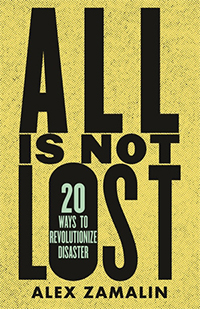
    All Is Not Lost

    All Is Not Lost: 20 Ways to Revolutionize Disaster

    Disaster is an opportunity to change the world. This is the first lesson of this book. You can expand democracy for the majority in times of crisis. Luckily for us, there’s a rich history of activists, intellectuals, and artists navigating the treacherous terrain of the unknown and unseen, and living to tell their stories in a new world they both helped create and, at times, never thought would be possible. . . . From them, you’ll learn how to resist successfully, speak emphatically, organize collectively, memorialize ethically, dream poetically, write prophetically, occupy vigorously, build durably, and act decisively.
    —Alex Zamalin 


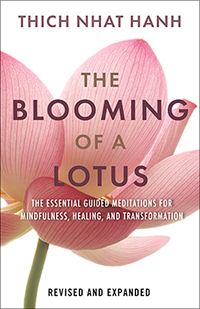
    The Blooming of a Lotus

    The Blooming of a Lotus: Essential Guided Meditations for Mindfulness, Healing, and Transformation

    To be alive, and to touch all the wonders of life within you and around you, is truly a miracle. We need only to open our eyes and to listen carefully to enjoy life’s richness. That is why the present moment can be the most beautiful and wonderful moment when you know how to be aware of your breathing to bring yourself back.
    —Thich Nhat Hanh 


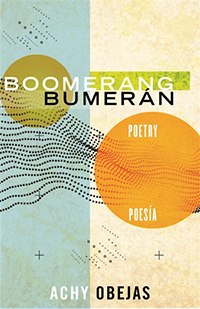
    Boomerang

    Boomerang/Bumerán : Poetry/Poesía

    We spin, then come down in a spiral,
    a high flying twirl, a spiral, a straight line.
    If done justly, the flow lifts both wings,
    understanding, of course, that at least half the time
    we’ll each find a higher velocity
    and then a subtracting tip speed.
    We try to arrange the spinning, the spiral,
    to control the curving along the unbalanced
    elliptical path, the spiral
    that returns us to our point of origin.

    //

    Giramos, luego descendemos en espiral,
    une giro elevade, une hélice, línea recte.
    Si se hace correctamente, le flujo levanta ambes alas,
    entendiendo, por supuesto, que a le menos le mitad de le tiempo
    cada une conseguirá une velocidad más alte
    y luego une velocidad de punta reste.
    Tratamos de arreglar le giro, le espiral,
    para controlar le curvatura a le largo de le desequilibrade
    camino elíptique, le espiral
    que nos lleva a nuestre punto de origen.
    —Achy Obejas, “Boomerang”/”Bumerán”


    Boyz n the Void

    Boyz n the Void: a mixtape to my brother

    Permission to fully inhabit our humanity isn’t something we need to ask anyone for. It is our birthright. When you dare to live wholly in your humanness—to extend luxuriantly into its every crack and corner—you will likely discover that every seemingly unified front conceals a few defectors-in-waiting. Should you find yourself shouted down by a majority, their unanimity is an illusion more often than not.
    —G’Ra Asim 


    Nothing Personal

    Nothing Personal
    with a foreword by Imani Perry and an afterword by Eddie S. Glaude, Jr.

    It has always seemed much easier to murder than to change. And this is really the choice with which we are confronted now.
    —James Baldwin


    Pregnant-Girl

    Pregnant Girl: A Story of Teen Pregnancy, College, and Creating a Better Future for Young Families

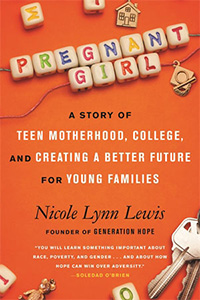
    I used to envision my graduation day when I sat in the Motel 6 as a way to help me make it through to the next day. When I pictured it, the scenes and faces were a blur, but now they were in front of me, each smile, wrinkle, and tearful eye exact and clear and just as it should be. Now I tried to envision what was next for me and [my daughter Nerissa], and it was hard to think of an existence that didn’t involve me functioning in a constant state of scarcity. I also couldn’t imagine leaving my experience here in Williamsburg and not doing something for the millions of other young mothers and fathers out there who could do the very same thing and just needed the support and resources to get there.
    —Nicole Lynn Lewis 


    The Radiant Lives of Animals

    The Radiant Lives of Animals

    When I think of change, I consider the re-minding of ourselves and I mean that it is time to consider other kinds of intelligence and ways of being, to stretch our synapses to take in new ways of thought. As an Indigenous woman, I look toward our Native knowledge systems, the times when our relationship with the earth wasn’t the disjointed connection most of us have learned from our Euro-American education systems. I am one human animal who wants to take back original meanings and understandings in ways that are possible and are necessary.
    —Linda Hogan 


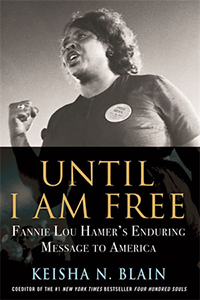
    Until I Am Free

    Until I Am Free: Fannie Lou Hamer’s Enduring Message to America

    Try as we might, we cannot disentangle ourselves from the concerns of others who make up this diverse nation. The work of democracy is incomplete, but the fight is certainly not over. As Hamer reiterated time and time again, we still have the power to make these ideals a reality. Our individual futures, as well as our collective future, in the United States depend on it. We must keep pushing for change. We have a long fight ahead.
    —Keisha N. Blain 


    We Need to Build

    We Need to Build: Field Notes for Diverse Democracy

    Tell a story of America where we all belong; build civic spaces where we can all contribute and feel connected. You want people who are being their worst selves to be their better selves. And truthfully, you want to be better too. All of us need to be better.
    —Eboo Patel

    Graduation ceremony