• By Daina Ramey Berry

    1861: “Slaves for sale, a scene in New Orleans.” 19th-century engraving Via New York Public Library Digital Collection

    1861: “Slaves for sale, a scene in New Orleans.” 19th-century engraving Via New York Public Library Digital Collection.

    On April 5, 2022, Daina Ramey Berry testified before the US House Financial Services Committee on the role of banks and insurers in US slavery. Her testimony cites her research and her book, The Price for Their Pound of Flesh. It is now part of the Congressional record.

    ~~~

    Good afternoon, Chairman Green, Chairwoman Waters, Vice Chair Williams and members of the Committee. It is an honor to come before this body to share my testimony on the legacies of slavery and connections to financial institutions. I have been studying this history for thirty years and I appreciate the invitation.

    Enslaved people were valuable financial investments. So valuable that financial institutions, municipalities, universities and private citizens bought, sold, gifted, deeded, traded, mortgaged, leased and transferred enslaved people as a form legal tender. Human chattel were foundational to western economies from the fifteenth to nineteenth centuries. They were one of the most unique commodities and assets because they were human beings. Defined as chattel, a movable form of property, we have records confirming their value at every stage of their lives from preconception to postmortem.[1] We also have documents that clearly outline the connections between enslaved people and specific financial institutions, such as insurance companies and banks. Those records can be traced from slavery to the present.[2] Such legacies reverberate throughout our society today and are reflected in all kinds of disparities. The wealth gap is so wide that most of us will not see it narrow in any appreciable way in our lifetimes.

    Turning to insurance agencies, the Southern Mutual Life Insurance Company, founded in 1848 under the name Georgia/Southern Mutual, shows evidence of profits generated from insuring the bodies and lives of enslaved people. During its second year offering policies to enslavers, the company saw growth from twenty-eight to 239 policies. It reported that most of those who purchased policies were modest enslavers who had “a small number of slaves, on who they are dependent” thus they secured their income “by taking policies on the lives” of human property.[3] Looking at policies from 1856 to 1863, we learn that the company insured enslaved people from age one to sixty. Some policies were for a month or two, others for as long as five years. Regardless of the length, each enslaved person underwent a medical examination to determine their value, and the company set premiums and rates based on their value. Although this company originated in Georgia, Southern Mutual Life Insurance Company had agents throughout the South.

    In addition to individual policies, some states, including Maryland, passed legislation that encouraged people to purchase policies on the enslaved. Here, the state supported policies that helped enslavers search for self-liberated individuals (runaways) in order to recover the cost of those who absconded and had been away for “a reasonable time.” That enslavers could make money off of those who escaped is remarkable. They also made money off of “elderly” enslaved people like forty-two-year-old Ellick, who was valued at $2,000 for a one-year premium at $80, with a four percent rate on the policy. What do these numbers reflect in contemporary times? Fifty-one-year-old Charlotte, valued at $800 in 1860, was equivalent to nearly $23,500 in 2014.[4] Insurance policies alone help explain why some enslavers keep elderly enslaved people—many would not command the insured value in the market. However, they could be replaced with someone younger at death.

    The banking industry literally facilitated transactions related to enslaved people by extending loans, securing deeds, gifts, and trusts. Banks including Citizens Bank and Union Bank kept track of collateral payments and issued notes that involved the enslaved whose names can be found through the records.

    According to an article that appeared on Bloomberg Quint in 2021, we know that “The racial wealth gap begins with slavery” and “was a huge wealth generator for White Americans.” The author estimated that the “economic value of the 4 million slaves in 1860 was, on average, $1,000 per person, or about $4 billion total.” To put that in perspective, “That was more than all the banks, railroads and factories in the U.S. were worth at the time. In today’s dollars, that would come out to as much as $42 trillion, accounting for inflation.”[5] This is, indeed, an underestimated value, and we need to take the time to do more calculations based on the primary records of these institutions to confirm the values of enslaved people.

    I would like to close my remarks with the voices of the enslaved, because most of my research focuses on enslaved people and how they responded to being treated as commodities and what they knew about the value of their bodies. One witness shared the following story of a young child and his father being auctioned: “I saw a beautiful boy of twelve years of age, put on the auction-block, and on one side of him stood an old gray-headed negro—it was plain he was his father—and he kept his eyes on the boy, and the boy kept his eyes upon the old gray-headed man, and the tears rolled in silence down the cheeks of each.”[6]

    After freedom, Henry Banner shared: “I was sold for $2,300—more than I’m worth now.” [7]

    Tempe Herndon and other enslaved women understood that their monetary value was linked to their fertility: “I was worth a heap . . . kaze I had so many chillun,” she explained. “De more chillun a slave had de more dey was worth.”[8]

    Hardy Miller remembered that enslavers paid “one hundred dollars for every year you was old,” claiming, “I was 10 years old so they sold me for one thousand dollars.” While Martha King remembered her sale at five years old. She went to the auction block with her grandmother, mother, aunts, and uncles. “I can remember it well,” she told interviewers in the 1930s. “A white man ‘cried’ me off just like I was an animal or varmint or something.” She also remembered her monetary value: “Old man Davis give him $300.00 for me.” [9]

    Today, I share these testimonies as part of mine so the enslaved voice is heard in the halls of Congress 157 years after the Thirteenth Amendment, because the wealth generated from their labor still serves as the foundation of the American economy.

    Thank you.

    ~~~

    Watch Dr. Berry give her testimony.


    [1] Daina Ramey Berry, The Price for Their Pound of Flesh: the Value of the Enslaved, from Womb to Grave, in the Building of a Nation (Boston: Beacon, 2017).

    [2] Daina Ramey Berry, “The Ubiquitous Nature of Slave Capital,” in After Piketty: The Agenda for Economics and Inequality, edited by Heather Boushey, J. Bradford DeLong, and Marshall Steinbaum (Cambridge: Harvard University Press, 2017); Calvin Schermerhorn, The Business of Slavery and the Rise of American Capitalism, 1815-1860 (New Haven: Yale University Press, 2015); and Sven Beckert and Seth Rockman, eds., Slavery’s Capitalism: A New History of American Economic Development (Philadelphia: University of Pennsylvania Press, 2016).

    [3] Second Annual Report of the Southern Mutual Life Insurance Company for the year 1856 (Columbia, SC: Edward H. Britton, 1857), quoted material on pp 12.

    [4] Berry, The Price for Their Pound of Flesh, footnote 36, p. 239. This value is the real price with CPI percentage increase from 1860-2014 based on the Eh-Net Measuring Worth website. As noted, Charlotte’s labor value would be approximately $147,000.

    [5] See Catarina Saraiva, “Four Numbers that Show the Cost of Slavery on Black Wealth Today,” Bloomberg Quint, https://www.bloombergquint.com/business/pay-check-podcast-episode-2-how-much-did-slavery-in-u-s-cost-black-wealth and Mehrsa Baradaran The Color of Money: Black Banks and the Racial Wealth Gap (Cambridge: Harvard University Press, 2017).

    [6] Berry, The Price for their Pound of Flesh, 63.

    [7] Berry, The Price for Their Pound of Flesh, xii.

    [8] Berry, The Price for Their Pound of Flesh, 45.

    [9] Berry, The Price for Their Pound of Flesh, 46.


    About the Author

    Daina Ramey Berry is the Oliver H. Radkey Regents Professor of History and Chair of the History Department at the University of Texas at Austin. She is the author or co-editor of several previous books, including The Price for Their Pound of Flesh: The Value of the Enslaved, from Womb to Grave, in the Building of a Nation, winner of the 2017 SHEAR Book Award for Early American History. Connect with her at drdainarameyberry.com and on Twitter (@DainaRameyBerry).

  • By Avery Cook

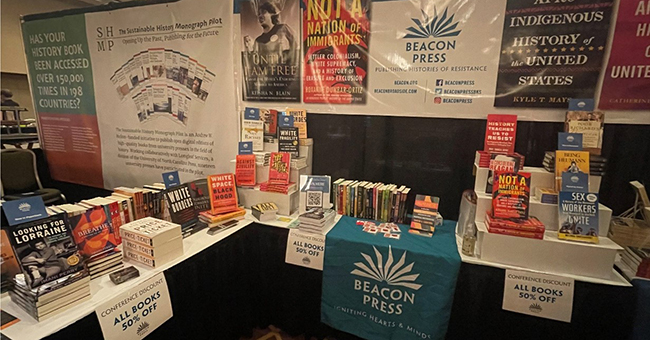
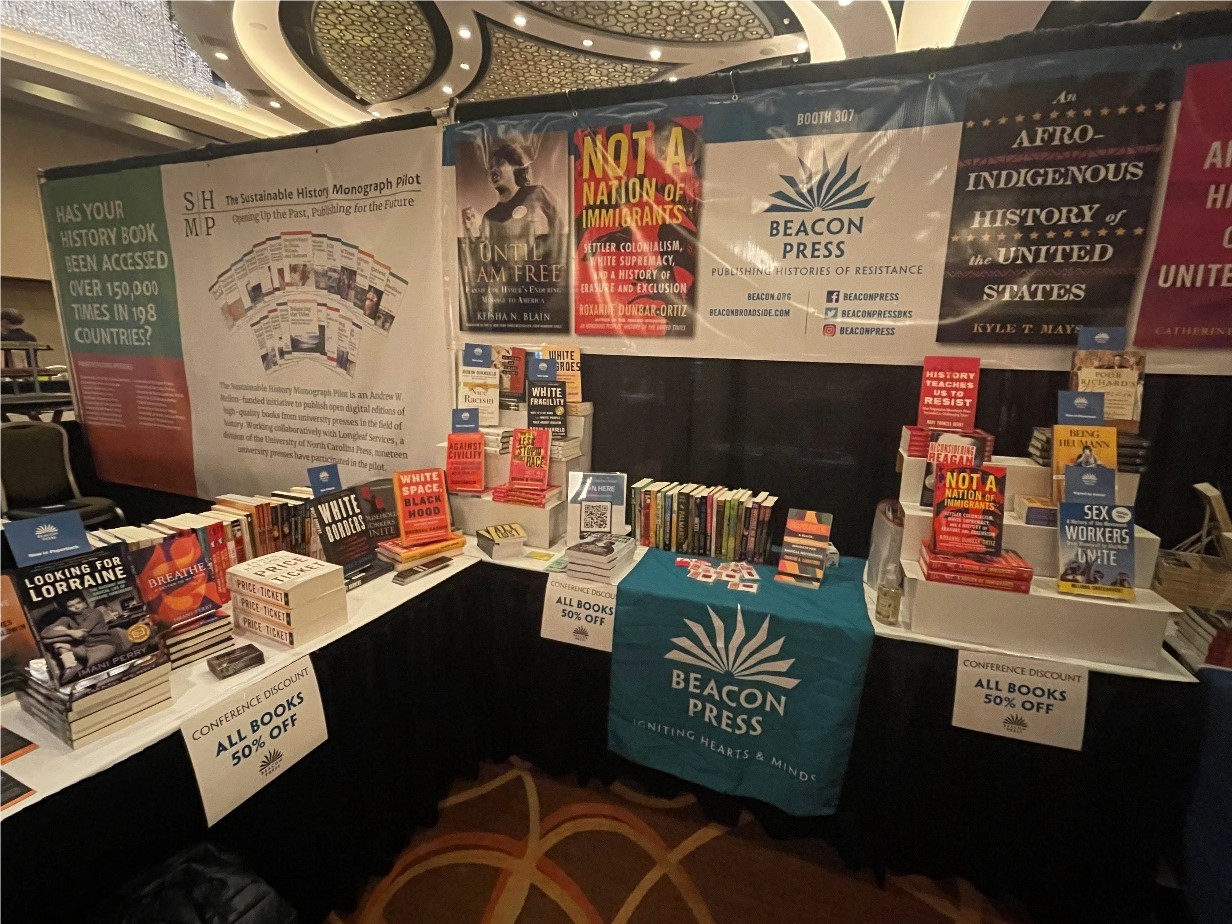
    Beacon Press display of books at OAH 2022

    All set up at the 2022 Annual Meeting of the Organization of American Historians! Photo credits: Avery Cook

    After two long years of conference Zoom rooms, we donned our lanyards once again and set up our table-skirted shop at the 2022 Annual Meeting of the Organization of American Historians (OAH) in Boston, from March 31 through April 3.

    With the conference in our backyard this year, we attended with numbers and enthusiasm, enjoying for the first time since 2019 the privilege of being surrounded by our books and chatting in person with some of our authors. Our booth saw visits from Mary Frances Berry, author of Five Dollars and a Pork Chop Sandwich and History Teaches Us to Resist and coauthor of Power in Words; Melinda Chateauvert, author of Sex Workers Unite; Dana Frank, author of Buy American and coauthor of Three Strikes; Marcus Rediker, author of Villains of All Nations, Outlaws of the Atlantic, The Fearless Benjamin Lay, coauthor of The Many-Headed Hydra, and editor of Prophet Against Slavery. And two of our forthcoming authors, Gloria Browne-Marshall, who wrote She Took Justice, and Rhonda Y. Williams, who wrote Concrete Demands, were there, too!

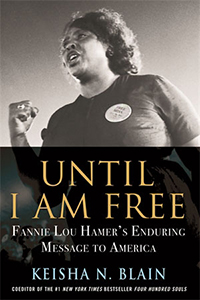
    The titles attendees flocked to at this year’s conference were Dr. Keisha Blain’s Until I Am Free, Roxanne Dunbar-Ortiz’s Not “A Nation of Immigrants” and An Indigenous Peoples’ History of the United States, David Lester, Marcus Rediker, and Paul Buhle’s Prophet Against Slavery, Daina Ramey Berry and Kali Nicole Gross’s A Black Women’s History of the United States, and Kyle T. Mays’s An Afro-Indigenous History of the United States. It was exciting to see titles both from our backlist and from recent years side by side reaching new audiences, and we look forward to sharing forthcoming history titles, including Catherine Ceniza Choy’s Asian American Histories of the United States, coming out this August, which was popular as advance reader copies at the booth.

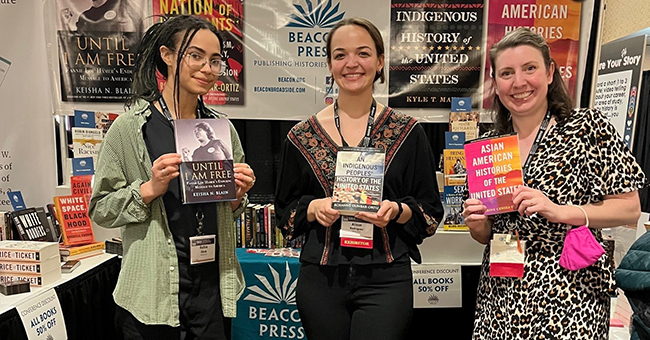
    Posing galleys and final copies at OAH 2022

    Posing with with galleys and final copies: Ruthie Block, editorial assistant (left); Alison Rodriguez (center); Emily Powers, senior marketing manager (right)

    We asked a few members of our team to share their thoughts about being back at OAH. Here’s what they said:

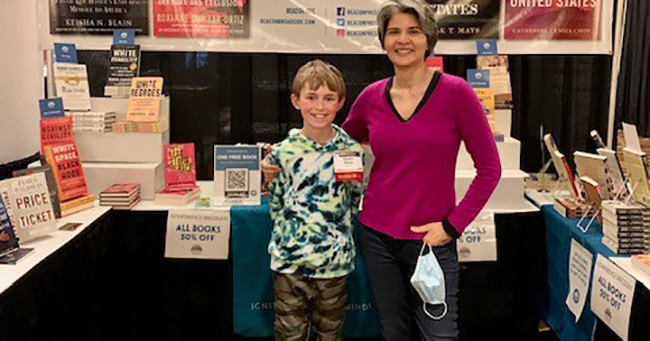
    Gayatri Patnaik and her son, Matthew, at OAH 2022

    Gayatri Patnaik and her son, Matthew

    “After two years of not being able to attend academic conferences, it was nothing less than a joy to be able to attend the OAH—and a definite plus that it was in Boston. It was wonderful to spend time with Beacon colleagues, meeting some of them in person for the first time. And after our virtual existence for the last two years, the impact of being together with other publishers in one space, surrounded by books and catching up with friends, was poignant. Highlights included sharing a meal with Beacon authors Mary Frances Berry, Melinda Chateauvert, Marcus Rediker, Paul Ortiz, and future authors Gloria Browne-Marshall and Rhonda Y. Williams. My son, Matthew, who joined us on the last day, thoroughly enjoyed his first OAH, generously helping himself to swag from every publisher and finally experiencing for himself these mysterious conferences his mother periodically attends!”
    —Gayatri Patnaik, publisher and incoming director


    “For me, I think the biggest positive changes were how much more we use technology at the booth. When I started five years ago, we were doing a lot of sales and requests on paper, and now we are using iPads for all transactions and using QR codes to link to special offers and newsletter sign ups. It’s exciting to see how much we’ve been able to streamline things.

    As many other people probably said, this was a slower year for us – most likely because of lingering COVID impacts. But it was a great opportunity to be able to be close to home for our first in-person event since November 2019! It was definitely a smaller conference than usual, but I imagine things will get busier later in the year.

    We still received numerous compliments and messages of thanks from people who noted how crucial these books are the current moment. And as always, everyone loves all our swag!”
    —Emily Powers, senior marketing manager


    “I was really motivated by the work the countless OAH historians were presenting and felt new energy towards different topics that I think would lend themselves really well to Beacon books. I got the opportunity to meet some of our authors for the first time and to share enthusiasm with them about their work and about the work we’ve done or will do together. It was amazing to get to see our books and our staff in action and to get to be in a space like that, in person, for the first time in too long!”
    —Ruthie Block, editorial assistant

    From here, Beacon Press continues plans for attending the 2022 Annual Meeting of the American Educational Research Association in San Diego later this month.

    Beacon Press display at OAH 2022


    About the Author 

    Avery Cook joined the Beacon sales and marketing teams in 2022. She graduated from Hamilton College in 2021, where she studied creative writing and worked in community outreach, interfaith organizing, and archival research around American communal societies.

  • By Lennard Davis

    Leo (Daniel Durant), Jackie (Marlee Matlin) and Ruby (Emilia Jones) swipe left on Tinder profiles in the movie “CODA.”

    Leo (Daniel Durant), Jackie (Marlee Matlin) and Ruby (Emilia Jones) swipe left on Tinder profiles in the movie “CODA.”

    Like many Children of Deaf Adults [CODAs], I was heartened to see that the film CODA had won Best Picture at the Academy Awards. It is very exciting that Troy Kotsur, who plays the Deaf father of the hearing child in the film, was the first Deaf male actor who won for Best Supporting Male Performance. It is also encouraging to see a movie in which all the roles of the Deaf characters were actually played by Deaf actors. Hurray! All a major step forward in the fight against audism. But as a CODA, I should step back from the cheering crowds of appreciative hearing and Deaf fans to express some serious regrets. 

    All the recent publicity has been about Deafness and very little about being a CODA. When we look at the interviews, they are largely with Marlee Maitlin, a wonderful Deaf actress and the first and only Deaf actress to receive an Academy Award for her starring role in Children of a Lesser God. The publicity material for the film stresses how Deaf-centric the film is. Hurray for that too! But where is the publicity around the actual experience the film professes to portray—being a CODA? 

    The director and writer, Siân Heder, is neither Deaf nor a CODA. CODA is a remake of the French film La Famille Bélier, written, acted, and directed by hearing people without any significant input from CODAs. I think it is important to note that Heder had no previous experience with Deafness nor being a CODA when she was approached by the producers of the French film who wanted to make an American version of it.

    She gets kudos for doing a lot of research and consulting with some CODAs as she rewrote and revised the original film script. But most of her interactions with CODAs were with a few sign language interpreters who were CODAs on set. It’s disingenuous to claim that CODAs seriously were part of the creative process when they were essentially hired for a different task—that of interpreting sign language. Isn’t it also ironic that the film’s central story is about CODAs having to do interpretation instead of following their dreams, yet the involvement of CODAs in the production entailed interpreting rather than being hired to be part of the creative team? It’s a little hard, though, to make last-minute adjustments when you are shooting a film since time and money dictate moving quickly at that point. Also important is that Emilia Jones, the actress who plays the CODA Ruby Rossi, was likewise unfamiliar with Deafness and the CODA experience. Of course, you don’t have to be “something” to write about it and act it. After all, that is what creativity is about—making something up. But given the general feeling about identity and representation in our time, it is a bit disappointing that CODAs were not more centrally involved in crafting the story.

    And the results of that lack of involvement showed, at least for me, in the final version of the film. According to Heder, “In the French film, I felt that it was much more focused on Ruby, the hearing character. There was an opportunity to build out the rest of the family—to make those characters really three dimensional, and not defined by their deafness.” But one wonders if the shift from the CODA to the Deaf family distorted the purpose of the film, which is called CODA, not A Deaf Family.

    In the film, Ruby seems like an average American teenager. She has two main problems—her parents rely on her to interpret for their fishing business, medical visits, and other public interactions and therefore do not want her to have extracurricular activities and to go to college. And she wants to pursue a career in music, which her Deaf parents foil because music isn’t important to them. The film focused on those two issues, which are both red herrings for most CODAs. The Americans with Disabilities Act and other legislation mandate that in most situations, like legal proceedings and medical encounters, sign language interpretation is a required accommodation. It makes sense that for the earlier French film, these might have been issues since they did not have the ADA. But that issue makes less sense in the present moment. And as for Deaf parents being unsupportive of musical endeavors, I haven’t met a single CODA who ever brought up the subject. So, in essence, the problems that the film’s plot revolves around are non-problems. And certainly not main concerns for CODAs. 

    Ruby, as a teenager, does have to field some peer-pressure embarrassment for having Deaf parents, and this is something that some CODAs have had to deal with, but so many kids in teen movies face the same bullying for one thing or another. What the film misses is the vast psychological and emotional turmoil that can sometimes come with being the hearing child of Deaf parents. I have attended numerous CODA conferences and have watched as my CODA “siblings” have run the gamut of emotion from deep pain and sadness to joy and love. The road CODAs must travel is not a simple one of working out the logistics of interpreting and the cultivation of music appreciation. Their issues run much deeper.

    Let me give you some examples. An only hearing child in an otherwise Deaf family, much like the Rossi’s who have another Deaf son, was so distraught about not being Deaf that they considered taking the point of a drawing compass and putting a hole in their eardrums so that they could better fit in with their Deaf family. Another was furious and depressed to the point of considering divorce because their partner did not bother to learn sign language so that he could communicate with her parents. Many others, including myself, have spent years in therapy trying to work out the fundamental problem of being an infant and not having one’s cries and calls for help heard from the very first day of birth onwards. Child monitors and other technology can ameliorate this issue to some degree, but these are not fool-proof solutions. Many of us are hypervigilant because we knew, growing up, that our parents couldn’t protect us from dangers that involved hearing warnings like fire alarms and those made by intruders. Most CODAs deal with the results of this structural problem by becoming fiercely independent and find it difficult to ask for help because we learned at a very early age that you very often weren’t going to get help.

    Let me make it clear that I am not saying that Deaf people should not have children nor that Deaf people do not make wonderful loving parents. And never should social services remove children from Deaf parents, saying that they are not competent to raise their children. We CODAs love and admire our Deaf parents. But that does not mean there aren’t issues we have to deal with and that have shaped our lives.  

    You would never know from this film that there are CODA organizations around the world made up of thousands of Ruby’s. There are KODA camps for “kids of deaf adults” run by other CODAs who are dealing with the complex issue of being a CODA. Indeed, it is sad that the filmmakers never seriously reached out to these groups to get some input from experts as the script developed. It is a well-used phrase within the disability community—“Nothing About Us Without Us.” But clearly, that idea did not catch on.

    One of the comforts of being part of this organization is that being a CODA, like being gay or Deaf, is an identity in which you are only “one generation thick.” This means that you probably don’t have any members of your own family who are of that identity. You fall “far from the tree” as Andrew Solomon has pointed out in his well-received book of the same name. Because of this, Deaf people tend to form communities of their own to replace their largely hearing families. The isolation of the Rossi’s is a distorted fiction of the film. And if Ruby were actually like most of us CODAs, she would have been playing with children like herself and sharing her problems with the hearing children of her parents’ Deaf friends.   

    But the Rossi’s and Ruby live in a Deaf desert created by the filmmaker and crew, although the town of Gloucester, Massachusetts, has a thriving Deaf community. How different would have been the outcome of this movie if Ruby had a CODA friend (think “Bechdel Test” applied in this case). How amazing would the film have been if an active Deaf community, and the regulations and laws of the ADA, had come to bear. Of course, if that were the case, the film’s flimsy and contrived plot would have dissolved and what we would have been left with was the actual emotional and psychological issues facing CODAs. How much better would that have been?


    About the Author 

    An award-winning author of eleven books, including My Sense of Silence and Enabling ActsLennard J. Davis is Distinguished Professor of Liberal Arts in the departments of Disability Studies and English at the University of Illinois at Chicago. He has written for the New York Times, Chicago Tribune, Nation, and Chronicle of Higher Education, among other publications. He lives in New York City. Follow him on Twitter at @lendavis.

  • Gayatri Patnaik

    Photo credit: Catherine Campbell

    In the wake of Helene Atwan’s retirement announcement, Beacon Press is delighted to share that Gayatri Patnaik, who has been with the press for two decades, has been appointed as the next Director, effective July 30, 2022.

    Beacon, a 168-year-old Boston-based independent, nonprofit publisher, is a department of the Unitarian Universalist Association (UUA). Announcing the appointment, UUA President Susan Frederick-Gray and Executive Vice-President Carey McDonald said, “The hiring process has only affirmed our high level of confidence in Gayatri’s leadership. We believe unequivocally that she is the right choice for Beacon’s next Director.” Helene Atwan, who led the Press for twenty-six years, added, “Hiring Gayatri was the best decision I ever made. I am just thrilled to have her taking over. The press simply could not be in better hands.”

    At a time when the book publishing industry is again reckoning with a diversity crisis among staff and in the voices they publish, Beacon, which has long held a commitment to diversity, equity, and inclusion within its staff as well as among its author representatives, is proud that a queer woman of color will be leading the press for the first time in its history. 

    Twenty years ago, Patnaik, who is Hindu, felt called to work at Beacon. “I wanted a publishing home where I could grow intellectually and bring my full self as a Brown, queer immigrant,” she notes. “I wanted to publish books I felt connected to and be part of a movement bigger than myself. I found all that and more at Beacon, through our books and through the richness of the community—our visionary authors, generations of talented Beacon staff, and the UUA. I am grateful for Helene’s support and incredibly honored to lead this historic press.”

    Patnaik (she/her) has a master’s degree in anthropology from The New School for Social Research, over twenty-five years of experience in book publishing, and previously held editorial positions at Rob Weisbach Books/William Morrow, Routledge, and Palgrave before moving to Beacon, where she has been Editorial Director, and most recently, Publisher. Patnaik has expanded and diversified Beacon’s list by acquiring 200 books and publishing folx from BIPOC, queer, and immigrant communities.

    Patnaik has published award-winning authors including Imani Perry, Roxanne Dunbar-Ortiz, Cornel West, Kate Bornstein, Jeanne Theoharis, and Marcus Rediker. She has developed books in “The King Legacy,” a series by Dr. Martin Luther King, Jr., and has created and launched three robust series, including “Queer Action/Queer Ideas,” as well as the acclaimed “ReVisioning History” series, which powerfully reframes history by centering the experiences of those from historically underrepresented communities. Patnaik delivered the commencement speech at her alma mater, Goshen College, in 2019 and was awarded the Editorial Excellence Award by the Biographers International Organization in 2020.

  • By Tourmaline

    Leslie Feinberg

    Photo credit: Leslie Feinberg

    I was a preteen when the first edition of Transgender Warriors—the foundational text by the late, great Leslie Feinberg—was published in 1996. It came into the world at a pivotal time for me, providing the life-changing context that would help me to understand who I was and who came before me. Context that, before this book, could only be found scattered in disparate places, passed down in whispers and folklore, or translated and excavated from bigoted depictions of historical trans figures deemed deviant by the status quo.

    In Transgender Warriors, Leslie writes, “I couldn’t find myself in history. No one like me seemed to have ever existed.” This is a reality that so many trans people have faced early in their lives, myself included. Our histories have been erased and whitewashed. We are told that transness is new, that transition is unprecedented. We know this to be patently untrue, but anti-transness continues to find new ways to protect the binary (see the contemporary emergence of gender reveal parties). It remains up to us to track down and preserve our own histories for ourselves. Leslie’s work showed me that it was possible to make history—to find, create, and archive the histories of those who laid the groundwork for us, who showed us how to move beyond the gender binary, and who existed all throughout time as their most full, beautiful, and expansive selves. “Making history” in this way would become central to my own archival work and artwork, and it was Transgender Warriors that remained my constant reference point in these explorations.

    Leslie’s worldview is truly inclusive, showing us transness belongs to everyone. As a kid, I was a basketball fanatic. A budding athlete, I loved sports, but felt alienated from much of the straight, hyper-masculine culture that surrounded the NBA. Watching Dennis Rodman publicly and proudly play with his gender presentation, wearing sparkly tops and wedding dresses, hanging out at gay bars, refusing to conform to anyone’s repressive expectations, and telling USA Today, “If you don’t like it, kiss my ass . . . I’m the guy who’s showing people, ‘Hey, it’s all right to be different,’” changed my life. I wanted to be him: a Black superstar being themselves in the public eye, having so much fun in the clothes that made them feel good. I bought Rodman’s memoir, his Chicago Bulls basketball jersey, and pierced my ears to feel myself in the gender abundant space, to which Leslie directs us so poignantly.

    In his memoir, Rodman opened up about how he had dressed “as a girl” since he was a child. Many mocked him, but many others expressed gratitude and support. Leslie writes of Rodman: “Bulls Coach Phil Jackson remarked to the media that Rodman ‘reached a heart space with other members of the team I’d never anticipated. Dennis has been a real blessing for us, because he’s like a heyoka.’ Jackson explained that among the Lakota people a heyoka ‘was a cross-dresser, a unique person . . . respected because he brought a reality change when you saw him.’” Rodman and Leslie both changed my reality, unlocking so much inside of me that I had been afraid to let out.

    Many years later, I started a short correspondence with Leslie by email, shortly before hir death. Leslie captured the essence of our conversation in the newly released version of Stone Butch Blues. We were discussing the incredible organizing and advocacy happening both on behalf of and led by CeCe McDonald, a young trans woman who had been criminalized and incarcerated for fighting back against a racist and transphobic attack in 2011. It was deeply meaningful to be in touch with Leslie at this time, and to have the opportunity to speak about freedom with someone who had, at such a core level, shaped and changed my life for the better. Leslie understood the intimate connections between labor organizing, anti-capitalist organizing, and prison abolitionist organizing. Zie understood that none of us are free until all of us are free; that, though painful, it was also hopeful and liberating to fight alongside our fellow warrior CeCe, who was braving the front lines of the inhumanity of incarceration, paving the path for the decriminalization of Blackness and transness.

    Many transgender warriors came before Leslie, and many will come after. The moment we exist in right now—a moment that continues to expand in its willingness to recognize the massive political, cultural, and aesthetic contributions of trans people, both today and throughout history—was made possible in no small part by hir work. And every time we platform and learn from trans writers, workers, artists, storytellers—including those who are disabled, who are poor, who are incarcerated, and who have been previously silenced—we allow Leslie’s immeasurable legacy to live on.


    About the Author 

    Tourmaline is an activist, filmmaker, editor, and writer. She is most notable for her work in transgender activism and economic justice, through her work with the Sylvia Rivera Law Project, Critical Resistance and Queers for Economic Justice. She is coeditor of Trap Door: Trans Cultural Production and the Politics of Visibility with Eric A. Stanley and Johanna Burton. She served as the 2016-2018 Activist-in-Residence at Barnard Center for Research on Women.

  • A Q&A with C. Pierce Salguero

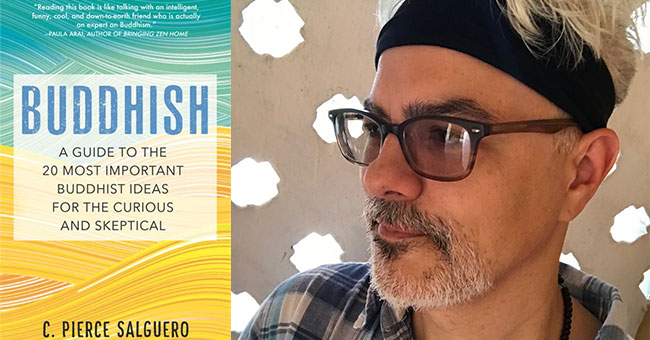
    C.-Pierce-Salguero-Buddhish

    Cover design: Carol Chu. Author photo: Simone J. Salguero

    Are you curious about Buddhism but find yourself met with scholarly texts or high-minded moralizing every time you try to pick up a book about it? Well, if so, relax. Dr. C. Pierce Salguero has written an engaging, accessible, streamlined overview of Buddhism with you in mind.

    In Buddhish: A Guide to the 20 Most Important Buddhist Ideas for the Curious and Skeptical, Dr. Salguero analyzes the ideas and philosophy of the complex tradition through the eyes of both a critic and an admirer—without the saccharine platitudes and dense pontification that you may have come to expect. For those who have already dipped their toes into the tradition through the practice of mindfulness or meditation, this guide will help you create a more well-rounded and informed experience by delving into the history of the Buddhist traditions that shape a mindful practice. Readers will have the opportunity to develop an approach to practice that is not quite Buddhist but Buddhish. We caught up with him to chat about it.

    Beacon Press: Why did you decide to write the book?

    C. Pierce Salguero: I had been teaching Introduction to Buddhism courses for over a decade to both college students and the general public and felt that there was a real need for a better introductory book. I couldn’t find a text for my students that provided an objective introduction to the various forms of Buddhism without being overly scholastic. I needed something that imparted a sense of what this tradition has to offer in an accessible way, without focusing on indoctrination or teaching the reader how to practice the religion. In the end, I gave up looking for that book and decided to write it myself.

    BP: What first drew you to studying Buddhism?

    CPS: Funnily enough, it may have been movies like Star Wars and The Karate Kid that I grew up on that planted the first seeds. By the time I was in high school, I was voraciously consuming books on Asian religions, even though I didn’t really understand what I was reading. In college, I minored in East Asian Studies partly so I could continue exploring Buddhism and Daoism. But it wasn’t until after graduation, when I travelled to Asia and connected with the living traditions in places like Thailand and China, that I realized that studying this topic would be my career.  

    BP: What is a common misconception that skeptics or people unfamiliar with Buddhism have about it?

    CPS: I think the biggest misconception is that Buddhism is one thing. I joke in the book about how wine lovers would be appalled seeing someone indiscriminately mixing different vintages together and chugging it down without appreciating their nuances. That’s a little how I feel when people unfamiliar with Buddhism conflate very different forms of this religion together. In contrast, many experts on Buddhism think that the major sects—Theravada, Mahayana, Vajrayana—are different enough that we should consider them separate religions. To me, it’s actually all the local customs, varying interpretations, and other differences between the different traditions that make this topic interesting to study.

    BP: What does it mean to be Buddhish and how can people who identify as secular or agnostic incorporate Buddhism into their lives?

    CPS: I wouldn’t want to propose “Buddhish” as a new identity. In the book, I introduce this word in a joking way, as a shorthand for talking about how I am a student, friend, and fan of Buddhism, but also a skeptic and a critic. That’s not meant as an endorsement of cultural appropriation, or the superficial practice of one aspect of the tradition without appreciating or understanding the whole. Nevertheless, I do think it’s possible to really appreciate what Buddhism has to offer—and even to take on board certain ideas and practices—while being critical of other aspects and not identifying as Buddhist. 

    BP: What do you hope readers take away from Buddhish

    CPS: In today’s global spiritual marketplace, certain aspects of Buddhism have become quite popular. Mindfulness is everywhere; Dalai Lama quotes are all over social media; Karma is a household word. I feel like these popular aspects are often decontextualized or disconnected from any larger understanding about Buddhism. I wanted to write a book that could educate people about the broader Buddhist tradition without having to slog through scholarly prose or being pressured to accept Buddhist teachings as true. If this book can serve to turn someone’s curiosity about mindfulness, or some other aspect of Buddhism they’ve heard about, into a bit more awareness about the richness and diversity of Buddhism as a whole, then my mission has been accomplished. 


    About C. Pierce Salguero

    C. Pierce Salguero is a transdisciplinary humanities scholar who is fascinated by the historical and contemporary intersections between Buddhism, medicine, and cross-cultural exchange. He has a PhD in the history of medicine from the Johns Hopkins School of Medicine (2010) and teaches Asian history, medicine, and religion at Penn State University’s Abington College, located near Philadelphia. He is the author of many books on the history and practice of Buddhism and Asian medicine. Connect with him online at piercesalguero.com or on Twitter at @piercesalguero.

  • By Bev Rivero

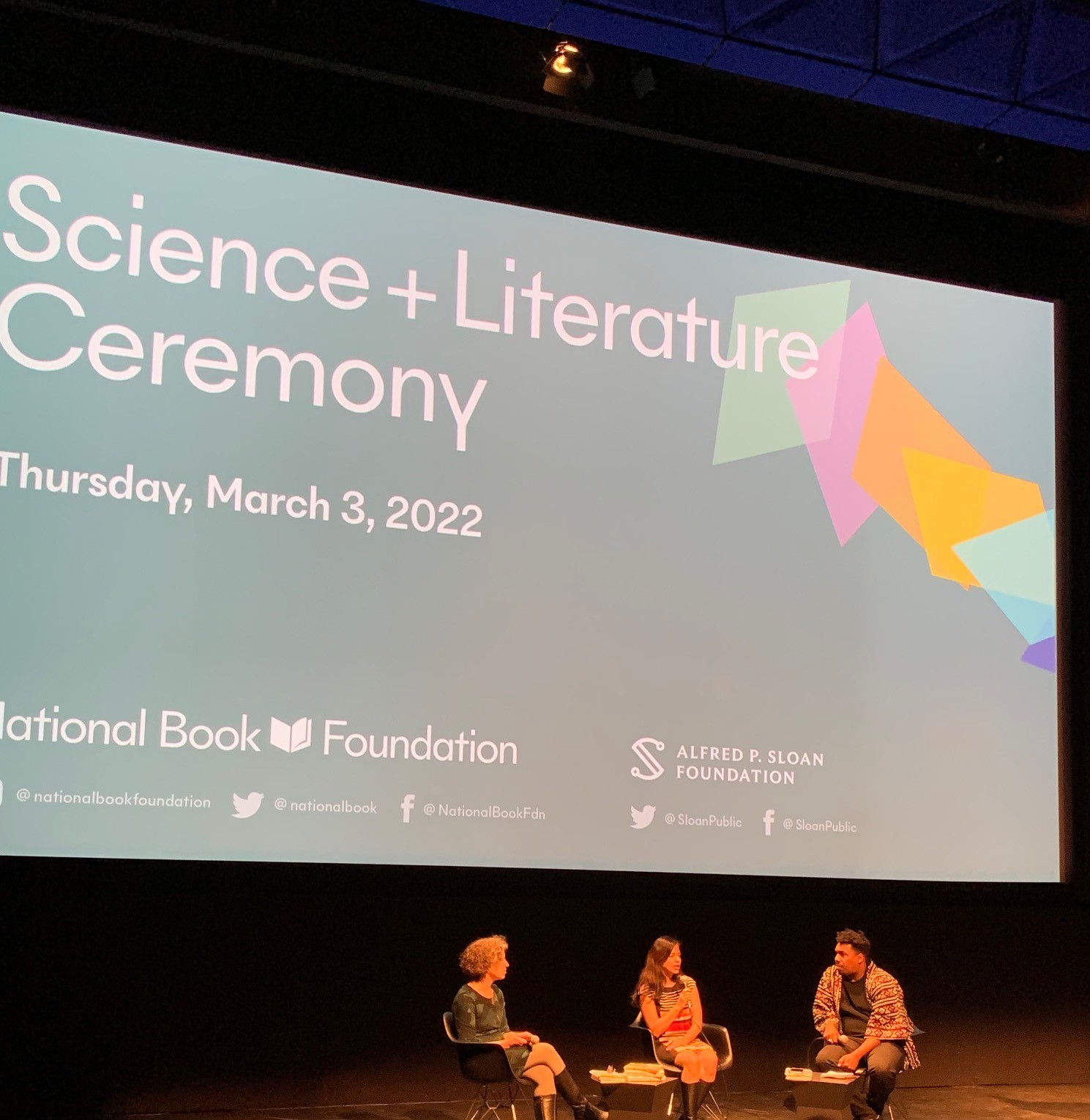
    Science and Literature Ceremony

    Photo credits: Bev Rivero

    In the early evening on the first Thursday in March, an excited crowd of invitees gathered at the Museum of the Moving Image to celebrate the first three titles honored by the new Science + Literature program from the National Book Foundation. In addition to the excitement of chatting in person with book folks, the event was a great start to Women’s History Month, as all three books are authored by women. The inaugural group is also entirely published by independent presses: Linda Hogan’s The Radiant Lives of Animals (Beacon), Daisy Hernández’s The Kissing Bug (Tin House), and Rachel Pastan’s In the Field (Delphinium Books).

    The evening’s panel was introduced by Doron Weber, Vice President and Program Director at the Alfred P. Sloan Foundation, the Science + Literature program partner with NBF. At Sloan, Mr. Weber runs the program for the Public Understanding of Science, Technology & Economics at Sloan, which uses diverse media—books, radio, television, film, theater, and new media—to bridge the culture of science and the humanities. Truly, a perfect partner to uplift literature that helps us understand our place in the world. Science writing is included in the umbrella of eligible books, but it is broadly meant to honor works that deepen our understanding of science and technology. As Weber aptly put it, “We need a better education on how to live in this world.”

    As Linda Hogan was unable to be physically present for the ceremony, the evening’s host, Saeed Jones, read from her essay “The Wolves” in The Radiant Lives of Animals:

    The day they arrived I first saw the wolves from the window. They walked so silently into my life that the moment I saw the five ghostly presences pass through a storm of snow, I whispered the name, Wolf, as they passed by. Wolf is the forest. Wolf is winter snow, dark night. It is red blood on the frozen shine of lake. An animal creation of golden eyes by daylight, brief green fires at night, and fur rich as the gentle drift of snow as it flies up around them. That day it was a wind with silent feet crossing the snow-blinding whiteness of early spring.

    They emerged from the invisible, as if coming from inside the hillside, walking silently across a windblown ridge. The wind blew snow clouds up around them. They seemed calm, as if they’d known all along there would be such protection by the elements.

    Like a curious deer behind trees, I went to another window to watch them move across earth the way a constellation of five stars might cross the night sky in darkness. Sharply awake inside the fur valuable to themselves, there was no hesitation in their movement.

    I watched carefully and kept track of their direction. On this land I am one of the animals, but I try to be one who cares for and maybe even knows the rest, where they are, and what they may do. I watch over an adopted wild mustang and horse, the daily deer herds, and even many wild plants. I care for the snakes as for the little fawn curled when tall grasses are green and new. This is the last remaining wildlife corridor in the region, so I note when the elk bugle, the time of day a certain fox crosses from one hill to the other, when crows see a predator and group together to send it away. Attention is the necessary act, and it is one from which we all benefit. It’s important to know where the mountain lions live and how their territory follows the changing curve of land, the creek bed on one side and on the other, past a moss-covered springhouse down the hill and up a high road until hidden above the old town church across the way.

    That day it was the pack of wolves I watched travel. They went around a curve of land where no one lived, into fog between hills and canyon walls. Few animals or humans walked there because it was a complicated land and, I hoped, safe. Then there was no sign of them, as if they’d vanished into the invisible from which they emerged.

    Afterwards, both Hernández and Pastan read from their books before sitting down with Jones for a conversation. Commenting on what led them to write about their subjects, Hernández spoke about how wanting to meet families affected by Chagas, a deadly infectious disease, pulled her into the science, and she was swept up in it. When she reached out to experts to learn more, she found that scientists were excited to hear from her. When an editor approached her about the idea of a memoir, the book was off and running.

    Saeed Jones in conversation with Daisy Hernández and Rachel Pastan.

    Saeed Jones (right) in conversation with Daisy Hernández (center) and Rachel Pastan (left).

    Saeed asked how Pastan made decisions about portraying Barbara McClintock in novel form. In speaking about the decision to write a fictionalized account of McClintock’s life, Pastan shared that the nonfiction accounts of McClintock as a difficult woman were intriguing. She wanted to explore that as well as the challenging nature of the genetic science she was involved in. The humanity within science and science writing and research came up throughout the conversation, whether finding out about possible medical experiment research that is not widely known and questioning why that’s the case, or learning that labeling a sample “LOL” stands for “Lots of Life.”

    The objective to uplift works that show how culture and science interact was very clear from the evening’s thoughtful conversation; it is great to see more attention given to how much science and society influence one another, as science and its history in any culture are an excellent starting place for examining the past and looking towards the future. Being present for the inaugural program was particularly special to me, as someone who worked at NBF and knows how much thought goes into setting up these events, selecting judges, and spreading the word about the Awards to the book community and beyond. Above all else, all the awards and programs are executed with the goal of reaching as many readers as possible and connecting writers and artists with all communities.  

    With readers in mind, it was illuminating to hear the writers on stage discuss their grappling with feelings about the worthiness of science writing and questioning whether they should be involved in research or advocacy themselves. In the end, writing these books helps get vital ideas out into the world, and in that way, expands the impact and reach of their subjects.

    Daisy Hernández summed it up perfectly before we all left for the evening: “Books have been medicine for me, and now I get to make medicine for other people.”


    About the Author 

    Bev Rivero is senior publicist at Beacon Press. Before joining Beacon in 2021, Bev was the communications and marketing manager at the National Book Foundation, where she worked on the National Book Awards, promoted the Foundation’s public and educational programs, and led all social media and marketing campaigns. Prior to NBF, she was in publicity at the New Press for 6 years, where she worked with authors committed to social justice, including Paul Butler, Michelle Alexander, and many more. She has extensive experience promoting nonfiction and tailoring outreach campaigns that resonate with activists and change-makers. Bev is a NYC-based graduate of Johns Hopkins University, ardent supporter of indie presses, and a graphic designer. You can follow her on Twitter @LOLBev, where she mostly retweets content about books, pickles, and migrant justice.

  • A Q&A with Margaret Peacock and Erik L. Peterson

    Masked Statue of Liberty

    Image credit: Alexandra Koch

    When we look back at the year 2020, how can we describe what really happened? In A Deeper Sickness: Journal of America in the Pandemic Year, award-winning historians Margaret Peacock and Erik L. Peterson set out to preserve what they call the “focused confusion,” and to probe deeper into what they consider the Four Pandemics that converged around the 12 astonishing months of 2020: disease, disinformation, poverty, and violence.

    Organized into the journal-entries along with dozens of archival images, A Deeper Sickness will help readers sift through the chaos and misinformation that characterized those frantic days. It is both an unflinching indictment of a nation that is still reeling and a testament to the power of human resilience and collective memory. Beacon Broadside editor Christian Coleman caught up with Drs. Peacock and Peterson to chat about it. This is part two of their two-part Q&A.

    Christian Coleman: You built a digital museum as a companion to the book. How did you put it together? What were some of the first sources you went to for archives?

    Margaret Peacock and Erik L. Peterson: Erik started collecting sources from China, including social media posts, in January 2020. Margaret had her own set of documents about how the US government was shaping the narrative surrounding the spread of the disease. And we had all this sitting on our computers. Between the two of us, we were worried:  

    1. that we would lose sources,
    2. that we would overlap what we were collecting and make each other’s work redundant,
    3. that we would be too siloed in what sources we located.

    So, our first step was simply to build this massive Zotero database in April 2020 to hold what were hundreds of sources. Then thousands. Within just a few weeks, we realized we needed a whole team of people to help us ensure we were getting sources from all over the place—as many diverse perspectives as we could get. We didn’t want to just replicate what would already appear on CNN or Fox or ABC or the New York Times. We wanted stuff that was way outside of the mainstream and was likely to be lost as soon as the pandemic waned. Plus, we wanted personal stories from healthcare professionals, attorneys, teachers, dairy farmers, parents stuck at home, “essential workers” at grocery stores and post offices and driving the bus, you name it. However, as you might expect, the more voices you add, the harder it gets to collect everything and make sense out of it.

    As June became July, then August, it became clear that our research was far too extensive for a single book. Because we were gathering not just material from nearly every single day of 2020 itself, we also tried to dive into the historical, medical, scientific, political, even philosophical context of every day’s events. Despite the fact that it seems that “nothing is lost in the internet,” the sheer volume means that you lose sources extremely quickly. They get buried. Or they just disappear from the ether. In other words, we knew we had to keep vacuuming up everything in sight because we didn’t know what would last and what would disappear. Which, once Twitter and other forms of social media started kicking people off as violence escalated in the last quarter of the year, did start happening in earnest.

    CC: What’s your process for adding stories and content to the website?

    MP and ELP: We were committed from the beginning to providing all the sources we used for the book in addition to any further primary and secondary research. In an age when belief is constantly being mistaken for fact, we wanted readers not just to see our footnotes, but to interact with them.

    Before becoming a historian, Margaret was an information and database architect in Silicon Valley. She came to this project with the skills needed to devise a robust data collection process and to construct the Digital Humanities site that would exhibit that data. We started by building a database with established metadata fields to help with searching and sorting data. In 2021, while Margaret built the actual digital humanities site in WordPress (housed on servers graciously provided by the Alabama Digital Humanities Center under the incredible direction of Dr. Anne Ladyem McDivitt), we worked with a separate team of programmers to develop a tool that would retrieve data in real time from the Zotero database and load it into WordPress. While parts of that tool had to be left on the cutting room floor (it had too many bugs to be able to go into production this close to publication), we and our team nonetheless managed to get the over 12,000 sources from 2020 loaded onto the site, with full searching capabilities and a sorting tool that allows you to view materials for any given day of the year.

    The site represents countless hours of labor by teams of people. We are very proud of it and hope it will be a resource for researchers, teachers, and students for years to come.

    CC: One line in the introduction really struck a chord with me. “Americans, as we found, too often substitute folklore for history.” Was this a launching point for the book? An observation that came to light as you wrote the book and put together the website?

    MP and ELP: History is a powerful force. It creates our sense of self, nation, people, tribe, town, family, etc. When it is constructed on false premises, like the myth that the Civil War was about states’ rights or the lie that slavery was not a terrible institution that sits at the founding of the country, it creates distorted, sick, Frankenstein-like versions of those identities, both at the individual and at the group level. Those false premises lead people to make the same ahistorical mistakes, generation after generation, and they render them incapable of facing the realities of their past so that they can heal and move on. 

    Despite the dangers of hanging on to mythical histories, Americans still create them because the myths are comfortable. They create a heroic sense of national destiny and exceptionalism. Our made-up personal histories make us feel like we’re going to be okay—that the problem is not that serious, not systemic. And yet, as the news media repeats ad nauseum, America feels more fractured now than it has since 1865. This has so much to do with the incompatible false histories, false identities we’ve constructed for ourselves. We’re sick with this falseness. And a significant proportion of state, school board, and even federal legislators want us to keep soldiering on with the sickness. They want to make it a crime to even diagnose it as “sick”!

    As historians have seen in Bosnia, in Northern Ireland, in so many other parts of the world, if we ever want to heal as a nation, we must clean out our festering historical wounds, set our broken historical bones. This is what historians do.

    CC: It’s an emotional roller coaster to re-experience 2020 through the book. What’s it like for you both to look back at that year now that the book is out and the website is live?

    MP and ELP: Jeez. We have talked a lot about this. For both of us, writing the book became a way to cope with the chaos. We could wake up each morning in 2020 and know that we had certain tasks that had to be completed. It provided structure when there was none. This lasted through 2021 as we worked feverishly to build the digital humanities site. That project ended a few months ago, and we are only now beginning to look back and make sense of the experience. On the one hand, we would like to forget all of it and move on. On the other hand, we know that the struggle against injustice requires a struggle against forgetting. And so, we have gone back to the classroom to teach the hard lessons. We look back on 2020 with the desperate hope that something was learned.


    Visit their digital museum.

    Read part 1.


    About Drs. Peacock and Peterson

    Dr. Margaret Peacock is a historian of media and propaganda in Russia, the United States, and the Middle East, with graduate degrees in history and information science. She currently teaches at the University of Alabama.

    Dr. Erik L. Peterson is a historian of science and medicine, with graduate degrees in history, philosophy, and anthropology. He currently teaches at the University of Alabama.

  • A Q&A with Jonathan Rosenblum
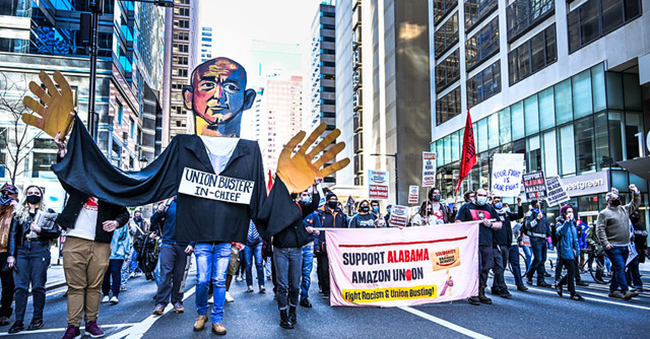
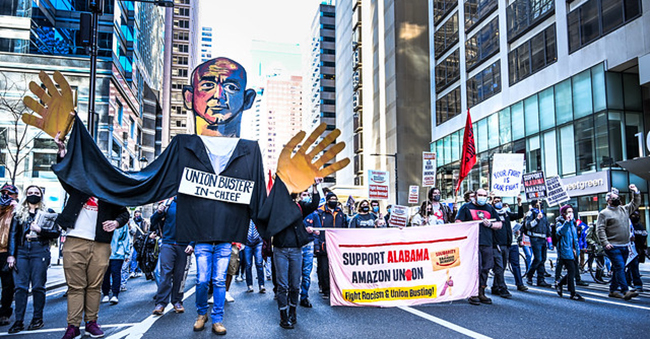
    Demonstrations in over 50 US cities to support the Alabama Amazon Union, March 20, 2021.

    Demonstrations in over 50 US cities to support the Alabama Amazon Union, March 20, 2021. Photo credit: Joe Piette

    Jonathan Rosenblum is a long-time union and community organizer in the US, particularly in Seattle and the Pacific Northwest. In part 1 of this interview, Jonathan spoke at length about Amazon’s recent NRLB settlement, and some of the obstacles to organizing at Amazon. Importantly, he also touched on the significance of unions having a sound organizing strategy that centres on building rank-and-file connections with and between workers.

    In this second part of the interview, Tori Fleming and Matt Davis ask Jonathan further about union strategy, as well as, the degree of difference between labour legislation in the US and Canada, and the continued need to not just hope, but also to organize and fight for a better world beyond capitalism.

    Matt Davis (MD): I’d like us to zoom out a bit to wider community support and public facing campaigns. What effect do you think public campaigns outside the workplace, such as the Fight for $15 or the struggle for universal healthcare, have on organizing inside the workplace? Do campaigns like these offer any openings for workers organizing at major employers like Amazon and Starbucks?

    Jonathan Rosenblum (JR): That’s a really good question, Matt. To the examples you gave, I would also add the fight to eliminate student debt. The Joe Biden administration is resuming mandatory debt payments for millions of workers in this country, which is going to be economically devastating. The Biden administration has also ended the eviction moratorium protecting people from eviction, millions and millions of working class people are now in jeopardy of losing their homes. The struggle for voting rights is notable too, where we’ve seen a tremendous attack on basic voter rights in this country. That, of course, doesn’t affect the millionaires and the billionaires. Attacking voting rights affects working class people, especially in communities of color.

    It’s not just things that outwardly seem purely economic, but a big social fight is important to organizing in a couple of ways. One is to the extent that it raises expectations for people that things can and should be better. That’s a good thing because it puts people into motion and into struggle. Another is that we can’t just simply have a campaign that exists on the communications level. Social struggles teach people the essential importance of organizing, and of building structures into that organizing. In the workplace you’ve got to build organizing committees. In the community, you also have to build similar groups of people who are grassroots leaders, who have the respect of their peers, and you can move the majority of people into action, as needed.

    Teaching those basic lessons of organizing is so important. I’m noting this because, all too often, movement leaders think that all we need to do is get a righteous message out there, and people will follow. This was, by the way, a mistake that the organizers made in Bessemer, because they absorbed their own rhetoric, about how their fight is a righteous one. How it’s working class people going up against this Goliath. We’re on the right side of history.

    Despite my critique, I want to be clear that I give credit to the organizers, who dove into this organizing, and notwithstanding the mistakes they made, they did it. I don’t see enough of that going on. It’s actually better to engage in the struggle, and to fall short than to say, this is too hard a problem, we’re not going to help the workers out in this situation. So good for them and good for the RWDSU for engaging in this fight. However, I hope they recognize that it’s not simply about the righteousness of the fight. You actually have to organize and build resilient structures to fight off the company and to prevail. That’s true whether it’s organizing in a workplace or the Fight for $15, or the student debt crisis, or voting rights.

    MD: Considering your being in the States, and doing so much work with labor there, we wanted to ask you a question from a Canadian perspective. There is a distinction between what the so-called right to strike looks like in the US compared to Canada. Many believe that there is a fundamental right to strike in the United States, at least at most workplaces. Is it correct to think that such a right exists or is protected? Are there any major differences in the obstacles that Canadian or American workers face in organizing and do you have any thoughts on the organizing going on in Canada versus what we’re seeing in the United States right now?

    JR: When I talk to Canadian colleagues and compare notes, I don’t see a fundamental difference in the legal regime around striking. I mean, there are certainly technical differences, but overall, it’s the same capitalism that we’re dealing with. Nominally, workers have the right to strike, but we all know that in practical reality, it doesn’t operate that way.

    Let me just say a little bit for your readers and listeners about the right to strike in the United States. It is generally not protected, as a practical matter. It’s true that many so-called private sector workers have the legal right to strike, but it’s also true that all American businesses have the right to permanently replace and fire workers who go on strike. We’ve seen that the threat itself actually serves to neutralize strikes and actually prevent strikes by intimidating workers.

    Importantly, many so-called private sector workers don’t enjoy any federal protections on the right to strike. Agricultural workers, gig economy workers, Uber and Lyft drivers, Instacart workers, truck drivers, all are excluded from federal labor law protections. By the way, if you did a racial analysis you’d find that disproportionately these are workers of color who are denied the right to strike. So, there is a racist component to the legal strike regime in this country. Federal government workers can’t strike by law. That’s also true for the vast majority of local and state government workers. In fact, in many cases public sector workers can’t even demand the right to bargain from their employer. Healthcare workers have to give 10 days’ advance notice before they strike, and there are restrictions on that even.

    Notably, all airport workers and railroad workers basically have to get court approval before they can go on strike. Just to give you a concrete example, during the SeaTac Fight for $15, there was a group of fuelers at the airport who were so frustrated with the problems with safety and the abuse from supervisors that they sent a notice to their boss saying they’re going to go on strike if these problems aren’t fixed. These are people soaked in fuel by the end of their shift, who are working for poverty wages, running around trying to get planes fueled on time, tripping over operating equipment that was outright broken and dangerous. Rather than fixing the problems, the company went to federal court and got an injunction against the workers. The federal court said the workers may not strike, they may not have a sickout, they may not have pickets, they may not engage in any concerted activity to protect their rights.

    It took us three years to get an appeals court to undo that adverse decision. What do you think happened to the workers and those problems in the meantime? Nothing happened to correct the issues raised and many of the workers got fired or pushed out the door. That’s the practical reality of the so-called right to strike in the United States. So we absolutely need to support workers who bravely do go on strike in the States, in Canada, and elsewhere. In particular, I want to note the John Deere workers, Columbia University graduate student workers, the grocery workers now on strike in Denver and elsewhere. We have to recognize that these strikes are not just over better contracts; they are examples of a direct challenge to the power of Capital.

    We also need to take note that most of the leading strikes in this country in recent years were outright illegal or not protected by labor law. If you think about the 2018 West Virginia educators strike, in 55 counties, teachers, aides, bus drivers, cafeteria workers, all went on strike, not just for better contracts, wages, and benefits, but for smaller class sizes and increased staffing. Those 20,000 people who were striking were all violating state law that said you may not strike. That instigated and inspired similar education workers in Oklahoma, Kentucky, Arizona, and Colorado to also go on strike and demand a better public education system. Those were all illegal strikes as well, without legal protections for workers.

    There’s a reason why the state tries to neuter and limit strikes in every capitalist country, because the bosses know that strikes have tremendous power. Effective strikes threaten profits, threaten the viability of business, and even threaten, in many cases, the political order. At its extreme, strikes call into question the very basic premise of labor exploitation; they get people asking basic questions about how power and wealth are distributed in society. That’s why strikes are so dangerous to political and economic elites, and why we have a legal regime that actively pushes workers away from that. As well as a court structure that actually actively tamps down strike threats. So, when workers do strike, we absolutely need to be there on the picket lines with them.

    MD: Considering the generally anti-worker labor law regime that does hold back worker power both in the US and Canada, what would you say to those whose response to these challenges are needing to prioritize struggling around issues of labor law reform? Should labor law reform be a priority for those seeking to organize their workplaces or for those who wish to support that organizing?

    JR: You’ll note that the West Virginia educators didn’t go to the state capitol demanding labor law reform, they demanded more money and smaller class sizes. That’s not to say that we shouldn’t argue and fight for labor law reform because it does reveal the contradictions of capital, like where there’s ostensibly the right to strike, as you’ve said, but in practical reality it doesn’t exist.

    I want to walk people back to some recent history in the United States. If you’ll remember in 2008, as Wall Street was actively crashing the economy, we had an election here that Barack Obama won. One of the things that he said to unions was, if you vote for me, I will make sure that we pass labor law reform. It was called the Employee Free Choice Act (EFCA). And Obama won in November of 2008. The Senate was a majority of Democrats, 60 Democrats and 40 Republicans. The house was also overwhelmingly Democrat. There were a number of union leaders who had very high hopes going into 2009 when Obama was inaugurated. EFCA didn’t get passed. EFCA didn’t come anywhere close to getting passed, even though the Democrats had super majorities at the time. Instead, Obama and Congress spent more time propping up Wall Street and giving handouts to the billionaires who had crashed the economy. Meanwhile, tens of millions of Americans suffered, lost their jobs, lost their homes, many of them lost their lives. We still didn’t get labor law reform. For people who say we have to fight for labor law reform, I would say, look at what happened back then.

    What we can achieve, whether it is at the bargaining table or in the political arena, is always a function of the balance of power between working people and the bosses. What we saw in 2009 was not just a sell out by the Democrats, who were happy to spout rhetoric but not deliver for working class people because they got our votes. We have to have a clear-eyed assessment that says, workers did not have the balance of power to prevail in that struggle.

    It’s not a matter of electing Democrats or figuring out a different kind of policy to put forward. It’s a matter of building power at the grassroots, so that workers actually can prevail and create a different kind of society. Some of that may be done through legislative battles, but we’re not going to win those battles until there’s more organizing and a more powerful base. I also would say not just more organizing, but more demonstrated capacity to engage in militant strikes in the community and in the workplace, that force these concessions. Anything we win in the political arena is not because of the beneficence or the enlightenment of elected officials. It’s a concession to our power. We have to recognize that’s what it comes down to in the end.

    Tori Fleming (TF): We want to pivot back a little bit and talk about strategy. What do you think it will take to actually unionize Amazon? We’ve frequently seen that unions can be very competitive over the chance to organize specific sectors. So, considering Amazon seems to be a pretty hot place to organize right now, do you think that unions need to cooperate to make a breakthrough within organizing at Amazon? How realistic is it to expect such a major breakthrough?

    JR: I am hopeful when I hear some of the things that union leaders are saying about the need to organize Amazon, particularly the Teamsters Union. But I’m not sure that rhetoric matches up with the resource commitment that it’s going to take for the international labor movement as a whole to see organizing Amazon as an urgent priority. That’s sort of the view from the top down.

    From the bottom, I would say I’m also very excited about a lot of the innovative organizing that’s happening at the grassroots, sometimes through institutional unions, and sometimes not. Workers at the grassroots have the creativity, imagination, and perseverance to figure out new models of organizing. A big part of the job of union institutions is to go talk to the workers, and more importantly, to listen to them and learn about tactics and strategies. They have to be accompanying workers, not dictating to workers, but accompanying them in the struggle to take on this behemoth, and figure out something that the working class hasn’t figured out in the history of the world yet.

    There was a time when workers hadn’t yet figured out how to organize basic industry. We overcame that in the ’30s in the US, and right after that, in Canada. We didn’t overcome it by having teams of paid organizers parachute into cities and tell workers what to do. It came through a bottom-up process that combined knowledge and struggle. Workers had years and years of struggling through many losing battles. Famously the steel strikes of 1919-1921. They were losing strikes; people lost their jobs and lives. But workers in the ‘20s and ‘30s began to understand power, starting with auto. Those workers had an assessment of how you choke off production with sit-down strikes and other militant tactics to hurt the employer. Some of those kinds of tactics and strategy will work in organizing Amazon, and some of them won’t.

    What capital learned from the struggles of the ’30s, is that you can’t allow your production process to become hostage to a militant group of organizers who can choke off your production and distribution networks. So now they build redundancy into those networks. Amazon is a classic example of it, where you could shut down an entire warehouse, but it won’t make a bit of difference to the company; they’ll simply shift distribution to another place. You could shut down a number of warehouses and it would barely register a blip. When workers in Germany go on strike at Amazon warehouses, Amazon simply shifts distribution to Poland. So, it’s not just a national problem.

    For capital, borders have always been porous and will continue to be. You can’t distribute goods that are being ordered in the United States very easily from a warehouse in Thailand. But if workers at Seattle warehouses all go on strike, Amazon can get warehouses in British Columbia to cover for them. So, we have to have a recognition that while all organizing starts out locally, it has to be regional, national, and ultimately international in order to succeed. Moreover, there’s tremendous power – structural power – that some workers in Amazon have. If I’m a warehouse worker, I have very little structural power, but I might have some power if I can unite with everyone in my warehouse. Better yet if I unite with everyone in warehouses throughout the region. Tech workers have more structural power as individuals or small groups because of the specialized nature of the work that they do.

    Just like how our predecessors in basic industry had an understanding of how to influence production and who has structural power and who doesn’t, we also have to have the same analysis, whether it’s organizing at Amazon, or Starbucks or any other big company. You have to start off with an analysis of power building, then organize from there.

    TF: To build on that, Canadian labor history has come up a lot recently within socialist conversations as well as in other areas of organizing activity around Toronto. What specific lessons do you think Amazon organizers can draw from the unionization efforts of the ’20s and ’30s that you reference?

    JR: The most important lesson is when workers unite and fight, we can win. We can do extraordinary things; we can transform workplaces and communities and even societies.

    The second thing I would say is that it’s extraordinarily hard work and there are no shortcuts to organizing. You have to build structure, you have to form committees, you have to identify organic leaders, you have to recruit people, you have to struggle with people who may have a different understanding or political inclination. You have to engage with people, starting from where they’re at, listening, and then challenging them. Those are the basics, the day-to-day work of organizing, which is not about putting out a press release or simply positioning yourself morally. It’s about the grassroots organizing that needs to happen.

    MD: Unfortunately, we’re nearing the close of our time here. As one final question, what would you say to organizers at places like Amazon in these trying times and who might be feeling positive about their chances of succeeding against these massive corporations?

    JR: I would say that these are really, really scary times when you think about it. Not just the nature of work, but the climate crisis too. You see what happened in my state of Washington and just north of here in BC with the floods and fires last summer. The already obscene wealth disparity in this New Gilded Age is only getting worse, it’s even accelerated under COVID. The devastating human toll over the last two years has for many people ripped to shreds any illusion that US political and economic leaders – and Canadian ones for that matter – are really committed to meeting the basic health and safety needs of the population. We see ultra-right, anti-democratic, outright racist, and xenophobic groups striding boldly onto the political stage and into office. One can become very despondent at this moment.

    Precisely because the crises are so grave, and severe and urgent, that’s why we need to organize. The only thing that’s going to save us, humanity, is the working class organizing and fighting for a different vision of society. And it starts in the workplace. It starts when you say, it’s not right that I’m making poverty wages, forced to walk or run eight miles a day through this cavernous warehouse, and subject myself to risk, danger, injury, and repetitive motion stress that is going to give me arthritis in a few years. There is a better way. But the only way we’re going to have that better way is if we join hands with other workers who are similarly facing the same situation. It starts in the warehouses; then it goes out from there.

    The problems that I started off by noting are not going to get solved immediately. They’re not going to get solved with shortcuts, and they’re not going to get solved because some miraculous leader emerges from the mist to steer this country or this world in a different direction. It’s going to happen when we come together and build the mass movement and demand a different kind of society. That starts with the work we do day to day on the shop floor, convincing coworkers that we deserve better, and we should form a union. Only then can we build an understanding that we are all in the same class, and we better stick together, no matter our gender, race, religion, or where we come from. We have to unite everybody in a common enterprise that says we actually deserve more. 


    Part 2 of this Q&A appeared originally in The Bullet.

    Read part 1.


    About Jonathan Rosenblum 

    Jonathan Rosenblum is a union and community organizer based in Seattle. He is the author of Beyond $15: Immigrant Workers, Faith Activists, and the Revival of the Labor Movement and a member of the National Writers Union.

  • Hands

    Image credit: Alexas_Fotos

    Remember those minutes-long social media videos of folks quarantine clapping for frontline workers? And for the medical staff and carers looking after droves upon droves of COVID patients? Do you also remember that most of the ones getting the applause were women? If our global health crisis has made one thing clear, it’s how much we depend on—and take for granted—the recognized and unrecognized work women of all cultures do to keep societies going.

    Cases in point. Kate Washington exposes the cultural expectation of women to take on the all-consuming role caregiver in Already Toast. Rosemarie Day shows how 80% of women make all healthcare decisions for their families in Marching Toward Coverage. Look back in the archives of human life and you’ll see repeats of this story.

    In the spirit of this year’s theme for Women’s History Month, Providing Healing, Providing Hope, here’s a batch of recommended reading and book-length shout-outs to the women who’ve done so, in the past and today. History would not be what it is without them.


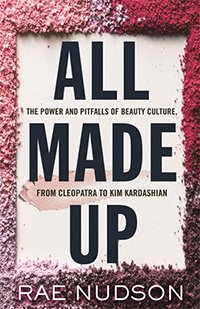
    All Made Up

    All Made Up: The Power and Pitfalls of Beauty Culture, from Cleopatra to Kim Kardashian

    “If beauty reproduces the social order, then beauty trends can shift to include or exclude certain groups—and we may be in that transition now. Studying makeup reveals why these preferences are in place, who sets them, and who benefits. There is no way to divorce beauty from cultural norms and power structures; looking closer at the tools of beauty is a step toward dismantling those systems. It’s time to take that step.”
    —Rae Nudson


    Already Toast

    Already Toast: Caregiving and Burnout in America

    “The cultural role of caregiving is in many ways an extension of the everyday forms of gender imbalance that exist in heterosexual relationships . . . Certainly not all women are subjugated in this manner, and far from all men expect to so subjugate us. This model, however, does offer some illumination of a cultural preconception that operates, I think, unconsciously for many people—and a dynamic I personally experienced: the expectation that caregivers give freely of their entire selves, and more so when we are women.”
    —Kate Washington


    Code of Silence

    Code of Silence: Sexual Misconduct by Federal Judges, the Secret System That Protects Them, and the Women Who Blew the Whistle

    “In 2006, an activist from New York, Tarana Burke, suggested that women should band together to combat pervasive stories of sexual abuse and assault by sharing what she called ‘Me Too’ stories, though Burke’s idea would not fully take hold until 2017. That year, other women finally began to speak out about how other powerful federal judges had committed sexual harassment and other forms of misconduct. Many men cloaked in the power of their black robes seemed to have gotten away with it.”
    —Lise Olsen


    Entry Lessons

    Entry Lessons: The Stories of Women Fighting for Their Place, Their Children, and Their Futures After Incarceration

    “Why aren’t there enough reentry programs across the country to address the specific issues formerly incarcerated women face? With eighty-one thousand women released from state prisons annually, we can’t afford to wait . . . Even those who describe themselves as ‘tough on crime’ must acknowledge that it’s more fiscally and socially responsible to support women and prevent future crime than to keep locking them up. Of course, fundamental to this entire discussion is the commitment to investing in these women and their communities before they become involved with the criminal justice system.”
    —Jorja Leap


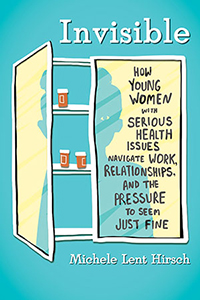
    Invisible

    Invisible: How Young Women with Serious Health Issues Navigate Work, Relationships, and the Pressure to Seem Just Fine

    “We have these images in our heads of what disability looks like and what counts. But many of the women I’ve met have made me realize that disability is largely about the world's failure to make space for you.”
    —Michele Lent Hirsch


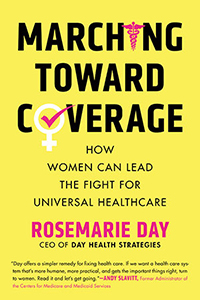
    Marching Toward Coverage

    Marching Toward Coverage: How Women Can Lead the Fight for Universal Health Care

    “Women are more likely to be caregivers for children and elderly parents, and they’re more likely to be patients themselves. This means that women are the ones who interact with the healthcare system most often and most intimately. In fact, according to the US Department of Labor, women make approximately 80 percent of all healthcare decisions for their families. As a result, underinsurance and skyrocketing medical costs represent more than a national health crisis; they’re a civil rights issue, and the next battlefront for the feminist movement.”
    —Rosemarie Day


    Mothercoin

    Mothercoin: The Stories of Immigrant Nannies

    “In our popular imagination, mothers are somehow always present—loving tirelessly, sacrificing constantly, protecting fiercely, and making the work of housekeeping and family nourishment as neat and invisible as the pressed sheets of a freshly made bed. The role of the immigrant nanny is to facilitate this ideal, but it comes at a cost. The choices she makes are limited by the realities she encounters—regional inequity exacerbated by globalism and the neoliberal policies meant to manage it, labyrinthine immigration practices that refuse to account for the reality of ‘the female underside of globalization,’ and maternity and childcare policies in the US that willfully ignore the social and economic value of childrearing.”
    —Elizabeth Cummins Muñoz


    Poor Richard's Women

    Poor Richard’s Women: Deborah Read Franklin and the Other Women Behind the Founding Father

    “The idea for this book grew out of my long interest in women’s lives. Today, as during previous waves of feminism, it is again acknowledged that women are the forgotten sex and that many of their deeds and influence have been dismissed or at best reduced to historical footnotes. Unfortunately, this loss of information has left a frustrating gap in our understanding about the lives of men as well. That became painfully obvious in the early 1990s as I first read traditional accounts of Ben Franklin’s life. The questions abounded. Why didn’t Deborah accompany him to England? What led her to remain in Philadelphia, far from the man she adored? Was that her decision, or Ben’s? Was their marriage filled with dissension? Was their separation an eighteenth-century version of divorce?”
    —Nancy Rubin Stuart


    The Seven Necessary Sins for Women and Girls

    The Seven Necessary Sins for Women and Girls

    “I want patriarchy to know that feminism is rage unleashed against its centuries of crimes against women and girls around the world, crimes that are justified by ‘culture’ and ‘tradition’ and ‘it’s just the way things are,’ all of which are euphemisms for ‘this world is run by men for the benefit of men.’ . . . I also want feminism to be led by the nonwhite and the queer, who don’t have the luxury of fighting only misogyny. We must fight the multiple systems of oppressions that patriarchy often intertwines itself with: racism, bigotry, homophobia, transphobia, classism, ableism, and ageism.”
    —Mona Eltahawy


    Trust Women

    Trust Women: A Progressive Christian Argument for Reproductive Justice

    “Reproductive justice has three primary principles: the right not to have a child, the right to have a child, and the right to parent in safe and healthy environments. It is an intersectional approach grounded in the multiple challenges and social realities that women face during their entire reproductive lives. This intersectional approach also recognizes the moral complexity of individual women’s life situations, rejects the position of moral absolutism, and holds that moral meaning and value can only be measured within the context of an existing moral life.”
    —Rebecca Todd Peters


    Until I Am Free

    Until I Am Free: Fannie Lou Hamer’s Enduring Message for America

    “In Hamer’s framing, no one could truly experience freedom if others in that society were constrained. She reiterated this message on a number of occasions, underscoring the danger of being complicit in the face of injustice. ‘Until I am free,’ she boldly told the mostly white audience members at the University of Wisconsin in 1971, ‘you are not either.’”
    —Keisha N. Blain


    Women and Other Monsters

    Women and Other Monsters: Building a New Mythology

    “This, in the end, is what matters: not that we stand proudly in all our monstrousness every day but that we find small ways to gestate dissent and deviation, to nurse and nurture the things that are supposed to be wrong with us until they grow into something great. This is our strength: that each of us has the capacity to be not only a monster but a mother of monsters. We can birth from our own bodies every one of men’s worst fears”
    —Jess Zimmerman


    A Worthy Piece of Work

    A Worthy Piece of Work: The Untold Story of Madeline Morgan and the Fight for Black History in Schools

    “Morgan’s demand that Black history receive a place in the school curriculum continues to hold relevance today, almost a century after she began teaching. Her conviction that the history of Black America must be acknowledged in the school curriculum anticipated the demands of civil rights workers in the 1950s, Black Power activists in the 1960s, and multiculturalists in the 1980s and 1990s.”
    —Michael Hines


    The Wrong Kind of Women

    The Wrong Kind of Women: Inside Our Revolution to Dismantle the Gods of Hollywood

    “It is time, once and for all, to dismantle the gods of Hollywood to whom we have all sacrificed too much for far too long. It is time to think and act radically about building a different kind of future for the industry that shapes our culture—not only for the women being actively hurt inside the film industry but also for those outside it, whose careers, relationships, purchasing decisions, and sense of self are shaped by the stories our industry is feeding them.”
    —Naomi McDougall Jones

    Hands