• By Bev Rivero

    Trophy and lights

    Image credit: PDPics

    Beacon has a lot of reasons to celebrate this spring! Several authors received awards recognition for their books, so let’s recap.

    Last week, the 2025 Pulitzer Prizes were announced, and Gayl Jones’s The Unicorn Woman was a finalist for Fiction in a livestreamed ceremony. Readers were quick to note that there were four finalists this year. As MJ Franklin notes in his New York Times review of The Unicorn Woman, “Part of the power of a Gayl Jones novel is the way she embroils her characters. They’re tangled in contentious relationships; they are frequently on the cusp of, or are responding to, terrible violence; whether they like it or not, they navigate their lives under the weight of history. They’re mired in the past and in the present, and that creates the stakes and the catharsis. Reading her books feels like walking through a minefield—we can see the decimated ground around us and we’re just waiting to see which step will set off the next explosion.”

    We love regional awards, and two authors were acknowledged locally in April. Lisa Mueller won the Minnesota Book Award for General Nonfiction for The New Science of Social Change: A Modern Handbook for Activists, which Booklist called an “eye-opening work.” And Jaclyn Moyer’s On Gold Hill: A Personal History of Wheat, Farming, and Family, from Punjab to California won the 2025 Sarah Winnemucca Award for Creative Nonfiction from the Oregon Book Awards. If you’re in the area, you can attend a book talk at the Monmouth Public Library with the author later this month on May 28, 2025. And if not, read an excerpt from the book in MUTHA Magazine or check out this interview with Moyer on Oregon KATU-TV’s Afternoon Live.

    This week, three of our titles were recognized as 2025 Next Generation Indie Book Awards Winners and Finalists. Omo Moses’s The White Peril: A Family Memoir won in the Autobiography/Biography category. Paul Peart-Smith’s graphic adaptation of Roxanne Dunbar-Ortiz’s An Indigenous Peoples’ History of the US was selected as a finalist in the BIPOC category. And David Lester, Marcus Rediker, and Paul Buhle’s Revolution by Fire came in as a finalist for the graphic novel category.

    Congratulations again to the authors, and if you add any of these to your TBR, let us know. Happy reading!


    About the Author 

    Bev Rivero is senior publicist at Beacon Press. Before joining Beacon in 2021, Bev was the communications and marketing manager at the National Book Foundation, where she worked on the National Book Awards, promoted the Foundation’s public and educational programs, and led all social media and marketing campaigns. Prior to NBF, she was in publicity at the New Press for six years, where she worked with authors committed to social justice, including Paul Butler, Michelle Alexander, and many more. She has extensive experience promoting nonfiction and tailoring outreach campaigns that resonate with activists and change-makers. Bev is a NYC-based graduate of Johns Hopkins University, ardent supporter of indie presses, and a graphic designer

  • By Christian Coleman

    Mother and daughter

    The start of the forty-seventh administration in the White House sounded off the red alert for mothers of all stripes in the US. They were already on high alert during the years leading up to the 2024 elections. For the next four years, mothers will be Mothering with a capital M against this administration’s wrecking-ball rampage. Mothers making sure people who can become pregnant get the abortion care they need. Mothers who take in gay and trans children who’ve been rejected by their blood relatives. Mothers running for school boards to prevent 47’s barrage of book bans. Mothers advocating for the rights and accessibility for disabled parents. Mothers fighting against poverty so families can take care of their children without worrying about a precarious social net. This Mother’s Day, this handful of titles will get you in the spirit of your Mothering era. But first, brunch.


    After Dobbs

    After Dobbs: How the Supreme Court Ended Roe but Not Abortion

    “[W]hat we have seen so far is that the predicted evisceration of abortion access has not materialized. In fact, because of the people profiled in this book—and many more like them throughout the country—we’ve seen quite the opposite. In the face of the major blow of overturning Roe, abortion has continued, maybe even stronger than before. How people are obtaining and providing abortions is changing and morphing as circumstances require, but people looking for an abortion are, once again, proving that they will always find a way to access it. And providers and supporters, like their predecessors, are proving once more that they will do everything they can to help women and other people capable of pregnancy control this central aspect of their lives.”
    —David S. Cohen and Carole Joffe 


    And the Category Is pb

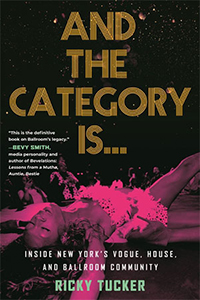
    And the Category Is . . . : Inside New York’s Vogue, House, and Ballroom Community

    “Built out of the human need for lineage and legacy, the house system is a clan barreling toward posterity with a common cause: freedom. And on an individual level, just like with biological families, these houses, Lanvin, Ebony, LaBeija, Pendavis, Mugler, et al., provide LGBTQ BIPOC youth an opportunity to metabolize centuries of generational trauma. Every gay parent, every gay child, is a chance to start anew.”
    —Ricky Tucker 


    Asian American Is Not a Color

    Asian American Is Not a Color: Conversations on Race, Affirmative Action, and Family

    “You were so young when you started asking different forms of a question I have pondered over a lifetime—a question many like us have confronted and answered in different ways for centuries. What does it mean to be Asian American? Although it’s probably not developmentally appropriate for a three- or five-year-old, this book is my way of exploring this question, and continuing our conversation you started. Your questions often remind me of my own journey of racial consciousness. Growing up in a working-class White immigrant town in western Massachusetts, I understood at a young age what Toni Morrison meant when she said, ‘In this country, American means White. Everybody else has to hyphenate.’”
    —OiYan Poon 


    Momfluenced

    Momfluenced: Inside the Maddening, Picture-Perfect World of Mommy Influencer Culture

    “Rose is not a snarling, oafish white man screaming incoherently about “white rights” or about Hillary Clinton running a child-sex-trafficking operation. Such a figure would be a hard sell to moms eager to raise their kids free from toxic mattress toppers. Rose presents a calm, sane impression of simply “asking questions,” and, most significantly, she presents herself as a loving mom, a good mom. A pretty mom. A white mom. And in this culture (and many other Western cultures), we’ve been taught to trust a good (white) mom, to never question her authority if it stems directly from her (good [white]) motherhood. If we trust her to recommend safe mattress toppers, maybe we should open our minds to trust her about other things as well? Like “QAnon stuff.” Social media, and the various algorithms impacting how we all want to look and how we all think, have made it easier and easier for “nice white moms” like Rose to embrace and spread disinformation and conspiracy theories.”
    —Sara Petersen 


    School Moms

    School Moms: Parent Activism, Partisan Politics, and the Battle for Public Education

    In a short period of time, this changed how moms—those practiced school volunteers—applied their expertise and offered their time. It may have surprised some to see the shift from wrapping-paper fundraisers to political organizing, but it is more natural than you’d think. That is because mothers’ labor has long been an undervalued force. Moms were already expert in assembling networks, organizing volunteer labor, and considering how best to respond to policies impacting children’s experiences. Now, they simply applied those skills in a new setting. The reality was that moms were tapping abilities that few gave them credit for having. An important lesson from this moment is the degree to which society has failed to acknowledge the detailed work of motherhood.”
    —Laura Pappano 


    Storming Caesars Palace

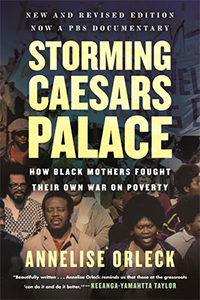
    Storming Caesars Palace: How Black Mothers Fought Their Own War on Poverty

    “Ruby Duncan felt that she was on her way to eradicating poverty in her community. Now she’s well past the age when she can think of going back to organizing. But the key to her approach is as relevant today as it ever was. You have to feed the children. But you also have to build self-esteem among their mothers, women who have been despised for so long that they’ve begun to despise themselves. Duncan’s great hope is that today’s young women will carry on her challenge: to break down the barriers against decent jobs, healthcare, daycare, housing, and education for poor women and their children, and to establish those goals as a birthright for all Americans.”
    —Annelise Orleck 


    Touched Out

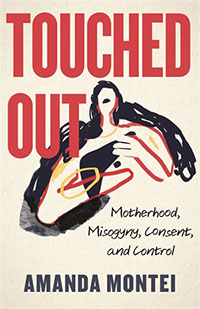
    Touched Out: Motherhood, Misogyny, Consent, and Control

    “I came to motherhood for the fantasy of family, but I stayed, at least in part, for the scientific and spiritual mysteries that shrouded my body, thanks to the sex education I had—and had not—received when I was young. Though most of what I knew about women’s bodies came from the cultural narratives I consumed growing up, my formal schooling around sex began in fifth grade, when my class was divided into rooms based on gender. Each group was forced to watch their own traumatizing videos on the terror of puberty. Girls went home with pads; boys, as far as I could tell, went home with permission to masturbate.”
    —Amanda Montei 


    Unfit Parent

    Unfit Parent: A Disabled Mother Challenges an Inaccessible World

    “Parenting, for everyone, when seen through the lens of their life before parenting, is unthinkable. Parenting two kids, through the lens of parenting one, is unimaginable. Every new stage of parenting is impossible to comprehend before you’re there. And yet we do it. We keep our kids safe; we love them in a way we never imagined; we delight in their lives. Our capacities exceed our imagination—they grow from our creativity. Disabled parenting is the same. If you look at my life through the lens of your body, it may seem unsustainable. But my capacity—for joy, for innovation, for community—is enough. Disabled parents, out of necessity, must reject the rules and standards that guide nondisabled parents.”
    —Jessica Slice 


    You Just Need to Lose Weight NYT

    “You Just Need to Lose Weight”: And 19 Other Myths About Fat People

    “Blaming parents for their children’s weight isn’t based in any observable scientific truth, nor does it remedy anything. It only leads to stigma, isolation, and fractured family systems, inviting more pain into the lives of fat kids. It is a reflection of a society that rejects fatness at every turn, making it an issue of personal responsibility so that it can reject fat people once again. And it is a reflection of a society that projects adult anxieties about a purported “obesity epidemic” onto children, then expects children to resolve those anxieties for us. In the process, we make children into political footballs, and we sacrifice their physical health, mental health, self-esteem, relationships, and dignity in the process.”
    —Aubrey Gordon 

    Mother and daughter


    About the Author 

    Christian Coleman is the digital marketing manager at Beacon Press and editor of Beacon Broadside. Before joining Beacon, he worked in writing, copy editing, and marketing positions at Sustainable Silicon Valley and Trikone. He graduated from Boston College and the Clarion Science Fiction & Fantasy Writers’ Workshop. Follow him on Twitter at @coleman_II and on Bluesky at @colemanthe2nd.bsky.social

  • By Michael Andor Brodeur

    Andrew Tate on the “Anything Goes with James English” Podcast in 2021

    Andrew Tate on the “Anything Goes with James English” Podcast in 2021. Photo credit: Anything Goes with James English

    Editor’s Note: It was the undoing of thirteen-year-old Jamie in the British Netflix crime miniseries Adolescence. Those incest brothers in The White Lotus’s third season gulped every drop of it in smoothies. And the MAGA party is pushing it as the baseline standard of what a “real man” is. It’s toxic masculinity, and a plethora of roided hucksters is hustling it on the manosphere. Culture critic and author Michael Andor Brodeur more aptly calls it broken masculinity. Why does this stuff work on very-online men young and old enough to know better? Brodeur asks this question in the following passage from Swole: The Making of Men and the Meaning of Muscle.

    ***

    These days there’s a guru waiting around every corner for young men to come clicking. They cover fitness, diet and nutrition, dating, politics, philosophy (however rudimentary), and, their favorite topic, masculinity—its dire state, its necessary preservation, its unlockable secrets, its bestowal of dominion. The difference between the manfluencers of old and today’s glut is that, because white heterosexual men now perceive themselves as having (so generously!) ceded physical, financial, professional, and cultural ground to women, people of color, and LGBTQ folks (i.e., everyone else), they’re doubling down on their occupation of virtual space. Unlike any other comparable Internet niche or eddy, the manosphere carries itself like it owns the place.

    Manfluencers have ushered in a new era of rules, details, and suffocating boundaries of what “real men” are supposed to do, how they’re supposed to behave, what and who they are supposed to prioritize—and they’re as arbitrary and stringent as the finest and fanciest dining etiquette. Salad is carcinogenic. Straws are feminine. Washing your ass is gay. Manfluencers are selling a pinkies-out approach to perfecting the illusion of manhood.

    Young men are especially vulnerable to these messages. Born into the chaotic marketplace of the Internet, staggered by its possibilities for self-definition and often opting for the path of least resistance, young men flock to their gurus like bugs to the indifferent glow of a zapper.

    On his wildly popular podcast, The Joe Rogan Experience—which has accrued over two thousand episodes since launching in 2009—Rogan, the former Fear Factor host and sometime UFC commentator, has trafficked in anti-vaccination conspiracies, blurry anti-Semitic rhetoric, and heavy skepticism toward the trans community and virtually any other issue in which he’s uninvolved and uninformed but interested in “just asking questions” about. Some of Rogan’s more egregiously error-riddled ruminations find quick correction in his often smartly selected roster of guests, but most of his extemporaneous observations go unchallenged, quietly calling into question the true efficacy of the nootropic “Alpha-Brain” supplement he regularly hucks. In a January 2021 podcast, he cited an “amazing point” by British author Douglas Murray “about civilizations collapsing—and that when they start collapsing they become obsessed with gender, and he was saying that you could trace it back to the ancient Romans, the Greeks.”

    Never mind which exact entire era of antiquity he’s referring to here, and never mind that the fifty-five-year-old Rogan’s own admitted use of testosterone and human growth hormone suggests more than a passing concern of his own with his personal gender expression.

    Rogan, who routinely performs a public struggle with the navigation of pronouns and other considerations of gender identity, still manages to summon rambling defenses against the term “toxic masculinity”—a descriptor he inexplicably expands to mean “anything men have ever done.”

    “That’s a hilarious expression,” Rogan says in one clip circulating around TikTok. “Because you need to thank ‘toxic masculinity’ for all the bridges all the fuckin’ . . . all the jets, all the rockets. Toxic masculinity? You break down all the things that men have invented, and that all these ‘toxic’ men have prevented you from being murdered, war and protected the country, and all the different things that you could attribute to ‘toxic masculinity’? Most of it is positive.”

    (A side note on the topic of toxic masculinity: I’ve never understood why it was considered an effective deterrent to label masculinity gone awry as “toxic.” Branding corrosive ideas of masculinity as “toxic” is akin to pouring them into a gray plastic bodywash bottle—it makes them more appealing to men, not less. Among men, “toxic” has now become a byword for “badass.” I propose the more straightforward “broken masculinity” as a potential replacement primarily because it accurately describes what we’re dealing with—a model of masculinity that’s completely broken—but also because it’s less likely that men will walk around puffing their chests and declaring themselves “broken.”)

    Rogan’s attempt at a point is an echo of a popular diatribe from recently decertified psychologist and ubiquitous manosphere fashion plate Jordan Peterson, who first tapped into the wild spirits of his expansive readership of disaffected men by giving them 12 Rules for Life: An Antidote to Chaos—a seemingly well-intentioned and not a bit ironic rulebook that includes such guidance as “Stand up straight with your shoulders back” (a metaphor for the acceptance of “the terrible responsibility of life”); “Set your house in perfect order before you criticize the world” (a patently ridiculous request to make of anyone contending against actual injustice); “Do not let your children do anything that makes you dislike them” (to which no other response is possible but “OK, Boomer”); and “Assume that the person you are listening to might know something you don’t”—actual sage advice that Peterson assiduously avoids taking himself. This is especially clear in his continued ascent as one of North America’s leading (or at least most audible) anti-trans voices.

    In a 2022 episode of his podcast dispatched in clipped form to TikTok, an earbudded and fastidiously outfitted Peterson winces with confusion when confronted with the imaginary prospect of freestyling social interaction with a hypothetical nonbinary person, and struggles aloud. “If I don’t know whether you’re male or female,” he crows in with ear-curling disdain, “what the hell should I do with you? The simplest thing for me to do is go find someone else who is a hell of a lot less trouble. Who is willing to abide by the social norms enough so that they don’t present a mass of indeterminate confusion on immediate confrontation.”

    The grammar strategy here is interesting—the installation of the other as the direct object, always the recipient of the action. Not How do you prefer to be addressed? (the only question trans and nonbinary folks would like to be asked) but What should I do with you? Peterson’s solution does not follow his edict to “assume the person he is listening to knows something he doesn’t,” because he has no interest in listening—only responding.

    The state of modern masculinity, to Peterson, is a human catastrophe and a financial jackpot, threatened at all times and from all sides by the tidal advances of inclusive language, politically correct rhetoric, and the ostensible Trojan horse of multiculturalism, which contains . . . I’m not sure what, exactly, apart from people of other cultures. The threat is real, and for Peterson, highly lucrative. (12 Rules has sold well over five million copies.)

    In one highly clicked clip, a glassy-eyed Peterson, asked by an interviewer for a 2019 Dutch documentary if it’s “OK to be a man,” struggles against tears and embarks on a Trumpian slideshow of familiar man tropes: “It’s not ‘OK’! It’s necessary!” he admonishes his questioner. “What the hell are we going to do without men? You look around the city here you see all these buildings go up. These men, they’re doing impossible things. They’re under the streets, working on the sewers. They’re up on the power lines in the storms and the rain. They’re keeping this impossible infrastructure functioning, and often literally. And the gratitude for that is solely lacking, especially among the people who should be most grateful.”

    Peterson’s skill with cultivating grievance, refining it to what seems like a point is one of his greatest skills as a manfluencer, matched only by his ability to forget that people of all genders perform each of the presumably man-specific occupations he lists.

    The sense of perpetual unfairness that he grooms into young men’s understanding of their own place in the world is couched in a fraudulent nostalgia for a functioning but somehow abandoned order. He peddles an assurance of righteousness—that men’s suffering isn’t for nothing, that it’s actually all part of the master plan of manhood, an essential cycle of masculine pain. Sorry, he suggests, we don’t make the rules. (Except when we do, which is always.)

    Peterson is correct when he asserts that the important and necessary role that men play in the world is not “toxic masculinity” (“that appalling phrase,” he hisses). But the reality is that men, instructed to stunt each other’s emotional growth, are routinely deprived of their ability to experience these roles as fully realized humans. Men learn to alienate themselves from their own feelings and turn their successes into subsets of vengeance.

    Meanwhile, alpha charlatans like Peterson and Rogan, when taken together (as they often are), form a kind of brains-and-brawn team, chewing on current events with a numbing combination of obtuseness and obfuscation (Peterson) or blunted credulity (Rogan). Peterson, in ridiculous custom suits that looked pulled from the closet of a shelved Batman villain, plays the role in young men’s minds of the firebrand public intellectual. Rogan, with his stoner chuckle, big cigars, and straining performance T’s, represents the masculine urge to reduce complicated topics to insultingly simple terms, to deny reality in service of escaping “the matrix,” to reserve their curiosity for aliens and ayahuasca and their cynicism for anyone who hasn’t taken the “red pill.”

    “Red pill” masculinity is at the heart of many a manfluencer’s core shtick. The term, a reference to the “red pill” in the 1999 sci-fi film The Matrix, denotes a man’s moment of revelation in which classic misogynist tropes about the place of women in society and the home are understood to be correct after all. The red-pilled reassert traditional masculine roles and almost cartoonishly celebrate patriarchal values, in terms so explicit as to make the whole thing seem almost like unwitting satire. (That so many red-pilled young men find unironic heroes in the fictional antiheroes of the past quarter century—from American Psycho’s Patrick Bateman to Fight Club’s Tyler Durden to The Sopranos’ Tony Soprano—lends credence to this theory.)

    Perhaps the primary pharmacist in the red pill masculinity movement is former professional kickboxer and self-described “Top G” Andrew Tate—who at the time of writing is sitting in a Romanian jail cell on charges of organized crime, human trafficking, and rape. Tate rose to prominence in the manosphere largely on the back of his “Hustlers University,” a mailorder program for entrepreneurs that attracted over 100,000 subscribers at $49.99/month.

    I have a whole stack of representative Andrew Tate quotes, but I only have room for him to park one Bugatti’s worth of his bullshit, so we’re going with this one: “When you’re a G”—a gangster—“you’re just accidentally like pimping hoes,” Tate said in one widely circulated clip. “Like, you go somewhere, there’s some bitch. She’s like ‘Hi,’ you’re like ‘Yeah, hi, I’m the man.’ Oops, you fuck her. Oops, now she’s in love with you and shit. The real G’s know what I’m saying. Like, you’re pimpin’ bitches, and you don’t even want to. When you’re pimpin’ bitches like me, it’s a fulltime job.”

    Tate, whose lean body reflects his semi-successful kickboxing career but whose blank eyes betray an unknowable emptiness, has won thousands of impressionable acolytes over to his rank brand of unabashed dick-stroking rhetoric.

    “You got convinced that being a strong man is toxic,” manfluencer and full-time debate-bro Sneako says to one of his millions of young male followers. “That being a natural man, acting on your basic organic desires is ‘problematic.’ You got programmed. That’s why your nails are painted. That’s why you’re 6’3”, 230 lbs. but saying [in a mocking voice] I think platforming these people is bad! A man shouldn’t sound like that. Why do you talk like that? What happened to you?”

    It’s the kind of blank-eyed soliloquy that gently reminds you that, while recording, these phones turn into little mirrors.

    On just a single casual scroll/stroll through the manosphere, I was able to pluck this bouquet of beauties grown in the wild: “Every man has a warrior inside of him; it must be accessed through continual delayed gratification.” “Do not give your strength unto women for those who ruin kings,” which is actually Proverbs 31:3. “A woman having an Instagram is 100% cheating.” “Chivalry is dead and women killed it.” “Modern women like to be cheated on.”

    Another tried and true trope on TikTok is the “How did men go from This to This?” video, in which the first “This” is represented by grainy photos of troops in the trenches of World War II or furrow-faced cowboys squinting indifferently from a momentary pause in their grueling daily ranchwork, and the second “This” is, like, Harry Styles in a borrowed floral gown posing in a meadow or something. This simple juxtaposition makes an even simpler justification for rusty old arguments that “real masculinity” is facing (yawn) another existential crisis.

    Why does this stuff work on men? For worse and for worse, the hole in men’s souls doubles as a gap in the market. And while the business of selling men their own manhood is as old as time itself, the current climate of hyper-individualism has driven American men into an uncanny variation on isolation—a population of loners created in each other’s image.

    Manfluencers reinforce suspicions men have about themselves, hunches offered to them by their dads and older brothers and uncles and coaches and the men they see in public. They capitalize on men’s low self-esteem in order to sell them heroic comebacks acquired through workout programs, intermittent fasting, and mental focus (“grindset”). Manfluencers tell men they are unlovable, that they are only valued when they are of use to others, that their status is equivalent to their “body count” (number of sexual partners). Because men derive so much of their self-worth from external validation from other men, they eagerly glom on to preconstructed value systems that keep their power in place, while still making their success seem against the odds.

    With its supplements and sales pitches, hucksters and gurus, and suffocating conformity dressed up as individual discovery, manosphere masculinity is, at best, a multilevel marketing scheme, and at worst, a form of crypto. Those men it lures invest everything into it. Their idealized notion of what makes a “high value man”—financially independent, physically fit, sexually successful—rests upon the mastery of an unstable infrastructure built upon a foundation of insecurity. Women are rated like commodities, and the chemistry of attraction is externalized as a system of market factors rather than a personal portfolio of desires. “Game” is essentially a transposition of sexual politics into the language and dynamics of economics. Guys trade tips and tricks to optimize their SMV (Sexual Market Value), a thing I swear I did not just make up. One YouTube video calculates SMV as a factor of height, facial features, body type, IQ, location, and several other factors—all condensed to a convenient something-point-something metric.

    But masculinity as it is currently marketed to men—as a commodity, a program, a regimen of behaviors and attitudes, a pricey myth—runs counter to the true nature of the stuff, which can be inexpensively expressed through confidence, compassion, strength, and through the values we inherit from and bestow to one another. Indeed, the way each man defines our own masculinity may be the only truly individual thing about us—which sounds like an unbelievable idea.


    About the Author 

    Michael Andor Brodeur has been the classical music critic at the Washington Post since 2020. Previously, he held editorial and staff-writer positions at the Boston Globe and Boston’s Weekly Dig. His essays, humor, and criticism have also appeared in NylonThrillistEntrepreneurMediumMcSweeney’s Internet Tendency and other publications. He has also released five music albums under different monikers, most recently writing and performing electronic music under the name New Dad.

  • A Q&A with Alisha Dietzman

    Cover design: Carol Chu. Photo credit: Victor Salazar

    Cover design: Carol Chu. Photo credit: Victor Salazar

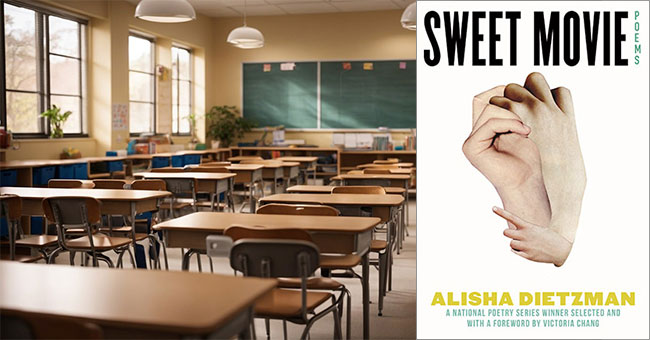
    In November 2024, poets from Beacon Press’s National Poetry Series and Raised Voices series gathered at a National Council of Teachers of English panel to discuss how they use poetry to explore themes such as family, history, and identity in their lives. Poetry and its ability to access truth can be a transformative experience as they explore writing about the complexities of their lives and the world around them. Alisha Dietzman was one of the panelists. Her volume in the National Poetry Series, Sweet Movie, confronts romantic and religious masochism to interrogate spiritual, sexual, and moral agency. What follows are his answers to the panel discussion questions. 

    Beacon Press: Tell us about your teaching practices. Where do you teach? Who are your students, what topics and texts do you cover? What are your goals as an educator? 

    Alisha Dietzman: I’m actually not teaching at the moment! At least not formally. I mentor a small group of incredible students from my last poetry workshop who wanted to continue to meet. Most recently, I worked as an adjunct at a small Quaker liberal arts college in rural Oregon where I taught freshman composition and intermediate poetry. Over the years, I’ve taught/tutored in a wide variety of environments and to a wide variety of students. I taught English Language courses in Lithuania and Czechia, where my students ranged from toddlers to adults in their sixties, and I also worked as a paraeducator in the public schools for two years. Additionally, I taught a mixed genre creative writing course at University of Wisconsin-Madison during my MFA.

    My students have been so varied that it would be impossible, almost, to pick a “student” to describe as typical, but the students I currently mentor—and who I most recently taught in a more formal setting—are largely religious. Most are from middle- and lower-income backgrounds. Faith—and wrestling with faith—plays a prominent role in their daily lives, including in their creative practice. This is also my background, and I see so much of myself in my students; sometimes that’s a challenge. I have been surprised at how rewarding but emotional it can be to work with students whose struggles and questions feel so familiar to mine.

    I have many goals, naturally—as any good teacher should—but above all else, I want students to explore creativity. (I often referred to my poetry workshop last fall as “creativity class.”) Not every student who I teach will publish a book—and most won’t, especially not students who, candidly, lack the economic and social resources that many successful writers/artists are born into—but all students have access to a rich and strange and gorgeous world teeming with texts and images to look at, to open, and to hold. And they have particular, worthwhile worlds! I want students to look at their own worlds and understand these worlds as valuable. So often, students come into workshop assuming that a poem must use formal or archaic imagery and diction and cover certain “acceptable” topics. I try to emphasize that they have this world, by which I mean, whatever world is in front of them. Gas stations and Evangelical churches and Target parking lots—whatever, all of it. I’m in love with the world around me, its flawed and “ugly” and weird language. Honestly, I try so hard to get my students to unlearn the idea of ugly language entirely, but then, I also have words/things I despise—mostly just the word crimson. In a Christian context—and this often resonates with my students—I like to tell them that nothing is beyond redemption. Metaphor redeems; metaphor makes new. 

    On a final note, returning to the lack of resources available to my students, I want as much as possible to show them that another life is possible, while also being straightforward about the challenges that students from low/middle-income backgrounds often face. I think this kind of honesty is critically needed in the arts community.

    BP: Do you find that your teaching and poetry practices shape one another? If so, in what ways? 

    AD: I love this question, and yes, with much intensity! I am not sure I thought this before last year, but my recent students impacted and continue to impact my practice. Some of this is particular and personal. Teaching students raised steeped in traditions that emphasize scriptural memorization and engagement allowed me to recognize for the first time how deeply my syntax owes itself to scripture. But the principle applies broadly! I think especially when you are re-entering your “home” culture after an extended absence. You will see things that you didn’t see before. My conclusions about metaphor, too, came out of wrestling with ways to meet my students’ needs, but helped me to see my own attachment to metaphor in a new light. Part of my love of metaphor is theological, I think. I have started to consider the ways that metaphor might be a spiritual practice as much as a poetic practice. 

    On a very basic level, too, the simple act of explaining your everyday creative practice to your students—the how of writing—pushes you to think about your own practice.

    BP: Our colleagues invited you to present one of your poems from Sweet Movie in the format of a sample lesson. Would you like to present your lesson now? 

    AD: I never teach my own work, so bear with me, please. This is an exercise I love to teach with the work of other poets. I usually teach it with Adrienne Chung’s wonderful poem, “Y2K.” I think it’s infinitely adjustable and malleable, though, which is part of its strength as an exercise. You can adjust this exercise for more advanced students or take it down to a more introductory level easily. And again, many, many poems work as examples!

    CREATING  A PERSONAL LEXICON 

    Sweet Movie poem

    A lexicon is a particular vocabulary or set of words. For example, languages have lexicons. I want you to think about your own personal lexicon through this exercise. Often, our first experience of poetry is formal: poems with high diction (diction = word choice); sometimes this diction feels fussy or archaic. Looking at “Love Poem by the Light of Eternity and a Reality TV Show About Love,” what kind of diction do you notice? What word or phrase choices stand out to you? The diction here is intended to root the reader in time and place while exploring contrasts between types of diction. The diction is also very personal to me, drawn from a particular and personal lexicon that—hopefully—still speaks clearly to readers. With all of this in mind, you’re going to construct your own personal lexicons.

    1. Take out a sheet of paper. Fold and tear it into three strips or pieces.
    2. Spend five minutes quietly and carefully considering the words you use frequently or that have significance for you personally. You might want to make a list on another sheet of paper. You can choose your words for any reason! Maybe one of the words holds cultural or spiritual significance for you or your family. Maybe you love one of the words. Maybe one of the words reminds you of a place or person or experience. Choose three of your words and write one word on each piece of paper.
    3. Stand up and talk to others in the class about your words and their words for the next five minutes. You have to trade one of your words for another student’s words; the trick is, whatever word you trade, it still needs to feel part of your personal lexicon and vice versa. Our lexicons are particular but they also communicate to others, and often, we can find overlap and shared significance within the lexicons of others.
    4. Once you have a lexicon of three words, spend ten minutes working on a poem in any style or form you want that incorporates your personal lexicon. You might do this via anaphora—repetition of a word or phrase in a poem—or by exploring the meanings of the individual words and their relationship to you, the poet. You might just use the words themselves, simply and straightforwardly. This is intentionally free and open-ended. You just need to use your lexicon of three words—all three—in the poem.

    Sweet-Movie-and-classroom


    About Alisha Dietzman 

    Alisha Dietzman is the author of Sweet Movie (Beacon Press, 2023), selected by Victoria Chang for the National Poetry Series. A finalist for the Kate Tufts Discovery Award and the Oregon Book Awards, Sweet Movie was also shortlisted for the John Pollard Foundation International Poetry Prize. Her chapbook, Slow Motion Something For No Reason, received the Tomaž Šalamun Prize Editors’ Choice Award (Factory Hollow Press, 2022). She received her PhD in Divinity with a focus on aesthetics and ethics from the University of St Andrews, supported by a grant from the US-UK Fulbright Commission. Her creative and critical work has also received support from the National Endowment for the Arts, the Rebecca Swift Foundation, the Jeffrey Rubinoff Sculpture Park, and the Barbara Deming Memorial Fund. Raised between Prague, Czechia and Columbia, South Carolina, she now lives in Oregon.

  • By Gloria J. Browne-Marshall

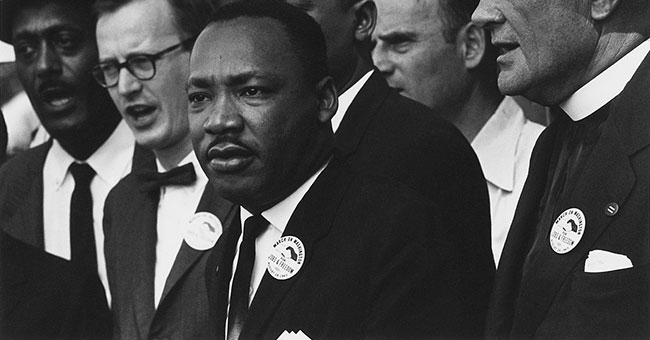
    Dr. Martin Luther King, Jr. at the Civil Rights March on Washington, DC, for Jobs and Freedom, 28 August 1963. Photo credit: Rowland Scherman

    Dr. Martin Luther King, Jr. at the Civil Rights March on Washington, DC, for Jobs and Freedom, 28 August 1963. Photo credit: Rowland Scherman

    Editor’s note: Gloria J. Browne-Marshall delivered a version of this keynote address at LibLearnX’s twenty-sixth annual Martin Luther King, Jr. Holiday Observance and Sunrise Celebration event in Phoenix, Arizona, on January 26, 2025. We share it here in observation of the anniversary of Dr. King’s assassination and his ongoing legacy.

    ***

    The God I serve does not live at 1600 Pennsylvania Avenue, run a multinational corporation, or control social media empires. As we bear witness to the schemes and diabolical machinations of this administration, we each shift through stages of grieving our loss, feelings of despair, depression, shock, trepidation and numbness, isolation and hopelessness, rage and even hatred.

    We face shameless greed, avarice, racism, xenophobia, misogyny and a blatant disregard for Constitutional principles or civil society, spreading like locusts across the land. With each new policy, our hopes for a brighter future drift further away. Wealth and cruelty may be the brand of some people, but it is not a shield of invincibility. We must protest.

    If control of Congress were all it took, women would never have won the right to vote in 1920 when men controlled all three branches of government. Women fought. They resisted. They protested, pushed and carved a path forward. Our Indigenous brothers and sisters know this struggle best. For over 500 years, they have fought to preserve their languages, religions, sacred lands and culture. They resisted. They protested. They survived and still fought. They carved a path forward.

    Protest done right is effective, but never easy. Dr. Martin Luther King, Jr. reminded us that progress is never a straight line. Dr. King would have been ninety-six years old this year had an assassin’s bullet not stolen his life at thirty-nine. In his final speech, he acknowledged, “Longevity has its place.” Yet he, like so many Civil Rights martyrs, sacrificed that longevity so we could live in a better world. They believed in resistance. They believed in protest.

    Dr. King was in Memphis, Tennessee, leading a protest for sanitation workers fighting to form a union when his life was taken. Through resistance and protest, those workers stood their ground, just as workers across the nation continue to do. Without resistance and protest, there would be no unions. As I stand here today, grateful for all that has been won, I wonder if we truly understand our role in the fight for social justice. I worry that those who have been given much now assume progress will march forward without their effort. In 1968, Beacon Press published Dr. King’s final book, Where Do We Go From Here? Chaos or Community? I say: community.

    A year before his death, Dr. King gave us our marching orders, posing the same question we must answer today: Where do we go from here? Chaos or community? Dr. King knew, even then, that the nation was slipping away from its short-lived promises of equality. Yes, Congress passed the Civil Rights Act and the Voting Rights Act, but to many White Americans, “equality” meant only slight improvement for Black lives, not true equity in politics and society. As Dr. King observed, too many of them believed that democracy is not worth having if it means equality. 

    In 1967, many Americans had no desire to share the nation’s opportunities equally. They believed their skin color entitled them to a larger portion, assuming that tossing a few crumbs from the table of plenty would be enough. It was not. So, there was resistance. To tell Black people to stop protesting in the streets is to demand our silence, King said. But as Dr. King reminded us, “Freedom is not won by passive acceptance of suffering. Freedom is won by a struggle against suffering.” 

    I am a proud African American, a descendant of those kidnapped and tortured, held in bondage to work from can’t see to can’t see—before the sun rose to after it set—for free, for others and were killed if they did not do it. Yet, they resisted and protested. They rose up against all odds of success when the murder of people of color carried no criminal consequences. When Congress, the Supreme Court, and the White House were all controlled by slaveholders. When some states chose war over freeing human beings from bondage. When the very Constitution enshrined a Fugitive Slave Clause, and federal law made freedom a crime while slavery remained the law of the land, they resisted.

    Women, men, and children protested. Frederick Douglass, formerly enslaved, said, “If there is no struggle, there is no progress. Those who profess freedom but deprecate agitation . . . want crops without plowing up the ground, rain without thunder and lightning. Power concedes nothing without demand. It never did and never will.” Progress has never come through wishful thinking or idle complaints. The arc of the moral universe may be long, but it does not bend toward justice on its own, it bends because we force it to.

    What are we resisting today? The answer is painful. We are confronting a regime, a self-declared dictator with no regard for democracy. This administration bows to leadership driven by revenge, self-worship, and the relentless pursuit of ill-gotten wealth with warmongering as its economic strategy. I see policies on the horizon designed to crush the working class into serfdom, shove our gay kinfolk back into the closet, deport immigrants, turn the working class into footstools for the rich, pressure White women into baby-making machines, and condemn Black Americans to Jim Crow servitude, mass incarceration and a cycle of death.

    Why? Progress frightens some people. Women in positions of power. Barack Obama’s two terms as president. Justice Ketanji Brown Jackson joining the US Supreme Court alongside Justices Sotomayor, the first Latina, and Kagan. The presence of gender, racial, ethnic and religious diversity in academia, government, corporate leadership, sports, the arts, and nonprofits. Some believed White male dominance was the American Dream. Never mind that it was built on violence and unjust laws. To some, equality felt like oppression. The looming reality of 2045, when people of color become the majority in the United States, is so terrifying that they are resurrecting racial apartheid. A system that took root here with Plessy v. Ferguson in 1896, then reached its full horror in South Africa, a nightmare that only ended in 1990 through relentless protest and resistance.

    The symbolism of Dr. King Day and the presidential inauguration falling on January 20 remains a bright and shining light, a North Star guiding us forward, urging us to build a future beyond their empty rhetoric. Go boldly into battle. Reject defeatism before the fight even begins. Slave masters knew that if they controlled the mind, they could eliminate the will to resist. Stand up. Protest, because power does not belong solely to the wealthy, the corporate elite, or the politicians. Yes, with money comes certain power, but we hold power too.

    Each of us, multiplied by millions across this nation, holds power. We have the right to free speech, to assemble, to petition the government for a redress of grievances, a right so often overlooked, enshrined in the final line of the First Amendment. To petition is to demand. To seek redress and insist on a remedy. This is not a privilege; it is our right. We must use it! I don’t know about you. But to borrow from Dylan Thomas, “I am not going gentle into that good night.” 

    My great-great-grandmother Eliza was born into slavery in Kentucky in the 1830s. As a child, she was torn from her mother and sold. As a teenager, she was sold again to Mr. and Mrs. Christian. Yes, the Christians. Her life was consumed by free labor, cooking, cleaning, and tending to every need of her enslavers and their children. One day, exhausted, she sat down. Mrs. Christian picked up a broom handle and cracked it against Eliza’s head. Then she beat her with the broken stick, pinned her down and poured salt into the open wounds. That evening, over dinner, Mr. and Mrs. Christian calmly discussed how severely Eliza should be whipped for her “impudence” and “laziness.” When Mr. Christian finished his meal, he calmly rose, walked to the kitchen and reached for the horse whip kept above the door. But Eliza had plans of her own. As they dined, she set a pot to boil, just as she boiled inside.

    When Mr. Christian reached for the whip, Eliza seized the pot and hurled the scalding water onto him, then onto Mrs. Christian. I can only imagine the screaming, the fussing, the cursing. But they never laid a hand on her again. She lived to see the end of the Civil War. She lived to see freedom. And she became an Exoduster, journeying from Kentucky to Kansas in the first great Black migration of the 1870s, a protest against the night riders and terrorist groups burning newly built schools in the South.

    We all come from ancestors who showed courage beyond measure. Call on them. The suffragists. The immigrants. The first union organizers. The anti-war demonstrators. Those who stood against police violence. Look to history. Find courage between the pages. Where do we go from here, chaos or community? I choose community. Dr. King warned us: “Today our very survival depends on our ability to stay awake, to adjust to new ideas, to remain vigilant, and to face the challenge of change.” In 1967, King warned us to stay woke.

    We must protest. We must resist. We must remain vigilant in defending the rights won by generations before us. These rights were not gifts, not favors from benevolent rulers. Look to history, regular people fought back against oppression. We, the people, seized our rights. We, the people, protested and resisted. We planned. We marched. We demanded. We litigated. We voted. We stood our ground.
    The eight-hour workday wasn’t handed down; it was won through decades of protest. Our rights require action. Stand. Kneel. Organize. Resist. When they ban our books, we build Freedom Schools in our living rooms. And we remind those in political office that re-election is not guaranteed. Those who can must march outside the White House, every day, just as women did to win the vote. We must write, march, strategize, unite with resistors across the nation: college students, clergy, seniors, veterans, women, unions. Rise and be heard!

    And Black women, again, we are forced to save this country. Our very survival is a protest. We, who carry the twin burdens of racism and sexism every day yet push forward anyway. We, my sisters, will be hit hardest by these policies, so we must hit back harder. Act where your passion runs deepest. Choose battles where your power shines. There is no shortage of injustice, enough tragedy for everyone to take a piece. But simmering in silence is not resistance. Complaining without action is not progress. Without a vision, the people will perish. Envision a world where people are safe, respected, with opportunity and justice for all. We dream a world with access to education that springs forward higher levels of literacy. 

    Dr. King was often dismayed by the silence of good people, those who grumble among friends but refuse to step forward. We are witness to sinful hypocrisy unfold as some weaponize the strength of our democracy to destroy it because our democracy is not worth having when equality comes with it. The insult of that knowledge runs deep. But rage alone is not enough. Turn that fury into action. We, the people, fought for freedom, equality and justice. Too many gave their lives for the rights we hold today. Honor their sacrifice. Embrace your power. Resist. Protest. The movement is forward.


    About the Author 

    Gloria J. Browne-Marshall is an Emmy Award-winning writer, an educator, a legal advocate, and a playwright. She is the author of A Protest History of the United States, releasing April 2025 from Beacon Press.

  • By Christian Coleman

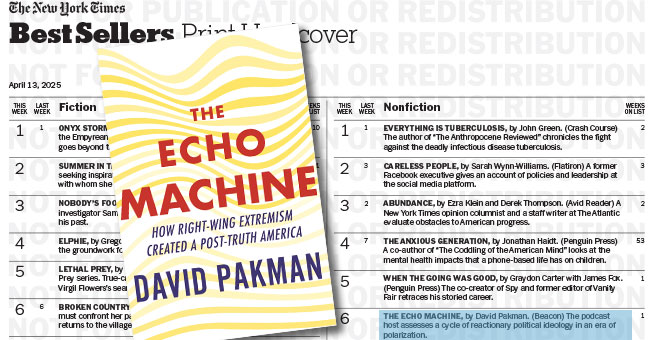
    The-Echo-Machine-on-NYT-Best-Seller-List

    Cover design: Carol Chu

    Four months into this administration defined by an onslaught of draconian executive orders, we finally have some good news. Just a week after publication, David Pakman’s The Echo Machine: How Right-Wing Extremism Created a Post-Truth America made it to the New York Times Best Seller List! It ranked number six on their print hardcover list and number seven on their combined print and e-book list! On top of that, The Echo Machine hit the Associated Press’s Audiobooks Top 10 and USA Today’s Best-Selling Booklist!

    If the 2024 election cycle made anything apparent, it’s that the right wing has benefited from and capitalized on disinformation and the polarization of US politics. The Echo Machine arrived in the nick of time to take stock of this. “For anyone who wants to stand up to disinformation and deepen their understanding of politics without getting lost in jargon,” said Brian Tyler Cohen, YouTuber and author of Shameless, in his praise for Pakman, “this book is essential reading.”

    At first blush, the title of the introduction of his book, “Why I Hate Politics,” comes off as a little tongue-in-cheek for the progressive political commentator and podcast host of The David Pakman Show. But Pakman told Bill Press on The Bill Press Pod why he unironically hates politics: “It feels like a waste of what could be really productive time, solving real problems and improving the country and the world for people in tangible ways. What I hate about it is that it’s become arguments with people with whom we can’t even establish and agree on basic facts from which we would then talk about policy. . . . What I hate about it is what it has become as a de facto reality in the United States.” The nature of what Pakman calls the echo machine, the right-wing amplification of disinformation and the mainstream media’s role in it, begs the question: How did we get here?

    In his Thom Hartmann Program interview, Pakman addressed how billionaires have been funding right-wing movements for years. What’s in it for them? Do they cynically not like democracy? Pakman explained that it’s about billionaires building an infrastructure that caters to their interests. On Talk Cocktail, Jeff Schechtman asked Pakman if there was a single inflection point that had steered our political dialogue to the point where it is today. There were many inflection points, Pakman told him, but talk-radio stations scooped up by the religious right played a significant role. This was part of a fifty-year move toward the extreme right by the Republican Party, and our tyrant in chief is the beneficiary of it. Pakman went further into detail in his interviews on The Young Turks, The Chris Cuomo Project, The Mark Thompson Show, and Relationscapes with Blair Hodges.

    What, then, can we do about this to save our democracy? On the day his book went on sale, Pakman recorded a segment for The David Pakman Show in which he said, “This is not just about how American politics got so broken. It’s also about what’s happening right now and what we can still do to stop things from getting worse. . . . The same forces that brought us here can be countered if we understand how they work and what to do about them. That’s what The Echo Machine is all about.” His critique and analysis of what led us to this political moment comes with practical ways we can shift the discourse through improved critical thinking, media literacy, and public education. We’ll need it all to get through the next four years.

    Congratulations and a massive thank-you go to David Pakman! Now he can add New York Times best-selling author to his bio.


    About the Author 

    Christian Coleman is the digital marketing manager at Beacon Press and editor of Beacon Broadside. Before joining Beacon, he worked in writing, copy editing, and marketing positions at Sustainable Silicon Valley and Trikone. He graduated from Boston College and the Clarion Science Fiction & Fantasy Writers’ Workshop. Follow him on Twitter at @coleman_II and on Bluesky at @colemanthe2nd.bsky.social

  • By Aviva Chomsky

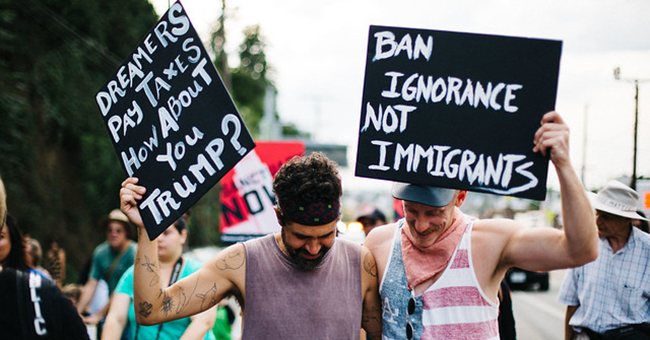
    Los Angeles March for Immigrant Rights, September 2017

    Los Angeles March for Immigrant Rights, September 2017. Photo credit: Molly Adams

    Since President Trump took office on January 20, he’s issued a torrent of executive orders aiming to criminalize, detain, and deport large numbers of immigrants. Close Trump advisor Stephen Miller promised that “Trump will unleash the vast arsenal of federal powers to implement the most spectacular migration crackdown,” and indeed he has. But why?

    As of late 2024, more than half of registered voters (and 88% of Trump supporters) wanted to see “mass deportations of immigrants living in the country illegally,” and 88% of voters wanted improved “security along the country’s borders.” 82% of Trump supporters said that immigration was “very important” to their vote, second only to the economy. 39% of Harris supporters also said that it was very important. But why?

    Over his entire political career and during the 2024 campaign, Trump has doubled down on the idea of the migrant threat. The Marshall Project tracked some of his major claims and how often he repeated them: “Unauthorized immigrants are criminals [said 575+ times], snakes that bite [35+ times], eating pets, coming from jails and mental institutions [560+ times], causing crime in sanctuary cities [185+ times], and a group of isolated, tragic cases prove they are killing Americans en masse [235+ times].”

    Trump’s own business interests—and those of his backers in agricultural, high tech, real estate/hospitality, and financial sectors—rely heavily on immigrant labor. So does the entire US economy. In our unequal world shaped by 500 years of European colonialism, the wealthiest countries have low birth rates, aging populations, and growing demand for workers, while the poorest have young populations with limited opportunities. Yet the wealthiest countries still cling to colonial attitudes of white supremacy and its civilizing mission. They need exploitable workers, both at home and abroad, to sustain their economic systems, and they need rationales for continuing to exploit these workers and their countries. Demonizing immigrants justifies the system.

    Anti-immigrant scapegoating under Trump has other purposes, too. It serves to distract domestic populations from Trump’s pro-corporate Project 2025 agenda, which promises to sacrifice the general population’s welfare to support corporate profits. And it justifies increasing authoritarianism and militarization of society.

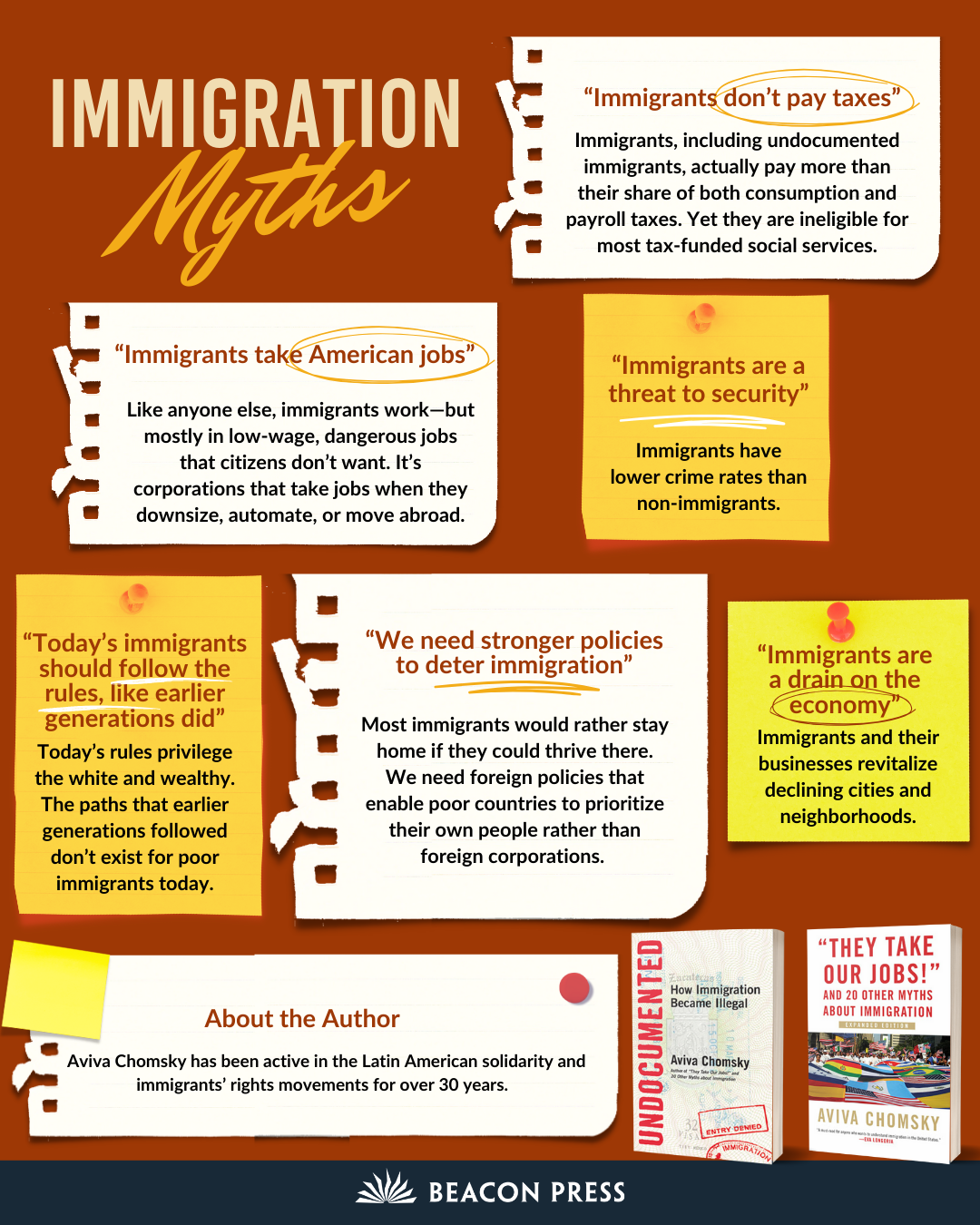
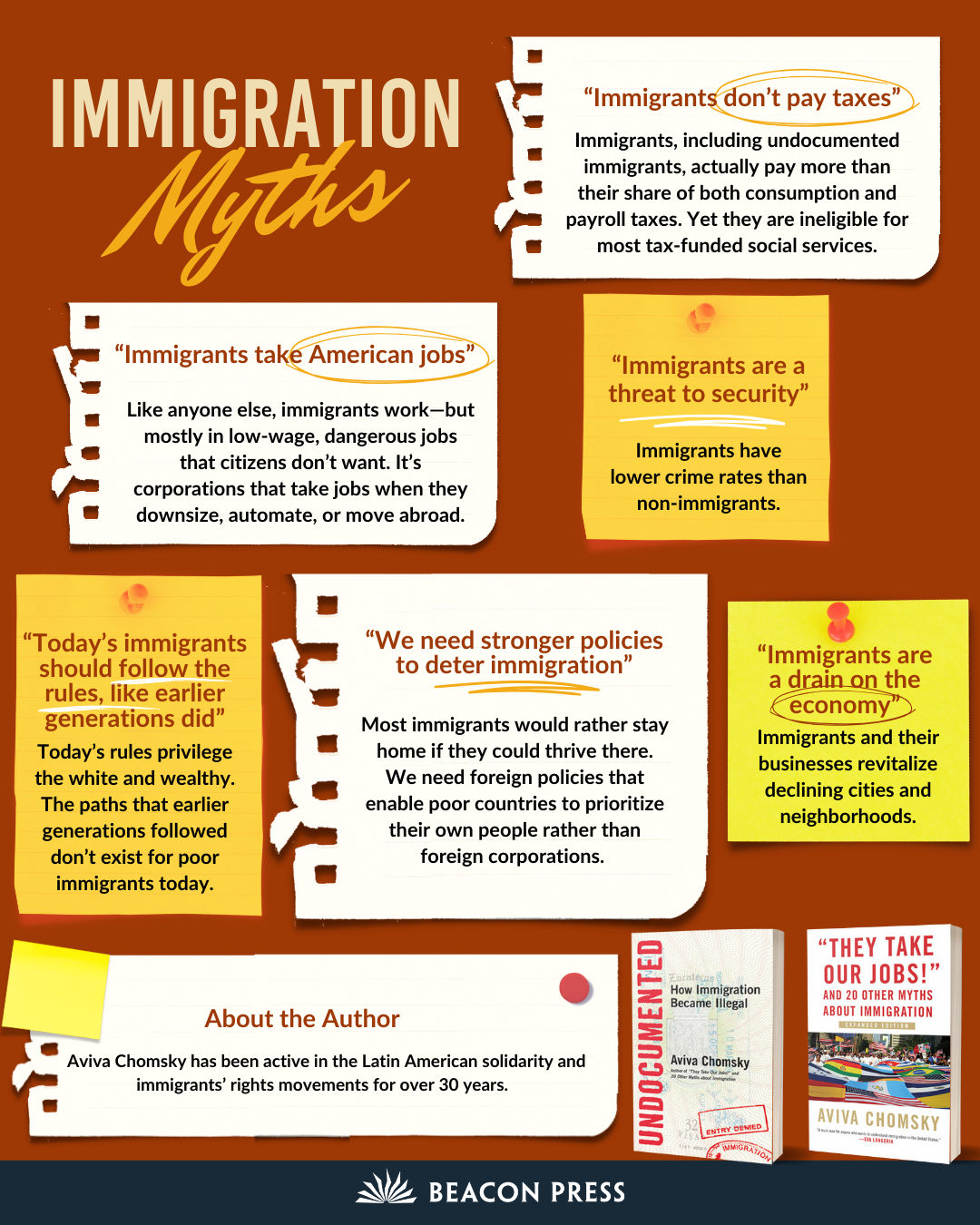
    Avi Chomsky - Immigration Myths (digital image for sharing)
    While Trump’s executive orders seek to greatly expand the detention and deportation of people living in the United States without legal authorization—“undocumented” people—they also strip the status of millions who are currently here with legal authorization: revoking Temporary Protected Status, parole, work authorizations, student visas, and even green cards. One reason for this is to expand the numbers of people that can be deported, since despite the rhetoric and the spectacle, the administration thus far has struggled to achieve the rates it has promised. Another reason is to exploit anti-immigrant sentiment to justify other goals—like instilling fear, controlling speech, attacking higher education, and promoting the genocide in Gaza in the interests of the administration’s corporate and foreign policy agenda.

    The cases of Mahmoud Khalil, Rasha Alawieh, Momodou Taal, and Yunseo Chung show one side of this onslaught; those of the Venezuelans spirited to extraterritorial detention in Guantánamo and El Salvador show another side. Both groups of cases involve attacks on people with legal status in the United States.

    Khalil, Taal, and Chung were all non-citizen students, Khalil and Chung holding green cards (that is, legal permanent residents), and Taal a student visa. All have been targeted for speech violations, with the Secretary of State invoking an obscure provision of the 1952 Immigration and Nationality Act created at the height of the Cold War Red Scare. The provision authorizes deportation for any “alien” if “the United States Secretary of State has reasonable ground to believe would have potentially serious adverse foreign policy consequences for the United States.” This provision is both completely arbitrary—the Secretary of State is not required to provide any evidence of any wrongdoing—and enables the government to claim, as it is doing in this case, that any criticism of US foreign policy could have “adverse” consequences. In these cases, they were targeted for protesting Israel’s genocide in Gaza. Marco Rubio has bragged that he has already revoked the visas of hundreds of others on these grounds.

    The case of Alawieh, a Rhode Island surgeon, is somewhat different since she was detained at the border (the airport) when she tried to re-enter the country with a valid work visa. At the border, Customs and Border Protection officials always exercise arbitrary and authoritarian power not constrained by the Constitution, since until they authorize entry, a person is considered to be outside of the United States. Still, her case sends the same message to those inside the United States: your legal rights are under threat if you even hint at opposing US foreign policy. Alawieh’s “crime” was attending the funeral of Hassan Nasrallah, the Hezbollah leader assassinated by Israel, while she was visiting her home in Lebanon.

    The hundreds of Venezuelans also mostly held legal status in the United States, having entered through Biden’s parole program or with ongoing asylum claims or Temporary Protected Status. They were detained under a different law: the 1798 Alien Enemies Act, which allows mass detention of non-citizens when their country has invaded the United States. It was last—and most notoriously—invoked to justify the mass detention of non-citizens and citizens identified as “Japanese” during World War II. By claiming—without evidence—that the Venezuelans were all gang members and—also without evidence—that, as such, they constituted an “invasion” by Venezuela, Trump justified the applicability of the act. By summarily dispatching parolees and asylum-seekers to extraterritorial gulags, Trump sends a message to anyone hoping for refuge or a better life in the United States—the same message that Kamala Harris conveyed in words: “Do not come.”

    And the Trump administration sends a message to everyone in the US and, in fact, to everyone around the world: “Do as we dictate or face the consequences.” The message has clearly been heard by elite universities (Columbia, Harvard, Yale) that are scurrying to take over academic departments and remove or silence faculty, by powerful law firms ingratiating themselves by agreeing to support pet Trump causes, and by countries like Yemen, suffering a hail of US bombardment, or France, facing a Trump ultimatum to eliminate corporate diversity policies there.

    Many of us are overwhelmed and bewildered by the daily onslaught. A lot of people are wondering what we can do. I would say, first, look for local organizations that are already mobilizing. Everywhere there are immigrants, there are organizations fighting for their rights. Some are focusing on the legal front: challenging the executive orders, working for local and state protections, raising money for legal aid, defending immigrants caught up in the system, pushing to create better laws. Others work on mutual aid and support for immigrants and their families, including food, shelter, education, transportation, and other basic needs. Some are organizing direct action, including civil disobedience, to impede immigration raids, and protests (including civil disobedience) against unjust laws and policies. Many are trying to do all of the above. There is no single right way to get involved: we need all of the above and more.

    We also need massive education and publicity to turn around the national narrative so that people will stop voting for, supporting, and enabling draconian anti-immigrant policies. We need to be much more visible in the public sphere, on social media, in local media, in educational events and public forums, debunking the many myths about immigrants and showing how they are being scapegoated to promote an agenda that harms all of us.


    About the Author

    Aviva Chomsky is a professor of history and the coordinator of Latin American Studies at Salem State University. The author of several books including Undocumented and “They Take Our Jobs!”, Chomsky has been active in the Latin American solidarity and immigrants’ rights movements for over thirty years. She lives in Salem, Massachusetts.

  • A Q&A with Aaron Caycedo-Kimura

    Cover design: Carol Chu. Photo credit: Victor Salazar

    Cover design: Carol Chu. Photo credit: Victor Salazar

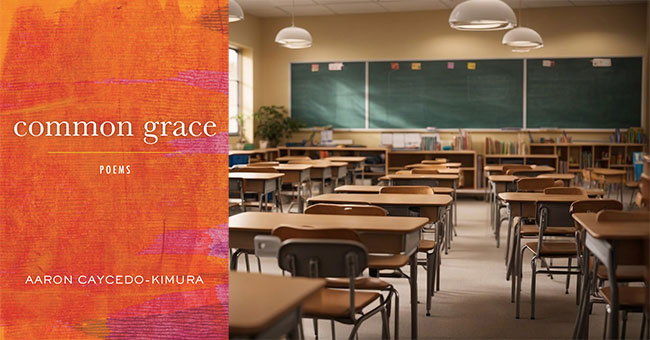
     In November 2024, poets from Beacon Press’s National Poetry Series and Raised Voices series gathered at a National Council of Teachers of English panel to discuss how they use poetry to explore themes such as family, history, and identity in their lives. Poetry and its ability to access truth can be a transformative experience as they explore writing about the complexities of their lives and the world around them. Aaron Caycedo-Kimura was one of the panelists. His volume in the Raised Voices series, Common Grace, explores the inherited trauma within his Japanese American family, his life as an artist, and his bond with his wife. What follows are his answers to the panel discussion questions. 

    Beacon Press: Tell us about your teaching practices. Where do you teach? Who are your students? What topics and texts do you cover? What are your goals as an educator?

    Aaron Caycedo-Kimura: I teach Introduction to Creative Writing at Trinity College in Hartford, CT, where most of my students are freshmen and sophomores. The goal of the course is to give the students a strong foundation in writing poetry, short fiction, and short creative nonfiction, and to introduce them to the joy and benefits that creative writing can have in their lives. I encourage them to use their life experiences and imagination to help develop their unique voices. My approach to teaching is to create a classroom environment of respect where everyone feels safe, where they can freely explore their families, histories, and unique identities. To help them, we read a lot of great examples from contemporary writers of different backgrounds.

    BP: Tell us about your poetry practices. What topics and themes do you explore in your poetry? How have your family, history, and identity influenced your poetry?

    AC-K: Family, history, and identity are what my poetry is all about. I think I’m just obsessed with trying to come to terms with who I am and what it is that I’ve inherited. Lately, I’ve been writing a lot about my father’s experience in the World War II incarceration camps here in the United States, as well as that of some Japanese American artists, like the painters George and Hisako Hibi (husband and wife), Miné Okubo, and the ceramicist Minnie Negoro.

    BP: Our colleagues invited you to present one of your poems in the format of a sample lesson. Would you like to present your lesson now?

    AC-K: I prepared a handout on one way you can go about teaching my poem “The Hardest Part” from Common Grace. I borrowed the format from poets.org’s Teach This Poem series. If you don’t know it, I highly recommend you check it out. It’s a great resource.

    My poem is about my parents when they were newlyweds, before my sister and I came along. At the heart of the poem is my mother’s PTS from World War II. She was a seventeen-year-old girl living in Tokyo during the US firebombing raids.

    The lesson starts with a warmup in which students watch the trailer to the indie film Paper City, a documentary about the firebombing of Tokyo, to give them context and a quick history lesson. Then it moves on to reading and listening to the poem. I have a link to a reading I did of it so students can hear it in my voice. Then the lesson goes on to a discussion about the craft of the poem regarding tone, images, figurative language, and music. And then it concludes with the wrap up questions: “What do you think was the poet’s intention in writing this poem?” and “Why does it matter?”

    Caycedo-Kimura Teach This Poem 1 Caycedo-Kimura Teach This Poem 2

    BP: Can you talk a little bit about exploring liminal identities in your work and how students might use poetry and writing to explore the liminal aspects of their own identities?

    AC-K: The liminality I explore in my work has to do with race, ethnicity, and nationality. I’ve spent my life trying to be comfortable in my own skin. Right now, I’m the most comfortable I’ve ever been—writing has helped with that—but if I’m to be honest, I don’t know if I’m 100% comfortable. I’m American. I’m also Japanese American but I have only a few Japanese American friends and acquaintances. I don’t have the support of an in-person Japanese American community. I don’t even know if I would be fully comfortable in such a community or if I would feel like an outsider.

    I wrote a poem that was published in DMQ Review last year called “It Stays with You.” It’s about buying a shirt at the Banana Republic outlet store. The shirt caught my eye because it reminded me of Japanese yukata fabric. But when I tried it on, my first thought was: “Does this look too Japanese?” Too Japanese. Where did that come from? Why would I ask that? So my poem explores that. I think for me and for students writing poetry is helpful to sort these things out. It might not solve any problems, but it may help us come to terms with who we are in our liminality.

    BP: Aaron, you describe works of art in your poems. In the classroom, such works are often taught under the ancient Greek principle of ekphrasis. What is it like to work as a modern poet in such an ancient tradition?

    AC-K: Writing ekphrastic poetry is a great way in which one can write about history, family, and identity. A work of art is the initial inspiration, but from there, I can take the poem in any direction.

    Two of my most recent ekphrastic poems have been inspired by the paintings Coyotes Came Out of the Desert and Floating Clouds by George and Hisako Hibi, respectively, who were incarcerated at the Topaz incarceration camp in Utah during World War II. The paintings were acquired by the Smithsonian a couple years ago. I start the poems by describing the scenes very briefly but then take the opportunity to bring in facts about the painters’ lives and some history about the camps.

    In another poem, this one inspired by a photograph taken of Minnie Negoro (a Japanese American ceramicist who was sent to the Heart Mountain incarceration camp in Wyoming), I insert something about my own family, imprisoned first at the Santa Anita Racetrack, then Jerome, and finally at Tule Lake. There are many ways to engage with the ekphrastic form.

    BP: We all see and acknowledge that humanity is facing unprecedented challenges right now, from wars of imperialism and colonial domination to the acceleration of climate change and the rise of authoritarian governments. What do you see as the role of poetry during times like these and how do we teach this to our students?

    AC-K: Poetry, both in the reading and writing of it, offers us the opportunity to slow down and deepen our experience of life and other people’s lives. It feeds our imagination, our curiosity, and hopefully, our empathy. Making poetry, making art of all kinds, is an entirely human act. And that’s what we need more of—humanity. We teach this to our students by having them read a wide variety of authors and write in their own unique voices.

    Common-Grace-in-the-classroom


    About Aaron Caycedo-Kimura 

    Aaron Caycedo-Kimura is a writer, a visual artist, and a teacher. He is the author of two poetry books: the full-length collection Common Grace (Beacon Press, 2022) and Ubasute, winner of the 2020 Slapering Hol Press Chapbook Competition. He is also the author and illustrator of the nonfiction book Text, Don’t Call: An Illustrated Guide to the Introverted Life (TarcherPerigee, 2017). His honors include a MacDowell Stanford Calderwood Fellowship, a Robert Pinsky Global Fellowship in Poetry, a Connecticut Office of the Arts Artist Fellowship Award, and a St. Botolph Club Foundation Emerging Artist Award in Literature. His work has appeared or is forthcoming in numerous journals and anthologies, including Beloit Poetry Journal, RHINO, The Cincinnati Review, Consequence, Shenandoah, Gordon Square Review, Cave Wall, and elsewhere. Caycedo-Kimura earned his MFA from Boston University and teaches creative writing at Trinity College.

  • A Q&A with Roque Raquel Salas Rivera

    Photo credit: Victor Salazar. Author photo: Tamara Maz Photography

    Photo credit: Victor Salazar. Author photo: Tamara Maz Photography

    In November 2024, poets from Beacon Press’s National Poetry Series and Raised Voices series gathered at a National Council of Teachers of English panel to discuss how they use poetry to explore themes such as family, history, and identity in their lives. Poetry and its ability to access truth can be a transformative experience as they explore writing about the complexities of their lives and the world around them. Lambda Literary Award winner Roque Raquel Salas Rivera was one of the panelists. His bilingual volume in the Raised Voices series, antes que isla es volcán/before island is volcano, is a powerful, inventive collection that looks to the decolonial future of Puerto Rico with love, rage, beauty, and hope. What follows are his answers to the panel discussion questions.

    Beacon Press: Tell us about your teaching practices. Where do you teach? Who are your students? What topics and texts do you cover? What are your goals as an educator?

    Roque Raquel Salas Rivera: I’d like to begin by saying I am very sad Danielle cannot be present to answer these questions. Meeting her at the panel this last year was truly a blessing, and I will never forget how generous and kind she was.

    I teach at the University of Puerto Rico. My students are almost all Puerto Rican, and I teach a variety of courses on Gender Studies, Cinema and Human Rights, Puerto Rican History and National Thought, Introduction to Literature—a wide range. I hold a PhD in Comparative Literature and Literary Theory from the University of Pennsylvania, and my dissertation focused on three poets: Julia de Burgos, Sotero Rivera Avilés, and Ángela María Dávila Malavé. I focus on anticolonial movements and decolonial poetics and have a strong interest in literature and poetry, which I integrate into most of my courses.

    As an educator, my goal is to meet the student where they are and contribute to their awareness of themselves as guardians of their own histories, cultural production, and political power. I consider myself successful as an educator if I am empowering my students and helping them better understand themselves as thinkers and creators.

    I am also an educator outside of institutions. I mentor younger poets and translators and often offer free community workshops. I consider the access I have had to different bodies of knowledge a privilege and one that should be shared.

    BP: Tell us about your poetry practices. What topics and themes do you explore in your poetry? How have your family, history, and identity influenced your poetry?

    RRSR: All the themes you have mentioned are present in my work. I would say my poetic practice is one that does not dictate or expect my work to have those or any specific themes. I am driven by the belief that poetry is soul-work, even though I am, by many standards, an atheist. What I call “soul-work” is the notion that there are many aspects of ourselves and the world we do not understand logically, and there are also things that come through the poems that can only exist in poetry. My commitment as a writer is to a practice, a search that does not hide that which is unpleasant and ugly, that does not assume what readers are or are not able to understand, and that opens a window into my language and experience of the world without sacrificing that which makes it mine. I believe great poets, like great musicians, have an allegiance to those who came before them, and a right to work within the specificity of their craft without having to justify it to the world. I also believe poetry should accompany collective liberation, but I am not one for dictating what that should look like. The poet Roque Dalton, whose name I have borrowed, once wrote the following:

    Querido Jorge:
    Yo llegué a la revolución por vía de la poesía.
    Tú podrás llegar (si lo deseas, si sientes que lo necesitas) a la
    poesía por la vía de la revolución. Tienes por lo tanto una ventaja.
    Pero recuerda, si es que alguna vez hubiese un motivo especial
    para que te alegre mi compañía en la lucha, que en algo hay que
    agradecérselo también a la poesía.

    My translation:

    Dear Jorge,
    I arrived at revolution via poetry.
    You can arrive (if you so desire, if you feel the need) at
    poetry via revolution. You therefore have an advantage.
    But remember, if you ever find any special reason
    to take pleasure in my company during the revolutionary struggle,
    to some extent you’d also have to thank poetry.

    BP: Do you find that your teaching and poetry practices shape one another? If so, in what ways?

    RRSR: Of course. I think my life shapes my poetry and teaching is part of my life. I couldn’t tell you exactly how, but I am always learning new things through teaching and through just listening to my students. I think one would have to make a conscious effort not to learn, especially at a public university in a US colony.

    BP: You use multiple languages in your poetry. Do you ever teach multilingual texts to your students? Are many of your students themselves multilingual, and if so, how does that shape the classroom experience? In general, how do you think languages relate to identity in poetry?

    RRSR: Because of the colonial relationship between the US and Puerto Rico, and the fact that most Puerto Ricans on the archipelago speak Spanish, I teach in Spanish and try to provide texts in Spanish or translated into Spanish. I think most people assume that because I self-translate into English or publish dual-language books I move between languages in my classrooms. The truth is that I don’t ever reprimand students for using English in class, but I almost always translate what they are saying into Spanish so everyone can access it. I also provide source texts in English along with the translations when possible.

    BP: Have you ever spoken with educators who are assigning your work in their classes? What was it like to hear about their teaching your work?

    RRSR: I often have educators approach me to say they are teaching my work. It is exciting. Younger poets approach me as well to say they read me in a class. It makes me feel so grateful that younger trans poets read my poetry. That’s who I write for! Sometimes I ask questions about how they approach my work in class, but I tend to think each educator has their own style.

    BP: You explore liminal identities in your work. Can you talk a little bit about this, and how students might use poetry and writing to explore the liminal aspects of their own identities?

    RRSR: It depends on how you define liminal. Would being Puerto Rican in Puerto Rico really be liminal? Would being trans for a trans person be liminal? Maybe you could say being a trans Puerto Rican is liminal, but it shouldn’t be. I think if we added all the liminalities, we’d get a majority.

    BP: The theme of last year’s National Council of Teachers of English conference is heart, hope, and humanity. We can all see and acknowledge that humanity is facing unprecedented challenges right now, from wars of imperialism and colonial domination to the acceleration of climate change to the rise of authoritarian governments. What do you see as the role of poetry during times like these, and how do we teach this to our students?

    RRSR: I was recently invited to lead a conversation on revolutionary poetics during a one-strike at the university where I work. The students, workers, and professors were and are protesting the proposed closure of sixty-four programs, which include Puerto Rican history, literature, and many others. Since the Department of Education cut PR history as a requirement, the first time that many students encounter the history of their own country is at the university. Cutting these programs will have a devastating impact on our archives and collective memory.

    Right now, there is a project called Esencia, which developers are trying to impose on the people of Cabo Rojo, which will essentially (pun intended) be a plantation-style mega-development for the tourism industry.  It is like that Chuwi song “Mundi” says: “La gente venía a mirarme / Por mi belleza admirarme / Pa’ después olvidarme / Este sitio es un zoológico / Que se está derrumbando.” Or: “People came to look at me / to admire my beauty / And later forget me / This place is a zoo / That is collapsing.” That’s what it feels like to be a puertorriqueño in Puerto Rico, like a zoo animal in a beautiful cage. Being trans makes it more intense. There is an active effort to erase us, to make us disappear, even as we are subject to stares, as spectacle. That is why I wrote a trans epic, to create memories in the face of our erasure, to write a history in my own voice. I don’t think I have to tell my students why that is important. They can see it themselves when they engage with the material, through our debates and just by having a trans Puerto Rican as their professor. They value me as I value them, because we are in this together.


    About Roque Raquel Salas Rivera 

    Roque Raquel Salas Rivera is a Puerto Rican poet, translator, and editor. His honors include being named the 2018-19 Poet Laureate of Philadelphia and receiving the New Voices Award from Puerto Rico’s Festival de la Palabra. He is the author of five previous full-length poetry books. His third book, lo terciario/the tertiary, won the Lambda Literary Award for Transgender Poetry and was longlisted for the 2018 National Book Award. His fourth book, while they sleep (under the bed is another country), was longlisted for the 2020 Pen America Open Book Award and was a finalist for CLMP’s 2020 Firecracker Award. His fifth book, x/ex/exis, won the inaugural Ambroggio Prize. He currently writes and teaches in Puerto Rico. 

  • By Christian Coleman

    Women

    Image credit: Simp1e123

    It wasn’t just Black History Month that Google Calendar removed from its holiday list. They did away with Women’s History Month, too. Just check your phones. In true fashion of an avowed fascist’s pick me, Big Tech was thorough with the forty-seventh administration’s anti-DEI scourge. But we said it once and we’ll say it again: We don’t need you to recognize Women’s History Month. Keep on with pandering to the patriarchy as we keep this party rolling.

    This year’s theme highlights how women have educated and inspired generations, and we have just the handful of titles from our catalog for the occasion! This inexhaustive list also serves as a shout-out to women writers. Because writing is yet another way to educate and inspire generations.


    The Cost of Fear

    The Cost of Fear: Why Most Safety Advice Is Sexist and How We Can Stop Gender-Based Violence

    “Embracing self-defense doesn’t mean giving up on legal and political change. What it means is knowing when not to depend on institutions or the law for our immediate safety. The systems we’ve fought for decades to change are reliable and unreliable. They are so much better than they were for previous generations and they’re no different than they’ve always been. Changing laws and attitudes is essential to preventing gender-based violence but also inadequate. Because gender-based violence is intimate and personal, strategies for stopping this violence need to be intimate and personal too.”
    —Meg Stone  


    The Dragon from Chicago

    The Dragon from Chicago: The Untold Story of an American Reporter in Nazi Germany

    “After Hitler’s rise to power, [Sigrid] Schultz found creative ways around the Nazis’ tightening control over the press. Described by fellow foreign correspondent Quentin Reynolds as “Hitler’s greatest enemy,” she reported on the passage of antisemitic laws, the opening of concentration camps, the closing of churches, and the reign of terror against Jews, Communists, and anyone who opposed Hitler’s government. She accurately predicted Hitler’s military intentions and shared details of Germany’s rearmament. She demonstrated how the Nazis manipulated and misreported the news to their own people and attempted to control the foreign press through a combination of bribery and threats.”
    —Pamela D. Toler


    Faux Feminism

    Faux Feminism: Why We Fall for White Feminism and How We Can Stop

    “Audre Lorde wrote that one of white feminists’ gravest mistakes was their assumption that women of color could only teach them about the lives of women of color. We absolutely need to see that the bodies of women of color are special sites in the production of racial, economic, and ableist hierarchies. But a hallmark of Black feminist activism has also been that looking at the lives of those facing multiple oppressions can help us learn what will liberate all women. The lives of women of color make particularly clear what is at stake for all women.”
    —Serene Khader


    The Hivemind Swarmed

    The Hivemind Swarmed: Conversations on Gamergate, the Aftermath, and a Quest for a Safer Internet

    “You know, what strikes me is that none of my students know what Gamergate is because it’s been three years. Well, now it’s become a historical event. . . . You talk about it as an event that was important because it signaled the fall of the game industry at that period of time. One of the problematic things about Gamergate is that you couldn’t say who won or lost. It just showed everybody’s ass.”
    —Lisa Nakamura, gender and technology researcher, interviewed by David Wolinsky


    Kindred - Monae foreword

    Kindred
    Foreword by Janelle Monáe

    “Kevin and I became more a part of the household, familiar, accepted, accepting. That disturbed me too when I thought about it. How easily we seemed to acclimatize. Not that I wanted us to have trouble, but it seemed as though we should have had a harder time adjusting to this particular segment of history—adjusting to our places in the household of a slaveholder. For me, the work could be hard, but was usually more boring than physically wearing. And Kevin complained of boredom, and of having to be sociable with a steady stream of ignorant pretentious guests who visited the Weylin house. But for drop-ins from another century, I thought we had had a remarkably easy time. And I was perverse enough to be bothered by the ease.”
    —Octavia E. Butler


    Looking for Lorraine

    Looking for Lorraine: The Radiant and Radical Life of Lorraine Hansberry

    “Whether domestic or internationally focused, Lorraine emphasized Black independence from white (European or American) political control. She continuously rejected the Western nations’ panic around the potential influence of Islam or communism as both condescension and an effort at control. In this way, she was something of a Black nationalist, not as a matter of separatism but as an ethic of self-determination.”
    —Imani Perry


    Mad Wife

    Mad Wife: A Memoir

    “Perhaps women are beginning to wake from the trance of male entitlement, which our culture encodes as romantic love and experts accept as integral to healthy marriages. Waking up can be slow and disorienting. I spent much of my fifteen-year marriage bound to my husband by our shared conviction that his entitlement to female caretaking mattered more than my own happiness, desires, or pain. When I finally wrenched myself free I did so simply to survive, having held myself in misery so long that I was fantasizing and occasionally plotting my own death.”
    —Kate Hamilton


    No Human Involved

    No Human Involved: The Serial Murder of Black Women and Girls and the Deadly Cost of Police Indifference

    “The indifference to Black women as human beings worthy of defense and respect is not a new phenomenon. Enslaved Black women were bought, sold, raped, exploited, and, in many cases, violently killed since their arrival on the shores of Jamestown, Virginia in 1619. More than four hundred years later, Black women continue to remain unprotected. Simply put, there is not, nor has there ever been, a safe place in this nation for Black women. This is especially true within the purview of law enforcement: an institution whose very existence originates from slave patrol and apprehension.”
    —Cheryl L. Neely


    On Gold Hill

    On Gold Hill: A Personal History of Wheat, Farming, and Family, from Punjab to California

    “Before my parents were married, my father, a hippie from Los Angeles with long blond curls and a mustache, decided to call my grandfather to ask for permission to marry his daughter. My mother told him she didn’t think this was such a good idea. Though the couple had been dating for a few years, my grandparents knew nothing of their eldest daughter’s relationship. They expected my mother to have an arranged marriage to a suitable Indian groom, not a white Californian who wore bell-bottoms and talked of such nonsense as ‘true love.’ My grandparents had already facilitated introductions between my mother and potential husbands—they’d gone so far as to send her to England to meet a prospective match. And though she had no intention to follow through with any of the arrangements, my mother had been amiable, willing to placate her parents by attending the introductions. I’m not sure how or when my mother did plan to break the news to her parents, had my father heeded her warning and given up on calling my grandfather to ask for his blessing.”
    —Jaclyn Moyer


    The Rebellious Life of Mrs. Rosa Parks - 10th-anniversary ed

    The Rebellious Life of Mrs. Rosa Parks: 10th-Anniversary Edition

    “As with many Southern migrants, Parks’s political activities did not end when she left the South. But the image of Parks on the bus in 1955 is fixed in the popular imagination partly because she left the South as the civil rights movement she helped spur was blossoming. As her comrades in Montgomery and across the South fomented a nonviolent revolution increasingly captured by the national media, Parks had a new political base. Though she remained personally close to many Southern movement people and attended some events, she wasn’t a daily participant—and so became frozen in time, heralded for starting it all but largely unrecognized as an ongoing political actor.”
    —Jeanne Theoharis


    Storming Caesars Palace

    Storming Caesars Palace: How Black Mothers Fought Their Own War on Poverty

    “Over the next year, Duncan testified before the Senate Health and Labor Committee, the Budget Committee, and the Economic Opportunity Committee, as well as Long’s Finance Committee. Duncan’s message was consistent: ‘It’s time people in Washington realize that if you can get good jobs with good pay, we’d be happy to get off welfare. . . . People are tired of having welfare officials tell them how to run their lives, when they can get sick, how much food they can eat. We want to rule our own lives. We want a piece of the American pie. We want jobs that will provide our families with a decent life.’”
    —Annelise Orleck


    The Trials of Nina McCall

    The Trials of Nina McCall: Sex, Surveillance, and the Decades-Long Government Plan to Imprison “Promiscuous” Women

    “Nina McCall spent nearly three months in captivity in the Bay City Detention Hospital. Inside, she was forced to endure inhumane (and ineffective) medical treatments. Her days were filled with scrubbing floors and washing dishes; her nights were spent sharing a bed with another woman in a small room. After Nina was released, a state agent followed and harassed her, forcing her to continue taking the agonizing mercury injections, on threat of reincarceration. Unable to tolerate the pain any longer, Nina eventually decided to sue the government. he needed this cruel mistreatment to stop.”
    —Scott W. Stern


    Unapologetic

    Unapologetic: A Black, Queer, and Feminist Mandate for Radical Movements

    “When people see that they matter in organizing spaces, they are more likely to repeatedly show up. It takes time to engage individuals in the process of building relationships in the movement, but it is more than worth it. In building those relationships, we are better able as organizers and leaders to ascertain what brings people to the table and what may keep them there, especially if we see that they have something important, large or small, enabling our work. Good movement organizing recognizes this by holding one-on-one or relational meetings, house meetings, and study groups.”
    —Charlene A. Carruthers


    With Her Fist Raised

    With Her Fist Raised: Dorothy Pitman Hughes and the Transformative Power of Black Community Activism

    “While Dorothy primarily identified as a childcare activist at this time of her life, her activism was not narrow. She also worked to create community-controlled resources that provided job training, adult education, a youth action corps, housing assistance, and food resources on the West Side. Like other organizers, Dorothy understood that the need for childcare was not independent of issues of needs for housing, employment, and welfare support. The renamed West Side Community Alliance addressed these issues as deeply interrelated problems that could not be effectively resolved in isolation.”
    —Laura L. Lovett

    Women


    About the Author 

    Christian Coleman is the digital marketing manager at Beacon Press and editor of Beacon Broadside. Before joining Beacon, he worked in writing, copy editing, and marketing positions at Sustainable Silicon Valley and Trikone. He graduated from Boston College and the Clarion Science Fiction & Fantasy Writers’ Workshop. Follow him on Twitter at @coleman_II and on Bluesky at @colemanthe2nd.bsky.social