• By Philip Warburg

    Bitcoin

    Image credit: Sulayman Sanyang

    The cryptocurrency rush is on. Morgan Stanley and Goldman Sachs now offer Bitcoin as an investment option to preferred clients, and electronic payments giant NCR will soon be offering cryptocurrency services to customers of some 650 smaller banks and credit unions.

    As they open cryptocurrency to clients, these and many other stakeholders seem utterly unconcerned about the mammoth energy waste associated with this emerging industry. Cryptocurrency leader Bitcoin consumes nearly three times Switzerland’s total electricity and about a quarter of Germany’s total power use—roughly 0.4 percent of the world’s electricity. This is especially appalling when one considers that all data centers worldwide, excluding those used for Bitcoin, account for about 1 percent of global electricity. 

    A twisted variant of pay-to-play is responsible for Bitcoin’s energy gluttony. Would-be buyers must expend enormous amounts of computer power—and money—solving hugely complex mathematical riddles that serve as the gateway to earning, or “mining,” Bitcoin. These computational gymnastics and the energy they consume make it prohibitively expensive for attackers to undermine the integrity of the Bitcoin ledger.

    Chris Larsen is executive chairman of Ripple Inc., which markets another leading cryptocurrency asset called XRP. He makes a point of distinguishing his own company’s modest energy demand from other cryptocurrencies that rely on Proof of Work, the energy-devouring validation method used by Bitcoin. Instead of setting costly computational hurdles, XRP operates through a network of peer-to-peer servers that secure their transactions with collateral. According to Ripple’s estimate, XRP uses an average of 0.0079 kilowatt hours per transaction, in striking contrast to the 952 kilowatt hours of electricity needed to transact in Bitcoin. Over the course of a year, Larsen claims that “low-energy” cryptocurrency providers like Ripple consume about as much electricity as fifty average US homes.

    Not all cryptocurrency proponents are ready to take on Bitcoin’s outsized energy appetite, preferring to focus instead on the type, rather than the amount, of energy consumed. Elon Musk’s erratic messaging of recent months is emblematic. In February, he purchased $1.5 billion of Bitcoin; in May, he signaled that Bitcoin could not be used as payment for Tesla vehicles because of its outsized carbon footprint; in June, he put cryptocurrency back on the Tesla table so long as the electricity used to “mine” it comes from renewable energy.

    According to a recent survey across 59 nations, 39 percent of the power fueling cryptocurrency comes from renewable sources, but that still leaves a huge share of the industry’s energy coming from conventional sources that pollute the environment and endanger our global climate. To meet this exploding demand, fossil fuel dinosaurs like the idled coal-fired Hardin Generating Station in Montana and the Greenidge coal plant in Dresden, New York, are being retooled to serve the industry. Greenidge, which has been converted to natural gas, is already powering nearly 7,000 Bitcoin data servers, or “mining rigs” as the industry calls them, and that number is expected to quadruple in the years ahead.

    In an attempt to mitigate the industry’s environmental downsides, an alliance of cryptocurrency purveyors, financial technology firms, and the nonprofit Rocky Mountain Institute are now working to advance a Cryptocurrency Climate Accord. This voluntary agreement seeks to shift all “blockchains,” or cryptocurrency ledgers, to 100 percent renewable energy by 2025. It also targets net zero carbon emissions for the industry as a whole by 2040.

    These may sound like laudable goals, but they fail to address head on the cryptocurrency sector’s stratospheric energy use. We already face a colossal challenge in converting our power sector to renewable energy—a transition whose magnitude will certainly grow as we shift to electric vehicles and all-electric buildings. Every increment of electricity wastefully consumed will only make the switch away from fossil fuels harder to achieve. 

    Another summer of extreme heat, wildfires, drought, and habitat destruction reminds us that the ravages of climate change are already upon us. In our eagerness to hop onto the cryptocurrency bandwagon, let’s not add fuel to the fires of global warming.


    About the Author 

    Philip Warburg is the author of two books published by Beacon Press, Harvest the Wind and Harness the Sun.  He is a Senior Fellow at Boston University’s Institute for Sustainable Energy.

  • Summer reading

    Image credit: Perfecto Capucine

    What are you in the mood for? Some global history? Historical dark fantasy? Literary fiction? Graphic memoir? These books are what some of our staff have been reading this summer and they come highly recommended. If you need any ideas for what to read by the pool, on the beach, or by the soul-affirming breeze of the A/C, check out what we have to say about our picks!

    ***

    Maoism

    An absolutely stunning mix of cultural and political history that spares no expense with the word “global.” The scope, the depth, the humor, the horror, and the humanity displayed through every page of Julia Lovell’s Maoism: A Global History is such an achievement. It completely flips a lot of what we assume to be the ideological underpinnings of the Cold War, positioning greater focus on the Sino-Soviet split, the exportation of Mao’s ideas, and its impact on pretty much every political organization since.
    —Travis Cohen, sales and marketing assistant


    Ring Shout

    Still hungry for more Black-centered, historically based horror after marathon watching HBO’s Lovecraft Country and Amazon’s Them? Open a copy of P. Djèlí Clark’s Ring Shout! In his latest novella, the film The Birth of a Nation has summoned monsters called Ku Kluxes that terrorize the country in white robes. But they’re no match for Maryse Boudreaux, her mystical sword, and her fellow resistance fighters armed with bombs, a Winchester, and Gullah magic. Clark marries his narrative chops with his expertise as a historian—he’s specialized in slavery, emancipation, and the Black Atlantic—to rope you in with his protagonist’s narrative voice, her kick-ass troupe of monster hunters, details of 1922’s Macon, GA, and my favorite bit, the body horror. Watch out for all those demonic mouths! Ring Shout already won the Nebula and the Locus and is up for more of science fiction and fantasy’s major awards.
    —Christian Coleman, associate digital marketing manager


    The-Secret-to-Superhuman-Strength

    I’m re-reading Alison Bechdel’s graphic memoir The Secret to Superhuman Strength. I raced through it in a few days and now I’m going back to savor the images. As a fellow biker and skier, I might be biased, but I think this is her best work, on par with Fun Home.
    —Beth Collins, production manager


    Open Water

    This tender, deeply intimate love story is the perfect summer read for anyone, like myself, that loves complicated stories about love. Set in London and written in the second person from the perspective of the male character, Caleb Azumah Nelson’s Open Water follows two young Black artists falling in and out of love as they navigate their own trials with young adulthood. The writing is exquisite, with poetic sentences that will catch your breath and make you pause to read them over again. A brilliant debut from an author I can’t wait to see more from.
    —Maya Fernandez, associate editor


    The Death of Vivek Oji

    I hadn’t read Akwaeke Emezi’s previous book, Freshwater, but was intrigued by the description of The Death of Vivek Oji, and it truly delivered. It’s set in Nigeria; Vivek Oji is found by his mother at their front door, deceased and wrapped in fabric, and the book is about a family’s journey to understand their son. It’s about gender identity and fluidity and shame, but also about friendship and community. It’s a joy to read—with evocative, insightful and tender writing. I highly recommend it!
    —Gayatri Patnaik, associate director and editorial director


    Minor Feelings

    If you’re looking for more than a straightforward memoir, this is the book for you. The essays in Minor Feelings: An Asian American Reckoning explore threads of generational trauma, othering in America, and hierarchy and white supremacy. Cathy Park Hong, who is also a poet, writes honestly and frankly across the personal and public, examining privilege and perception in a wholly unique way.
    —Bev Rivero, senior publicist

    Summer reading

  • By Rev. Dr. William J. Barber II with Jonathan Wilson-Hartgrove

    Rev. William Barber and Rev. Liz Theoharis at Poor People's Campaign: Mass Rally & Moral Revival

    Rev. William Barber and Rev. Liz Theoharis at Poor People's Campaign: Mass Rally & Moral Revival. Photo credit: United Church of Christ/Jessie Palatucci

    Since the summer of 2013, the Reverend Dr. William J. Barber II has been championing the Third Reconstruction to dismantle racist policies and structures in a sweeping effort at the level of federal government. And just three years ago, he stepped down as North Carolina state chapter president of the NAACP to join the new Poor People’s Campaign to advocate economic justice for all across the racial spectrum. Now his calls to reimagine US society for the betterment of us all has gained traction over the last year. This passage from The Third Reconstruction, which he wrote with Jonathan Wilson-Hartgrove, not only lays out the blueprint for movement building but also lays out the issues the moral movement advocates for. This is where it all began.

    ***

    As I’ve traveled to share North Carolina’s story, I’ve seen how a reconstruction framework can help America see our struggles in a new light. Everywhere we’ve gone—from deep in the heart of Dixie to Wisconsin, where I saw water frozen in waves for the first time—I heard a longing for a moral movement that plows deep into our souls and recognizes that the attacks we face today are not a sign of our weakness, but rather the manifestation of a worrisome fear among the governing elites that their days are numbered and the hour is late.

    Sharing the story of North Carolina’s Forward Together Moral Movement, we’ve had the opportunity to drink from tributaries that run toward the great stream of justice throughout America—whether in the Hands Up, Don’t Shoot, I Can’t Breathe, and Black Lives Matter movements; the fast-food workers’ Raise Up and minimum wage movements; the voting rights and People Over Money movements; the women’s rights and End Rape Culture movements; the LGBTQ equality movements; the global movement to address climate change; or the immigrant rights, Not One More movements. Within the framework of a Third Reconstruction, we see how all of our movements are flowing together, recognizing that our intersectionality creates the opportunity to fundamentally redirect America.

    Within two years of our first Moral Monday in Raleigh, we saw Moral Mondays movement coalitions come together in fourteen states, not only in the South but also in the Midwest, New York, and Maine. Even as our North Carolina coalition partners organized over two hundred events, rallies, and protests across the state, the Moral Mondays movement was taken up and extended in other states, growing beyond our ability to keep count. Ours is a movement raising up leaders, not an organization recruiting followers.

    If we refuse to be divided by fear and continue pushing forward together, I have no doubt that these nascent movements will swell into a Third Reconstruction to push America toward our truest hope of a “more perfect union” where peace is established through justice, not fear. This is not blind faith. We have seen it in North Carolina. We have seen it throughout America’s history. And we are witnessing it even now in state-based, state-government-focused moral fusion coalitions that are gathering to stand against immoral deconstruction. Ours is the living hope of America’s black-led freedom struggle, summed up so well in Langston Hughes’s memorable claim that although America had never been America to him, even still he could swear, “America will be!”

    Despite the dark money, old fears, and vicious attacks of extremists, we know America will be because our deepest moral values are rooted in something greater than people’s ability to conspire. All the money in the world can’t change that bedrock truth. This is the confidence that has sustained every moral movement in the history of the world.

    In 1857, when the Supreme Court ruled in its Dred Scott decision that a black man had no standing in America’s courts, Frederick Douglass said:

    In one point of view, we, the abolitionists and colored people, should meet this decision, unlooked for and monstrous as it appears, in a cheerful spirit. This very attempt to blot out forever the hopes of an enslaved people may be one necessary link in the chain of events preparatory to the downfall and complete overthrow of the whole slave system.

    The whole history of the anti-slavery movement is studded with proof that all measures devised and executed with a view to ally and diminish the anti-slavery agitation, have only served to increase, intensify, and embolden that agitation.

    He was right, of course. But he was speaking a long eight years before the end of the Civil War. Only as we reconstruct this moral movement mentality can we begin to shift the conscience of the nation. But we know as surely as Douglass did in 1857 that we will. We’ve not won yet, but we are gaining ground. When we started Moral Mondays in North Carolina, most of the issues we supported didn’t have majority support in the polls. But after we shifted the public consciousness by engaging in moral critique, 55 percent of North Carolinians oppose refusing federal aid for the long-term jobless and the unemployed. Fifty-five percent of North Carolinians support raising the minimum wage. Fifty-eight percent of North Carolinians say we should accept federal funds to expand Medicaid. Sixty-one percent of North Carolinians oppose using public funds for vouchers to support private schools. Fifty-four percent of North Carolinians now would rather raise taxes and give teachers a pay raise than cut taxes. Sixty-six percent of North Carolinians now don’t agree with the North Carolina legislators’ strict limits on women’s reproductive rights. Only 33 percent agree with cutting funding for prekindergarten education and child care. Fewer than 25 percent agree with repealing the Racial Justice Act. Seventy-three percent favor outlawing discrimination against gays in hiring and fi ring, and 68 percent of voters oppose cutting early voting and favor an alternative to voter ID.

    After the 2014 elections, when the extremists held on to power and succeeded in sending their leader, Thom Tillis, to the US Senate, some suggested we had failed by not running Forward Together Moral Movement candidates who would champion our agenda. But a reconstruction framework helps us to see that we will not win by starting a third party. We will win by changing the conversation for every candidate and party. To be sure, we’re not there yet. But if we reconstruct a movement mentality that begins to create a public consensus about what is acceptable, then we will see a reconstruction of the legal and statutory protections that establish justice and ensure the common good.

    Indeed, this is already beginning to happen. At home in North Carolina, we’ve seen local people’s assemblies emerge in “conservative” districts, changing the conversation in places that are bright red on any political strategist’s map. When we educate people about how our state’s refusal to expand Medicaid is closing rural hospitals and killing white people just the same as black people, they don’t follow the party line. They see how their own health is tied to the well-being of others.

    As we’ve walked with service workers, framing their life-and-death struggle as a moral issue, we see living-wage campaigns becoming a ballot issue. When public opinion gets ahead of the party line, we need to put the question directly to the people.

    Likewise with education. We’ve seen that we have to expose the connections between “community schools” or voucher programs and resegregation. Fully funded public education is a bedrock of multicultural democracy. In North Carolina, our constitution has provided legal grounds for this argument. But it is an essential moral issue in every state.

    As our coalitions move from a new moral consensus toward legal and statutory changes, we know we have to put faces on the issues that our partners care about. We cannot be abstract. Directly affected people must lead the way and we must support and stand with them. While we continue to petition for Medicaid expansion in North Carolina and in a score of other states, we are convening People’s Grand Juries to hear testimonies of citizens who are suffering because their elected officials are failing to uphold their oaths of office.

    Even as we focus on real people’s lives and stories, we must work to help people see how their issues are connected. Constitutional marriage amendments and so-called “religious freedom bills” must be exposed as a cynical political ploy to exploit religious convictions to divide gay folks from black folks. When any of us suffer, all of us suffer. We must stand together.

    The same is true in our criminal justice system. The Third Reconstruction must abolish the death penalty in America on grounds of its unjust application. But this cannot be narrowly defined as an abolitionist struggle in which convicted killers are pitted against victim’s family members. We must end the death penalty instead as a first step toward dismantling America’s system of mass incarceration, which has rightly been called a “new Jim Crow.” We cannot do this without reexamining three-strikes-you’re-out laws and a broken plea-bargaining system in which prosecutors elected by a white-majority electorate in counties have unchecked power in over-policed inner-city neighborhoods.

    Because political power is a democracy’s chief safeguard against injustice, we must continue to engage the voting rights issue after the US Supreme Court’s decision in Shelby County v. Holder, which removed protections against voter suppression in Southern states that had been in place for half a century. This fight is, in many ways, bigger than Selma and the Voting Rights Act of 1965. That expansion of voting rights fifty years ago was a concession to the civil rights movement. We didn’t get all we were asking for. Now, fifty years later, we’re fighting to hold on to the compromise. What we really need is a constitutional amendment to guarantee the same voting rights in every state. This must be a cornerstone of the Third Reconstruction.


    About the Authors 

    The Reverend Dr. William J. Barber II is the president and senior lecturer of Repairers of the Breach, cochair of the Poor People’s Campaign: A National Call for Moral Revival, and pastor of Greenleaf Christian Church in Goldsboro, North Carolina. A visiting professor of public theology and activism, Rev. Dr. Barber is also the author of The Third Reconstruction.

    Jonathan Wilson-Hartgrove is cofounder of the Rutba House for the formerly homeless and director of the School for Conversion. His books include Common Prayer: A Liturgy for Ordinary Radicals (with Shane Claiborne) and The New Monasticism.

  • Audiobooks

    Image credit: Marco Verch Professional

    This will be our second summer with our favorite global party-crasher, the pandemic. (Leave already, Pandy! We want to get on with our lives.) Seems like a lifetime ago when this started, huh? Except this season, the rollout of vaccines is making outdoor time under the sun a little freer and a little less fraught with worry. Although still nowhere near the comfort and safety level we need, some of us may make to the beach. Others may make it as far as their backyard. Wherever you set your beach blanket or beach chair, vaxxed and masked, we have some audiobook suggestions for the occasion.

    First off, we are so stoked about our audio rerelease of Kate Bornstein’s memoir, this time narrated by the gender outlaw herself with a new epilogue! A Queer and Pleasant Danger is as outrageous as it was when it first came out. Listening to it in Kate’s own voice makes it all the more delicious. From nice Jewish boy to Scientologist to the lovely lady she is today, her story is unforgettable and wickedly told. Just in time for Pride Month, too!


    Bornstein audio

    “I don’t call myself a woman, and I know I’m not a man. That’s the part that upsets the pope—he’s worried that talk like that—not male, not female—will shatter the natural order of men and women. I look forward to the day it does.”
    —Kate Bornstein

    Listen to a selection.

    Summer is also the season for blissing out to bops and jams. We selected some choice memoirs and biographies on music and musicians from our catalog for you to cue up on your playlists, four of which are perfect for Black Music Month! You may even discover some new tunes to carry into the fall and winter. (I know: Let’s not think that far ahead into the year yet. We need to enjoy what we can of months coming up.)


    Boyz n the Void audio

    In a rocking debut that Kimberlé Crenshaw calls “a spellbinding odyssey,” G’Ra Asim pens a survival guide to his younger brother, Gyasi, for tackling the sometimes treacherous cultural terrain particular to being young, Black, brainy, and weird in the form of a punk rock mixtape.

    Listen to a selection.


    Odetta audio

    An AudioFile Earphones Award winner and selected as an AudioFile Best Audiobook of 2020! Ian Zack brings the legendary singer and Voice of the Civil Rights Movement back in the spotlight in her first in-depth biography. So many folk roads lead back to Odetta. Where’s her Grammy?

    Listen to a selection.


    Wald audio

    Leslie Uggams, Shawn T. Andrews, and Anthony Heilbut lend their vocal talents to narrate Gayle Wald’s biography of America’s first rock guitar diva, 2018 Rock and Roll Hall of Fame inductee Sister Rosetta Tharpe. She was the Woman Who Rocked before Women Who Rock.

    Listen to a selection.


    Ollison audio

    The late pop music critic and culture journalist Rashod Ollison had such an ear for music and such acumen for laying out the cultural context in which it was written. In his memoir, he described how music was his refuge during his tumultuous upbringing, especially soul and R&B, as he came of age Black and gay in 1980s’ Arkansas. 


    Stadler audio

    What’s left unexamined in many Woody Guthrie bios is how the bulk of his work delves into the importance of intimacy in his personal and political life. Gustavus Stadler dismantles the man we’ve been taught to reveal the overlapping influences of sexuality, politics, and disability on his art.

    Listen to a selection.


    If you get through these as fast as you get through a tall glass of lemonade on a hot day, look no further than our bestselling audiobooks! They cover a wide range of subject matter—asexuality, abolitionist teaching, fat justice, white fragility, embracing life and meaning in the face of stark hardship—to tide you over through the season. 


    Chen audio

    Aces today are not concerned with how to have sex, but we are not anti-sex either. We don’t ask people to stop having sex or feel guilty for enjoying it. We do ask that all of us question our sexual beliefs and promise that doing so means that the world would be a better and freer place for everyone.
    —Angela Chen

    Listen to a selection.


    Love audio

    Abolitionist teaching stands in solidarity with parents and fellow teachers opposing standardized testing, English-only education, racist teachers, arming teachers with guns, and turning schools into prisons. Abolitionist teaching supports and teaches from the space that Black Lives Matter, all Black Lives Matter, and affirms Black folx’ humanity.
    —Bettina L. Love

    Listen to a selection.


    Gordon audio

    Regardless of our size, working toward fat justice will call upon our most honest, compassionate selves. It will require deep vulnerability, candor, and empathy. Together, we can create a tectonic shift in the way we see, talk about, and treat our bodies, fat and thin alike.
    —Aubrey Gordon


    DiAngelo audio

    Though white fragility is triggered by discomfort and anxiety, it is born of superiority and entitlement. White fragility is not weakness per se. In fact, it is a powerful means of white racial control and the protection of white advantage.
    —Robin DiAngelo 

    Listen to a selection.


    Frankl audio

    The rules of the game of life . . . do not require us to win at all costs, but they do demand from us that we never give up the fight.
    —Viktor E. Frankl

    Listen to a selection.

    Put on your shades, pull up your umbrella, and jack in those headphones.

    Audiobooks

  • Rage

    Image credit: Gerd Altmann

    The townspeople have clutched their pearls and fetched their pitchforks to raise hell against the new boogeyman du jour allegedly stomping the horizon. Do we dare speak its name? That boogeyman is . . . Critical Race Theory. White conservatives don’t want its antiracist agenda infecting children’s minds. During a Newsmax segment, even political commentator Dick Morris went as far as to call Critical Race Theory a “cancer” and suggested that teaching it to children in schools could “reinforce the Oedipal notion all kids have of wanting to kill their father and marry their mother.” Honestly, there are wilder conspiracy theories that make more sense. The backlash is no different from the time when our former white supremacist in chief called for teaching “patriotic” histories.

    Amid the hubbub, President Biden signed a law, making Juneteenth a federal holiday. But you can’t appreciate the celebration and relevance of the holiday without knowledge of the US’s original sin and its overarching reach in our policies today. In response to this, we reached out to some of our authors to weigh on all the sound and fury. Here’s what they had to say.


    Keisha N. Blain

    The recent decision of the Biden-Harris administration to recognize Juneteenth as a federal holiday coincides with widespread efforts to pass new laws restricting voting at the state level and renewed attempts to limit the teaching of diverse histories in classrooms across the country. These developments are connected and serve as an important reminder that symbolic gestures, while meaningful, fall short of addressing systemic racism in American society. Making Juneteenth a federal holiday does nothing to dismantle racism or its legacies. It should, however, serve as an impetus to reaffirm our commitment to building a more just and equal society—one that truly encapsulates the spirit of Juneteenth.
    —Keisha N. Blain, Until I Am Free: Fannie Lou Hamer’s Enduring Message to America


    Paul Ortiz

    This is less a backlash against Critical Race Theory—a set of rigorous, theoretical concepts that obviously very few of the current CRT critics have read—and more a blow against the global Black Lives Matter movement. We are in an Empire Strikes Back moment when elements of the ruling class are trying to crush movements for policing reforms, historical truth, and working-class power. 

    The people inside of the vibrant social movements today have developed a new understanding of this nation’s past as well as its potential. They are on the cusp of major breakthroughs. The millions of people who have marched, organized, and have attended city council meetings across the country in support of BLM are moving toward creating the conditions for dismantling mass incarceration and creating a universal health care system. Above all, this is what the enemies of Critical Race Theory fear. They fear the power of a people awakened to their potential and they tremble at the vision of a truly antiracist and democratic society. We must push ever harder to bring a new world into existence.
    —Paul Ortiz, An African American and Latinx History of the United States


    Leigh Patel

    For an educator like me, the federal observance of Juneteenth brings up a familiar and well-historied divide between word and deed that has worked, for centuries, to perpetuate contorted versions of US history. In the same week that Biden signed into law the national holiday observing Juneteenth, four states had voted in laws forbidding the teaching of Critical Race Theory in K-12 schools, and similar bills were in process in nineteen other states. Critical Race Theory is a multi-faceted legal theory with evidence that asserts that racism is enshrined in the nation’s laws. Some states, such as Iowa, are extending this McCarthy-esque ban to higher education. Iowa House Bill 802 “prohibits the use of curriculum that teaches the topics of slavery, racial oppression, racial segregation or racial discrimination . . . ”

    It is literally impossible to teach the accurate history of Juneteenth without referring to slavery as an economic system that enslavers in Texas simply refused to cede until Union soldiers came to Galveston to enforce the then two-year-old Emancipation Proclamation. Interestingly, these white supremacy-fueled backlash bills and laws do not forbid teaching about the ongoing project of erasing Indigeneity.

    Like the struggle to make Martin Luther King Jr.’s birthday an observed federal holiday, Juneteenth is surrounded by watered down references that blur historical accuracy. However, the long-standing antiracist teaching parses out these contradictions and lifts up accuracy and facts.
    —Leigh Patel, No Study Without Struggle: Confronting Settler Colonialism in Higher Education


    Alex Zamalin

    The current controversy over Critical Race Theory is a reflection not of the American Right’s cultural strength, but of its waning ideological influence. Under the eras of Ronald Reagan and even George W. Bush, when conservatives controlled the bipartisan policy conversation around cutting taxes, going to war, and neglecting racial inequality, terms like freedom, equality of opportunity, and democracy were used, without second thought or much philosophical elaboration, to support right-wing initiatives.

    Now, as the Right is unable to win national elections through the popular vote and is forced to confront a cultural landscape where—after the George Floyd protests of 2020—antiracism is a mainstream idea, it resorts to increasingly technical attacks on racial justice through demonizing an academic discipline like Critical Race Theory. In doing this, the Right is playing on the home turf of the scholarly journals and elite law schools that it claims to despise and showing that it can no longer control the narrative around race in the US. The Right no longer is confident that populist terms like “All Lives Matter” or “Blue Lives Matter” are winning slogans, like they were in the early 2010s. The Right can’t brazenly invoke the idea of colorblindness like it used to, effectively, in the 1990s—not after public attention on mass incarceration and police brutality. So, instead, it tries to say “Critical Race Theory” is dangerous and anti-American. Doing this might be fine for playing to the Right’s hardcore Fox News watching base, but it isn’t a strategy for seizing the US cultural vocabulary.

    And yet, as the Right watches from the sidelines and seethes around the culture’s shift on antiracism, the young interracial activists on the ground are doing just this. They’re not just taking about Critical Race Theory; they’re already putting it into practice: running for office, organizing in their communities, and unapologetically advocating for policies to end racism.
    —Alex Zamalin, Against Civility: The Hidden Racism in Our Obsession with Civility

    Rage

  • A Q&A with Aviva Chomsky

    US-Mexico Border Fence, just south of San Diego, CA, at the Pacific Ocean. From the US side, facing south.

    US-Mexico Border Fence, just south of San Diego, CA, at the Pacific Ocean. From the US side, facing south. Photo credit: Tony Webster

    She really said that, didn’t she? During her visit to Central America, Vice President Kamala Harris told Guatemalans, “Do not come” because “the United States will continue to enforce our laws and secure our border.” There is a lot to unpack, namely the US’s history of interventions in Central America and the cycle of its neocolonial policies implemented there, which caused the migration crisis we see unfolding today. That’s missing from her statement. Historical amnesia at work. Aviva Chomsky delves into this suppressed history in Central America’s Forgotten History: Revolution, Violence, and the Roots of Migration. Our publicity assistant, Priyanka Ray, caught up with her to chat about it and about Harris’s visit.

    Priyanka Ray: In Central America’s Forgotten History, you argue that the US interventions of the 1980s and 90s set the stage for violent unrest and neoliberalism in Central America. How did this, in turn, lead to the influx of refugees seeking asylum today? How else has the US been complicit in creating migration?

    Aviva Chomsky: The United States has tried to remake Central America in its own (US) interests and in the interests of US corporations, time after time. During the 1970s and 80s, Central Americans rose up in protest against a system that dispossessed peasants from their land in favor of big plantations and export agriculture enforced by US-supported militaries and police. Nicaraguans won their revolution in 1979, toppling the US-supported Somoza dictatorship. In Guatemala and El Salvador, popular movements and armed guerrilla forces also fought to overthrow the system that left foreigners and small elites in control of their countries’ politics and economies.

    The United States intervened savagely to destroy the Nicaraguan revolution and to crush the movements for social change in Guatemala and El Salvador. By the 1990s, a US-supported government was elected in Nicaragua and peace treaties signed in El Salvador and Guatemala, and the path was clear for a full-fledged neoliberal assault. The Central America Free Trade Agreement followed in the footsteps of NAFTA, basically “opening” the economies to US imports, foreign extractivism and megaprojects, maquiladoras (export-processing plants), and tourism.

    What makes most profit for foreign investors is exactly the opposite of what the poor in Central America need. Investors want low wages, low taxes, easy access to land, no environmental regulation, and a strong, armed police presence to make sure that workers and peasants don’t get ideas about trying to fight for their rights. That’s basically the neoliberal project.

    Central American refugees from the US-sponsored wars started coming to the United States in the 1980s. But neoliberalism is another kind of war against the poor.

    PR: You write that, in Central America, “forgetting is layered upon forgetting.” And in the US, we have the “privilege of forgetting” our culpability in producing many of Central America’s crises. What is the “politics of forgetting”? And how has “forgetting” shaped both US and Central Americans’ conceptions—or misconceptions—about Central America’s history? 

    AC: People in the United States are taught that our country is essentially good and innocent, and that we go around helping people around the world. When we hear facts that contradict that narrative, we dismiss those as errors or exceptions.

    Most people in the United States don’t even know—that is, they have the privilege of forgetting—how many times the United States has invaded Central American countries, how many times we’ve overthrown democratically-elected governments there, how many war criminals and death squad leaders we’ve trained and armed, how many peasants our corporations have displaced, and how much our corporations have profited from US “aid” to Central America and from their investments there.

    Biden and Harris claim that they want to address the “root causes” of migration, which they’ve defined as poverty, violence, and corruption. But those aren’t the “root causes”—they are the result of over a hundred years of US imposition of our policies and our goals in Central America.

    We can’t go back and undo that history. But if we want to change course, we need to begin by confronting honestly what we’ve done rather than pretending that Central America’s poverty, violence, and corruption have nothing to do with us.

    PR: On her recent trip to Central America, Vice President Harris told Guatemalans, “Do not come,” warning them that the US will “continue to enforce our laws and protect our borders.” How do these statements reflect the “politics of forgetting”? 

    AC: Harris takes it for granted that “our laws” treat people fairly and “our borders” are something that should be “protected.” But our immigration laws are unjust and discriminatory, and our border was created by colonialism, conquest, and genocide. The militarized border serves to “protect” stolen privilege, stolen resources, and stolen labor on stolen land.

    PR: Given the US’s role in creating much of the violent conditions that Central Americans are forced to flee, you point to the need for accountability and restorative reparations. What should restorative reparations look like? And considering Vice President Harris’s controversial statements, do you think the Biden administration will actually take steps towards meaningful accountability? 

    AC: Biden has made it clear that he has no interest in accountability. His Plan for Security and Prosperity in Central America emphasizes militarization and foreign investment, and its prime aims are making profits and stopping migration, not helping Central Americans.

    Given how much harm the United States has caused in Central America, it’s kind of the height of arrogance to think that now, suddenly, we’re going to come up with the “right” solution and impose it.  But I do have some ideas about ways we could be thinking about restorative reparations.

    One.) There is something very concrete that Central America needs from us right now: vaccines. That one’s simple: we have them, they need them. And not, as Biden-Harris have insisted so far, with strings attached, like requirements that Central American governments up their enforcement of US immigration policy.

    Two.) We could undo the provisions of the Central America Free Trade Agreement that privilege corporations over the Central American people. Some aspects of this are very straightforward, like removing the legal privileges the agreement gives to corporations that invest there, or to US agricultural companies that want to dump their products there.

    Three.) Central America, like other poor regions, is ensnared in unpayable debts that undermine governments’ ability to carry out progressive social policies. We need to have a debt jubilee.

    Four.) Central America, again like other poor regions, is suffering inordinately from the effects of the warming planet. Think drought, hurricanes, floods. And who is responsible for the climate crisis? More than anywhere else, we need to look in the mirror. The United States bears, by far, the greatest responsibility for cumulative emissions—the amount of greenhouse gases currently in the atmosphere.  We need to stop burning fossil fuels.

    Finally, we could open our borders, remove restrictions on working, and raise the minimum wage. That would allow Central Americans to travel freely, increase remittances (one of the most effective forms of foreign aid), and reduce inequalities between the United States and Central America. The purpose of the closed border is to turn the United States into a kind of gated community, hoarding resources and keeping the poor out (while continuing to exploit their resources and their labor).


    About Aviva Chomsky 

    Aviva Chomsky is a professor of history and the coordinator of Latin American Studies at Salem State University. The author of several books including Undocumented and “They Take Our Jobs!”, Chomsky has been active in the Latin American solidarity and immigrants’ rights movements for over 30 years. She lives in Salem, Massachusetts.

  • By V. P. Franklin

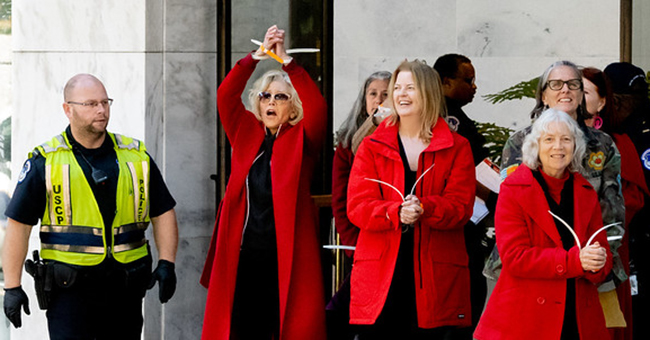
    Jane Fonda and other demonstrators arrested in the Hart Senate Office Building during a Fire Drill Friday protest.

    Jane Fonda and other demonstrators arrested in the Hart Senate Office Building during a Fire Drill Friday protest. Photo credit: Victoria Pickering

    This essay appeared originally on youngcrusaders.org.

    In the fall of 2019, award-winning actress and political activist Jane Fonda felt compelled to launch a campaign of civil disobedience to call attention to the climate crisis facing current and future generations. Atmospheric greenhouse gases had reached their highest levels that year, and the Trump administration was not only denying the climate crisis but was also engaged in striking down federal regulations aimed at mitigating the impact of fossil fuels.

    On Friday, October 11, 2019, Fonda spoke before a small crowd of political activists near the Capitol and declared, “We have to ensure that the climate crisis remains front and center, and that’s why we’re here.” The “climate strikers,” following the lead of Swedish teenager Greta Thunberg, had drawn international attention to the climate emergency, and high school students in countries around the world organized “Fridays for Future” with marches and rallies beginning in August 2018. “I’m standing here with the young people,” Fonda announced, because “our house is on fire. And so we’re calling these rallies Fire Drill Fridays.”

    Over the next fourteen Fridays, weekly teach-ins, along with the rallies, were held by representatives of Greenpeace, Climate Action Network, Friends of the Earth, Poor People’s Campaign, the Sunshine Movement, Africans Rising for Justice, Peace, and Dignity, Kenya’s Green Belt Movement, Women’s Earth Alliance, Women Environment and Development Organization, Veterans for Peace, New York City’s WE ACT, the Environmental Justice Center for Rural Enterprise and Environmental Justice, Green Latinos, and others. At the end of the rallies, Fonda and her supporters marched toward the Capitol building, chanting “The fossil fuel industry will not bury us. We will live to bury them . . . . Tell me what democracy looks like! This is what democracy looks like!”

    As they approached the Capitol steps, a police officer gave them a warning: “Move back, people. Move all the way back!” When they refused, the police grabbed them and secured the hands behind them with plastic zip ties. Fonda had been arrested before, so she was not afraid. “As each of us were taken by an officer to the waiting vans, people cheered, clapped, and chanted in support. It felt good.” They were taken to the station, placed in cells, and after three hours were processed, fingerprinted, and paid the $50 fine. Upon leaving the station, friends were waiting and provided food, water, and other types of “jail support.”

    Afterward, Fonda convinced many other celebrities to join the Fire Drill Friday rallies and teach-ins—Lily Tomlin, Sam Waterson, Ted Danson, Sally Field, Gloria Steinem, Joaquin Phoenix, and others. “And for every one of our fourteen Fridays that involved arrests, rain or shine or frigid weather, jail support was always there.” And when Fonda could no longer risk another arrest, “I would be part of it myself.”

    In her book, What Can I Do? My Path from Climate Despair to Action (2021), Fonda recounts her experiences and those others who joined her. She includes broadsides and speeches from those who participated in the protest. The speakers addressed the Green New Deal, “Women and Climate Change,” water pollution, food, agriculture, and climate change; environmental racism, health and employment outcomes; and most importantly, the damage to people’s lives, the environment, and our children’s future carried out by the fossil fuel industry.

    Hundreds of children from the local public and private schools attended the rallies, and speaker after speaker emphasized the need to hold the fossil fuel industry accountable for the damage it has done. “My advocacy as an environmentalist,” declared Robert Kennedy Jr., “is about democracy, is about fairness, and about equality and justice.” With the assistance of the political establishment, “These corporations are commodifying the commons.”

    Addressing the global COVID-19 pandemic, however, became political leaders’ main preoccupation in 2020 after the Fire Drill Fridays ended. The deceased use of fossil fuels during the lockdowns allowed people in many locations to experience what their lives would be like without the unrelenting pall of pollution. However, the oil and gas companies merely raised their prices to make up for the loss of profits during the pandemic. The Biden administration has promised to move the economy toward greater use of renewable energy, but the billions of dollars in subsidies to the coal, gas, and oil companies continues, as well as the practice of fracking, the extraction process that pollutes the air and water and damages the health of those living nearby.

    In answering the question, “What Can I Do?” Jane Fonda describes the importance of marches, rallies, teach-ins, and civil disobedience. However, the most effective weapon in the arsenal of nonviolent direct action protest—the boycott—is not discussed. The profiteering before and during the pandemic must be challenged, and environmental and racial-justice groups and organizations that participated in the Fire Drill Fridays and other protests need to come together and target a gas and oil company for a nationwide boycott. The situation for future generations is becoming more and more perilous, and something must be done before 2030. If the adult leaders and organizations do not organize the oil company boycott, then the young people in the Sunrise Movement, Black Lives Matter, and March for Our Lives must take the lead because they are the ones who suffer the economic and physical burden of environmental destruction.

    Eighteen-year-old Abigail Leedy described what it was like for her and other children growing in South Philadelphia near an oil refinery. Large numbers of children suffer from asthma and other respiratory diseases due to the pollution, where fossil fuel explosions release tens of thousands of pounds of hydrofluoric acid into the air. So Leedy decided to defer going to college and founded the Sunshine Movement because “in Philly, people die because of fossil fuels.”


    About the Author 

    V. P. Franklin is Distinguished Professor Emeritus of History and Education at the University of California, Riverside, and author of The Young Crusaders: The Untold Story of the Children and Teenagers Who Galvanized the Civil Rights Movement.

  • A Q&A with Dr. Stephanie Pinder-Amaker and Dr. Lauren Wadsworth

    Stephanie Pinder-Amaker and Lauren Wadsworth

    Stephanie Pinder-Amaker author photo: John Soares; Lauren Wadsworth author photo: Crista Wadsworth

    It’s common for the phrase “Did that just happen?!” to cross the minds of employees from marginalized communities. Be it because of a microaggression (“you’re so . . . articulate!”); a misguided marketing campaign (Barnes & Noble’s 2020 Diverse Editions gaffe); or a short-sighted diversity statement (an online post in solidarity with Black lives with little or no follow-through internally), people from marginalized identities have witnessed and experienced incidents that leave them uncomfortable at best, and at worst feeling unsafe to be authentic in their jobs. With their book Did That Just Happen?!: Beyond “Diversity”—Creating Sustainable and Inclusive Organizations, clinical psychologists Dr. Stephanie Pinder-Amaker and Dr. Lauren Wadsworth invite professionals at every level, in companies, schools and nonprofits, to reconsider common “diversity landmines” and how to manage them. They also bring their expertise in diversity, equity, and inclusion (DEI) work at various companies and their own experiences to the book. Beacon Broadside editor Christian Coleman caught up with them to chat about it.

    Christian Coleman: What was the inspiration for writing Did That Just Happen?!

    Dr. Stephanie Pinder-Amaker and Dr. Lauren Wadsworth: As people who hold marginalized identities, we often have been the “only” or the “pioneer” in our workplace. As a result, we frequently experienced not only identity related aggressions but consistent requests to train those around us on how to be more culturally aware and responsive. Neither of us started our careers aiming to be “diversity experts,” but like many with marginalized identities, we continued to be called upon, and eventually embraced the role. Over the years that we worked at the same institution, we found solace and support connecting over this experience. One day while walking the campus, both a bit burnt out and tired from recent identity-related events, Lauren turned to Stephanie and said, “Maybe we should just write a book about all of this!”

    We found the book a powerful place to channel our pain, experience, and voices. We poured everything we could think of into it: examples, strategies, terms we’d coined in our trainings. Our hope was that we could write a book that could not only help leadership who want to do better but also to validate those who had been harmed, giving them a book packed full of skills to anonymously slip under their boss’s door in hopes of creating change while keeping them safe.

    CC: Both of you are clinical psychologists. Tell us a bit about your backgrounds and how you bring your expertise to your work as co-founders of Twin Star – Intersectional Diversity Trainers.

    Drs. SPA and LW: As psychologists, we know that trying to force people to change can often backfire. We also know the power of empathy in inspiring change. So instead of writing a book about why diversity and inclusion are important, we opened each chapter with a real-life story about something going wrong in the workplace. Our hope was that the reader could connect to and care about the characters, and from that place, get curious about how they could reduce and recover from harm in similar situations.

    We also realize that self-efficacy is key if someone is going to keep trying something hard (for example, work against their racist socialization). We wrote the book to be accessible, with takeaways on every page, so that the reader can feel smarter and more skilled as they read along and try the simple and complex skills in their interactions across identities.

    CC: That brings me to a question about the book’s structure. As you just mentioned, each chapter begins with an individual/s’ real-life story/ies and then moves onto a diagnostic of what went wrong and a section on what to do about it. How did you decide on this format?

    Drs. SPA and LW: In our experience, books on diversity, equity, and inclusion (DEI) can be dense and textbook-like. One of our goals for the book was to keep it interesting, trying not to lose the readers who might be on the fence about the whole DEI thing. We thought that breaking each chapter into these repeated three sections would make each chapter appear more “bite size.” The reader knows what they’re getting into in each chapter and can see goal posts ahead of what’s coming. We thought this would feel more approachable. Also, we thought this would be a format that would lend itself to being shared in smaller chunks. For example, an employee might relate to a particular example and choose to just share that chapter with their team. With this format, each chapter can stand alone or flow from and to the chapters surrounding it.

    CC: The terms “diversity” and “inclusion” are often used interchangeably in daily lingo. Why was it important to make a distinction between them in the book?

    Drs. SPA and LW: The distinction is important because grabbing for diversity without inclusivity is counterproductive, costly, and painful. In the book, we refer to this as putting “the cart before the horse.” A company might quickly hire new BIPOC and queer staff, trying to “do the right thing.” This is the cart. The horse is the skill set people need to communicate and work well across identities. Try to visualize the cart going before the horse. Now, picture the cart going before the horse while climbing a steep incline. We all know it’s not going to end well, and yet this is what we do over and over again in the workplace. The goal is to create environments in which people feel welcomed, seen, heard. We want people to know that they can bring their full selves to work and relationships and be rewarded for doing so. Put the horse in front of the cart and it might actually take flight!

    CC: Last year, you wrote for us an essay on Barnes & Noble’s Diverse Editions gaffe. Are there any examples, current or old, of organizations that have been successful at sustaining diversity and inclusion in the workplace that have caught your attention? Or better yet, any examples of organizations that have learned from their gaffes?

    Drs. SPA and LW: We want to encourage individuals and organizations to shift their view of what success looks like in this realm. There is no such thing as a “D&I Seal of Approval.” Gaffes are inevitable because no one can be perfect in this work 100 percent of the time. What we can be is committed to ongoing growth and learning. Companies that are doing the best right now are those that have committed to investing (financially and emotionally) in ongoing DEI trainings and skill development. We can name bias and oppression when we see it. We can commit to change. The companies that are moving toward sustainable, inclusive organizations are learning how to do these things. As we discuss in the book, the growth is not linear. As organizations commit to doing better, people will feel empowered to share their truths. We need to be prepared to hear them, express gratitude for the feedback and recommit—even when it hurts. 

    CC: Now that we’re in the full swing of the new admin though still in the throes of repeated injustices against marginalized communities, what would you like readers to take away from the book?

    Drs. SPA and LW: We would like readers to walk away from each chapter, and the book as a whole, with increased hope. We would like them to feel like they have new words to label and describe injustices in their day-to-day lives and be able to pull from a large toolbox of new skills to address each injustice (if they so choose). We hope that readers will use the book as a road map to navigate complex issues and feel inspired to build new relationships across identities and feel the incredible benefits that follow.


    About the Authors 

    Dr. Stephanie Pinder-Amaker is a clinical psychologist and Harvard Medical School professor committed to achieving multicultural excellence in organizations. As founding director of McLean Hospital’s College Mental Health Program, she has consulted with numerous institutions on diversity and inclusion. She is also the cofounder of Twin Stars Diversity Trainers, a consultation company offering diversity and identity-related trainings for organizations. Dr. Pinder-Amaker currently serves as the McLean Hospital-Harvard Medical School’s chief diversity, equity, and inclusion officer.

    Dr. Lauren Wadsworth is a clinical psychologist passionate about furthering diversity and inclusion efforts. She serves as a senior advisor on the Anti-Racist, Justice, and Health Equity team at McLean Hospital/Harvard Medical School. She is the founder and director of the Genesee Valley Psychology (GVP), a clinic providing evidence-based treatment to the Rochester, NY, area and specializing in OCD, trauma, DBT, and a newly launched Racial Trauma and Healing center. She is also the cofounder of Twin Stars Diversity Trainers, a consultation company offering diversity and identity-related trainings for organizations and leadership. Finally, she is a clinical senior instructor in psychiatry at the University of Rochester Medical Center.

  • By Leigh Patel

    Nassau Hall, Princeton University

    Nassau Hall, Princeton University. Photo credit: Elisa Rolle

    On Friday, June 4, the remains of two Black girls, Delisha and Katricia “Tree” Africa, were to be collected from the home of physical anthropologist Alan Mann, an emeritus professor associated with both the University of Pennsylvania and Princeton University. Delisha and Tree were members of the Black liberation community in Philadelphia known as the MOVE. On May 13, 1985, Philadelphia police officers fired thousands of shot and grenades at 5:30 in the morning, peppering the row house where this communal organization resided. The assault concluded with a bomb dropped on the house from a police aircraft. Philadelphia fire fighters were present at the scene of the bombing and took no action as the rowhouse and sixty other homes burned to the ground. In the ashes were the remains of eleven Black members of the MOVE, including Delisha and Tree’s remains.

    How did these two Black girls’ bones wind up in an emeritus professor’s home after being the property of either the University of Pennsylvania or Princeton University for twenty-five years?

    To begin addressing that question, along with how to right the many wrongs that led to two Black children being killed and their remains being treated as university property, requires no less than an honest confrontation with the very foundations of universities, their practices of extraction, and the communities that have both been deeply harmed and lived above and beyond these harms. Put more simply, to make sense of these Black girls’ bones being in the hands of white anthropologists and used in online courses requires a reckoning.

    Historian Craig Steven Wilder has named higher education as the third pillar of the US, alongside church and state. In his work, Wilder details how the nation’s most elite institutions were not only built by enslaved peoples but also how much that stolen labor was an engine for accruing white wealth and property in higher education. Wilder’s historical account takes on further resonance when we remember that the nation’s universities and colleges all occupy Indigenous lands. The removal of Indigenous peoples and the ongoing assaults on Black people are in the DNA of higher education. Little wonder, then, that in addition to Delisha and Tree Africa’s bones, thousands of remains of Native and Black peoples are ‘housed’ in academic institutions, sometimes in their museums and sometimes as research or teaching props. As a settler colony, the United States was not only formed through the structure of stolen labor on stolen land, but maintains that structure to secure whiteness as property.

    When members of the very much alive MOVE community articulated demands in April about the appropriate current and future actions that the University of Pennsylvania could take, hundreds of Philadelphia residents joined in outrage. While outrage is appropriate, it’s also important to shine the light of historical truth that this instance is part and parcel of extraction for the proprietary inclinations of a settler colony. At the moment of capture, Africans ceased to be human and became chattel property under settler colonialism. Adjoined, native peoples were rendered as savages so that their relations to land could be severed and land could be recast as inert property. Universities have long engaged in extracting life from people and from land because extraction has strengthened universities’ endowments and carved pathways for professors to benefit economically and symbolically from patterns of extraction.

    Delisha and Tree Africa’s remains simply remind us of one of the many connected parts of the project of settler colonialism. Both Princeton and the University of Pennsylvania have apologized for their parts in the shuttling of these Black girl’s bones between the institutions. However, neither university has moved to dismantle physical museums or return the remains of Black and Indigenous peoples, partly out of an insistence that the remains are necessary for scientific progress. Nor has either university offered reparations as a form of restitution for the profit they literally built through the examination of these girls’ bones, lacerating them from their home community. In fact, the act of claiming remains from people of color is justified as necessary for scientific progress.

    At what cost does this settler science make its progress? How can we hold this idea of progress and reckon with the railways lain on top of the of the bodies of Chinese laborers who built them, the enslaved Black people who built wealth for the founding fathers’ pockets, and the Native peoples who to this day live in relation to land as a life form, not a parcel to be owned? At minimum, this latest contradiction between the outward facing image of higher education as a social good and its internal practices of extraction is an invitation to redress harm.

    But, before harm can be redressed, it must named in its full truth. Relatedly, the StrikeMoMa movement makes the poignant claim that “Their exhibits are our receipts.” Put another way, the very property that universities own, including stolen land, stolen human being’s remains, and stolen art from its cultural origins, are the receipts for harm and theft that communities of color have shouldered and suffered. Even some of the most obvious demands to transform universities, such as #CopsOffCampus, must, to recast a phrase commonly associated with anthropology, dig deeper. In a recent panel addressing the responsibility of higher education to the StrikeMoMa movement, art, and activism, scholar and poet Fred Moten did part of the deeper dig, noting: “When we say we want cops off campus, we can’t say that without acknowledging the vast majority of policing on campus is done by faculty, in the classroom.” His point also applies to extraction—who it hurts and who benefits from it.

    Alan Mann, the anthropology professor who was asked by the city of Philadelphia to consult about the remains of Delisha and Tree Africa’s bones directly after the bombing, then simply kept the bones as his property, looping into the extraction logics of thousands of Black and Indigenous bodies. The remains of these humans are decoupled from families and held in research archives. They continue to be used to support scientific racism that created false categories to justify slavery and the ongoing plunder of land and peoples. We have apologies from Princeton and the University of Pennsylvania. What we lack is a full reckoning with what these institutions and specific accumulations of whiteness as property are refusing to give up. While it’s plain what institutions are not willing to give up, they do not voice it. Social movements like the MOVE provide sharp contrasts in demands that move well beyond apologies. They demand freedom of wrongly incarcerated Black activists. They demand actions for better realities right now and better futures for all. This is what evades so much of university statements and fractional actions when extraction is cast under a public light: an ability to think beyond managing public relations crises.

    Not dissimilar from the ways that Critical Race Theory has come under legislative attack, the backlash to explicit analyses of racism and the thin apologies speak volumes about how tightly whiteness is protected. However, as many scholars, both university-based and community-based, of racism and settler colonialism have noted, the reach of whiteness does its deepest damage to white people in constricting their ability to fully reckon with the harm upon which their cultural domination relies. Poetically just, it is precisely within communities that have been harmed that we find not only imagination and possibility, but fully dimensional humanity and recognition that all actions and practices have impact.

    As universities move into full re-openings of campuses for the coming academic year, most are operating out of a frame of scarcity and capitalist competition, even ones as wealthy as Princeton and the University of Pennsylvania. When and where will students learn about the plunder by universities and the much larger life and fortitude of peoples that settler colonialism has tried to erase? History teaches us that, largely, when students have learned about these realities, it has not been through university curriculum but rather beyond and often in opposition to the university. Moreover, when people form their own study groups to grapple with racist extraction and the attempt to erase not only the practices of extraction but family lines that have been severed, study groups often lead to activism for social change. Social movements have always included art as a way to lift up humanity, rather than enclose it in a glass case as property.  More just societies arise from this kind of study and struggle that seeks to document life and creation, not separate it for the sake of spectacle in the classroom or museum.


    About the Author 

    Dr. Leigh Patel is an interdisciplinary researcher, educator, writer, and professor at the University of Pittsburgh. She works extensively with societally marginalized youth and teacher activists. Patel is a recipient of the June Jordan Award for scholarly leadership and poetic bravery in social critique and is a national board member of Education for Liberation, a long-standing organization dedicated to transformative education for and by youth of color. She is the author of Youth Held at the Border, Decolonizing Educational Research, and the forthcoming No Study Without Struggle: Confronting Settler Colonialism in Higher Education. Connect with her on Twitter at @lipatel.

  • NYC Pride

    Photo credit: Melissa Gagnon

    Raise your hand if you’re going to Pride this year! 2020 has been voted off the island. More importantly, we missed Pride. As we strut our stuff under the sun, let’s not forget why we have the parades in the first place. The queers, drag queens, and trans women—especially the folx of color—who fought back against police violence. The fight for LGBTQ rights has never stopped since the Stonewall uprisings. Whether it’s the fight for self-acceptance and self-expression, for the right to marry, for the right to use the bathroom aligned with your gender identity, for affordable access to HIV medication, for the abolition of violent and oppressive systems, there’s always a fight. And the fight has always been intersectional. That’s this year’s theme for NYC Pride. It’s also the theme that runs through all the books we’re recommending this month. Get your queer on!


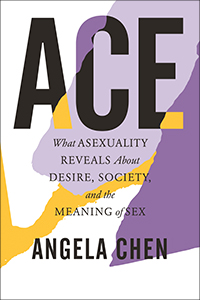
    Ace

    Ace: What Asexuality Reveals About Desire, Society, and the Meaning of Sex

    The goal of ace liberation is simply the goal of true sexual and romantic freedom for everyone. A society that is welcoming to aces can never be compatible with rape culture; with misogyny, racism, ableism, homophobia, and transphobia; with current hierarchies of romance and friendship; and with contractual notions of consent. It is a society that respects choice and highlights the pleasure that can be found everywhere in our lives. I believe that all this is possible.
    —Angela Chen


    And-the-Category-Is

    And the Category Is . . . : Inside New York’s, House, and Ballroom Community

    The Ballroom community is unabashedly radical in its awareness of the ability to use identity as creatively as a makeup brush, whilst liberated from the gravity of greater social norms and the consequences of defying them: some so heavy—like transphobia—that they could be fatal. This is only one of many paradoxes Ballroom as a subculture so gorgeously embodies. And for over a century, it has advanced a concept that the mainstream is still grappling with: that all things can be many things at once.
    —Ricky Tucker (forthcoming this December!)


    At-the-Broken-Places

    At the Broken Places: A Mother and Trans Son Pick Up the Pieces

    We both sensed that we had always needed a book like At the Broken Places, which digs into the muddy middle where we disagreed on so much, and we always knew we wanted to return to a loving, more empathetic space for each other. The majority of families with transgender children exist in this more conflicted space. Now, finally, I have mustered the emotional strength to share with them our real story.
    —Mary Collins

    There is incredible trepidation that comes with moving away from your starting place toward something else. It is exciting; it is horrifying. It is this form of “trans” that not only moved me but also moved the others in my life, away, away, away, to a place where we had no reliable guides and no right words. For my mom and me, this book represents our best efforts, our worst shortcomings, and our frequent misunderstandings.
    —Donald Collins


    A Cup of Water Under My Bed

    A Cup of Water Under My Bed: A Memoir

    The worst part about trying to date women is that I don’t have my mother’s warnings. There is no indicator if I am doing it right or wrong. And so, my queer friends and the spoken-word artists in New York are my teachers, and they know the formula. Sleep with your friend, sleep with her friend. Break up and get back together again. Write her a poem, show her the piers, pretend you want less than you do. One-night stands, one-night nothing. You’ll see her at Henrietta’s again and again.
    —Daisy Hernández


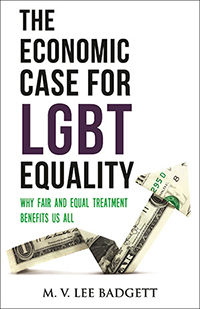
    The Economic Case for LGBT Equality

    The Economic Case for LGBT Equality: Why Fair and Equal Treatment Benefits Us All

    If homophobia and transphobia are costly, then we can and must make changes that will reduce those costs and more fully include LGBT people in our economies and societies. . . . Over time, more and more people around the world are being asked to make a choice about LGBT issues, whether in their votes for antigay politicians, their acceptance of family members, or their hiring decisions. They need to know the consequences of their decisions for us all, including for LGBT people.
    —M. V. Lee Badgett


    How to Love a Country

    How to Love a Country: Poems

    I knew it then—when we first found our eyes,
    in our eyes, and everything around us—even
    the din and smoke of the city—disappeared,
    leaving us alone as if we were the only two
    men in the world, two mirrors face-to-face:
    my reflection in yours, yours in mine, infinite.

    I knew since I knew you—but we couldn’t.
    —Richard Blanco, from “Until We Could”


    Looking for Lorraine

    Looking for Lorraine: The Radiant and Radical Life of Lorraine Hansberry

    I believe that if we take her work seriously, we must talk about sexuality. I take the careful preservation of Lorraine’s writings in which she explored and expressed her sexuality seriously. Though her romantic relationships remain, for me, somewhat opaque, it is unquestionable that her desire for women and her love of women was meaningful as part of her politics, her intellectual life, and her aesthetics, as well as her spirit. I could not possibly write a portrait of her as an artist without it.
    —Imani Perry


    A Queer and Pleasant Danger

    A Queer and Pleasant Danger

    I don’t call myself a woman, and I know I’m not a man. That’s the part that upsets the pope—he’s worried that talk like that—not male, not female—will shatter the natural order of men and women. I look forward to the day it does.
    —Kate Bornstein


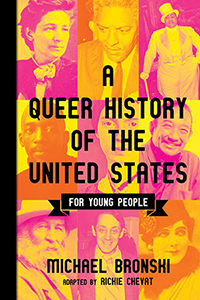
    A Queer History of the United States for Young People

    A Queer History of the United States for Young People

    For LGBTQ people—and especially youth and people just coming out—it’s not as easy to find out our true history. It’s not taught in schools; it’s not on postage stamps; the statues and monuments are only now beginning to appear. Many famous Americans have been LGBTQ, yet when their names appear in textbooks or histories, their sexuality is never discussed. Their love lives—and sex lives—are never mentioned. If we are erased from the history books, then how can we ever know who we are? This absence, this erasure, denies us the right and the ability to use our history as a guide, to feel pride in the heroism and accomplishments of the LGBTQ people who came before us.
    —Michael Bronski, adapted by Richie Chevat


    The Queering of Corporate America

    The Queering of Corporate America: How Big Business Went from LGBTQ Adversary to Ally

    Most historical accounts of the LGBTQ movement have focused on activism directed at government actors, with the aim of explaining how the movement sought either to end discrimination by the government itself or to persuade public officials to prohibit privatesector discrimination. But it is not possible to have a complete and accurate picture of what the American LGBTQ rights movement has been able to achieve since the Stonewall riots without understanding how and why the movement targeted large corporations as a means to advance LGBTQ civil rights.
    —Carlos A. Ball


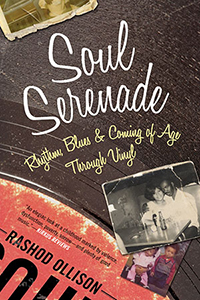
    Soul Serenade

    Soul Serenade: Rhythm, Blues & Coming of Age Through Vinyl

    This burning curiosity about other boys, I figured, would pass . . . . Whatever it was, I didn’t know what to do with it, and I told myself that the feelings would all fade away. The dashikis and clumsy Afrocentric rhetoric would disguise the desire, distract me from it, or maybe erase it altogether.
    —Rashod Ollison


    Unapologetic

    Unapologetic: A Black, Queer, and Feminist Mandate for Radical Movements

    Verbal and physical attacks on Black lesbian feminists may seem surprising to some, as if they belong to a less enlightened era, but they are predictable in times of our high activity and visibility. Regardless of the risk, however, we Black queer and trans women have been on the front lines of anti-police and Black liberation organizing in the United States. We have been there after Black men and boys have been slain by police officers and vigilantes. We have shown up, even when masses have not, after a Black woman, girl, or trans, or queer, or gender-nonconforming person has been killed. And we will continue to show up. What we choose to support and oppose defines our politics.
    —Charlene A. Carruthers


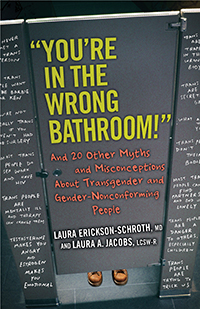
    YoureInTheWrongBathroom

    “You’re in the Wrong Bathroom!”: And 20 Other Myths and Misconceptions About Transgender and Gender Nonconforming People

    Would you recognize someone as transgender if that person didn’t tell you? Most people think they would. But they would be wrong. Many transgender people live “stealth,” at least to the general public, telling only those they are close to about their identities. For centuries, long before hormone therapies or gender-reassignment surgeries, there were people whose cross-gendered lives were not known until their deaths. Today, thousands of transgender Americans go about their lives with few people knowing that they are transgender.
    —Laura Erickson-Schroth and Laura A Jacobs

    NYC Pride