• By Aviva Chomsky

    Joe Biden speaking with supporters at a town hall hosted by the Iowa Asian and Latino Coalition at Plumbers and Steamfitters Local 33 in Des Moines, Iowa, August 2019.

    Joe Biden speaking with supporters at a town hall hosted by the Iowa Asian and Latino Coalition at Plumbers and Steamfitters Local 33 in Des Moines, Iowa, August 2019. Photo credit: Gage Skidmore

    This piece appeared originally in TomDispatch.

    Joe Biden entered the White House with some inspiring yet contradictory positions on immigration and Central America. He promised to reverse Donald Trump’s draconian anti-immigrant policies while, through his “Plan to Build Security and Prosperity in Partnership with the People of Central America,” restoring “US leadership in the region” that he claimed Trump had abandoned. For Central Americans, though, such “leadership” has an ominous ring.

    Although the second half of his plan’s name does, in fact, echo that of left-wing, grassroots organizations like the Committee in Solidarity with the People of El Salvador (CISPES), its content highlights a version of security and prosperity in that region that’s more Cold War-like than CISPES-like. Instead of solidarity (or even partnership) with Central America, Biden’s plan actually promotes an old economic development model that has long benefited U.S. corporations. It also aims to impose a distinctly militarized version of “security” on the people of that region. In addition, it focuses on enlisting Central American governments and, in particular, their militaries to contain migration through the use of repression.

    Linking Immigration and Foreign Policy

    The clearest statement of the president’s Central America goals appears in his “US Citizenship Act of 2021,” sent to Congress on January 20. That proposal offers a sweeping set of changes aimed at eliminating President Trump’s racist exclusions, restoring rights to asylum, and opening a path to legal status and citizenship for the immigrant population. After the anti-immigrant barrage of the last four years, that proposal seems worth celebrating. It follows in the footsteps of previous bipartisan “comprehensive” compromises like the 1986 Immigration Reform and Control Act and a failed 2013 immigration bill, both of which included a path to citizenship for many undocumented people, while dedicating significant resources to border “security.”

    Read closely, a significant portion of Biden’s immigration proposal focuses on the premise that addressing the root causes of Central America’s problems will reduce the flow of immigrants to the US border. In its own words, the Biden plan promises to promote “the rule of law, security, and economic development in Central America” in order to “address the key factors” contributing to emigration. Buried in its fuzzy language, however, are long-standing bipartisan Washington goals that should sound familiar to those who have been paying attention in these years.

    Their essence: that millions of dollars in “aid” money should be poured into upgrading local military and police forces in order to protect an economic model based on private investment and the export of profits. Above all, the privileges of foreign investors must not be threatened. As it happens, this is the very model that Washington has imposed on the countries of Central America over the past century, one that’s left its lands corrupt, violent, and impoverished, and so continued to uproot Central Americans and send them fleeing toward the United States.

    Crucial to Biden’s plan, as to those of his predecessors, is another key element: to coerce Mexico and Guatemala into serving as proxies for the wall only partially built along the southern border of the US and proudly promoted by presidents from Bill Clinton to Donald Trump.

    While the economic model lurking behind Biden’s plan may be old indeed, the attempt to outsource US immigration enforcement to Mexican and Central American military and police forces has proven to be a distinctly twenty-first-century twist on border policy.

    Outsourcing the Border (from Bush to Biden)

    The idea that immigration policy could be outsourced began long before Donald Trump notoriously threatened, in mid-2019, to impose tariffs on Mexican goods to pressure that country’s new president into agreeing to his demand to collaborate with Washington’s anti-immigrant agenda. That included, of course, Trump’s controversial “remain in Mexico” policy that has continued to strand tens of thousands of asylum-seekers there.

    Meanwhile, for almost two decades the United States has been bullying (and funding) military and police forces to its south to enforce its immigration priorities, effectively turning other countries’ borders into extensions of the US one. In the process, Mexico’s forces have regularly been deployed on that country’s southern border, and Guatemala’s on its border with Honduras, all to violently enforce Washington’s immigration policies.

    Such outsourcing was, in part, a response to the successes of the immigrant rights movement in this country. US leaders hoped to evade legal scrutiny and protest at home by making Mexico and Central America implement the uglier aspects of their policies.

    It all began with the Mérida Initiative in 2007, a George W. Bush-initiated plan that would direct billions of dollars to military equipment, aid, and infrastructure in Mexico (with smaller amounts going to Central America). One of its four pillars was the creation of “a 21st century border” by pushing Mexico to militarize its southern border. By 2013, Washington had funded 12 new military bases along that border with Guatemala and a 100-mile “security cordon” north of it.

    In response to what was seen as a child-migrant crisis in the summer of 2014 (sound familiar?), President Barack Obama further pressured Mexico to initiate a new Southern Border Program. Since then, tens of millions of dollars a year have gone toward the militarization of that border and Mexico was soon detaining tens of thousands of migrants monthly. Not surprisingly, deportations and human-rights violations against Central American migrants shot up dramatically there. “Our border today in effect is Mexico’s border with Honduras and Guatemala,” exulted Obama’s former border czar Alan Bersin in 2019. A local activist was less sanguine, protesting that the program “turned the border region into a war zone.”

    President Trump blustered and bullied Mexico and various Central American countries far more openly than the previous two presidents while taking such policies to new levels. Under his orders, Mexico formed a new, militarized National Guard and deployed 12,000 of its members to the Guatemalan border, even as funding from Washington helped create high-technology infrastructure along Mexico’s southern border, rivaling that on the US border.

    Trump called for reducing aid to Central America. Yet under his watch, most of the $3.6 billion appropriated by Congress continued to flow there, about half of it aimed at strengthening local military and police units. Trump did, however, temporarily withhold civilian aid funds to coerce Guatemala, Honduras, and El Salvador into signing “safe third country” agreements that would allow the United States to deport people with valid asylum claims to those very countries.

    Trump also demanded that Guatemala increase security along its southern border “to stem the flow of irregular migration” and “deploy officials from US Customs and Border Protection and US Immigration and Customs Enforcement to advise and mentor host nation police, border security, immigration, and customs counterparts.” Once the Central American countries conceded to Trump’s demands, aid was restored.

    This February, President Biden suspended those safe third country agreements, but is clearly otherwise ready to continue to outsource border enforcement to Mexico and Central America.

    The Other Side of Militarization: “Economic Development”

    As Democratic and Republican administrations alike outsourced a militarized response to immigration, they also sought to sell their agendas with promises of economic-development aid to Central America. However, they consistently promoted the very kind of assistance that historically brought violence and poverty to the region—and so led directly to today’s migrant crisis.

    The model Washington continues to promote is based on the idea that, if Central American governments can woo foreign investors with improved infrastructure, tax breaks, and weak environmental and labor laws, the “free market” will deliver the investment, jobs, and economic growth that (in theory) will keep people from wanting to migrate in the first place. Over and over again in Central America’s tormented history, however, exactly the opposite has happened. Foreign investment flowed in, eager to take advantage of the region’s fertile lands, natural resources, and cheap labor. This form of development—whether in support of banana and coffee plantations in the nineteenth century or sugar, cotton, and cattle operations after World War II—brought Central America to its revolutions of the 1980s and its north-bound mass migration of today.

    As a model, it relies on militarized governments to dispossess peasant farmers, freeing the land for foreign investors. Similarly, force and terror are brought to bear to maintain a cheap and powerless working class, allowing investors to pay little and reap fantastic profits. Such operations, in turn, have brought deforestation to the countryside, while their cheap exports to the United States and elsewhere have helped foster the high-consumption lifestyles that have only accelerated climate change—bringing ever fiercer weather, including the rising sea levels, more intense storms, droughts, and floods that have further undermined the livelihoods of the Central American poor.

    Starting in the 1970s, many of those poor workers and peasants pushed for land reform and investment in basic rights like food, health, and education instead of simply further enriching foreign and local elites. When peaceful protest was met with violence, revolution followed, although only in Nicaragua did it triumph.

    Washington spent the 1980s attempting to crush Nicaragua’s successful revolution and the revolutionary movements against the right-wing military governments of El Salvador and Guatemala. The peace treaties of the 1990s ended the armed conflicts, but never addressed the fundamental social and economic divides that underlay them. In fact, the end of those conflicts only opened the regional floodgates for massive new foreign investment and export booms. These involved, among other things, the spread of maquiladora export-processing plants and the growing of new export-oriented “non-traditional” fruits and vegetables, as well as a boom in extractive industries like gold, nickel, and petroleum, not to speak of the creation of new infrastructure for mass tourism.

    In the 1980s, refugees first began fleeing north, especially from El Salvador and Guatemala, then riven by war, repression, and the violence of local paramilitary and death squads. The veneer of peace in the 1990s in no way brought an end to poverty, repression, and violence. Both public and private armed forces provided “security”—but only to elites and the new urban and rural megaprojects they sponsored.

    If a government did threaten investors’ profits in any way, as when El Salvador declared a moratorium on mining licenses, the US-sponsored Central America Free Trade Agreement enabled foreign corporations to sue and force it to submit to binding arbitration by a World Bank body. In the Obama years, when the elected, reformist president of Honduras tried to enact labor and environmental improvements, Washington gave the nod to a coup there and celebrated when the new president proudly declared the country “open for business” with a package of laws favoring foreign investors.

    Journalist David Bacon termed that country’s new direction a “poverty-wage economic model” that only fostered the rise of gangs, drug trafficking, and violence. Protest was met with fierce repression, even as US military aid flowed in. Prior to the coup, Hondurans had barely figured among Central American migrants to the United States. Since 2009, its citizens have often come to predominate among those forced to flee their homes and head north.

    President Obama’s 2014 Alliance for Prosperity offered a new round of aid for investor-driven economic development. Journalist Dawn Paley characterized that Alliance as in “large part a plan to build new infrastructure that will benefit transnational corporations,” including “tax breaks for corporate investors and new pipelines, highways, and power lines to speed resource extraction and streamline the process of import, assembly, and export at low-wage maquilas.” One major project was a new gas pipeline to facilitate exports of US natural gas to Central America.

    It was Obama who oversaw Washington’s recognition of the coup in Honduras. It was Trump who looked the other way when Guatemala in 2019 and Honduras in 2020 expelled international anti-corruption commissions. And it was Trump who agreed to downplay the mounting corruption and drug trafficking charges against his friend, Honduran President Juan Orlando Hernández, as long as he promoted an investor-friendly economy and agreed to collaborate with the US president’s anti-immigrant agenda.

    The January 2021 Caravan Marks the Arrival of the Biden Years

    All signs point to the Biden years continuing what’s become the Washington norm in Central America: outsourcing immigration policy, militarizing security there, and promoting a model of development that claims to deter migration while actually fueling it. In fact, President Biden’s proposal designates $4 billion over four years for the State Department and the US Agency for International Development to distribute. Such disbursement, however, would be conditioned on progress toward Washington-approved goals like “improv[ing] border security,” “inform[ing] . . . citizens of the dangers of the journey to the southwest border of the United States,” and “resolv[ing] disputes involving the confiscation of real property of United States entities.” Significant resources would also be directed to further developing “smart” border technology in that region and to Border Patrol operations in Central America.

    A preview of how this is likely to work came just as Biden took office in January 2021.

    One predictable result of Washington’s outsourcing of immigration control is that the migrant journey from Central America has become ever more costly and perilous. As a result, some migrants have begun gathering in large public “caravans” for protection. Their aim: to reach the U.S. border safely, turn themselves in to the border patrol, and request asylum. In late January 2021, a caravan of some 7,500 Hondurans arrived at the Guatemalan border in hopes that the new president in Washington would, as promised, reverse Trump’s controversial remain-in-Mexico policy of apparently endless internment in crowded, inadequate camps just short of the US.

    They hadn’t known that Biden would, in fact, continue his predecessors’ outsourcing of immigration policy to Mexico and Central America. As it happened, 2,000 tear-gas and baton-wielding Guatemalan police and soldiers (armed, trained, and supported by the United States) massed at the Guatemala-Honduras border to drive them back.

    One former Trump official (retained by President Biden) tweeted that Guatemala had “carr[ied] out its responsibilities appropriately and lawfully.” The Mexican government, too, praised Guatemala as it massed thousands of its troops on its own southern border. And Juan González, Biden’s National Security Council director for the Western Hemisphere lauded Guatemala’s “management of the migrant flow.”

    In mid-March, President Biden appeared to link a positive response to Mexico’s request for some of Washington’s surplus Covid-19 vaccine to further commitments to cracking down on migrants. One demand: that Mexico suspend its own laws guaranteeing humane detention conditions for families with young children. Neither country had the capacity to provide such conditions for the large number of families detained at the border in early 2021, but the Biden administration preferred to press Mexico to ignore its own laws, so that it could deport more of those families and keep the problem out of sight of the US public.

    In late January 2021, CISPES joined a large coalition of peace, solidarity, and labor organizations that called upon the Biden administration to rethink its Central American plans. “The intersecting crises that millions in Central America face are the result of decades of brutal state repression of democratic movements by right-wing regimes and the implementation of economic models designed to benefit local oligarchs and transnational corporations,” CISPES wrote. “Far too often, the United States has been a major force behind these policies, which have impoverished the majority of the population and devastated the environment.”

    The coalition called on Biden to reject Washington’s longstanding commitment to militarized security linked to the creation and reinforcement of investor-friendly extractive economies in Central America. “Confronting displacement demands a total rethinking of US foreign policy,” CISPES urged. As of mid-March, the president had not responded in any fashion to the plea. My advice: don’t hold your breath waiting for such a response.


    About the Author 

    Aviva Chomsky is a professor of history and the coordinator of Latin American Studies at Salem State University. The author of several books including Undocumented and “They Take Our Jobs!”, Chomsky has been active in the Latin American solidarity and immigrants’ rights movements for over 30 years. She lives in Salem, Massachusetts.

  • Stop Anti-Asian Racism and China Bashing rally in Washington, DC, 27 March 2021.

    Stop Anti-Asian Racism and China Bashing rally in Washington, DC, 27 March 2021. Photo credit: Elvert Barnes

    Beacon Press supports our authors, the Asian and Asian American and Pacific Islander communities, and all those fighting against American xenophobia and hatred. This violence is not new. It has a long history in this country. We know that recent acts of violence are rooted in the same white supremacy and hate that take the lives of Black, Indigenous, Latinx, and other people of color. We remain committed to publishing resources to help dismantle the systems of white supremacy, hate, and toxic masculinity. #StopAsianHate #EndWhiteSupremacy

    As a department of the Unitarian Universalist Association, their seven principles guide the work that we do. Through partnerships with the UUA, its affiliated organizations, and other groups, our books reach audiences who can use our books as resources for movement building. They are also used for professional development to help improve teacher and student experience in the classroom and transform education. Reading groups choose our books to gain a better understanding of current issues or events in American history.

    See below for some recommended reading that helps to make sense of the issues and also provides ways for people to take action. Now more than ever, we are committed to lifting up the voices and providing resources that speak to the current political climate and social activism.

    Reading Up on the Issues

    Bullets into Bells

    Bullets into Bells: Poets & Citizens Respond to Gun Violence
    Edited by Brian Clements, Alexandra Teague, and Dean Rader

    Focuses intensively on the crisis of gun violence in America. This volume brings together poems by dozens of our best-known poets. Each poem is followed by a response from a gun violence prevention activist, political figure, survivor, or concerned individual.
     

    Considering-Hate

    Considering Hate: Violence, Goodness, and Justice in American Culture and Politics
    Kay Whitlock and Michael Bronski

    Boldly assert that American society’s reliance on the framework of hate to explain violent acts against marginalized communities is wrongheaded, misleading, and ultimately harmful. Kay Whitlock and Michael Bronski invite readers to radically reimagine the meaning and structures of justice within a new framework of community wholeness, collective responsibility, and civic goodness.


    Defund Fear

    Defund Fear: Safety Without Policing, Prisons, and Punishment
    Zach Norris

    Lays out a radical way to shift the conversation about public safety away from fear and punishment and toward growth and support systems for our families and communities. The result reinstates full humanity and agency for everyone who has been dehumanized and traumatized, so they can participate fully in life, in society, and in the fabric of our democracy.


    How To Be Less Stupid About Race

    How to Be Less Stupid About Race: On Racism, White Supremacy, and the Racial Divide
    Crystal M. Fleming

    Draws upon critical race theory to unveil how systemic racism exposes us all to racial ignorance—and provides a road map for transforming our knowledge into concrete social change.


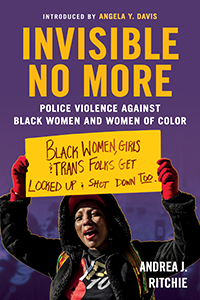
    Invisible No More

    Invisible No More: Police Violence Against Black Women and Women of Color
    Andrea J. Ritchie

    A timely examination of how Black women, Indigenous women, and women of color experience racial profiling, police brutality, and immigration enforcement. It documents the evolution of movements centering women’s experiences of policing and demands a radical rethinking of our visions of safety—and the means we devote to achieving it.


    Proud Boys and the White Ethnostate

    Proud Boys and the White Ethnostate: How the Alt-Right Is Warping the American Imagination
    Alexandra Minna Stern

    Brings awareness to the underlying concepts that guide the alt-right and its overlapping forms of racism, xenophobia, and transphobia. By unearthing the hidden mechanisms that power white nationalism, Alexandra Minna Stern reveals just how pervasive the far right truly is.


    The Seven Necessary Sins for Women and Girls

    The Seven Necessary Sins for Women and Girls
    Mona Eltahawy

    Seizes upon the energy of the #MeToo movement to advocate a muscular, out-loud approach to teaching women and girls to harness their power through what Mona Eltahawy calls the “seven necessary sins” that women and girls are not supposed to commit. It’s a manifesto for all feminists in the fight against patriarchy.


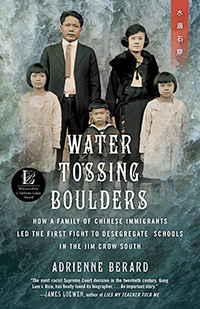
    Water Tossing Boulders

    Water Tossing Boulders: How a Family of Chinese Immigrants Led the First Fight to Desegregate Schools in the Jim Crow South
    Adrienne Berard

    Chronicles the event that would lead to the first US Supreme Court case to challenge the constitutionality of racial segregation in Southern public schools, an astonishing 30 years before the landmark Brown v. Board of Education decision, led by one Chinese family and an eccentric Mississippi lawyer.


    We-Are-All-Suspects-Now

    We Are All Suspects Now: Untold Stories from Immigrant Communities After 9/11
    Tram Nguyen

    Reveals the human cost of the domestic war on terror and examines the impact of post-9/11 policies on people targeted because of immigration status, nationality, and religion. Tram Nguyen tells the stories of people who witnessed and experienced firsthand the unjust detainment or deportation of family members, friends, and neighbors.


    White Fragility

    White Fragility: Why It’s So Hard for White People to Talk About Racism
    Robin DiAngelo

    Explores the counterproductive reactions white people have when their assumptions about race are challenged that serve to maintain racial inequality.


    Mouth-guard-4791772_1920

    Yellow Peril, Again: Coronavirus and the Echoes of Chinese Exclusion
    Adrienne Berard

    “The coronavirus outbreak has put into sharp relief the American tradition of conflating immigration and infection. In fact, America’s fear of the ‘diseased immigrant’ dates back to the nation’s first major wave of immigration and our initial understanding of disease itself.”


    Taking Action

    Stop Asian Hate

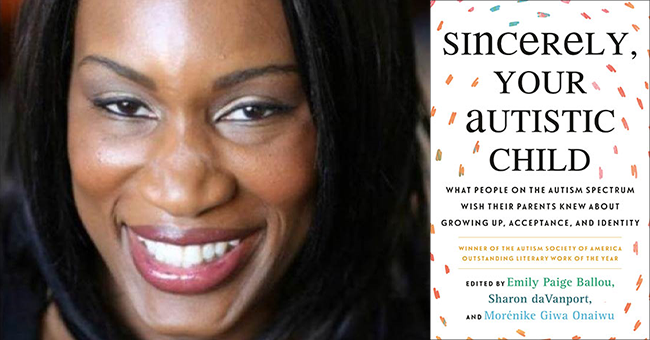
  • A Q&A with Sharon daVanport

    Sharon daVanport

    Sharon daVanport. Cover art: Louis Roe

    Most resources available for parents come from psychologists, educators, and doctors, offering parents a narrow and technical approach to autism. Sincerely, Your Autistic Child, edited by Emily Paige Ballou, Sharon daVanport, and Morénike Giwa Onaiwu, represents an authentic resource for parents written by autistic people themselves. From childhood and education to culture, gender identity, and sexuality, this anthology tackles the everyday joys and challenges of growing up while honestly addressing the emotional needs, sensitivity, and vibrancy of autistic kids, youth, and young adults.

    In this blog series, our editorial intern, Evangelyn Beltran, introduces you to each of the editors to talk about the book and about how parents can avoid common mistakes and misconceptions, and make their child feel truly accepted, valued, and celebrated for who they are. Next up this Autism Acceptance Month is Sharon daVanport!

    Evangelyn Beltran: Tell me about your experience founding Autistic Women & Nonbinary Network (AWN).

    Sharon daVanport: AWN finds our history deeply rooted in the need to find community and shared-lived experiences.

    At the time AWN entered the autism community, the narrative centered mostly around young white boys and men. In those early days, we discovered quickly that AWN was an initiative that was desperately needed.

    AWN also recognized early on the importance of engaging researchers in order to address the underrepresentation of all marginalized genders within autism research. Autism studies have been historically dominated by young school-aged boys, and it became obvious to AWN’s founders how disproportionately distorted the autism diagnostic criteria is due to gender and racial bias.

    It was also during those early days when parents to autistic children held the microphone, and too often they didn’t see the benefit of sharing the conversation with autistic people; and as difficult as those formative years were on our community, it was those very same experiences which encouraged us to keep moving forward with purpose.

    Today, we find a much different autism community where Autistic adults are loudly and proudly holding the microphone, and the majority of parents are more cognizant of the benefits of Autistic adults being front and center while leading the conversation as the experts in our own lives.

    Of course, like most organizations, there are many layers to our history as well as the many ways by which we have implemented our own needed changes in order to be equitably representative of our community members. You can read more about Autistic Women & Nonbinary Network’s history and progress over the years in Steven Kapp’s book, Autistic Community and the Neurodiversity Movement: Stories from the Frontline.  

    EB: When did you first start becoming involved in disability justice?

    SD: My start in disability justice evolved gradually over time and after having been in the online autism community for several years. As AWN grew, we realized the importance of building relationships with cross disability coalitions and we made deliberate choices to engage other activists and organizations within the greater disability community. There’s always power and strength when those of us with like-minded goals join forces. I guess you can say that the rest is history.

    EB: What are the biggest issues regarding disability justice in your view? 

    SD: The disability community is not unlike all other communities which make up society as a whole. This means that we face the same disparities that all marginalized people face. These include, to name a few: racism, xenophobia, sexism, homophobia, and oppression against all marginalized genders. More often than not, when these subjugations are inflicted upon disabled people, there’s an extra layer for which our community is forced to fight against. Internalized ableism IS a thing and it’s a constant battle for most of us who have grown up in a world that tries to tell us we are not enough.

    EB: What is it like being a parent to neurodiverse children, being neurodiverse yourself?

    SD: This is always one of my favorite interview questions, because being a parent continues to be the most meaningful experience of my life. It is through observing my children’s diverse expressions of individuality that I have learned to accept my whole self without exception.

    In our family, we have regularly contended with an array of competing access needs. Most of these are specific to communication and sensory sensitivities. And though we are never perfect, we somehow manage to come out the other side with a determination to keep loving and appreciating one another for being faithful and true to our individual selves.

    EB: What advice would you give young autistic people who are interested in advocacy and want to get started?

    SD: I’d say, first and foremost, be kind to yourself; and as cliché as it may sound, never have these words been truer as it applies to self-advocacy and activism.

    Understand and accept that you will make mistakes. We are an ever-evolving community, and you can expect that the strategies which worked in the disability advocacy community fifteen years ago might not work to our community’s benefit now.

    Be ready and willing to accept the mistakes you’ll make from time to time. Allow yourself to be called in (or even called out) when need be. Remember that it’s not the mistakes we make that count but rather our willingness to correct and commit to do better as we learn.

    Don’t try to be perfect. In fact, it’s our human imperfections that give us the ability to be empathetic and understanding to our fellow disabled advocates. The universe is wise and continues to teach us lessons. Speak out when you’re able and take a seat when necessary, but never ever forget to be kind to yourself.


    About Sharon daVanport

    Sharon daVanport lives in the Midwest by way of their home state of Texas where they spent young adulthood writing short stories, poetry and serving as co-editor of their academic newspaper. After nearly a decade in social work, Sharon founded the Autistic Women & Nonbinary Network (AWN). Appointed by their state’s board of education, Sharon served a full term on the SILC board of directors. Publications include co-authoring a paper in Sage Pub Autism Journal, a chapter in Autistic Community and the Neurodiversity Movement: Stories from the Front Line, and pieces in Welcome to the Autistic Community, and Disability Visibility Project.

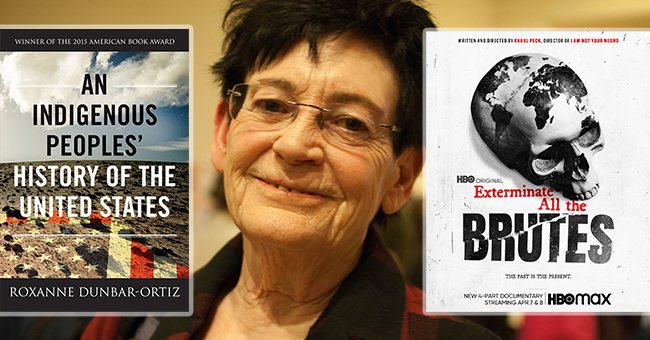
  • A Q&A with Roxanne Dunbar-Ortiz

    Roxanne Dunbar-Ortiz

    Author photo: Barrie Karp

    Make way for the next brilliant documentary by Raoul Peck! His four-part HBO docuseries, Exterminate All the Brutes, examines the history of Native American genocide and American slavery to reframe the overarching consequences of European colonialism. If you’ve seen his Academy Award-nominated James Baldwin documentary, I Am Not Your Negro, you won’t want to miss this! It begins airing on April 7. Peck based his series on three books, two of which are from Beacon: Roxanne Dunbar-Ortiz’s An Indigenous Peoples’ History of the United States and Michel-Rolph Trouillot’s Silencing the Past: Power and the Production of History. Beacon Broadside editor Christian Coleman caught up with Dunbar-Ortiz to chat with her about her involvement with the production.

    Christian Coleman: An Indigenous Peoples’ History of the United States was originally published in 2014. Is this the first time anyone has approached you about using it as source material for a film adaptation?

    Roxanne Dunbar-Ortiz: Yes, it was the first time a filmmaker showed interest in the book. I never imagined that any filmmaker, even if they loved reading the book, would be interested in using it in a documentary. But Raoul Peck is not any ordinary filmmaker. I have long admired his work. His first documentary, from 1991, was Lumumba: Death of a Prophet, which is about the first president of the former Belgian Congo colony that won its independence in 1960 and was then assassinated with CIA involvement. But he made it a personal story, telling his own story as an Afro-Haitian. All his films are extraordinary, the dramatic one and the documentaries.

    CC: How did you get news about the series and that Raoul Peck would be referencing your work in it? 

    RDO: Raoul Peck called me on my cell phone! I had received an email the day before that I sort of ignored, saying that a production company in Paris was interested in using the book in a film. I was out walking to a meeting when the call came. He said, “I am Raoul Peck,” and I thought it might be a crank call and nearly cut off the call, but then he said he loved my book and was making an HBO docuseries on colonial genocide. Beacon Press had already been contacted to obtain the film rights, but I didn’t know that, and they were dealing with the film company, Velvet Film. I was truly stunned that the filmmaker I most admired in the world would read my book and want to make it a part of his film. He explained to me that he had already been working for a year with two other history texts when my book came to his attention in the Spring of 2018, one by Haitian historian Michel-Rolph Trouillot, Silencing the Past: Power and the Production of History, which was also published by Beacon Press, and the other by Swedish writer, Sven Lindqvist, “Exterminate All the Brutes:” One Man’s Odyssey into the Heart of Darkness and the Origins of European Genocide. He said he had never conceived of United States continental imperialism, only US imperialism, and of course, the thirty plus years that the United States occupied Haiti. He then asked me if I would work with him on it, with such humility in his voice, as if I might decline!

    CC: Wow! How much involvement did you have in the production?

    RDO: We met in New York City for three days in June 2018. An assistant had already gone through my book and brilliantly excerpted key passages. He had not begun developing the script, only the research. He asked me to be a consultant, so I was on the Velvet Film payroll for the next six months, going over the script as he wrote it. Unfortunately, the historian Trouillot died an untimely death and never was able to work on the project. Despite having a terminal illness, Sven Lindqvist did work closely with Raoul in shaping the concept, and he passed away, but they had accomplished a great deal. Throughout 2019, every step of the way, Raoul kept me informed. Then in late November, he brought me to New York to view the four hours; it wasn’t complete, as there were reenactments with an actor to be filmed and the addition of many images, but the structure and story were there, and it is truly amazing. Nothing like this documentary has ever been made. There are many documentaries that are good on European colonialism, but none ever include United States colonization of North America.

    CC: On social media, you said Peck’s choice of using your book as source material was radical. Tell us why.

    RDO: I think all three books are radical histories; Lindqvist documents the connection between the Holocaust and German colonialism and genocide in Africa in the late nineteenth century, and Trouillot’s book is a radical indictment of the West’s failure to acknowledge the most successful slave revolt in history, in Haiti, and thereby distorts the whole European history of colonialism and its continuing crimes. So, my book fits in very well, but I found it radical that Raoul recognized that the Indigenous Peoples of North America also experienced classic European colonialism and genocide, first by the British Empire, then by the independent United States in its one hundred years of wars against the Indigenous peoples to take the continent and import settlers to people Native land. It was certainly a risk, I thought, in that rarely is US colonial history located within the larger European colonial conquest, with the US even seen as anti-colonial in expelling the British empire.

    CC: And what does your book mean to you now that it, along with the other two books the series references, is part of a visual presentation of the consequences of European settler colonialism?

    RDO: It certainly feels like a validation at another level than the success of the book in reaching tens of thousands of people and being used in high school and university courses. I believe the documentary will reach another audience who may be interested to read the book. Raoul Peck is a great intellectual as well as being a great filmmaker, and his respect for literature is unusual, I think, for someone in the visual arts.


    About Roxanne Dunbar-Ortiz

    Roxanne Dunbar-Ortiz grew up in rural Oklahoma in a tenant farming family. She has been active in the international Indigenous movement for more than 4 decades and is known for her lifelong commitment to national and international social justice issues. Dunbar-Ortiz is the winner of the 2017 Lannan Cultural Freedom Prize, and is the author or editor of many books, including An Indigenous Peoples’ History of the United States, a recipient of the 2015 American Book Award. She lives in San Francisco. Connect with her at reddirtsite.com or on Twitter @rdunbaro.

  • A Q&A with Morénike Giwa Onaiwu

    Morenike Giwa Onaiwu

    Author photo: Rick Giudotti of Positive Exposure. Cover art: Louis Roe

    Most resources available for parents come from psychologists, educators, and doctors, offering parents a narrow and technical approach to autism. Sincerely, Your Autistic Child, edited by Emily Paige Ballou, Sharon DaVanport, and Morénike Giwa Onaiwu, represents an authentic resource for parents written by autistic people themselves. From childhood and education to culture, gender identity, and sexuality, this anthology tackles the everyday joys and challenges of growing up while honestly addressing the emotional needs, sensitivity, and vibrancy of autistic kids, youth, and young adults.

    In this blog series, our editorial intern, Evangelyn Beltran, introduces you to each of the editors to talk about the book and about how parents can avoid common mistakes and misconceptions, and make their child feel truly accepted, valued, and celebrated for who they are. To kick off Autism Acceptance Month, we’re starting with Morénike Giwa Onaiwu!

    Evangelyn Beltran: How do your identities, being disabled and a woman of color, intersect?

    Morénike Giwa Onaiwu: It’s interesting, because it kind of makes me think about certain medications. Some do not have any adverse reaction when taken together. Neither is there a positive reaction. They just coexist simultaneously but aren’t necessarily interrelated in any meaningful way. Another medication might help enhance the efficacy of another—maybe by increasing its metabolism rate or boosting its effect in some other way so they interact in a helpful way. However, when some medications are paired together, it can be dangerous and potentially even fatal. Their combination can result in very serious circumstances, and not in a helpful way. And that’s not because there’s anything inherently “bad” or “wrong” with the medications themselves individually, but together it increases the risk of a suboptimal outcome. That’s kind of how I perceive my identities; they “play” off one another in shifting ways depending upon the circumstances. I wish I could say most of the time it’s more like the second scenario, but I’d be lying.

    EB: What was it like being diagnosed as an adult rather than as a child?

    MGO: It’s the only way I know, so to me it’s hard to fathom what it’s like to be diagnosed when one is younger. Being that my two youngest children received their autism diagnoses as toddlers, I do have a way to directly compare the way things are for them versus the way things were for me growing up undiagnosed. I think having a better understanding of oneself can be really beneficial for a child (or anyone, but especially for a child), because when you are pondering how you might be different from others and vice versa, you have some insight into not just the “what” but also the “why” of things. You also might have the verbiage to be able to express what you need, what your preferences are, etc. and hopefully people might be accommodating of that. When you don’t have a diagnosis and can’t really articulate a “reason” that makes sense to people, they tend to be a lot less empathetic, although they shouldn’t be. I do wish to say that obtaining the diagnosis for me personally has been very empowering and has helped put much of my life, retrospectively, into context; I don’t know if that would be the case if I’d had the diagnosis younger.

    EB: What was your experience as a child, trying to decipher the words, facial expressions, and tones of other kids, all while trying your best to mask?

    MGO: Talk about exhausting! Everything felt like work. There’s a saying in the Black community that references how, unfortunately, we often have to overachieve and exceed minimal expectations just to obtain the consideration that more privileged groups receive merely by existing and/or meeting expectations. Essentially, it is said that we have to “work twice as hard to get half.” It sucks, but there’s truth in it. I feel that a different but similar sentiment can be applied to disability as well, at least in my case. There was never such a thing as “just” doing anything. Everything that was practically effortless for many others required a series of agonizing, stress-inducing steps for me to perform them.

    For example, the act of starting to get dressed—maybe putting on a pair of socks—is a lot more complicated when you have coordination and movement differences as well as sensory differences; it might take you a lot longer to be able to select a pair that isn’t physically uncomfortable and then to put them on. The act of saying “Hi!” to a neighbor passing by—totally not simple. At what interval exactly do you meet their gaze to acknowledge them? How long do you hold the gaze? Do you stop going toward your destination to greet them or is it okay to greet them while you continue going on your way? Do you smile first before saying hi, or say hi and smile at the same time, or say hi and then smile? Do you smile with teeth or only with closed lips? How long do you hold the smile? Are you expected to add some additional words to the “Hi,” (i.e. small talk) or can you just say hi and leave without being rude? How loud or how soft should your volume be? Should you lilt your tone to indicate enthusiasm, or can you keep your tone normal? Do you also wave, and if so, when exactly? Before you smile but after you speak? After you smile, but while you speak? Is “Hello,” more appropriate than “Hi,” and do you need to include the person’s name if you know what it is (i.e. “Hi, Morgan,”) or is it okay not to? And there’s a lot that I’m leaving out when trying to navigate that “simple” greeting scenario. This is just a sampling.

    EB: How do you think parents should prepare their children for the possibility that other kids might be mean to them because of their autism?

    MGO: I think that kids need to know, but parents need to introduce the topic in a balanced way that is tailored to the way that particular child comprehends things. It does us a disservice to act like everyone is kind and that the world is some Utopia; when we learn otherwise, it will be hurtful and shocking, and we will have likely unintentionally placed ourselves potentially in harm’s way because of that naïveté. Yet we don’t need to be raised in fear either, looking for the “bogeyman” around every corner and assuming everyone will bully/mistreat/hate us because we’re different. That’s no way to live. I have taken the perspective that I need to prepare my children for ableism in the same way I’ve educated them about and prepared them for racism and sexism: that there’s nothing wrong with who and/or what you are, but some people don’t understand it, fear it, or view it negatively and that can result in mistreatment. That’s their issue, not yours, and you are not to blame for them being ignorant or bigoted. It isn’t appropriate and shouldn’t be tolerated; do not internalize it nor accept blame for being who you are.

    EB: At what point in your life did you become comfortable in your identity?

    MGO: Truthfully, I think, in a sense, I’m still working on that. It’s a continuous process for me! However, I feel that I have been on a constantly evolving quest to understand and accept me for me for a number of years. It’s almost like a physical journey; me gradually accepting one aspect of my identity (i.e. gender, personality characteristics, race, ethnicity, sexuality, etc.) is like me traveling over time to Point A, then eventually, over time, successfully making it to Point B and so on.

    EB: In what ways have your autistic traits helped you in life?

    MGO: I feel that in many ways they’ve helped me be my true and real self. I don’t have this curated, ultra-Photoshopped filter draped across my life. I am my authentic self, strengths and weaknesses. I feel that it has helped me to be more inclusive of others and has helped me to survive some ultra-painful and craptastic experiences in my life. In many ways, my autistic traits have probably saved my life.

    EB: Have your identity and experiences influenced your career choices at all?

    MGO: Absolutely. There’s a phrase I love from a fellow autistic colleague, Kassiane Asasumasu (the originator of the term “neurodivergent”), which describes autism as “deep love” and notes how we’re all about “going big or going home.” This resonates with me so much because we’re not “in between the lines” people. We’re on the lines or out of the lines. I personally do not have the capacity to effectively “do” an exceptional job consistently over a lengthy period of time on tasks that I dislike. It’s just not how I work. When I’m leaning into my abilities and my interests, however, I’m phenomenal and I shine. So, for me, knowing my strengths, knowing what I’m NOT good at and/or what I need support with is crucial. I could never work in a field that required certain tasks such as lengthy, extensive “networking with potential clients, or having to “people” a full day around the clock with no breaks to regroup, or with rigid time frames. I thrive in an environment where there is flexibility, where I can express some creativity in my approach to managing my responsibilities and/or solving problems, also and where I can have a level of autonomy while also knowing precisely what is expected of me by whom, when, why it is needed, and how to deliver it.

    EB: What do you think should be done about the lack of representation of female and BIPOC autistic people?

    MGO: I saved this question for last because it’s a downer for me, for I (and other gender and racial minorities) get asked this question quite frequently, and although it’s a sensitive topic, we try to respond earnestly with practical recommendations—all of which typically get ignored in terms of implementation. We explain the critical need to include and amplify us in a respectful, non-tokenizing manner; we suggest BIPOC women, nonbinary, and trans individuals as well as books and organizations; we seek opportunities for meaningful leadership and involvement; we empty out our hearts . . . and it’s typically in vain.

    At this point, I think that “mainstream” autism—and disability, for that matter—aren’t really invested in having better representation of us, because clearly, they don’t think it’s worth the effort, time, or resources. All the inequities that already exist in society at large regarding race and gender are present within the autism community as well, and I would even propose that they’re magnified. If people struggle to comprehend that autism is not the Peter Pan of developmental disability (existing in some form of perpetual childhood) and that autistic children grow up and become teens and then adults, it’s doubtful that they will be able to see that it’s a spectrum in terms of race and gender. If they can’t/won’t see (white) autistic adults, it’s almost laughable to believe they’ll see someone like me. Nor do they want to. BIPOC Autistics and Autistic gender minorities aren’t at the table; we haven’t been invited, and I don’t know when/if we ever will be.

    So, while I can humor you and myself by telling you what SHOULD be done to increase our representation, instead, I will tell you what WILL be done: my people will continue, as the great Shirley Chisholm advised, to “bring a folding chair” to that table, regardless of our lack of invitation. Because it’s our table, too, and we belong there, and we’re not going to perish waiting in vain for an invitation that may never ever come.


    About Morénike Giwa Onaiwu

    Morénike Giwa Onaiwu, MA, is a global self-advocate, educator, parent and disabled person of color in a neurodiverse, multicultural, serodifferent family. A prolific writer, public speaker, and social scientist/activist whose work focuses on meaningful community involvement, human rights, justice, and inclusion, Morénike is a Humanities Scholar at Rice University’s Center for the Study of Women, Gender, and Sexuality and a member of several executive boards. Publications include: Knowing Why: Adult-Diagnosed Autistic People on Life and AutismAll the Weight of Our Dreams: On Living Racialized Autism, and various peer-reviewed articles. Learn more at: morenikeGO.com.

  • By David Freedlander

    Rep. Alexandria Ocasio-Cortez (D-NY) at the Women’s March on NYC 2019. Photo credit: Dimitri Rodriguez

    Rep. Alexandria Ocasio-Cortez (D-NY) at the Women’s March on NYC 2019. Photo credit: Dimitri Rodriguez

    In 2018, the country watched as Alexandria Ocasio-Cortez rose from unknown part-time bartender to the halls of Congress at the age of twenty-nine and became a household name for her progressive, passionate politics. In The AOC Generation: How Millennials Are Seizing Power and Rewriting the Rules of American Politics, journalist David Freedlander gives firsthand accounts detailing the final days of her campaign, which he spent beside her as she fought for every last vote. He also connects her ample political talents and ability to command the media and the public’s attention to the newfound political awakening of millennial activists. This selection from his book details the last moments of her campaign as she ran against her opponent, former US Representative Joe Crowley, and the night she made history on many fronts—including women’s history.

    ***

    Alexandria Ocasio-Cortez did something unheard of in politics: she skipped town.

    While the Crowley forces were holding a big rally on a rainy Saturday, Ocasio-Cortez was thousands of miles away at the US-Mexico border to protest the Trump administration’s child separation policy.

    It led to striking visuals that rocketed around social media of Ocasio-Cortez pleading with guards at the gate, but it seemed suicidal politically. It was Ocasio-Cortez’s idea, and no one tried to talk her out of it.

    “As a campaign manager, yes, it is hard not to have the candidate present for the final weekend,” said Vigie Ramos Rios. “But here’s the thing: You are talking about a district that is 50 percent immigrants. And so you’re talking about a candidate who is recognizing what’s important to them and is highlighting it.

    “We could see a path to victory at that point, but she also had a spotlight and if she could take that spotlight and highlight something that mattered to the people in her district, that’s what she was going to do. It wasn’t about winning. It was a movement. Victory comes in getting people to see somebody who’s willing to represent her district wholly, even if that means for her personally, it might not be a gain. She might go back to being a bartender and a waitress. She was going to take that little bit of spotlight and highlight an issue, and that was incredibly important to people in her district.”

    On Election Day, the streets of the district were flooded with volunteers from both sides, but it was clear that many of the those there for Crowley were connected in some way to the Queens political machine; they were staffers for local elected officials or members of a local political club. Shawna Morlock, the hairdresser from Astoria, stood outside of a polling place in her neighborhood to urge voters to pull the lever for AOC, but she thought something was up when she got to talking with a person, a firefighter, who was there on behalf of Crowley’s campaign. He was a union guy, and as they started talking, she was surprised to hear him say good things about Donald Trump and bad things about immigrants. Later, he admitted he wasn’t a Democrat at all but was there at the polling place because his union asked him to be.

    Ocasio-Cortez spent much of Election Day tweeting photos of places where she thought the Crowley forces had hung illegal signs, and then accusing the Crowley forces of taking down her signs and putting theirs up illegally. There was no evidence of it, and it wasn’t the only baseless accusation thrown out by Ocasio-Cortez during the campaign. She accused the incumbent of not having bilingual campaign literature, which was false, and of Crowley acolytes tampering with election machines, which would have been a violation of state law and for which there was also no evidence. Crowley couldn’t make one of the debates because he had a previous commitment in another part of the district, so he sent a surrogate in his place, a local city councilwoman named Annabel Palma, and Ocasio-Cortez accused him of deliberately attempting to confuse voters by sending a Latina in his stead.

    Ocasio-Cortez’s mother, Bianca, joined the campaign for the final days. She became a regular campaign volunteer, joining the others who had been inspired by Ocasio-Cortez’s campaign, and allowing herself to feel the faint hope that her daughter could actually win. As they were waiting for the election results, Morlock told Bianca to just relax, saying, “She is going to be president one day, just you watch,” to which Bianca replied, “Don’t jinx it!”

    As the team members finished their day on the streets, Ocasio-Cortez gathered with a few of them in a pocket park in the Bronx. At polling stations across the district, the enthusiasm for her seemed palpable, yet, still, no one believed she could win. Surely, they figured, there was a reserve army of Crowley supporters who could pull this off.

    “No matter what happens, this does not stop here,” Ocasio-Cortez said to her supporters as evening fell. “I want every single one of you, to stay active, to keep pushing. Once people have been woken up, they don’t go back to sleep.”

    The minute the polls closed, the Crowley forces knew the race was over. There had been massive turnout in areas good for Ocasio-Cortez and very limited turnout in Crowley’s precincts. The Crowley election night party was a new bistro on Northern Boulevard in Jackson Heights. The room didn’t have any TVs, and so the people in attendance, who were most of the city’s political class, including at least three people then planning on running for mayor in three years and hoping to pay homage to one of the most powerful people in the city, had no idea what the early returns showed: that Ocasio-Cortez had opened up a big lead on Crowley. As more votes came in, the lead only widened. Crowley staffers were in tears. Local elected officials stormed off in disgust, with one suggesting that was why primaries were a bad idea. Some, seeing which way the wind was blowing, dashed out and headed up to Ocasio-Cortez’s election night party in the Bronx. Crowley came in eventually to cheers. An amateur musician, Crowley’s band was set up in a corner of the restaurant and, with the congressman on guitar and vocals, launched into a rip-roaring rendition of “Born to Run,” dedicated to AOC.

    “I may not have gotten proper credit for all the things I have done,” Crowley said afterward while sipping on a beer as the band played “Ramblin’ Man” behind him. “The people in this district know me. It was a Democratic primary at a time of low turnout. It is what it is.”

    “People know me as a national figure, not a local one,” he added. “I think I always maintained my connectivity to the district. But at the end of the day it’s not about me. It’s about the people. I give my opponent, Alexandria Ocasio-Cortez, a lot of credit. She ran a good race.”

    Meanwhile, up in the Bronx, Ocasio-Cortez was in a car with her partner, Riley Roberts, and a few campaign staff were on their way to her election night party at a pool hall in the Bronx.

    Naureen Akhter had made two cakes for the occasion, figuring that win or lose, the occasion called for cake. Ocasio-Cortez refused to look at the returns coming in, and so was genuinely shocked when a reporter for NY1 pulled her aside as she was declared the victor. Actor and activist Cynthia Nixon showed up to celebrate. Most media had been banned since they had not bothered to cover the race in the first place.

    “I told you!” Morlock said when she saw Bianca Ocasio-Cortez standing off to the side, weeping tears of joy. “She is going to be president. I am calling it right now!”

    Roberts was interviewed by People for Bernie, which livestreamed his words to the group’s Facebook account, and he said they always had talked about something like this happening but never thought it would happen so soon. The crowd began to chant, “AOC! AOC!”

    Ocasio-Cortez stood up on the bar and addressed her exhausted supporters: “This room won this seat! Every person out here changed America tonight. What is very clear is that this is not the end, this is the beginning. The message we sent to the world tonight is that it is not okay to put donors before your community. The message that we sent tonight is that sometime between midnight and darkness there is still hope for this nation. You have given this country hope that when you knock on your neighbor’s door, when you come to them with love, when you come to them and tell them that no matter their stance, you are there for them, we can make change. What you have shown is that this nation is never beyond remedy, it is never beyond hope.

    “Every person in this room is going to DC with me,” she added. “We have to dedicate ourselves to this fight because I can’t do it alone.”


    About the Author 

    David Freedlander is a contributor to Politico Magazine and New York Magazine, and writes for a variety of publications about politics, the arts, and New York City, including The New York TimesThe Daily BeastSlateRolling Stone, and Town and Country. Freedlander is an adjunct professor at the Columbia University Graduate School of Journalism where he teaches politics and political theory, and is frequently called onto CNN, MSNBC and national radio programs to discuss current events. He lives in Jackson Heights, NY. Connect with him at davidfreedlander.com and on Twitter (@freedlander).

  • By Emily Paige Ballou

    Child

    Photo credit: Nathan Legakis

    My guess is that if you have a child or family member on the autism spectrum or have been involved with the special education system or disability services as a professional, you have most likely been taught, at some point, that the correct way of referring to people with disabilities is to use “person-first language,” or to “put the person first.”

    Meanwhile, over the past couple of decades, much of the autistic community, as well as other disability pride-focused communities, have actually come to prefer “identity-first” language. We call ourselves disabled, or autistic, or Deaf, rather than “people with disabilities” or “people with autism,” for instance, because we don’t believe that our disabilities or communication differences are something that should have to be separated from our personhood, instead of treated as an intrinsic but morally-neutral aspect of our identities. We say “women,” not “people with femaleness,” and would call an adherent of a particular faith system a “Buddhist” or “Christian,” not a “person with Buddhism” or a “person with Methodism.”

    Similarly, autism isn’t something we feel we should be ashamed of or be required to hold at arm’s length in order to be seen as people, just as we don’t feel people should have to rhetorically distance themselves from their gender, sexual orientation, race or ethnic identity, hair color, or faith in order to be seen as whole people deserving of respect and autonomy.

    But my aim here is not to argue for or against either identity-first or person-first language. I feel that many other autistic and disabled advocates have amply addressed that particular topic, and there is very little new ground that I could tread there.

    Rather, I’d like to challenge a phenomenon that tends to occur in nearly any online conversation between autistic people and mostly non-autistic parents about that language debate. I don’t, in fact, think I’ve been involved in a single one, in over ten years of involvement in autistic advocacy now, in which someone didn’t make this contribution to the conversation:

    “I asked my child what he wanted to be called, and he said ‘my name.’”

    Now, I think I know what the intent of this anecdote is. I think you want to tell this story to honor your child’s full and unique humanity and relationship to you.

    Unfortunately, the effect, probably inadvertent, can be to disparage the importance of disability communities having terminology preferences, of being able to know that we share a common language and identity with other autistic people (or people with other disabilities), as well as to further entrench harmful stereotypes of autistic people as being lost “in our own little worlds” or irreparably disconnected from other people.

    But here’s the truth: Autistic people are connected to each other. We’re connected by shared experiences of the world—similar sensory experiences, similar challenges growing up, shared experiences of mistreatment, ostracism, and loneliness, of feeling like we are always speaking a foreign language even in our own native tongues. We’re connected by time spent doing activism together, advocating for both ourselves and each other, and of course, simply by being friends and enjoying each other’s company.

    Many autistic people are partnered or married to each other. Some of us are autistic parents to autistic children. Some of us belong to intergenerational families of autistic people.

    And like almost any other group of people who have been marginalized for some facet of shared identity, we have a diverse set of opinions about the terminology we use to talk about ourselves that has shifted and evolved over time for various reasons.

    As Lydia X. Z. Brown wrote in their essay “Dear Well-Meaning Strangers,”Autistic is not a swear word. It is a beautiful word, a name for an identity that represents an entire group of people who are diverse in their personalities, characters, abilities, and deficits. Autism is not homogeneous. Autistics are not homogeneous. But we are everywhere.”

    If my friend Jane is going to be in my city and wants me to come out to get coffee or dinner with her, then she will just use my name to e-mail me and say “Hey, want to hang out this week?” But if we are going to have an in-depth conversation over coffee about the kinds of issues and challenges we share because of our neurology, or that we share with a whole community of similarly disabled people, then the word “autistic” is going to be very helpful to our ability to do that.

    When we ask you to understand the reasons autistic people choose the identifying language we do, no one is asking you not to call your child by their name in any context in which that would be the normal and obvious thing to do. That is not what this is about.

    It’s about the right of autistic people to have access to the language with which to talk about our experiences, to share an identity as a community, and to have words with which to advocate effectively for our needs.

    Whether your child comes to identify as autistic, as a person with autism, or wishes to keep that information private or not identify with the autistic community at all, is up to them.

    But your child deserves access to information about what our communities believe and why, disabled adults in their lives, and exposure to open and nonjudgmental discussion about autism and disability, in order to make these decisions for themselves.

    Our anthology, Sincerely, Your Autistic Child, includes contributions from authors who identify as both autistic and as people with autism. Some of us feel very passionately in favor of one or the other, and others less strongly, or identify more closely with the broader community of people with intellectual and developmental disabilities.

    But all of those preferences are informed by our personal histories, our sense of ourselves in the world, the communities of disabled people we’ve been a part of and the work of autistic and disabled elders and activists we’ve looked up to.

    There’s nothing shameful about being autistic. Nothing about knowing and understanding our linguistic history detracts from your child’s individuality or personhood. And there’s nothing trivial or strange about having discussions about autistic identity.


    About the Author 

    Emily Paige Ballou is an old Millennial from the Midwest who currently lives and works in NYC, where she primarily stage manages off-Broadway new plays and new musicals, including works such as the Hello Girls with Prospect Theater Company, Nikola Tesla Drops the Beat at the Adirondack Theatre Festival, and Rose with Nora’s Playhouse. She graduated from the University of Georgia, where she was also a member of the Demosthenian Literary Society. Previous publications include pieces in the Thinking Person’s Guide to AutismThe Real Experts: Readings for Parents of Autistic ChildrenNeuroQueerBarking Sycamores, and Fuckit: A Zine.

  • Women unite to fight back on International Women’s Day in Baltimore, MD, 8 March 2017. Photo credit: Elvert Barnes Photography

    Women unite to fight back on International Women’s Day in Baltimore, MD, 8 March 2017. Photo credit: Elvert Barnes Photography

    Where would we be without the leadership of extraordinary women who chose to challenge the societal status quo? This year’s theme for International Women’s Day was Choose to Challenge. As Women’s History Month draws to a close, we’re highlighting books from our catalog to celebrate the inspiring women who saw the need for change, and took action for equality!

    Judith Heumann’s lifelong battle to achieve respect, acceptance, and inclusion in society built up to the demand for protections for disabled peoples’ rights. Clara Park challenged the medical establishment to advocate for the support and education of autistic children and their parents. With her book Launching While Female, Susanne Althoff has exposed the gender gap faced by women and nonbinary entrepreneurs—especially those of color—to chart a road map for a more inclusive and economically successful future for us all. And Black women have innovated the digital space with their use of social media language and movement-building hashtags to spread the word of Black feminist theory and raise awareness of ongoing oppression. 

    These stories are just the tip of the iceberg of what we have to offer. Scroll down to check out a selection of titles from our catalog. And you can click here for more!


    Being Heumann pb

    Being Heumann: An Unrepentant Memoir of a Disability Rights Activist

    Some people say that what I did changed the world. But really, I simply refused to accept what I was told about who I could be. And I was willing to make a fuss about it. I must say right up front, though, that it wasn’t actually an “I,” it was a “we.” For any story of changing the world is always the story of many. Many ideas, many arguments; many discussions; many late-night, punchy, falling-apart-laughing brainstorms; many believers; many friendships; many failures; many times of almost giving up; and many, many, many people. This is my story, yes, but I was one in a multitude, and I hope I will do justice to the many heroes, those who are alive and those no longer among us.
    —Judith Heumann with Kristen Joiner


    A Black Women's History of the United States

    A Black Women’s History of the United States

    To write a history about the United States from the perspective of Black women is to chart a course where the incredible, the fantastic, and the triumphant meet, mix, and mingle, often simultaneously, with hardship, and terror. Although it largely defies uniformity, African American women’s history is marked by the ways that we have marched forward, against all odds, to effect sustained change, individually, locally, and nationally.
    —Daina Ramey Berry and Kali Nicole Gross


    Here She Is

    Here She Is: The Complicated Reign of the Beauty Pageant in America

    Beauty pageants trace the arc of American feminism. Pageants may appear to be an unexpected instrument for this, due to feminist critiques of them. In reality, the history of pageants mirrors the many monumental changes related to a woman’s place in society, while still showing how far we have to go in our expectations of and for women and girls.
    —Hilary Levey Friedman


    Inferior pb

    Inferior: How Science Got Women Wrong—and the New Research That’s Rewriting the Story

    Today, hidden among the barrage of questionable research on sex differences, we have a radically new way of thinking about women’s minds, bodies, and their role in evolutionary history. Fresh theories on sex difference, for example, suggest that the small gaps that have been found between the brains of women and men are statistical anomalies caused by the fact that we are all unique. Decades of rigorous testing of girls and boys confirm that there are few psychological differences between the sexes, and that the differences seen are heavily shaped by culture, not biology. Research into our evolutionary past shows that sexual division of labor and male domination are not biologically hardwired into human society, as some have claimed, but that we were once an egalitarian species. Even the age-old myth about women being less promiscuous than men is being overturned.
    —Angela Saini


    Intelligent Love

    Intelligent Love: The Story of Clara Park, Her Autistic Daughter, and the Myth of the Refrigerator Mother

    Clara [Park] was called “an intellectual mother.” [Her daughter] Jessy was categorized as “autistic.” For a long time, both labels made them suffer deeply and restricted what they could become. But in their remarkable journey together, Clara and Jessy broke through the straitjackets of those labels, learning from each other and eventually helping each other to construct a life on their own terms. Exemplifying different ways of combining intelligence and love, Clara and Jessy also helped transform our understanding of what mothers and autistic people can do.”
    —Marga Vicedo


    Invisible No More

    Invisible No More: Police Violence Against Black Women and Women of Color

    It is not only the experiences of women of color with racial profiling and police violence that must be invisible no more but also our long-standing resistance. This book is ultimately a celebration of the roles that Indigenous women, Black women, and women of color have played in movements to resist racial profiling and police violence against communities of color, and in challenging antiviolence movements’ investment in criminal legal systems to demand safety on our terms.
    —Andrea J. Ritchie


    Launching While Female

    Launching While Female: Smashing the System That Holds Women Entrepreneurs Back

    [Women] own fewer companies than men, and those businesses have access to significantly less start-up capital, make significantly less revenue, and employ far fewer people. An entrepreneurial gender gap exists, and it leaves us with fewer jobs, a weaker economy, and less innovation. Building a start-up world that’s open and inclusive would benefit us all.
    —Susanne Althoff


    Marching Toward Coverage

    Marching Toward Coverage: How Women Can Lead the Fight for Universal Health Care

    Inadequate access to healthcare is a common and persistent national headache—and in many ways, the pain is suffered mostly by women. Think about it. Women are more likely to be caregivers for children and elderly parents, and they’re more likely to be patients themselves. This means that women are the ones who interact with the healthcare system most often and most intimately. In fact, according to the US Department of Labor, women make approximately 80 percent of all healthcare decisions for their families. As a result, underinsurance and skyrocketing medical costs represent more than a national health crisis; they’re a civil rights issue, and the next battlefront for the feminist movement.
    —Rosemarie Day


    Radicalizing Her

    Radicalizing Her: Why Women Choose Violence

    Radicalizing Her is rooted in the perspective of the female fighters who demand to be seen as political actors. While much has been rightly made of the surge of women in electoral politics, this text reclaims women’s place in another form of political life: on the battlefield and in the streets. the erasure of the female fighter from narratives on gender and power is not only dangerous but also antifeminist.
    —Nimmi Gowrinathan


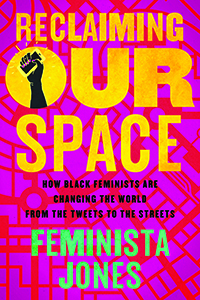
    Reclaiming Our Space

    Reclaiming Our Space: How Black Feminists Are Changing the World from the Tweets to the Streets

    Black feminist women are being heard in ways they have never been heard before. Social media networks provide platforms for conversations that we have long been having in our hair salons and our churches, by our watercoolers and in our breakrooms, and in our housing project courtyards and systematically segregated classrooms . . . . We have to look at how, over the last decade, Black women have harnessed their ingenuity and their magic and have taken to digital platforms to advance the fight toward liberation while honoring the ways in which Black Feminism has been the guiding theoretical framework for our collective progress.
    —Feminista Jones


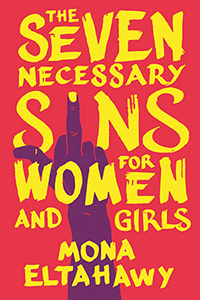
    The Seven Necessary Sins for Women and Girls

    The Seven Necessary Sins for Women and Girls

    Words like “feminism” and “resistance” are being drained of their meaning when we offer them up as band-aids that offer temporary relief to women and girls against the vagaries of patriarchy. I have had enough of giving women and girls ways simply to survive rather than tools to fight back. The danger and fear that should emanate from feminism and resistance must not be stamped out. Feminism should terrify the patriarchy. It should put patriarchy on notice that we demand nothing short of its destruction. We need fewer road maps toward a peace treaty with patriarchy and more manifestos on how to destroy it. The Seven Necessary Sins for Women and Girls is my manifesto.
    —Mona Eltahawy


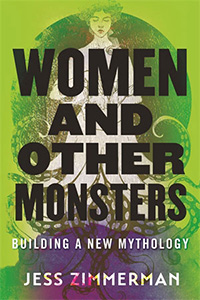
    Women and Other Monsters

    Women and Other Monsters: Building a New Mythology

    I’ve had a long-standing interest in female heroes, the women who have broken through gendered notions of who is allowed to embody valor and strength, and I was beginning to suspect that monsters, perhaps ironically, could offer a whole new approach to heroism for people (like me) who are often tripped up by feminine ideals . . . . We’re still struggling to create or consume stories about valorous women, unless they also display the “feminine” virtue.
    —Jess Zimmerman


    Women Warriors

    Women Warriors: An Unexpected History

    The disappearance of women warriors is part of our larger tendency to write history as “his story.” The tendency is explicit in the world of military history. As military historian David Hay points out, “The assumption that war is something essentially male—be it the apotheosis of masculinity or the incarnation of patriarchy—has banned the study of the female combatant to academic purgatory.” But women’s contributions in science, literature, politics, and economics are also routinely minimized, dismissed, or forgotten. Look at almost any subject and you’ll discover another example, whether it’s classicist Alice Kober’s critical role in the decipherment of Linear B or the existence of all-female volunteer fire brigades in the early twentieth century. In the case of women warriors, the tendency to erase women’s roles in history is complicated by the contested question of whether women should fight.
    —Pamela D. Toler

    Women unite

  • A Q&A with Robin Broad and John Cavanagh

    Robin Broad and John Cavanagh

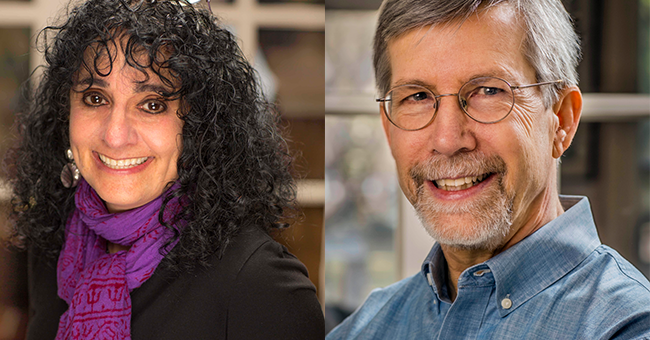
    Left: Robin Broad; right: John Cavanagh

    In the early 2000s, many people in El Salvador were at first excited by the prospect of jobs, progress, and prosperity that the Pacific Rim mining company promised. However, farmer Vidalina Morales, brothers Marcelo and Miguel Rivera, and others soon discovered that the river system supplying water to the majority of Salvadorans was in danger of catastrophic contamination. With a group of unlikely allies, local and global, they committed to stop the corporation and the destruction of their home.

    Robin Broad and John Cavanagh tell their David-and-Goliath story of winning two history victories in the face of seemingly insurmountable odds in The Water Defenders: How Ordinary People Saved a Country from Corporate Greed. Beacon Broadside editor Christian Coleman caught up with Broad and Cavanagh to ask them what inspired them to write the book and what its message holds for this year’s World Water Day.

    Christian Coleman: What was the inspiration behind writing The Water Defenders?

    Robin Broad and John Cavanagh: This book is about two of the most unlikely and inspiring victories that we’ve ever witnessed or had the privilege to be part of. That these wins take place in a poorer country, one that the United States and global corporations have exploited for decades, makes the wins even more remarkable. As we celebrated the victories, we realized that by sharing the story of these wins in a narrative nonfiction book, we could also share this sense of hope with readers, including readers who may have given up hope in these challenging times.

    If ordinary people can stand up to the economic and political power of global corporations in El Salvador and win not one, but two, improbable victories, imagine what people can do elsewhere. So too did we want to cull the lessons of these victories for fights in other countries that people are waging against the likes of Amazon, Walmart, ExxonMobil, Facebook, Pfizer, and Wells Fargo.        

    CC: You’ve been involved in the Salvadoran gold mining saga since 2009. Tell us about how you got involved?

    RB and JC: Truly, it was serendipity. John’s organization, the Institute for Policy Studies, selected a national network of Salvadoran water defenders to win IPS’s prestigious annual human rights award in 2009. Five water defenders were to come to Washington, DC, in October 2009. But three months before the award ceremony, we received the shocking news that one of the five, teacher and cultural worker Marcelo Rivera, had been brutally assassinated. We were horrified.

    Marcelo’s younger brother, Miguel, came to Washington, DC, in his place to accept the award. And after the ceremony, he respectfully asked for help. The mining corporation had initiated a legal case against El Salvador in a secretive tribunal at the World Bank Group in Washington, and the water defenders knew little about this venue. What began for us as a brief affirmative answer—a “yes, of course we’d be happy to do a bit of research”—on that balmy evening in October 2009 turned into a decade of the most rewarding work of our lives.       

    CC: You begin the book with Marcelo Rivera’s murder. He’s the first of several water defenders to be assassinated in the twenty-first-century fight over mining in northern El Salvador. Why did you choose to begin with his story?

    RB and JC: We begin the book with Marcelo’s murder because we wanted the reader to begin where we began: with the horrifying realization that murder can be the cost of protecting the environment in other countries. We knew that people, disproportionately poor and people of color, are killed by the slow violence of chemical poisoning of the air, land, and water by global mining, agribusiness, and fossil fuel firms. Yet, in the United States, seldom do people get murdered for leading these fights for water, for environmental justice. 

    As the nonprofit, Global Witness, reminds us, hundreds of people around the world are assassinated each year simply because they are environmental defenders. Marcelo was one of these—and his death still haunts us. We dedicated this book to him and three other of the Salvadoran water defenders murdered for choosing water over gold. 

    We also began the book with the words of Honduran environmental martyr Berta Cáceres, killed five years ago this month: “I knew that we would triumph, the river told me so.”   

    CC: The book is the sum of over a decade of research and your roles as international allies of the community groups in El Salvador. Did you come across any surprises in your research or during your stays with the Salvadoran villagers?

    RB and JC: As readers will discover, there are constant—and unexpected—twists and turns.   

    But as we contemplated writing a book about this, one of the big revelations for us—something that made writing this book possible—came when we fell into a treasure trove of emails and memos by the mining company executives. Yes, we knew that big corporations usually win because they have more money and they buy political influence. But as we scoured the documents, we were somewhat surprised that the big corporation made a lot of mistakes, often born of hubris and ignorance of the culture into which they were walking. More often than you’d imagine, the top executives underestimated the smarts and sophistication and moral cores of the people who lived in the frontline communities atop the gold. Moreover, the mining executives also inadvertently slighted some wealthier people who should have been their allies. 

    A final surprise: who knew that this story would lead half-way around the world to the Philippines, a country where we’ve lived and worked over the decades, to find a secret weapon in the final victory in El Salvador?    

    CC: And lastly, how do you see The Water Defenders connecting with this year’s World Water Day theme, Valuing Water?

    RB and JC: Most people in richer countries, such as the United States, take clean water as a given. After all, for most of us, it comes with the flick of a wrist to turn on the faucet.

    Writing this book reminded us what the people of Texas and Mississippi learned in the recent harsh winter freeze and what many who can’t pay their water bills know well—that most people in the world don’t take access to water as a given. Billions live in communities where water is scarce, and people must fight for the right to clean and affordable water. 

    In the US, the Poor People’s Campaign of Rev. William Barber is lifting up the voices of people from Flint, Michigan, to Alabama to the Apache sacred lands in Arizona, each of whom are fighting for the right to clean and affordable water. As we explain, their fight is linked to that of communities across El Salvador and the Global South and the lessons to be learned go in both directions.  

    The slogan of water defenders all over the world says it all: “Water is Life.” Water is indeed more precious than gold.


    About the Authors 

    Robin Broad is an expert in international development and was awarded a prestigious Guggenheim fellowship for her work surrounding mining in El Salvador, as well as two previous MacArthur fellowships. A professor at American University, she served as an international economist in the US Treasury Department, in the US Congress, and at the Carnegie Endowment for International Peace. Broad and her husband, John Cavanagh, have been involved in the Salvadoran gold mining saga since 2009. They helped build the network of international allies that spearheaded the global fight against mining in El Salvador. They have co-authored several previous books together.

    John Cavanagh is director of the Washington, DC-based Institute for Policy Studies, an organization that collaborates with the Poor People’s Campaign and other dynamic social movements to turn ideas into action for peace, justice, and the environment. Previously, he worked with the United Nations to research corporate power. Cavanagh and his wife, Robin Broad, have been involved in the Salvadoran gold mining saga since 2009. They helped build the network of international allies that spearheaded the global fight against mining in El Salvador. They have coauthored several previous books together.

  • By Christian Coleman

    Octavia E. Butler

    Author photo: Nikolas Coukouma

    It’s another fest of firsts for Octavia E. Butler! The multi-award-winning author and MacArthur fellow is having a moment, or rather a series of rolling moments that’s been gaining speed over the last few years, and we hope it keeps going!

    One of the goals Butler wrote about in her journal was to become a New York Times best-selling author. In September 2020, fourteen years after her death, she finally became one for the first time.

    https://platform.twitter.com/widgets.js

    Her bestseller status owes itself to Parable of the Sower, the first in her Parable duology in which America dives off the dystopian deep end in a way that rings too true for the last four years. Butler explained in her Democracy Now! interview, her final television appearance, that she wrote the duology as a cautionary tale. Readers have been turning to it as a prophetic reflection of our society during one of our peak turbulent times on record, and it’s alerting them to the genius and wonder of her other fiction.

    Where to start if you’re fresh off the rush of the Parable novels? Critic and reporter Stephen Kearse charted a reading guide of Butler’s entire output for the New York Times, beginning with her time-travel classic, Kindred. Because of its crossover appeal and “controlled and precise” depiction of American slavery, Kearse recommends it for readers who swear that they’re not fans of science fiction. They will be once they read it.

    NPR’s Throughline produced an hour-long feature about her career, “How Octavia Butler’s Sci-Fi Dystopia Became a Constant in a Man’s Evolution.” It features commentary from her former editor Dan Simon; writers Nnedi Okorafor, Ayana Jamieson, and adrienne maree brown; and readings from her books. The first part covers Kindred. About her intentions in writing it and her innovative approach to the time travel trope, she’s quoted as saying:

    “I wrote Kindred to make people, I hoped, feel history as opposed to merely knowing facts of history. It seemed important to me to get . . . the awareness of what it might have been like to be a slave, to feel it on your own skin, so to speak. And to understand the lack of control of your own fate that a slave suffers.”

    In his extensive New Yorker piece, “How Butler Reimagines Sex and Survival,” Julian Lucas singles out Kindred as the novel that kicked off the neo-slave narrative as a genre. Colson Whitehead’s The Underground Railroad and Ta-Nehisi Coates’s The Water Dancer are its direct descendants. Lucas goes on to remark that Kindred’s “enduring power lies in how it forces [protagonist] Dana not simply to experience slavery but also to accept it as a condition of her own existence.” And in a time when Black women are being lauded for saving the country from itself, its “premise feels newly mordant.”

    The Library of America enshrined Kindred’s literary legacy in the first ever volume of Butler’s collected work, released this January. Edited by writer Nisi Shawl and scholar Gerry Canavan, the LOA’s Butler volume includes her other stand-alone novel, Fledging, as well as her short stories and selected essays. She joins Ursula K. Le Guin, Philip K. Dick, and Ray Bradbury as science-fiction writers whose work has been recognized for its cultural significance to American letters. In signature Butler fashion, she’s the first Black science fiction author to have a full volume of their work added to the canon. Always a first. Always a trailblazer.

    All trailblazing paths begin somewhere, and Butler’s began in her hometown of Los Angeles. The Los Angeles Times mapped out her literary landscape and the old haunts where she wrote in their interactive feature for us to explore.

    Her path opened the way for today’s newest generation of writers, like N. K. Jemisin, Tochi Onyebuchi, Nnedi Okorafor, and adrienne maree brown. In particular, brown centers much of her work on Butler’s. On Democracy Now!, she talked about Butler’s impact as a deeply feminist writer on her:

    “I think one of the things that was so powerful to me when I first picked up Octavia is that she wrote these strong Black feminine characters, these protagonists, who now you might look back and see the nonbinary, see the queerness, see other things in them, but at the time, she was writing these characters, and it was like, ‘Oh, there’s young Black women, and they’re leading.’”

    The National Women’s Hall of Fame took notice of Butler’s feminist influence too. This October, they will induct her in the class of 2021, and in an announcement noted that “the issues she addresses in her Afrofuturistic, feminist novels have become more obviously relevant.” Here’s what else they had to say about her:

    “Her life and works have been highly influential in science fiction, the literary world and popular culture, especially for people of color and marginalized communities. Scholars note that Butler’s choice to write from the point of view of characters in these communities expanded the science fiction genre to reflect the experiences of disenfranchised people.”

    Her fellow inductees include poet Joy Harjo, NASA mathematician Katherine Johnson, and former First Lady, Michelle Obama.

    On the anniversary of her passing this year, Symphony Space hosted an evening of readings and conversation to celebrate her fiction. Such literary superstars as N. K. Jemisin, Walter Mosley, and our very own Imani Perry were part of the extraordinary roster that read selections from her work. It’s so heartening to see other writers and fans outside of science fiction fandom hopping on the Butler bandwagon.

    Just like Earthseed, the godless religion Butler invented for her Parable novels, her name has been taking root among the stars and worlds far from our planet. In 2018, the International Astronomical Union named a mountain on Charon Butler Mons to honor her. The year after, Asteroid 7052 Octaviabutler, discovered by American astronomer Eleanor Helin at Palomar Conservatory in 1988, was named in her memory. And this year, on March 5, NASA named the Mars 2020 Perseverance rover landing site after her. She would have loved this.

    Mars Perseverance Rover - Octavia E. Butler - Landing Site In Jezero Crater - March 5, 2021

    Mars Perseverance Rover – Octavia E. Butler – Landing Site In Jezero Crater – March 5, 2021. Photo credit: NASA/JPL-Caltech/University of Arizona

    There’s another Mars connection here. Butler started writing science fiction because she went into competition with Devil Girl from Mars, the kind of campy, post-war B movie that ghettoizes science fiction for its adolescent traits, like laser guns—pew pew pew!—and sexy yet dangerous women from outer space. “I could write something better than that,” she thought to herself as a precocious twelve year old after watching it. If NASA had this in mind when naming the landing site, hats off to them for the nod!

    By stars, we’re not just referring to astronomical objects. Last December, Dolly Parton gave the best shout-out to Kindred in the New York Times. And soon, stars of the small screen will bring the characters of the novel to life. FX Networks ordered a pilot for the TV adaptation of it. Yes, please! A screen adaptation of Butler’s work was long overdue.

    There’s only one thing missing in all the great news: Octavia E. Butler herself. It’s a shame she’s not here for this. We wish she were here to see how much she and her visions of the future mean for so many people.

    Octavia E. Butler

    About the Author 

    Christian Coleman is the associate digital marketing manager at Beacon Press and editor of Beacon Broadside. Before joining Beacon, he worked in writing, copy editing, and marketing positions at Sustainable Silicon Valley and Trikone. He graduated from Boston College and the Clarion Science Fiction & Fantasy Writers’ Workshop. Follow him on Twitter at @coleman_II.