• By Kyle T. Mays

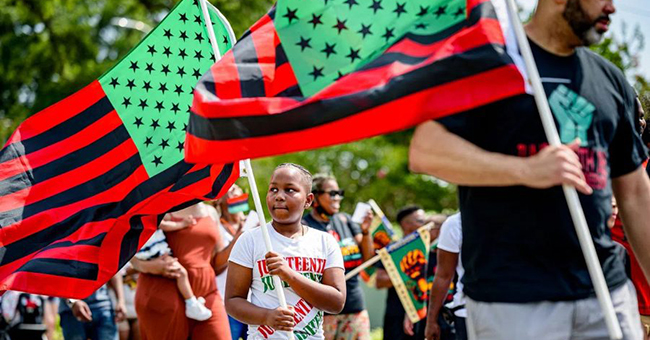
    Juneteenth celebration and march through Uptown Greenville, North Carolina.

    Juneteenth celebration and march through Uptown Greenville, North Carolina. Photo credit: Rawpixel

    Since the racial reckoning in the summer of 2020, reparations have become a greater part of the national consciousness and discourse. Municipalities across the US implemented some form of reparations programs; two states, including California and New York, have implemented task forces to study the possibility of it. There is no consensus on reparations and cash payments, though. The recent discussions and debates on reparations for Black Americans remain controversial across racial and party lines. According to a 2022 Pew Research Center Poll, 18% of white Americans support reparations for the descendants of enslaved Africans; 77% of African Americans support reparations for the descendants of enslaved peoples. For those who vote Democrat or are Democrat-leaning independents, 48% support reparations while 49% do not. 8% of Republicans support reparations while 91% do not.

    What we cannot forget is that the core of reparations is about compensation for exploited labor, stolen land, and property, to address past wrongs from the period of slavery and through the period of Jim Crow. Land and property rights are essential characteristics of what it means to be an American, a core part of the promise of democracy. However, the core idea of democracy in the US, both in theory and practice, was based on the dispossession of Indigenous peoples and the enslavement of African peoples. Critical race scholar Cheryl Harris reminds us that the notion of property was based on the “parallel systems of domination of Black and Native American peoples.” In other words, whiteness was the determinant of who could own property and who could become property—that is, Indigenous peoples could not properly hold property and Black people could become property. A quick perusal of the founding documents, including the Constitution and the Federalist Papers, reveal the accuracy.

    In general, advocates of reparations seek either compensation for land promised in the form of 40 Acres or a return of land stolen from the period of Reconstruction and throughout the period of Jim Crow. Others seek cash payments to be paid to descendants of enslaved Africans for enslaved labor. From the investigative journalism produced at Mother Jones or the recent publications, such as The Black Reparations Project: A Handbook for Racial Justice, a focus on private property and generational wealth seems central to remedy past wrongs. We should reject seeking reparations in the form of general wealth and private property. Let’s take a step back in time, during the period of Reconstruction (1865-1877).  

    In W. E. B. Du Bois’s classic, Black Reconstruction (1935), he spends a significant time on the importance of land in the South for white plantation owners and Black, formerly enslaved workers. During Reconstruction, Black people “expressed their right to land and the deep importance of this right.” As Du Bois further opines, Black people had earned that land because of their 250 years of uncompensated labor, “and by every analogy in history, when they were emancipated the land ought to have belonged in large part to the workers.” The US has tried their hardest to include Black people only slightly into this democracy, often at the expense of Indigenous peoples. For example, on January 16, 1865, General William T. Sherman declared in Special Field Order No. 15: “Whenever a negro has enlisted in the military service of the United States, he may locate his family in any one of the settlements at pleasure and acquire a homestead and all other rights and privileges of a settler.” Notice the term settler. While I don’t consider those enslaved peoples nor their descendants as settlers in the same way I do Europeans who came to settle and replace Indigenous peoples and whose ancestors continue to benefit from expropriated land, they can participate in the colonial project. And while it makes sense for those ancestors to seek land, I would suggest that they didn’t know much about Indigenous dispossession in their time. And certainly, it does not mean that we must carry the settler-colonial project into the present.

    As my grandma would say, “When you know better, you do better.” So, despite Mother Jones fantastic reporting and tracing of 1,500 land titles that were given to freedpeoples and swiftly taken away, can we also have a serious conversation why land should not be the sole focus on Black American reparations? Do we want to continue the violent nature of this so-called democracy—built on both the enslavement of Black people and the expropriation of Indigenous land? Do we really want to be compensated for the exploitation of people and land, both forms of property under a settler colonial society? Private property should not be the goal of reparations; it should be justice and a complete banishment of private property as well as a fundamental critique of American capitalism.

    Why should Black people care about abolishing private property? One of the few Black people who understood the nature of the settler colonialism point was Stokely Carmichael, who would change his name to Kwame Ture. In a speech he gave in front of a mixed Black and Indigenous crowd in St. Paul, Minnesota in 1975, he argued that this is not Black people’s land. And any dealings with land should center Indigenous nations. If he understood this in 1975, we should keep this same energy going in 2024 and beyond. After all, we should never desire to live in this wretched nation-state as is, without working in comradeship with our Indigenous relatives. Will this be perfect? No. But perfection is not the point of solidarity—it is about being on the right side of history, for the future of us all.

    We should strive in every way possible to reject capitalism, and in this case, that means avoid harping on the generational wealth as a route to reparatory justice. In The Black Reparations Project, editors William Darity and A. Kirsten Mullen state: “We propose that a true reparations plan . . . must focus on the elimination of the black-white wealth disparity at the mean, rather than the median.” I’m not opposed to helping the most vulnerable in society right now. If you’ve known the depths of inhumanity that exists in being poor in this country, you know what I mean when I say the most vulnerable in society could use cash right now. I also think, in the interim, Universal Basic Income would be great for most people. And yet I stand by the idea that we must reject generational wealth. Surely, reading that we should reject generational wealth as a fundamental ideal will have a strong reaction because our ancestors’ blood and sweat tarries in the soil. I ask this in response: How much are our ancestors’ bones worth? I understand that the development of United States’ wealth was based on land expropriation and enslavement, but that does not mean Black people should so eagerly want to become inducted into the hall of settler-capitalist shame. A focus on securing wealth, even to become average with white Americans, is not ideal because it does not lead to decolonization.

    Historian Robin D. G. Kelley asks in the latest version of Freedom Dreams: The Black Radical Imagination: “Is it possible to reconcile reparations for slavery and structural racism with decolonization?” If people want to focus on generational wealth and private property, the answer is no. If the desire is to imagine something more, where Black and Indigenous peoples can coexist, then yes, it is a possibility. But we must change our approach. So, what can reparatory justice look like? Rejecting generational wealth and private property should be fundamental in our approach toward reparatory justice. Sure, reparations could be a part of a broader social program to redistribute wealth to all workers as some socialists suggest. However, the land question must remain primary. You can’t redistribute Indigenous land without Indigenous say so. What good is redistributing wealth and paying reparations if land is not returned to Indigenous peoples? Someone will likely say that the “Indians enslaved Black people.” No, those were a handful of elites in the Five Tribes who did so under difficult circumstances. Most Indigenous nations did not enslave Africans. In our move toward reparatory justice, there two primary things that could happen sooner rather than later so we can iron out the details for our Afro-Indigenous future.

    First, Black and Indigenous peoples must connect together on the land. We must meet on the land and discuss how we envision shared land beyond private property and how we can pool resources that seek to take care of the collective and not focus on building generational wealth. After all, we haven’t had it anyways, right? So why start engaging in this capitalist hoarding process now? Second, Indigenous nations, using whatever protocols they have, should consider classifying Black Americans as kin in their territories. This could take many forms and it is up to those nations how they do so. What I am asking requires re-education, ending anti-Blackness and anti-Indianness in our communities. I think we can do it, though. We will need to have long, hard conversations over seasoned food, fit for everyone’s diet, but it can happen. We shall get our freedom, in this life.


    About the Author 

    Kyle T. Mays (he/him) is an Afro-Indigenous (Saginaw Chippewa) professor of African American Studies, American Indian Studies, and History, at the University of California, Los Angeles. He is the author of An Afro-Indigenous History of the United States (Beacon Press, 2021). Connect with him online at kyle-mays.com, on Twitter (@mays_kyle), and Instagram (@mayskyle).

  • By Dara Baldwin

    Lois Curtis, plaintiff in the “Olmstead v. L.C.” SCOTUS case, (center) presents President Barack Obama with a self-portrait of herself as a child.

    Lois Curtis, plaintiff in the “Olmstead v. L.C.” SCOTUS case, (center) presents President Barack Obama with a self-portrait of herself as a child, 20 June 2011. Photo credit: Pete Souza

    This June 22, we celebrated the twenty-fifth anniversary of the historic civil rights Supreme Court of the United States (SCOTUS) case, Olmstead v. Lois Curtis. In 1999, SCOTUS “upheld the unjustified segregation of people with disabilities.” Many people are unaware of this significant civil rights case and its significance to the lives of disabled people. But even more egregious is the erasure from history of its lead plaintiff: a Black disabled woman.

    Lois Curtis had a mental health diagnosis and developmental disabilities and was voluntarily institutionalized in a Georgia state facility. But after her treatment was completed and clinicians in the facilities stated she should be released, the administrators forced her to remain for multiple years. It was never the intent to permanently institutionalize her, and she made it clear that her life was outside of that place. Her determination to be free and being a Black woman are imperative to the legacy of this historic case. 

    In the advocacy work of the disability rights movement, they call on the Olmstead case, which is used in the de-institutionalization of this community. The Supreme Court ruled that “unjustified segregation of persons with disabilities constitutes discrimination in violation of Title II of the Americans with Disabilities Act of 1990.” This case is used around the country to move states to get disabled people out of institutions. Over the years, it continues to be referred to with one word—Olmstead—which completely erases lead plaintiff Lois Curtis.

    The disability rights movement centers white disabled people and is steeped in oppression. For years, it has been called out for not recognizing Lois Curtis as the lead plaintiff in this SCOTUS case. This is part of the erasure of many BIPOC disabled and particularly of Black disabled people from the history of the movement. The erasure of people like Lois Curtis from disability history has led to the creation of disability justice, a movement that negates the disability rights movement and centers BIPOC disabled people in the work of creating change.

    For years and even today, when referring to this case, the only name used is Olmstead. It is ironic and even insulting that a community with a focus on ending institutionalization uplifts Tommy Olmstead instead of Lois Curtis. Olmstead was the white man and commissioner of the Georgia Department of Human Resources who wanted to keep disabled people in these institutions. Yet in the many disability rights celebrations of this case, there is little mention of Lois Curtis being a Black woman.

    There are two plaintiffs on this case, but Lois is the first. When citing these cases, the practice is to state both sides, such as Brown v. Board of Education, and to use the lead plaintiff. So, on June 22, when celebrating this case, let’s all make sure to include this woman and her plight for freedom.


    About the Author 

    Dara Baldwin, MPA (she/her/hers) is an activist for human rights and Black liberation and is the author of To Be a Problem: A Black Woman’s Survival in the Racist Disability Rights Movement (forthcoming from Beacon Press, July 2024).

  • By Christian Coleman

    Pride Month

    Image credit: Simp1e123

    Rainbow season is in full, fierce bloom, honeys! Take to the streets with your most fabulous fans and clack them with pride! Clack them to reflect, empower, and unite for queerness in all its joys and liberation! Clack back to the haters intimidated by queerness! Because this is your month. They all are, really.

    As you’re living it up at the block parties, parades, and gatherings, clack your fans for this handful of titles by our queer authors! Their books will make you reflect on the history of our queer ancestors, on how male body image determines what masculinity is (or isn’t), on what it means to be Black in the US. They will empower you with stories of women embracing their bisexuality, of House mothers and fathers taking in disowned queer youth, with truth bombs about what to do about our “national conversation about race.” They’ll embolden you to unite for queer and trans resistance on all fronts.

    These books are for us. For everyone. Clack away, honeys, and happy Pride Month!


    And the Category Is pb

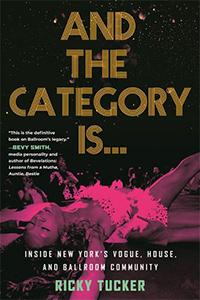
    And the Category Is . . . : Inside New York’s Vogue, House, and Ballroom Community

    “[F]inding a family like the folks in Ballroom, hand-picked and talented, a flamboyance of family, can be the precious gift that fills seemingly unfillable voids like homelessness, alienation, sorrow, the hunger to be seen—a sense of purpose. The supplemental nature of house-Ballroom parents adopting LGBTQ homeless youth could be and often is discounted in terms of its legitimacy, perhaps because it points out through its deep intimacy, fierce support, and unconditional love for tossed-aside children, the rich cruelty, ineptitudes, and toxicity of heteronormative biological families.”
    —Ricky Tucker 


    A Cup of Water Under My Bed_10th Anniversary

    A Cup of Water Under My Bed: A Memoir

    “Generally speaking, gay people come out of the closet, straight people walk around the closet, and bisexuals have to be told to look for the closet. We are too preoccupied with shifting. There isn’t a good verb for what begins happening to me in college. Yes, I am meeting lesbians, but I am not one of them. I still find men attractive; it is that I am thinking of women in a new way. It is as if I am learning that I can shift my weight from one leg to the other, that I have a second leg. Kissing women is like discovering a new limb.”
    —Daisy Hernández 


    Everybody's Protest Novel

    Everybody’s Protest Novel: Essays

    “One writes out of one thing only—one’s own experience. Everything depends on how relentlessly one forces from this experience the last drop, sweet or bitter, it can possibly give. This is the only real concern of the artist, to recreate out of the disorder of life that order which is art. The difficulty then, for me, of being a Negro writer was the fact that I was, in effect, prohibited from examining my own experience too closely by the tremendous demands and the very real dangers of my social situation.”
    —James Baldwin 


    Homeland of My Body

    Homeland of My Body: New & Selected Poems

    Become the salt of my blood, my veins’
    abating pulse. Become the soft alabaster
    of my softening bones, the stale marrow
    of this aging life. Become my dull teeth,
    and faded lips, still glossing a smile when
    you smile into my dimming eyes. Become
    my eyes that’ve studied the anatomy of
    our love: my arms in the arc of your arms,
    my thighs knotted with yours, our fingers
    woven into each other. Become my lungs,
    their last gasp, my nerves firing through
    every scene of our loving. Become the soil
    of my soul. There’s nothing more blessed
    than taking you with me into the ground.
    —Richard Blanco, “Become Me” (for my husband) 


    How To Be Less Stupid About Race

    How to Be Less Stupid About Race: On Racism, White Supremacy, and the Racial Divide

    “I hate to be the one to break it to you, but we’re not going to end white supremacy by ‘hugging it out.’ And we’re certainly not going to fuck our way out of racial oppression. That’s not how power works. In the interest of science, I just took a break from writing this chapter to enjoy a roll in the hay with my half-white, half-Japanese girlfriend. Despite our best efforts, our interracial, interethnic lovemaking was surprisingly unable to usher in the Age of Aquarius. Maybe if we just keep trying, we’ll eliminate the racial wealth gap through the sheer power of our orgasms and loving-kindness. Or maybe not. ¯\_(ツ)_/¯”
    —Crystal M. Fleming 


    A Queer History of the United States

    A Queer History of the United States

    “Perhaps the most startling revelation, which did not occur to me until I had finished writing, was that many of the most important changes for LGBT people in the past five hundred years have been a result of war. From the American Revolution to the war in Vietnam, wars have radically affected LGBT people and lives. These wars have had an enormous impact on all Americans, but their effects on LGBT people have been particularly pronounced, in part because the social violence of war affects sexuality and gender.”
    —Michael Bronski 


    The Queering of Corporate America

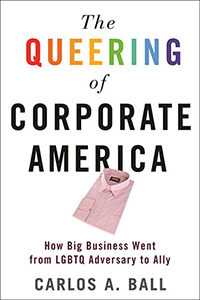
    The Queering of Corporate America: How Big Business Went from LGBTQ Adversary to Ally

    “The fact that a growing number of large corporations were willing initially to embrace LGBTQ equality measures internally, and later to advocate externally on behalf of public policies that promoted LGBTQ rights, went a long way toward normalizing and mainstreaming LGBTQ equality claims. After all, how radical or destabilizing could equal treatment of queer people and relationships actually be if such treatment had been publicly embraced by blue chip corporations such as Apple, General Mills, Google, IBM, Microsoft, and Procter & Gamble?”
    —Carlos A. Ball 


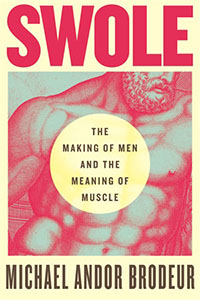
    Swole

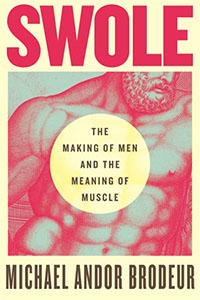
    Swole: The Making of Men and the Meaning of Muscle

    “[L]ifting weights has given me a greater sense of physical stability and personal security. For a gay guy, muscles function as both attractant and repellant, as armor and invitation. (For many of us, muscle embodies this duality—a feedback loop of defense and desire.) But there’s more to it than that.”
    —Michael Andor Brodeur 


    Transgender Warriors

    Transgender Warriors: Making History from Joan of Arc to Marsha P. Johnson and Beyond

    “As trans people, we have a history of resistance of which we should be proud. Trans warriors stood up to the slave-owners, the feudal landlords, and the capitalist bosses. Today, as trans warriors we are joining the movement for a just society in greater and greater numbers. By raising the demands of our trans movements within the larger struggle for change, we are educating people about our oppression, winning allies, and shaping the society we’re trying to bring into being.”
    —Leslie Feinberg 


    Unapologetic

    Unapologetic: A Black, Queer, and Feminist Mandate for Radical Movements

    “Understanding and expressing what it means when one’s race, class, gender, and sexuality simultaneously shape one’s political values is part of a long tradition of being a Black woman who is queer or transgender or both. While the language has evolved over the years (from the likes of ‘Negro’ and ‘transsexual’), the conditions and systems of oppression have been consistently violent.”
    —Charlene A. Carruthers

    Pride Month


    About the Author 

    Christian Coleman is the digital marketing manager at Beacon Press and editor of Beacon Broadside. Before joining Beacon, he worked in writing, copy editing, and marketing positions at Sustainable Silicon Valley and Trikone. He graduated from Boston College and the Clarion Science Fiction & Fantasy Writers’ Workshop. Follow him on Twitter at @coleman_II and on Bluesky at @colemanthe2nd.bsky.social.

  • By Remica Bingham-Risher

    Forrest Hamer

    Photo of Forrest Hamer © by Matt Wong.

    One of the reasons why poet Remica Bingham-Risher wrote Soul Culture: Black Poets, Books, and Questions that Grew Me Up was to give our celebrated Black poets their flowers while they are still with us. And what better way to give them their flowers than to interview them and invite them to talk about their creative process in this collection of essays! For Pride Month, the spotlight is on Forrest Hamer, featured in this passage. He was one of Bingham-Risher’s instructors at the Callaloo Workshop.

    ***

    BINGHAM-RISHER: Do you remember your first encounter with poetry?

    HAMER: I would guess it happened as my body responded to my mother’s heartbeat, to lullabies or the Bible stories I heard each night before sleep, or to my grandfather’s singing.

    ~~~

    When I asked Forrest Hamer to autograph his books, I had never seen anyone so upset about such a small mistake. We were at the Callaloo Creative Writing Workshop where he was teaching and, like all the other students there, I became enamored with his work and unassuming nature, wanting nothing more than to spend the last few nights surveying his words. As he signed his books, he misspelled my name, and when I crossed out one letter for another, he apologized to no end. He held me there, despite the line forming behind us, repeating, “I’m so, so sorry about that. Names are important. Please let me take care of things.”

    I was sorry to have pointed out the mistake in front of him, as he seemed so deliberate in showing each student deference and care. In addition to being a poet, he is a listener, a psychologist and psychoanalyst, the combination of which, he’d explain during our interview, were “twin efforts to discover mind through language merged.” He said: “You have to be an avid listener, as a psychoanalyst, and an intense kind of listening has to happen to be a poet as well.” After the signing mishap, he offered to buy me another set of books and was sincere in this, though I refused. But the fact that he was willing to do so told me that he is a poet, and human, of shrewd watchfulness and deep compassion; he hears what’s singing in us and bears out our glory.

    ~~~

    At the Callaloo Workshop, Hamer was quiet and observant. It seemed like most of the students there were extroverts or at least a bit eccentric, and he was just the opposite. I worked with Natasha Trethewey and Hamer had another set of poets, but I remember—in the large forums where we’d all meet together—feeling like Hamer was “reading” us (maybe like patients?). He made us think of ourselves, and others, as individual critical beings. We were all fully invested in his heart and eye (as he was so “care/full,” as Lucille Clifton might have put it), and we hoped his keen observations would make us keener as well. By the end of the workshop, a hush would fall over the room every time he started to speak.

    When I interviewed Hamer, he expressed that, as poets, we are “surrendering to the process of discovery through language” and that he hopes “by paying closer attention to what has been said we will be better able to say what has yet to be imagined.” But in his book Middle Ear, most of the poems start in the middle of quiet, loss. I question why he often mulls over what’s missing and he explained: “I’m half-deaf and the meanings of listening have been amplified by that fact of my constitution. It highlights the idea that there is more sound than one can hear—regardless of one’s capacity—and another that sound is both an exterior and interior matter.” He said, thinking about himself as a therapist and a reader, “I respond acutely to the tension between what is sounded and what is not, and I try to listen for presence and absence at once.”

    ~~~

    Hamer and I turned to music briefly when I asked about the blues myths and mythos that appear throughout Middle Ear in poems like “Arrival” and “Crossroads.” He said he shunned the blues as a child, but living a bit more, growing up, gave him an acute understanding: “I could hear loss—of love, of hope, of security—in a way that let me hear the survival and the thriving implicit to the blues. So blues helped Middle Ear come into being with its repetitions, its worrying of lines, its holding of contradiction, its gut-uttering, and the meditation on what we do and do not bear to hear.”

    With my daughter, and cousins, and girlfriends, I ruminated on this idea—this “survival and thriving implicit” to the creation of the thing— when Beyoncé released Lemonade. It’s not a blues album, it’s a hybrid of sorts; not pop, not straight-up soul. It’s an amalgamation of the embodied weight and wisdom of living: an accusation, a warning, a mingling of verse and reverb, what lies you’ve been told, and, despite this, what the body knows.

    ~~~

    In [his collection] Rift, as in the poem “Common Betrayal,” change is a recurring theme often met with reluctance, so I asked Hamer about this and he said: “I’m surprised—though I really shouldn’t be—by how much transformation is a subject of my work. . . . That we are also in a constant state of change does seem to make urgent the matter of paying attention to what we can, if only for the sake of addressing the awe of what has already been.”

    How do we capture children, milestones, admiration, the wide-open heart as they are? They are all fleeting and imperfect, most more wonderful (or unbearable) in theory, in the faint haze of distance growing wider over time.

    Somewhere along the way, I realized [my daughter] Sonsoréa and I were both impressed with self-reinvention. How could we make ourselves over, even if the world around us was a swirling unknown haze? That was my world when my parents separated, when we traveled across the country to start another life. This was what Sonsoréa and her brother were asked to do, and in the wake of this, we all, in our own ways, looked for forces to help us reassess who and how we could be.

    ~~~

    I gave in to my daughter’s request for an eponymous poem, but where would a poem like this begin? First, I thought much about what could have been the literal meaning of her name. (I tried to pin it down to one culture or root, but haven’t found anything near it yet.) I thought instead of how she embodied her name, what she’d made it mean for me and others around her.

    ~~~

    If you are Black in this life, race informs everything. I frequently dream about being in paradise a few lifetimes from now where I’ll explain this to the newly living and how bizarre they’ll find it that all these generations, in every place we inhabited, had this obsession with skin/gender/color/ names. But why was it important? they’ll ask again and again. Those of us who lived through it will have to try to deconstruct history without making ourselves culpable or diminished.

    While working on my daughter’s poem, I was also studying Forrest Hamer. In each of his books, Call & Response, Middle Ear, and Rift, much like in life, race is a change agent that enters and often consumes. In Hamer’s poem “Edge,” the speaker and the landscape, even the onlookers, are changed by experience, fragmented by time. The speaker’s mother, passed on into another life, recounts the painlessness to her daughter, then there is a flashback to bygone days: a homecoming parade. The Supremes are blaring and the speaker dreams it is the end and beginning of life as they know it. But an all-white cemetery looms across the street, so does the absence of people the speaker loved—his mother, the daughter, the eventual self—mean they weren’t there, the joy never all-encompassing and everywhere?

    What edge is this? The edge of innocence, of a life just before it ends? The edge of a street, a cemetery, the changing times? Is it nearer the edge of a sharpened knife, or more like the corner of a dresser protruding, or maybe the edge of the world as some of us know it? Hamer leaps and shifts, through hindsight, as the speaker finds himself marked by what he cannot know or name. This mother, who was and is no longer but is still in rumination, the joy that was a passing parade covering over hopelessness, the dire times and those who couldn’t transcend them: all edges of what remains. Reading “Edge” underlined what a privilege it was to be a dark woman mother poet, in this day and space and time, to be able to sit with wonder and gaiety, then try to capture those moments as they are.

    ~~~

    As much of Hamer’s work has the tinge of the spiritual, I asked him about his poems in Kevin Simmonds’s anthology Collective Brightness: LGBTIQ Poets on Faith, Religion & Spirituality and how reverence served as an impetus for his work. He said: “What I came to appreciate, and still do now, is how as humans we strive to articulate something of the awe we experience when we recognize the depth and breadth of existence over time.” He went on: “I think this address of that awe—and to it!—is inherent to the process of making, and I delight in how poetry offers me one of the most profound dwellings wherein to engage my awe of being alive as this one version of life I happen to be.”

    Part of naming is amazement and articulation, recognizing the wonder and seriousness of ushering another in. Naming is a way to honor this life, this particular elation, as is addressing the minutia of our whole human, complex selves in poetry.


    About the Author 

    Remica Bingham-Risher is a Cave Canem fellow and Affrilachian Poet. Her work has been published in the New York Times, the Writer’s ChronicleNew LettersCallaloo, and Essence, among other journals. She is the author of 3 volumes of her own poetry: Conversion, winner of the Naomi Long Madgett Poetry Award; What We Ask of Flesh, shortlisted for the Hurston/Wright Award; and Starlight & Error, winner of the Diode Editions Book Award. She lives in Norfolk, VA with her husband and children. Follow her online at remicabinghamrisher.com, on Twitter (@remicawriter), and on Instagram (@remicawriter).

  • By Christian Coleman

    Fathers Day wallpaper

    Image credit: Sohryu22

    This Sunday, it’s dad’s turn to be given his flowers—or tie or power tool or gift card. You get the idea. Our flowers come in the form of books, some of which are written by fathers. Books for the daddies and zaddies on their muscle-bound journey. For the House fathers taking the rejected queer kids under their wing. For the feminist dads who don’t want to go the way of the Kens in Barbie. For the fathers living from hustle to hustle to keep a roof over their loved ones’ heads. For the fathers who persevere in the face of the world’s horrors. For the fathers who love America more than any other country in the world and insist on the right to criticize her perpetually. For the dads who can’t get enough of their history fix. For the Daddies whose special bedroom community matches their freak. For the fathers worried about the natural world we’re leaving for the next generation. Whichever father or father figure you are, these books are for you.


    And the Category Is pb

    And the Category Is . . . : Inside New York’s Vogue, House, and Ballroom Community

    “If you shadowed other gay Black fathers, or anyone in Ballroom for that matter, you’ll find that everyone’s theoretical approach to parenting is also primarily an iteration of that of their first and most formative role model—their mother . . . Within this culture, a quintessential act of masculinity (fathering) can be driven by classic femininity (mothering), and Black femininity in particular—the most marginalized group who again and again care for the greater good, the type of tender, put-upon yet persistent nurturers consistently known for and expected to save the world from itself.”
    —Ricky Tucker 


    Don't Look Left

    Don’t Look Left: A Diary of Genocide

    “Yasser [my son]—who, at 15, has only witnessed two wars so far—is still scarred by memories of the 2014 conflict. He was seven at the time, and remembers it all vividly. His younger sister Yaffa, who was only two, claims she remembers it, but when asked to describe it, it seems she is only describing videos she’s seen of the war. She also knows I talked a lot about her in my book, so has a kind of strange nostalgia for it. Memories of war are strangely positive, because to have them you must have survived.”
    —Atef Abu Saif 


    Drive

    Drive: Scraping By in Uber’s America, One Ride at a Time

    “I sat down and made a list of the pros and cons. Pro: I could choose my own hours to work. Cons: I was risking getting hurt in a car accident and I’d spend more money on gas, which would wreck my budget if I couldn’t make it work. I knew that working as a rideshare driver would beat up my vehicle, leave me sitting down for long periods in my car, and inevitably end with someone puking in my backseat. I tried not to think about phrases like ‘deep vein thrombosis’ and whether my life insurance policy would be enough for my son, Alex, to go to college.”
    —Jonathan Rigsby 


    Everybody's Protest Novel

    Everybody’s Protest Novel: Essays

    “I don’t think that the Negro problem in America can be even discussed coherently without bearing in mind its context; its context being the history, traditions, customs, the moral assumptions and preoccupations of the country; in short, the general social fabric. Appearances to the contrary, no one in America escapes its effects and everyone in America bears some responsibility for it. I believe this the more firmly because it is the overwhelming tendency to speak of this problem as though it were a thing apart.”
    —James Baldwin, from “Autobiographical Notes” 


    Junk Raft

    Junk Raft: An Ocean Voyage and a Rising Tide of Activism to Fight Plastic Pollution

    “The Junk would be my eighth raft. In my journal, I sketched elongated pontoons of plastic bottles wrapped in fishing nets, poles lashed across the deck, a cabin that looks like a giant doghouse, and a square sail billowing in the wind. Plastic bottles are an ideal boatbuilding material. Seemingly unsinkable, they’re tough, UV-resistant, and designed to last on store shelves for decades. Having been sold the idea that bottled water is better than tap water, consumers bought more of it than milk and beer by the 1990s, and by the turn of the twenty-first century, they paid more for it than gasoline. Today, water packaged in plastics that may contain leached plasticizers and microplastic fibers is likely bottled locally, despite pictures of mountains and waterfalls on the labels, and the industry has complete freedom from any standard of quality, unlike free water from your tap. Plastic bottles are plentiful on roadsides and beaches. They’re floating down rivers and bobbing across oceans. If you puncture one on your raft, there’s likely another one floating by.”
    —Marcus Eriksen 


    Life As Jamie Knows It

    Life As Jamie Knows It: An Exceptional Child Grows Up

    “When Jamie was still little, it meant everything to us to meet parents with older kids, parents who could give us some details on it might be OK after all and (or but) you never know. Now that Janet and I are in the position of parents-with-older-kids, we try to return the favor: your mileage may vary, but our journey has been more complex and wonderful than we could have dreamed. We take deep joy from narratives like that of the man who was initially so distraught by the idea of having a child with Down syndrome that he could not talk to us about it—and has since found (you never know!) that his child is charming, beautiful, and the light of his life.”
    —Michael Bérubé 


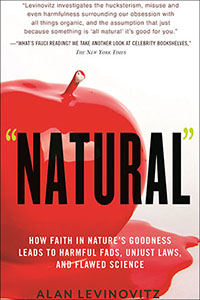
    Natural pb

    Natural: How Faith in Nature’s Goodness Leads to Harmful Fads, Unjust Laws, and Flawed Science

    “Here’s the difficulty: when our culture is shot through with nature worship, talking about the value of natural birth seems like tacit endorsement of that religion. It doesn’t have to. Nature is not the ultimate source of value, in birth or anything else. “Natural” is not synonymous with beautiful, healthy, true, or good. Once freed from this theological understanding of nature, it becomes possible to discuss the potential benefits of natural childbirth—and there are many—without evangelizing obedience to nature. It also becomes possible to state clearly the benefits of unnatural childbirth—and there are many—without being labeled a heretic.”
    —Alan Levinovitz 


    The Patriarchs

    The Patriarchs: The Origins of Inequality

    “Older, wealthier free men would eventually come to rule over their households, elite men would come to rule over their states, and powerful gods would rule over them all, the same way that the English political theorist Robert Filmer would go on to describe in his Patriarcha in the seventeenth century. After the start of classical antiquity in this part of the world, around 800 BCE, male domination would become the social norm. It would weed its way into people’s minds, warping how they thought about themselves—and about human nature itself.”
    —Angela Saini 


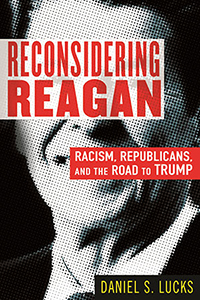
    Reconsidering Reagan

    Reconsidering Reagan: Racism, Republicans, and the Road to Trump

    “Reagan harbored the myopic view that with the passage of the landmark civil rights legislation of the 1960s, which he, of course, had opposed, America was now ‘a color-blind’ society whose doors were open to African Americans as long as they took ‘the initiative to walk on through.’ Reagan’s preposterous notion that America had ever transcended racism remains a staple of the conservative zeitgeist.”
    —Daniel S. Lucks 


    Swole

    Swole: The Making of Men and the Meaning of Muscle

    “One thing you’ll notice after reading a century’s worth of men lamenting the ‘crisis’ of dwindling masculinity is that, in many ways, masculinity itself is the crisis: this fitful obsession with living up to an inheritance of standards that feels distorted beyond reason or recognition, the absurd conclusion of a game of telephone strung over millennia of men.”
    —Michael Andor Brodeur 


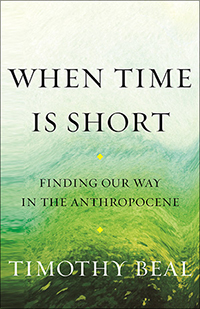
    When Time Is Short

    When Time Is Short: Finding Our Way in the Anthropocene

    “I wonder, do kids have that sense more than we adults do? What if growing up is about learning to forget that uneasy, half-conscious knowledge of the unbearable precariousness of being human in a here-today-gone-tomorrow world? Maybe, over the years, we gradually learn to deny such mortal unease, building moments of experience into a big story, a story of where we’ve been and where we’re going, which provides a kind of narrative bridge to block our view of the abyss we daily cross.”
    —Timothy Beal

    Fathers Day wallpaper


    About the Author 

    Christian Coleman is the digital marketing manager at Beacon Press and editor of Beacon Broadside. Before joining Beacon, he worked in writing, copy editing, and marketing positions at Sustainable Silicon Valley and Trikone. He graduated from Boston College and the Clarion Science Fiction & Fantasy Writers’ Workshop. Follow him on Twitter at @coleman_II and on Bluesky at @colemanthe2nd.bsky.social.

  • By Philip C. Winslow

    Wardan jetty, Yangon

    Wardan jetty, Yangon. Photo credit: Philip C. Winslow

    This is the last of three parts of a photo retrospective on three countries where Philip C. Winslow has worked since the mid-1990s: Angola, Sierra Leone, and Myanmar (Burma). All photos © Philip C. Winslow. Read part one and part two.

    Thirty years ago when I was reporting the civil war in Angola, a Catholic nun needed to explain to people in a remote village what a journalist was, why I was there. With no word in the local language, she created one that translated as “the people who come and ask a lot of questions and then go away.” Her delightfully accurate description stayed with me for years as I interviewed people in other countries whose lives were in turmoil or about to get that way.

    Looking back now at Angola, Sierra Leone, and Myanmar (Burma) is partly a late-in-life feeling that I owe people whose stories I wrote down before habitually leaving for somewhere else. My sense of benign debt follows the plea that I (and many reporters) frequently hear in troubled places: “We are alone. Please tell our stories.” Tell their stories I did. Some may find the notion that I “owe” highfalutin; it was a job, right? I reported, and moved on to other stories.

    Memory and fondness (or loathing) are personal, and what we pick up along the way stays with us. Many of the people I’ve interviewed and photographed are displaced or dead. I’ve had the privilege, and the luck, of being able to go away, as the nun said. Most of these people had less opportunity. Many fled as terror descended. Or, they stayed put because wherever they were was home. Decades later, I want their lives, or at least their faces, seen through other eyes and remembered. That’s all they asked of me.

    III — MYANMAR (BURMA): BETWEEN PEACE AND WAR, 2009-2011 

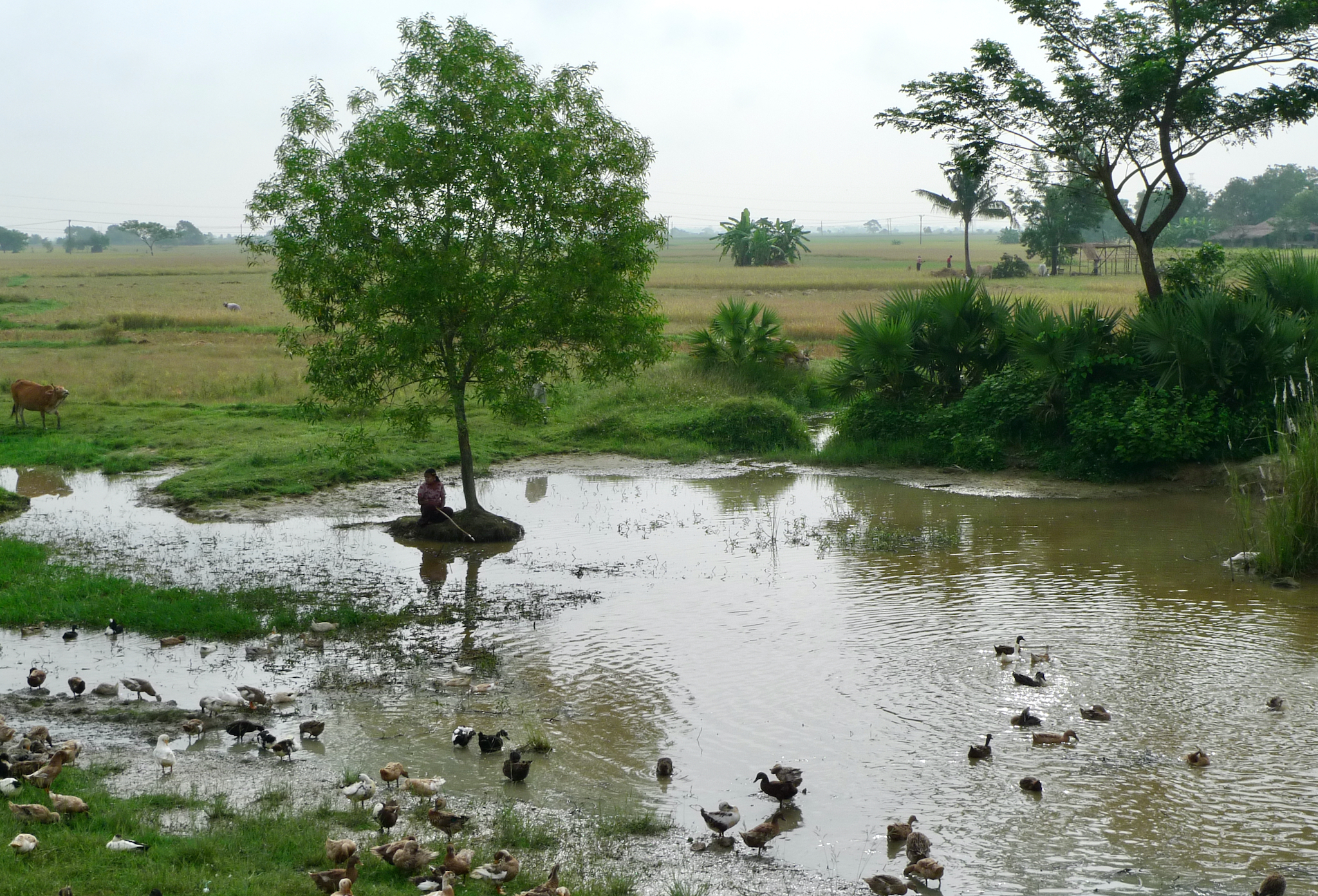
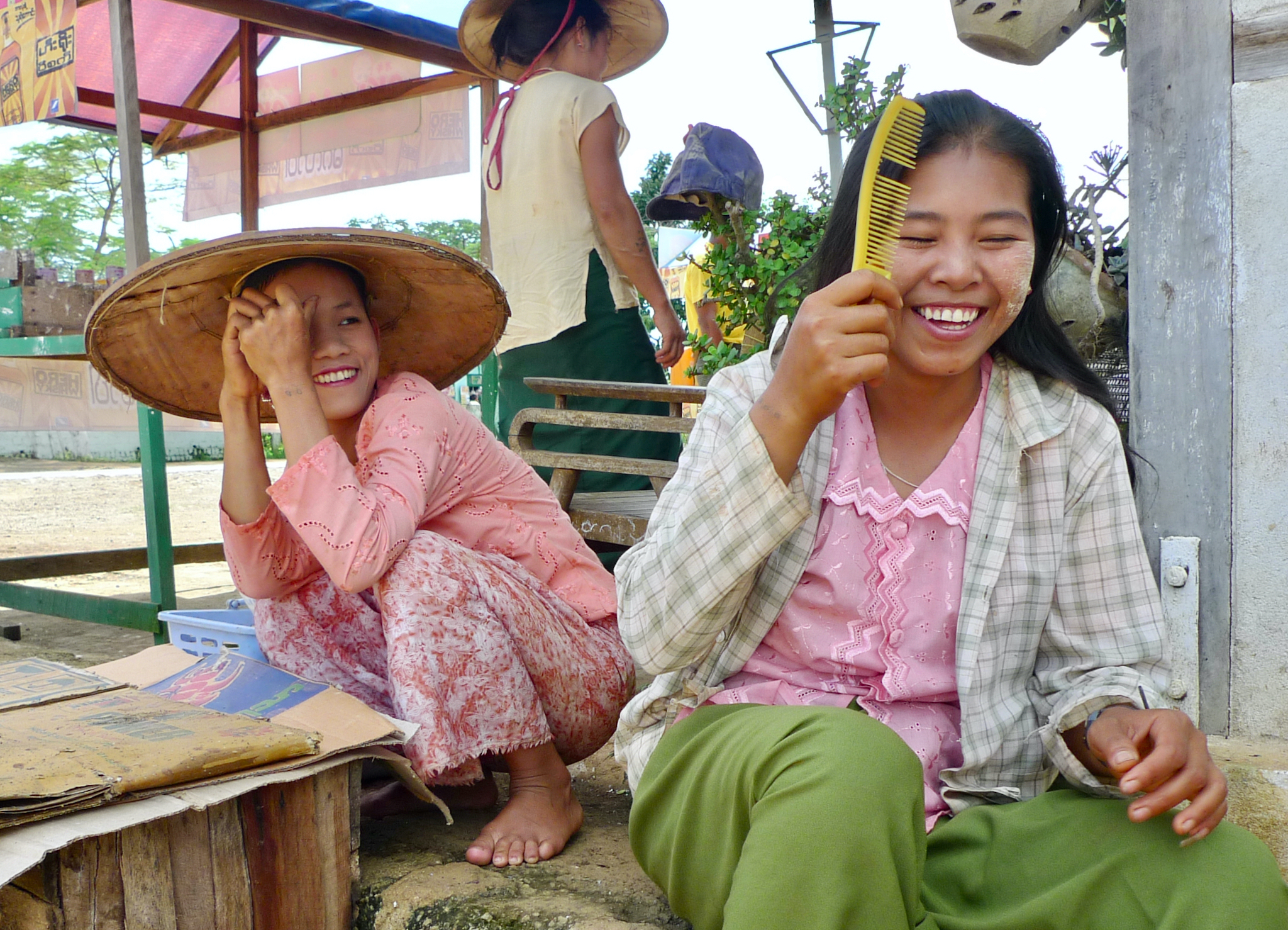
    In February 2021, Myanmar’s long-dominant military overthrew the elected government and set about to crush the shoots of democracy once and for all. Some years before that, I traveled parts of the country: across Yangon, Bago and Mandalay divisions, through northern Kachin and the Shan states; through the plains, down south through Kayin and Mon states and back again. This was initial research for a planned book on the Irrawaddy River, which I was not able to finish. I moved around mostly unhindered through a country in fragile balance between partial peace and today’s savage war on civilians. Some people I met had already been displaced by the fighting or were being forcibly rehoused in “model villages.” Others knew what was coming and allowed me to document their stories. The documentation is not exhaustive: often just pictures of ordinary people whose lives had not yet been wrecked.


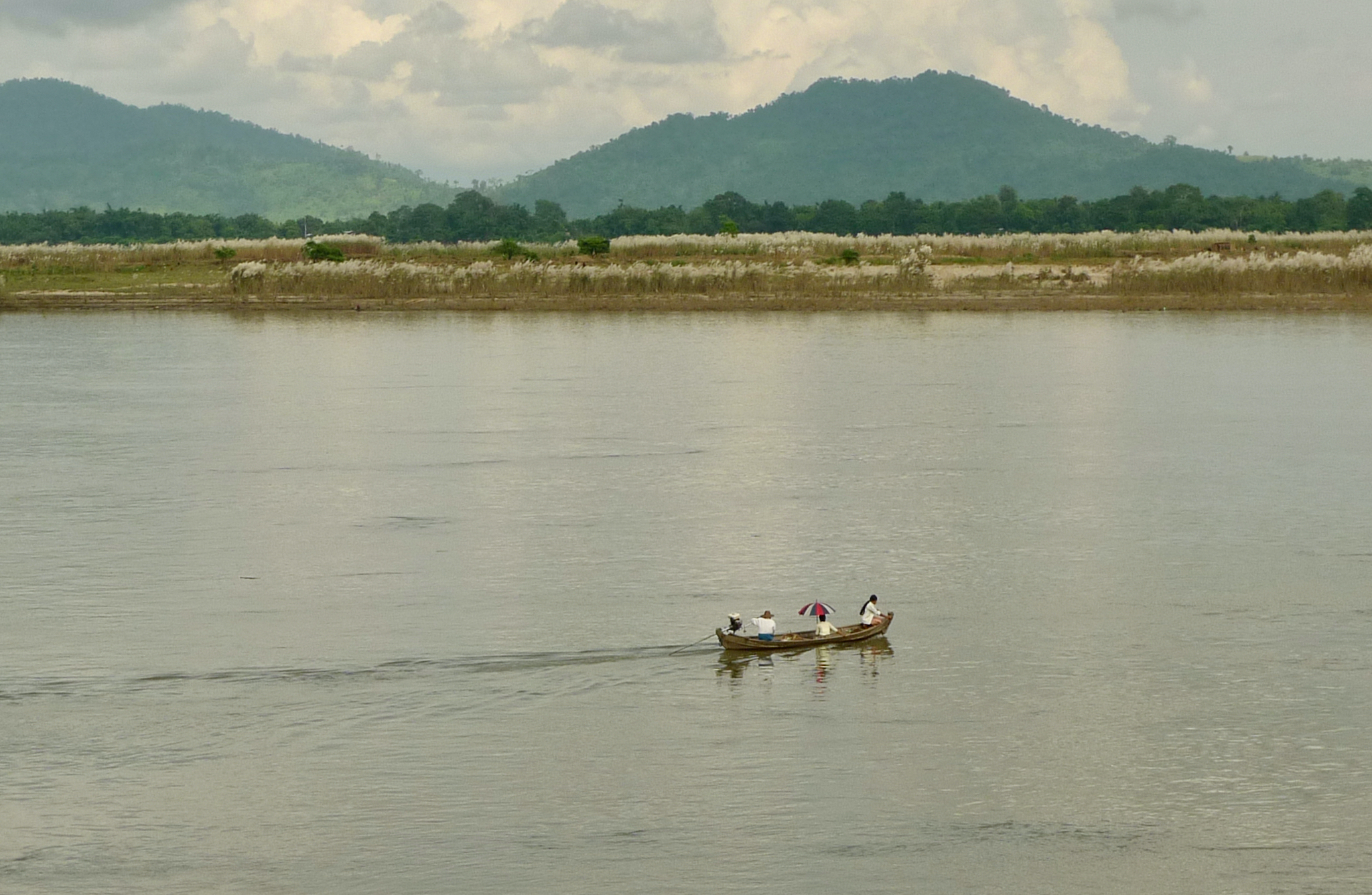
    A-Wardan jettyWardan jetty, Yangon


    B-  near Myitkyina L1000481 copyCrossing the Irrawaddy, near Myitkyina, Kachin State.


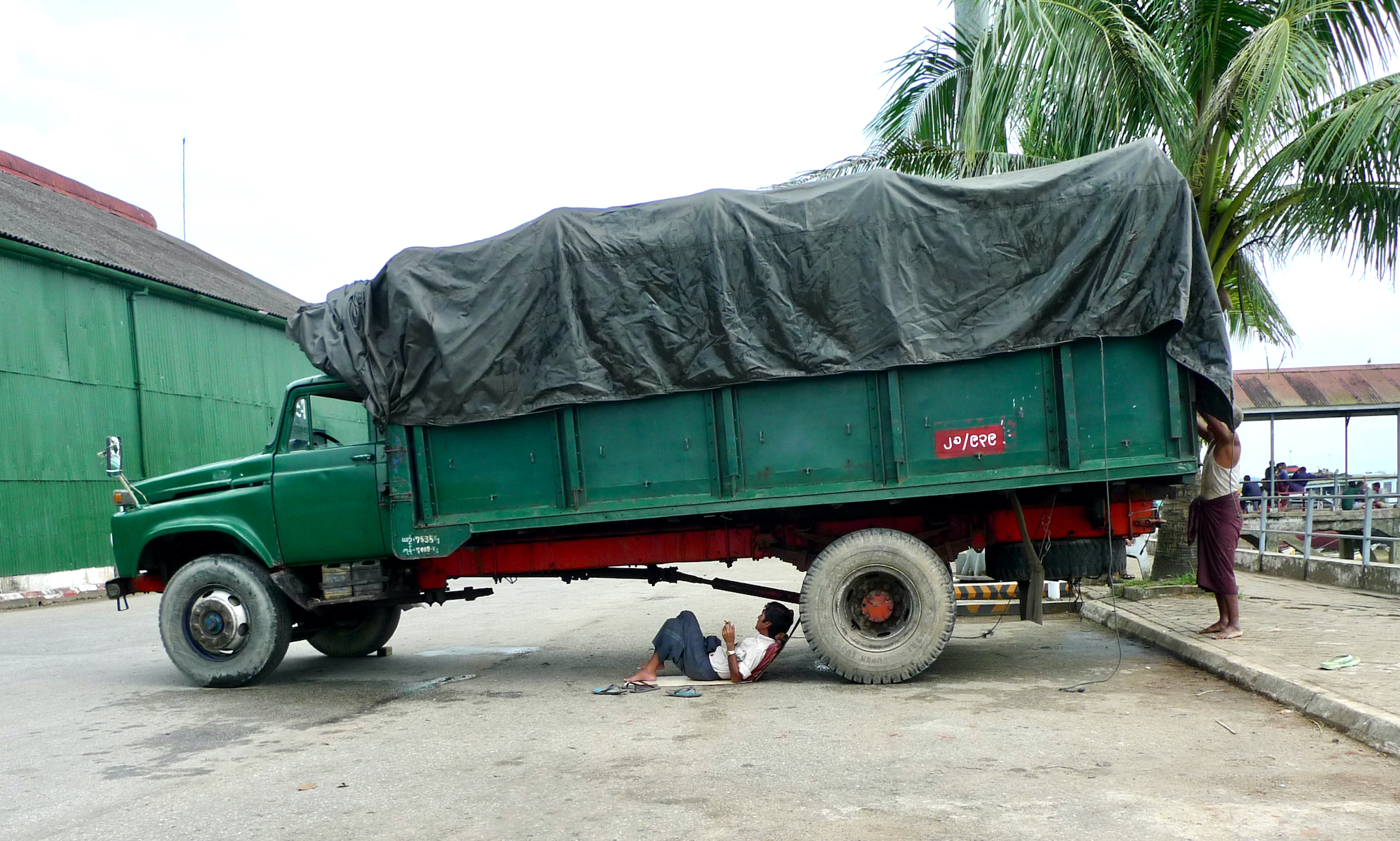
    C- Yangon jetties L1000614 copyWaiting for cargo. Yangon docks.


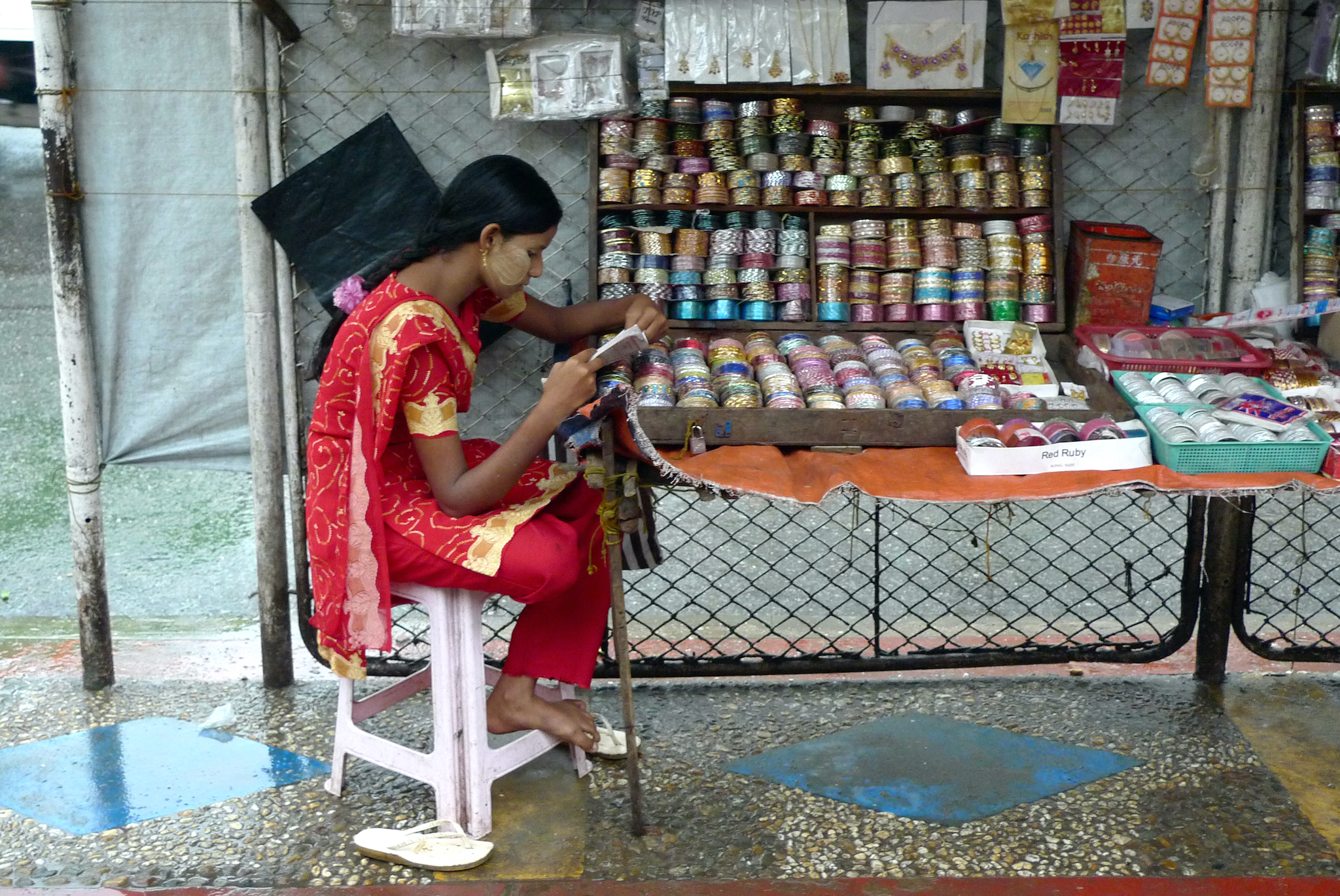
    D- Shwedagon L1010036 copyShwedagon Pagoda, Yangon. Her family runs a retail shop.


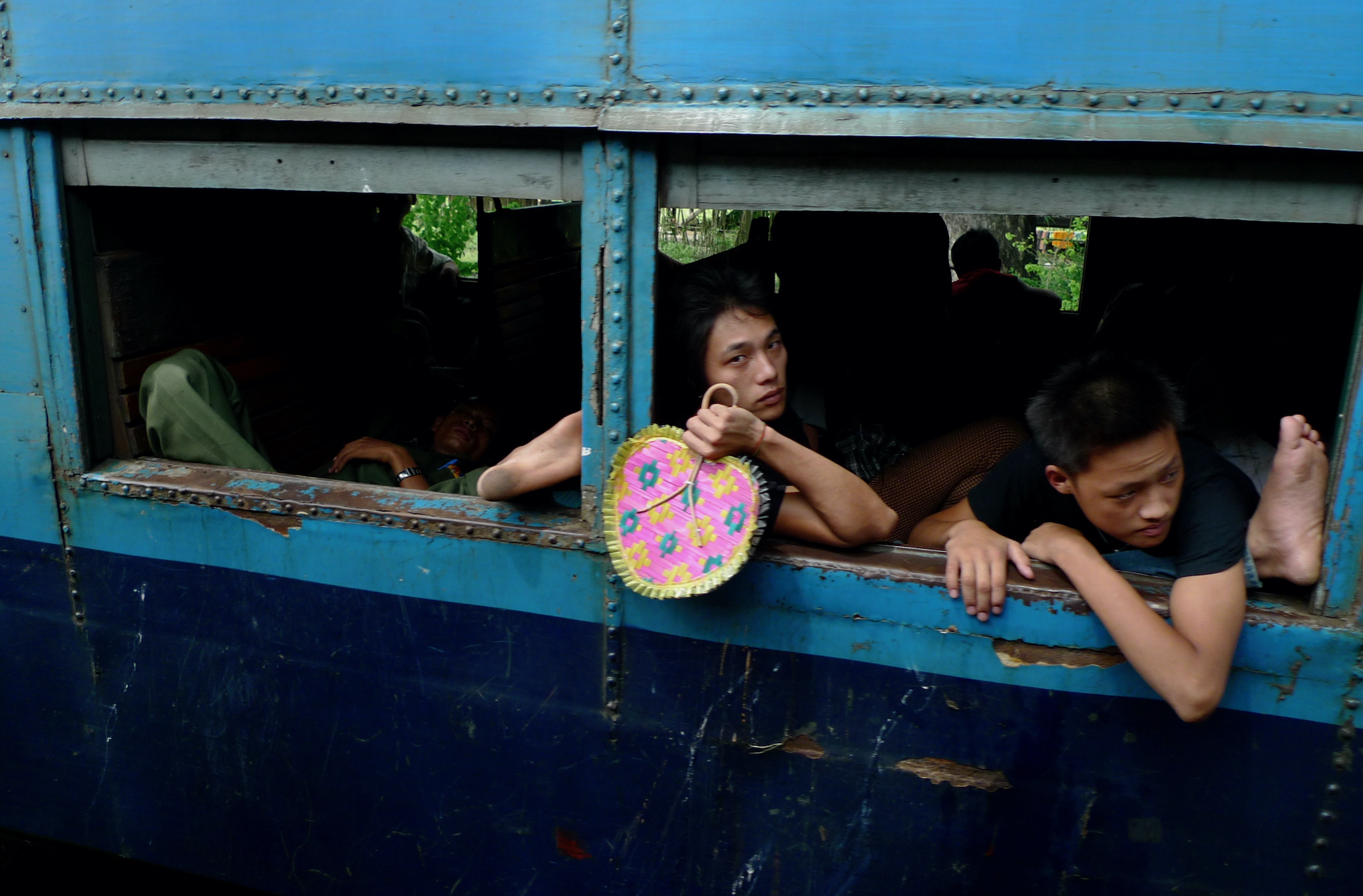
    E- to Mawlamyine L1010634 copySouthbound train to Mawlamyine, formerly Moulmein.


    E1- Mawlamyine Yangon L1000930 copyMawlamyine to Yangon


    E2- Kachin State L1010638Kachin State


    E3- between Yangon and Mawlamyine L1000900 copyBetween Yangon and Mawlamyine, Mon State.


    E4- Kachin State Bhamo L1010633Bhamo Township, Kachin State


    F- Merchant Rd L1000652 copyMerchant Road, Yangon


    G- Confluence L1000557 copyConfluence of the Irrawaddy, Mali and N’Mai rivers, Myitsone, Kachin State.


    H- Myitsone Pagoda L1000569 copy 2Myitsone Pagoda. A planned dam will leave the ancient pagoda and many villages under water.


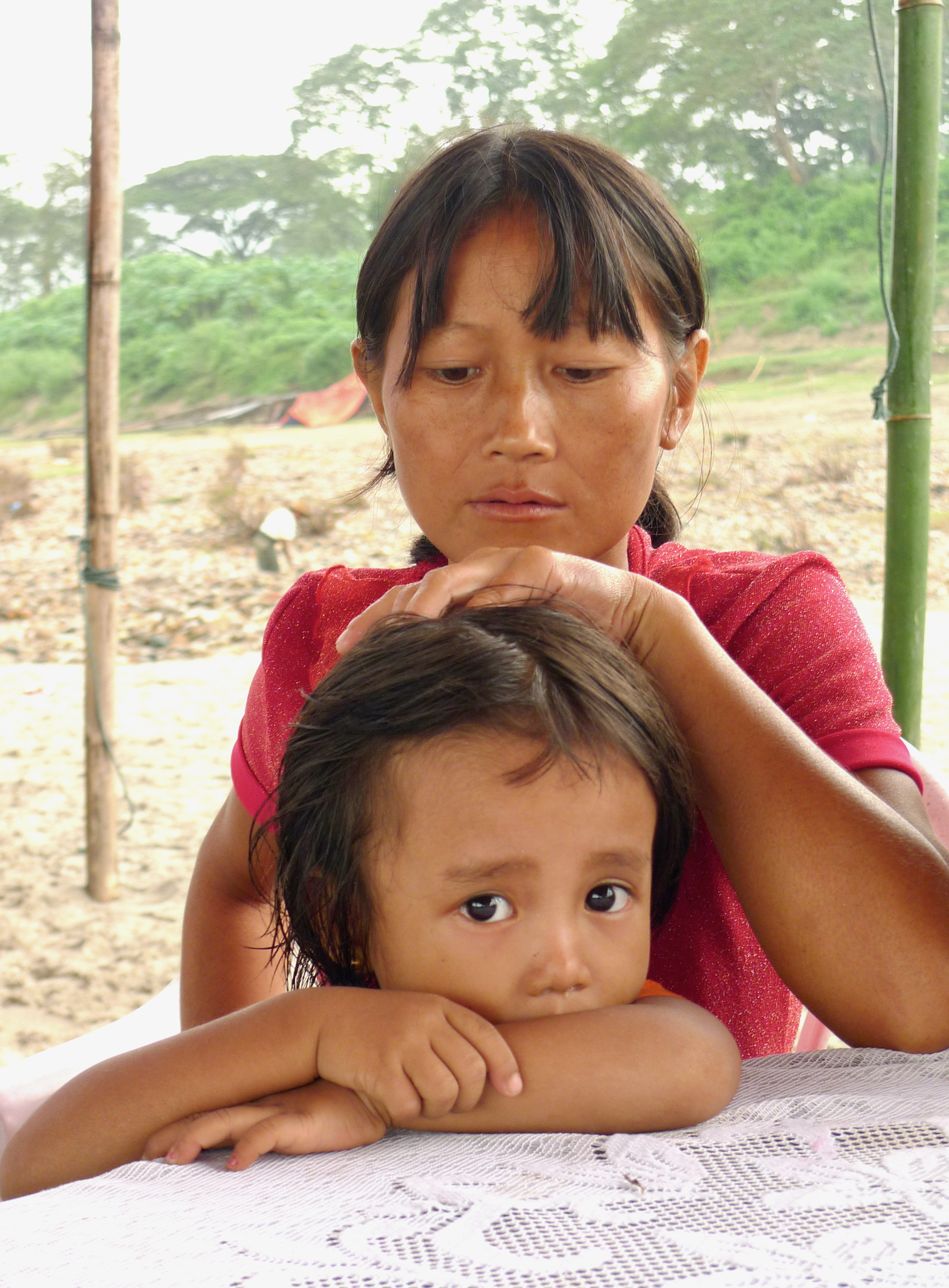
    H1- Confluence restaurant owner L1000546 copyA riverside restaurant owner and a friend’s daughter on the beach. The Irrawaddy confluence is a major national tourist attraction. Shops offer fresh grilled fish, cold beer and the smell of clean river water. Even in 2010 business had fallen off due to fighting in Kachin State. As the war intensified, most shops closed.


    I- Thanbyuzayat L1000781 copyThanbyuzayat, Mon State. A father watches his son get a haircut before becoming a novice monk.


    J- Shwedagon L1010007 copyShwedagon Pagoda


    J1- Shwedagon L1010016 copyShwedagon Pagoda


    J2- Shwedagon L1010028 copyShwedagon Pagoda


    J3- Shwedagon L1010001Shwedagon Pagoda


    J4- Shwedagon L1010062 copyShwedagon Pagoda


    K- Yangon L1000452 copyThese backstreet Yangon kids asked me to take their picture. I didn’t pose them; this is how they arranged themselves.


    L- Kachin State  L1000576 copyShe and her family have farmed along the Irrawaddy for generations. Many farmers have been forcibly displaced for the hydro dam projects. She served sliced pomelo dusted with fiery Kachin chilies, and anticipated my reaction.


    M- Yangon sidecar L1000650 copy

    Sidecar drivers wait for customers near the Yangon waterfront.


    N- Yangon ribbon L1020100Downtown Yangon during monsoon.


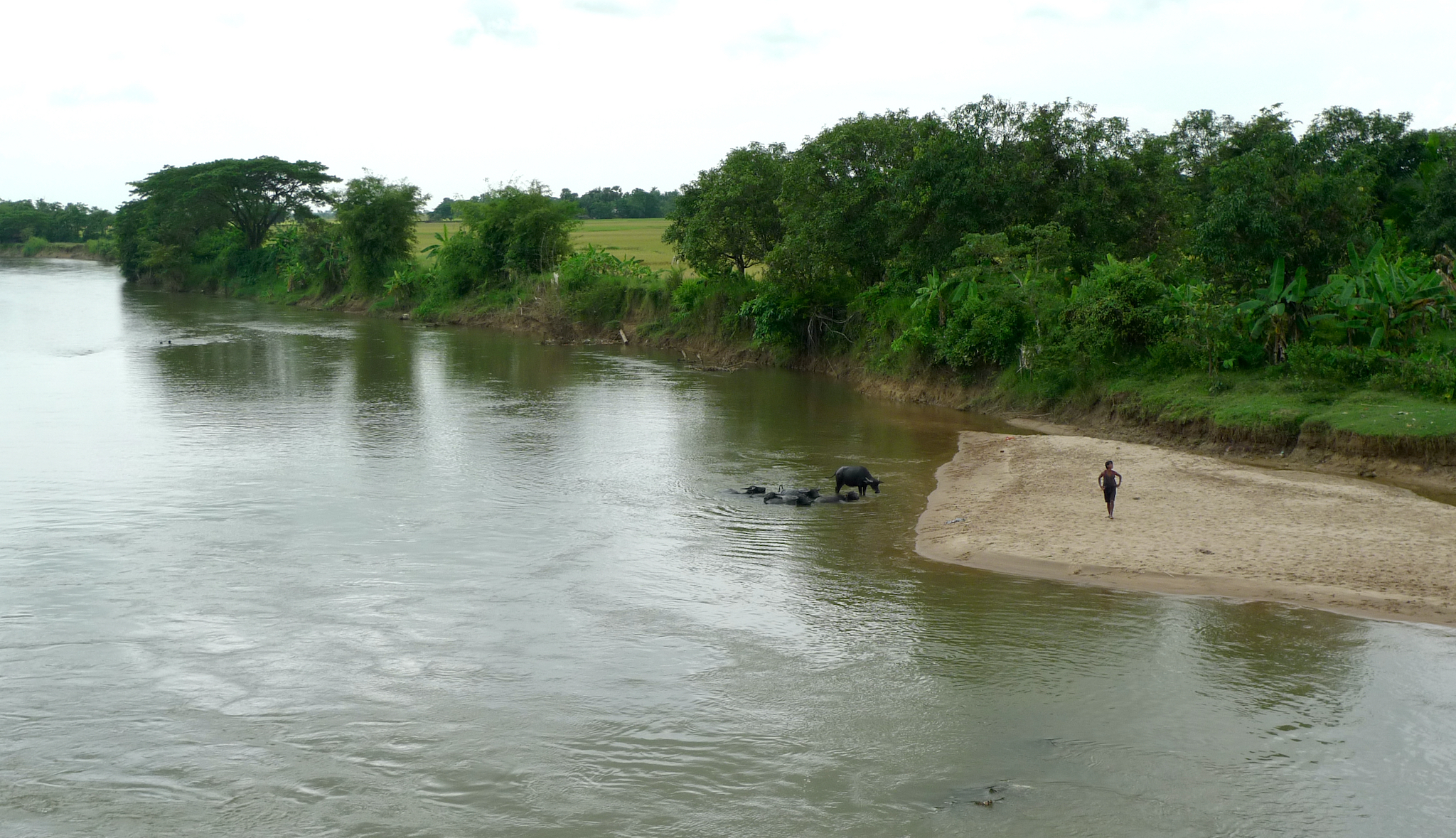
    O- Sittang River nr Waw L1000740 copyThe Sittang River, close to where British forces blew the original bridge in February 1942.


    P- Yangon jetties L1020023 copyOffloading cargo at the Yangon jetties.


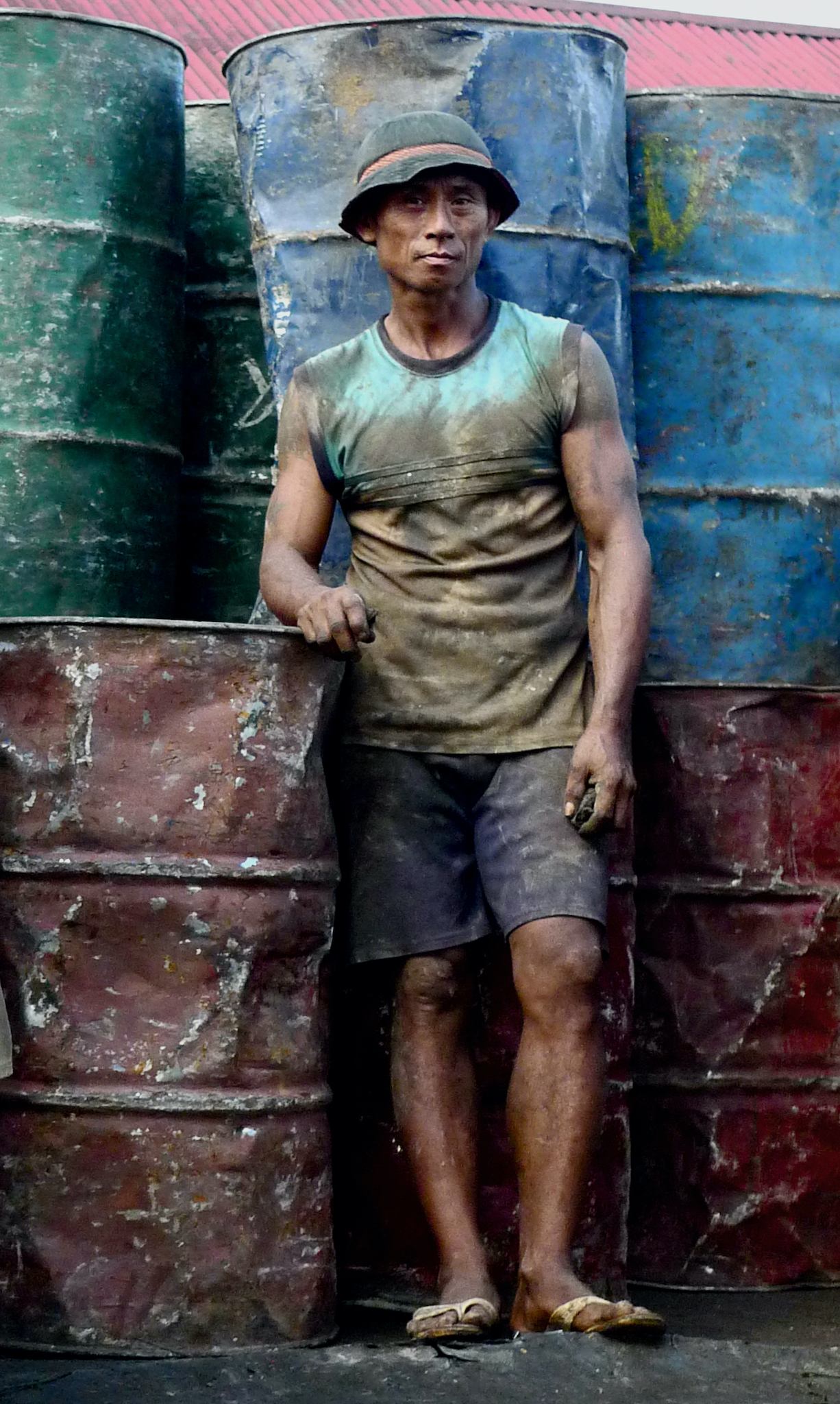
    P1- Yangon jetties L1020036 copyThe barrels contained a tar product. It took four men to lift one.


    P2- Yangon jetties L1020053 copy


    P3- Yangon jetties L1020040 copy


    P4- Yangon jetties  L1020047 copy


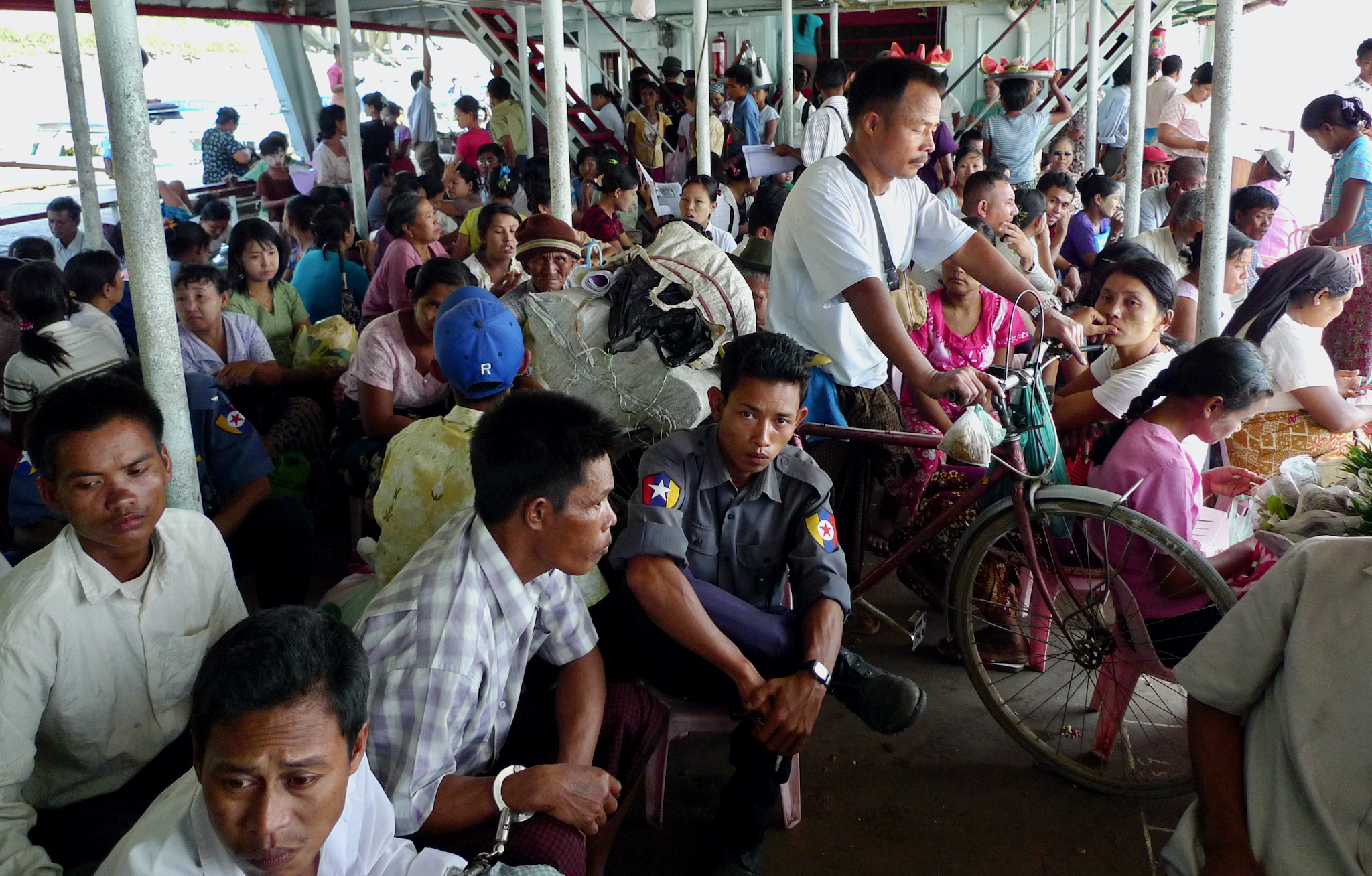
    P5- Yangon ferry L1010924 copyOn board a Yangon River ferry.


    P6- Yangon river L1010906 copyWaiting to cross the river after shopping in Yangon.


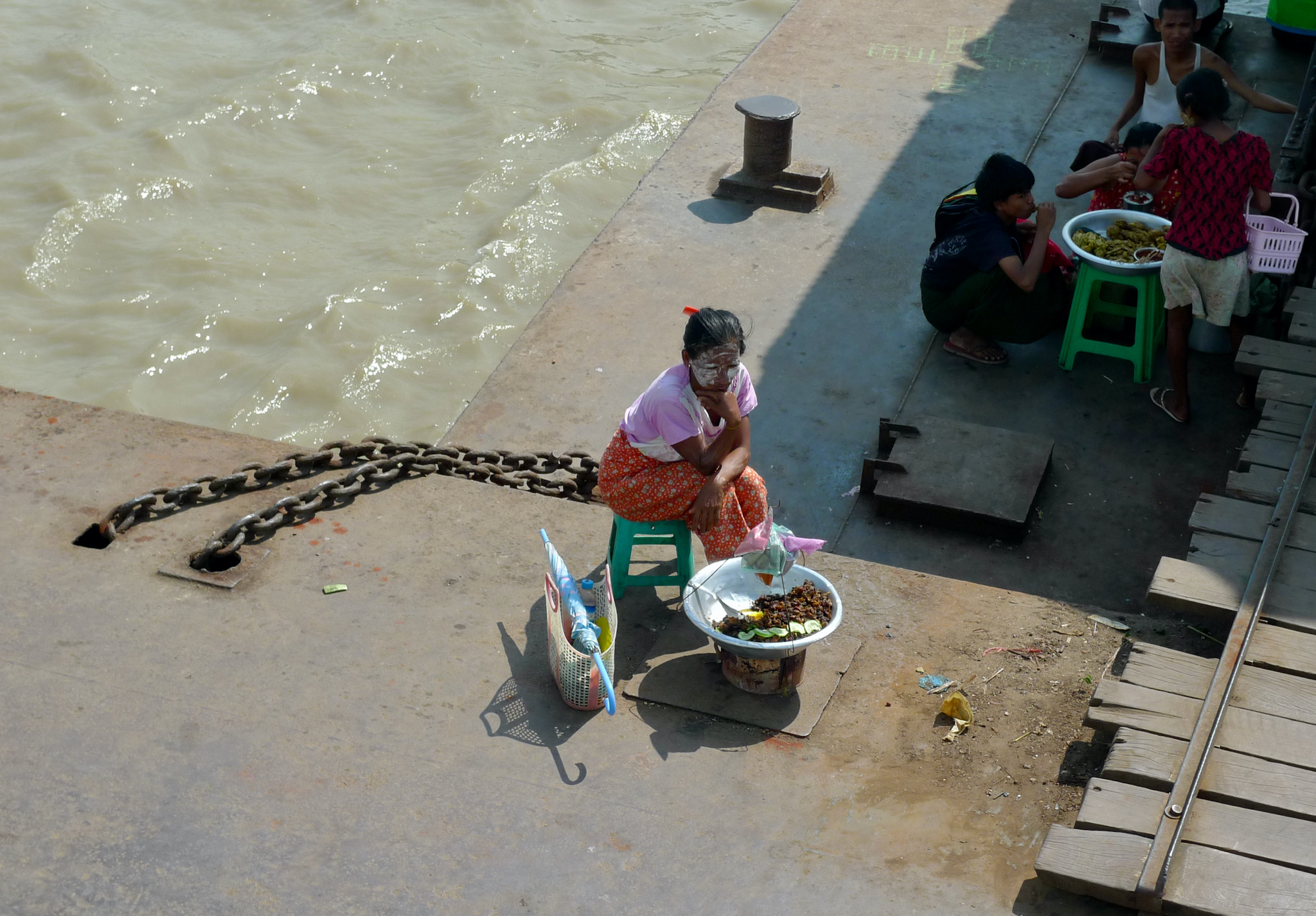
    P7- Yangon River L1010148 copySnack sellers on the quay.


    P8- Yangon river ferry  L1010100 copyThe ferry from Yangon to Dala.


    Q- Near Waw L1000705 copyNear Waw, Bago district.


    R- Mawlamyine YGN L1000909 copyMawlamyine to Yangon train, with his granddaughter.


    S- nr Lashio NSS L1010671 copyFarmworkers near Lashio, Northern Shan State.


    T-Kachin state L1000505 copyNorthern Kachin State


    T1- Kachin State L1000510 copyNorthern Kachin State


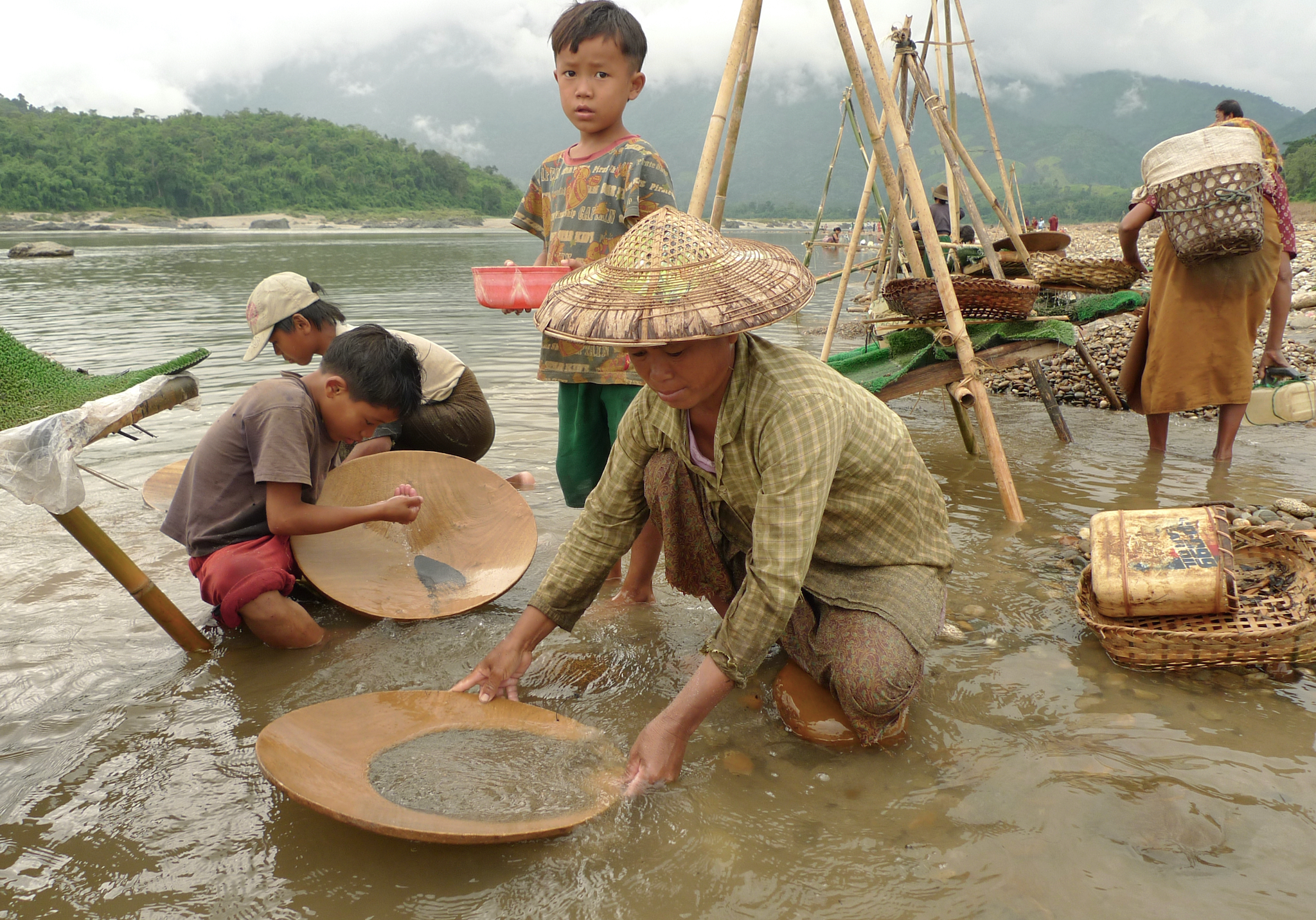
    U- Confluence L1000527 copyPanning for gold on the Irrawaddy, Kachin State.


    U1- Confluence  L1000523Panning for gold on the Irrawaddy at Myitsone.


    U2- Confluence L1000529 copyWashing ore on the Irrawaddy, standing in the river in the rain with a bad cold.


    V- Waimaw L1010548 copy

    Near Waimaw, Kachin State. The area is rich in gold, jade and poppies. Fighting continues between the Myanmar forces and the Kachin Independence Army, with regular casualties, destruction of villages and massive displacement of civilians.


    W- nr Waimaw L1010531 copyCrossing a river east of Waimaw. Fighting and shelling have driven tens of thousands into camps for the displaced.


    X- Northern Shan L1010797 copyThree generations of a family in Northern Shan State. They had been trying to finish their home but were repeatedly driven out by fighting in the area.


    X1- Northern Shan L1010799


    X2- Northern Shan L1010802


    About the Author 

    Philip C. Winslow has been a journalist for fifty years; he has worked for the Christian Science Monitor, the Toronto StarMaclean’s Magazine, ABC Radio News, CTV News, and CBC Radio. He also served in two United Nations peacekeeping missions and spent nearly three years living in the West Bank. He is the author of Victory For Us Is to See You Suffer and Sowing the Dragon’s Teeth.

  • By Jonathan Rosenblum

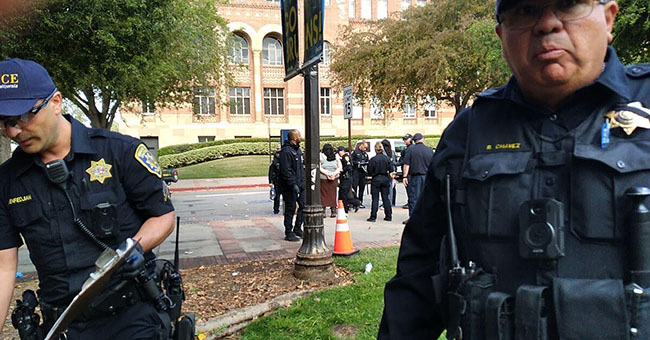
    LAPD arresting student protestors the day after they raided the student encampment, UCLA, 2 May 2024

    LAPD arresting student protestors the day after they raided the student encampment, UCLA, 2 May 2024. Photo credit: Darlene L, Matt Baretto

    This article appeared originally in The Nation.

    This spring’s university encampment protests represented a welcome step up in the Palestine solidarity movement. Now, as students leave campus for the summer, their activism is spawning a further escalation—one that holds tremendous promise for the US anti-war movement: worker strikes.

    This week, 48,000 University of California (UC) workers—postdocs, graduate student researchers, and teaching assistants—began a rolling strike in response to the violent police crackdown on pro-Palestinian campus students and workers. On Monday, 3,000 union members at UC Santa Cruz walked out of classrooms and research laboratories and onto picket lines. Today, May 23, Union leaders announced that beginning next Tuesday, more than 10,000 workers at UCLA and UC Davis will begin to strike as well, and other workers in the 11-campus UC system will soon follow.

    Mass anti-war street demonstrations seek to disrupt political discourse. But there are very few instances—at least in the United States—of workers wielding the strike weapon to disrupt the war economy. The UC strike could introduce a powerful new strategy to not just resist today’s US support for the Israeli war on the Palestinians but also challenge the US imperialist war machine in the years ahead.

    Two factors will determine whether this new anti-war front succeeds: First, whether UC workers can persuade others to expand the strike strategy to more universities—and even other industries; and second, whether the workers can sustain strikes through the inevitable backlash, which will be particularly brutal precisely because opponents will properly see widespread strike action as a significant threat to their war plans.

    The UC workers—members of UAW 4811—credit the student-led protests for inspiring their union to go on strike. Along with their peers across the country, UC students this spring began building encampments in solidarity with Palestine. The backlash from UC administrators mirrored the repression at Columbia University and elsewhere: mass, often violent arrests of students, graduate workers, and faculty at UC campuses in San DiegoBerkeleyIrvine, and most notoriously, in Los Angeles, where on April 30 police stood aside while a far-right mob attacked the peaceful encampment, shooting fireworks and pepper spray and beating pro-Palestinian students and workers with sticks. Just 24 hours later, as the protesters were recovering from the assault, police swept in and violently broke up the encampment, arresting 209 people.

    “We watched our union siblings beaten by Zionist mobs while the university did nothing, at first,” said Jake Orbison, an English Department graduate student worker at UC Berkeley. Then, by “calling the cops to beat their students a second time,” the UC administration “politicized every UC campus,” Orbison said.

    Last Wednesday, police from at least 23 different Orange County police departments assaulted the UC Irvine pro-Palestine encampment. They beat dozens of protesters, including History Department graduate student worker Mark Gradoni, who spent the night in jail alongside National Lawyers Guild legal observers, a journalist, faculty, and others who had been seized in the police riot. “It’s surreal to be at @UCIrvine, my workplace & intellectual home, to attend my friend’s dissertation defense and then be attacked, beaten, and jailed because members of our academic community hung a banner in the memory of the late [assassinated Palestinian human rights activist] Alex Odeh,” he tweeted the next day.

    In the wake of the police crackdown, the UAW filed a series of unfair-labor-practice charges against the university, detailing how it violated the members’ legal and contractual rights when it attacked and arrested union members alongside others protesting peacefully.

    The union demanded that the university provide amnesty for all protesting UC workers, students, and faculty; commit to the right to free speech and political expression on campus; divest from weapons manufacturers, military contractors, and companies profiting from Israel’s war on Gaza; disclose all funding sources and investments; and, most ambitiously, give research workers transitional funding to opt out of projects tied to the US military or oppression of Palestinians.

    In a series of strike authorization votes last week, nearly 20,000 UAW 4811 members statewide voted 79-21 percent in favor of striking.

    Contemporary strikes in America usually focus on the traditional union contract topics of “wages, hours, and working conditions.” In this strike, the UAW members are pointing out that police violence, the suppression of speech, and the university’s role in the war economy are integrally tied to working conditions; solidarity with Palestinians half a world away starts with defending your own rights at work.

    “When we’re fighting for wages, it’s about who has access to the university. Right now, our fight is about our right to political speech and protest, which goes to the heart of our rights as workers,” said UAW 4811 President Rafael Jaime, a graduate worker in the UCLA English Department. Workers elsewhere should take note of this expansive understanding of union rights.

    UC leaders were quick to call the action “illegal.” But the UAW members appear undeterred by these employer threats. As education workers in the #RedForEd movement of recent years know well, the go-to union-busting move for employers facing a powerful strike is to declare it outside the law. Indeed, the declaration of illegality by employers is simply proof of workers’ tremendous strike power.

    Observers outside the university setting may be skeptical that graduate student workers and postdocs striking for Palestine will have much economic impact. What does the ivory tower have to do with the Pentagon or the Israeli assault on Gaza?

    Quite a lot, as it turns out.

    In 2021, the Department of Defense (DoD) gave a staggering $7.36 billion in research grants to 454 different colleges and universities. Last year, the University of California accepted $333 million from the DoD; the University of Texas at Austin, $191 million; the University of Southern California, $126 million; Columbia University, $49 million; Northeastern University, $33 million. These grants weren’t just for engineering programs and the hard sciences. Hundreds of millions of dollars in DoD grants went to math, psychology, and other social science departments. And those figures are likely a vast understatement of the war economy’s iron grip on higher education—they do not include grants from other federal agencies, outside of the Pentagon, that have military applications.

    “People think about academic workers as somehow being removed from the supply chain of war production,” said Sarah Mason, a UC Santa Cruz graduate student worker. “The reality is that universities are a research arm of the defense industry. Millions and millions of dollars flow into laboratories on campuses across the UC, across the country. And this money is directly funding research that supports the war and occupation, not just in Palestine, but US imperialism around the world.”

    Much of this military grant money gets obscured in “dual-use research,” which Isabel Kain, a graduate student worker in the UC Santa Cruz Astronomy Department, described as “research that has an obviously weaponizable threat, but also could be put to positive use in society,” such as medical and biological research. In the past, Kain said, many university researchers avoided confronting basic questions about their role in the war economy: “My research is my research and what other people do with it is not my problem.”

    But the Israeli mass killings of Palestinians and universities’ violent reaction to the anti-war movement have changed the calculus for thousands of UC scientists, Kain said. “The brutal police crackdown is the thing that’s pushing them over the edge to take collective action,” she said.

    This symbiotic relationship between universities and the military puts higher-education workers in a position of significant structural power. A strike by university workers won’t have the immediate impact of, say, longshore workers blocking a weapons shipment. But over time, and enacted across many campuses, a university workers’ strike could challenge the imperial war machine.

    “We have a unique opportunity—we are workers at an institution that hides its financial interests behind a veil of the pursuit of knowledge, while maintaining its position as a key node in the military industrial complex’s knowledge production,” said Tara Plath, a graduate student researcher in Film and Media Studies at UC Santa Barbara. “We have a role to expose and condemn how business is conducted at the UC, and how its bottom line is prioritized over the safety of academic workers and students alike.”

    Two important developments in recent decades have made this strike moment possible. First is the changing composition of the university workforce. Fifty years ago, more than three-quarters of university faculty were tenure or tenure-track. Today, under the influence of increasing corporate control, universities have flipped those numbers: Some 75 percent of college classroom teachers are precariously employed as “adjuncts”—lecturers or graduate teaching assistants with no long-term job security. Laboratories, too, are dominated by graduate student workers and postdoctoral scholars. And increasingly, universities are turning to undergraduate workers to teach their peers, lead course sections, and do lab work.

    The second development is that these workers—very highly trained, but just as precariously employed as Uber drivers or Amazon warehouse workers—did what comes natural to workers in exploitative circumstances: They banded together for self-defense.

    In the last decade, more than 120,000 graduate and undergraduate workers across the US organized into unions, with more than 100,000 of those workers organizing in just the last three years, according to Joseph van der Naald at the City University of New York. Thousands more faculty—more than 8,200 last year alone—also formed unions during this period. In these new unions, workers have wasted little time in exercising their strike muscles. In the last year, there have been at least 18 higher education strikes, involving as many as 29,000 workers at a time, according to Cornell University’s Labor Action Tracker project. The UC workers now on a rolling strike know what it takes to run a picket line, having struck for six weeks in 2022.

    None of this potential for worker strikes would have been possible during the last major anti-war upsurge, following the 2003 US-led invasion of Iraq. Veteran union organizer Gene Bruskin, one of the founders of US Labor Against the War, recalled the uphill battle just to get unions on record opposing the war. “We had to crank it out local by local, resolution by resolution, taking it into the national unions, organizing all the different entities to bring things to the floor. And that took months and months, and in some cases years,” he said.

    Today, with university workers organized into unions, the opportunities are much greater. Yet none of the UC workers I spoke with in the last week seemed to be under any illusion about the scale of the challenge. They are going up against not just hostile university administrations but also big business leaders who are lobbying for severe crackdowns on the movement, a Biden White House that shamefully has denounced the protesters, and Israeli government leaders who are pledging to bring a new McCarthyism to US college campuses.

    The student-led encampments have been organized admirably, but “organizing a strike is something of a different prospect,” said Jack Davies, a graduate worker at UC Santa Cruz. “A relatively small and coherent portion of the student body can drive a successful encampment and reach advanced positions on messaging, demands, platforms, etc. When you’re trying to organize a strike, you need a far broader commitment from the body of workers.”

    Yet, Davies said, UAW 4811 members on the UC campuses seem determined to accept that challenge. “It’s crucial that we punch back right now, that we actually fight back, because workers across this country are getting the shit kicked out of them on this issue,” he said. “They’re getting fired, they’re getting arrested, even beaten. We’re seeing this in all kinds of sectors. And I think an example of a genuine fightback by organized labor in any sector is critical now, one that shows workers everywhere, in this moment, that the boss can’t have it all their way. What exactly is possible in our strike, and where it might lead in terms of winning real demands and setting precedents over disclosure, divestment, and transitional funding, is hard for anyone to say right now. I only know we have to hit back.”


    About the Author 

    Jonathan Rosenblum is the author of Beyond $15: Immigrant Workers, Faith Activists, and the Revival of the Labor Movement (Beacon Press, 2017) and a member of the National Writers Union.

  • By Leigh Patel

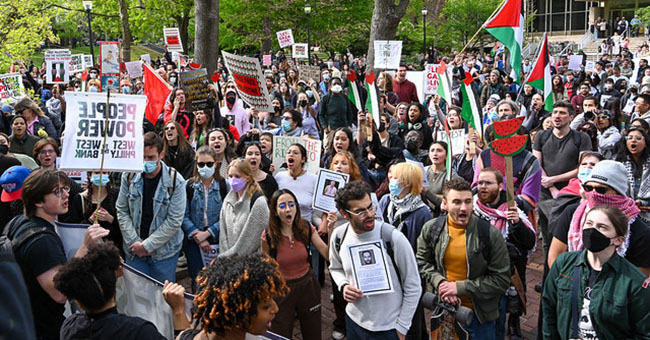
    Hundreds of Temple, Drexel and UPenn students marched in solidarity with Palestine to UPenn's campus on April 25, 2024, where professors walked out of classes. Students also set up tents in solidarity with the Columbia University student encampment.

    Hundreds of Temple, Drexel and UPenn students marched in solidarity with Palestine to UPenn's campus on April 25, 2024, where professors walked out of classes. Students also set up tents in solidarity with the Columbia University student encampment. Photo credit: Joe Piette

    Mainstream media’s coverage of the campus-based student protests and encampments across the globe primarily addresses the ‘need’ to use law enforcement, including university police and politicians’ calls for National Guard. Armed with riot gear which does not include mace, batons, firearms, or metal or rubber tie handcuffs, this armament has been firmly in place long before this student mobilization. Through phones and social media, the world watches as students’ encampments are forcibly assaulted and police officers, municipal and university, use blunt force to remove students and faculty from these sites of protests.

    With the images of unspeakable yet undeniable violence in Gaza and the horrific use of militarized deployment to destroy every university, hospital, and private home, it might be easy to miss the fact that rigorous study is in every encampment, every faculty group of solidarity, and myriad teach-ins that have been a staple in the encampments. On the contrary, students’ encampments are providing public pedagogy. In the United States, this public pedagogy has supplanted vacuous stories on mainstream media, often leaning into stories that don’t require saying Gaza, Israel, or genocide.

    It is neither new nor revelatory that study has always been a crucial component of struggle. The 1960s movement that led to the creation of Ethnic Studies included regular study groups, now codified as essential curriculum in many states. When Puerto Rican and Black youth, then the dominant population of Harlem and the Bronx, demanded admission to the City College of New York in 1969, they were joined by June Jordan, Adrienne Rich, and Audre Lorde. Students’ study-fueled resistance was supported by students’ protests of the relentless bombing of the US monetary and weapon-fueled attack on Gaza and has been lifted by the presence of faculty. Dr. Ruha Benjamin made public her presence at a sit-in at Princeton University. At University of California, Irvine, Professor Dr. Tiffany Willoughy-Herald held no punches in indicting the funding for police at the expense of students’ monetary support to succeed higher education. When asked if she feared losing her job as she was cuffed and moved from the students’ encampment, Dr. Willoughy-Herald responded: “What job do I have if the students don’t have a future?” Faculty support of righteous student mobilization against the termination of Palestinians peoples, while powerful, is also a response to the rigorous study that students engaged in order to learn from history and create a movement that stems from a resounding silence from universities and punishment of key leaders. Faculty responses haven’t sought its own unique space in this movement, rather they have shown up as teaching and learning in struggle.

    Embodying the potent truth-telling force and commitment to learning without extraction and imperialism, the students’ encampments are a real-time lesson in the fact that the rightful place of study is in struggle.

    Youth, including college students, have been historically dismissed as idealistic, more recently as sensitive snowflakes and subject to ‘woke’ curriculum, which is indicted as creating factions and divisions. Less insulting but still questioning the disruption of students’ mobilization, longtime CNN broadcast journalist Jake Tapper bemoaned to former Brandeis University president, Frederick Lawrence, that the student mobilization has limited Tapper’s coverage of the attacks on Gaza. Lawrence clarified that the student mobilizations are founded in commitment to raise awareness.

    And awareness is not nearly enough for these students. From their study, these students demand divestment from any industries that support Israeli militarism and violence because they have studied universities’ economic investments.  They have indicted the United States for its imperialism and politicians’ demurral from speaking the truth of a genocide happening before us. They have made public how they are treated by campus and municipal police in riot gear as they are simply sitting, encamping, interrupting business as usual, because mass state violence should never be usual. It is poignant and purposeful that this student mobilization has gripped college campuses in many nations, as every university in Gaza has been obliterated. Rather than creating factions, the student encampments are calling for the cessation of silence to protect universities’ coffers and public images. Some divisions are righteous.

    And there is, unfortunately, although predictably, more constricted form of reading, one grounded in search for control. Some university administrators have reviewed and hastily altered university policy to justify counterinsurgency. The day after Indiana University changed its policy on protests, thirty-three protestors were arrested. This is not study. It is, instead, reading and altering text for the sake of self-preserving alteration. As they call for additional force from law enforcement, university administrators use contorted definitions of free speech and safety as a tactic for policing students’ words and policing their thoughts.

    Students’ encampments have been consistent areas of study, led by students, teach-ins led by faculty, and listening sessions from people in Gaza. Lives depend on study. Reminiscent of Ella Baker’s leadership of SNCC, this movement does not need a charismatic leader because it is growing rigorous study in spaces where strong and always learning young people do not need a charismatic leader. Of course, people in this struggle will err in confusing supporting Palestine with antisemitism. This, too, is part of study in struggle. Mistakes will be made, and people learn from mistakes. As writer and educator Carla Shalaby reflected to me: the rightful place of study is in struggle.

    Mainstream media lacks the distinctions among Judaism, Zionism, Hamas, and Palestine, organizations such as Jewish Voices for Peace, choosing instead a false binary of Israel and Palestine. Yet, in the dozens of student encampments across the globe, these distinctions are foundational. It has been the entry point for further, deeper study of imperialism, settler colonialism, and the gendered, raced, and ableist tactics of genocide. It also includes care. Study includes planning for arrest, noting students who are most vulnerable, such as migrant students, will be taken and contained in a detention center, notorious for obscuring traces of detained people. At an encampment at UCLA, seeing that the motorcade of LAPD SUVs pulling up, student organizers communicated quickly to hundreds of protestors guidelines for protecting those who could not risk engagement with law enforcement as well asking those most bolstered through their social position to be the front line. No one was obligated to do this, and there was a plan. The plan existed because they had studied who has the most to lose in confrontation and likely arrest by police in riot gear.

    Ironically, university responses of calling for more cops on campuses has also revealed a clear commitment to the settler colony of the United States and its core commitment: protection of economic and cultural capital. Not learning, not dialogue, not transformation. Capital. On May 13, the University of North Carolina, Chapel Hill’s Board of Trustees voted unanimously to reallocate $2.3 billion from initiatives supporting diversity  to ‘campus safety.’ In an attempt to explain this gutting of diversity and equity education, board member Marty Hotis was clear: “When you destroy property, or you take down the US flag and you have to put up gates around it—that costs money. It’s imperative that we have the proper resources for law enforcement to protect the campus.” It is an astonishing and unvarnished statement that to critique the university, to critique the police is tantamount to critiquing the nation itself. Learning is glaringly absent from what must be protected from university administrators. And the world hears, sees, and senses how student mobilization is met with police action and shifting policies to ensnare them as violators of free speech. The world is watching as free speech is reserved for some and weaponized against many.

    There is a moment in the 2018 film, Black Panther, in which King T’Challa, recently ascended to the throne and responsibility of the protector of Wakanda, is physically and psychologically interrogating a thief of vibranium on busy streets of Busan, South Korea. King T’Challa is cautioned by his elite guard: “King! The world is watching.” T’Challa steps away, presumably because the world watching a decontextualized moment of force and threat would too easily criminalize a Black nation already cast as underdeveloped and savage. I am reminded of this scene as I reflect, daily, on how the world is watching unfettered destruction of Gaza and the discipline and punishment delivered to university students’ mobilization to defend Palestinians. Students have been calling for the attention that slowed King T’Challa. They have decried genocide and made explicit the implications of universities and colleges that are both financially invested in Zionism and the US-based militarized police force that is the dominant response to their protests. I hope, as daily horrors persist, that the world is also learning from these students that the rightful place of study is in struggle. Universities have a thing or two to learn from their actions with student protestors.


    About the Author 

    Dr. Leigh Patel is an interdisciplinary researcher, an educator, a writer, and a professor at the University of Pittsburgh. She works extensively with societally marginalized youth and teacher activists. She is an elected member of the National Academy of Education. She has been involved in organizing for educational justice and labor rights. Patel is a recipient of the June Jordan Award for scholarly leadership, and the Inaugural Advocacy Award for the journal, Equity and Excellence in Education. She is the author of Youth Held at the BorderDecolonizing Educational Research, and No Study Without Struggle. Connect with her on Twitter at @lipatel.

  • By Alexander Kriss, PhD

    Woman pondering

    Image credit: Chenspec

    Matthew, a twenty-year-old man I’d worked with in individual psychotherapy for a few months, began a session saying he was in crisis. “I think I’m a narcissist,” he told me. “I’m terrified of it.”

    I asked Matthew why he thought this. He said the night before he had, after much agonizing, confronted his boyfriend, Patrick, about his controlling behavior: Patrick decided when they socialized and with whom; he required advance approval of any expenses related to the apartment they shared; he discouraged Matthew from engaging in any interests that did not help to “build the relationship,” especially Matthew’s longtime passion for oil painting.

    “Then Patrick told me that, by bringing this up, I was trying to control him,” Matthew said. “He said I was using guilt to get what I wanted, which he said was worse than anything he had done because all of his rules were completely rational.” Matthew put his head in his hands. “And I couldn’t . . . I see how he flipped the conversation around on me, but I couldn’t really deny that what he was saying was true . . .” He looked up at me with desperate, searching eyes. “Is it true? Am I a narcissist?”

    Despite a pantheon of personality disorders listed in psychiatric diagnostic manuals, only two are commonly used by mental health professionals today: borderline personality disorder (BPD) and narcissistic personality disorder (NPD). The “borderline” and “narcissistic” stereotypes are also well-known in public imagination: the former calls to mind a wild woman who manipulates others through seduction and threats of suicide, the latter a grandiose man who will happily step on another person’s neck in order to get what he wants. This gendered split is not a distortion of the aforementioned diagnostic manuals, but a reflection of how doctors use them. One longstanding datum in the Diagnostic and Statistical Manual for Mental Disorders (DSM)—the premiere such manual in the United States—shows that 75% of all people labeled as “borderline” are women, while 75% of all people labeled as “narcissists” are men. It was fitting, then, that Matthew—whom I had diagnosed with BPD—had come to session worried that NPD was the more accurate label.

    What the DSM does not attempt to show is why this uncanny divide exists. Like other modern manuals of mental disorder, the DSM defines diagnosis by clusters of symptoms, without any theoretical discussion of what causes them or why. This can lead to the erroneous assumption that the information it presents—such as discrepancies in rates of diagnosis between men and women—is biological fact, rather than something influenced by culture or the diagnostic manuals themselves.

    The truth is, what we call BPD and NPD are two ways a person might deal with the same core issue of being forced to grow up in a confusing, chaotic, or invalidating environment. Borderline and narcissistic adults come from similarly troubled origins but, starting in childhood, are treated differently. The one who grew up to adopt a borderline organization was called worthless; she was hit for being disobedient, perhaps, or praised for being beautiful enough to one day ensnare a rich husband—that is, as an object for someone else to possess. The future narcissist was perhaps called a prodigy and forced into public, competitive spaces despite expressing no inherent interest in them; he was praised as strong for his cold-heartedness, berated as weak when he cried.

    Psychologists, particularly those of us trained in a psychoanalytic tradition, have long understood that individuals with BPD and NPD feature certain commonalities: both struggle with managing powerful, negative emotions; both rely on splitting the world into good and bad. But where the borderline often casts herself as bad to preserve the goodness of others—on whom she relies for validation that she is real and alive—the narcissist organizes his internal world so that he is always good, the outside world always inadequate and unappreciative. The narcissist can appear better adapted to the world than the borderline, as he possesses a self-idealization that could be misconstrued as confidence. But beneath the brittle surface lies a tumult that, when put under pressure, can compel him into strange and harmful behavior.

    People organized around narcissistic defenses are afraid more than anything of vulnerability, of being seen as weak, which makes the therapy situation inherently unappealing to them. They are driven to point out ways they are smarter than the therapist or already knew what the therapist is going to say. Borderline patients like Matthew, on the other hand, could be described as pathologically vulnerable, porous to the point of diffusion, and their reliance on others for cohesion means that they are excellent candidates for a relationship-based treatment like psychotherapy—but also that they can be easily confused or manipulated. I treat NPD in my practice, though most often I encounter it as with Matthew: listening to a patient with BPD talk about a narcissistic partner, parent, or sibling. The two personality organizations tend to gravitate toward each other, a toxic magnetism. One person seeks definition, the other seeks to define; the borderline wants to love even if it hurts, the narcissist wants to wield power even over someone he loves.

    Matthew and I discussed this dynamic. That night, he had a long conversation with Patrick, which he relayed to me at our next session.

    “I described the way we feed into each other. I ask Patrick to tell me what to do, he happily tells me, then I confuse his orders for my own thoughts. I told him that I was borderline for the first time. I’m still confused about what happened next. Something changed in him, like I’d made him angry. I explained a bit about the diagnosis. I said I was susceptible to him telling me what I am, like that I’m controlling or narcissistic, and also that it was related to stuff from early childhood. And he flew into a rage, shouting, ‘What even happened to you that’s so bad?! I could tell you things that would make your heart turn to ice.’”

    Matthew hadn’t known what to do. He didn’t want to invalidate Patrick or turn the conversation back to himself—fuel for Patrick’s charge that Matthew was the true narcissist. I suggested that Patrick may have felt threatened by Matthew’s BPD diagnosis: it made Matthew special in a way that Patrick could not bear. Moments like this show how narcissism is not a pleasant way of living, filled with self-love and confidence—it is a frantic struggle to always be on top, even if that means waging a contest for who is the most ill.

    I’ve treated borderline men and narcissistic women—individual circumstances can always overwhelm larger cultural forces. But there is a gendered split to these pathways, the same split found across so many aspects of life. Unfortunately, no edition of the DSM has dared broach the idea that these conditions represented two ways a person might resolve the same core problems according to the strictures of a sexist society. Suffering is not only something we inherit; it is actively shaped by the world around us—our family dynamics, our expectations of what men or women are supposed to be like. Healing, if it is to be effective, must also adapt to evolving understandings of identity development and mental health. This includes a willingness to shed gendered clichés and consider what is truly going on underneath a given diagnostic label, and how that person—and that label—came to be that way.


    About the Author 

    Alexander Kriss, PhD, is an assistant clinical professor of psychology at Fordham University, director of the Fordham Community Mental Health Clinic, and author of The Gaming Mind and Borderline: The Biography of a Personality Disorder. His private psychotherapy practice is based in Sleepy Hollow, NY.

  • By Frederick S. Lane

    United States Postal Service (USPS) Chevy Express

    Photo credit: Jason Lawrence

    In my previous post, “The Napoleon of the Mailbags,” I talked about the enthusiasm of Christian nationalists for a re-invigoration of the 1873 Comstock Act. In the view of zealots like US District Court Judge Matthew Kaszmyrak (D. 19th Cent.), the law's long-dormant prohibition against the mailing of “(e)very article or thing designed, adapted, or intended for producing abortion” amounts to a national ban of mifepristone and misoprostol, the two medications most commonly used to induce abortion.

    After hearing oral arguments in Alliance for Hippocratic Medicine v. FDA on March 26, 2024, SCOTUS is weighing whether or not to uphold Judge Kaszmyrak’s decision. The high court’s opinion most likely will be issued at the end of June or in early July 2024.

    Even if the Court rules in favor of the plaintiffs, that does not necessarily mean that mifepristone or misoprostol will be banned from the mails. For more than 100 years, despite the language of the Comstock Act, federal courts and the US Postal Service have upheld the mailing of contraceptives or abortion-related items so long as there is a legally-permissible use of such items in the destination state.

    The Biden administration supports that position. In a December 2023 memo, Assistant Attorney General Christopher H. Schroeder concluded that 18 U.S.C. § 1461 (the statutory location of the Comstock Act) “does not prohibit the mailing, or the delivery or receipt by mail, of mifepristone or misoprostol where the sender lacks the intent that the recipient of the drugs will use them unlawfully.” Since both mifepristone and misoprostol can be used for a variety of purposes other than abortion, Schroeder said, a shipper of the drugs may not intend to break the law even if the drugs are shipped to a state that prohibits their use to induce abortion. For the sake of thoroughness, Schroeder also listed seven other legal theories that could protect mail delivery of these drugs.

    Courts and administrations can change, of course, so there are at least two scenarios in which the USPS might be required to prohibit the mailing of abortion drugs.

    First, if asked, SCOTUS could overrule more than a century-plus of precedent and declare that even if abortion drugs can be used for other legal purposes, the language of the Comstock Act prohibits sending them through the mail. A year ago, I would have said it was very unlikely the Court would arbitrarily reverse such a long-standing interpretation of the statute. But like so many others, I underestimated the depths of the majority’s hostility to abortion in particular and women in general.

    Second, a hostile Congress and administration could join forces to specifically criminalize the drugs themselves. Among its myriad other assaults on abortion, the Heritage Foundation’s Project 2025 Mandate for Leadership calls for the Food & Drug Administration to reverse its approval of both mifepristone and misoprostol. Alternatively, Congress could adopt legislation that bans the drugs outright. (Louisiana, for instance, is considering legislation that would add both mifepristone and misoprostol to the state’s list of “controlled dangerous drugs.” Anyone caught possessing one or both drugs without a prescription could be imprisoned for up to ten years; a possible exception, however, may be added for pregnant women planning to use the pills to end their pregnancy.

    Let’s assume that one (or even both) of those scenarios occurs. It would then become a federal crime to mail abortion drugs, punishable by imprisonment for up to five years for a first offense and up to ten years for each succeeding offense. Mifepristone and misoprostol would join the long list of things that the USPS works aggressively to interdict each day.

    “Mail Cover” Investigations 

    For the time being, at least, the privacy of first-class mail is well-established. Under the principles of the Fourth Amendment to the United States Constitution, postal employees are required to obtain a search warrant from a judge or magistrate before opening a letter or package. Criminals, of course, are aware of that, which is one of the reasons that so many risk using the US mails to ship drugs and other types of contraband.

    As many currently incarcerated drug dealers could tell you, the warrant requirement for opening first-class mail does not prevent US postal inspectors from investigating criminal activity. Over the decades, the USPS has developed a variety of tools and techniques for identifying potential suspicious packages and establishing the probable cause necessary to obtain a search warrant. All these techniques (and more) could be deployed to stop the shipment of abortion drugs.

    One investigative tool, the so-called “mail cover,” dates to 1893, when Anthony Comstock was serving as a special agent for the Postal Service (although there is no evidence that he was involved in its implementation). The concept of the “mail cover” is simple: whenever someone is suspected of using the mails for criminal purposes, postal service employees or other law enforcement officials can request that the USPS create a record of any information on the exterior of mail sent to that person. Much like public social media posts or garbage cans on the sidewalk, courts have held that postal customers have no expectation of privacy in what is written on the outside of first-class mail that they send or that is sent to them.

    The information generated by a “mail cover,” particularly if collected over a long period of time, can be very useful in criminal investigations. A return address, for instance, might foolishly reveal the actual source of the contraband. Handwriting might confirm another suspect’s involvement. The look and feel of multiple packages can help postal inspectors develop a “profile” for possible shipments of contraband. The list of possible evidence goes on and on.

    The use of “mail covers” by the USPS was largely unknown to the public until the early 1950s, when allies of Senator Joseph McCarthy (R-Wis.) discovered that his mail was being monitored as part of an investigation into alleged financial improprieties. A decade later, “mail covers” again generated headlines during an extensive examination of ongoing government surveillance of American citizens. Led by Senator Edward V. Long (D-Mo.), the probe catalogued a wide range of surveillance practices, including “mail covers,” that were being used by government agents with little or no oversight. In a lengthy op-ed published in 1964, Senator Long argued for the outright abolition of “mail covers”:

    The time has come for the Post Office Department to return to its function as a postal service. It has no business concerning itself with who writes to whom or with what is said in personal correspondence. Its job is to pick up, transport and deliver the mail, not act as an agent for law enforcement officers be they lazy or overzealous. I would think that few postmen cherish the role which is now forced upon them of private eye or secret police. We should leave these practices to the police state and to the tyrant. 

    Senator Long’s arguments fell on deaf ears. While the Postal Service agreed to make some changes to its handling of “mail covers,” the practice has continued to the present day. Lawmaker concerns persist; just last year, Wired obtained a letter from a bipartisan group of US Senators to Chief Postal Inspector Gary Barksdale, asking him to stop the practice unless a “mail cover” is approved by a federal judge or necessary due to exigent circumstances. The USPS declined to comment on the letter to Wired and there is no indication that any changes have been made.

    What no one saw coming in the 1890s, and what Senator Long barely suspected in the 1960s, was the dramatic impact of both computer technology and digital imaging. As I’ll explore in more detail in my next post on this topic, the information gathered using a “mail cover” is no longer limited to a series of handwritten notes in a dusty file cabinet.

    Instead, each piece of information is a digital Lego block that can be stored, connected to other blocks gathered from myriad of sources, sorted, manipulated, and compiled into a data portrait of incredible detail and specificity. As we’ll see, all of this can occur without any court supervision whatsoever. In benign hands, governmental data collection is scary enough; for malign actors, the potential for misuse and abuse is profound. (For a disturbing metaphor of this process, check out Brickit, an app that uses AI to catalog a pile of random Lego blocks in a photo and suggest things that can be made from those specific blocks.)

    The real teaser for the next post is this: even if the USPS is not required to prohibit the mailing of mifepristone and misoprostol, one or more states will pass laws targeting those drugs. While states cannot pass laws directly affecting the US mails (Congress has sole authority under the US Constitution), they can adopt legislation controlling possession or distribution of the drugs within state lines. Information from “mail covers” could be very helpful in prosecuting such cases and over the years, the USPS has been more than happy to set up “mail covers” for any state or local law enforcement agents who request one.

    And as we’ll see, “mail covers” are just the tip of the iceberg. Data collection by the USPS (and other government agencies) has been on steroids in this country since the attack on 9/11. All that investigative firepower can far too easily be trained on people who are simply trying to exercise their right to make their own reproductive healthcare choices, and the people who want to help them.


    About the Author 

    Frederick S. Lane is an author, attorney, educational consultant, and lecturer based in Brooklyn, NY. He is a nationally-recognized expert in the areas of cybersafety, digital misconduct, personal privacy, and other topics at the intersection of law, technology, and society. Lane has appeared on The Daily Show with Jon Stewart, CNN, NBC, ABC, CBS, the BBC, and MSNBC. He has written eight books, including Cybertraps for Educators. Find him online at FrederickLane.com and on Twitter (@fsl3).