• A Q&A with Jonathan Rigsby
    Drive and Jonathan Rigsby

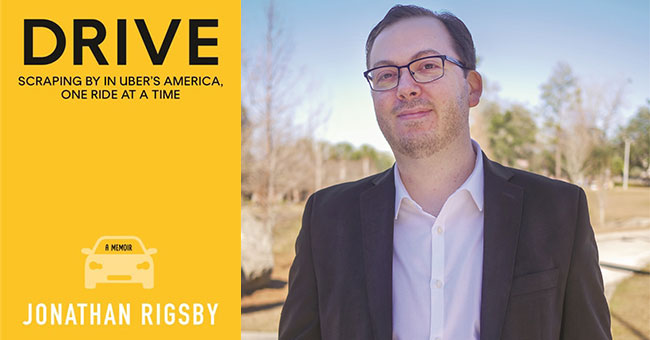
    Cover design: Carol Chu. Author photo: Casey Chapter

    Jonathan Rigsby spends his days as a crime intelligence analyst and his nights as an Uber driver. Reeling from his divorce and struggling to pay rent while caring for his autistic son, Rigsby became a rideshare driver, joining the millions of people with a side hustle just to make ends meet. With a compelling blend of honesty and sardonic wit, Rigsby wrote Drive: Scraping By in Uber’s America, One Ride at a Time, inviting us into his car to reveal the harsh reality of gig work for so many: grueling hours, living paycheck to paycheck, and hoping to avoid disaster long enough to prepare for the next bill. Along the way, he showcases the humor and humanity in the private moments of vulnerability that happen when people are left alone with a stranger. Beacon Press senior publicist Bev Rivero caught up with him to chat about it.

    Bev Rivero: In your introduction, you share that “[t]his is a story about how I rebuilt my life from behind the wheel of a car. It’s a story about letting go of my dreams and learning to live with reality, about focusing on the things in life that really matter: family, love, and happiness.” I’m sure many people can relate to the raw process of changing priorities in their lives. How did the writing process fit into your journey?

    Jonathan Rigsby: By the time I sat down to write Drive, I’d had to put a lot of thought into where I wanted to focus my energy. Working, parenting, and driving were taking up the majority of my time, and I had to choose how to spend the very small amount of free time I had. I’m very fortunate to have an incredibly supportive partner. When I decided to get serious about writing a book, she was with me every step of the way.

    There were a lot of nights spent sitting side by side on the couch with her as I tapped away at a computer. Every free moment, I was working on the manuscript or scribbling in an outline or writing out hundreds of notecards I used to keep myself organized. I missed out on using that time to unwind, but the writing process was relaxing in its own way.

    BR: There’s an element of confession to the book, and you talk about how sharing with your passengers helped you get through some tough moments. It’s rare to read a masculine-authored narrative, outside of memoirs explicitly about recovery, that is so open about experiencing low moments, battling feelings of failure, and seeking help. Do you feel like gender, mental health, and fatherhood are linked in your writing?

    JR: Absolutely. A lot of men deal with a sense that they have to be everything to everyone in their lives, that they have to be these stoic providers who aren’t allowed to feel anything or ask for help, and if you can’t do that for your entire life, you’re failing. It took being at a pretty low point in my life for me to realize I wasn’t going to be the sort of man I wanted to be for my son if I was constantly exhausted, moody, and desperate. He deserved better than that, and it led me to ask for help even when I couldn’t see that I deserved to be happy, too.

    When I first started driving, people would ask what led me to become a rideshare driver, and I would cringe as I told them I was divorced because I thought I deserved scorn for failing in my marriage. People would share their experiences and tell me that things would get better. It helped a lot, both as exposure therapy and from hearing people thank me for getting them across town. I felt like I had value, and that eventually grew into a sense of self-worth I badly needed.

    BR: In the epilogue, you write, “It is not merely a system that exploits workers; it relies on lying to people to convince them to exploit themselves. Gig work is not a streamlining of economic relationships but a technologically enabled engine of human trafficking.” You share some ways that people working the gig economy can dig themselves into debt when trying to make money, like the Uber fuel card, where drivers could go into the negative, and future earnings would be counted against the balance. What are some other examples people might not know about? And are there ways to better inform yourself as an app user?

    JR: The biggest issue for gig workers is the asymmetry of information. The app companies know where the demand is. They know the trends. They know exactly how much money is passing through the system but do everything they can to hide this information from the workers themselves. You get notifications all the time on your phone that drivers in your area are earning these really high hourly wages, and if you look at your own earnings, you can’t help but wonder about the difference. Why am I not earning that much? It makes you tell yourself that you must be doing something wrong, and there’s an entire “hustle culture” that plays into this. They’ll tell you that you aren’t working hard enough and that it is your own fault that you aren’t making it, but the truth is that those earning numbers are mostly made up. Yeah, you can make big money for a few hours on a Friday night, but that’s not the consistent experience. You don’t make that kind of money all the time, but the app companies love to pretend that it’s the norm.

    Uber actually had a program for years that would help you buy a car and then make your payments through the app, deducted right from your earnings. The program trapped a lot of people into working long hours so they could make payments on cars that qualified for the platform. Imagine working twenty or thirty hours in a week before you actually earn the first dollar that you get to keep. They might as well have been paying people in corporate scrip.

    If I open up my phone right now, there’s a program pushing drivers to buy Teslas. Rideshare companies want to be able to sell consumers rides in luxury vehicles, but there’s no consideration on the financial impact that buying an expensive vehicle like that might have on the driver’s financial situation. The companies are glad to have you take on the risk of buying an expensive asset that will lose most of its value while you drive it around town, and if it doesn’t work out, well, that’s your problem.

    As a user of these apps, the best thing you can do is to realize that the price you are being charged has nothing to do with what the people providing the service are being paid. That’s why tipping is so important. I know everyone has “tipping fatigue,” but gig workers are truly dependent on your generosity. The base fares aren’t enough to make a living unless you’re working long hours.

    BR: You mention joining a Facebook group for new drivers. Of course, Twitter—now X—plays a role in what led you to write this book. Can you talk about the role of social media in your experience as a source of camaraderie and knowledge, and perhaps in finding your voice or POV for the book?

    JR: Other drivers were the best source of information for getting the hang of the work. Whether it was on that local Facebook group or standing around talking in the airport parking lot while we waited for planes to land, there’s a sense among drivers that you’re all in it together even as you’re hoping that your phone will ding before theirs does so you can get going. People share tips on where to find free vacuums, the best car washes, and which fast-food restaurants have the cleanest bathrooms (Jimmy John’s, if you’re wondering).

    When I first started my Twitter/X account, I experimented with a bunch of different “voices” for what I was doing. I tried being sarcastic about passengers or mean or judgmental, but it didn’t feel authentic. I initially started the account because I didn’t want to forget the people I was meeting. Their stories had become part of me, and forgetting them felt like losing a part of myself. People are strange and sad and funny all on their own. You don’t have to embellish it. In terms of my own voice, I had to learn to dial back the anger and outrage at the things I experienced. It helped to remember that what I went through was my own story, but it wasn’t unique. Lots of people know what it’s like to sacrifice and struggle.

    BR: Finally, what got you through writing Drive (anything from books, to movies, or other media)? This can include inspiration, source material, or what gave you much needed joy.

    JR: While I was working on the initial outlines and drafts that would become Drive, I read a lot of books about poverty. I owe a lot to Stephanie Land, who wrote Maid. Maid is about a single parent going through absolute hell as she tries to find a way through poverty for her and her daughter, and I really identified with it. Linda Tirado’s Hand to Mouth was really insightful, and it was helpful to read Anne Helen Petersen’s Can’t Even, which is about Millennial burnout (something I definitely experienced while I was working sixty hours per week).

    I’m a big fan of folk music and often found myself listening to songs about the everyday struggles of working-class people. There’s a quote in the beginning of the book from a song about chemical workers in England. That’s a song I liked so much that I tracked down the artist’s estate through a folk music association in England to get permission to use it in the book. I listened to a lot of sea shanties and work songs—the sorts of things that helped embody a sense that I wasn’t alone in my experiences. It helps to know that other people understand the emotions that come with struggling to get by. In terms of artists, I owe a lot to Stan Rogers, The Longest Johns, and a nerd rock band called The Protomen.


    About the Authors 

    Bev Rivero is senior publicist at Beacon Press. Before joining Beacon in 2021, Bev was the communications and marketing manager at the National Book Foundation, where she worked on the National Book Awards, promoted the Foundation’s public and educational programs, and led all social media and marketing campaigns. Prior to NBF, she was in publicity at the New Press for six years, where she worked with authors committed to social justice, including Paul Butler, Michelle Alexander, and many more. She has extensive experience promoting nonfiction and tailoring outreach campaigns that resonate with activists and change-makers. Bev is a NYC-based graduate of Johns Hopkins University, ardent supporter of indie presses, and a graphic designer. You can follow her on Twitter @LOLBev, where she mostly retweets content about books, pickles, and migrant justice.

    Jonathan Rigsby is a crime intelligence analyst for the state of Florida during the day and a rideshare driver by night. He lives in Tallahassee with his son. He has a bachelor’s degree in political science from Vanderbilt University and a master’s degree in Middle Eastern studies from the University of Chicago. He is the author of Drive: Scraping By in Uber’s America, One Ride at a Time. Follow him on Twitter (@ride_trips).

  • By Philip C. Winslow

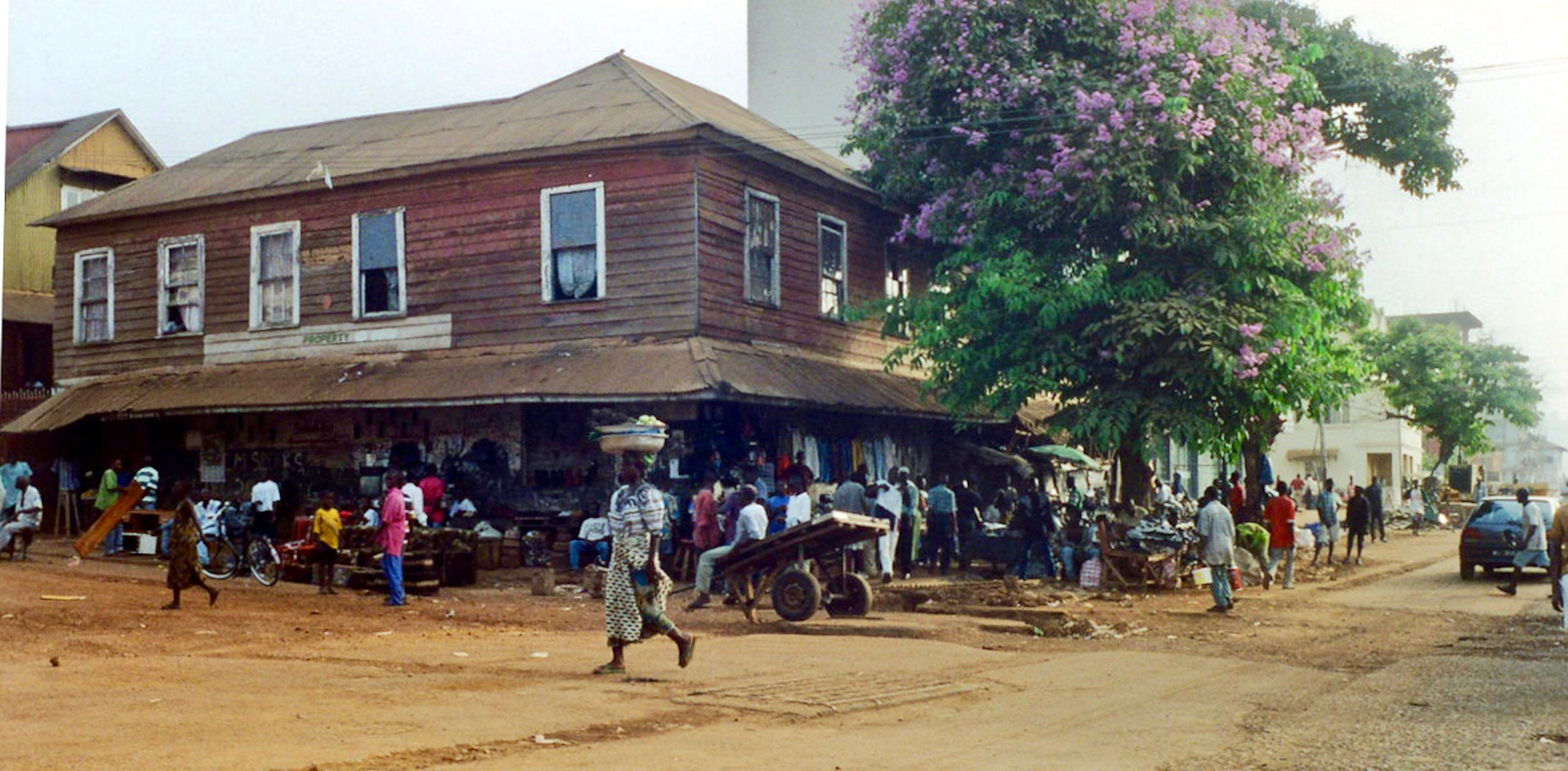
    A Freetown neighborhood. For Sierra Leone’s poor, life was precarious. Terror was never far away.

    A Freetown neighborhood. For Sierra Leone’s poor, life was precarious. Terror was never far away. Photo credit: Philip C. Winslow

    This is the second of three parts of a photo retrospective on three countries where Philip C. Winslow has worked since the mid-1990s: Angola, Sierra Leone, and Myanmar (Burma). All photos © Philip C. Winslow. Read part one and part three
    Thirty years ago when I was reporting the civil war in Angola, a Catholic nun needed to explain to people in a remote village what a journalist was, why I was there. With no word in the local language, she created one that translated as “the people who come and ask a lot of questions and then go away.” Her delightfully accurate description stayed with me for years as I interviewed people in other countries whose lives were in turmoil or about to get that way.

    Looking back now at Angola, Sierra Leone, and Myanmar (Burma) is partly a late-in-life feeling that I owe people whose stories I wrote down before habitually leaving for somewhere else. My sense of benign debt follows the plea that I (and many reporters) frequently hear in troubled places: “We are alone. Please tell our stories.” Tell their stories I did. Some may find the notion that I “owe” highfalutin; it was a job, right? I reported, and moved on to other stories.

    Memory and fondness (or loathing) are personal, and what we pick up along the way stays with us. Many of the people I’ve interviewed and photographed are displaced or dead. I’ve had the privilege, and the luck, of being able to go away, as the nun said. Most of these people had less opportunity. Many fled as terror descended. Or, they stayed put because wherever they were was home. Decades later, I want their lives, or at least their faces, seen through other eyes and remembered. That’s all they asked of me.

    II — SIERRA LEONE

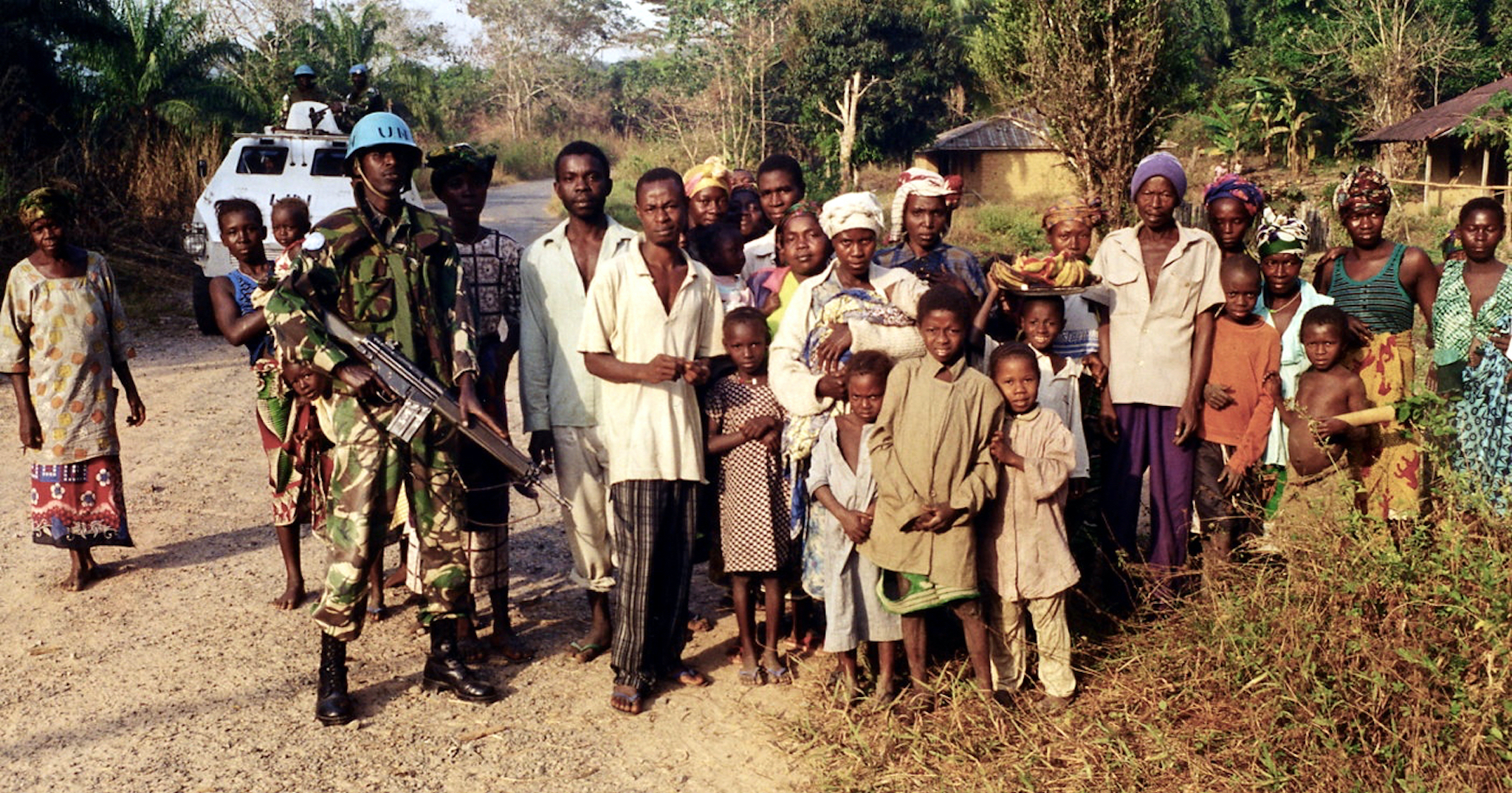
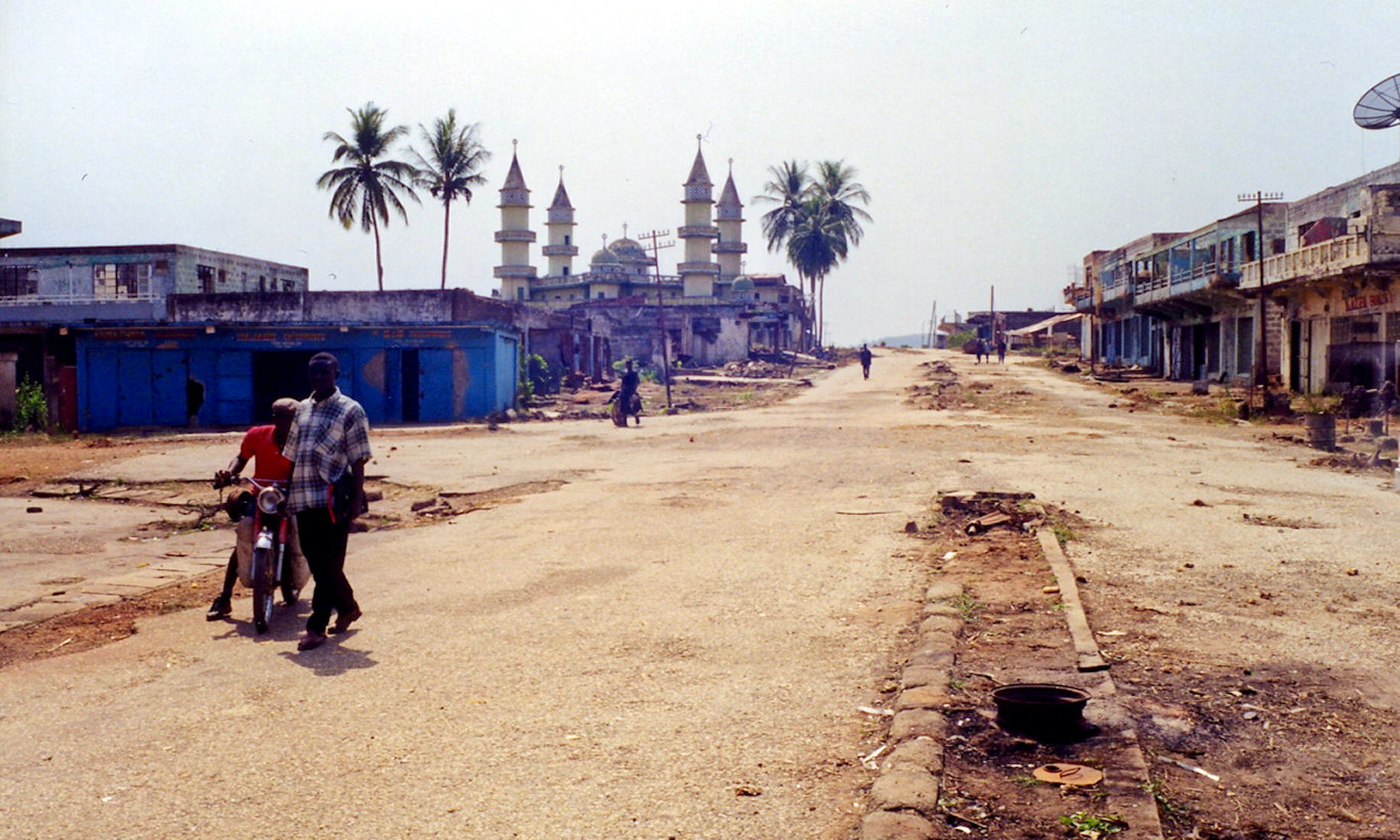
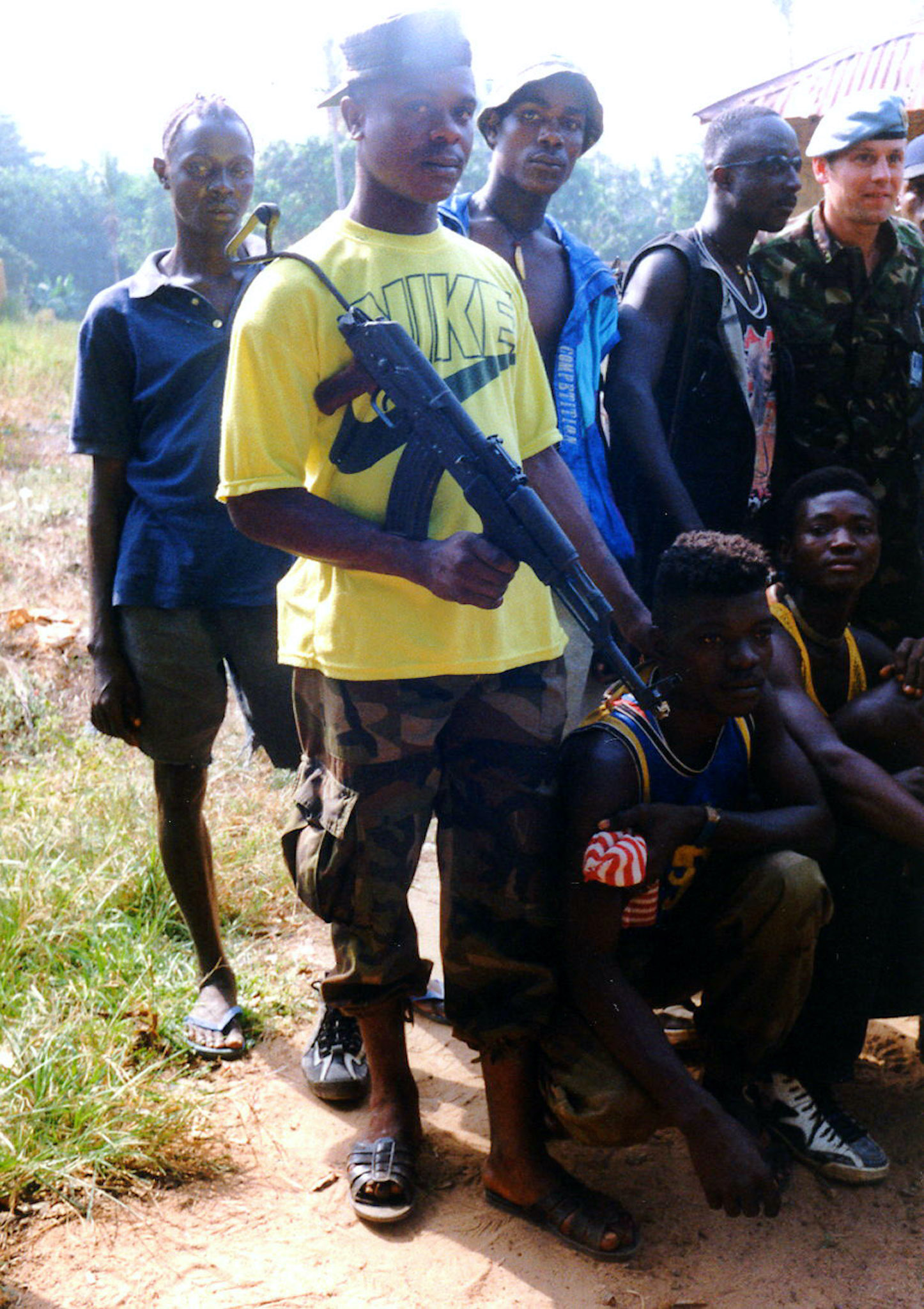
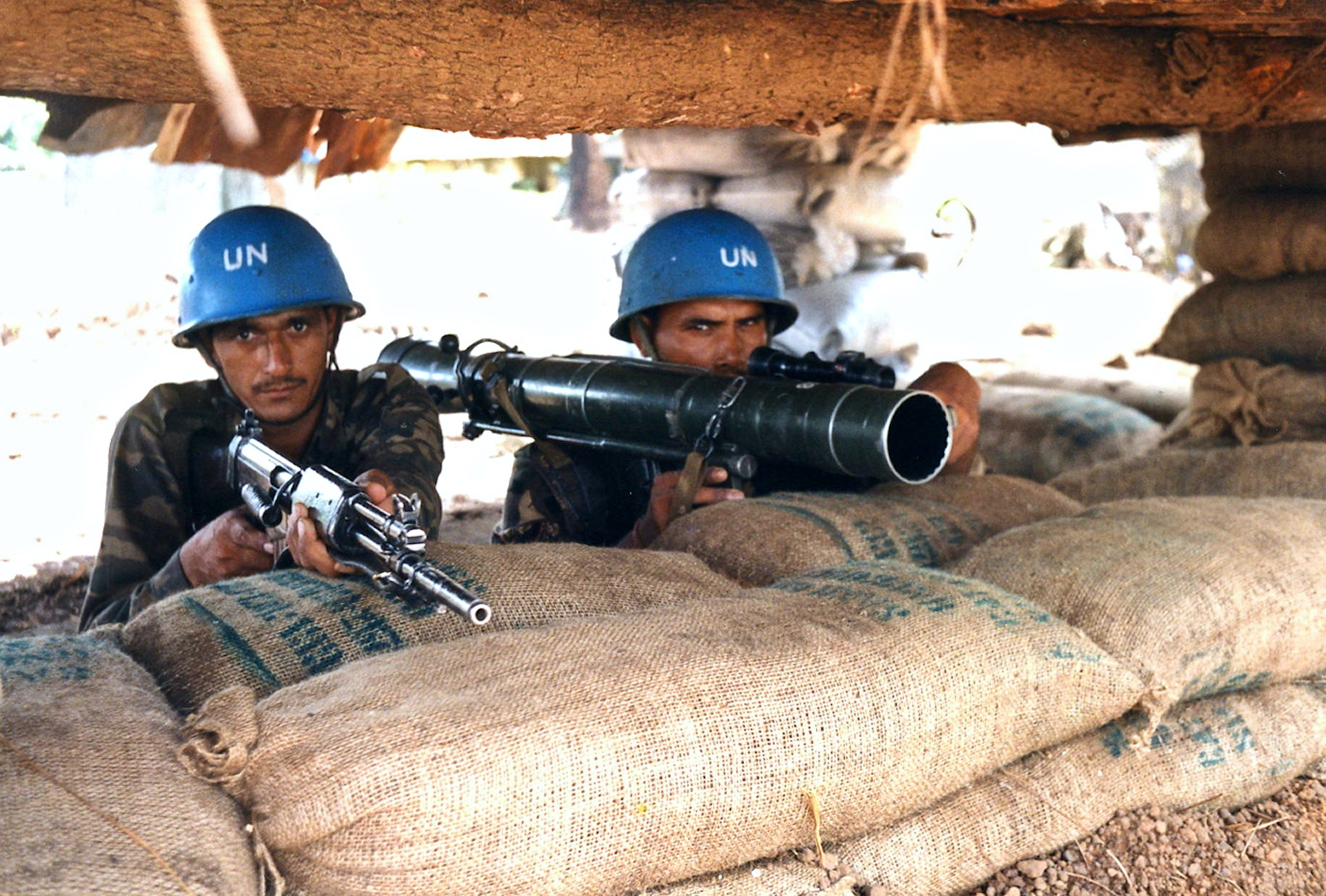
    Sierra Leone’s civil war ran from 1991 to 2002. I reported it occasionally, in 1994 and 1995, mainly about a group of South African mercenaries hired by the Freetown government. (The same mercenaries had also worked in Angola.) In 1999-2000, I worked there again, not as a journalist, but with UNAMSIL, the United Nations peacekeeping mission, with 17,500 troops then the world’s largest. Against a weak and incompetent central government, the war was prosecuted with indiscriminate brutality by the Revolutionary United Front (RUF), which relied on conscript child soldiers and was headed by an addled faux revolutionary called Foday Sankoh. The RUF had plenty of competition from an array of equally violent splinter groups. The war was materially backed by Liberia’s Charles Taylor. For eleven years, civilians suffered serial war crimes and crimes against humanity: murder, mass rape, amputation of limbs, abduction of children, and slavery. The combatants’ sole motivation was to acquire Sierra Leone’s diamond wealth; there was nothing revolutionary or liberating about their motives.

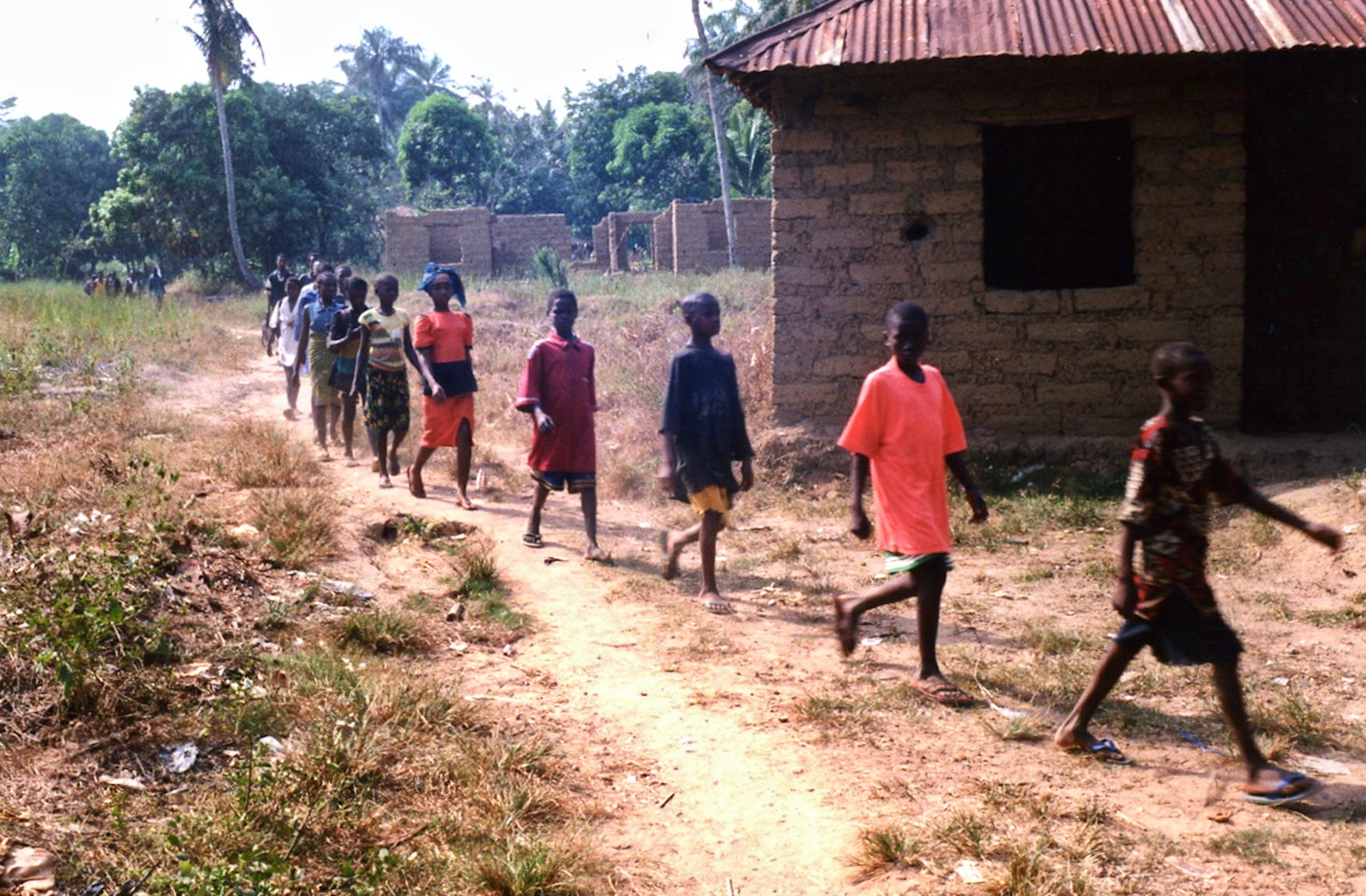
    My photos are from the war’s second phase, when I worked for the UN and when the RUF and other groups still controlled large parts of the country. The photos are not necessarily in chronological order, as UNAMSIL operated in the same areas at different times.

    Since the war ended, the people of Sierra Leone have seen some justice: many of the rebel leaders and the worst of the fighters are dead. Others, convicted by the Special Court for Sierra Leone, are serving long prison sentences. But it cannot be said that the civilian population has recovered from its long trauma.


    A- Lumley beach Freetown peninsula copyLumley Beach, Freetown peninsula, looking over the Atlantic.


    B- ECOMOG checkpoint Lumley Beach copyAn ECOMOG (West African Monitoring Group) checkpoint on Lumley Beach. I don’t know which prospect scared me more: waking the dog or waking the sentry inside the hut.


    C- Freetown neighborhood copy

    A Freetown neighborhood. For Sierra Leone’s poor, life was precarious. Terror was never far away.


    C1- Freetown police station from 1999 copyA Freetown police station burned in a terror attack in 1999.


    D- Jungle flyover copyHeaded north from Freetown in a Russian-piloted UN helicopter.


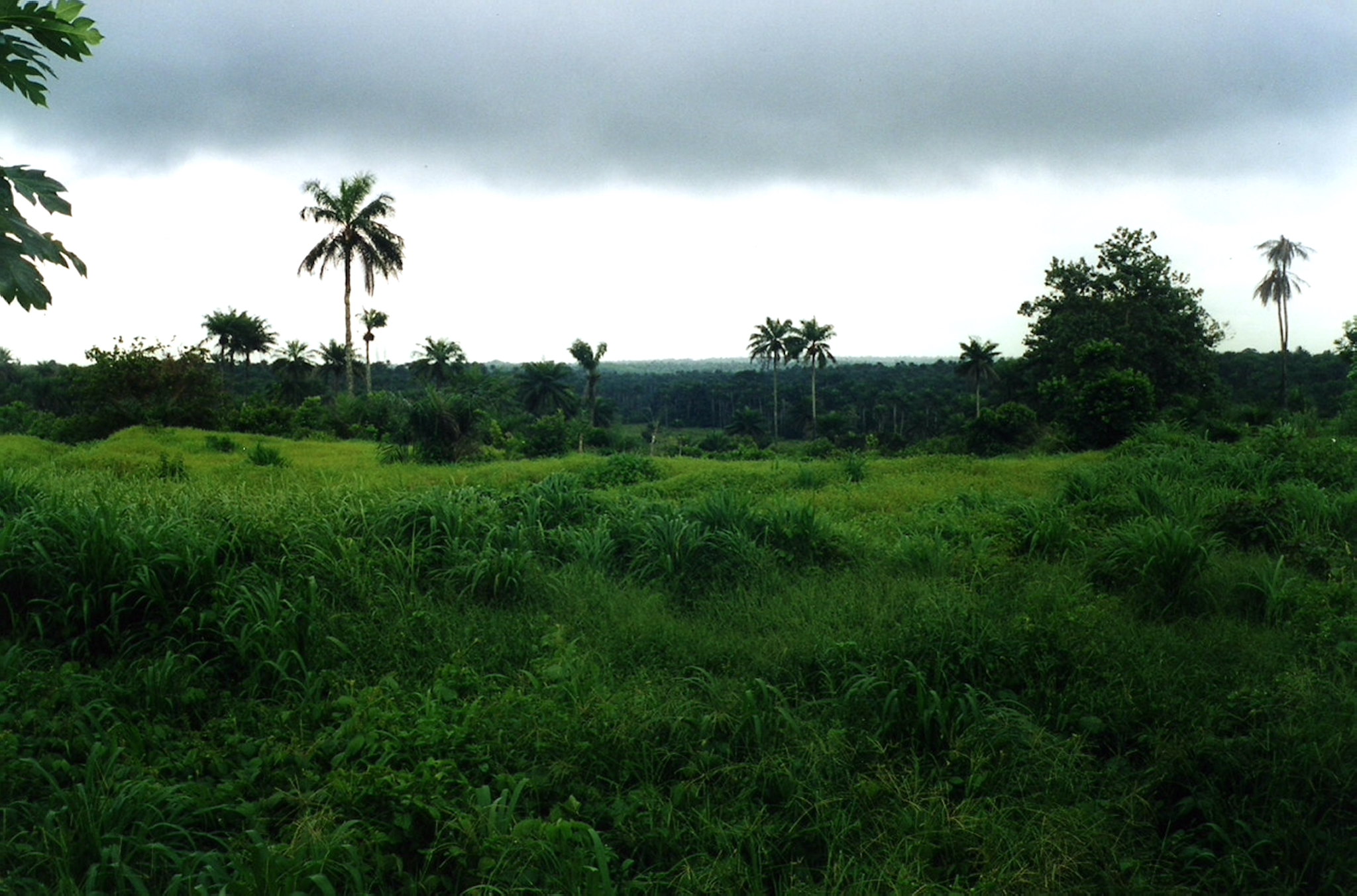
    D1- masiakajungle copyJungle near Masiaka, forty miles east of the capital, at the start of the rainy season. UN troops were conducting operations against the West Side Boys for their serial atrocities.


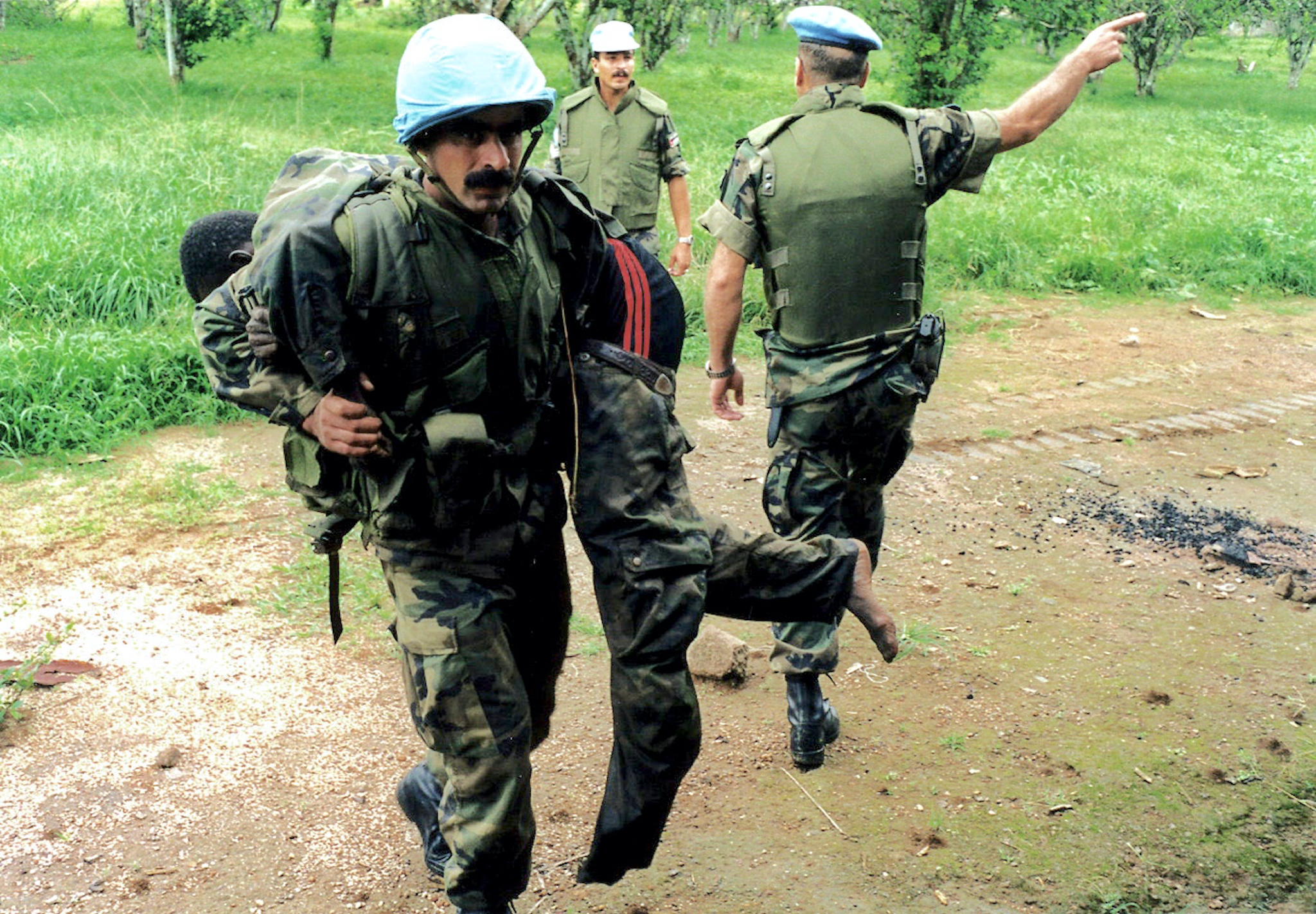
    D2- Jordanian with casualty  Magburaka copyJordanian troops rescue a man from the jungle grass. Wounded by the rebels, he lay hidden for more than a week. He called out only when he heard UN troops speaking Arabic.


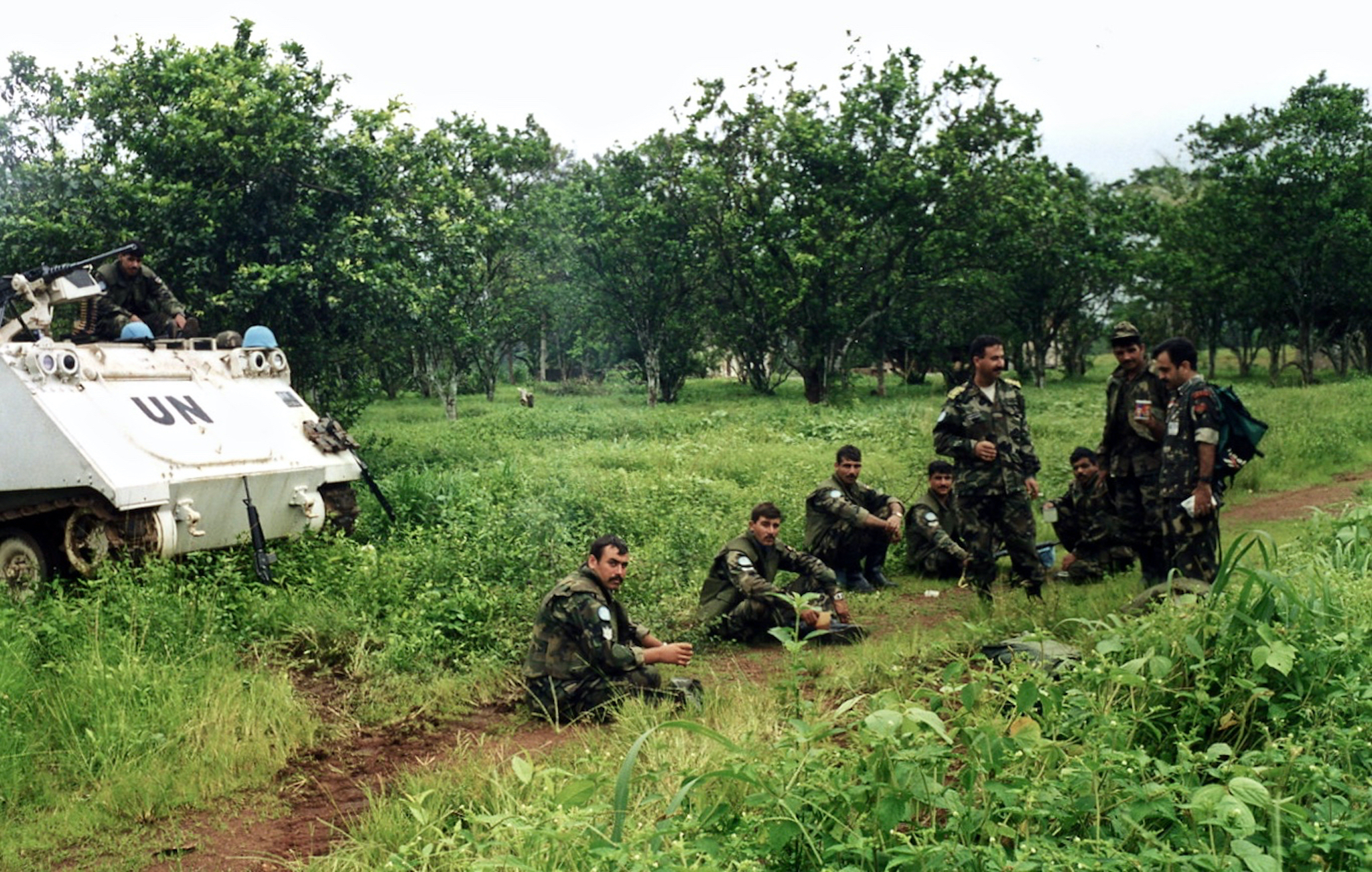
    D3- JORBAT on break copyUN Jordanian battalion troops on patrol near Magburaka, central Sierra Leone.


    E- WSB2 rogberi copyMembers of the West Side Boys gang blocking the Rokel River bridge. Heavy drinkers and drug users, the gang repeatedly raped women and girls and randomly amputated limbs of women, children, and men.


    E1- WSB AAgun copyWest Side Boys joyriding on a stolen ECOMOG gun truck. (ECOMOG was the West African force that preceded UNAMSIL.) UN peacekeepers had been conducting disarmament negotiations with rebels in a roadside tent. Other fighters, in the stolen truck, kept buzzing the tent. We were given a sharp warning of intent, and broke off talks.


    E2- WSB AAgun amath copy

    A second rebel gun truck after it was caught on the road by South African contractors flying a helicopter gunship. The Mi-24 gunships, owned by the Sierra Leone government, were the only thing the rebels feared.


    F - rape victims in Masiaka copyNear Masiaka, I stopped at an apparently abandoned village. Seeing my UN jeep, these women and girls quietly came out and told me their stories. All had been raped by rebels. The yellow parcels contained humanitarian rations provided earlier by an NGO or by the UN.


    G- RUF at Magburaka copyUNAMSIL military observers and RUF fighters, with their families, posing at an RUF roadblock near Magburaka. After an hour of chitchat that alternated between amiable and tense, we were allowed to pass.


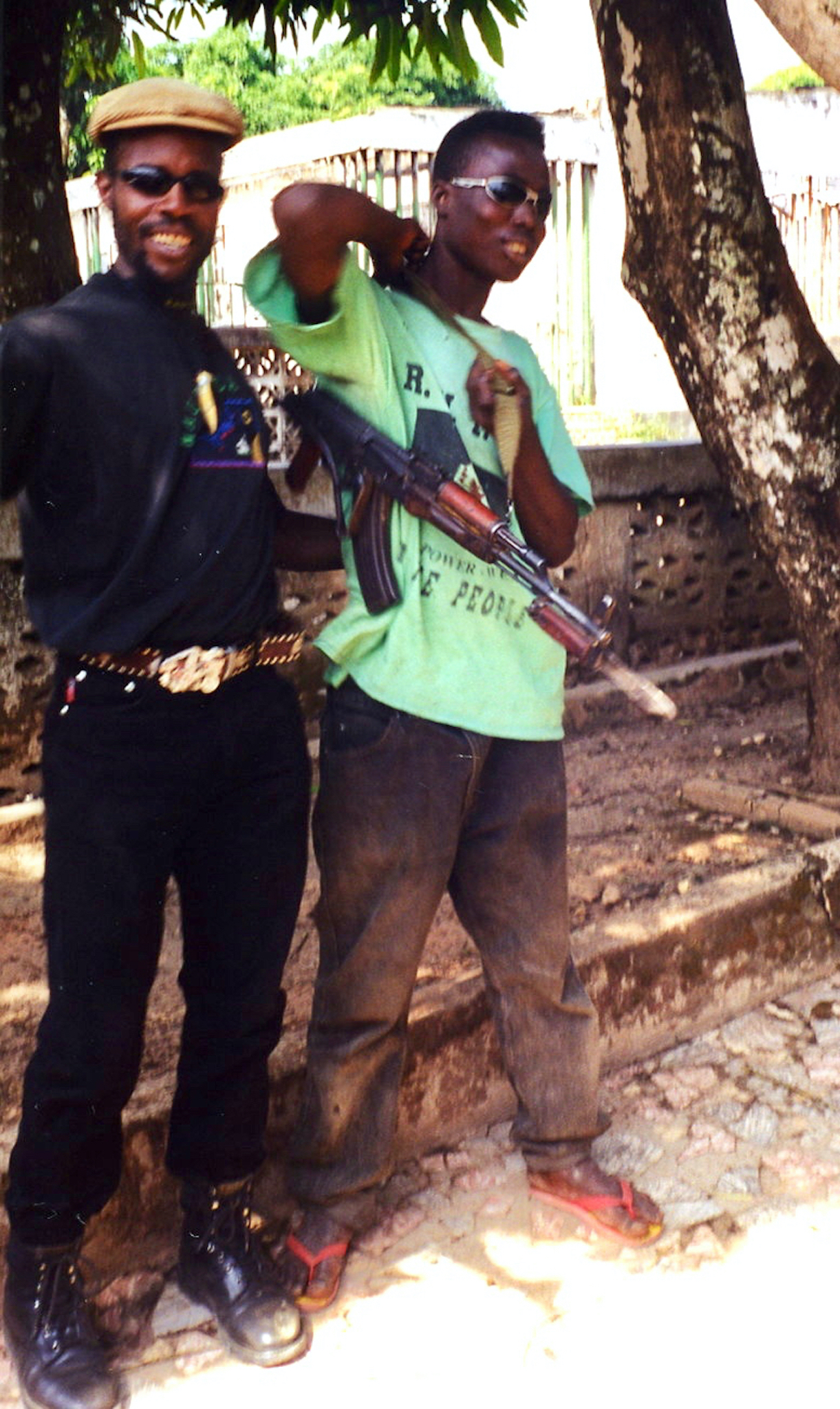
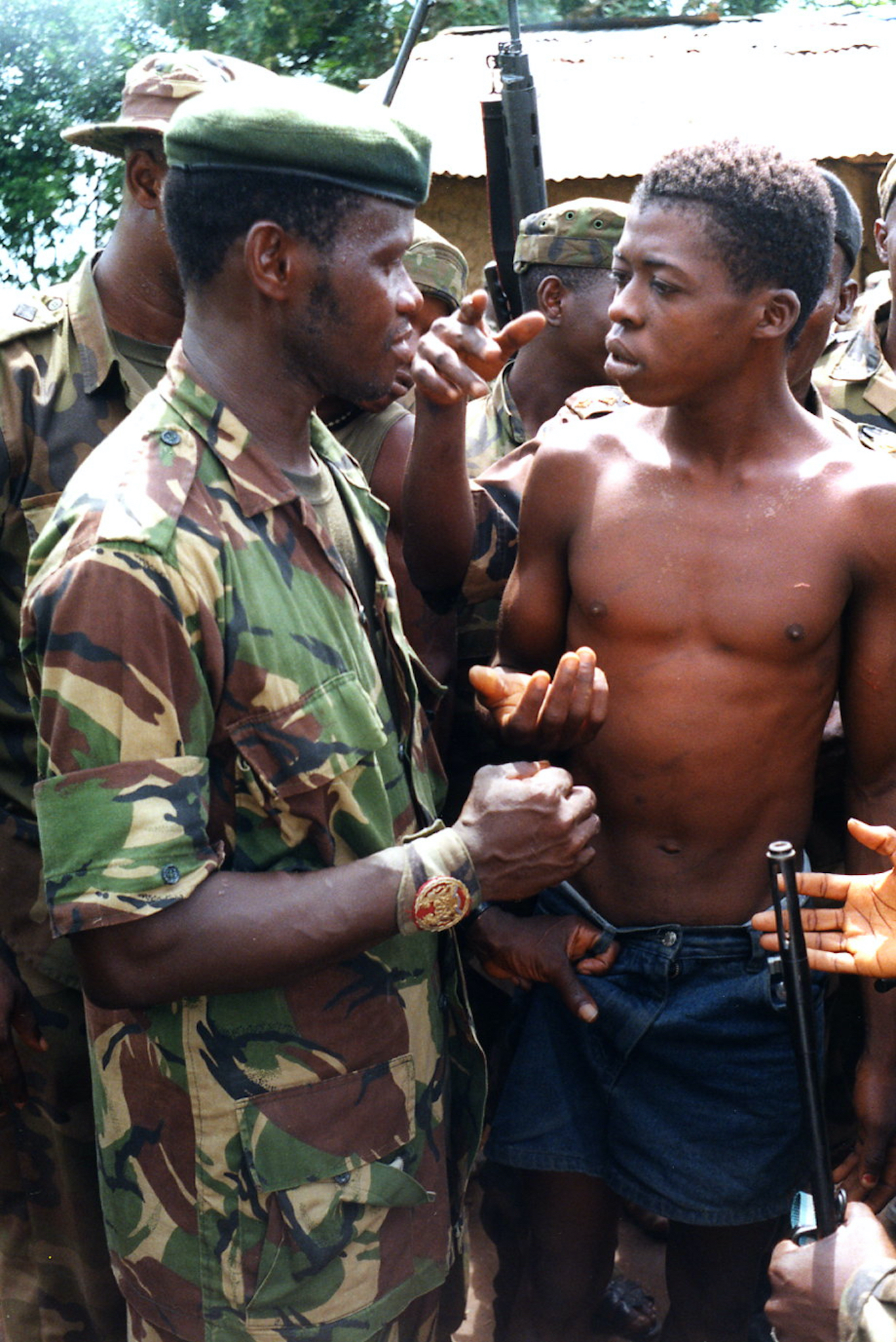
    H- Killer and Good Soldier copy“Killer,” left, and “Good Soldier,” the boys’ noms de guerre, at a rope they had strung across a road outside Masiaka. As rebel/terrorist conscripts, they sustained themselves by extorting money and food from any villagers who dared use the road. “Killer” had lost his left arm during fighting in Freetown in 1999.


    H1- WSB Riflegrenadekid Masiaka copyDrunk and shy, this young fighter, in new boots and kit, watched a UNAMSIL patrol near Masiaka.


    H2- kidguard copy

    A child soldier attached to the West Side Boys guarded some empty buildings near Masiaka. He let me take his picture but was twitchy and would not speak. He was about fourteen.


    H3- RUF Sesay CPD Magburaka copyThe close protection detail for an RUF commander at Magburaka. They were drunk and stoned, and allowed me one quick photo. Nearby, “Brigadier General” Issa Hassan Sesay was slumped in an armchair under a mango tree, swigging out of a bottle of Tia Maria. The fighters’ prodigious consumption of drugs and alcohol made negotiations or even normal conversation difficult.


    I Eye- Mabang Bridge copy

    Terrorist attacks had kept the Mabang Bridge closed for years, shutting off vehicle traffic on a main south-north road.


    I1 EyeOne- Kamajors nr Mabang copyKamajors, traditional Mende hunters, guarding a closed approach to the Mabang Bridge. The Kamajors then worked for a faction of government called the Civil Defence Forces, run by Sam Hinga Norman. Norman and some CDF leaders later were indicted on charges of war crimes and crimes against humanity by the Special Court for Sierra Leone.


    J- Abandoned RUF copyFormer RUF fighters who had been abandoned by their commanders. UN medics patched up their wounds as our convoy passed through on the way to Koidu, in the east.


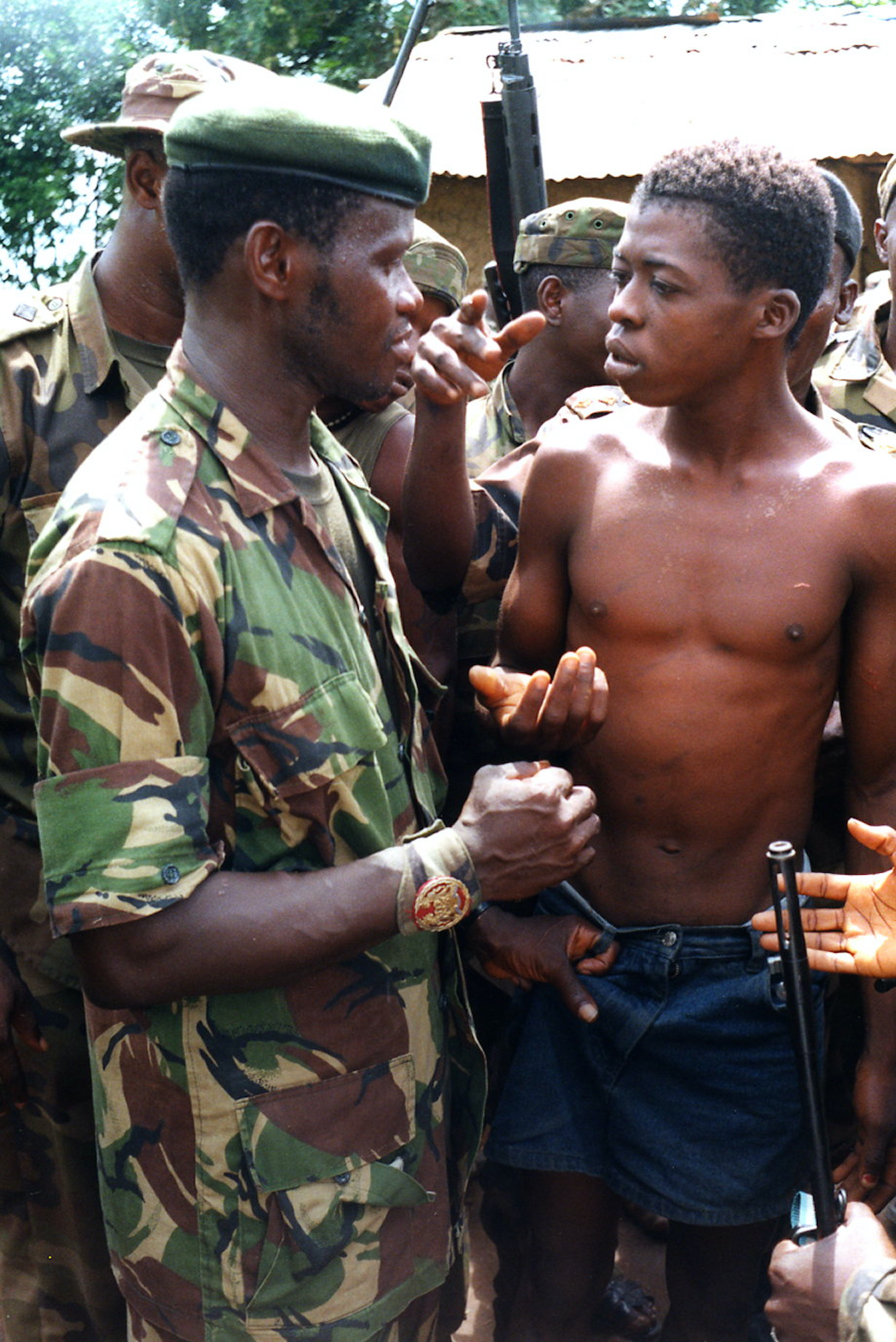
    J1- PoW1 copyAfter a jungle skirmish, a Sierra Leone Army officer holds a prisoner suspected of being RUF.


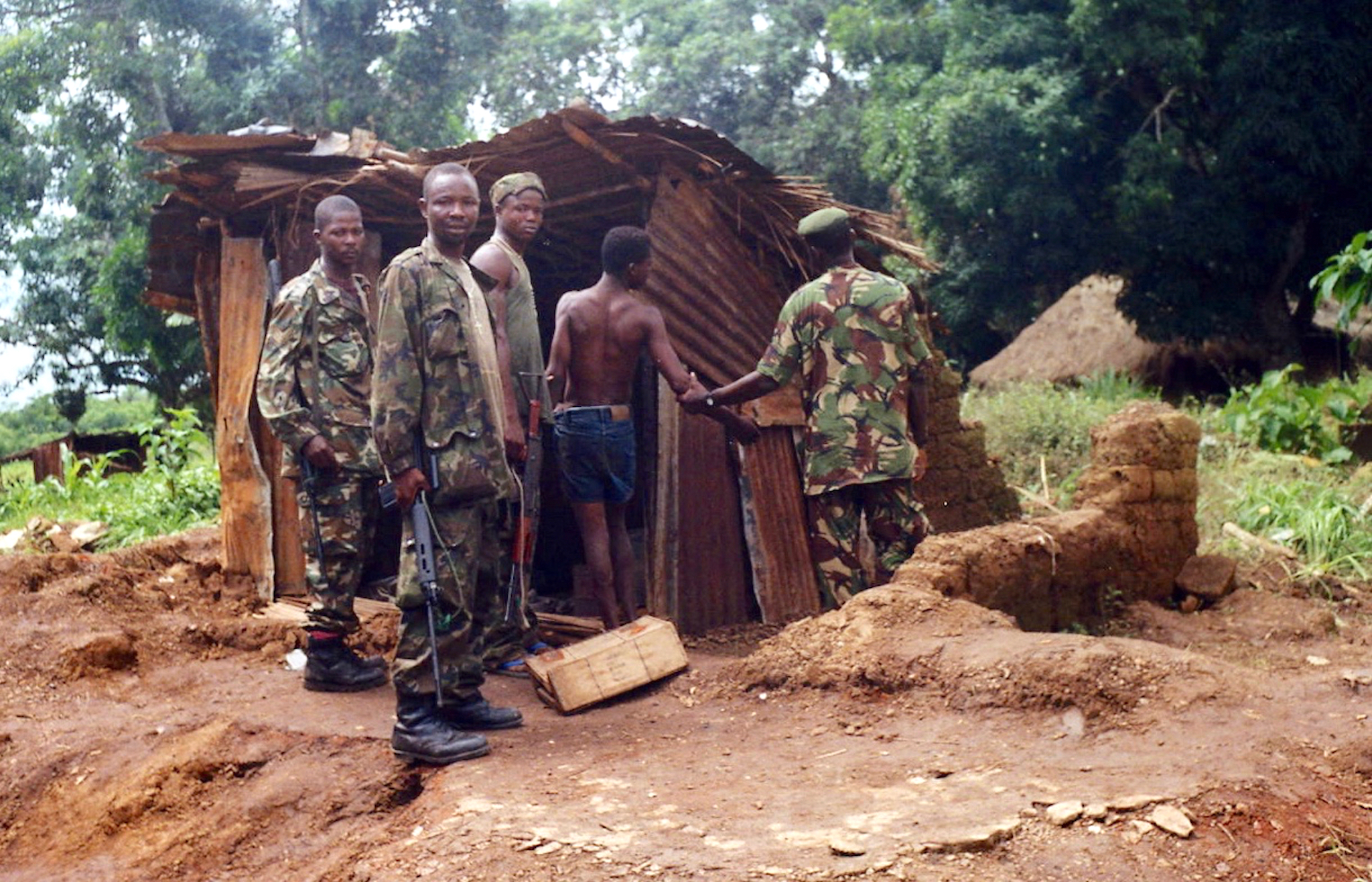
    J2- PoW4 copyThe boy was taken to a shed for interrogation.


    J3- PoW6 copyThe officer was not satisfied with his answers.


    J4- PoW7 copyI hoped that the tough questioning allowed for some flexibility.


    J5- PoWs suspected rebels copyThe Sierra Leone Army detained these local men on suspicion of being RUF.


    K- Woman who hid from rebels copy

    She had been hiding in the bush for weeks, terrified by rebels rampaging through the villages. She came out when she heard Indian peacekeepers setting up camp and she could smell their field kitchen. She eventually got a good lunch.


    L- burnedvillage copyA burned village where we had gone to search for remains of UN peacekeepers killed by the rebels.


    M- village enroute Koidu copy

    As a UN convoy headed for Koidu in the east, an entire village turned out to beg for protection from the West Side Boys.


    N- Ruined Koidu copyKoidu, Eastern Province.


    N1- UNAMSIL Winslow interview Sesay in Koidu copyWith my UN colleagues, I questioned Issa Hassan Sesay, an RUF commander, in Koidu in the spring of 2000. It was the first formal meeting with Sesay. We hoped to convince him to bring his fighters into the disarmament program. For Sesay himself, it was too late, and he returned to the bush. He was later indicted and convicted.


    O- WSB slave release1 copyChild slaves of the West Side Boys being walked out of the jungle after their UN-brokered release. The terrorists used the children as sex slaves, cooks, and porters.


    O1-WSB slave release2 copy

    Child slaves being led out of the jungle into a UN field station for medical care and hoped-for reunification with their families.


    O2- WSB slave release3 with Sikaonga copyChild slaves after their release. UNAMSIL Major Francis Sikaonga (Zambia), at right, had led months of painstaking, secret negotiations to free the children.


    P- UNAMSIL observers registering combatants for DDR copyUN officers register surrendering combatants for the disarmament program.


    P1- Makeni weapons copyWeapons, not many of them serviceable, surrendered by fighters in Makeni.


    P2- DDR Kabala copySurrendered fighters at a disarmament and reintegration camp in Kabala, Northern Province.


    P3- WSBs exjungle copyWest Side Boys near their jungle camp, with UNAMSIL Major Richard Rochester. The fighters were deciding whether to join the UN disarmament program.


    Q- INDBAT position Koidu copy

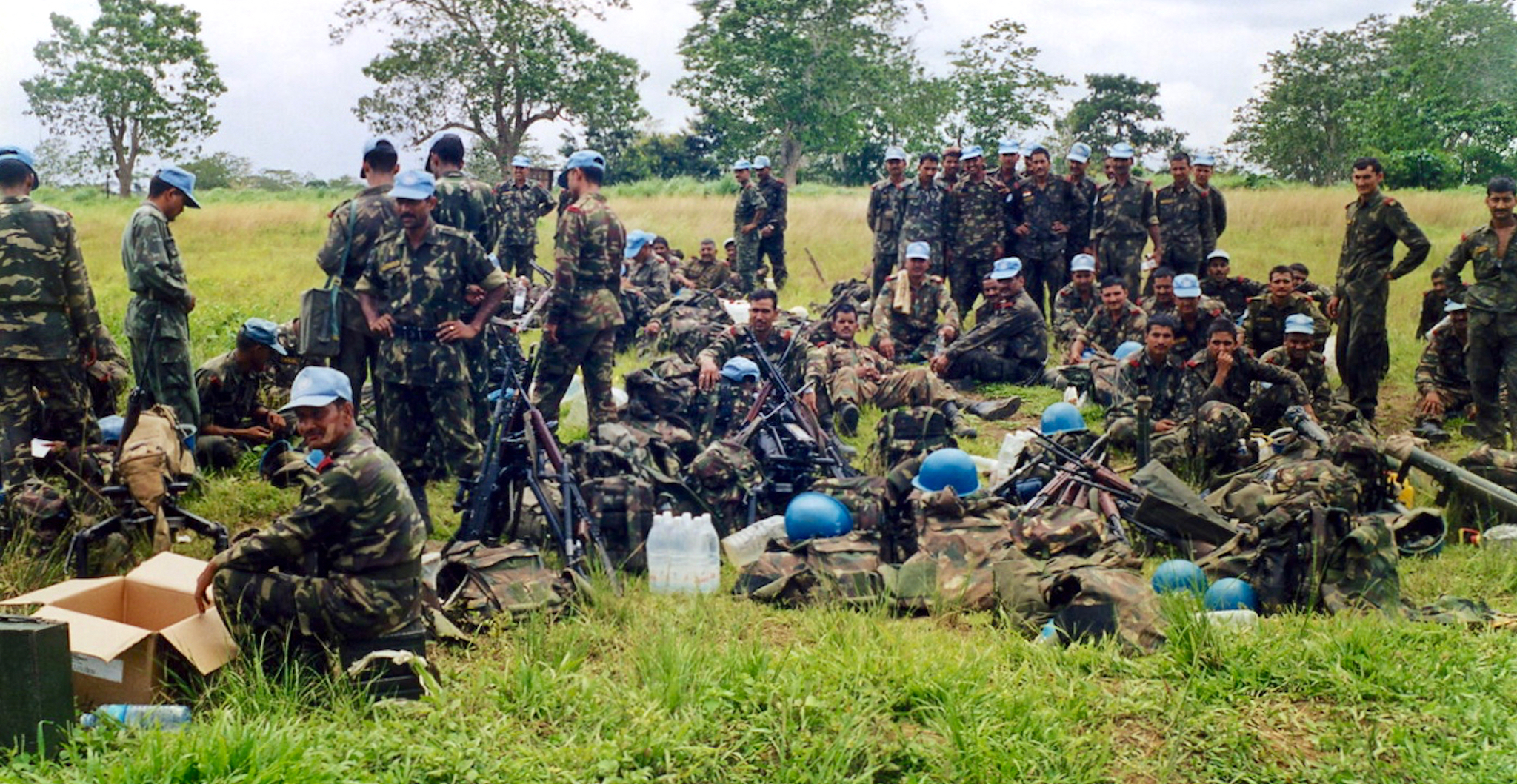
    UNAMSIL Indian battalion position at Koidu, eastern Sierra Leone.


    Q1- INDBAT after Koidu fight copyUN Indian troops resting after a battle with rebels. One Indian soldier was killed.


    R- Chinook at HQ copy

    A British Army helicopter shortly before an operation in September 2000 to rescue British soldiers held by the rebels. The British assault, separate from UNAMSIL operations, was carried out by 22 SAS and 1 PARA, and killed about two dozen West Side Boys. It led to the surrender of hundreds of other rebels, and ended the long reign of terror. One British soldier was killed.


    S- Lumley beach end copyLumley Beach. No tourists in those days.


    About the Author 

    Philip C. Winslow has been a journalist for fifty years; he has worked for the Christian Science Monitor, the Toronto StarMaclean’s Magazine, ABC Radio News, CTV News, and CBC Radio. He also served in two United Nations peacekeeping missions and spent nearly three years living in the West Bank. He is the author of Victory For Us Is to See You Suffer and Sowing the Dragon’s Teeth.

  • By Christian Coleman

    From Asians for Abolition, WSP Vigil for Asian Americans, Berkeley, CA, 20 March 2021

    From Asians for Abolition, WSP Vigil for Asian Americans, Berkeley, CA, 20 March 2021. Photo credit: Andrew Ratto

    “How do you teach a kindergartener about the histories and contemporary legacies of race and racism in a way that affirms her humanity and agency?” Dr. OiYan Poon poses herself this question in the introduction of Asian American Is Not a Color: Conversations on Race, Affirmative Action, and Family after her three-year-old daughter Té Té broaches the topic of race. An answer to her question could be found by turning to this year’s theme for Asian American and Pacific Islander Heritage Month. Appropriately, it’s “Bridging Histories, Shaping the Future,” which is all about embracing the interconnectedness of our stories and honoring the ancestors who came before us. This handful of titles from Beacon Press’s catalog aims to do just that. With these books, we can pass down the myriad histories of Asian American communities, trace the commonalities among them, and picture the future that affirms our humanity and agency.


    Asian American Histories of the United States

    Asian American Histories of the United States

    “The contemporary general definition of ‘Asian Americans’ signifies Americans of Asian ancestry. However, the name ‘Asian American’ hasn’t always been with us. It was born of defiance and a radical imagination in the late 1960s. In 1968, UC Berkeley graduate students Emma Gee and Yuji Ichioka coined the term ‘Asian American’ when they founded the Asian American Political Alliance in Berkeley. An anti-imperialist, anti-capitalist, Third World political organization, the Asian American Political Alliance fought for self-determination and liberation for Asian Americans. The name ‘Asian American’ was a rejection of externally imposed categories of identity, such as the popular usage of ‘Oriental.’”
    —Catherine Ceniza Choy 


    Asian American Is Not a Color

    Asian American Is Not a Color: Conversations on Race, Affirmative Action, and Family

    “Racism cannot be narrowly determined and defined by access to college degrees or household income. In the years after the start of the COVID-19 pandemic in March 2020, alarming reports raised public concern over a rise of anti-Asian violence. This new self-reported data on racial harassment and violence adds to the continuing Islamophobic violence targeting Muslim and South Asian Americans following September 11, 2001. Still, there are differences and conflicts between Asian Americans and how we understand racism and what to do about it.”
    —Dr. OiYan Poon 


    Coming Out as Dalit

    Coming Out as Dalit: A Memoir of Surviving India’s Caste System

    “Indian society doesn’t create spaces for Dalits to flourish. Constitutional reservation allows Dalits to enter and survive in a system that tries to keep them on the periphery. The system is designed to keep Dalits confined to undesirable professions. Dalits who use the reservation policy to advance are accused of being ‘opportunistic’ for using their only option for progress. Thousands of years of religious and social policies that denied education to Dalits are discounted and they are regularly challenged to prove their talent without using the “crutch” of reservation. Reservation allows Dalits entry into the upper-caste system, but only their drive, talent, and ability create genuine, viable opportunities for them to get ahead.”
    —Yashica Dutt 


    Don't Wait

    Don’t Wait: Three Girls Who Fought for Change and Won

    “All Sonia knew so far was that Amir was a big-shot ACLU lawyer working on getting access to arts funding for California youth. Four days after she sent the email, Amir responded—‘I was so excited, it was like hearing from a celebrity’—and they scheduled a phone call. Sonia showed up with a pink sticky note covered in questions, expecting him to refer her to some articles to read. Instead, Amir asked Sonia all about her life, her work, her passions and what she wanted. He told her about the zine that arts justice fellows with the ACLU of Southern California had made. She seemed passionate and talented, he said, and our last arts justice fellow just left. Would you be interested in taking their spot?”
    —Sonali Kohli 


    For-Want-of-Water

    For Want of Water: and Other Poems

    The violins in our home are emptied
    of sound, strings stilled, missing
    fingers. This one can bring a woman down
    to her knees, just to hear again
    its voice, thick as a callus
    from the wooden belly. This one’s strings
    are broken. And another, open,
    is a mouth. I want to kiss
    them as I hurt to be kissed, ruin
    their brittle necks in the husk of my palm,
    my fingers across the bridge, pressing
    chord into chord, that delicate protest—:
    my tongue rowing the frets, and our throats high
    from the silences of keeping.
    —Sasha Pimentel, “If I Die in Juárez”


    How to Be a Muslim

    How to Be a Muslim: An American Story

    “Representing the Islamic Center became my life. I perceived my place in the community, and the crisis in our country, as fate working its ways; because I was relatively well read in Islamic history and because, in no small part thanks to my upbringing, I could hold my own at many of the events I was called to, I felt called. I did not give out, give in, or seek to absolve myself of the burdens of the moment. But don’t misunderstand me. I was no rabbi, priest, pastor, professor. I was a kid in way over his head. Reporters I’d never met stuck microphones in my face and rattled off listicles before the Internet invented them: Islam, jihad, Shari’ah, suicide bombing, polygamy, Iraq, Pakistan, Afghanistan, Taliban, terrorism, Palestine, explain, explain, explain! Now! Now! Now! You had eight seconds and, oh yeah, if you fuck it up, you might give added momentum to the hawks eager to use 9/11 as a global casus belli.”
    —Haroon Moghul 


    Humanizing Immigration

    Humanizing Immigration: How to Transform Our Racist and Unjust System

    “‘Abolish ICE’ is more than a catchy phrase—it represents a political movement whose most fervent adherents seek to put an end to the US Immigration and Customs Enforcement (ICE) agency. Support for the movement grew in 2018 after Ocasio-Cortez, in her election campaign, advocated abolishing ICE, and when then president Donald Trump separated children from their parents at the border. The movement has developed into a kaleidoscope of different advocacy efforts. . . . In essence, by reviewing critical aspects of the current system, I make the case for dismantling ICE. I call for continued disruption until transformation of the system is accomplished.”
    —Bill Ong Hing 


    No Study Without Struggle

    No Study Without Struggle: Confronting Settler Colonialism in Higher Education

    “how has colonialism limited our very idea of achievement and what it means to study in formal education spaces? It has, in essence, told us the lie that the information taught in various disciplines contains objective facts, impermeable and without context. That lie has provided opportunity and access for a precious few. Settler colonialism has attempted to commodify knowledge itself, anointing it as property, convertible into careers and well-being.”
    —Leigh Patel 


    On Gold Hill

    On Gold Hill: A Personal History of Wheat, Farming, and Family, from Punjab to California

    “I didn’t tell her I was Punjabi. In fact, I don’t think I’d ever said those words—I’m Punjabi—to anyone. Though the statement was true—my mother was born in Punjab, as were both her parents, and their ancestors as far back as anyone knew—it seemed equally false. At the time, I’d never been to India, knew little about Punjabi customs or traditions, didn’t speak the language. I knew only that my mother had left that place and come to America with her family when she was fifteen, and at some point thereafter lost her Punjabi accent. To me, her voice had always sounded just as Californian as my own, with one exception: the v and w sounds had gotten irrevocably switched in her mind, so that windshield wiper often came out vinshield viper; wisteria, visteria. It was the one remnant of India my mother had failed to shed.”
    —Jaclyn Moyer 


    The Racism of People Who Love You

    The Racism of People Who Love You: Essays on Mixed Race Belonging

    “It is worth noting that many an Indian person, certainly my relatives (whether or not they share the name), but also various aunties and uncles whom I am only meeting for the first time, have felt free both in my childhood and in my adulthood to correct me on the pronunciation of my own name. My name is a shibboleth, letting any member of the Indian community, or honestly, any non–South Asian person who has put serious time and effort into learning South Asian languages, know that I am, in the end, not authentic. All I have to do, in order to fail the most basic authenticity test, is introduce myself. I have failed before I have even begun.”—Samira K. Mehta 

    From Asians for Abolition, WSP Vigil for Asian Americans, Berkeley, CA, 20 March 2021


    About the Author 

    Christian Coleman is the digital marketing manager at Beacon Press and editor of Beacon Broadside. Before joining Beacon, he worked in writing, copy editing, and marketing positions at Sustainable Silicon Valley and Trikone. He graduated from Boston College and the Clarion Science Fiction & Fantasy Writers’ Workshop. Follow him on Twitter at @coleman_II and on Bluesky at @colemanthe2nd.bsky.social.

  • By Philip C. Winslow

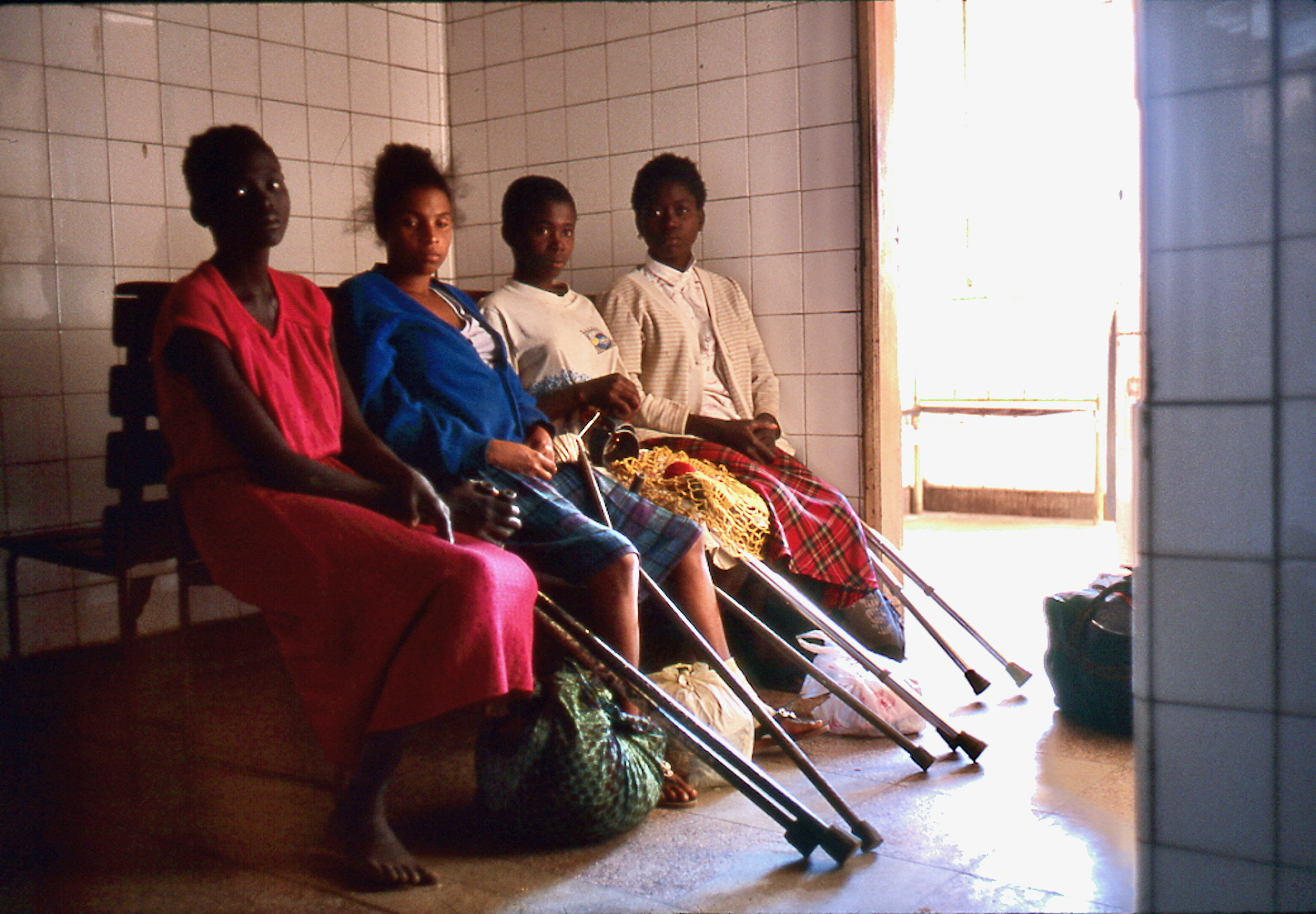
    Maternity clinic, Luena Central Hospital, Moxico Province, 1996. Photo credit: Philip C. Winslow

    Maternity clinic, Luena Central Hospital, Moxico Province, 1996. Photo credit: Philip C. Winslow

    This is the first of three parts of a photo retrospective on three countries where Philip C. Winslow has worked since the mid-1990s: Angola, Sierra Leone, and Myanmar (Burma). All photos © Philip C. Winslow. Read part two and part three.
    About thirty years ago when I was reporting the civil war in Angola, I heard about what in those days was called a leper colony, an isolated village in Angola’s northeast Lunda Sul province, near the Congo (then Zaire) border. Because all the villagers were thought to have leprosy—Hansen’s disease—both the Angolan Armed Forces (FAA) and UNITA rebels generally left the village alone rather than molesting and pillaging as they did everywhere else. 
     
    On the last leg of the journey, I was escorted by a Catholic nun who knew the villagers well. As she introduced me, she realized there was no word in Chokwe, the local language, for “journalist,” so she had to invent one. The description she came up with translated as “The white people who come and ask a lot of questions and then go away.” That day, I sat with the villagers in the shade of a large mango tree and listened to tales of survival, their anxieties and their faith during Angola’s long, grinding war. Reluctantly, I said goodbye to these gracious people and went away, back to Luanda on the Atlantic coast.
     
    Looking back at Angola, Sierra Leone, and Myanmar is partly a late-in-life feeling that I owe people whose hardships and simple stories I chronicle before habitually leaving for somewhere else. My sense of benign debt follows the plea that I (and many reporters) frequently hear in troubled places:  “We are alone. Please tell our stories.” And tell their stories I did. Some may find the notion that I “owe” highfalutin: it was a job, right? I did it and moved on to the other stories.
     
    Memory and fondness (or loathing for the bad actors) are personal, and what we pick up along the way stays with us. Many of the people I interviewed and photographed are displaced or dead. I’ve had the privilege (and often the luck) of being able to go away, as the nun said. Most of these people did not. Or, they stayed put because they were home. Decades later, I still want their lives, or at least their faces, seen through other eyes and remembered. That’s all they ever asked of me.
     
    I — ANGOLA: THE WORST WAR IN THE WORLD, 1994-1995, 1996
     
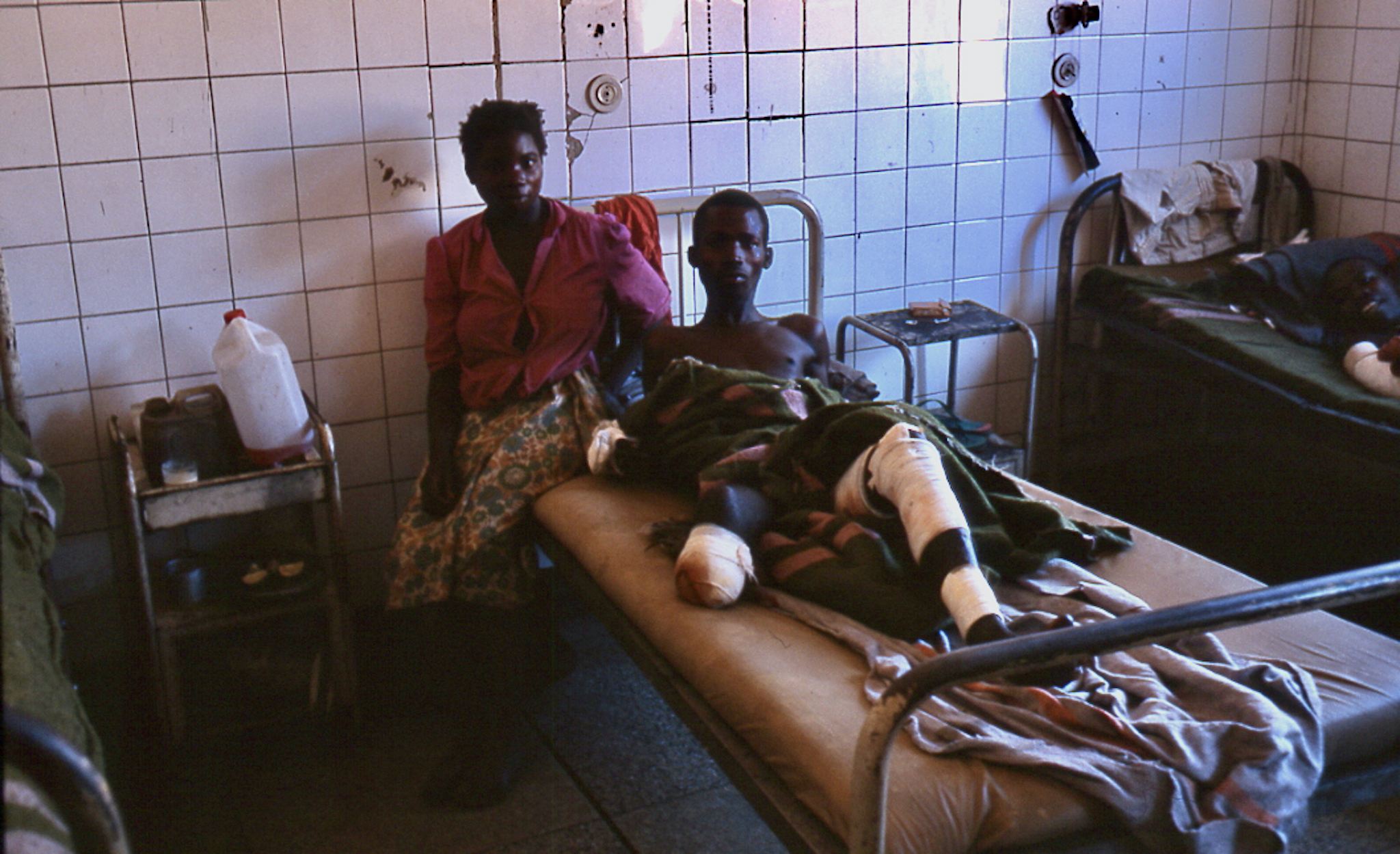
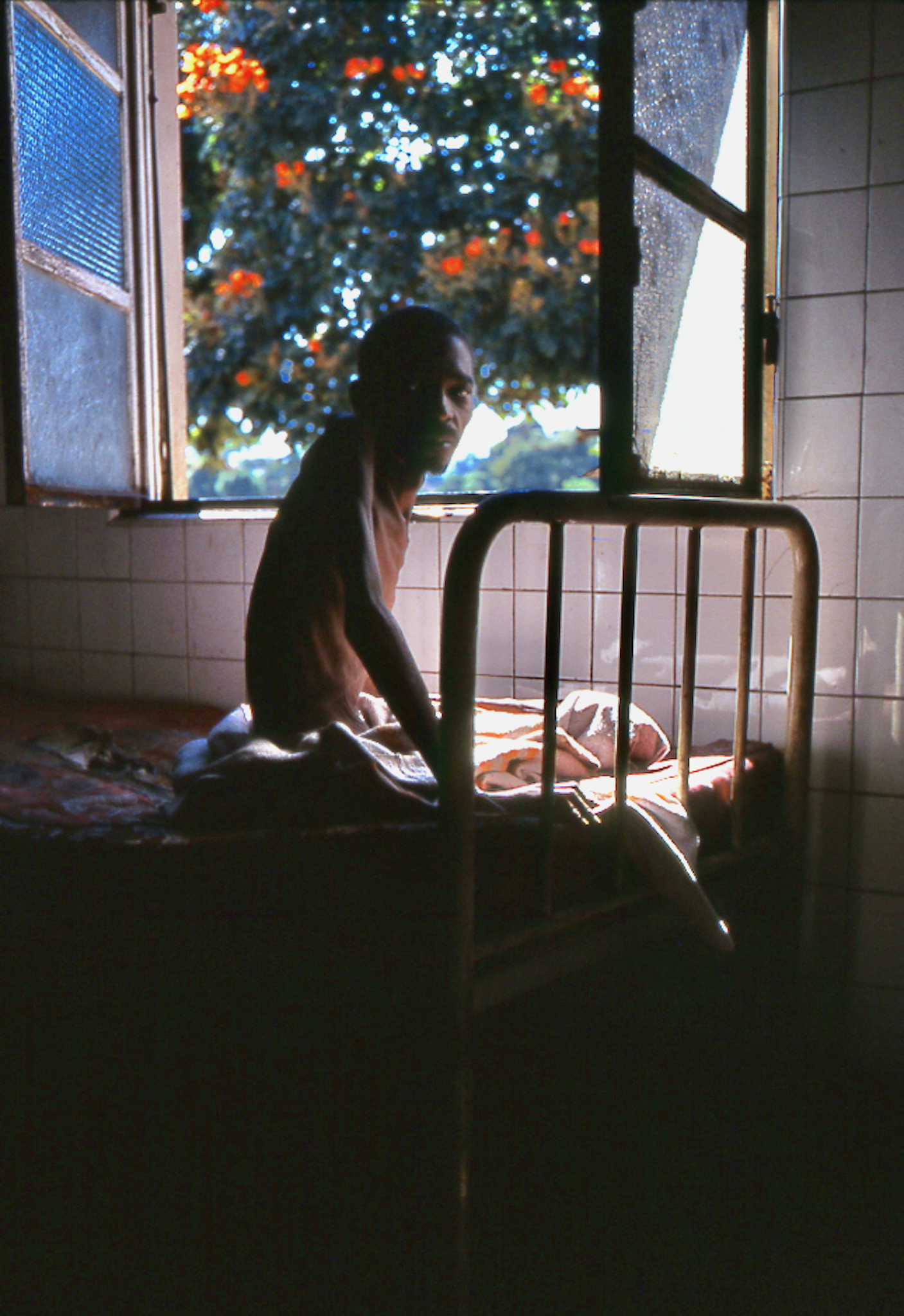
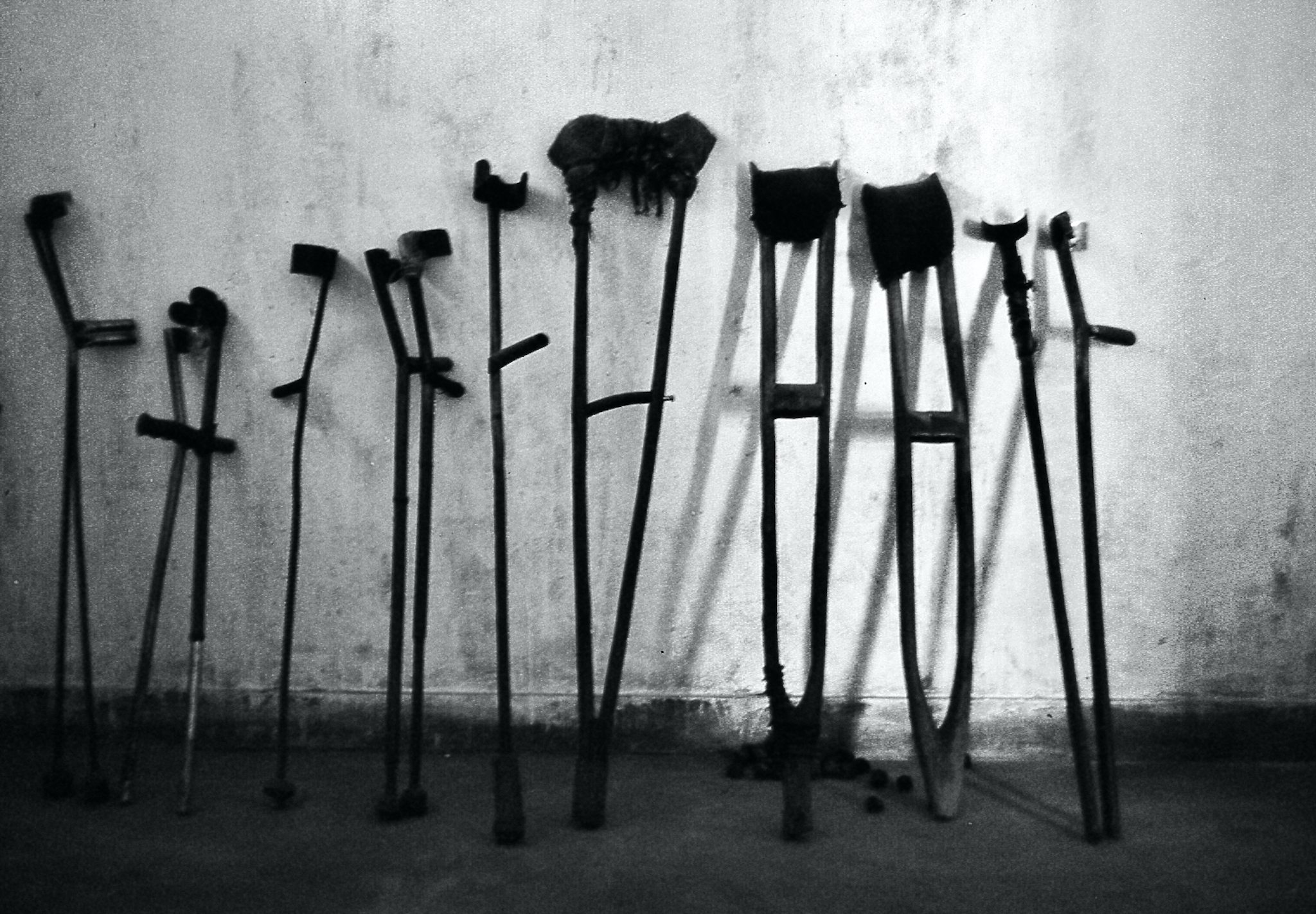
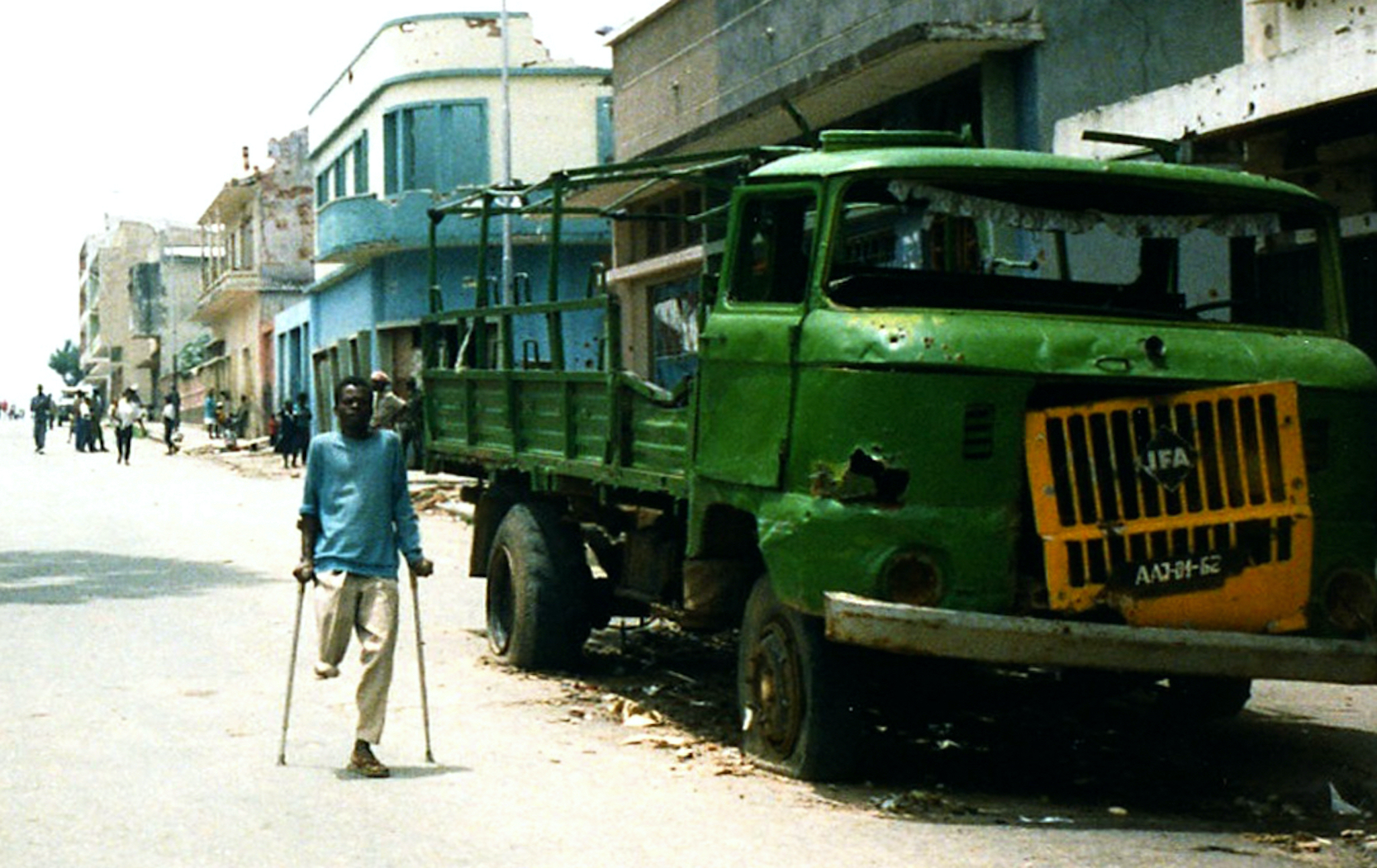
    I reported from Angola 1993-1995 as the Southern Africa radio correspondent for the Christian Science Monitor, and later on my own. The war took a terrible toll on civilians, mostly through the use of landmines, but also through murder and various forms of coercion. For a time, the civil war, extravagantly fueled by the US and the Soviet Union, with help from South Africa and Cuba, was known as “the worst war in the world.” Although that title has passed to other conflicts, Angola’s forty-one years of war remain a distinct chapter in the annals of human destruction. My pictures show a large number of mine victims. They do not seem disproportionate: astonishing numbers of amputees—mutilados, as they were called in Portuguese—made their way along the dusty streets in every town and village I visited. Those who had lost a leg were the most visible because they were on crutches. Steel or aluminum shanks whose rubber tips had worn away clanked and scraped along the pavement, radiating pain upward through the shoulders and contorting what had been a symmetrical body. Those who had lost hands, arms or eyesight, or had perished, hovered like ghosts. 
     
     
    A- Luena Central Hosp  Maternity clinic copyMaternity clinic, Luena Central Hospital, Moxico Province, 1996.


    A1- Luena Central Hospital copyKids outside the clinic, taking a break from a soccer game. They were highly skilled, using a crutch to whack a homemade rag ball. Most of the children had lost a leg to a mine, one to a gunshot wound.
     
     
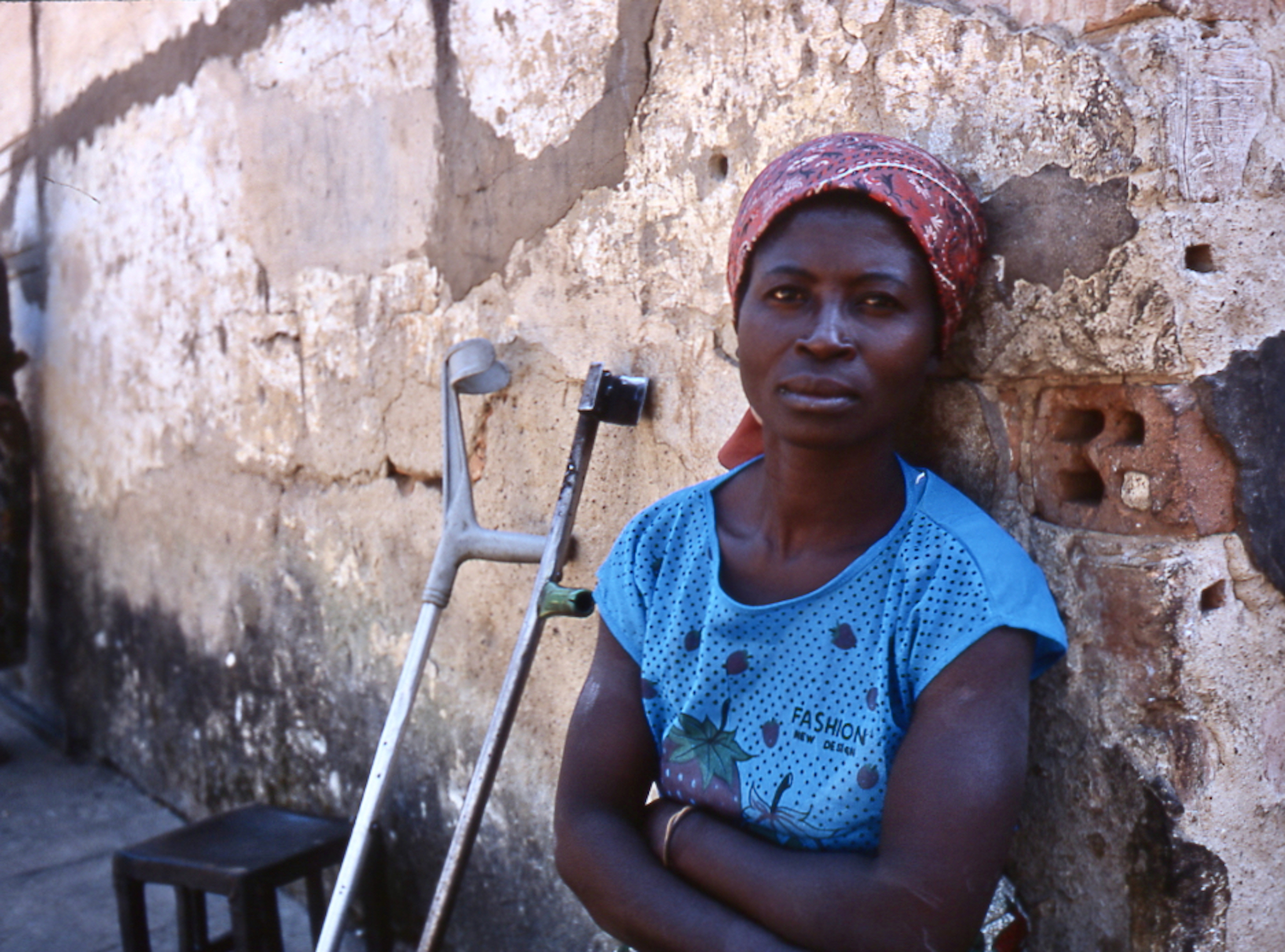
    B- Chisola Jorgeta Pezo copyChisola Jorgeta Pezo, outside the abandoned Luena railway station where she and other displaced lived, in 1996. An antipersonnel mine blasted off her right foot on June 2, 1990, while she was searching for cassava. She was age thirty-six at the time, with three children. Infection later required an above-the-knee amputation.
     
     
    B1- Sunday church copyChisola and friends at Sunday church in Luena.
     
     
    B2- Henrique Ferreira Cardoso  Secretary  Cazombo Dos church copyHenrique Ferreira Cardoso, Secretary, Cazombo Dos church. He lost a leg to a mine in 1984.
     
     
    C- Tomas Jonas and Jodiki Cadita  wife  Luena Central Hosp. copy 2

    Tomas Jonas and Jodiki Cadita, his wife, Luena Central Hospital, 1996. He stepped on a mine near Luena airport.


    C1- Joao Adolfo  Luena Central HospitalJoão Adolfo, a firewood seller, Luena Central Hospital.


    C2- Dr. Manuel Nzinga  Director  Luena Central Hosp. copy

    Dr. Manuel Nzinga, director and chief surgeon, Luena Central Hospital director. Over the years, Nzinga and three other doctors amputated the limbs of hundreds of mine victims. The hospital had no anesthetic, soap or disinfectant. Patients had to supply their own food or medicine.


    C3- Museum of Crutches  Luena Central Hosp  copyThe Museum of Crutches, Luena Central Hospital, Moxico Province, 1996.


    C4- Museum of Crutches  Luena Central Hospital copyThe Museum of Crutches, Luena Central Hospital, Moxico Province, 1996.


    C5- Luena Central Hosp.  malaria deathA woman grieves as the body of her mother, who just died of malaria, is taken to the hospital morgue, 1996.

     
    D - At Museum of Rev  Luena copyPeople living in the fuselage of a shot-down civilian airliner, Luena, Moxico Province, 1996.
     
     
    D1- Benguela Railway  Luena 1996 copyThe Benguela Railway yard at Luena, Moxico Province. Carriages on the cross-country railway provided some shelter for the displaced, 1996.
     
     
    D2- Museum  Luena copyThe Museum of the Revolution, at Luena, was repurposed as shelter for displaced Angolans.
     
     
    E- Chisola  daughter  Luena RR station copyChisola Pezo and her daughter walking to the abandoned railway station, Luena, 1996.
     
     
    F-Luena RR station copyA boy living with other displaced in the railway station, 1996.
     
     
    G - Broken angola  1994 Luanda copyA mine victim, walking in Luanda, 1994.
     
     
    H - A soldier with a visiting general at Cangando garrison  near Malanje  after a battle with UNITA. copyAn Angola general visiting a soldier he described as a hero, in the central highlands, after a fierce battle with UNITA forces that left a field full of dead, 1995.
     
     
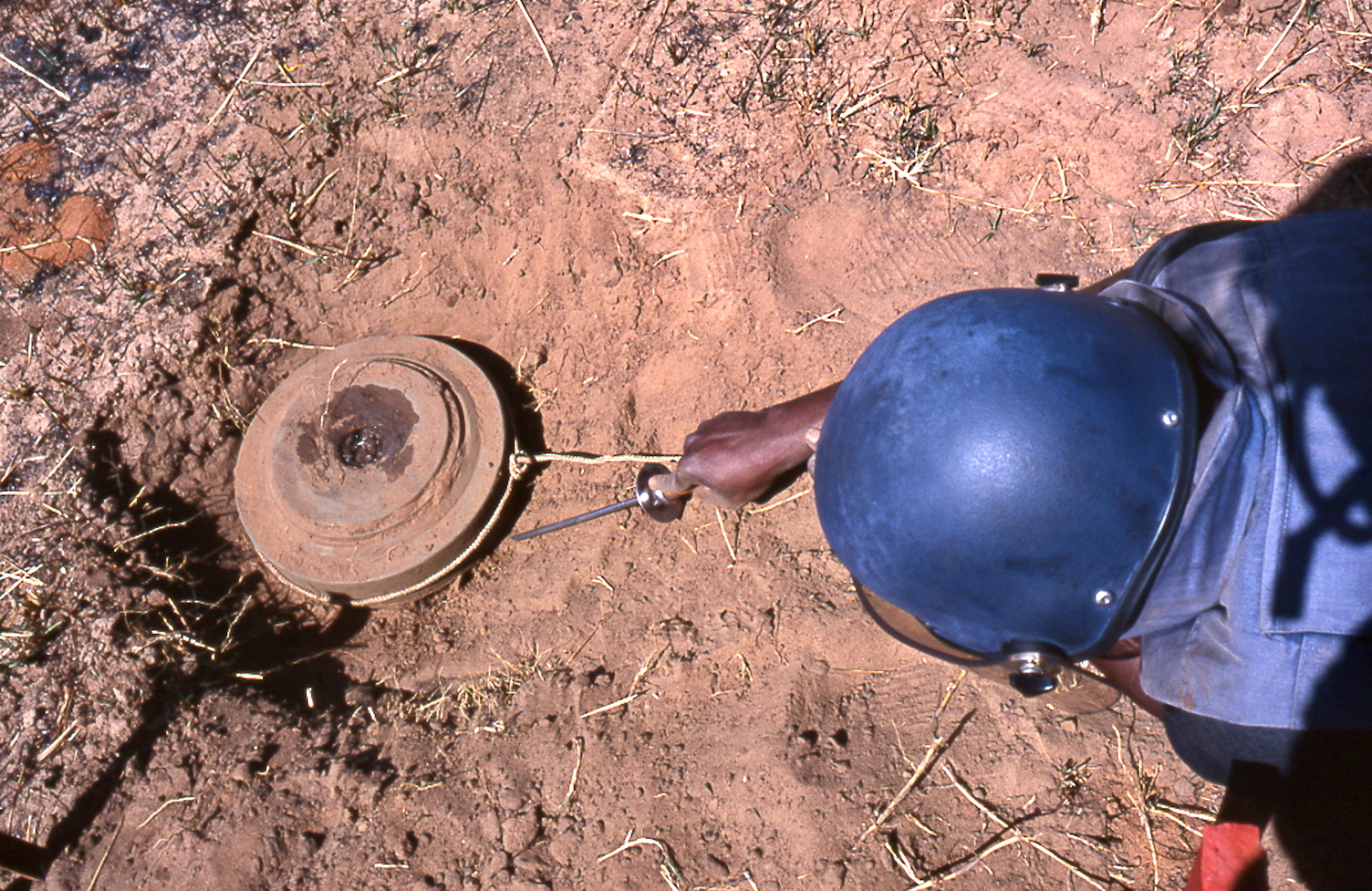
    I- Francisco Muiengo  MAG  with MAI-75 copyFrancisco Muiengo, an engineer with the Mines Advisory Group, disarming a Romanian-made antipersonnel mine. A Russian anti-tank mine is visible underneath. Combatants often stacked the mines to maximize casualties.
     
     
    I1- Paulo Generoso and TM-72 mine. Generoso is Chisola's brotherPaulo Generoso probing around an antitank mine. Generoso, an engineer with the Mines Advisory Group, was Chisola Pezo’s brother.
     
     
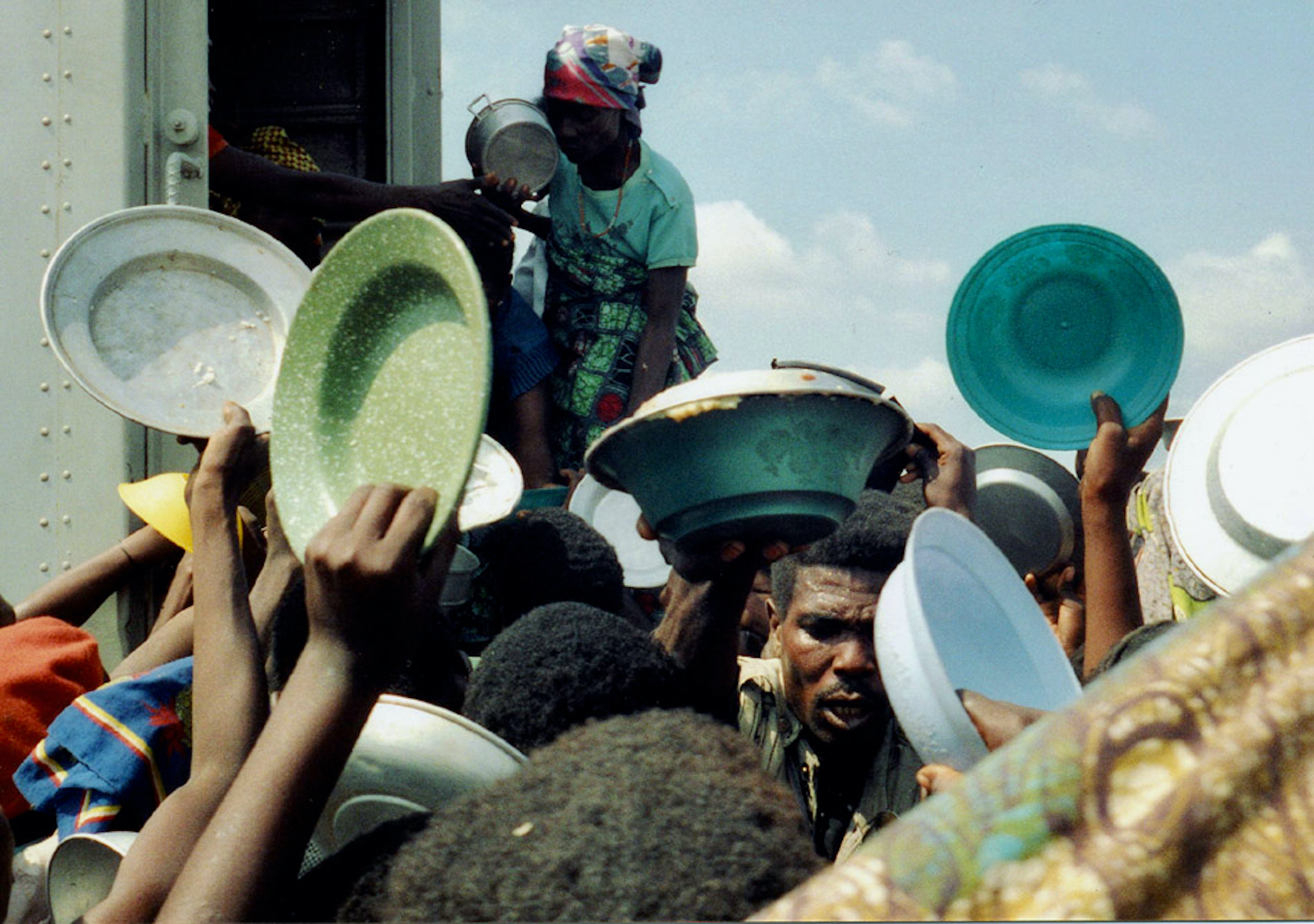
    J- Caxito camp  feeding center  north of Luanda. copyCaxito camp feeding center for the war-displaced, north of Luanda, 1994.
     
     
    K- an emergency feeding center 1995An emergency feeding center, 1995. The message on the T-shirt was the election slogan of Angola’s ruling MPLA party.
     
     
    L- A young Angolan soldier  ill with malaria  at a bush camp near Menongue. copyA young Angolan soldier, sick with malaria, at a bush camp near Menongue, Cuando Cubango Province, 1995.
     
     
    M- In Malanje a medic treats a gunshot wound with the enzyme-rich flesh of a papaya. copyIn Malanje, in the central highlands, a medic uses papaya pulp to treat a gunshot wound.
     
     
    N- Family cooks in ruined building  KuitoA family cooks in a ruined building in Kuíto, central Bié Province. UNITA besieged the city for nine months in 1993. More than 30,000 civilians were killed or died of starvation, burying the dead in back gardens. Bié Province vice-governor Estêvaõ Kossoma told me that for nearly a year, “The only song we heard was the sound of shelling. The only smell we knew was blood.”
     
     
    N1-  Kuito kids copyChildren in Kuíto hoping to sell a few potatoes and ground nuts during UNITA’s nine-month siege of the city.
     
     
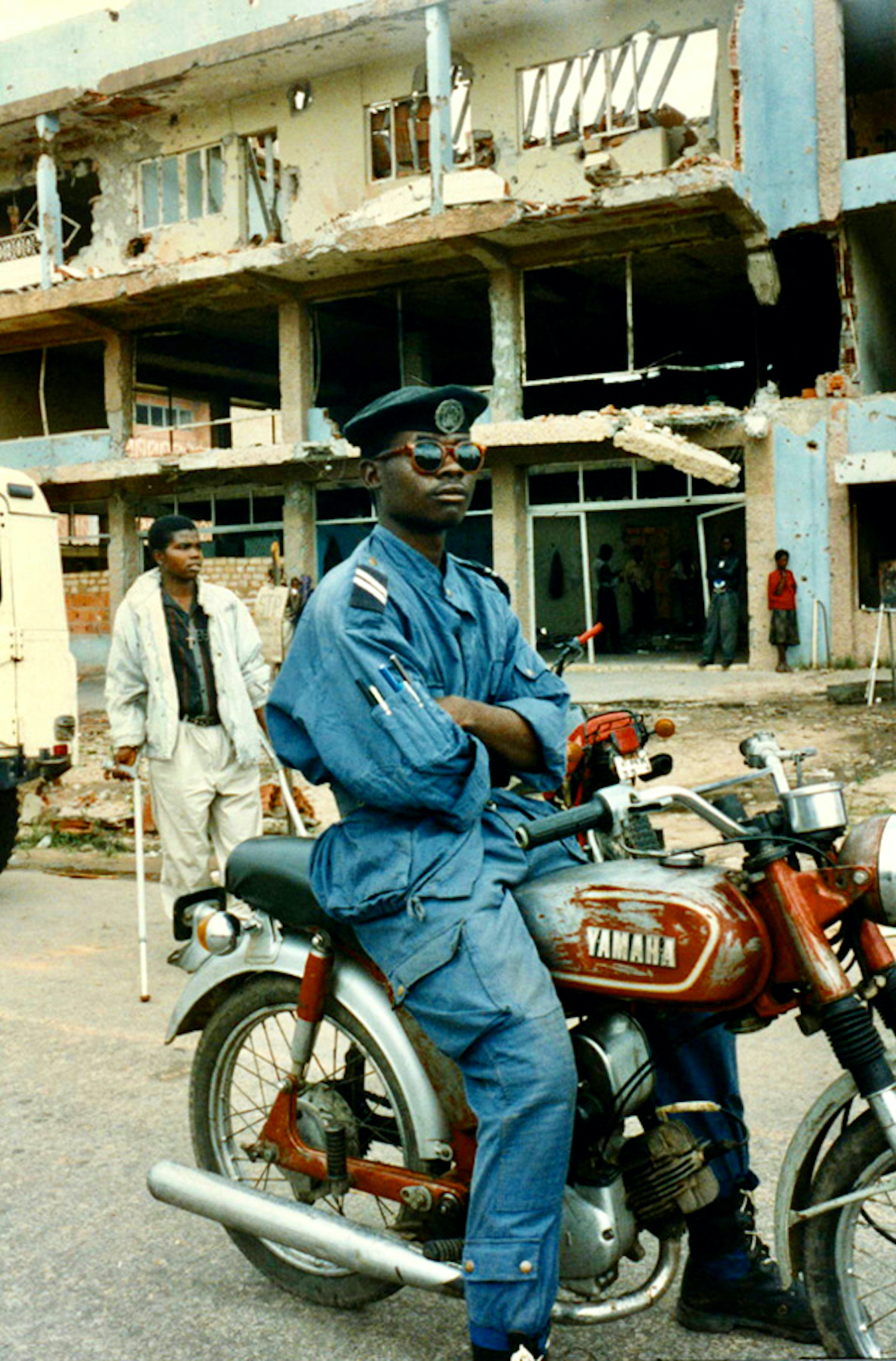
    N2- A Kuito policeman with nothing to police during the siege in 1994. copy

    A police officer with nothing to police, during the siege of Kuíto, 1994. A mine amputee stands behind him.


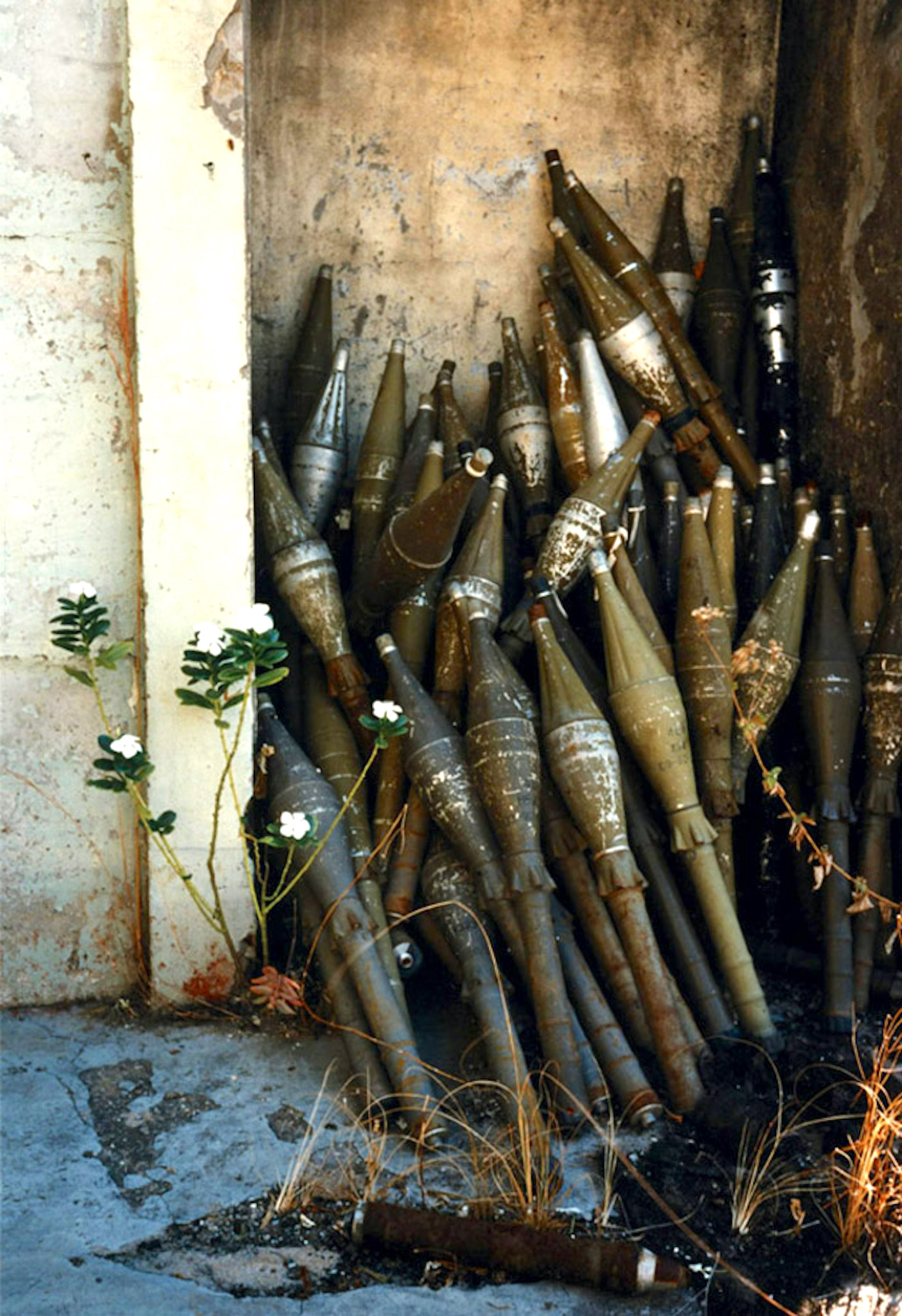
    O- Abandoned rocket-propelled grenades found by a Mines Advisory Group team near Luena in 1996. copyAbandoned rocket-propelled grenades, near Luena, 1996.


    P- Canhengue  8 km from Luena  Moxico copy

    Near Canhengue village, Moxico Province. Landmines rendered large areas of land unusable.


    P1- Which path is safe.. Outside Canhengue  Moxico prov copyNear Canhengue, Moxico Province. No path could be said to be safe.


    P2- Eastern Moxico prov  copyCharcoal traders bicycle on a mined road near Canage, eastern Angola near the Zaire border.


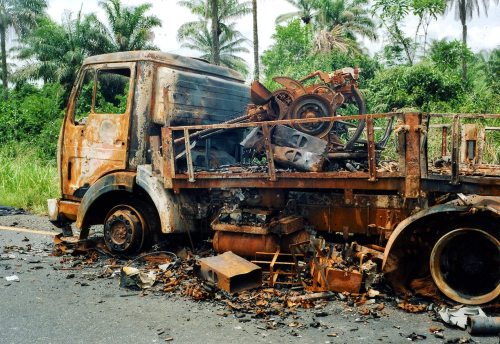
    P3- Eastern Moxico prov  copyThe road was littered with the remains of blown-up trucks. About a dozen civilians were said to have been killed when this flatbed hit a mine.


    P4-Eastern Moxico prov copyThe boot of a soldier who had been on one of the trucks.


    P5- Moxico Prov

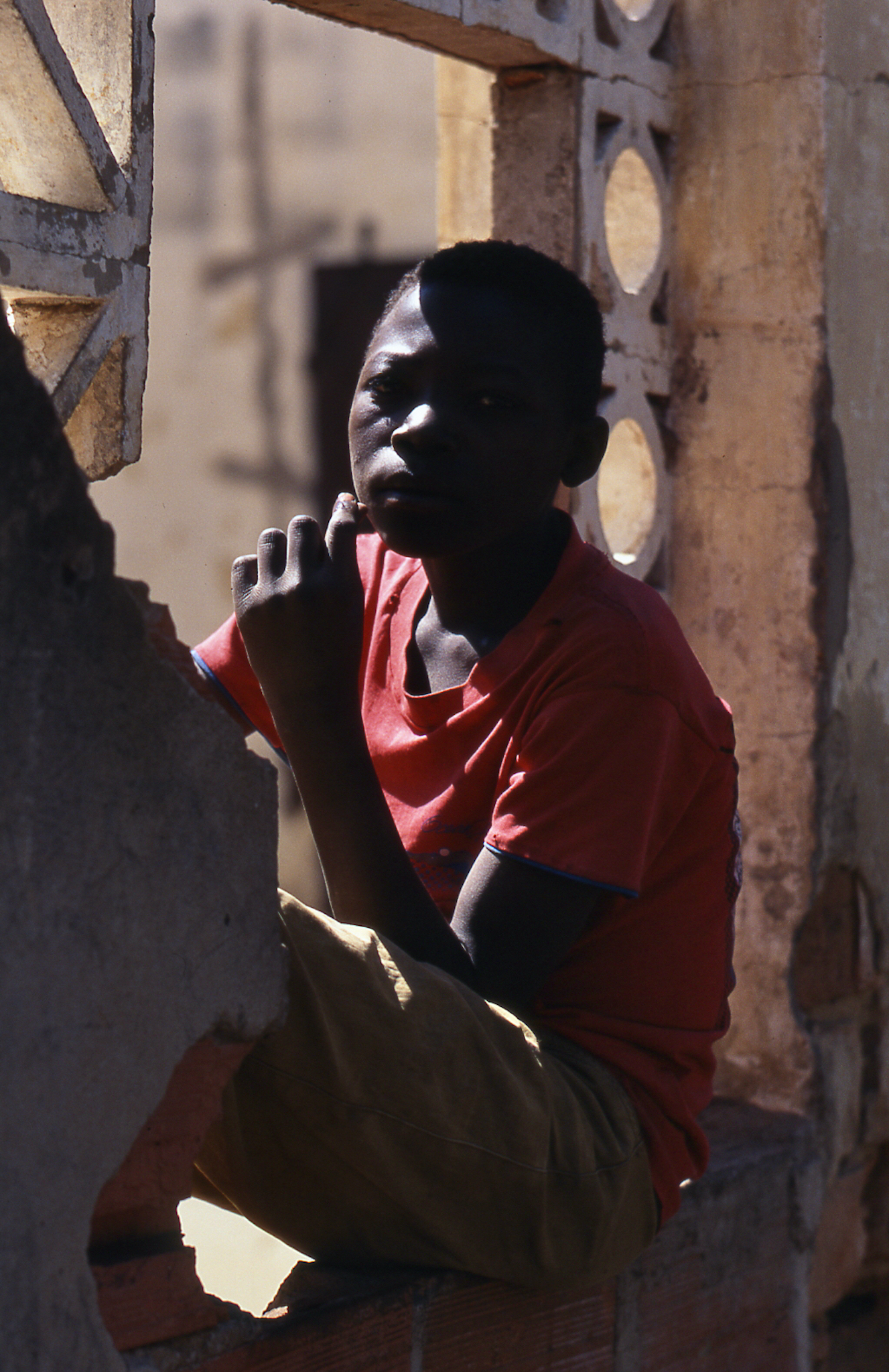
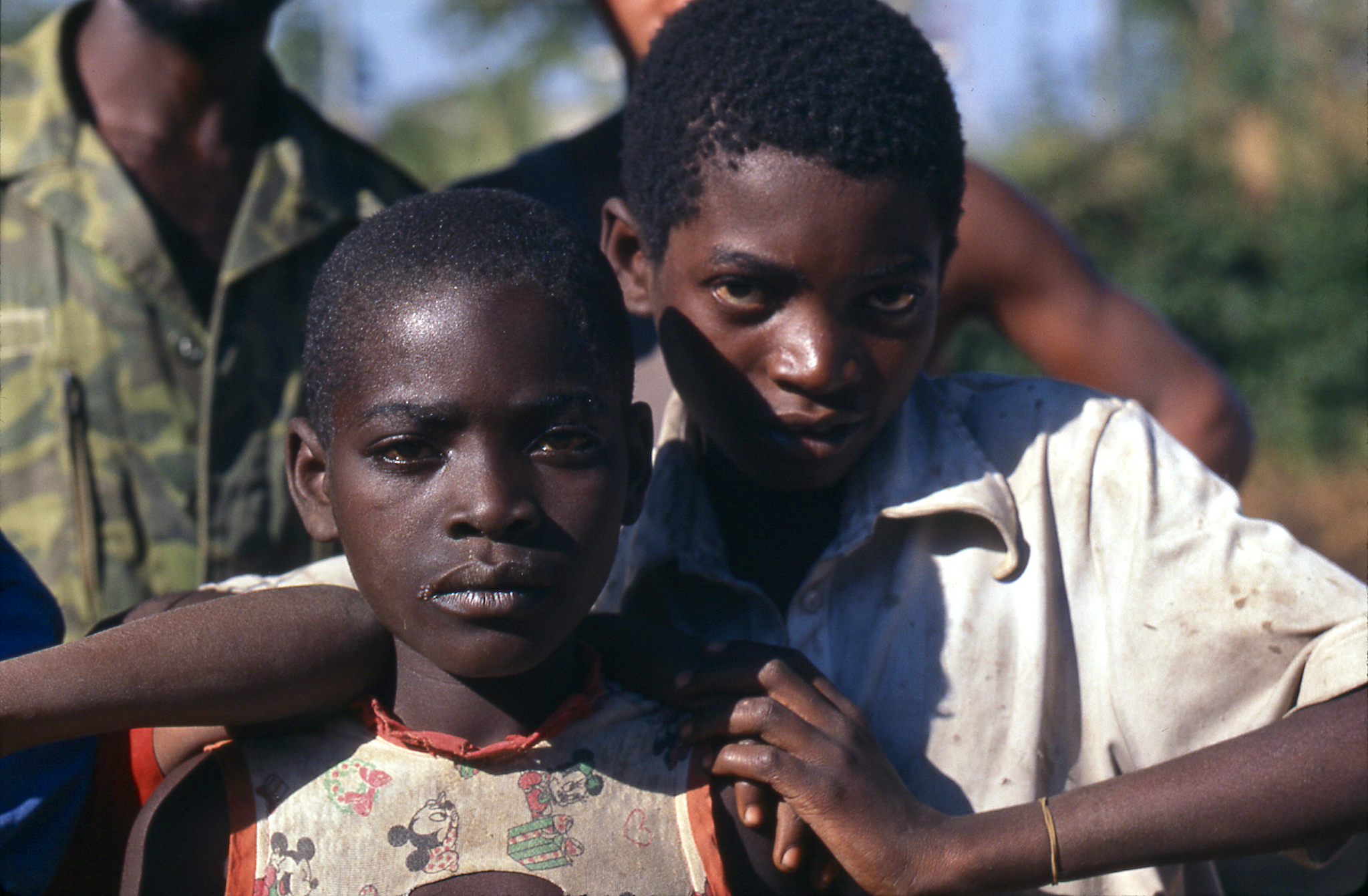
    Children in Moxico Province.


    Q- The Barracuda Restaurant  as seen from inside  where patrons enjoy cold drinks and excellent food.The Barracuda restaurant, a popular watering hole for foreigners and wealthy Angolans, near Luanda.

     
    Q1- The Barracuda Restaurant near Luanda. mutilados' - await handouts. Barracuda popular watering hole for foreigners  wealthy Angolans.

    Outside the Barracuda, mine victims and former soldiers silently wait for handouts.


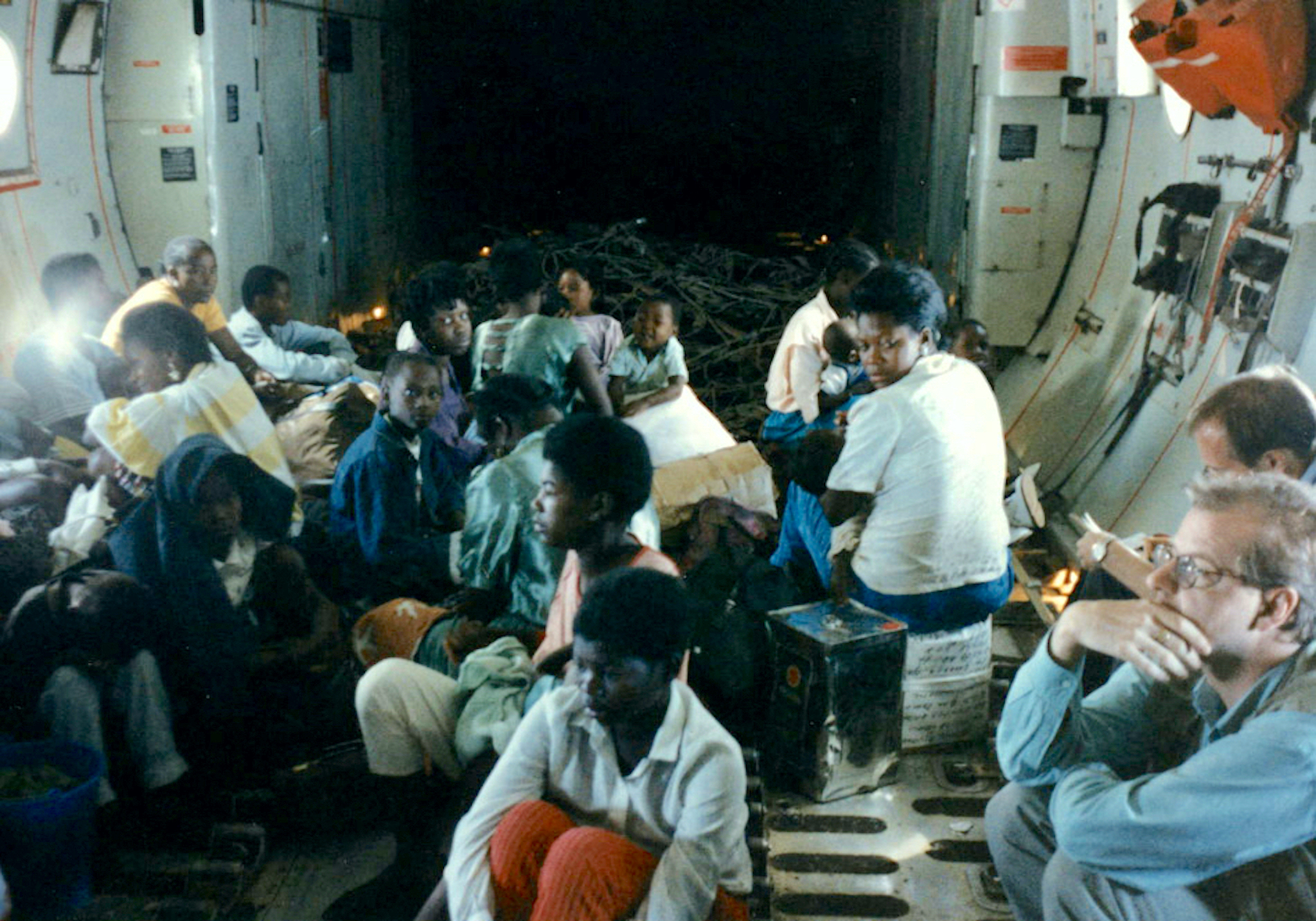
    R- wounded soldiers on flight to LuandaWounded government soldiers, their families and a few journalists on a cargo flight from the highlands back to Luanda. In the forward hold lay a heap of broken weapons gathered from a battlefield. When the plane landed, the children on board inexplicably began whooping and smashing the broken weapons.


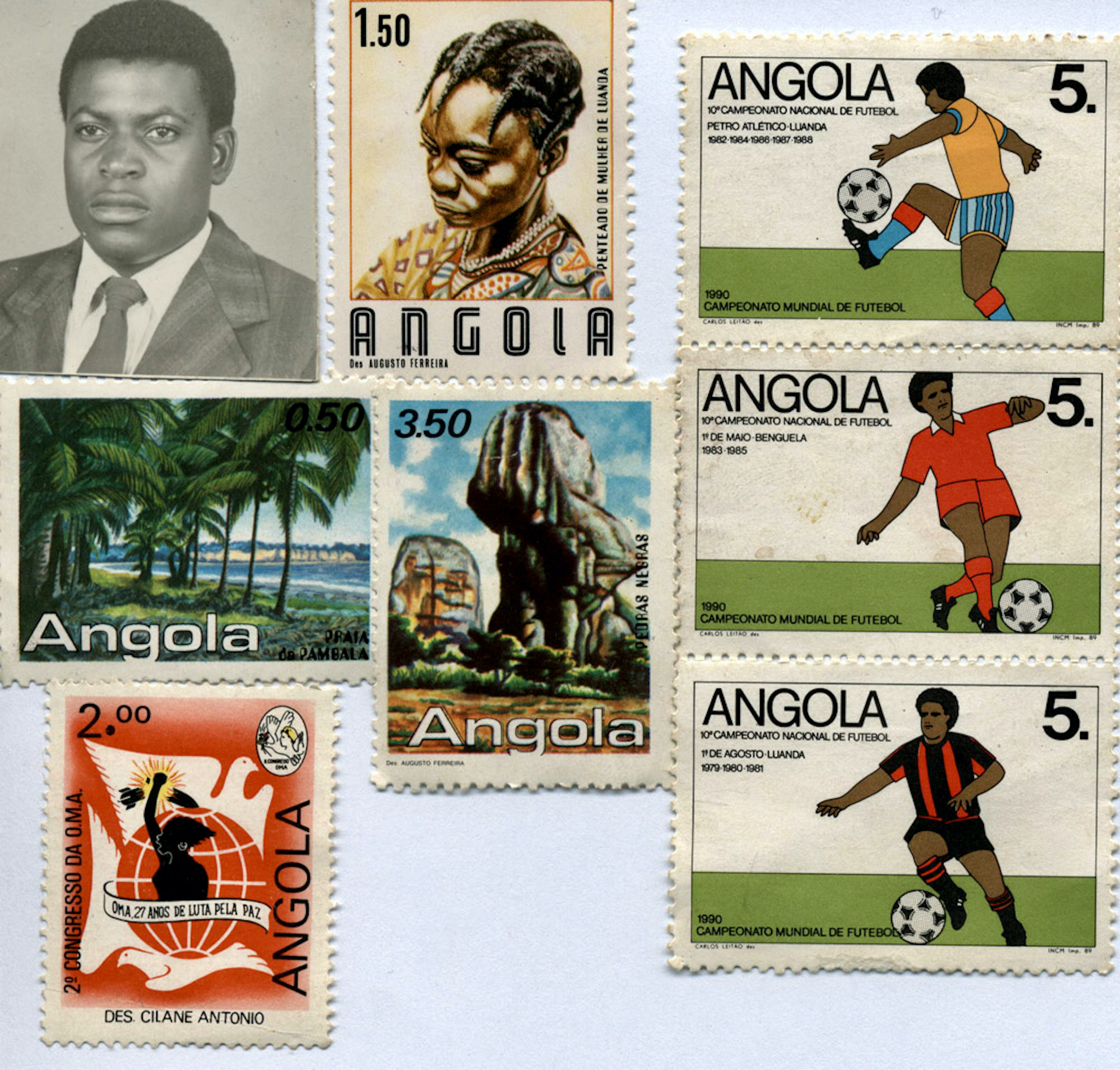
    S- Tchau! So long! Farewell gift from Luena. never knew man's name. Gave his pic  stamps and hand grip of AK-47 copyTchau! So Long! This man, in his thirties, and I chatted at a ruined army barracks near Luena. As I left, he turned out his pockets and handed me the contents: a picture of himself in better days, some postage stamps, and the broken hand grip of an AK-47 rifle. I never knew his name.


    About the Author 

    Philip C. Winslow has been a journalist for fifty years; he has worked for the Christian Science Monitor, the Toronto StarMaclean’s Magazine, ABC Radio News, CTV News, and CBC Radio. He also served in two United Nations peacekeeping missions and spent nearly three years living in the West Bank. He is the author of Victory For Us Is to See You Suffer and Sowing the Dragon’s Teeth.

  • A Q&A with Dr. OiYan Poon

    OiYan Poon and Asian American Is Not a Color

    Author photo: Anna Cillan. Cover art: Carol Chu

    Before being struck down by the US Supreme Court in June 2023, affirmative action remained one of the few remaining policy tools to address racial inequalities, revealing peculiar contours of racism and anti-racist strategies in America. In Asian American Is Not a Color: Conversations on Race, Affirmative Action, and Family, Dr. OiYan Poon looks at how the debate over affirmative action reveals the divergent ways Asian Americans conceive of their identity. Through personal reflective essays for and about her daughter, Dr. Poon combines extensive research with personal narratives from both herself and a diverse swath of individuals across the Asian American community to reflect on and respond to her daughter’s central question: What does it mean to be Asian American? Beacon Press publicity assistant Mei Su Bailey caught up with Dr. Poon to chat about it.

    Mei Su Bailey: One of the most poignant and unique parts of your book is how you begin and end each chapter with a letter to your young daughter, Té Té. They’re so moving and really show how these policy issues are so personal and impactful. How did you make the decision to address this book to your daughter and structure the chapters this way? 

    Dr. OiYan Poon: I had been trying to write a book on Asian Americans and affirmative action since at least 2012. Each time I started, I couldn’t figure out who my intended audience was. As a result, my writing process kept stalling out. I was accustomed to writing for scholarly and technical audiences but had a hard time explaining things to wider audiences—people who are intelligent, curious, and civically engaged.

    Like many toddlers, my daughter started to ask a lot of questions when she became verbal. I found myself talking with her and asking questions, driven both by a curiosity of how she was thinking and a desire to support her exploration and learning of what it means to be Asian American. The decision to adapt an epistolary approach was a way to keep me accountable to being nurturing and supportive in sharing things I’ve learned through my lifetime and career, while remaining caring and curious in conversation. It challenged me to tell a compelling story about how people who identify as Asian Americans have made meaning of race and racism in different ways.

    MSB: In chapter 1, you write about the importance of intergenerational stories and how the “ancestry of changemakers” is so influential in defining Asian American identity. Who are some of these changemakers you think more people should know about? 

    OP: There are so many changemaking ancestors across generations and global diasporas! I included some in the book, but there are so many others! I would love if people learned more about and from people like Yuri Kochiyama, Grace Lee Boggs, Gabriela Silang, Mamie Tape, Patsy Mink, Dalip Singh Saund, Connie Wun, Anurima Bhargava, Larry Itliong (check out the new musical—Larry the Musical: An American Journey!), Taz Ahmed, Corky Lee, Deepa Iyer, Sahra Nguyen, Bill Ong Hing, Al Robles, among many other individuals. I think it’s also critical to learn from contemporary and historical community organizations and movements, including AAPI Women Lead, the Coalition to Protect Parcel C for Chinatown in Boston, the Asian American Studies Movement and Third World Liberation Front, Tuesday Night Project in Los Angeles, VAYLA in New Orleans, the Providence Youth Student Movement (PrYSM), Khmer Girls in Action, National Queer Asian Pacific Islander Americans, Desis Rising Up & Moving (DRUM), Asian American Midwest Progressives, Freedom Inc., the Asian Pacific Environmental Network, and so many more than I can name here. These are just some of the public figures and organizations I know about. There are countless teachers, community leaders, and members who identify as Asian American making a difference every day!

    MSB: Throughout your research, you spoke to thirty-six Asian Americans about their stances on affirmative action as well as how they conceived of their Asian American identity. What were some of the most surprising things you learned in your research? 

    OP: There are so many things that surprised me through this research project. Allow me to share three things I learned.

    First, it surprised me to learn that Asian Americans who opposed affirmative action understood that racism was a significant problem in the US that needed to be addressed. This stance on racism is different from traditionally White affirmative action opponents, who have argued that racism was not a problem that needed fixing.

    Second, both Asian American supporters and opponents of affirmative action were generally equally misinformed about how affirmative action worked. How they felt about affirmative action had much more to do with how they understood racism. If they understood racism as a systemic problem, they were more likely to support affirmative action. If they felt that racism was an individual or interpersonal attitude problem, they were more likely to oppose affirmative action.

    Finally, I was really fascinated that I generally enjoyed getting to know people who held policy opinions that were very different from my own.

    MSB: When writing about the many conversations you had with these community members, you say that you came into these interactions with the attitude of “I love you, therefore, I challenge you.” It was really striking to read this, especially since we live in an era in which political disagreements and divides often seem uncrossable. How did you balance standing up for your own beliefs while also centering humanity and love in the debate? 

    OP: The balance requires taking on an educator’s mindset—one that respects that everyone, myself included, is always learning and evolving. In my engagements with policy debates, I’ve come to realize that there is a vast majority of people who are uncertain about their stances on any given contentious policy. This majority in the middle are watching and listening to those of us who are key players in policy debates. Earlier in my career, I would furiously assert my arguments and evidence, assuming everyone listening was my opponent. Then I started polling my audiences at the start of many of my public talks. In a crowd of 100, there would always be a small group of firm supporters and another small group of ardent opponents, but the majority expressed uncertainty. I realized that audiences were curious and wanted to learn, and that my role was to be a caring teacher.

    Good teaching requires skillfully guiding people to follow their natural curiosities to explore and consider evidence and facts as they engage civically in the world. It requires teachers to also examine our understandings. I wish people engaged in political discourses would take several moments throughout the day to lead with curiosity and examination of evidence and ideas.

    MSB: I really enjoyed reading about how you are teaching Té Té about political activism and the importance of being engaged in her community, like going to protests and neighborhood campaigning. What are some other ways that parents and young activists can get involved and build solidarity? 

    OP: Parents and young activists can get involved in building solidarity and solutions to social problems in all kinds of ways. Children and teachers at Té Té’s elementary school recently started a Kindness Club, which is currently learning about poverty and class inequalities. They recently launched a toiletries drive for their community—an idea that the third- and fourth-grade members of the club designed with support from their faculty mentor. Recently, she has been asking me a lot of questions about the humanitarian crisis in Gaza. We have been leaning into our community of friends and families with elementary-aged children to support each other in learning more about the conflict and helping our little ones build their analyses, too. Collectively organized by a local grassroots group called Portraits 4 Palestine in Chicago, we have written letters to our Congressional representatives, local electees, and attended a Letters for a Free Palestine action to write to the Biden Administration. In every case, I follow and support my child’s curiosities, and offer ideas to take action.

    MSB: Now that we’re approaching the one-year anniversary of the US Supreme Court’s June 2023 affirmative action ruling, what do you hope readers take away from your book as we move into the future? 

    OP: The ruling in 2023 was devastating. We know that without an acknowledgement of the role racism plays in producing persistent inequalities in education and other social systems, colleges and universities in states that have had affirmative action bans have been losing out on talented students across racial demographics. This will have negative effects on achieving a more robust multiracial democratic society, unless community, institutional, and elected leaders take action.

    The 2023 ruling ended the consideration of race at the decision point in selective admissions. One critical tool was taken away. However, there are many other approaches and strategies that can be adopted to continue advancing diversity and fair access to the benefits of higher education. The ruling did not outlaw targeted recruitment efforts, scholarships, ethnic studies academic departments, initiatives to pursue minority serving institution (MSI) status and funding, and the collection and analysis of demographic data for organizational changes—to name just a few tangible strategies by public universities in states with affirmative action bans implemented prior to 2023. Yet today, we are seeing higher education leaders follow the fear of litigation in ending targeted scholarships for example, rather than their stated institutional mission statements and values. We need courageous and creative collective leadership to stand up for what’s right and morally just.


    About the Authors 

    Mei Su Bailey is the publicity assistant at Beacon Press. Prior to joining Beacon in 2024, Mei Su worked at various youth advocacy and literary organizations, including 826 Boston, Dear Asian Youth, and the Fir Acres Writing Workshop. She holds a degree in sociology and anthropology from Lewis & Clark College in Portland, Oregon, and graduated from the Columbia Publishing Course at Oxford. Outside of work, you can find her playing with cats, making things with yarn, and enjoying many bowls of noodle soup with chili oil.

    Dr. OiYan Poon is a codirector of the College Admissions Futures Co-Laborative (cafcolab.org). Her research agenda brings together organizational theories and race and ethnic studies to study rejective admission and selection processes, the racial politics of Asian Americans and education, and affirmative action policies. She has received grants from the Gates Foundation, Joyce Foundation, and Spencer Foundation to support her research, and her work has appeared widely in national media outlets including the New York Times, the Washington PostThe Atlantic, the Chronicle of Higher Education, and the New Yorker. She is the author of Asian American Is Not a Color: Conversations on Race, Affirmative Action, and Family. Follow her on Twitter (@spamfriedrice) and Instagram (oiyanpoon).

  • Andrea_Morales

    Welcome to our rebooted “Beacon Behind the Books” series! In these times when readers are responding to our books “more than ever,” when our authors—including Aubrey Gordon, Tanya Katerí Hernández, Robin D. G. Kelley, Angela Saini, Atef Abu Saif, and Percival Everett—are appearing in the media, their ideas going viral on social media, their voices being heard on so many platforms, we thought it would be good to take a break to focus on some of the staff who work hard to find, shape, edit, produce, and promote those works. Our blog series introduces to you a staff member and gives you a behind-the-scenes look, department by department, at what goes on at our office. And not only our staff, but our interns, too.

    This month, we introduce you to Andrea Morales, our digital and social media intern! 

    What drew you to publishing, Andrea? How did you find your way to Beacon?

    Since I was little, books have been my favorite place of solace. Once I found out that there are people who work on books for a living and are a part of a little thing known as the publishing industry, I knew I had to make my way there. In my sophomore year of college, I was lucky enough to gain an internship with Books & Books in Miami, FL, a local bookstore chain. There, I started off as an intern and made my way to part-time marketing and events assistant.

    It was my supervisor there, Cristina Nosti, who encouraged me to apply to Beacon Press. I love Boston and let her know that my plans, post grad, were to stay here and see if I could find any experience in the publishing industry. She pointed me in the direction of Beacon Press, and the rest is history!

    What’s a typical day in the life of a digital marketing intern?

    It can change from day to day, but mostly my job is to work on projects geared toward social media. A lot of it is brainstorming new content and then executing the content for Instagram, TikTok, Facebook, and Twitter. That means working with Canva, revising TikTok drafts, and overall being creative with whatever you’re doing. In addition, I’ve also had the chance to research influencers across platforms to see who’s the right fit to promote upcoming books.

    How much of what you learned in college have you found vital to your work?

    Studying public relations at Boston University has been eye-opening for me. What I've learned in the classroom directly influences how I approach my work. One key takeaway has been the importance of knowing our stakeholders inside out and communicating effectively with them. This lesson has been a game-changer, especially in the fast-paced world of social media, where reaching specific demographics is crucial.

    What helps you focus when you’re working?

    I’m the type of person who needs to have some sort of sound going on in the background. I would definitively say that my headphones are essential to a productive working day. Whether I listen to music or podcasts, it’s just nice to have noise while I do tasks.

    What skills have you taken from previous jobs to help you do your work at Beacon?

    I think the skills I have gained from previous jobs is my ability to produce fast results. For example, at Books & Books, details about author events could change at the drop of a hat, so it was my job to update event listings and reach out to potential consumers with the new information. In a similar vein, if there’s a pop culture event, we have to make content to cater to it, even if it’s on the same day.

    Favorite thing about Boston (or your remote home base)?

    My favorite thing about Boston is how it’s a city that encourages you to be outside. Whether it’s the (sometimes) reliable transportation system, its beautiful parks, or how every weekend there’s always a new event happening, it’s a city that wants you to join its community.

    Favorite food?

    Ooh, my favorite food is a traditional Nicaragüense meal. It’s pollo jalapeño, gallo pinto, queso frito, and tajadas. If that’s my last meal, I could leave this world with a smile on my face.

    Hobbies outside of work?

    As a proud member of AMC Stubs, I would definitively say going to the movies with my friends. I think we go at least once a week. Shout-out to the Boston Common AMC!

    Favorite album?

    Reputation by Taylor Swift. I’m still waiting for the (Taylor’s Version).

    Favorite podcast?

    The Broski Report with Brittany Broski.

  • A Q&A with Thomas Hitoshi Pruiksma

    Mountain and valley

    Photo credit: Trey Tallent

    Poetry and philosophy make a potent combination. Where can you get practical wisdom and spiritual sustenance delivered in condensed, musical language? That would be the Kural, the classical Tamil masterpiece on ethics, power, and friendship. Rich with indelible wordplay, learning, and heart, Thomas Hitoshi Pruiksma’s translation into English transforms the barrier of language into a bridge, bringing the fullness of Tiruvalluvar’s poetic intensity to a new generation. For National Poetry Month, Beacon Press assistant editor Nicole-Anne Keyton caught up with him to chat about the Kural’s influence on his creative writing and practices, what makes its spiritual insights distinct, and his course that teaches how to integrate its philosophies and ethics into our everyday lives.

    Nicole-Anne Keyton: I like this sentence from your course’s description about teaching from The Kural: “When you listen deeply to the voice of a great poet or teacher, you are listening not just to the voice of one individual, but to an entire lineage of thought, feeling, and action.”

    We see this in your own translation of the Kural, where you recall commentaries from the past to invite new pathways of thought. How does this affect your own creative writing and practices?

    Thomas Hitoshi Pruiksma: That’s a wonderful question. At a conscious level, when I’m in the process of writing, I don’t necessarily think about these things at all but I certainly do when I take a step back to look at the larger piece and revise and polish it. Then all the ways I’ve learned to read and all the things I’ve read offer themselves as exemplars and guideposts as I bring the work to its final form.

    Perhaps even more importantly, I’m aware that, at a much deeper level, not only my language but also my ways of perceiving the world have been shaped by my long engagement with Tamil literature as well as with the Spanish of certain Latin American writers, and indeed, with the history of the English language itself. I seek to know where the words I write or speak are coming from, to learn who have written or spoken them most memorably and how, and to allow this knowledge to inform everything I do when I write.

    N-AK: Can you share the anatomy of a kural from a poet’s perspective? What are the kural’s formal elements that define it? Far from a couplet, I’m aware. 

    THP: A kural consists of two lines, or rather, of a first full line and a second much shorter line. The first line has what we could call four metrical feet and the second a mere two and a half. Within the form, there is also a complex interplay of rhyming consonant sounds, sometimes at the beginning of words and sometimes in the middle of words, and a complex interplay of internally rhyming vowel sounds. These consonantal and internal rhymes can come together in a variety of patterns, but only when enough of them are there can the verse be called a kural.

    Within the rigorous structure of this form, however, Tiruvulluvar works wonders. He fills those six and a half feet with entire worlds, often by pairing two apparently simple observations. Take, for instance, kural 103:

    The weight of good done without weighing results—grace
    Greater than oceans

    I’ve tried to suggest something of the meter by the relative length of the lines, and something of the play of consonant and vowel sounds with “weight” and “weighing,” “grace” and “greater,” and “done,” “than,” and “oceans.” All these elements help the verse take us into the greater mystery of how astonishing such acts truly are.

    N-AK: The ancient platitudes of living and acting ethically in our world can often feel too abstract or distant for folks to grasp and wield in their daily lives. How do you see The Kural interacting with aspects of your own daily life? 

    THP: Although the Kural is often seen as didactic text, if one reads it closely, one notices how rarely it says to “do this” or “don’t do that.” Instead, the poet simply observes, with wit and good humor, how certain actions or states of mind connect to certain outcomes or possibilities. Take, for instance, kural 102:

    Even if small help given in time—far
    Far larger than the world

    This is a verse I think of often in my daily life because it reminds me to notice the true size of even a seemingly small act of kindness or assistance, whether it’s an act I see someone else doing or an act I’m contemplating doing myself. The verse trains my attention, and by training my attention, it strengthens my heart.

    N-AK: Could you share a situation, pivotal or mundane, where a kural came to mind in a moment of conflict, or a moment of joy? 

    THP: A number of years ago, I attended a political event where one of the leaders involved was both very charismatic and very controversial. I hadn’t been prepared for that and was uncertain how to proceed. Afterwards, of course, I could study up and come to a better sense of where to position myself, but in the moment itself, there wasn’t space for that. Then I found kural 691 echoing in my mind:

    With irascible kings move like one who warms
    By a fire—neither close nor far

    Even not knowing the background I’d come to know later, the verse gave me an image that helped me enormously in navigating a precarious situation. 

    N-AK: What makes the spiritual insights from Tiruvalluar’s Tirukkural unique from the Buddhist-influenced mindfulness that is so prevalent in our contemporary culture? Or from the poetic spiritual insights from the Tao te Ching and Rumi’s poetry, which are more commonly known to Western readers? 

    THP: Two qualities make the insights from Tiruvalluar’s Tirukkural particularly noteworthy. First, its verses are insistently focused on the nitty-gritty of daily life, unafraid to enter the complexities of our lives in families, in communities, in positions of leadership, and in love. They are meant to be lived with and practiced in the midst of life, not because of some ethical decree from above, but because they help love and good sense and compassion and harmony to flow more easily through our lives and deeds. Their very form—short, easy to carry, easy to memorize—lends itself to this practicality.

    Second, the Kural doesn’t align itself with a particular religious sect or school of metaphysics. Instead, it embodies an extraordinary openness to all people so that adherents of any number of traditions can find wisdom and guidance in its words. I’ve done several interviews with Buddhist teachers and practitioners, for instance, who note how many of its verses are consonant with genuine mindfulness and awareness. At the same time, people without any religious inclination or who might call themselves “spiritual but not religious,” or not even spiritual at all, can easily find hundred of verses that pertain to the complex work of being fully and joyfully human. 

    N-AK: What does your course, “Taller Than a Mountain,” aim to accomplish for those who are interested in learning how to integrate the philosophies and ethics of the Kural in their daily lives? 

    THP: Whether one has never heard of the Kural or has known of it for years, the prospect of actually studying it can be a little daunting. The work covers so many areas of life that one can feel at a loss for where to begin. It’s not exactly the sort of book one takes to the beach and reads in a single sitting. Though, come to think of it, that could be quite an afternoon.

    My primary aim in offering the course is to share a culturally and poetically informed way to enter the work that is as respectful of different people’s lived experience as of the work itself. I want to offer a framework or guide to the work as a whole so that people can navigate its chapters knowledgeably, easily, and insightfully. Through the way I’ve structured the course and its components, I also hope to share the key insights I’ve found for integrating the wisdom of the Kural into your practical life: let your curiosity lead, dare to listen with all of yourself, and go one verse at a time. That way, you can discover your own personal Kural of 2 or 20 or 200 verses—those that speak most directly to your life circumstances now. In the paradoxical way that poetry works, they may prove to be more than enough.


    About the Authors 

    Thomas Hitoshi Pruiksma is an author, translator, teacher, and performer. His translation of the classical Tamil masterpiece on ethics, power, and love, The Kural, was published by Beacon Press in 2022 and is the subject of his upcoming online course, Taller Than a Mountain. Other books include The Safety of Edges and Give, Eat, and Live: Poems of Avvaiyar. He speaks and performs widely, teaches for the Cozy Grammar series of online video courses, and has received grants and fellowships from the National Endowment for the Arts, 4Culture, Artist Trust, and the US Fulbright Program. Connect with him at thomaspruiksma.com

    Nicole-Anne Keyton is an assistant editor at Beacon Press. Nicole serves on the Raised Voices poetry board and is Beacon Press’s liaising editor for the National Poetry Series. In their spare time, Nicole can be found writing short fiction, creating moody Spotify playlists, making zero progress with their endless TBR bookshelf, and hanging out with their dog, Sassy.

  • By Howard Bryant

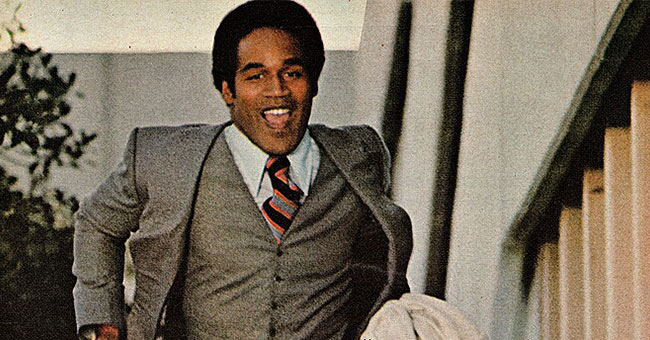
    O. J. Simpson in the 1976 Hertz Rent-a-Car ad

    O. J. Simpson in the 1976 Hertz Rent-a-Car ad

    Editor’s note: It bears repeating now that O. J. Simpson’s death was announced on April 10, 2024. One thing he will not be famous for is joining the heritage of Black athlete activists like Muhammad Ali, Tommie Smith, and John Carlos. As Howard Bryant explains in this passage from The Heritage: Black Athletes, a Divided America, and the Politics of Patriotism, Simpson helped usher in the era of the greenwashed Black athlete who chased big salaries and “colorblind” clout, all while kowtowing to white America.

    ***

    Americans have shown they can only discuss race within two frameworks: Things are better than they were or Get over it. So what exactly happened to the Heritage in the 1970s that began a nearly half-century slide into dormancy, when protest was transformed from noble to toxic? O. J. Simpson happened to it.

    These two racial frameworks defined the 1970s well, and OJ was the perfect embodiment of both. The country was tired, tired of war, tired of race, tired of fighting—and definitely tired of black people asking for stuff. America wanted to call itself colorblind (an odd aspiration for a place that also prided itself on being a “melting pot”), and Simpson represented the future, the hope, the American dream for both races.

    He was the anti–Jim Brown, the anti–Harry Edwards, which for black people meant that he was the symbol of long-promised equality and for whites, proof of their goodness and willingness to finally open the door, proof that black people could finally, at long last, stop bitching about race. All they had to do was work hard, like OJ, and if they had the goods, the rewards would come, just like they would for OJ. Across many a dinner table in white America, the frustration of “What do these people want?” was assuaged by the clean-cut, wholesome, and uncontroversial figure of O. J. Simpson. If they could only all be like him. Black people, tired of being represented by the Bad Negro (Sonny Liston, villainous boxer, line 1) or the Mad Negro (Jim Brown, rich, famous but always angry, line 2), desperate for the formula that would coax white society into accepting black people, were saying it too. “Give me a guy like O. J. Simpson, who is neat and clean and well-spoken,” wrote the longtime Chicago Defender columnist Doc Young. “You take all those guys who are too lazy to get a haircut, who foul the air with curses and other dirty words each time they have an audience, who talk about killing humans like the deed is no worse than swatting flies, all the while bemoaning ‘whitey’s’ brutality.” None of this would age well.

    Simpson was postracial before that became a thing. He benefited from the battles and the boycotts and the protests without having participated in them. In the 1970s, mainstream popular culture began to slowly permit an increasing black presence in television and movies, and commercial endorsements, and sports was already ahead of other industries in featuring African Americans. Someone was going to profit from this new day, especially if he was willing to leave the confrontation behind and make America feel good about itself, and O. J. Simpson was the one uniquely positioned to take full advantage of the exciting and lucrative new doors that were opening.

    ~~~

    While the government held hearings on redlining, and white resistance over school desegregation ripped cities apart (and black frustration that black communities were denied resources to improve their schools without having to attend schools with white children), the good life awaited O. J. Simpson. There were opportunities for black athletes to join the mainstream world of endorsements and integration that had never existed before, and OJ took advantage of every one of them. The other great, top-shelf player during the early 1970s was Kareem Abdul-Jabbar, but the ad men and marketers of Madison Avenue weren’t too keen on him. Kareem was too aware, too serious, and, most of all, too political. Simpson was by far the most attractive to the ad makers.

    And OJ was in the perfect storm. The bidding war for players between the NFL and AFL before the 1970 merger increased salaries. Simpson’s 1969 four-year contract was for nearly $400,000. It was once unheard of that a rookie would begin his career making $100,000 in a season, but the money was exploding in all sports. In the three seasons from 1972 to 1974, the Milwaukee Bucks paid Abdul-Jabbar $350,000, $378,000, and $399,000, respectively. In December 1975, what Curt Flood had started in baseball was finished when baseball arbitrator Peter Seitz ruled in favor of pitchers Andy Messersmith and Dave McNally. Both were granted free agency, and the reserve system was dead.

    When players asked for salary increases, owners had forever told them the teams were broke, but the money following the Seitz ruling exploded. In 1972, the Atlanta Braves made Aaron the highest-paid player in baseball at $200,000 per season. In 1976, the Yankees signed Reggie Jackson to a five-year, $3 million deal—$600,000 per season. Three years after that, Nolan Ryan became the first player to earn $1 million per season. In 1981, the Yankees signed Dave Winfield to the biggest contract in professional sports history: ten years, and—wait for it—$23 million. The following year, George Foster signed a free-agent deal with the New York Mets that made him the first player (because Winfield’s contract was backloaded) to earn at least two million dollars per season.

    The money even came with some ceiling-shattering seats at the table that just five years previous appeared unlikely. In 1973, the Milwaukee Bucks made Wayne Embry the first black general manger in NBA history. The next year, the Cleveland Indians hired Frank Robinson, the first black manager in baseball history. In 1977, Ted Turner, the new owner of the Atlanta Braves, made Bill Lucas, Henry Aaron’s former brother-in-law, the first black general manager in baseball.

    Less than a decade earlier, Bob Gibson, the legendary St. Louis Cardinals pitcher, had complained that his 1967 World Series MVP award may have come with a car but very few product endorsement opportunities. And that’s where O. J. Simpson steered the black athlete, from the Heritage to the suburbs, from identifying with black issues to green ones. Simpson opened a word of financial possibilities to black athletes. The baseball player Reggie Jackson and basketball star Julius Erving served as pitchmen for everything from Coca-Cola to TV sets. Before Jackson joined the Yankees, he once boasted, “If I played in New York, they’d name a candy bar after me.” And they did.

    Simpson embodied the new mind-set of the advertising suits on Madison Avenue so much that in 1975, the rental-car company Hertz made Simpson the first black man to lead an advertising campaign. He was a national name, and his commercials became iconic in sports and marketing history. They made him the most visible black athlete in team sports, and in terms of overall name recognition in America, only Ali rivaled him. Simpson wore the face of possibility, proof to the corporate world that Nixon’s notion of “black capitalism” could be profitable. In 1965, the mean average salary for black workers was $3,318 per year; by 1975, the figure had doubled. Black financial health was a concept attractive also to Jim Brown, and it would explain why over the years he would rather vigorously support a string of Republican politicians who ostensibly stood for positions anathema to the people who thought they knew the man. In the end, though, “black capitalism” was a clumsy, hopeful term that was essentially meaningless. While the players grew wealthy, the boon for the community in the face of redlining and illegal schemes to depress minority areas was nonexistent. This was illustrated in the faraway year of 2015, when the Federal Reserve Bank of Boston published a study titled The Color of Wealth in Boston, in which it calculated that the net worth of the average white Bostonian was close to $250,000. For non-immigrant African American Bostonians, nearly a half century after Nixon introduced black capitalism, the study found their next worth to total eight dollars.

    While selling his products to the black community, which was a major part of his appeal to Hertz, Simpson himself spent as much time as he could avoiding the same black communities in which he was raised.

    Meanwhile, in that same year, 1975, but in a different universe, Muhammad Ali, Pan-African, anti-capitalist despite earning $10 million the previous two years, the anti-OJ, sat down for an interview with Playboy: “I was driving down the street and I saw a little black man wrapped in an old coat standing on a corner with his wife and a little boy, waiting for a bus to come along—and there I am in my Rolls-Royce. This little boy had holes in his shoes and I started thinking that if he was my little boy, I’d break into tears. And I started crying. Sure, I know I got it made while the masses of black people are catching hell, but as long as they ain’t free, I ain’t free.”

    The Hertz campaign was brilliant, groundbreaking, and also sinister, proof that the right black face could sell not only to black consumers but also to white—with a catch. Black and white consumers could interact with Simpson the pitchman, but not with each other. In his Hertz commercials, Simpson was affable, appealing to white middle-class America, from Boy Scouts to grandmothers. He was seen racing through airports, cheered on only by white people. In fact, Simpson was often the only black person in his commercials, assuaging any white fear that the advertising industry was promoting integration. After all, one black person was acceptable. Two meant they were taking over.

    Advertising Age named Simpson the 1977 Presenter of the Year, even as he suffered one of the worst seasons of his career on the field, his last with the Buffalo Bills. The commercials were historic successes, helping to make Hertz the top rental-car company in America and O. J. Simpson a superstar. Simpson was as far from the Heritage as he could possibly be: nonthreatening, friendly, the guy you wanted to live next door. (Note: This would not age well, of course.)

    Simpson was also, in contrast to Abdul-Jabbar, a test case for a new conceit: the colorless black athlete. Where Abdul-Jabbar would feel socially isolated as a black man living in segregated Milwaukee, Simpson was attractive to the public, who liked to think of him (and themselves) as color-blind. The product-buying public loved Simpson precisely because he did not identify his blackness as a particularly obvious or important characteristic. That made him saleable in a way Kareem, Jim Brown, Jackie Robinson, and Bill Russell would never be. If the athlete was the most powerful player in the black American workforce because his success in sports suggested a more equitable, less race-conscious society, Simpson was the model for how capitalism was seen by whites as a vehicle, in their eyes, to erase racism. As Simpson once famously told New York Times writer Bob Lipsyte, “I’m not black. I’m OJ.” Black became green.

    Simpson encouraged the erasure. He did not discuss politics, on camera or off. There was, for him, no Heritage. He did not make whites uncomfortable with demands on behalf of his people. Simpson did not use his power as the best football player in the game to demand the hiring of a black head football coach in the NFL, even though the league had nothing that resembled a pathway to head coaching in a sport that profited heavily from black labor. Despite its big-name, Super Bowl quarterbacks—Terry Bradshaw, Roger Staubach, Bob Griese—the biggest name in football was Simpson, a guy whose teams made the playoffs exactly once in his ten-year career. Nor did Simpson use his celebrity to attack discrimination as Abdul-Jabbar and [Hank] Aaron did during the tense racial moments over segregation in housing in Milwaukee.


    About Howard Bryant 

    Howard Bryant is a senior writer for ESPN.com and ESPN the Magazine and has served as the sports correspondent for NPR’s Weekend Edition Saturday since 2006. He is the author of The Last Hero: A Life of Henry AaronJuicing the Game: Drugs, Power, and the Fight for the Soul of Major League BaseballShut Out: A Story of Race and Baseball in Boston; and the three-book Legends sports series for middle-grade readers. A two-time Casey Award winner (2003, 2011) for best baseball book of the year, Bryant was also a 2003 finalist for the Society for American Baseball Research Seymour Medal. In 2016, he was a finalist for the National Magazine Award and received the 2016 Salute to Excellence Award from the National Association of Black Journalists. He lives in Northampton, Massachusetts. 

  • By Alana Lopez

    James Baldwin, Los Angeles, California, 1964. Photo credit: R. L. Oliver, Los Angeles Times

    James Baldwin, Los Angeles, California, 1964. Photo credit: R. L. Oliver, Los Angeles Times

    One of the first ideas taught in my Literature of the Harlem Renaissance course last semester at Boston University was the concept of Harlem as a haven. In Claude McKay’s Home to Harlem, it was, as its name suggests, a motivating factor for its main character, like that of Ithaca for Odysseus. It was a hub of inventive and unorthodox expressions of self as shown by Louis Armstrong’s jazz or Gladys Bentley’s blues. For Rudolph Fisher, Harlem’s culture is familiar and, though often written off as a fad, rich with history and ultimately timeless in “The Caucasian Storms Harlem.” To James Baldwin, it is home and birthplace as well and, much like him, I’ve come to find that “home” and “haven” are vastly different things. 

    “We cannot escape our origins,” Baldwin notes in “Many Thousands Gone,” the second essay of Notes of a Native Son, “however hard we try, those origins which contain the key—could we but find it—to all that we later become.” Like so many of us, he holds a complicated relationship with the place he calls home, and I can’t help but be fascinated by the deftness with which he describes the collision between origin and identity: “those brutal criteria bequeathed to him at his birth.

    I come from a smaller town in Arizona full of people who look, think, and act differently than I do, and I can’t pretend that I wasn’t overjoyed to leave it for college. I hated it all through high school, so when I first got to Boston, and people asked where I’m from, I would say (verbatim): a nothing town from Arizona. I spoke about it with absolutely no affection. To me, home is and always will be something I left with a brisk pace and a hesitant glance backwards.

    Now, I experience such a contradiction towards my hometown. Two years later, I have come to realize that its narrowness would never negate the fact that it is still my home, still the place where my younger siblings would be raised, and still full of so many people I loved. I somehow simultaneously hate it and love it for everything that it is, and I’ve looked for a way to express this more articulately, more precisely, but I have always come up short. It makes me think of my friend Austin, who is from Arkansas and talks about it in this affectionate way that somehow cherishes and denounces it all at once. I have sought out a way to describe how one loves the (at times) suffocating place they come from in some twisted, backward way, how the place I’m from seems to be the source of all my folly and how I love it anyway. And Baldwin gave it to me.

    He speaks of his hometown in “The Harlem Ghetto,” its crowded streets “in desperate need of repair” that seem to incite constant congestion. “Like the insistent, maddening, claustrophobic pounding in the skull that comes from trying to breathe in a very small room with the windows shut,” he posits, and the description is so subtly familiar, slightly harsh, and full of the type of details you can’t quite convey unless you take the time to pay attention. It’s something you can only ever know when you feel it.  

    I find this perfect intersection of love and attention so interesting, which Baldwin expresses in “Autobiographical Notes” as it pertains to America as a whole, stating, “I love America more than any other country in the world, and, exactly for this reason, I insist on the right to criticize her perpetually.” I know, Austin knows, Baldwin knows: even when you find yourself condemning it with unrelenting conviction, it will still always be the place you know best. I only have Baldwin to thank for the answers to my incessant search for clarity.  

    When I moved to Boston—though it was a relief—I felt displaced and inconsequential to this new place that was not mine. It surprised me that both feelings can exist—that you can go somewhere else in hopes it will give you what your hometown cannot, only to find you feel that you don’t necessarily “belong” in either. The same attitude is reflected in the introduction of Notes of a Native Son written by Edward P. Jones as he discusses the feelings he had as an English student in Massachusetts: the feeling that your existence is an independent factor to the world around you.  

    When I am so used to being taught Chaucer, Austen, Defoe, and many other authors so far from the setting of my own life, it feels inordinately rewarding to hear thoughts of belonging and identity in Baldwin’s writing that reflect my own. I, too, have searched for traces of myself in other places, just to prove that I am not only a product of my environment, but it is just as Baldwin says: “I might search in them in vain forever for any reflection of myself. I was an interloper; this was not my heritage.” 

    More than anything, when I read Baldwin’s writing in class or for pleasure, I feel entirely too lucky to have my scope of understanding expanded. The converging issues of identity and belonging are ones that weigh heavily on my life and the lives of so many others; however, James Baldwin eases this difficulty. “I am what time, circumstance, history, have made of me, certainly,” he states in the preface of Notes, “but I am, also, much more than that. So are we all.” 


    About the Author 

    Alana Lopez is a sales and marketing Intern for Beacon Press. Currently, she is in her sophomore year at Boston University, studying English.  

  • A Q&A with Amy Caldwell and Perpetua Charles

    Atef Abu Saif and DON’T LOOK LEFT

    Atef Abu Saif in Gaza. Cover design: Carol Chu

    In October 2023, Minister for Culture for the Palestinian Authority and writer Atef Abu Saif was visiting family in Gaza with his fifteen-year-old son Yasser. They had only planned to be there for three days. On Saturday, October 7, during a morning swim, the bombing began.

    Abu Saif dispatched a series of WhatsApp and voicemail messages to his publisher, Ra Page of Comma Press UK, relaying his firsthand account in harrowing detail of the first eighty-five days of the Israeli invasion of Gaza. Compiled together, they became Don’t Look Left: A Diary of Genocide. Beacon Press joined ten international publishers, including Comma Press UK, to release his book as quickly as possible to call attention to the genocide in Palestine. Beacon Broadside editor Christian Coleman caught up with Beacon Press editorial director Amy Caldwell and publicist Perpetua Charles to chat about the release. Profits of the book will go to Palestinian charities committed to providing aid to the war’s victims: Medical Aid for Palestinians and the Middle East Children’s Alliance.

    Christian Coleman: How did you find out that Atef Abu Saif had written Don’t Look Left? What was the acquisition process like for this book? 

    Amy Caldwell: I’d worked with Ra Page, Atef Abu Saif’s editor at Comma Press in the UK, on a previous book, The Drone Eats with Me, which chronicles Abu Saif’s experiences on the ground in Gaza during the 2012 Israeli incursion. And then last fall, after the post-Oct 7 Israeli campaign and invasion of Gaza began, Ra reached out. I didn’t know Atef had been visiting Gaza on October 7, and it was, of course, distressing to hear. Ra was looking for contacts and help to reach out to US media that might publish the accounts Atef was writing as he was able to in the dull moments in between terror and grief and search for food and safety—an element of war he captures powerfully. And then he was getting the work to Ra when the internet was up, often via WhatsApp. I talked with my colleagues in publicity, who immediately put together list of contacts, and it really helped gets excerpts from the diary out into the US media.   

    In January, Ra reached out to say that he and Atef wanted to collect his writings from the war and put them out as a book with a group of international publishers and with all profits donated to Palestinian charities. I immediately said I’d love to be a part of it and would propose the book in house. My colleagues were uniformly enthusiastic. We’re a nonprofit mission-based press, and while we need to earn our keep, we are very clear about the political and human importance of certain books and particular historical circumstances. 

    CC: What are the similarities and differences between The Drone Eats with Me and Don’t Look Left?

    AC: Atef is such a skilled writer. One of the first things I felt as I began to read was that sense of him, of a writer who can deftly paint a scene, pick out a telling detail, bring a person to life in a few sentences. And so, while the content is often very tough, it’s not only that: one gets to know people, gets a feel for the texture of life in Gaza—the cafes, the food, the carefully tended gardens—before the war and under assault. He’s also a writer with a deep knowledge of the reality of war and occupation. As he notes, he was born into war, suffering his first wounds as a baby. 

    The situation—the scale of destruction, the presence of death and suffering—in Don’t Look Left is, of course, so much more dire than in The Drone. And members of his extended family are terribly, horribly wounded in Don’t Look Left. There are scenes that powerfully bring home not just the deaths that are occurring but the tremendous suffering, the terror, and the scale of it all. Early on in my reading, I found I was thinking about the pictures of European cities destroyed in World War II, and a short time later, Atef made the comparison himself.

    CC: How did Beacon decide to release Don’t Look Left as an eBook first and then in paperback?

    AC: The goal with this book was to get it out, to make the book available as soon as possible, and that meant eBook first. But we found that there was a strong demand from indie booksellers for a paperback edition, so we got a paperback out there as soon as possible.

    CC: Beacon had to work quickly to release the eBook and paperback editions. What were some of the editorial and production challenges that came up?

    AC: We had to do a lot of reading very quickly, clearly, and to think quickly about copy, designing a cover, discussing issues around publication dates and press announcements with a group of publishers in many time zones, and other behind-the-scenes tasks that have to be handled for books to be available online and at stores.

    CC: Molly Crabapple had already sent in her endorsement for Atef’s book. How did you manage to get a starred review from Kirkus Reviews in so little time?

    Perpetua Charles: Trade publications care about books that speak to urgent, history-making issues in our time. Even in less time-sensitive circumstances, my experience with Kirkus has been that they take time to seriously review—and feature prominently in their publication thereafter—books that stand to have a lasting impact on culture and in readers’ lives. It’s no surprise to me that they were among the first to respond to my pitch!

    CC: Is this the fastest you’ve put together a publicity campaign for one of our titles?

    PC: Yes! It was only two months ago but it’s already a blur. Helpfully, I worked with Atef on the publicity for his last book, and our collaboration with his other international publishers made the process quite smooth. Though Don’t Look Left was a last-minute addition to our list, I can’t think of a book more worthy of the effort.

    CC: How has media been responding to this international event of releasing his book as quickly as possible to call attention to the ongoing genocide in Palestine? Is media aware of how global and important this cause is?

    PC: Atef’s UK publisher, Comma Press, worked with other artists using their mediums to protest the genocide to generate an arts event in Manchester that supports the suffering citizens. Atef’s book is among the works being featured. A local Jewish organization called for the event’s cancellation, alleging Atef had issued anti-Jewish sentiments in the past. Artists and residents successfully petitioned for the event to be reinstated, and it will take place on April 22. Coverage of the politics surrounding this event and Atef’s involvement speak not only to importance of calling attention to the genocide through public events like this one, but also show how necessary it is for a light to be shone on those who wish to deny and discredit the suffering of Palestinians like Atef who have survived this siege. I hope the attention this event received leads to large and engaged crowd later this month, and that it encourages other outlets to keep writing about the significance of Atef’s and other survivors’ stories as this war rages on.


    About the Authors 

    Amy Caldwell is the editorial director at Beacon Press. She acquires in religion, with special emphases on interfaith issues; the relation between politics, culture, and religion; and how Americans live out their religious beliefs. She also acquires in science and society, as well as narrative nonfiction/memoir.

    Perpetua Charles joined Beacon Press in 2015. She is a graduate of Florida Southern College and earned her MA in Publishing and Writing from Emerson College. Perpetua has extensive publicity experience in the areas of race and culture, memoir, education, and history. Some of her favorite things include the Lord, TV, Disney princesses, books, 90s-00s teen pop, and the color pink. Connect with Perpetua on Instagram at @princessperpetuaa.

    Christian Coleman is the digital marketing manager at Beacon Press and editor of Beacon Broadside. Before joining Beacon, he worked in writing, copy editing, and marketing positions at Sustainable Silicon Valley and Trikone. He graduated from Boston College and the Clarion Science Fiction & Fantasy Writers’ Workshop. Follow him on Twitter at @coleman_II and on Bluesky at @colemanthe2nd.bsky.social.