The Broadside took a couple of days off for turkey, stuffing, and family fun. We’re back today with a reminder of why we shouldn’t spend our holiday shopping dollars without thinking about the impact of our choices.
 Whether to patronize a chain or a locally owned business is not top of mind for many holiday shoppers, but it should be. It’s a choice that has profound implications for our economy.
If you shop at an independent toy store, such as Be Beep in Annapolis, Maryland, you will likely see products made by Beka, a small toy manufacturer in St. Paul, Minnesota.
A family-owned business, Beka has opted not to sell to chains like Target and Wal-Mart. Doing so, explains co-owner Jamie Kreisman, would require moving production to low-wage factories overseas, which would eliminate what he and his brothers most love about the business: their relationships with their employees and working hands-on with their products.
Beka is healthy, but its future depends entirely on the survival of independent toy stores. Over the last decade, Wal-Mart and Target have aggressively overtaken this sector and now capture 45 percent of U.S. toy sales.
If you buy groceries for your holiday meals at an independent
grocer, like Catalano’s Market in Fresno, California, you will find
lots of food produced by small-scale, local farmers, such as Paul
Buxman.
A second-generation grower of peaches, Buxman nearly lost his farm
selling to supermarket chains, which demand cutthroat prices and
truckloads of perfect-looking, though often flavorless, fruit that only
industrial farms can supply.
With bankruptcy looming, Buxman dropped the chains and forged
relationships with independents like Catalano’s. He works hard to give
them the best fruit and they honor this by paying a fair price and
accepting the natural ebb and flow of supply.
Today, Buxman’s farm is back on track. Catalano’s is doing well
too, but owner Michael Catalano worries about Fresno approving still
more chain supermarkets and recently a Wal-Mart. Since 1998, the top
five supermarket chains, led by Wal-Mart, have doubled their market
share and now capture nearly half of all grocery spending.
Patronize an independent CD store, like Waterloo Records in Austin,
and you not only support a business owned by a music aficionado, but
help to ensure opportunities for new artists. Many beloved bands got
their start when a few store owners fell in love with their first
albums and began recommending them.
That does not happen at Wal-Mart, Best Buy, and other mass
merchandisers, which now account for more than half of all album sales,
but stock only chart-toppers and have no room for unknowns.
Chain retailers have expanded dramatically over the last two
decades. Home Depot and Lowe’s, barely a blip on the radar screen in
1986, control half of the hardware and building supply market. Barnes
& Noble and Borders account for half of bookstore sales. Every
sector is now dominated by a couple of chains, and Wal-Mart dominates
them all, capturing one of every ten retail dollars we spend.
We assume that the chains represent economic progress, but in fact they take far more out of our economy than they contribute.
As the chains have expanded, tens of thousands of independent
retailers have lost their livelihoods and laid off hundreds of
thousands of employees. A study by David Neumark at UC-Irvine found
that every new Wal-Mart store actually eliminates many more retail jobs
than it creates.
The expansion of the chains has triggered a cascade of losses in
other economic sectors. Some three million U.S. manufacturing jobs
have been eliminated since 1990, in part because the chains have
pressured companies, including Black & Decker and Levi’s, to slash
costs by moving overseas.
The chains also return very little of what their stores take in back
to the communities where they operate. A study in Maine by the
Institute for Local Self-Reliance found that only 14 cents of a dollar
spent at big-box store remains in the state’s economy.
In contrast, the study found that independent retailers spend more
than half their revenue locally. They bank at local banks, hire local
accountants, advertise in local media, and require many other local
services that chains do not. For mid-sized and smaller cities
especially, this is a vital source of economic activity and jobs that
pay a middle-class income.
In exchange for all the businesses and jobs they destroy, the chains
offer us employment in their stores. Wages for most of these jobs are
so low that many big-box employees rely on Medicaid, food stamps, and
other taxpayer-funded programs to get by.
None of this looks much like progress. In fact, what the big-box
model most closely resembles are the old colonial economies of the
European superpowers, which were organized, not to improve the lives of
the local inhabitants, but to extract their wealth.
This holiday season, we can declare our independence and begin
building a more prosperous economy by forgoing the chains and seeking
out locally owned businesses.
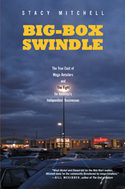
Stacy Mitchell is a senior researcher at the Institute for Local
Self-Reliance and author of Big-Box Swindle: The True Cost of
Mega-Retailers and the Fight for America’s Independent Businesses.
Use the comments below to link to your own favorite local stores, craftspeople, and family farms.


 Beacon Broadside
Leave a comment