by Glenn Branch

The missing link?
The recent battle over the place of evolution in Florida’s
state science standards wasn’t quite ripped from the pages of a Carl Hiaasen novel—as far as I could
tell from my office in California, at any rate, there were no greedy
developers, lubricious politicos, or redneck gangsters involved, and no feral
ex-governors emerging from the swamp to save the day. But zaniness was abundant
among the creationist opponents of the standards, from the fellow who testified that, according
to evolution, oranges are "the first cousin to somebody’s pet cat,"
to the student who argued
that evolution was unprovable because "no one was around 6,000 years ago."
(Then who was it who left a bottle gourd
at the Windover site outside Titusville, Florida, about 7,290 years ago?)
Ultimately, however, on February 19, 2008, the state board of education voted
to accept a new set of
state science standards that recognize evolution as a fundamental concept
underlying all of biology.
That’s quite a change. The previous set of state science
standards sedulously avoided even using the e-word, and when the Thomas B.
Fordham Foundation conducted its review of state science standards in 2005, it commented,
"The superficiality of the treatment of evolutionary biology alone
justifies the grade ‘F’." But hostility toward evolution education in the
Sunshine State is nothing new: after William Jennings Bryan retired to Florida
in 1920, he lobbied for legislation prohibiting "the teaching as true of
Darwinism or any other evolutionary hypothesis that links man in blood relation
with any form of animal life below man." Bryan was only partly successful;
in 1923, the legislature passed a resolution that described such teaching as "improper
and subversive," but stopped short of prohibiting it altogether. Two years
later, the Tennessee legislature passed a law outright banning the teaching of
evolution, and the Great Commoner eventually hauled himself from Florida to
Dayton, Tennessee, for the trial
of John Thomas Scopes.
Note, in Bryan’s proposal, the phrase "as true."
In a letter to a Florida state senator (quoted in Edward J. Larson’s excellent Trial
and Error), he explained, "A book which merely mentions
[evolution] as a hypothesis can be considered as giving information as to views
held, which is very different from teaching it as fact." Bryan died just
after the Scopes trial, but his position—that it’s okay to teach about
evolution, but only as a theory, something conjectural or speculative, and not
as a fact—continues to resonate. Creationists who weren’t pressing for
creationism (whether in the old-fashioned form of creation science or in the
new-fangled form of intelligent design) to be added to the Florida state
science standards were following Bryan in trying to stigmatize evolution as
just a theory. A father in the Panhandle put a Möbian twist on the
slogan, saying
of his daughters, "I just don’t want them to hear a one-sided fact."
As the biologist T. Ryan Gregory recently observed,
"That evolution is a theory in the proper scientific sense means that
there is both a fact of evolution to be explained and a well-supported
mechanistic framework to account for it. To claim that evolution is ‘just a
theory’ is to reveal both a profound ignorance of modern biological knowledge
and a deep misunderstanding of the basic nature of science." Nevertheless,
responding to the creationist pressure in Florida, someone—the details are
still hazy—proposed a revision, just days before the state board of education
was scheduled to vote on the new state science standards. The proposed changes
involved inserting the phrase "the scientific theory of" before
mentions of evolution. As the Orlando Sentinel reported,
"By adding the word theory, which many opponents of the standards had
argued for, the new version may appease those who do not view evolution as a
scientific fact or those whose religious beliefs are in conflict with
evolution."
Clumsy, unnecessary, and apparently opposed
by a majority of the writing committee, the revisions were accepted anyway,
despite a valiant effort on the part of board member Roberto Martinez, who described
the revisions as "an effort by people to water down our standards."
As the dust settled, though, it was increasingly clear that the revisions didn’t,
after all, succeed in materially compromising the scientific integrity of the
standards. Evolution wasn’t invidiously singled out for attention: plate
tectonics, cell theory, atomic theory, electromagnetism, and the Big Bang all
received the same treatment. Evolution is still described, correctly, as "the
organizing principle of life science" and as "supported by multiple
forms of evidence." And the standards distance themselves from the
pejorative sense of "theory" that creationists from Bryan onward like
to exploit: "a scientific theory is the culmination of many scientific
investigations drawing together all the current evidence concerning a
substantial range of phenomena; thus, a scientific theory represents the most
powerful explanation scientists have to offer."
Small wonder, then, that Florida Citizens for Science rejoiced: "Florida won!
Science education won! Teachers, students, Florida’s future economy, etc. all
won! No, it wasn’t a clean victory, but it was a victory nonetheless." And
small wonder, then, that Donna Callaway, the most strident voice against
evolution on the board of education, lamented, "Evolution won." But
the battle isn’t over yet: a handful of state legislators have threatened to
introduce legislation to amend the standards. In late January, the St.
Petersburg Times‘s Ron Matus interviewed the chair of the House Schools and
Learning Council, Joe
Pickens (R–Palatka) about the prospect of such legislation. "Among
scientists, there is virtually no debate about the fundamental soundness of
Darwin’s theory," Matus reported,
before quoting Pickens as saying, "most of the people who are our
constituents, and who vote for us, are not scientists." It’s to be hoped,
though, that even Floridians who aren’t scientists still care about the
integrity of science education enough to let their representatives know.
Update, March 3, 2008: It happened. On February 29, state senator Ronda Storms (R–Valrico) introduced a bill, SB 2692 [pdf], styled “The Academic Freedom Act.” Purporting to protect the right of teachers to “objectively present scientific information relevant to the full range of scientific views regarding biological and chemical evolution in connection with teaching any prescribed curriculum regarding chemical or biological origins” and the right of students not to be “penalized in any way because he or she subscribes to a particular position or view regarding biological or chemical evolution,” the bill would not affect the content of the standards, although it is clear that it was introduced at the behest at those who opposed their excellent treatment of evolution. A string of similar bills in Alabama—HB 391 and SB 336 in 2004; HB 352, SB 240, and HB 716 in 2005; HB 106 and SB 45 in 2006—failed. With only sixty days in the regular legislative session, perhaps the Florida legislature will be able to find something useful to do, instead of wasting its time mollifying creationists.
Glenn Branch is deputy director of the National Center for Science Education, a
non-profit organization that defends the teaching of evolution in the public
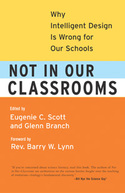
schools. With NCSE’s executive director Eugenie C. Scott, he edited Not in Our Classrooms:
Why Intelligent Design is Wrong for Our Schools (Beacon Press, 2006).


 Beacon Broadside
Leave a reply to BobC Cancel reply