Today’s post is from Stephen Burt, author of The Forms of Youth: Twentieth-Century Poetry and Adolescence (Columbia University Press). His essays and articles on modern and contemporary poetry have appeared
in many journals in America, Britain, and elsewhere, among them American Literary History, Boston Review, London Review of Books, the New York Times Book Review, the Times Literary Supplement, and the Yale Review. Burt is an Associate Professor of English at Harvard University.
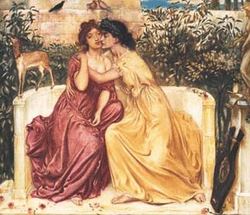
There have been gay poets—or, at least (if you prefer historical accuracy) poets who presented same-sex erotic passion—for as long as poetry has been written down; maybe longer. Think of Sappho, whose name has referred for centuries both to the idea of eros between women and to the ancient idea of lyric itself: think of what may be her single most famous poem, "He seems to me equal to a god, that man/ Who sits beside you," its first sentence a feint towards opposite-sex desire, its substance an homage to the young woman Sappho loves. Shakespeare’s sonnets, most of them addressed to a comely young man, have inspired centuries of arguments about his erotic investment in, "the master-mistress of my passion." Walt Whitman insisted that he wrote for, and about, both women and men, but what records there are tell us that he loved men; he put his poems about same-sex love ("adhesiveness," as he called it) in a discrete segment of his lifework, Leaves of Grass, entitled "Calamus" (after the phallic plant of the same name): Whitman inspired what later became gay movements as his poetry circulated internationally—in England, Edward Carpenter and J. A. Symonds thought they had found in his work a model for gay Utopia. Federico Garcia Lorca’s "Ode to Walt Whitman" called together, under Whitman’s name, the stigmatized homosexual men of the Old and New World, trying to wring new lives from their frequent self-hate.
The expansion of forms and inventions in American poetry after the
Second World War would not make much sense without the gay writers in
it, though many of them chose not to make their sexuality obvious in
their work. Even Thom Gunn, the transplanted Englishman
who later described the "barricades" of Pride Day in San Francisco, was
anything but explicit about sexuality in his poems of the 1950s and
early 1960s: he pointed out later, in interviews, that obviously gay
foreigners risked deportation. Frank O’Hara,
who might or might not have been surprised to find himself on so many
collegiate reading lists now, put his friends, his sex life, and his
friends’ sex life into his poems without apology: he even wrote a good
poem called "Homosexuality," and some of his most affecting poems came
out of his tumultuous love affair with the dancer Vincent Warren. And
yet, when O’Hara died in 1966, gay poets still felt that they had to
disguise their desires if they wanted to hold the respect of a larger
public: O’Hara himself reached (as he knew) only a coterie, and other
gay poets of his generation, poets whose books appeared from New York
trade houses to wide reviews, had to think hard about how much of their
love lives to permit into their work. Some of those poets—James Merrill and Adrienne Rich—kept writing for decades (Rich is still doing remarkable
work). The stories we tell about those poets’ careers are, in part,
stories about the new openness to gay experience, to same-sex love in
its many
forms and to the signs of gay subcultures, that those poets
felt able to get into poems, and able to publish, after the moment of
Stonewall.
The first book about a tradition of gay poetry in the English
language, the first book to say that there was such a tradition—and
that it was a good thing, that enduring poems could not have been
written had gay men and women not described that aspect of their
lives—was almost certainly Robert K. Martin’s The Homosexual
Tradition in American Poetry. Martin could draw direct lines
from Whitman to Hart Crane, to Gunn, to Merrill; in the same years Adrienne
Rich, and soon afterwards Audre Lorde and Marilyn Hacker,
could publish whole books, well-received books, now movement classics
(most notably Rich’s The Dream of a Common Language), about the new
loves in their own lives.
And yet only now, almost forty years after the Stonewall riots that
touched off the modern gay rights movement (the riots that are the
reason for Pride month in June), can we look back and see the
difference to poetry that Stonewall made: only now can we see a
generation of poets, at least in the United States, who have grown up
with the idea of gay pride, with the idea that their sex lives and
their love lives, in the first poems they publish as in the last poems
they write, can be either as clear or as hidden, as celebrated or as
subject to mixed feelings, as the poets’ own emotions allow. These
poets may offer snapshots from closeted years, from difficult teenage
lives, from scandals in their early lives, but they write in the
knowledge that almost anyone in this country who reads poetry seriously
will see coming out as something to be celebrated, same-sex love as,
simply, love. They write, now, after Vermont and Hawai’i and
Massachusetts and California,
for readers who know that a prothalamium or an epithalamium (poems in
formal celebration of a marriage) can celebrate a marriage no matter
the sex of the partners. They write poems of dilemmas, of difficult
emotions, of mixed feelings—Auden,
by some lights the most accomplished gay poet of the last 100 years,
called poetry the clear expression of mixed feelings—but they also
write for a climate in which same-sex love is love, as a matter of
course: a climate created by the movement and the moment remembered in
June.
It wouldn’t be fair to end without examples: here are two of my favorites—you can also find your own. D. A. Powell’s first book, Tea, described a coming out inseparable from a rough early life and from the advent of AIDS: Powell called a fine later book Cocktails,
meaning at once the drugs taken to treat HIV and a sociable round of
drinks. (You can read Powell’s own
blog at the Poetry Foundation this year.) If Powell’s poems
look back to the years of Act Up, Liz Waldner’s poems fit the "queer
and now" late 1990s in which they first began to acquire a following:
she describes love between men and women, love between women, desire
and erotic commitment—especially in her fine, slippery book Dark
Would (the missing person)—and draws clear lines from the
era of Sappho to the age of the text message and the drag king. Her
poems celebrate not only the variety of people we can love, but the
ways in which we can declare it: "What happiness and a relief," she
writes, "I once again seem to be me."
We invite you to share your own favorite poems on this theme in the comments below.


 Beacon Broadside
Leave a reply to sapp-hirepoetry Cancel reply