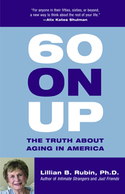
There are many differences between the two presidential candidates, but age is one of the most obvious. Beacon Broadside invited Lillian Rubin, author of 60 On Up: The Truth about Aging in America, to offer her perspective on whether discussing John McCain’s age amounts to "ageism."
 What is it with us anyway? Why is it that every time we coin words like racism, sexism, ageism – words that describe something real about prejudice and discrimination against a social group – we wind up applying them so frivolously that they lose all meaning? If commenting on Hillary Clinton’s pants suits is sexist, what do we call the guy who waves a sign that shouts "Iron My Shirts"? If it’s racist to say that it took President Lyndon Johnson to make Martin Luther King’s dream of equality before the law come true, how do we characterize the 3 in 10 Americans who say they would have trouble voting for a black man for president?
Certainly, there are sexist and racist undertones in American life, and the discourse in this election campaign has highlighted them. But when every slight, sling, and barb, from the benign to the malignant, is indiscriminately tarred with the same epithet, it substantially weakens the case for the real thing. Which brings me to the question of age.
The McCain campaign and its supporters cry foul when anyone even whispers that, if elected, he will be 72 years old when he puts his hand on the bible to take the oath of office. But if it’s ageist to ask whether a 72-year-old has the mental, emotional, and physical stamina to take on what is undoubtedly the biggest and toughest job in the world, what label do we give to the common corporate practice of not hiring people over 50? Ageism-Plus? And what to the real prejudice that reduces the old to caricatures from whom we want to turn away lest they somehow contaminate us with their "oldness?" Ageism-Squared?
Come on, people, get real. Sure, we’re living longer, healthier
lives, and on the average, many of us, especially if we’re middle class
and white, can now expect to live in reasonable health until somewhere
around 75 if you’re a man, 80 for a woman. But the operative phrase
here is reasonable health, and it’s operable only when we compare it to
earlier periods.
Is it ageism or sensible precaution when the government lifts the
mandatory retirement age for commercial pilots from 60 to 65, but
requires that when the captain of an aircraft is over 60, there must be
a second certified pilot on board who is under 60? Certainly, some 70-
or even 75-year-olds may be quite able to fly a plane as safely as any
50-year-old. But would you want to bet your life on it? If not,
isn’t it an equally fair question to ask whether we want to bet our
country’s future on a 72-year-old whose hand is on the nuclear
trigger?
Ask any of us who are living this new longevity. Long before we
reach our seventies, we’ve had plenty of reminders that various systems
are showing distinct signs of wear: memory slips, reflexes slow,
eyesight dims, people suddenly seem to mumble, muscles sag, knees
creak, energy wanes as we tire in situations we managed easily before.
Even when we follow all the advice about aging well — even when we
never put another pat of butter on our bread, eat another morsel of red
meat, or another bite of a trans-fat-filled cookie; even when we spend
an hour at the gym and run five miles a day, do brain calisthenics in
the morning and math equations in the evening — our bodies and brains
seem to have a mind and a timetable of their own that remain outside
our control.
It’s because we know these things, feel them in our bodies and our
minds, that recent polls have found that people over 55 are more likely
than any other group to hesitate to vote for a 72-year-old. It’s one
thing if I forget why I walked into my office, can’t remember where I
left my keys or my glasses, have trouble at times finding words, and
can’t always coordinate all my limbs as quickly and efficiently as I
did before. But what if I were President of the United States? Is it
ageist to ask what such lapses could mean, or is it political
correctness at its most absurd?
I don’t take a backseat to anyone in my condemnation of our
society’s prejudice and discrimination against women and men of "a
certain age." I’ve recently written a book about how hard it is to
grow old in America, about the revulsion we Americans feel for the
aged, about the millions who are abused by their caregivers while we
turn our backs, about the systematic job discrimination against older
people that continues despite laws that forbid it, about how much
ageism is the signature mark of oppression in our society. But there’s
something terribly wrong when we shout ageism for the "crime" of asking
for some public discussion about whether it is cause for concern for a
72-year-old to hold the most demanding job in the world, while we
remain silent about the real crimes of ageism.
Further reading: An interview with Lillian Rubin at Caring.com; her contribution to Dissent magazine’s Symposium 1968; and Claire Budoff Brown’s analysis of the alleged "codes" being used by Democrats to highlight McCain’s age.

 Beacon Broadside
Leave a reply to Bill Baar Cancel reply