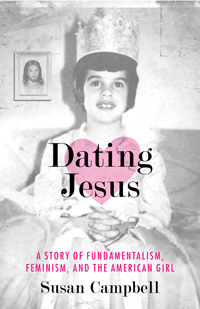
Today's post is from Susan Campbell, author of Dating Jesus: A Story of Fundamentalism, Feminism, and the American Girl. Campbell's writing has been recognized by the American Association of Sunday and Features Editors; National Women's Political Caucus; the Sunday Magazine Editors Association, and the Connecticut chapter of Society of Professional Journalists. She was also a member of the Hartford Courant's 1999 Pulitzer Prize-winning team for breaking news.
When did Sarah Palin become a fundamentalist?
I'd like to know, because I never once saw her in the pews of my own fundamentalist church in southwest Missouri, where I came to Jesus, taught Sunday school, and worked a church bus route.
When precisely did Sarah join the Elect, for whom the media has the strangest reaction, like at any moment we're going to reach into our satchels and start handling snakes.
(We aren't, I promise. At least, my church isn't. I can't speak for Palin's.)
Maybe Palin joined the flock about the time that video of her old church began circulating on the Internet, the one where they talked about "cell phone anointing." For people who treat their religions like a Sunday coat – take it out of the closet once a week, wear it and look pretty, and then slip it back onto a hanger until next Lord's Day – this was wacky stuff.
And so the media and the culture reach into its own satchel and pulled out the worst descriptor they could think of, religion-wise. She became "fundamentalist." Except a Pentecostal is emphatically not a fundamentalist. A Pentecostal's faith is open to latter-day revelations. A fundamentalist's faith is contained within the pages of the Holy Bible. There is no speaking in tongues. There is no laying on of hands, cell phone anointing, or – yes! – snake handling. No matter how rousing our song service might be, we cannot compete with the lively and loud charismatic worship of the Pentecostals.
In fact, Sarah Palin is no more a fundamentalist than Barack Obama is a Muslim. The faith-reassignment of both candidates (she's non-denominational evangelical with roots in Roman Catholicism and Pentecostalism; he's a Congregationalist) is based in an ignorance that is, like the Sunday school song we used to sing, deep and wide.
Fundamentalist or no, Palin will never be my candidate. She and I part ways on a woman's right to choose, on marriage equality, and on the sorry little wars in Iraq and Afghanistan. In fact, my list of reasons for not voting for her is so long that one hardly need bring religion into it.
But right's right, and the hypocrisy of labeling showed itself rather quickly. Some of the early coverage of Palin contained the breathless announcement that her church believes it is the guardian of the only path to heaven. Horrors! Did not the Roman Catholic (One, True) Church make roughly that same claim for centuries?
The afterlife will be interesting, because my church said the same thing. Even if you were baptized and attending church three times a week – as were we – if you were doing so at First Baptist, you were in scriptural error and in danger of hellfire.
Much has been made of her Pentecostal years because for some, it's a foreign faith. But then, from the outside looking in, all faiths can look pretty foreign. I used to think it odd that some Christians believe the communion wafer becomes Jesus' literal flesh. Now I think, "To each her own, I guess."
Though I've left the church, it pains me to think that that "fundamentalist" is the worst thing you can be if you are a candidate for a national political office. How about "warmonger?" That's a pretty bad thing, isn't it?
I learned to love Jesus as a fundamentalist. I learned to look out for my neighbors, pray hard, and find answers in my Bible. The stuff I rejected meant that I, in the eyes of my brothers and sisters in Christ, had to reject the faith as a whole – that women can never be clergy, that our faith is the only one God recognizes – but it wasn't as scary as all that. I don't have a tail. And I don't have horns.
If Palin possesses either, it's not because of her religion. She is an evangelical, the tribe of Christians to which, according to the Pew Forum on Religion & Public Life, roughly 26 percent of Americans belong. A fundamentalist is a unique (roughly three-tenths of a percent) subgroup of that, and Palin doesn't make the cut. Sorry. Most of you don't, either.
I don't either, not any more. We'll all just have to pray on that.
Boiled down, fundamentalists believe in the strict inerrancy of the Bible, and all the stories contained therein. We believe in adult baptism by immersion. We parse the little things. My church didn't allow instrumental music because Jesus never played the piano. (He didn't use air conditioning, either, but we somehow managed to make an exception for that bit of modernity.) We are more than a bit separatist. We'll be your friend, but we probably won't marry your cousin.
We are accustomed to being the bad guy, in part because our numbers are so small. But during this ragged election season, we'd do well to remember that every religion – including that of a fundamentalist – is nuanced. And just because you've never heard of a church is no reason to get scared.


 Beacon Broadside
Leave a reply to Victor Cresskill Cancel reply