 Today’s post is the latest in a Beacon Broadside series: Observation Post by journalist and foreign correspondent Philip C. Winslow. Over a career that has spanned more than twenty-five years, Winslow has reported on world events for the Christian Science Monitor, the Toronto Star, Maclean’s magazine, ABC radio news, CTV News, and CBC radio. He also served in two United Nations peacekeeping missions and worked for the UN in the West Bank for nearly three years. He is the author of Victory For Us Is to See You Suffer: In the West Bank with the Palestinians and the Israelis and Sowing the Dragon’s Teeth: Land Mines and the Global Legacy of War.
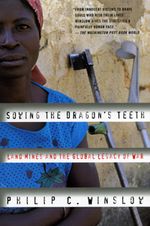 Angola’s decades-long terror often was called “the worst war in the world.” The civil war left as many as 1.5 million people dead and millions more maimed, orphaned and homeless. The description never seemed overstated.
Following a bloody struggle that ended with independence from Portugal in 1975, Angola plunged into a Cold War-fueled regional conflict that eclipsed all that had gone before. The Marxist government of the MPLA (Popular Movement for the Liberation of Angola) was backed by the Soviet Union, with Cuban fighters and others on the ground. Jonas Savimbi’s UNITA (National Union for the Total Independence of Angola) rebels were armed and supported by the United States and an aggressive, interventionist South Africa. Hopes for peace flickered for an instant before ill-timed elections in 1992; UNITA lost, and Savimbi re-started the war with intensified brutality. This chapter of the tragedy lasted for the next ten years.
Whatever destruction the superpowers and their several proxies didn’t facilitate
or sponsor, Angolan factions managed themselves. Like a terrestrial tsunami,
the fighting ground back and forth over a helpless civilian population. Beautiful
and productive cities such as Menongue, Malanje, Kuito and Luena were ringed
with land mines and shelled for months on end. Kuito, on the central Bie plateau,
was besieged — by UNITA and by government forces — for nearly a year in 1993
and 1994, and again in 1998 and 1999. Artillery bombardments were so relentless
that trapped families buried their dead in back gardens and eventually ate all
the town’s dogs, cats and even the rats. As many as 30,000 people, many of them
children, died from wounds and disease in Kuito alone. Strategic centers such
as Huambo and Luena and small towns like Cazombo were pounded into rubble, overrun
multiple times or just slipped into isolated ruin. A United Nations map is here.
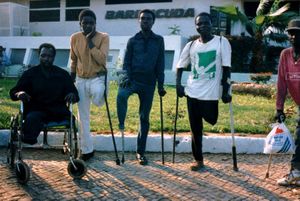
Landmines, laid by both sides, took a horrific toll, and Angola sometimes looked
like a nation of "mutilados," as the amputees are called in Portuguese.
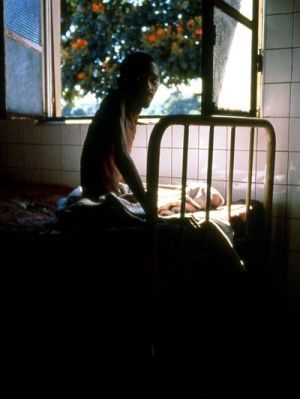
On a quiet evening in almost any town (there were few cars) an inevitable sound
was of bare-tipped aluminum crutches rhythmically striking the pavement. For
radio broadcasts I recorded the sounds but could not convey the smell of the
hospitals where exhausted doctors operated without anesthetic, nor could I find
words for the sour odor of unattended despair and death. Some photos of the
humanitarian crisis caused by the mines, which still claim lives today, can
be seen here.
 |
| Click here to view the entire album. |
Both sides forced children into their armies, tearing through villages to round
them up. I once asked a cold-eyed soldier guarding a compound in the central
highlands how old he was. "Twelve," he said. I asked how long he’d
been a soldier. "A long time," he replied, ending the small talk without
taking his eyes off me or his finger off the trigger. Twenty meters away, in
the weeds between zig-zag fighting trenches lay the uniformed skeleton of another
soldier. It was a very small skeleton.
As children or adults, Angolans’ lives counted for little with those who prosecuted
the war. From Luanda to Luena civilians sarcastically referred to the MPLA and
UNITA, interchangeably, as "the owners." Civilians in most provinces
depended on the UN World Food Programme and persistent international charities
for food and medical aid; because of the mined roads, all aid had to be transported
by air, and it was never enough.
The shroud began to lift in 2002 when Jonas Savimbi, once Washington’s darling
"democrat," was killed in a gun battle. Defeated on the battlefield,
UNITA reverted to being an opposition movement, although with little leverage
against the MPLA. After 27 years of war, Angolans were beyond destitute. More
than four million people had been displaced, the country was littered with explosives,
and the national health, education and transport infrastructure was reminiscent
of an earlier century.
I hadn’t been in Angola since 1996 and wanted to know if any of its 13 million
people had gotten the "peace dividend," as the fingers-crossed phrase
used to have it. With estimated oil reserves of at least 9 billion barrels,
Angola is the second largest producer of crude in Africa, after Nigeria, and
oil accounts for more than 80 percent of government revenues. The U.S. imports
about 450,000 barrels a day from Angola, its seventh leading supplier. China
imports even more.
Superficial reports looked encouraging. Oil production was up, some of the
millions of mines have been cleared, life was said to be improving in some places,
and the government was promising still more. A construction boom was underway,
I read, to get the country moving and to prepare for hosting the Africa Cup
of Nations in 2010. Roads and bridges were being built and plans revived for
a $2 billion upgrade of polluted Luanda Bay, with parks and pricey hotels. I
envisioned Angolans with jobs, and money circulating through the system to those
devastated towns.
But beneath the headlines, the indicators of a nation’s health painted a darker
picture. Statistics vary slightly by agency and methodology, but all are grim.
Seven years after the end of the war, an Angolan’s estimated life expectancy
at birth is 38.2 years, one rung above the bottom on a list of 224 countries.
(An American can expect to live to age 78, a Japanese to 82.) The infant mortality
rate (IMR), the number of infant deaths per 1,000 live births, is an estimated
180, the highest in the world (the IMR in the U.S. is 6.2; in Japan 2.8). Angola’s
maternal mortality rates are roughly four times the world average. The incidence
of water-borne, food-borne and vector-borne diseases, which contribute to the
alarming death rates, remains very high.
Using the World Bank’s Worldwide Governance Indicators project, you can generate
a set of tables that compare factors such as rule of law, corruption control
and accountability in 212 countries. Angola hovers depressingly close to the
bottom in all categories except for political stability. (The charts also show
that the Angolan leadership is not unique. It has plenty of company in the world’s
league of bad governance.)
Why does this continue in a country blessed with rich farmland, natural resources
and ocean ports? Political stability ought to facilitate economic growth, after
all. In the 2008 elections, the first in 16 years, President José Eduardo
dos Santos’s MPLA, not surprisingly, won 82 percent of the vote. President dos
Santos has led the country since 1979.
For a current perspective, I asked Paula Cristina Roque, a long time Angola
and Africa security expert at the Institute for Security Studies in Tshwane,
South Africa, what went wrong.
"The post-war environment, due to the military defeat of such a strong
movement [UNITA], provided the MPLA with the opportunity to consolidate its
authoritarian hegemonic power," she told me. "This was further accomplished
after the ‘legitimacy’ and legality conferred [on] the government by what were
deemed free and fair elections in September 2008. What has happened since has
been a crackdown on the media and NGOs [non-governmental organizations]. The
opposition was crushed and are trying to gain a voice but without any success.
Angola has become a de facto one-party police state. The role of SINFO [Angola’s
main internal security agency]), certain advisers, generals, and Sonangol [the
state-owned oil company] are now the pillars – with the presidency at the apex."
Are there prospects for change, hopefully through the ballot box? Change could
come through a strengthened reformist faction in the MPLA, Roque said, but the
picture is more complex and more worrying.
"Change in Angola will come from either the military that will want to
equate their newly acquired economic power with political influence – [that
is] the generals, or within a movement led by a lower-ranking officer, propelled
by the need to cleanse the regime after it continues to fail the population
and unrest becomes a serious possibility."
Roque pointed to another destabilizing factor: imported foreign labor. For
instance, most of the 900 workers building the 50,000-seat football stadium
outside Luanda are from China. As part of China’s massive investment drive in
Africa, driven by the search for minerals and oil, tens of thousands of Chinese
workers come along with the deals. From Algeria to South Africa the practice
has raised concerns about excluding local workers.
Angolan writer Artur Pestana, known as Pepetela, compared the society to a
volcano waiting to erupt unless the government tackles poverty and social exclusion.
"If that volcano one day explodes, we cannot say there weren’t enough warning
signs," he said.
The divisions in society have been clear throughout war and, now, peace. The
head of a pro-democracy group said in 2007 that with power and business wealth
concentrated around the highest echelons of the MPLA there are "special
Angolans" and "the rest of Angolans who are part of the landscape."
Those part-of-the-landscape Angolans, the nearly three-quarters of the population
who live on less than two dollars a day, are a strong people and easy to like.
You can see some of the ones I met between 1993 and 1996 in these pictures.
 |
| Click here to view the entire album. |
Finally, a few more images from that vivid and lovely country during the war
years:
On a C-130 cargo flight from Menongue back to Luanda, the main hold was filled
with wounded government soldiers and the relatives of others, plus a few reporters.
In the forward hold, inexplicably, was a massive heap of broken and rusted AK-47
rifles and machine guns that had been collected from the battlefields; they
were beyond use or repair. When the Hercules landed at Luanda airport, a team
of small barefoot boys swarmed up the back ramp, hoping to earn a few cents
carrying luggage. But when they spotted the broken guns, something came over
them and they stopped in their tracks. Then, yelling like banshees, they dashed
forward and began pounding and smashing the junk weapons with an astonishing
fury. Hearing the commotion, soldiers arrived and shooed the boys off.
I’ve often wondered what became of one young fellow I met in Luanda. He was
about nine, and was sitting cross-legged on a broken sidewalk next to a pile
of empty toothpaste tubes he had collected. From the pile, he set aside the
best-looking tube and then starting cutting open the others. With a tiny flat-tipped
stick, he painstakingly scraped out the remaining tubes and began packing the
lumps of paste into the one tube through its nozzle. With intense concentration
he was making a full tube to sell on the street. In Angola empty toothpaste
tubes, believe me, are really empty. It was going to be an all-day job.
Around the same time, in early 1994, World Food Programme flights out of Luanda
were grounded due to fighting in the interior. I had a day to kill, and with
my tape recorder wandered down to Luanda Bay. I fell in behind two young men,
one of them blind and carrying a homemade guitar. Alongside the foul-smelling
bay, where a couple of rusted half-sunk freighters shimmered in the heat haze,
they sat on a decrepit bench and started singing. The blind man played, and
his friend tapped out rhythm on the guitar box. I listened for awhile and then
asked if they had any ballads about the war. "No, man, we don’t do songs
about politics. We only do songs about love." And this is what they sang.


 Beacon Broadside
Leave a reply to Steve Cancel reply