By Jeremy Adam Smith.
What happens when we define some people as more human than others? A Q&A with Susan Fiske about the new science of racism. Note: This post originally appeared on the Greater Good.
The questions raised by racism and xenophobia go straight to the heart of what it means to be human, for they involve dehumanization. Prejudice means we implicitly embrace a definition of humanity that includes some—usually those who most resemble us—and excludes others.That’s why Susan T. Fiske was invited to speak at Being Human 2013, a showcase (co-sponsored by the Greater Good Science Center) of scientific insights into the nature and direction of our species.
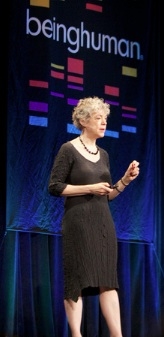
Susan T. Fiske speaks at Being Human 2013.
As the Eugene Higgins Professor of Psychology and Public Affairs at Princeton University, Fiske has become one of the leading investigators of stereotyping, prejudice, and discrimination, and she is the author or co-author of many books, including Envy Up, Scorn Down: How Status Divides Us, and The Human Brand: How We Relate to People, Products, and Companies, just released this month.
Fiske has especially explored how snap judgments shape our social interactions. She has found that people we see as warm and competent elicit the most positive emotion and behavior from us. Unfortunately, however, her studies show that those perceptions are heavily influenced by factors like race, age, gender, disability, and more—and that this millisecond social-sifting translates into widespread stereotyping and discrimination.
As Fiske described at Being Human, all over the world it is the poor, homeless, and immigrants who bear the brunt of discrimination, eliciting feelings of outright—but often subconscious—disgust from study participants. I spoke with her backstage at that event about her research and hopes for a future without prejudice.
Jeremy Adam Smith: What does prejudice reveal about what it means to be human?
(more…)