• A Q&A with Alexandra Lytton Regalado
    Alexandra-Lytton-Regalado-and-Relinquenda

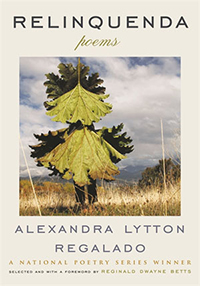
    Cover design: Louis Roe. Cover art: Verónica Vides. Author photo: Lucy Tomasino

    When COVID-19 broke and the United States closed the border to travel, poet Alexandra Lytton Regalado was separated from family back in El Salvador. She wrote Relinquenda entirely during lockdown as a meditation on cancer, the passing of her father, and the renewed significance of community. Selected by Reginald Dwayne Betts as Beacon Press’s winner in the National Poetry Series, her four-part poetry collection also explores the impermanence and the body, communication and inarticulation, and the need to let go in order to heal regrets. Our assistant publicist, Priyanka Ray, caught up with Regalado to chat about it.

    Priyanka Ray: You are a photo-essayist as well as a poet. What influence do photography and visual art have on your poetry?  

    Alexandra Lytton Regalado: For a long time, it was either the camera or the pen. If I managed to express myself visually, there was no need to describe it in writing. But now, I use both processes to dig deeper, although I haven’t been able to combine the two just yet; each medium still stands on its own. I carry around my obsessions, my questions, and when something nips at my attention, I spend a lot of time trying to unravel what it is about that image that has me hooked.

    When I was writing my first book, Matria (Black Lawrence Press, 2017), I knew I wanted to write about women’s experiences in El Salvador. I spent a lot of time traveling in the back of a car observing people’s day-to-day activities. I started photographing them and I realized that there were certain iconic images that one could expect to see on a regular basis. I started collecting these images and mentally playing a road bingo when I realized that I wanted to re-consider the game of lotería, but rather than including traditional Mexican images like “la chalupa” or “el nopal,” I wanted to reimagine a Salvadoran feminine lotería. The poem titles became that new lotería, and my photography project, which I worked on parallelly as I wrote the book, continues on Instagram at @through_the_bulletproof_glass.

    As I worked on Relinquenda, I continued to photograph, but most images are too personal and painful to release into the world just yet. When it came to writing, I did return to the images to tap into the live wire of the moment, and I used that rawness to draw out the poems. In that case, the photographs act as bookmarks, reminders, research. A lot of those became the long poems rendered narratively. Other poems, especially towards the end of the collection, are more mineral; they’re short and imagistic, and describe a dream-world. These develop through observation of the external world and focus on objects as symbols to describe my interior landscape. Sometimes other people’s artwork also functions as a launching point. A lot of my poems in this collection are ekphrastic; I respond to the work of Leonora Carrington, Ana Mendieta, René Magritte, Graciela Iturbide, and others.  

    I am currently working on a video project related to grief and memory that also incorporates my writing. Through these experiments, I hope to understand how word and image work together.

    PR: Relinquenda explores Salvadoran masculinity in a post-war immigrant family, as reflected primarily through your relationship with your father during his six-year struggle with cancer. What has writing Relinquenda taught you about the interplay between gender, national identity, and grief? 

    ALR: That’s the best description of my book I’ve read so far, and yes, that interplay is exactly what I wanted to explore. I was born in El Salvador, and when the war broke out, my family and I moved to Miami, Florida, and eventually we all became citizens. I returned to El Salvador after having lived more than twenty years in the United States. Now, I call myself a double agent because I have lived about half my life in each place. I was not present for most of the 1980’s armed conflict and yet I find it curious that the Salvadoran civil war is included in most summaries of my book—and I wonder what that says about my Latinx identity in publishing, about the reductive tendency to assume topics of interest, and if my work is considered less relevant if it doesn’t directly address politically charged topics.

    But the personal is political, right? And, yes, the war is there in the background, in the anxiety and fear, in the perpetual questioning; the immigrant is there in the constant limbo of existence, of never feeling fully realized. But these poems focus on the human experience that unites us all: loss and grief. In parenting, marriage, illness, preparing for death—what does it mean to care for someone, what does it mean to be cared by someone? How do we care for ourselves?

    In my exploration of masculinity, my father becomes the central figure in Relinquenda. At first, we present as opposites: he faces death as an atheist, science-minded, half American-macho Salvadoran. But then I consider: What parts of me are also American? How do I tap into my masculine side? I tried to learn from his resilience, but his impassivity communicated estrangement and disapproval. After some time, I realized that I also share some of his qualities; I, too, am a hermit and an escapist, and I also obsess for definite answers.

    I consider gender roles in what it means to be a mother, wife, and daughter and the inherent shuffle of responsibility, power, and vulnerability. I consider physical pain and the way we, as women, handle pain. Salvadoran women are said to be “arrechas y aguantadoras” (capable, resilient) and it is said with a level of pride, but there is also a layer of tragedy. We are survivors, and we are resourceful because we have had to confront hard realities, and if we are quick on our feet, and have a high pain threshold, it is because grief is expected, and we have had to prepare ourselves for hardship. We’ve passed on this knowledge and this way of life as a kind of inheritance.

    PR: In the poem “Escape Room,” you write, “My mother says he has to be in the ground / for these poems to be born,” which speaks to the collection’s theme of communication/inarticulation. How does Relinquenda wrestle with the idea of carrying forward a legacy for the deceased when there is so much unsaid and unknown?  

    ALR: Yes, there is a lot of self-negotiation in the poems. I feel uneasy about the amount I reveal in this book. I think much has to do with the intensity of the writing period. The bulk of the book was written over three months, although many of the poems already existed as drafts in my journal. And perhaps, if I had been given more time to edit and reconsider the way I present myself and my loved ones, I might have polished out that raw honesty.

    Relinquenda is not about mourning—it centers on pre-grieving, and it’s framed by anxiety and fear. For a long time, I felt my father couldn’t die without first healing our bond. Many of the poems struggle with that exact moment: confronting the unsaid while knowing there was a ticking clock. But the words were amber in my throat, and all I could do was stand by his side. I tried to learn from my father’s stoicism and endurance but learning to live with loss is not coming to a one-time resolution; it’s a cumulative, daily action. Or as Emily Dickinson says in the epigraph, letting go is “a presence.”

    I came to understand that I had to accept exactly what he had given of himself, expect no more, and at the end, I had to leave room for mystery and for forgiveness. And that is the relinquenda—I had to relinquish control. Months after I received notice that Relinquenda won the prize and was going to be published, my mother died of a heart attack. We were very close, and I hope in the end she carried my love for her because with that sudden loss, all opportunities to say what I needed to say were ripped right out of my hands, and now there is only memory, silence, time.

    PR: I was struck by the appearance of animals throughout the collection, including the snake in the titular poem. You write, “The snake is not an animal I identify with. / I mean, it’s a garden-variety queen snake but I’d still lop off its head with a machete. / Isn’t it expected that one thing will chase another?” What is the relationship between the snake and the idea of “relinquishing”/ letting go?  Is letting go a violent process? 

    ALR: I wish it were that easy. Rather than chopping off its head, for me, living with loss has been more a shedding of skin. I feel the presence of my dead; I speak with them in dreams, glimpse shadows as I pass a doorway, and yes, sometimes I feel they visit me through animals. We had a trumpet vine growing in the side yard, and hummingbirds visited daily; my mother believed they were spirits of the dead. Now, whenever I hear the clicking of the emerald-breasted hummingbirds that dip and roll across the firecracker bush outside my office, I always think it’s my mother.

    Animals are present throughout the collection; you can find a reference in almost every poem, and together they take on a kind of psychological mythology; I like to think of them as oracles. I am especially interested in animals because so much of the collection deals with inarticulation, and since their form of communication doesn’t use words, they also come to represent the things that are unsaid, and instead felt. Also, in line with the animal side of us, the collection addresses our instincts, fight-or-flight reactions, and the poems reference a lot of things that people consider repugnant because they point to our human decay: fingernails, teeth, bones, bodily fluids. I have a cabinet of curiosity in the corner of my office filled with seashells, feathers, coral, seeds, and other interesting bits of nature. We haven’t been able to bury my parents yet, so I also have their ashes at the center of the cabinet, and it’s become my altar to them. Looking at it, I always think of what’s left after we’re gone: the tangible and intangible, how brief and wondrous.


    About Alexandra Lytton Regalado 

    Alexandra Lytton Regalado received an MFA in poetry from Florida International University and an MFA in fiction from Pacific University. She is the author of Matria (Black Lawrence Press, 2017), which received the St. Lawrence Book Award. Regalado is co-director of Editorial Kalina and editor of Puntos de fuga/Vanishing Points (Editorial Kalina, 2017), a bilingual anthology of contemporary Salvadoran prose. She lives in San Salvador, El Salvador.

  • By Ruth Behar

    Meeting of the minds

    Image credit: Gerd Altmann

    When I called myself a vulnerable observer twenty-five years ago, most other scholars looked at me askance. The word “vulnerable” wasn’t on everyone’s lips then, so it always took a moment for colleagues to realize that it could be used in a positive way as something to be embraced rather than avoided at all costs. But since the 1990s, the word “vulnerable” has gone through a boom in the English language. We hear the word daily, referring to people, the environment, the planet. In cultural anthropology alone, the field I’m in, its usage has increased enormously, as a new generation of anthropologists seeks to be open about themselves while asking others in communities around the world to share the truth of their lives.

    I began thinking about the shared vulnerability of the observer and the observed at a fraught moment in my life. It was the summer of 1987, and my beloved maternal grandfather, Zayde, as we called him, was dying of cancer in Miami Beach. We didn’t know how many months he had left, but the family hoped against hope he’d hang on for a while. With strange poetic justice, I had received a grant to do research that summer about death customs in a Spanish village, and then I’d present my findings at a conference in the fall. But I wanted to stay with Zayde. How could I go to Spain while he was dying? My mother and my aunt adamantly urged me not to sit by his bedside waiting for him to die. It would make him die faster. And so I went, and listened to the stories of elderly Spanish Catholic farmers who told me how things were changing, and their loved ones were dying in hospitals and being buried in crypts that looked like the cold modern pisos, the urban apartments, everyone was moving to, leaving behind their ancient adobe houses. They cried and I cried, their stories moved me, broke my heart, for all through those days and weeks I knew Zayde was dying, and I wasn’t there. Sure enough, he died before I could get back, and I missed his funeral, and realized how little I knew about how to say goodbye in the Jewish tradition while I’d learned perfectly how to recite a rosary in Spanish.

    I wrote about this experience in the paper I presented at the anthropology conference, and I was so scared to speak so personally in this academic space that I broke out in lip blisters and got a migraine. I knew I’d misbehaved, but after that, I could no longer pursue my research and writing in any other way but vulnerably. Being an immigrant, a Latina, a first-generation college student, and the only one in my family to earn a PhD, it had been a strain for me to learn how to look at the world with the distance and detachment that was required in the academic world. I could never forget that in graduate school, one of my professors had called me “unteachable,” because I kept failing to write papers with the proper “objectivity”—which meant erasing yourself and your emotions from your writing. I realized that if I was to continue in the academic world, I had to find a way for it not to destroy my spirit but to nourish it.

    I soon learned there were many of us who, with much struggle and acute imposter syndrome, had entered through the gates of the ivory tower only to discover we weren’t willing to pay the price of belonging if it meant doing our research and writing in ways that deadened our souls. We had to allow ourselves to be vulnerable, to open the door to creativity, and to discover innovative ways of expressing ideas and sharing stories about the profound and unfathomable encounters that can take place as we share our mortality with others in seeking to learn about the myriad complexities of the human condition. Much contemporary research in the social sciences and humanities now embraces the idea of vulnerability. There is, at last, a general awareness of the need for researchers to speak personally and include themselves in the narratives they co-create with their research subjects, to bring deeper meaning to the relationship between the observer and the observed.

    While making the case for vulnerability in the academy, I could never have imagined how intensely relevant vulnerability would become as a general concept in our era, how heartbreak would be an all-too-familiar condition. The entire world has endured more than two years of an unending pandemic. The rise of new Covid variants still makes it difficult to fully embrace life. And the death of millions of people around the world has taken a toll on us all, whether or not we wish to recognize it. These plague years have been accompanied by a sense of apocalyptic dread about global warming. Catastrophic climate disasters have led to droughts, floods, fires, poverty, hunger, homes fallen to ruin, homes gone in the blink of an eye.

    The proliferation of nuclear weapons and militarization around the world puts us all at risk. School shootings in the United States and violent hate crimes around the world fill us with anguish. The unjust profiling and incarceration of people of color and the deportation of refugees and undocumented immigrants have increased racial inequality and normalized the brutality of white hegemony. Growing anti-gay and anti-trans discrimination, and the precarious position of women, as domestic violence increases and our rights over our bodies diminish, reflect a worrisome trend toward the kind of dystopian future imagined in Margaret Atwood’s The Handmaid’s Tale. The rise of authoritarian governments, political fractures around the world, the banning of books, and threats against freedom of expression further intensify the feelings of insecurity that have become all too common in twenty-first century society.

    Not only is our world vulnerable, but we’ve all become vulnerable observers as we move about our lives concerned about the next catastrophe. The pandemic has shown how entangled we all are with one another. It is no longer possible to pretend to be a distant, detached observer, whether of other societies or our own. Never has it been so urgent that we envision the world that could be, a world that values life, justice, and wellbeing for all.

    I’ve recently become a grandmother. I am constantly wondering what the future holds for my granddaughter and others of the generation just emerging now, born during the pandemic, a moment of reckoning with mortality, a moment when vulnerability became the norm. It is my hope that, even in these times of strife and intense political divisions, we will find a way to join together in our interconnectedness and heal our global society and our one and only planet. As vulnerable observers, let’s build that trust so we can fill in the gaps in our histories and strive to imagine a future where all can coexist peacefully, telling stories that teach us how to approach the world with wonder and without fear.


    About the Author 

    Ruth Behar is the author of The Vulnerable Observer: Anthropology That Breaks Your Heart, recently reissued in a twenty-fifth-anniversary edition, and the James W. Fernandez Distinguished University Professor of Anthropology at the University of Michigan.

  • By Meghan Privitello and Abbey Clements

    Memorial candle

    In observance of the Sandy Hook memorial’s opening, we’re sharing poet Meghan Privitello’s “[When a child hears gunshots]” and Abbey Clements’s response essay from the anthology Bullets into Bells: Poets & Citizens Respond to Gun Violence. Clements was a second-grade teacher at Sandy Hook Elementary School on December 14, 2012.

    ***

    “[When a child hears gunshots]”
    By Meghan Privitello


    When a child hears gunshots,
    she will say Mom is beating
    the pots and pans. She will say
    It sounds like home. Let’s keep it
    this way; our children
    misinterpreting the sound of dying
    as a crude percussion.
    When they kneel at their beds
    and ask God where he was
    when their best friend stopped
    being alive he will say
    I was at the drive-thru,
    I was so hungry I thought the gunshots
    were my stomach begging for food.
    He will say I know nothing
    until strangers tell me about it first,
    I could have bullet wounds in my hands
    and I’d know nothing about what hurts
    and doesn’t hurt. What a God; making
    the world out of variations of madness,
    refusing to hold its face in his hands
    and saying You, you are mine.
    It is not ours: the young blood,
    the unfinished drawings,
    the last blurry thoughts before a world
    goes black. When God is busy wiping grease
    from his mouth, we can stand in a line
    with the dead in our backpacks,
    next to our pencils and our snacks;
    he won’t notice when
    we give the whole damned world back.

    ~~~

    Response to “[When a child hears gunshots]” from Abbey Clements, Second-Grade Teacher at Sandy Hook Elementary School on December 14, 2012, and Gun Violence Prevention Activist

    154 shots. They heard them all. I thought they were folding chairs falling. We huddled into the coats and backpacks. Some of them cried. Some of them laughed—how could they know? And if they knew, how could they believe? We shared a water bottle, a blue one, passing it around. Little arms poking out to take it. We waited. We had to believe the police were who they said they were. I opened the door. They scattered. A few in my outstretched arms. We ran. We were lucky. Surviving is a gift and a burden. What do you do with that?

    For me, as soon as I could, I started to fight. I fight to keep guns out of the hands of dangerous people. I fight to keep guns locked up and away from curious toddlers and depressed teens. I fight against arming teachers, and I fight to keep guns out of college dorms and classrooms. Lockdowns, active-shooter drills, and backpacks that morph into shields aren’t the answer.

    Parents shouldn’t have to worry about whether or not their kids will make it home from school. A year or two after the tragedy, one mom told me that every day after school she left a gift for her daughter sitting on her bed—a celebration for making it home.


    About the Authors 

    Meghan Privitello is the author of A New Language for Falling Out of Love (YesYes Books, 2015). Poems have appeared in Boston Review, Gulf Coast, A Public Space, Best New Poets, Please Excuse This Poem: 100 New Poets for the Next Generation, and elsewhere. She is the recipient of a NJ State Council of the Arts Fellowship in Poetry.

    Abbey Clements was a teacher at Sandy Hook from 2004 to 2015.

  • By James Baldwin

    The Exorcist

    We’re not done with spooky season yet. The Exorcist, based on William Peter Blatty’s best-selling novel, has gone down in film history as one of the scariest movies ever made. It’s canon in the horror genre. Uncle Jimmy had his own take. 

    ***

    I first saw The Exorcist, in Hollywood, with a black friend of mine, who had his own, somewhat complex reasons for insisting that I see it: just so, one of my brothers had one day walked me into the film The Devils, which he had already seen, saying, cheerfully, as we walked out, “Ain’t that some shit? I just wanted you to see how sick these people are!” Both my friend and my brother had a point. I had already read The Devils; now, I forced myself to read The Exorcist—a difficult matter, since it is not written; then, I saw the film again, alone. I tried to be absolutely open to it, suspending judgment as totally as I could. For, after all, if I had once claimed to be “filled” with the Holy Ghost, and had once really believed, after all, that the Holy Ghost spoke through me, I could not, out of hand, arbitrarily sneer at the notion of demonic possession. The fact that I had been an adolescent boy when I believed all this did not really get me off the hook: I can produce no documents proving that I am not what I was.

    My friend and I had a drink together, after we had seen the film, and we discussed it at some length. He was most struck by the figure of the young priest: he found the key to this personage in a rather strange place, and his observation haunted me for weeks. Father Karras confesses, at one point, that he has lost his faith. “So, we must be careful,” David said to me, “lest we lose our faith—and become possessed.” He was no longer speaking of the film, nor was he speaking of the church.

    I carried this somewhat chilling admonition away with me. When I saw the film again, I was most concerned with the audience. I wondered what they were seeing, and what it meant to them.

    The film, or its ambience, reminded me of The Godfather, both being afflicted with the same pious ambiguity. Ambiguity is not quite the word, for the film’s intention is not at all ambiguous; yet, hypocrisy is not quite the word, either, since it suggests a more deliberate and sophisticated level of cunning. The Exorcist is desperately compulsive, and compulsive, precisely, in the terror of its unbelief. The vast quantities of tomato paste expended in The Godfather are meant to suggest vast reservoirs of courage, devotion, and nobility, qualities with which the film is not in the least concerned—and which, apart from Brando’s performance, are never present in it. (And, at that, it is probably more accurate to speak of Brando’s presence, a pride, an agony, an irreducible dignity.) The Exorcist has absolutely nothing going for it, except Satan, who is certainly the star: I can say only that Satan was never like that when he crossed my path (for one thing, the evil one never so rudely underestimated me). His concerns were more various, and his methods more subtle. The Exorcist is not in the least concerned with damnation, an abysm far beyond the confines of its imagination, but with property, with safety, tax shelters, stocks and bonds, rising and falling markets, the continued invulnerability of a certain class of people, and the continued sanctification of a certain history. If The Exorcist itself believed this history, it could scarcely be reduced to so abject a dependence on special effects.

    In Georgetown, in Washington, DC, a young movie actress is shooting a film. She is forthright, and liberated, as can be gathered from her liberated language. The film she is making is involved with a student uprising—in the book, she describes it as “dumb!”: in the film, one of her lines suggests that the students work within the system. This line, however, is neatly balanced by another, which suggests that the political perceptions of this film-within-a-film may owe a great deal to Walt Disney.

    Before this, we have encountered the aged priest, who will become the exorcist, digging in the ruins of northern Iraq. This opening sequence is probably the film’s most effective, ruthlessly exploiting the uneasiness one cannot but feel when touched by the energy of distant gods, unknown. It sets up, with some precision, the spirit of the terror which informs the Christian-pagan argument: it may be something of a pity that Ingmar Bergman could not have guided the film from there. However, Max von Sydow, the exorcist—rather like Marlon Brando, in The Godfather—having been exhibited, is now put on ice, and, if we wish to await his return, we have no choice but to see the end of the movie.

    The horror of the demonic possession begins with what sound, to the heroine, like rats in the attic. Her daughter’s dresses are misplaced. Room temperatures change, alarmingly and inexplicably. Furniture is mysteriously moved about. Her daughter’s personality changes, and obscenities she has never used before become a part of her speech. (Though she overhears the mother using some of them: over the trans-Atlantic telephone, to her father, who is estranged from her mother.) The daughter also plays around with a Ouija board, and has made a friend in the spirit world, called Captain Howdy. The mother worries over all these manifestations, both worldly and otherworldly, of the mysteries now being confronted by her growing daughter with all of the really dreadful apathy of the American middle class, reassuring herself that nothing she has done, or left undone, has irreparably damaged her child; who will certainly grow up, therefore, to be as healthy as her mother and to make as much money. But, eventually, at a very posh Georgetown party, of which her mother is the hostess, this daughter comes downstairs in her nightgown, and, while urinating on the floor, tells a member of the party that he is going to die. After this, her affliction, or possession, develops space.

    The plot now compels us to consider a Jesuit priest, young, healthy, athletic, intelligent, presumably celibate, with a dying mother, and in trouble with his faith. His mother dies, alone, in a dingy flat in New York, where he has been compelled to leave her, and he is unable to forgive himself for this. There is the film director, a drunken, cursing agnostic, other priests, psychiatrists, doctors, a detective—well: all people we have met before, and there is very little to be said about them. One of the psychiatrists is nearly castrated by Regan, the daughter, who has abnormal strength while in the grip of Satan. Along with the mumbo-jumbo of levitating beds and discontented furniture and Wuthering Heights tempests, there is the moment when the daughter is compelled by Satan to masturbate with a crucifix, after which she demands that her mother lick her, after which she throws her mother across the room, after which the mother screams, after which she faints. It develops that the film director, dead in a mysterious accident, has actually been pushed, by Regan, through her bedroom window, to his death: again, while in the grip of Satan. All else having failed, the aged priest is called from his retreat to perform the exorcism: the young priest is his assistant. The strain of exorcising Satan proves too much for the aged priest, who has a heart attack, and dies. The young priest, still mad with guilt concerning the death of his mother, taunts Satan, daring him to stop picking on helpless little girls, and enter him. Satan does this with an eagerness which suggests that he, too, is weary of little girls and hurls the priest through the bedroom window, to his death, and, also, presumably, to eternal damnation; as to this last point, however, I really cannot be clear.

    The young priest is tormented by guilt, and especially in reference to his mother, throughout the film: and Satan ruthlessly plays on this, sometimes speaking (through Regan) in the mother’s voice, and sometimes incarnating her. And Satan also plays on the guilt of Regan’s mother—her guilt concerning her failed marriage, her star status, her ambition, her relation to her daughter, her essentially empty and hypocritical and totally unanchored life: in a word, her emancipation. This uneasy, and even terrified guilt is the subtext of The Exorcist, which cannot, however, exorcise it since it never confronts it.

    But this confrontation would have been to confront the devil. The film terrified me on two levels. The first, as I have tried to indicate, involved my deliberate attempt to leave myself open to it, and to the extent, indeed, of reliving my adolescent holy-roller terrors. It was very important for me not to pretend to have surmounted the pain and terror of that time of my life, very important not to pretend that it left no mark on me. It marked me forever. In some measure I encountered the abyss of my own soul, the labyrinth of my destiny: these could never be escaped, to challenge these imponderables being, precisely, the heavy, tattered glory of the gift of God.

    To encounter oneself is to encounter the other: and this is love. If I know that my soul trembles, I know that yours does, too: and, if I can respect this, both of us can live. Neither of us, truly, can live without the other: a statement which would not sound so banal if one were not endlessly compelled to repeat it, and, further, believe it, and act on that belief. My friend was quite right when he said, “So, we must be careful—lest we lose our faith—and become possessed.”

    For, I have seen the devil, by day and by night, and have seen him in you and in me: in the eyes of the cop and the sheriff and the deputy, the landlord, the housewife, the football player: in the eyes of some junkies, the eyes of some preachers, the eyes of some governors, presidents, wardens, in the eyes of some orphans, and in the eyes of my father, and in my mirror. It is that moment when no other human being is real for you, nor are you real for yourself. This devil has no need of any dogma—though he can use them all—nor does he need any historical justification, history being so largely his invention. He does not levitate beds, or fool around with little girls: we do.

    The mindless and hysterical banality of the evil presented in The Exorcist is the most terrifying thing about the film. The Americans should certainly know more about evil than that; if they pretend otherwise, they are lying, and any black man, and not only blacks—many, many others, including white children—can call them on this lie; he who has been treated as the devil recognizes the devil when they meet. At the end of The Exorcist, the demon-racked little girl murderess kisses the Holy Father, and she remembers nothing: she is departing with her mother, who will, presumably, soon make another film. The grapes of wrath are stored in the cotton fields and migrant shacks and ghettoes of this nation, and in the schools and prisons, and in the eyes and hearts and perceptions of the wretched everywhere, and in the ruined earth of Vietnam, and in the orphans and the widows, and in the old men, seeing visions, and in the young men, dreaming dreams: these have already kissed the bloody cross and will not bow down before it again: and have forgotten nothing.

    Originally published The Devil Finds Work by The Dial Press, 1976. Excerpted from The Price of the Ticket, published by Beacon Press, 2021. Copyright © 1985 by James Baldwin. Reprinted by arrangement with the James Baldwin Estate. All rights reserved.


    About the Author 

    James Baldwin (1924–1987) was a novelist, essayist, playwright, poet, and social critic, and one of America’s foremost writers. His writing explores palpable yet unspoken intricacies of racial, sexual, and class distinctions in Western societies, most notably in mid-20th-century America. A Harlem, New York, native, he lived periodically in exile in the south of France and in Turkey. He is the author of several novels and books of nonfiction, including Notes of a Native SonGo Tell It on the MountainGiovanni’s RoomAnother CountryTell Me How Long the Train’s Been GoneIf Beale Street Could TalkJust Above My HeadThe Fire Next TimeNo Name in the Street, and The Evidence of Things Not Seen, and of the poetry collection Jimmy’s Blues.

  • The Rebellious Life of Mrs. Rosa Parks

    You don’t know Rosa Parks. Not really. Not the way you know about Malcolm X and Martin Luther King, Jr. Unless you have read Jeanne Theoharis’s NAACP Image Award-winning The Rebellious Life of Mrs. Rosa Parks, you are familiar with Parks’s Cliff Notes claim to civil rights fame taught in school and not much else. Until Theoharis’s biography was published in 2013, there was no serious footnote or book about her. Let that sink in. Six decades of activism, and not a single book! And more recently, there hadn’t been a feature documentary made about her either. Until now.

    Filmmakers Johanna Hamilton and Yoruba Richen joined forces to adapt Theoharis’s biography to a film with the same title. Theoharis joined the crew as a consulting producer. Produced by Soledad O’Brien’s SO’B Productions, it was released on Peacock on October 19. So much happened before Parks’s bus stand and so much happened afterward. From the pages to the screen, this is the civil rights icon you will meet in these highlights from The Rebellious Life of Mrs. Rosa Parks.


    From the beginning, she knew oppression had to be done with.

    “Many young people were warned by their parents and teachers not to get involved in civil rights. There was this very popular phrase saying in order to stay out of trouble you have to stay in your place,” Parks recalled. But then, she added, “when you stayed in your place, you were still insulted and mistreated if they saw fit to do so.”

    Feeling like “puppets on the string in the white man’s hand,” Parks lamented how “we perform to their satisfaction or suffer the consequence if we get out of line.” Repeatedly, then, she underscored the pressure on black people not to dissent and the difficulties in mobilizing in the years before her bus stand, writing, “People blamed [the] NAACP for not winning cases when they did not support it and give strength enough.” She found it demoralizing, if understandable, that in the decade before the boycott “the masses seemed not to put forth too much effort to struggle against the status quo,” and she noted how those who challenged the racial order like she did were labeled “radicals, sore heads, agitators, troublemakers.”


    Nevertheless, she persisted.

    The first officer addressed Parks and asked her why she did not stand up when instructed to. Parks coolly asked back, “Why do you all push us around?” He replied, “I don’t know but the law is the law and you’re under arrest.” Parks thought to herself, “Let us look at Jim Crow for the criminal he is and what he had done to one life multiplied millions of times over these United States.” 


    Never mistake quietness for acquiescence.

    Her quietness has been misread. She may have seemed “schoolmarmish but there was a storm behind it,” observed activist-journalist Herb Boyd. That evening, as she waited on that bus, there was thunder in her silence. Years later, Parks clarified what motivated her stand, reframing the discussion away from its narrow idea of a seat next to a white person to the actual goal of equal treatment and full human dignity. “I have never been what you would call just an integrationist. I know I’ve been called that. . . . Integrating that bus wouldn’t mean more equality. Even when there was segregation, there was plenty of integration in the South, but it was for the benefit and convenience of the white person, not us. So it is not just integration.” Her aim was to “discontinue all forms of oppression against all those who are weak and oppressed.”

    Her resolve to change it began early. Parks’s grandmother worried about young Rosa’s feistiness, scolding her that she wouldn’t “live to be grown if you don’t learn not to talk biggety to white folks.” Parks told her grandmother, “I would rather be lynched than live to be mistreated, than not be allowed to say ‘I don’t like it.’” For Rosa Parks, getting to dissent, to say “I don’t like it,” was fundamental. Parks’s “determination never to accept it, even if it must be endured,” led her to “search for a way of working for freedom and first class citizenship.” She described the “frustration” of her teenage years and young adulthood—“anger, bitterness, hopeless.” With her husband, Raymond, she helped organize around the Scottsboro case and, in 1943, joined the Montgomery NAACP, becoming secretary and being active for the next dozen years, “getting registered to vote, examin[ing] cases of police brutality, rape, murder, countless others.”


    She, too, knew rape culture. 

    As she kept moving around the living room, trying to stay an arm’s length from him, Parks coolly began haranguing Mr. Charlie [a white neighbor] about the “white man’s inhuman treatment of the Negro. How I hated all white people, especially him. I said I would never stoop so low as to have anything to do with him. . . . I asked him if the white women were not good enough for him, and it was too bad if something was wrong with them.” On and on she went, determined to resist Mr. Charlie’s advances. “I taunted him about the supposed white supremacy. The white man’s law drawing the color line of segregation. I would stay within the law—on my side of the line.” Standing up for herself as a respectable young woman, she informed him she wouldn’t engage sexually with anyone she couldn’t marry, noting that interracial marriage was illegal in Alabama. When Mr. Charlie replied that color didn’t matter to him and that he had gotten permission from Sam to be with her, she informed him that Sam didn’t own her. She hated Sam as much as she hated Mr. Charlie. Mr. Charlie repeatedly offered her money and then volunteered to set her up with Sam. Rosa stated there was nothing he could do to get her consent—that “if he wanted to kill me and rape a dead body, he was welcome but he would have to kill me first.” The story finishes with Rosa sitting down and reading the paper, trying to ignore Mr. Charlie while he sits across from her. “I said he couldn’t pay me or fool me, or frighten me. At long last Mr. Charlie got the idea that I meant no, very definitely no.” With no clear-cut conclusion to the story, it is not evident what transpired.


    She passed down the civil rights torch to the next generation.

    Claudette Colvin, Parks’s protégée, was seen as “feisty,” “uncontrollable,” “profane,” and emotional” by some community leaders who worried that she was too young and not of the right social standing to organize a broader campaign around . . . . Mrs. Parks hoped that Highlander would help her find a way to accomplish that. “I wanted our leaders there to organize and be strong enough to back up and support any young person who would be a litigant, if there should be some action in protest to segregation and mistreatment.” According to Colvin, Parks was the only adult leader who kept up with her that summer.


    What mythologizing her says about us and how we view history.

    Jeanne Theoharis: “A statue was the way we were going to remember the civil rights movement, and so she gets trapped in this image of this long-ago problem that we had in this country. And in many ways the statue reduced and trapped what her legacy actually asks of us.” 


    The same day her statue was revealed, South Carolina amped its voter suppression tactics. So much for the memorial power of statues and monuments. This is why we are immensely grateful for both Theoharis’s biography and the documentary. We get Parks’s full story, her political philosophy, her complexities as a lifelong activist. We also see how civil rights history is equally our civil rights present.

  • By Helene Atwan

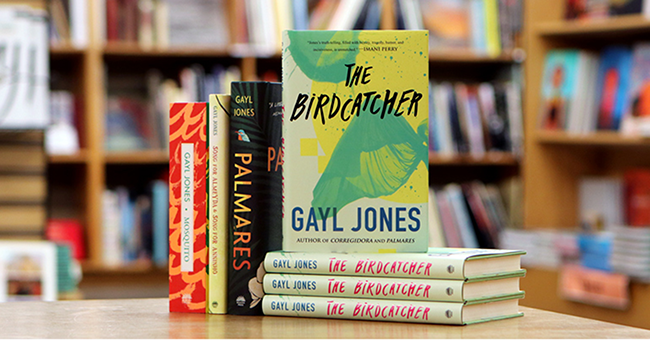
    Gayl Jones books

    This essay appeared originally on PowellsBooks.Blog

    Gayl Jones, the highly acclaimed author who was first “discovered" and mentored by Toni Morrison has twice disappeared from our sight. The first time was after a stellar launch as one of America’s most daring and distinctive literary lights, after two brilliant novels (Corregidora and Eva’s Man) brought out by Morrison at Random House, and one slim but oh-so-astonishing story collection (White Rat), when she went into a self-imposed exile in France, from the late 1970s until the late 1990s. She and her husband had rejected the racism that surrounded them, and Gayl had made the decision to leave her job in academia and her very promising career as a writer, as well as her friends and supporters in the literary community, and live in Europe.

    I was very, very lucky that in 1997, less than two years after I had stepped into the job of director of Beacon Press, Gayl contacted me. She had not been in touch with anyone in US publishing and wasn’t planning on showing me or anyone else new work at the time; in fact, she was asking me to take her two novels out of print (they had been added to Beacon’s visionary series Black Women Writers in the 1980s, after briefly falling out of print). She didn’t want those two books to be her only novels in print, she said, since they both presented negative portraits of Black male characters. I understood that, but, on the other hand, I shared the perspective of so much of the literary community: these were canonical works of American literature, not just of women’s literature or Black literature. As Toni Morrison had said when she published Corregidora, no novel about any Black woman could ever be the same after that book—and of course she included her own. Above all, I loved and valued these books, and I couldn’t imagine Beacon or the entire culture losing them.

    I panicked just a little bit, and then proposed to Gayl that instead she give me new work to publish, work that would present a different lens on Black men. I didn’t really think she would agree to this.

    To my great surprise, she answered quickly by sending me the manuscript for her novel The Healing. And shortly after that, before we could even publish The Healing (which we did, to great acclaim; it was a National Book Award finalist), she sent me a long manuscript for a book called Mosquito and a book-length poem, Song for Anninho. We published everything she sent, with great pride, and the acclaim just kept pouring in. The central figures in these books were strong, passionate Black women, but they also presented portraits of intelligent, sensitive men.

    Then Gayl’s husband died, and she disappeared a second time, and again for almost two decades. Her phone number and email disappeared too, but over those years, I continued to mail letters to her (and of course we sent royalty checks!). I never quite gave up hope that she would someday reply, and after many years, she began sending very brief replies, handwritten. The thaw began in earnest when I sent her back the last manuscript she had sent to me, just before her second disappearance, the monumental Palmares. I had also had a scan made for her, and asked her in another of my handwritten notes, for the fourth or fifth time, to consider letting us publish it. The problem was that my copy was missing almost 100 pages from the middle of the 1,000-page original.

    Gayl apparently had an old computer, with very limited memory. She began rekeying and revising the manuscript, but the machine kept running out of memory, so she sent off “parts" to various services that would store the files and ended up with seven “volumes," which she would send to me one by one. By the time she got to the fourth volume, I was able to persuade her—again by US mail—to let us publish the book. We signed it up, I made some minor editorial suggestions, and we published Palmares in the fall of 2021, once again to great—honestly, even greater—acclaim, and this one was a finalist for the Pulitzer.

    In the interval, Gayl began sending me other manuscripts, a total of five others, which we have been publishing one by one as we finalize edits, designs, and roll them off the press. Beacon is about to launch The Birdcatcher, which Publishers Weekly just hailed with these words (in their “Starred Review”): “Jones continues her marvelous run after last year’s Pulitzer finalist Palmares with the gloriously demented story of an artist who keeps trying to kill her husband,” and which the great minds at Powell’s have declared a Pick of the Month. Here, Gayl shifts from seventeenth-century Brazil to twentieth-century Ibiza (and various US cities) for a very modern account of Black Americans in exile.

    I find that each of Gayl’s books offers such a different and engrossing experience, and I value each one so much and recommend each one to you, but if you haven’t read Gayl’s work before, The Birdcatcher is a very good place to start. And we have a spectacular collection of short fiction coming this spring called Butter and another novel, one narrated by a male character, next fall called The Unicorn Woman. Wherever you start in your Gayl Jones discovery journey, I hope you’ll discover all the gifts of her work and relish them each and every bit as much as I do.


    About the Author 

    Helene Atwan was the Director of Beacon Press, an independent non-profit book publisher founded in 1854, from 1996 to 2022. She began her publishing career in 1976 at Random House in New York, before moving to Alfred A. Knopf in 1977. She then joined The Viking Press in 1979. In 1981, she moved to Farrar, Straus and Giroux, where she became a vice president of the house in 1987 and the associate publisher in 1991. In 1993, she joined the Pocket Books division of Simon & Schuster as a vice president and director of marketing. She was appointed director of Beacon Press by the board of trustees of the Unitarian Universalists Association in October of 1995.

  • A Q&A with Aaron Caycedo-Kimura

    Aaron-Caycedo-Kimura-and-Common-Grace

    Cover art and design: Carol Chu; Author photo: Luisa Caycedo-Kimura

    The third volume of our Raised Voices poetry series is here! Common Grace is Aaron Caycedo-Kimura’s first major poetry collection. Organized as a deeply felt triptych, the poems explore his life as an artist, the inherited trauma within his Japanese American family, and the close bond between him and his wife. The word triptych will tip you off to how visual art plays a part in Caycedo-Kimura’s verse. An award-winning student of Robert Pinsky, Caycedo-Kimura is also a painter. Pinsky praised Common Grace as “wry, tender, musical and unsentimental.” Beacon Broadside editor Christian Coleman caught up with Caycedo-Kimura to chat about it.

    Christian Coleman: What’s the story behind naming the collection Common Grace?

    Aaron Caycedo-Kimura: My manuscript was originally named What’s Kept Alive, after one of the poems in the second section. This poem compares the keeping of a Japanese maple shrub alive to keeping my family’s history alive. The title captured the overall essence of the manuscript but lacked a certain punch. My amazing editor, Catherine Tung, suggested Common Grace—the title of one of the poems in the third section. As a theological concept, common grace is the idea that there are blessings given by God for all to enjoy. These would include things like nature, relationships, even art. Common grace offers another view of the manuscript and a certain strength as a title.

    CC: The poems are divided up into three parts—a triptych. How did you decide on this structure to organize your poems?

    AC-K: Over the past nine or so years, I wrote a lot about my parents, my wife and our life together, and other personal experiences, including those related to my art life. The poems pretty much organized themselves.

    CC: The second part also covers the racial trauma—your father’s time in the American internment camps of WWII and your mother’s memories of the firebombing of Tokyo—and joys passed down from your parents. Why was it important for you to anchor parts one and three with the poems in part two?

    AC-K: The second section digs deeper into my family history and what has shaped me as a person. It also relates the most profound experience I’ve had in the past decade: the death of my parents. I wanted a way to honor them and keep their memory alive.

    CC: Since the poetry in this collection explores your personal life, would you consider Common Grace an autobiography or memoir in poems? Or perhaps a biography in poems? I’m curious because the voice or the “I” of the poems doesn’t necessarily have to be that of the poet who wrote them.

    AC-K: Common Grace is a memoir in poems, based on true events. That being said, poems are pieces of art, where facts are often edited and adjusted for the artistic good of the piece. Just like a landscape painting may leave out a tree here or move it over there for the good of the composition, certain facts may be changed or left out in a poem for various reasons—to protect others, for instance, or for the sake of sound, a stronger image, or to economize and move the poem along more quickly.

    CC: I was really taken by the intimate, daily-life details you write about: microwaving frozen meals with your wife, fishing with your father, eating candy as a child in a salon while your mother gets her hair done. The scenes are vivid, and then there’s a turn toward the end that reveals to the reader a deeper insight underneath. Where did you learn this technique?

    AC-K: When I was just starting out, I attended an ekphrastic poetry workshop given by the poet Laurel Peterson. Most of us were beginners, so she listed several guiding ideas about the nature of poetry. The last item she mentioned was that poetry reveals some bit of insight, some kernel of truth, and that’s always stayed with me. I love writing about daily life and finding some meaning that readers might be able to relate to.

    CC: You have a master’s degree of music in percussion and you’re a painter. You share pictures of your artwork on your Instagram account, too. Do these arts inform your poetry in any way, and if so, how?

    AC-K: It makes sense to me that I would be a poet. Poetry brings together music and visual art—sound and images. I’m very conscious of these two things when I write. With respect to images, I create places, like painting scenes, with sensory details for the reader to enter and experience what I’m feeling for themselves. With respect to sound, I try to create a kind of music with my words. I’m constantly reading the words out loud to myself. It’s like composing music.

    CC: And lastly, how does it feel to have your first major poetry collection out in the world?

    AC-K: It feels amazing! I’m deeply grateful to Catherine and the entire Beacon Press team for their dedication to bringing Common Grace into the world.


    About Aaron Caycedo-Kimura 

    Aaron Caycedo-Kimura is a writer and visual artist. His chapbook, Ubasute, was selected by Jennifer Franklin, Peggy Ellsberg, and Margo Taft Stever as the 2020 Slapering Hol Press Chapbook Competition winner. His honors include a Robert Pinsky Global Fellowship in Poetry, a St. Botolph Club Foundation Emerging Artist Award in Literature, and nominations for the Pushcart PrizeBest of the Net, and Best New Poets anthologies. His poetry has appeared or is forthcoming in the Beloit Poetry JournalPoetry DailyRHINOupstreetVerse DailyDMQ ReviewPoet LoreThe Night Heron Barks, and elsewhere. Caycedo-Kimura earned his MFA in creative writing from Boston University and is also the author and illustrator of Text, Don’t Call: An Illustrated Guide to the Introverted Life (TarcherPerigee, 2017).

  • By Alicia Kennedy

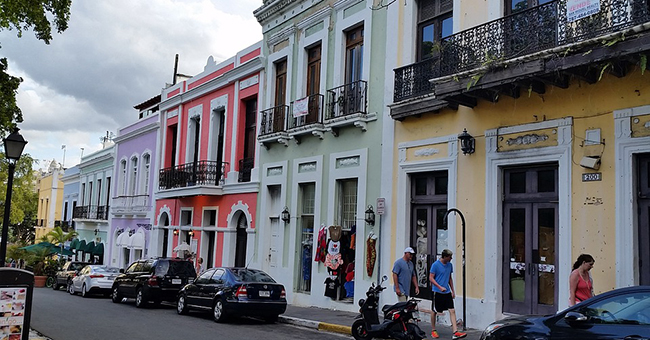
    San Juan, Puerto Rico

    San Juan, Puerto Rico

    This post appeared originally in Alicia Kenney’s newsletter “From the Desk of Alicia Kennedy.”

    The day after category 1 Hurricane Fiona had left the entire archipelago of Puerto Rico with no power, caused destructive flooding, and generally unleashed catastrophe in most places, tourists were back to normal in Old San Juan. My husband and I biked throughout the metro area to take stock of the damage and hear just how many generators were running—the hum and smell of burning diesel were constant—and when we returned, we saw the photo shoots continuing as planned: Women in their best dresses with full faces of makeup, flip-flops on their feet and Instagram-ready heels in hand; men attempting to keep up, carrying heavy cameras or maybe just a selfie stick. Bars were full because what else were we going to do? But you could tell who wasn’t local: They’d showered, their hotels being outfitted with cisterns for occasions such as this. The rest of us had no water. We couldn’t find a reason to put on our nicest clothes, but we could certainly find a reason to have a drink.

    In the days since the storm, the question used to greet everyone is, “Do you have everything—light and water?” Luz y agua—everything, a blessing. We in Old San Juan are in a bubble, and we’ve been even luckier this week to be in a section of the town with power. Throughout the week, most people have not had their power restored; many who had lost it again on Sunday. We are hanging on by a thread, with water pumps and cellular communications towers powered by a dwindling supply of diesel, running on generators that aren’t intended as long-term solutions. Protests against LUMA, the private power authority that has been upping our rates while doing nothing to stabilize the grid, are springing up everywhere.

    Living in Puerto Rico right now is like practice for the future in a world where no real steps are taken to move toward sustainable energy, to sustainable anything. It’s practice to hurry to get work down while it’s possible, to read while there’s light, to shower when there’s water, to fill every container with some for cleaning and hopefully enough for drinking. It’s practice to eat all the avocados that fell from trees. (My husband tells me that his grandfather always told him he knew a storm was coming because avocados would fall from their trees: a signal, an offer from the earth.)

    It’s practice for survival, imposed upon a colony by the United States empire and its cronies. It’s the theft of working people’s lives by the rich and powerful, untouched as they are by it all. The other day, someone said, “I just don’t want to wake up and think about this. I want to think about anything else.” So much time, so much creativity, so much leisure! Stolen.

    We went to the farmers’ market on Saturday morning per usual. The farmers, bakers, and chefs who were there were visibly exhausted, and many of the regular vendors didn’t show up. La Casa Vegana de la Comunidad was selling avocados for $1 each to raise money for a hard-hit community, so we got as many as we could carry and left some on our neighbors’ doorsteps. Another farmer had limited greens—this is what happens whenever there’s heavy rains—but suffered minimal damage, losing some of their plantain crop. Another had fewer eggs than usual, fewer greens, and said this would be the last of their eggplant for a while. Plantain trees had fallen in large number throughout the island, the images shared on social media stark and sad.

    In the wake of disaster, misinformation spreads and the posting of any old thought seems to ensure virality. I am allergic to this kind of crap, though that doesn’t mean I’m always immune—there is simply so much pressure to perform some kind of duty, however ill-defined that might be. I don’t share what I can’t verify; I respect the process of journalists who are reporting.

    To that ends, I want to suggest some reading:

    Throughout this week, Israel and I have just been trying to work. Work cannot stop, even if our internet is out. He wrote a brilliant, fiery piece for the New York Times opinion section on the current situation’s roots: “¡Basta de Apagones! The Rot in Puerto Rico Runs Deeper Than Its Disastrous Power Company.

    Puerto Rico was unraveling economically and politically long before LUMA and Hurricane Fiona. Austerity programs cut deeply into the public service budget, health care, pensions and education to pay off creditors. Newly elected officials reward party loyalists with government employment, creating a series of sycophants who use public office for their own gain. They award million-dollar contracts to companies that are sometimes owned by party members or relatives, in exchange for kickbacks, or, worse yet, create ghost companies to divert the funds into their own pockets.

    To understand why calls for statehood are ill-advised, read this new, fantastic, epic piece by Jaquira Diaz in The Atlantic, “Let Puerto Rico Be Free”:

    Albizu Campos returned to Puerto Rico in 1947. A year later, the U.S.-appointed governor signed Law 53, La Ley de la Mordaza. It is widely referred to as the Gag Law, and it made flying Puerto Rican flags, even privately, illegal. The Gag Law also made it a crime to sing the Puerto Rican national anthem; to speak out against the United States; and to speak, organize, or assemble in favor of independence. Law 53, which violated the First Amendment, was in effect for nearly a decade, until it was repealed in 1957. It essentially empowered authorities to penalize Puerto Ricans just for being Puerto Rican.

    It’s a good time to revisit Yarimar Bonilla’s “The coloniality of disaster: Race, empire, and the temporal logics of emergency in Puerto Rico, USA”:

    Some see these rising calls for resilience as part of the larger dominance of neoliberal forms of governmentality across the globe, in which citizenship is increasingly being refashioned as individualized self-care. With the increasing cuts in social safety nets, all individuals are increasingly being called upon to take on entrepreneurial modes of self-care and self-management (Muehlebach, 2012). However, we must ask: which communities have historically been required to demonstrate resilience and incessantly forced to endure both the shocks of neoliberalism and the slow traumatic violence of colonial extraction? And is it possible that the push towards resilience has actually made them disproportionately vulnerable to the current challenges of climate change?

    Someone asked me last week how to do tourism without also reinforcing colonialism, and there is no real answer: The world is unequal, shaped by colonialism, and some people have benefitted from this while others… lose their power because of a storm. They sit in hospital beds, kept alive by generators. Others throw out all the food in their refrigerator because it’s begun to rot, not knowing when they will be able to afford to fill it up again. Still more can’t rest, as heat and mosquitos envelop them in their beds. Work cannot stop, but some are forced to stop—forced into a more precarious financial situation, in a place where 44 percent of the population already lives in poverty and pays much more for basic goods and services than others with the same passport. Small businesses run out of gas for generators and then what? Supermarkets run out of gas for generators and then what? Hospitals?

    To get a handle on tourism and colonialism, start with June Jordan’s “Report from the Bahamas, 1982” and this transcript of a conversation with Bani Amor on For the Wild, “BANI AMOR on Tourism and the Colonial Project.” 

    Also read Lillian Guerra’s 2014 piece “Why Caribbean History Matters”:

    Caribbean history matters for the same reason everyone in the Caribbean “remembers” slavery: the legacies of slavery, imperialism, and historical responses to it are, in the Caribbean, immediately evident in all the “weightier” concepts we associate with modernity: notions of citizenship, individual freedom, collective liberation, and nation. Caribbean history is not merely about the “colonial origins of poverty”; it addresses the most fundamental questions of who we are, what we believe, and how we got that way. Yet the uncomfortable facts of Caribbean history rarely make it into the consciousness of even the most educated of our society’s elite.

    Decolonization Is Not a Metaphor” by Eve Tuck and K. Wayne Yang is a necessary reminder right now. Empire is active. The colonial period is not history.

    When metaphor invades decolonization, it kills the very possibility of decolonization; it recenters whiteness, it resettles theory, it extends innocence to the settler, it entertains a settler future. Decolonize (a verb) and decolonization (a noun) cannot easily be grafted onto pre-existing discourses/frameworks, even if they are critical, even if they are anti-racist, even if they are justice frameworks. The easy absorption, adoption, and transposing of decolonization is yet another form of settler appropriation. When we write about decolonization, we are not offering it as a metaphor; it is not an approximation of other experiences of oppression. Decolonization is not a swappable term for other things we want to do to improve our societies and schools. Decolonization doesn’t have a synonym.

    That’s all I have for now, as I’d like to get this scheduled before we lose our internet again. Next week, I hope, we will be back to regular programming.


    About the Author 

    Alicia Kennedy is a writer from Long Island now living in San Juan, Puerto Rico. Her work on food and culture has been published in the New York Times, the Washington PostT: The New York Times Style Magazine, Eater, Bon Appétit, and many other publications. She has a newsletter titled “From the Desk of Alicia Kennedy,” where she publishes essays, cultural criticism, a podcast, and recipes. Her book, No Meat Required: The Culture History and Culinary Future of Plant-Based Eating, is forthcoming in 2023 from Beacon Press.

  • By Bev Rivero

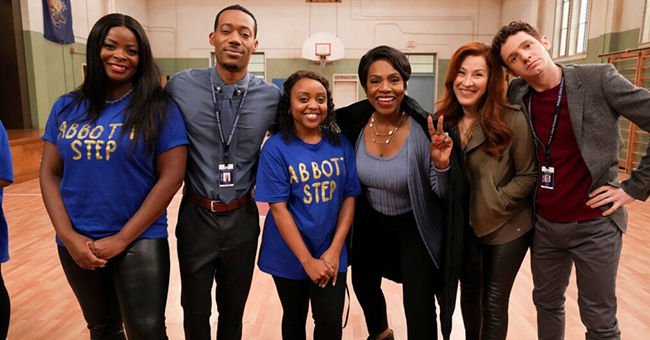
    Abbott Elementary, Season 1 Cast

    Abbott Elementary, Season 1 Cast

    To everyone’s delight, beloved ABC comedy, Abbott Elementary, has returned for its second season! The award-winning show has earned fans across every demographic and pulls off being sweet while still being grounded in the reality faced by staff and parents navigating the public school system.

    When we first met the core cast, we learned that earnest teacher, Jacob, had taken the lessons of White Fragility to heart.

    White Fragility Jacob

    And as this season’s premiere finds the teachers in development week, it’s the perfect time to imagine and recommend some other Beacon books our favorite Philly educators and staff might enjoy, professional development and otherwise. Bonus: They’re all available in paperback, making them affordable for teachers and the rest of us, too.


    History teacher Jacob Hill, played by Chris Perfetti Walter (ABC/Liliane Lathan)

    History teacher Jacob Hill, played by Chris Perfetti Walter (ABC/Liliane Lathan)

    Jacob started off the season with a shout-out to CODA, and for a deeper dive, he could read Terry Galloway’s take on the film as well as her memoir, Mean Little deaf Queer. As comics legend Alison Bechdel says, “Yes, Terry Galloway is resilient. But she’s also caustic, depraved, utterly disinhibited, and somehow sweetly bubbly, a beguiling raconteuse who periodically leaps onto the dinner table and stabs you with her fork. Her story will fascinate, it will hurt, and you will like it.”


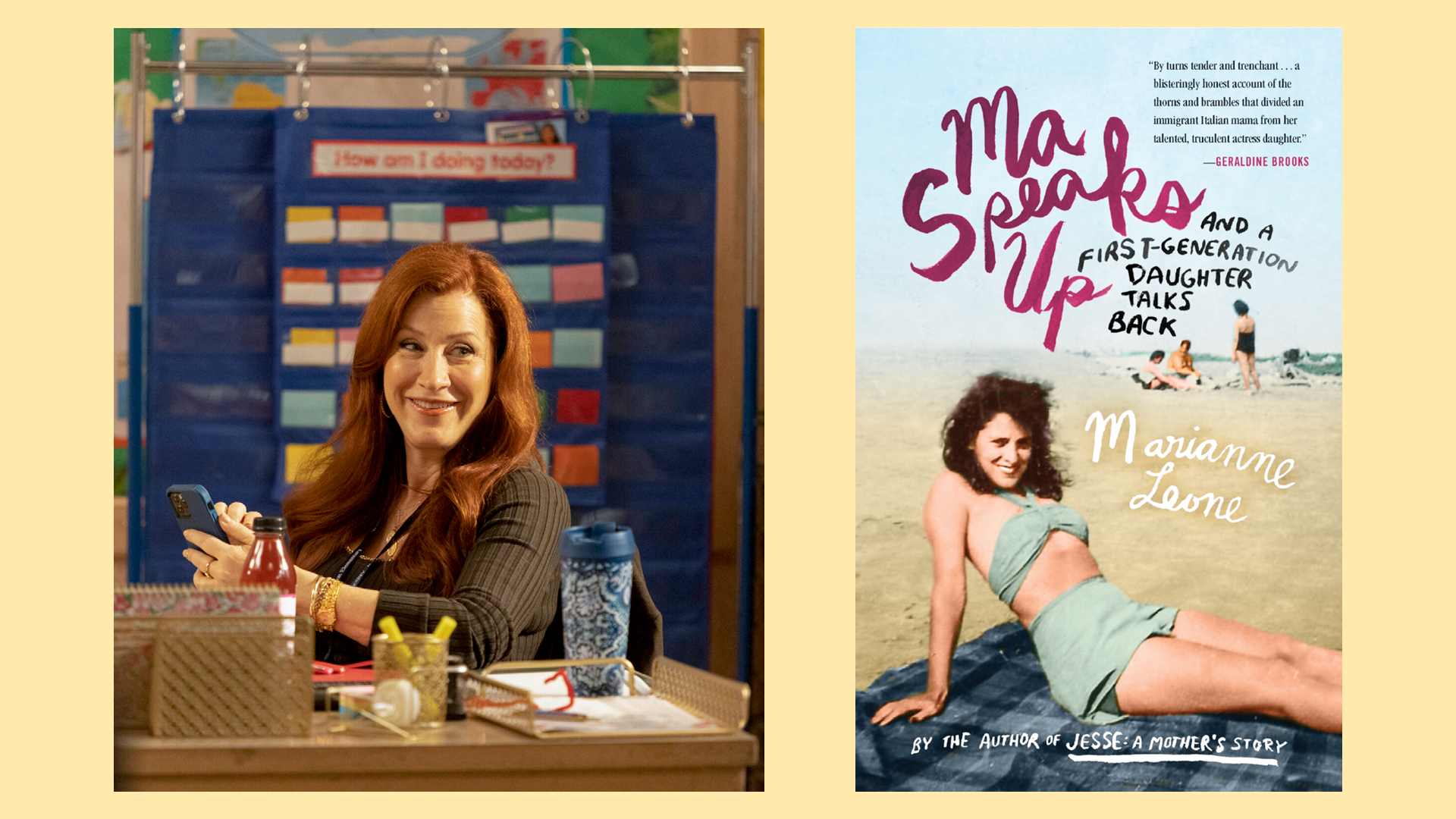
    Second-grade teacher Melissa Schemmenti, played by Lisa Ann Walter (ABC/Liliane Lathan)

    Second-grade teacher Melissa Schemmenti, played by Lisa Ann Walter (ABC/Liliane Lathan)

    Brash Melissa’s reading habits might be harder to pin down, but we know she has a deep love for her Italian roots and Philadelphia’s true history. I picture her waiting for a branzino in the oven while reading Ma Speaks Up, the story of Marianne Leone’s outspoken immigrant Italian mother who becomes a school lunch lady when she is suddenly widowed with three young children.


    Principal Ava, played by Janelle James (Getty Images)

    Principal Ava, played by Janelle James (Getty Images)

    Style and beauty are important to Principal Ava, always camera ready for her own TikTok or any news crews that might show up at the school. She would pick up a copy of All Made Up for its eye-catching cover and come to appreciate the author’s discussion around what it means to participate in creating your own self-image.


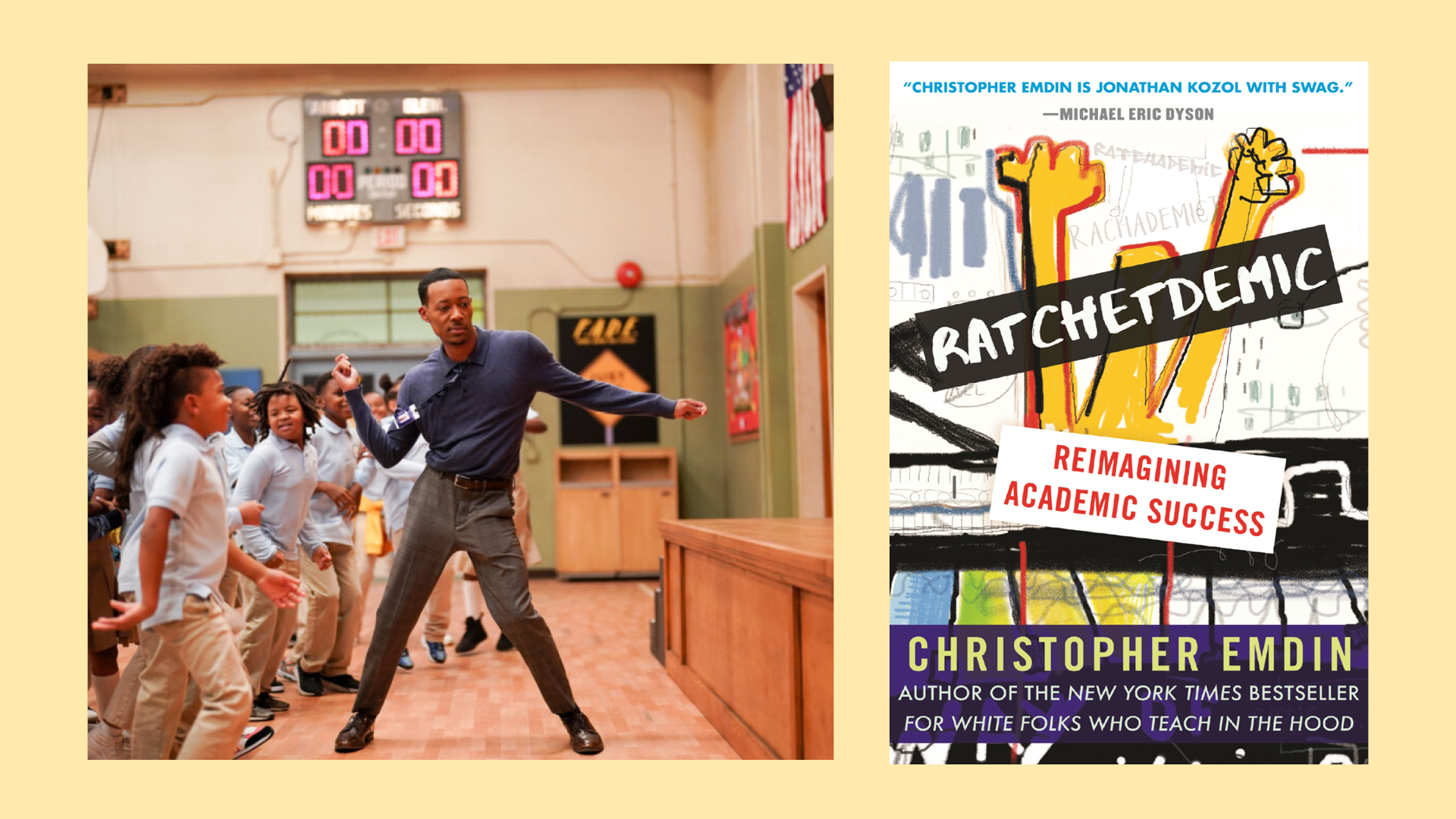
    Gregory Eddie, played by Tyler James Williams (Tell-Tale TV)

    Gregory Eddie, played by Tyler James Williams (Tell-Tale TV)

    New teacher Gregory might be putting his admin dreams aside for now, but as he commits to being a full-time teacher, we love his ongoing journey to loosen up and roll with the chaos of a grade-school classroom. Ratchetdemic would be perfect for him to learn to continuously bring his whole authentic self to his role. He’d value Emdin’s message about the power in intuitional versus institutional teaching.


    Barbara Howard, played by Sheryl Lee Ralph (ABC/ Scott Everett White)

    Barbara Howard, played by Sheryl Lee Ralph (ABC/ Scott Everett White)

    Barbara, our composed elder stateswoman of Abbott, has done and seen everything. I can see her being nourished by The Spirit of Our Work, but it would also be great to see her take a break with some fiction. Like Gayl Jones’s Mosquito, in which Sojourner Nadine Jane Johnson, an African American truck driver known as Mosquito, discovers a stowaway who nearly gives birth in the back of her truck, resulting in her involvement in the sanctuary movement for Mexican migrants, meeting a wide cast of characters, and a romance.


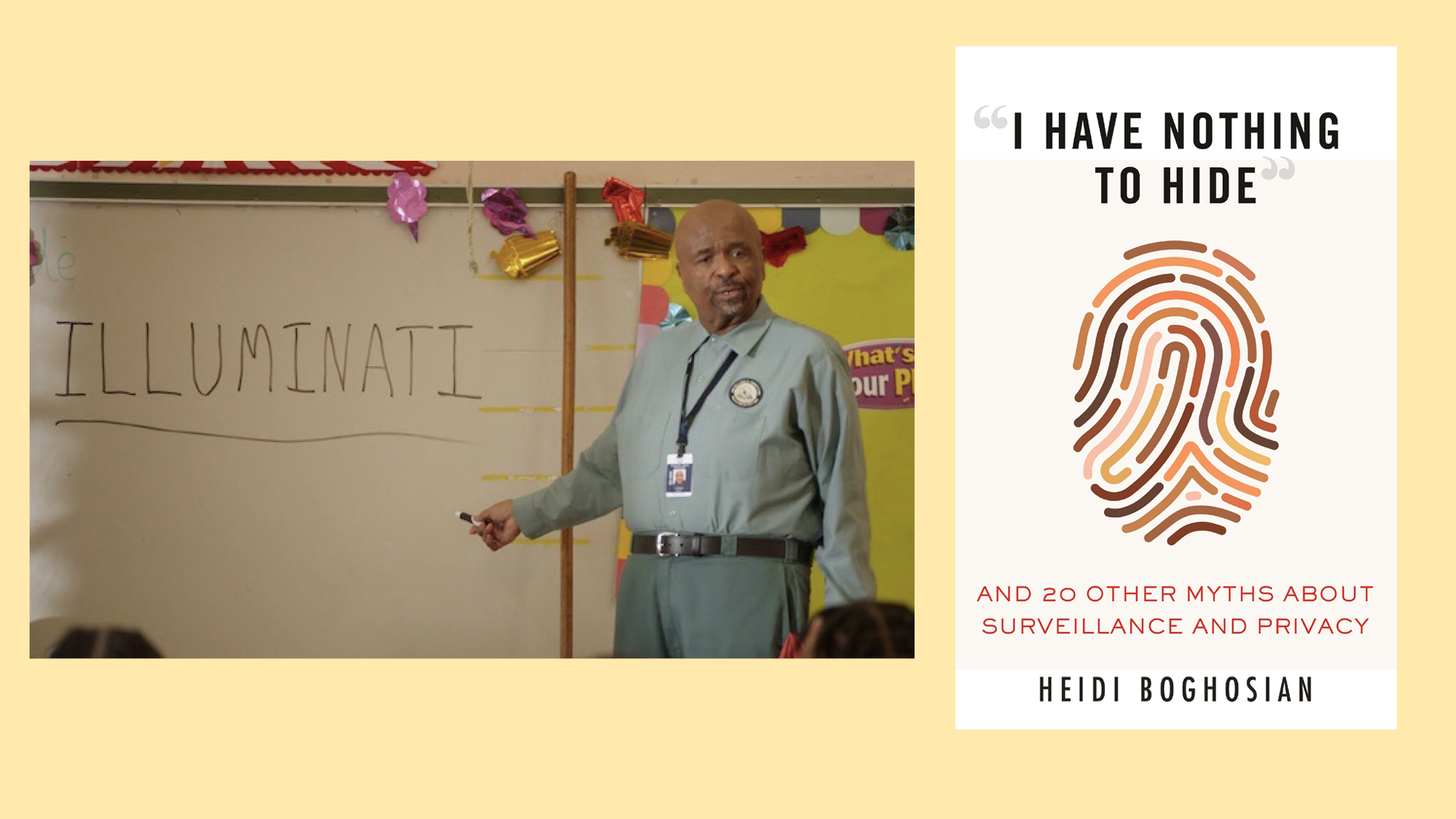
    Mr. Johnson, played by William Stanford Davis (Paste Magazine)

    Mr. Johnson, played by William Stanford Davis (Paste Magazine)

    We know Mr. Johnson has a penchant for conspiracy theories and a soft spot for Boyz II Men. His interest in the former would lead him to read up on the realities of the surveillance state, data collection, and how to protect your privacy as a consumer in “I Have Nothing to Hide”: And 20 Other Myths About Surveillance and Privacy.


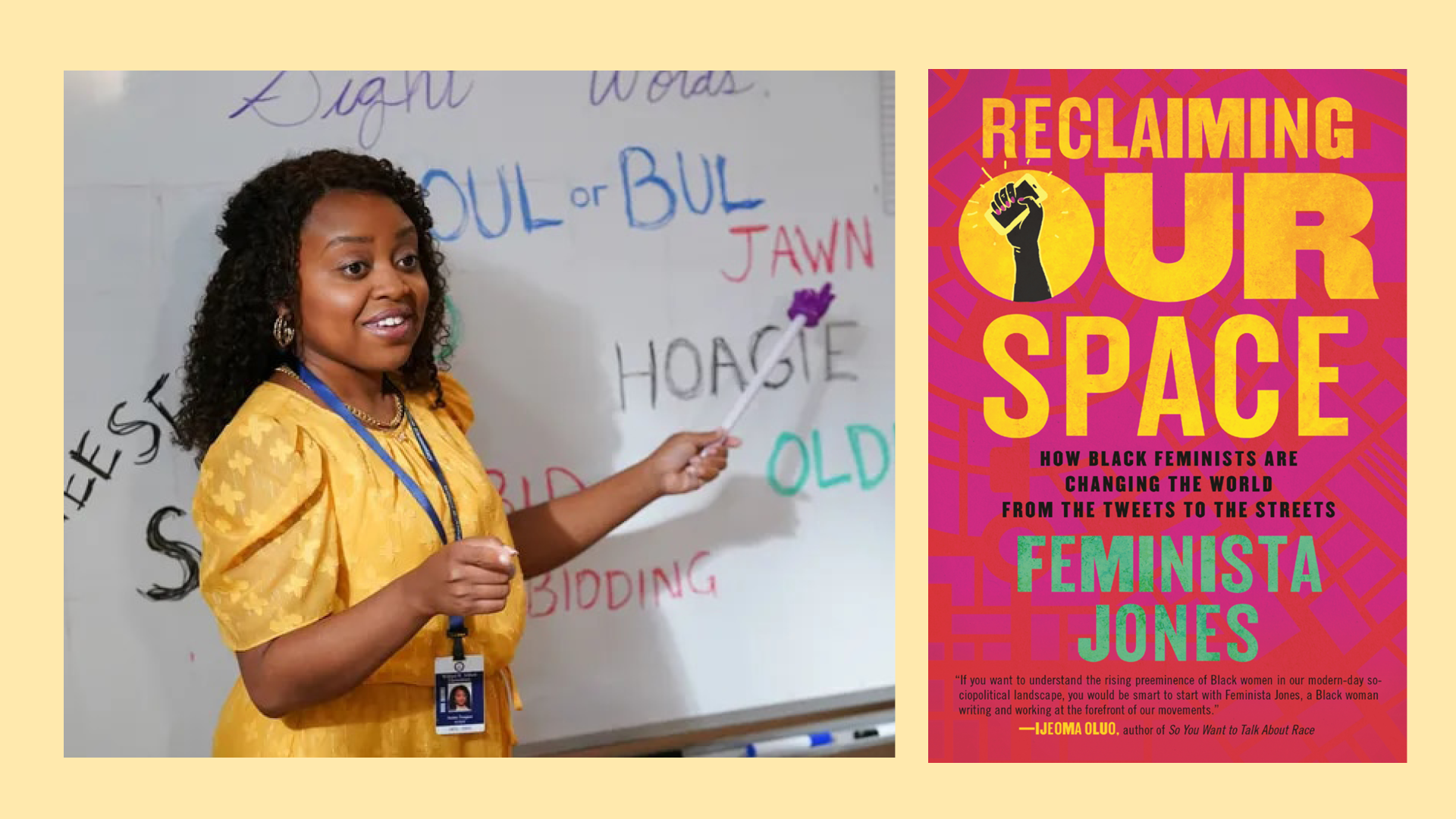
    Janine Teagues, played by Quinta Brunson (ABC/Gilles Mingasson)

    Janine Teagues, played by Quinta Brunson (ABC/Gilles Mingasson)

    Last but not least, series heroine Janine is likely a voracious reader when she’s not overwhelmed by life, which makes suggesting a book for her even more challenging. But Feminista Jones’s Reclaiming Our Space seems like a good pick for this new chapter of her life.

    Honorary mentions:

    We think the teachers and Ava would have a very lively book club discussing Ratchetdemic or “You Can’t Fire the Bad Ones”: And 18 Other Myths About Teachers, Teachers’ Unions, and Public Education. We can also see them doing the same for lots of great books from other publishers, like Monique W. Morris’s Pushout: The Criminalization of Black Girls in Schools by or Lisa Delpit’s Teaching When the World is On Fire.

    Happy reading, Abbott Elementary!

    Reading kid


    About the Author

    Bev Rivero is senior publicist at Beacon Press. Before joining Beacon in 2021, Bev was the communications and marketing manager at the National Book Foundation, where she worked on the National Book Awards, promoted the Foundation’s public and educational programs, and led all social media and marketing campaigns. Prior to NBF, she was in publicity at the New Press for 6 years, where she worked with authors committed to social justice, including Paul Butler, Michelle Alexander, and many more. She has extensive experience promoting nonfiction and tailoring outreach campaigns that resonate with activists and change-makers. Bev is a NYC-based graduate of Johns Hopkins University, ardent supporter of indie presses, and a graphic designer. You can follow her on Twitter @LOLBev, where she mostly retweets content about books, pickles, and migrant justice.

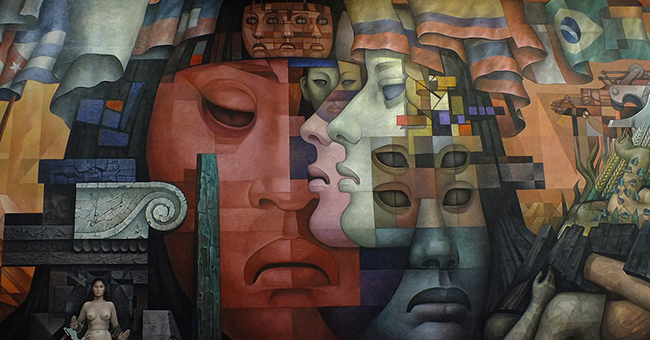
  • Presencia de América Latina mural by Jorge González Camarena, 1964-1965, Casa del Arte (Pinacoteca) de la Universidad de Concepción

    Presencia de América Latina mural by Jorge González Camarena, 1964-1965, Casa del Arte (Pinacoteca) de la Universidad de Concepción

    Talk about an affront to human life. In a bait-and-switch tactic to push the Right’s anti-immigrant message, FL Governor Ron DeSantis paid to send 50 migrants like cattle on an airplane from San Antonio, TX, to Martha’s Vineyard, MA. The migrants were told they’d land in Boston, where they could get expedited work papers. On top of that, hundreds of thousands of people across Puerto Rico are waiting for water and power to be restored after Hurricane Fiona knocked out power lines and collapsed infrastructure with massive flooding.

    A rough way for Hispanic/Latinx Heritage Month to start. Which makes this year’s theme, Unidos: Inclusivity for a Stronger Nation, hit even harder.

    The goal is to ensure that all Hispanic/Latinx voices are represented and welcomed to build stronger communities. Seeing how anti-immigrant feels, climate change TKOs, and the can’t-quit-you legacy of colonialism are flaring, this is what we’re doing by highlighting this (inexhaustive) list of titles from our catalog.


    An African American and Latinx History of the United States

    An African American and Latinx History of the United States

    We must give credit to immigrants of the Global South for sharing practical visions of liberation that have reinvigorated civic culture in the United States. A basic knowledge of the battles fought by the ancestors of today’s immigrants—whether they hail from Latin America or elsewhere—is important if we are to understand contemporary US politics.
    —Paul Ortiz 


    And-the-Category-Is

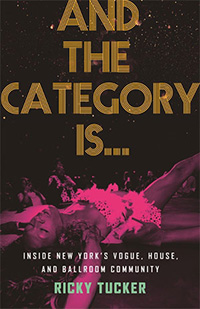
    And the Category Is: Inside New York’s Vogue, House, and Ballroom Community

    Built out of the human need for lineage and legacy, the house system is a clan barreling toward posterity with a common cause: freedom. And on an individual level, just like with biological families, these houses, Lanvin, Ebony, LaBeija, Pendavis, Mugler, et al., provide LGBTQ BIPOC youth an opportunity to metabolize centuries of generational trauma.
    —Ricky Tucker 


    Before island is volcano

    antes que isla es volcán/before island is volcano: poemas/poems

    me encadenaste para liberarte
    de un amo en común
    y todavía piensas que
    yo soy el caníbal.

    /

    you chained me to free yourself
    from our common master,
    and you still believe
    i’m the cannibal.
    —Raquel Salas Rivera, “calibán a ariel”/“caliban to ariel” 


    Boomerang

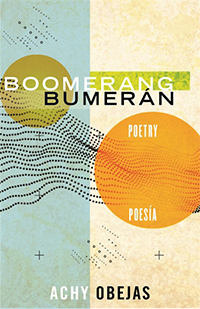
    Boomerang/Bumerán: Poetry/Poesía

    Te apoyas en mí
    mientras bailamos, le suave roce
    de nuestres cabezas juntes,
    nuestres alientos une vapor limpie en le humo
    azul, rápide, agotade.
    Mezclamos margaritas porque
    me gusta le nombre; es
    la mujer que amas. Tú eres mayor.
    Yo estoy dispuesta, borracha, desabrochada.

    /

    You lean against me
    as we dance, the soft huddle
    of our heads together,
    our breaths clean steam in the blue
    smoke, rapid, exhausted.
    We mix margaritas, because
    I like the name, a
    woman you love. You’re older.
    I’m willing, drunk, unbuttoned.
    —Achy Obejas, de/from “Bailando en le paraíso”/“Dancing in Paradise” 


    Central America's Forgotten History

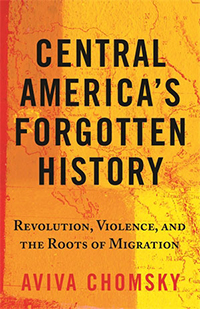
    Central America’s Forgotten History: Revolution, Violence, and the Roots of Migration

    The politics of forgetting took on a new significance in the United States as more and more Central Americans fled their homes to make new lives in el norte (the North). Large-scale Central American migration to the United States dates to the civil wars of the 1980s and came primarily from El Salvador and Guatemala. Most came fleeing political violence, and their presence became politically very inconvenient for the Reagan administration, which was seeking to justify its support for these countries’ governments. Others were economic refugees. Either way, the refugees gave the lie to Reagan’s claims of the governments’ legitimacy and right to US support.
    —Aviva Chomsky


    Detained and Deported

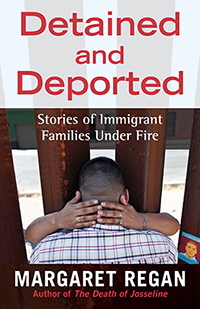
    Detained and Deported: Stories of Immigrant Families Under Fire

    As the numbers of detainees imprisoned in this infrastructure skyrocketed, human rights complaints likewise multiplied. Critics noted the racial dimension of the incarcerations. The vast majority of detainees were Mexican—64.4 percent in 2012—with Guatemalans coming in second at 10.6 percent, Hondurans next at 8.5 percent, and Salvadorans at 6.6 percent, for a Central American total of 25.7 percent. And organizations from the ACLU to Amnesty International have cited physical, verbal, and sexual abuse of detainees, inadequate health care and food, use of solitary confinement as punishment, prolonged detention, and even an untoward number of deaths. Arizona plays an outsized role in this human tragedy.
    —Margaret Regan


    How Does It Feel to Be Unwanted

    How Does It Feel to Be Unwanted?: Stories of Resistance and Resilience from Mexicans Living the United States

    “Why doesn’t the US want us?” In my experience, this is the question that immigrants puzzle over, the question that gets under their skin, especially when they are the victims of workplace abuse or bigoted comments, when their children are victims of bullying at school, or when a politician in power insults and stigmatizes an entire community in spite of their struggle and hard work every day.
    —Eileen Truax


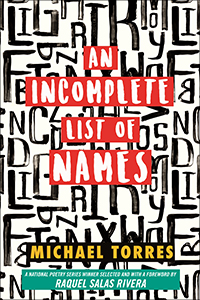
    An Incomplete List of Names

    An Incomplete List of Names: Poems

    I keep the photographs of my father—one behind each ear.
    Like accent marks. The father behind my own ear, a man
    holding light in his hand, tells me how to get home: find
    a freeway; go east, away from water. Behind my borrowed
    ear, my father spins the gun on his finger. Wind whistles.
    He tells me, when buying the newspaper, pay for one
    but make sure to take two: one for yourself;
    one for who you cannot be.
    —Michael Torres, from “[Mexican] America” 


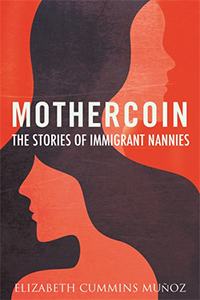
    Mothercoin

    Mothercoin: The Stories of Immigrant Nannies

    Women like Sara and her mother are part of a broad phenomenon of international migration for domestic and carework that has been growing since the end of the last century, spurred by widening global inequality and an increased demand for domestic service in the north. As cleaners and caregivers move from poorer regions into wealthier ones, they leave behind a material and emotional absence that is keenly felt by their families in the global south. North of these borders, children of wealthier regions are bathed and diapered and cared for in clean homes with folded laundry and sopa de arroz simmering on the stove, while their parents work ever longer hours and often struggle with these daily separations.
    —Elizabeth Cummins Muñoz 


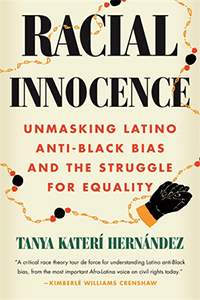
    Racial Innocence

    Racial Innocence: Unmasking Latino Anti-Black Bias and the Struggle for Equality

    The anti-Black slurs I heard used in the Latino community with respect to African Americans only reinforced my early impressions that Blackness was problematic, despite our assertions of Latino pride in being a mixture of races. It became evident to me that cultural mestizaje pride (race-mixture pride) aside, not all parts of the mixture were equally welcomed or celebrated.
    —Tanya Katerí Hernández


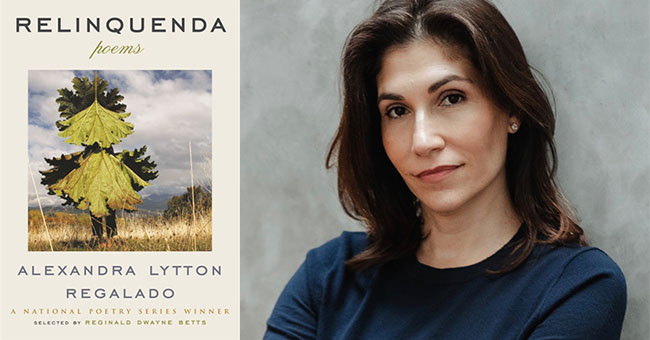
    Relinquenda

    Relinquenda: Poems

    For my husband in El Salvador,
    separated for eighty-three days
    during COVID-19, 2020

    Without you, the hours I measure in my skin,
    deepening to a darker brown as I write
    canalside. You say I worry too much,
    & it’s true, I often stay silent rather
    than go off-key. Like the bufo frogs, I too,
    find protection beneath a broad leaf, hidden
    from the jaws of snake or iguana, invisible
    to spear-beaked ibis. These days are wet sand
    through my fingers, pouring out in hills & turrets.
    —Alexandra Lytton Regalado, from “Bufo Lovesong” 


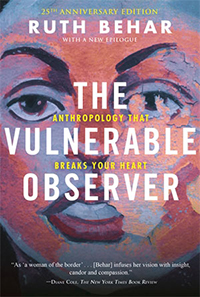
    The Vulnerable Observer 25th Anniversary

    The Vulnerable Observer: Anthropology That Breaks Your Heart

    Readers say the notion of “the vulnerable observer” put a label on something many anthropologists and other scholars had been grappling with: how to describe the practice of thinking through and laying bare one’s subjectivity and personal connection to research. They point out that the book heightened the awareness of the emotional stakes of being an observer of any social world.
    —Ruth Behar 

    Mural__Presencia_de_América_Latina__04