• Carlos Ball's From the Closet to the Courtroom was praised by Colorado Accident Lawyer, which said that it “should become a basic text for college LGBT studies courses and is also valuable to students of LGBT law.” The Anderson Library Blog also posted an excellent write-up about his book.

    Read an excerpt from Banned in Boston, the newest book from Neil Miller about the Watch and Ward Society that acted as a moral guardian over the city of Boston, in The Boston Globe Magazine. For a detailed slideshow of the books and plays that were blacklisted in Beantown, go to Boston.com.

    But where there was once censorship, pornography has invaded. Gail Dines, the author of Pornland: How Porn Has Hijacked Our Sexuality, appeared in an interview for The Times of India. In the interview, she discusses the pornographic gaze that attracts young boys and eventually draws them in to today’s gonzo pornography.

    David Chura, an educator of incarcerated youth and the author of I Don’t Wish Nobody to Have a Life Like Mine, describes his experience teaching these vastly misunderstood teens in the Fall 2010 issue of Education Next:

    “The majority of the teenage boys I taught—mostly poor and minority—didn’t lack ability. They lacked focus and old-fashioned seat time, but most had an aptitude for learning. Some were quite bright. It was just that “other things” got in the way: addictions, street violence, fractured families, homelessness, racism.”

    Finally, Sonia Sanchez’s newest collection Morning Haiku received a great review in August’s issue of Alabama Writer’s Forum. The review states: “Morning Haiku shows Sonia Sanchez’s gift for breathing life into language. It makes this reader yearn for more of her one-breath poems.” Sanchez was also recently featured in Poets and Writers in the “Writers Recommend” section.
  • On August 11 and 12, 1834, a riot fueled by anti-Catholic fervor resulted in the burning of an Ursuline Convent in Charlestown, Massachusetts, in what is now Somerville. In this excerpt from A City So Grand: The Rise of an American Metropolis, Boston 1850-1900, Stephen Puleo examines the height of Irish immigration to the city in the years following the riot, and the deeply anti-Catholic and anti-Irish discrimination the new arrivals faced.

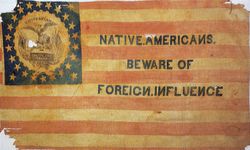
    Know-nothing-flag
    The Know-Nothing Party flag.

    When Charles Dickens visited Boston in 1842, he might have had the Irish in mind when he told guests at a dinner in his honor: "Virtue shows quite as well in rags and patches as she does in fine linen . . . she goes barefoot as well as shod . . . she dwells rather oftener in alleys and by-ways than she does in courts and palaces." He urged Bostonians to "lay [your] hands upon some of these rejected ones whom the world has too long forgotten" and to understand that "these creatures have the same elements and capacities of goodness as yourselves."

    But Dickens's message went unheeded during the height of Irish immigration to Boston.

    Thousands of Boston Irish, who had witnessed such devastation in their own country—who saw it transformed from a nation of bucolic splendor to a blight-infested isle of death—arrived in their adopted city to find not succor but prejudice, not welcome but suspicion and contempt. Boston's closed Yankee society, its deep anti-Catholicism, its intellectualism—all of these were completely foreign to, and conspired against, the bedraggled Irish who stepped weakly off the coffin ships and sought refuge among her narrow streets. Beginning in earnest with the ransacking and torching destruction of the Ursuline Convent in Charlestown in 1834, the Athens of America, one of the most progressive and educated locales in the New World (or the Old World, for that matter), rejected the Irish with an unprecedented, unrelenting, white-hot vitriol that rocked the newcomers and left them dispirited and disillusioned.

    But not broken.

    (more…)

  • Stacy Mitchell is a senior researcher with the New Rules Project and author of Big-Box Swindle: The True Cost of Mega-Retailers and the Fight for America's Independent Businesses.

    book cover for Big Box Swindle Or, for that matter, why does Best Buy have one in the Republic of Mauritius? And why does the supermarket chain Supervalu, which has exactly zero stores outside the U.S., maintain five subsidiaries in exotic locales like the Grand Cayman Islands? 

    Tax avoidance might be the answer. All three of these countries are known as tax havens, places where corporations and wealthy individuals can hide their income from the IRS. According to a U.S. Government Accountability Office report, 83 of the 100 largest U.S. corporations now have subsidiaries in offshore tax havens. Recent studies have estimated that these schemes enable big companies to dodge between $37 and $60 billion a year in taxes. 

    Small businesses don't have the option of hiding profits overseas, which puts them at a distinct competitive disadvantage. The U.S. now has, in effect, two tax systems: one for corporations and one for small businesses.

    (more…)

  • Today’s post is from Amie Klempnauer Miller, a frequent speaker about gay and lesbian families and author of the book She Looks Just Like You: A Memoir of (Nonbiological Lesbian) Motherhood. Miller works as a development consultant to the public media industry and lives with her partner and daughter in St. Paul, Minnesota.

    book cover for She Looks Just Like You “You remember that judge in California, Hannah? The one who was going to decide if the law saying that two men or two women are not allowed to get married is a good law or a bad law?”

    “Yes,” she says. We were in San Francisco, coincidentally, on the day of the closing arguments, so we had talked about the case over Prop 8.

    “He made his decision. He said that it should be OK for two men or two women to get married,” I say. “He’s just saying that for California, but it’s still really important.”

    “YES!” she says. “This is the most important thing of all to me.”

    I’m a little surprised by her reaction.

    “Why’s that?” I ask.

    She points to Jane and then to me.

    “Hel-LO? Girl. Girl.”

    I know that she wants same-sex marriage to become legal, in part because she wants to plan a wedding for Jane and me. She wants to be a bridesmaid. She wants to ride in a limo. She wants ice sculpture in the shape of a swan. She wants us to wear elaborate gowns. But honestly, I think what she really, really wants is for us to be married like everyone else.

    And, in the end, I think it’s her reaction that is the most important thing of all to me. Yes, I would like to have the rights and recognition that come with a marriage license. Yes, I think that gay and lesbian people should have the same range of choices as straight people – whether around marriage, parenthood, where we work, where we live, whatever. That said, for me personally, legal marriage sounds a bit anti-climactic, now that Jane and I have already been together – and believe me, married – for 26 years.

    But it matters a lot to me that it matters so much to Hannah. For those of us who have children, it is tremendously important to be able to show that our families are just as valued as everyone else’s. We can tell our kids that our families are just as important, but those statements are undermined by laws that say they aren’t. The truth is that our kids are on the frontlines of explaining our families to the world. Marriage rights would make that work much easier because they would take away one of the major ways in which our families are set apart. And, if they mean that Hannah gets to be a bridesmaid, so much the better.

    Read an excerpt of She Looks Just Like You on Scribd.

  • The iconoclastic director John Waters recently spoke with the Paris Review Daily about his love of Provincetown and his time spent working in bookstores there. (Thanks to Shelf Awareness for the link.)

    It was a magical time in my life. I worked in the bookshop. First I worked in the East End Bookshop that was run by Molly Malone Cook and her girlfriend, Mary Oliver, the poet, who was not famous yet. And then I worked at the Provincetown Bookshop for many, many years. And it's still there. Elloyd Hansen, one of the owners, was the guy who really gave me my complete education about books. I didn't go to school, so he's the one who told me about Ronald Firbank, Jane Bowles; I learned everything working there.

    And when I worked there they said, "you can have free books—whatever you want, but you have to read 'em and you have to sell 'em." So I read everything and would get obsessed by a book and sell tons of copies.

    Mary Oliver is one of Beacon's most acclaimed and beloved authors, and a collection of photos from her life with Molly Malone Cook, several of which were shot in the bookshop, was released in 2007.

  • On the New York Times' Well blog, Dr. Danielle Ofri (Medicine in Translation) looks at the connection between unemployment and poor health. Dr. Ofri also contributed a "Cases" column for the Times about how a physical examination can help a patient's mental well-being.

    From Stepford wife to Stepford slut: Gail Dines (Pornland), looks at how the idealized pop culture feminine image has morphed from Betty Draper to hardcore porn star. Also check out this great interview about gonzo pornography at vocalo.org.

    "'Jesus!' he said. 'Did you see how many Mexicans they’ve got?'" This Is American Soccer posted a second excerpt from Steve Wilson's The Boys from Little Mexico.

    Sonia Sanchez "drenches her words in honey goodness so they sound like the sweetest thang you've ever heard," The Root gushes in this feature interview, where the poet discusses what she's reading and the future of African-American literature.

    Chalk the union of one man and one woman up to the good influence of their gay friends: it took a lesbian wedding for Jeremy Adam Smith to understand the importance of marriage.

    At Education Next, David Chura discusses teaching students behind bars.

    Eddee Daniel (who appeared on Beacon Broadside as a guest blogger a while back) reviews The Coming Population Crash.

    Have a great weekend!

  • Carlos A. Ball is Professor of Law at the Rutgers University School of Law (Newark). He has written extensively on gay rights issues and is the author of From the Closet to the Courtrom: Five LGBT Rights Lawsuits That Have Changed Our Nation. He lives with his family in Brooklyn, New York.

    book cover for From the Closet to the Courtroom The most striking aspect of Judge Vaughn Walker's ruling, voiding California's ban on same-sex marriage, is how it makes clear that defenders of Proposition 8 did not even come close to presenting evidence in court supporting their claim that gay marriages harm society and individuals. It is one thing to say, during a political campaign in support of a ballot initiative, that same-sex marriage constitutes a threat to society or to the family or to children. It is another thing altogether to back up those claims through the introduction of specific evidence in a court of law.

    Judicial rulings by trial courts are almost always forgotten after appellate courts have their say. This is hardly surprising given that appellate courts get the final word on how a lawsuit should be resolved. But there is one thing that trial judges can do that appellate judges cannot, and that is make findings of fact based on evidence submitted by the parties.

    For the last twenty years, conservative activists have been prognosticating doom if society were to give same-sex couples the opportunity to marry. And yet, when they had the chance to defend that claim in court earlier this year, they called only one witness — David Blankenhorn, the President of the Institute for American Values – to testify. While on the stand, Blankenhorn gave such a convoluted and unsupported explanation of how same-sex marriage is harmful — he claimed that it contributes to the "deinstitutionalization" (whatever that means) of traditional marriage — that Judge Walker's ruling gave no weight to his testimony.

    (more…)

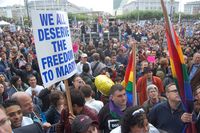
  • Photo by Patricia Montes Gregory on Flickr. Used under Creative Commons.  “Fundamental rights may not be submitted to a vote." So says yesterday's historic ruling overturning Proposition 8 in California. For the first time, a judge has granted the right to marry based on Constitutional grounds, saying that Prop 8 violated the 14th Amendment.

    You can read the full ruling on Scribd, or and here's a roundup of some great media:

    The New York Times editorial page with an excellent overview of the ruling and its importance. Also at the Times, an article explaining how the Supreme Court will have a hard time overturning Judge Walker's findings.

    Lisa Keen offers analysis of the ruling and related cases in the courts. 

    Dana Rudolph on how a court case brought by Jehovah's Witnesses aided the ruling.

    LGBTQ civil rights have long been a central subject here at Beacon Press. Here are a few of our recent books relevant to yesterday's legal victory:


    book cover for From the Closet to the Courtroom by Carlos BallFrom the Closet to the Courtroom: Five LGBT Rights Lawsuits That Have Changed our Nation

    by Carlos Ball

    Engaging and largely untold, From the Closet to the Courtroom explores how five pivotal lawsuits have altered LGBT history. Beginning each case narrative at the center-with the litigants and their lawyers-law professor Carlos Ball follows the stories behind each crucial lawsuit. He traces the parties from their communities to the courtroom, while deftly weaving in rich sociohistorical context and analyzing the lasting legal and political impact of each judicial outcome.

    Read an excerpt of the book.


    book cover for Beyond Straight and Gay Marriage by Nancy Polikoff  Beyond (Straight and Gay) Marriage: Valuing All Families under the Law

    by Nancy Polikoff

    Beyond (Straight and Gay) Marriage reframes the family-rights debate by arguing that marriage shouldn't bestow special legal privileges upon couples because people, both heterosexual and LGBT, live in a variety of relationships-including unmarried couples of any sexual orientation, single-parent households, extended biological family units, and myriad other familial configurations. Nancy D. Polikoff shows how the law can value all families, and why it must.

    Read Nancy Polikoff on another recent ruling affecting gay families.


    Courting Equality book coverCourting Equality: A Documentary History of America's First Legal Same-Sex Marriages

    by Patricia Gozemba and Karen Kahn

    On November 18, 2003, the Massachusetts Supreme Judicial Court granted equal marriage benefits to same-sex couples. The decision provoked a searing public debate over the meaning of marriage and family, civil rights, and the role of religion in law and society. But the experiment went forward nonetheless: thousands of Massachusetts gays and lesbians married and, remarkably, the sky did not fall.

    Through engaging storytelling and powerful photographs, Courting Equality takes readers through the volatile public debate following the decision and introduces some of the many lesbian and gay families who have taken advantage of equal marriage laws. In Massachusetts, equal marriage has not destroyed the family but rather has reinforced the importance of love, commitment, fairness, and equality to the functioning of healthy democratic communities.

    Read Karen Kahn on the fifth anniversary of marriage equality in Massachusetts.

  • David Chura has worked with at-risk teenagers for forty years. His book, I Don't Wish Nobody to Have a Life Like Mine, documents the lives of children in adult lockups and how we as individuals and as a society have ultimately failed them. The following article was written to draw attention to the Juvenile Justice and Delinquency Prevention Act that is slowly making its way through Congress.

    Book cover I've done a number of interviews since publishing I Don't Wish Nobody to Have a Life Like Mine: Tales of Kids in Adult Lockup, and I find, like many authors, that I'm often asked the same questions. "I can answer them in my sleep," I heard one author grumble. I felt the same way until I started to really listen to the questions and give them deeper thought. After all, they raised good points, and interviewers repeated them because they got to the core of both the book and the issue.

    Why I wrote the book was one of those questions. Initially, I answered the same way because it was true. I wanted to put a face to the statistics that abound in juvenile justice circles. Although they are just numbers (for instance, on any given day there are 7000+ kids in US adult jails, or African American youth are 5x more likely to be locked up than their white peers) they are powerful in their consequences, and I wanted to show just who we are talking about before important decisions and polices are made based on those numbers.

    But I began to wonder if making those numbers real was my only reason for telling the stories of kids like Darquel with his life-long scars from sexual abuse, or Ray, who lived most of his life in group homes, juvenile centers, or homeless shelters.

    Digging a bit more, I realized that I also was drawn to the idea of giving voice to the voiceless. Many young people are inarticulate. The teens I taught in the county jail, however, were at a greater disadvantage. They didn't have the tools other teens have to express themselves nor the opportunities to do so. Besides, of all the lessons life posed for them the one they really got was that no one listened, so why bother.

    (more…)

  • Michael Lanza is a freelance photographer and writer. The creator of TheBigOutside.com,
    Lanza dedicates his site to sharing personal hiking adventures and
    offering guidance to fellow wilderness enthusiasts. He is the Northwest
    Editor of Backpacker magazine, the voice behind the Trip Doctor blog on backpacker.com, and a former editor for AMC Outdoors magazine. Author of previously published hiking guides, Lanza's newest book, Before They're Gone
    (Beacon Press, spring 2012), examines climate change in national parks
    through the lens of family hiking excursions. The following post is an
    example of one such adventure.

    Yosemite My seven-year-old daughter, Alex, is engaged in some heavy intellectual lifting. I can tell by the way she stares quietly, her brow knitted in thought, at Upper Yosemite Falls. We've hiked for 90 minutes up a thousand vertical feet of hot, dusty trail above Yosemite Valley to stand below this curtain of water that plunges a sheer 1,430 feet off a cliff, ripping through the air with a sound like fighter jets buzzing us.

    I can only imagine how it challenges her young sense of perspective. I was an adult when I first saw Yosemite Falls, the tallest in North America at 2,425 feet, consisting of the upper falls in front of us, several hundred feet of cascades below it, and 400-foot-tall Lower Yosemite Falls, out of sight far below us. It awed me then, as it still does. But I'm wondering what it looks like to the eyes of a seven-year-old.

    Finally, Alex asks me, "How does the water go up the mountain?"

    (more…)