• Brittany Wallace

    The reboot of our “Beacon Behind the Books” series is still rolling! In these times when readers are responding to our books “more than ever,” when our authors—including Colm Tóibín, Sheryll Cashin, Robin DiAngelo, Eboo Patel, and Gayl Jones—are appearing in the media, their ideas going viral on social media, their voices being heard on so many platforms, we thought it would be good to take a break to focus on some of the staff who work hard to find, shape, edit, produce, and promote those works. Our blog series introduces to you a member of our staff and gives you a behind-the-scenes look, department by department, at what goes on at our office.  

    For the month of August, we introduce you to our sales and marketing assistant, Brittany Wallace! 

    What drew you to publishing, Brittany? How did you find your way to Beacon?

    When I was a kid, my favorite store was Barnes & Noble. I’ve always been a reader, and quite frankly, I’ve only ever really felt qualified to work with books. I started out with the starry-eyed vision of publishing everyone has: editing. I learned in graduate school that being an editor probably wasn’t for me and, feeling a little hopeless toward the end of my graduate career, took a marketing and sales class. It changed the game for me, and I realized I could get paid to use my favorite bookselling skill: connecting people with books they’ll love.

    I found Beacon in a roundabout way. I had an informational interview with my now-colleague Haley Lynch when I first moved to Boston in 2019. When I finished my master’s program, I applied for the Business Operations Assistant role, met several Beaconites during the interview process, but ultimately didn’t get the job. Little did I know, a sales and marketing assistant position was opening, and the hiring manager graciously passed along my application materials to the hiring manager. A few interviews later, I got the offer. I’m not a big believer in fate, but the journey to this job swayed me.

    What’s a typical day in the life of a sales and marketing assistant?

    I’ve just taken up journaling again—couldn’t recommend the Morning Pages approach more—so I wake up about thirty minutes before I start work to write. Then my partner makes me a Nescafé frappe before he leaves for his very cool job as Master Model Builder at Legoland, and I crack open my trusty work laptop.
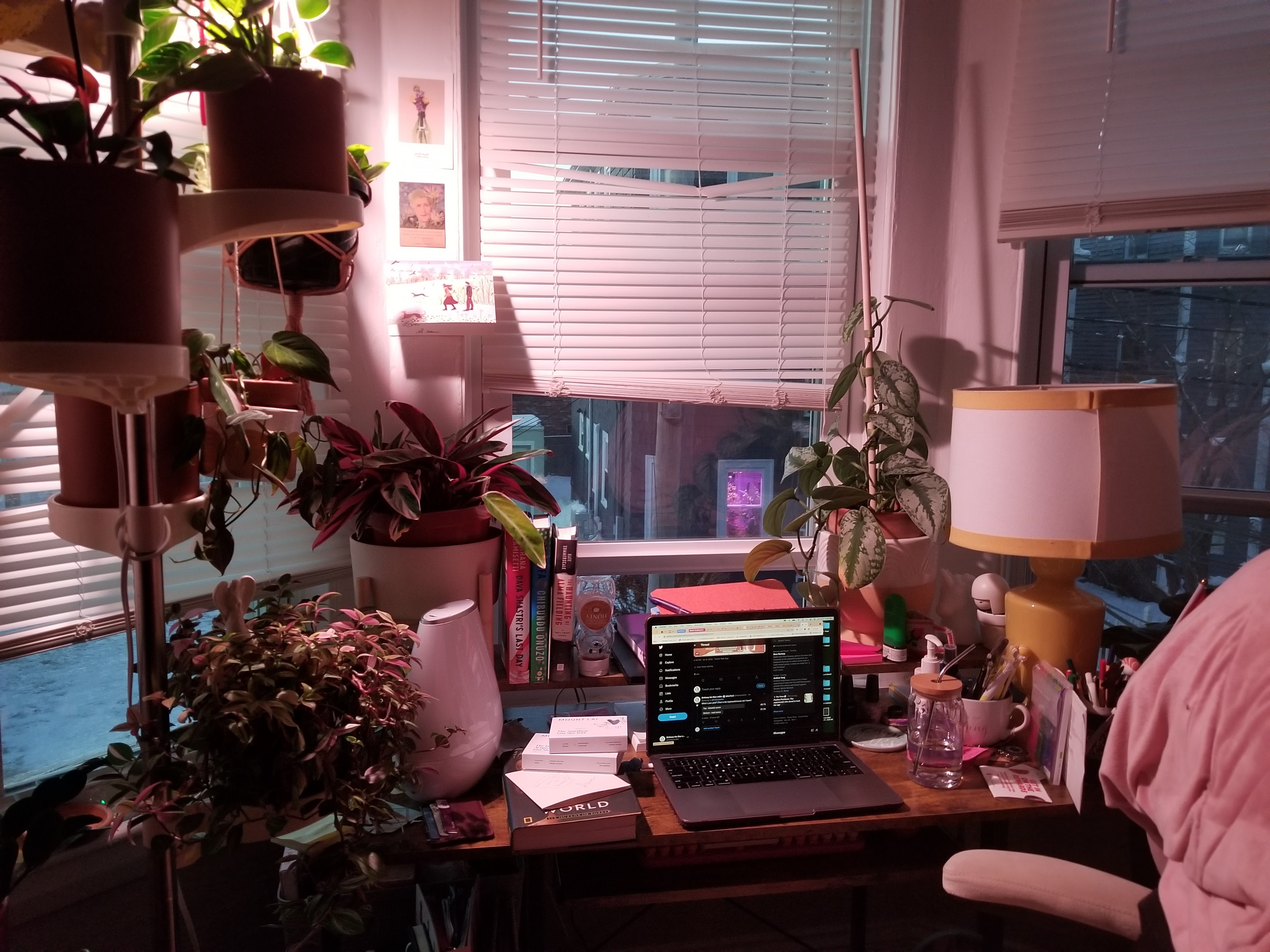
    Brittany’s workspace

    Brittany’s workspace

    I check email for about twenty minutes to make sure I don’t have any fires to put out, and then I write down my top three goals for the day in my planner. If I don’t do this, the day feels too nebulous, and my attention span suffers even more.

    Some days are more sales heavy than others, where I work with outside organizations and authors on bulk sales, but my days recently have been more marketing forward. I email with authors and editors, create digital assets, execute various marketing plans, and schedule Facebook ads. I also run our bookseller newsletter, so you might catch me making GIFs for it in Canva.

    I tend to work straight through the day with short breaks in between to snuggle my dog or do a quick ten-minute meditation. Once my day wraps, I take the two-foot walk to my bed and scroll through Instagram to decompress.

    What are some of the challenges of being a sales and marketing assistant? What do you find most rewarding?

    My biggest challenge as a marketer is that I like to think outside the realm of reality, so I have to be pulled back down to earth. But that’s also one of the most rewarding things because I have a supportive team that lets me flex my creative muscles (see: my tea towel for Breaking Bread). My relationships with our authors and my colleagues, though, are the most rewarding.

    The “it takes a village” phrase has been co-opted to death, but it really does apply to book publishing. I think of it as a road trip, where we’re all driving our little cars to the same destination and supporting each other along the way.

    What are your experiences attending conferences like and how do they add to your work?

    One of my very favorite meeting types is the sales conference, where we get to share our forthcoming books with sales representatives and hear their feedback. Sales reps are the unsung heroes of book publishing. It’s easy to congratulate the author for a great book, to thank the booksellers for their great work promoting the book, to even pat the publishing team on the back for their behind-the-scenes work. But sales reps are the heart that pumps excitement about books to each other and booksellers. They’re all so brilliant—and I’m not just saying that because I want them to like me. I learn something new each time we meet with them and come away with excellent advice for how to better position my books for readers.

    What’s your advice to someone interested in entering the publishing field?

    Get a bookselling job if you can swing it. There are all kinds of prohibitive factors that I don’t want to discount with that advice; for many, bookselling won’t pay the bills. But if you can be a bookseller, even for a year, you’ll learn so much more about books and what goes into them than you will from any degree. You’ll learn about the consumer (your favorite regular who loves thrillers!) and the business behind it (the finicky inventory system that, once conquered, will make you feel like you can learn anything). All of the (literal) on-the-ground experience primes you for pretty much any publishing job, but especially editorial, publicity, or marketing.

    In an alternate universe, what career would you have?

    I think I’d be a jewelry designer. If you know me, you know I’m a ring person, and I love to accessorize with various baubles. I’d love to create custom designs for myself and for others.

    Favorite book ever?

    Tie between Rachel Harrison’s The Return and Charlotte Brontë’s Jane Eyre. The latter fills that need for dark but romantic, even if problematic, while the former is dark, smart as hell, skin crawly, and such a brilliant interrogation of female friendship through horror.

    Hobbies outside of work?

    Hiking and watching my dog run around in the woods, living her best life.
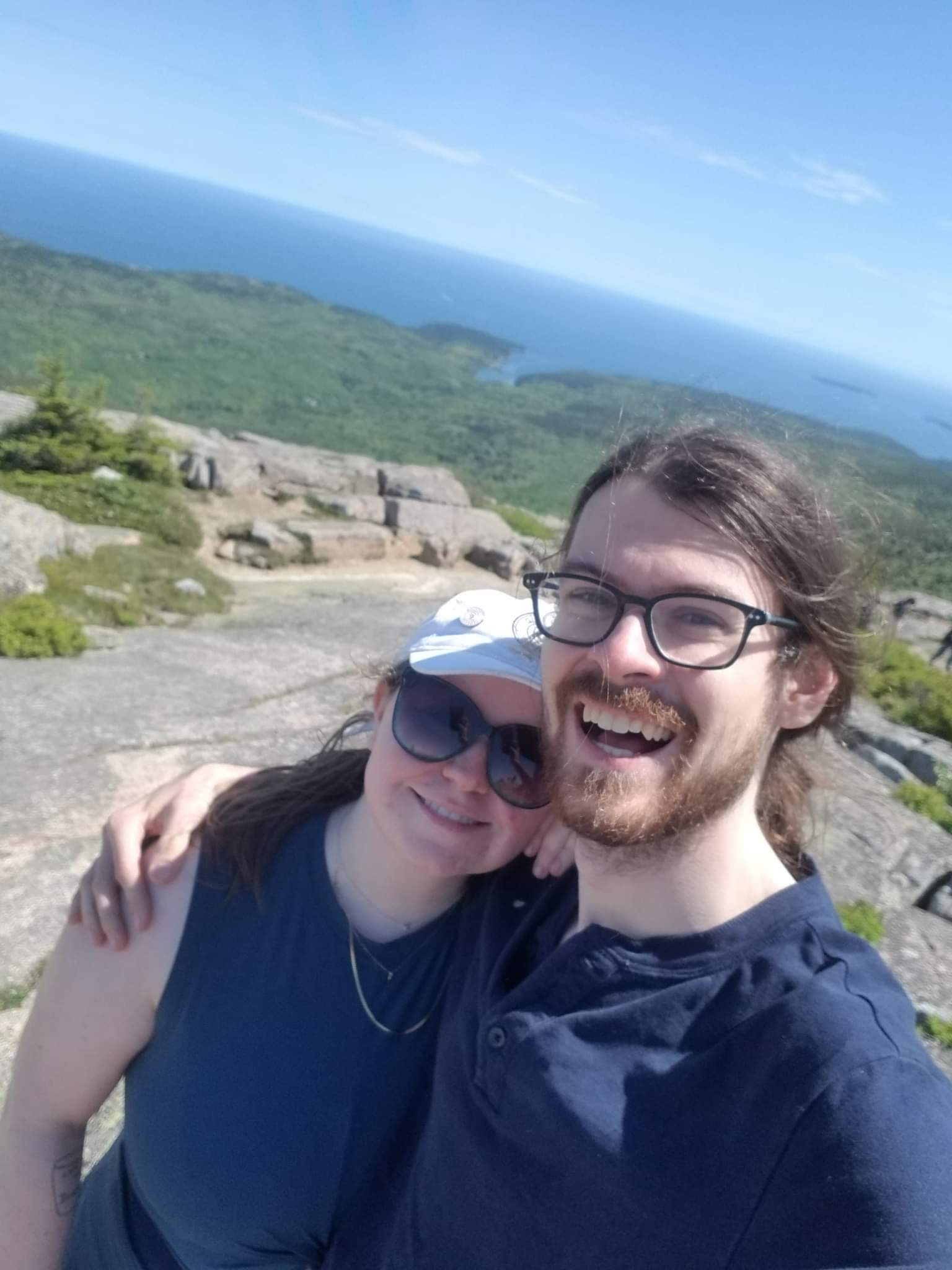
    Brittany and Sean hiking

    Brittany and Sean hiking

    Favorite type of music?

    Right now, I’m really into the music that you’d hear if you tuned into the radio in the 1940s. Is that blues? Jazz? I don’t really know.

    Name three things at your workstation that you can’t live without.

    My wireless mouse that is both pretty and silent, my mechanical keyboard because it makes those fun clickety-clackity sounds, and my houseplants.

    Brittany Wallace


    More About Brittany Wallace 

    Brittany Wallace joined Beacon Press in 2021 after completing her master’s in Publishing and Writing at Emerson College. Previously, she worked as a bookseller and magazine buyer at a Boston-based independent bookstore, and before that, she was at Barnes & Noble. She also has several years of experience editing at an online magazine, where she curated the fiction and nonfiction sections. When she’s not working, Brittany is likely hiking in the forest while listening to a true crime podcast telling her to stay out of the forest. You can find her yelling about books and her dog on Twitter @thebooseller.

  • Summer reading by the pool

    Photo credit: Capucine

    Don’t mind us. We’re just getting through this heat wave by chilling with our summer reads, TV shows, and podcast binges. A tall glass of lemonade, with or without additive, really pairs well with them. Don’t judge! Need some recommendations? We have plenty!

    ***

    From Helene Atwan, Contributing Editor

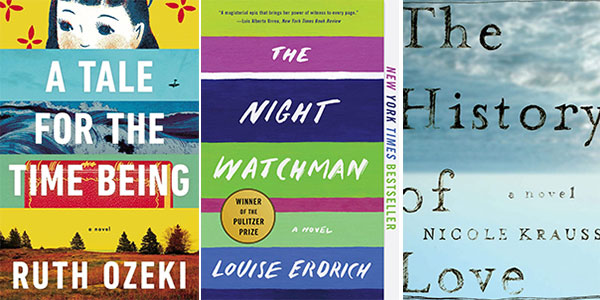
    Ozeki-Erdrich-Krauss

    Now that I’m finally, mostly, retired, I’m looking forward to really reading for pleasure, which means rereading a few novels I feel like I powered through, rushing to get to the nonfiction, though they deserved a more leisurely pace, including Ruth Ozeki’s A Tale for the Time Being, and Louise Erdrich’s The Night Watchman. I’ve also got The History of Love, Nicole Krauss’s 2006 book, which I found only half read as I was sorting books. Busy times, what can I say? 


    Heumann-and-Baldwin-audios

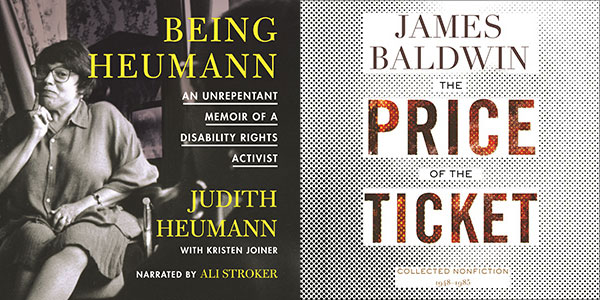
    And I’m going to listen to a whole bunch of Beacon titles for the sheer pleasure of it, including Judy Heumann’s Being Heumann, because it’s read by Ali Stroker, and finally indulge myself in listening to the award-winning narrator JD Jackson read James Baldwin’s many essays collected in The Price of the Ticket. I might just have to dole them out to myself, so they last through the fall.


    Endeavour-and-Only-Murders-in-the-Building

    My binge watch will be the BBC Mystery’s new season of Endeavour. I already know I don’t want that one to end. But first, of course, I need to finish Only Murders in the Building.
     

    From Beth Collins, Production Manager

    100 Foot Wave

    I have been watching and rewatching 100 Foot Wave on HBO, a six-part documentary about a professional surfer’s ten-year quest to hunt down and surf the biggest waves the in the world. It’s kind of like if Captain Ahab was on a surfboard and chased Moby Dick to Portugal. It literally has more drama, excitement, and action than most Hollywood films. Just watch the first episode, and I bet you will be hooked. Pun intended.


    From Avery Cook, Sales and Marketing Assistant

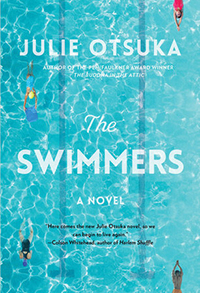
    The Swimmers

    I loved Julie Otsuka’s new novel The Swimmers. I had heard an excerpt read on an NPR podcast and was hooked on the collective first-person voice—as I always am—and on the strange, limited profile that’s created from seeing people only through their interactions at a gym pool. When their world begins to crumble, the novel hits a stride that had me glued to the page until I reached the end. It’s heartbreaking in a relieving way, because it feels so uniquely honest about and compassionate to the swimmers who once shared their lives and lanes together in one place.


    From Alyssa Hassan, Associate Director of Marketing

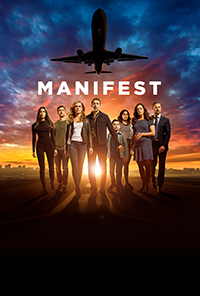
    Manifest

    A plane disappears, everyone’s presumed dead, and it reappears five years later, and while the world has aged, everyone on the plane is the same age as when they left. There’s secret government operations, a cult-like group, a bunch of people who fear the returned, and at the center of it all, a family who really loves each other and wants to figure out what happened to them. Also, there’s a guy slowly dying of hypothermia as he’s just walking around living his life and getting married. Can’t give too much away on that. But it’s hilarious. What I really enjoy is how many times they repeat certain phrases like “Did you have the calling?” and “Death date.” And whoever told these actors that to really sell it they need to act with their eyes, got a whole cast having the most expressive eyes I’ve ever seen in every single scene. The amount of fear, anxiety, worry, confusion, and sometimes happiness they show through their eyes is like nothing I’ve ever seen. And Netflix stepped up and is doing a final season because there was one hell of a cliffhanger!


    Z Nation

    I started watching Black Summer because Netflix recommended it as a TV show I might like. It’s about the zombie apocalypse but was just too serious for my taste right now. So, I did a little Googling and found out it was a prequel of sorts to Z Nation, a SyFy show. Now I’ve had good luck with SyFy shows (12 Monkeys is an absolute fave), but they have embraced the ridiculous with this show. They’re laughing right along with us. It’s got a zombie tornado (same group that did the Sharknado movies), a guy who is the hope for humanity because he’s got antibodies . . . and he might be turning into a zombie, and DJ Qualls. He rocks. I’m only six episodes in but I’m on board for this show. From what I’ve read, there’s some zombie dance number in a couple seasons, and I can’t wait!


    From Nicole-Anne Keyton, Assistant Editor

    Shrapnel Maps

    Reading: Shrapnel Maps, a poetry collection by author and activist Philip Metres, professor of English and director of the Peace, Justice, and Human Rights program at John Carroll University. Using documentary poetics (vintage postcards, found records, erasure maps of the Middle East, and military dispatches), Metres navigates the past and present of Palestine and Israel in order to interrogate possibilities for a Palestinian future.

    Favorite poems: Ode to the Oranges of Jaffa” and “Future Anterior”


    The Orville

    Watching: What began as a comedic riff off Star Trek tropes has now started to take itself seriously. Episodes from the latest season, now streaming on Hulu, cover topics such as suicide, trans rights, feminism, nationalist propaganda, and even a rigged election. The Orville manages to confront the issues we face today through the veil of science fiction, which might make them easier to introduce to some of your more politically polarized relatives than more direct approaches to difficult conversations.

    Listening: Exolore, a world-building podcast with astrophysicist and folklorist Dr. Moiya McTier.

    Favorite episode:The World of Freedom,” in which the podcast speakers collectively envision a world free from colonization and slavery.


    From Gayatri Patnaik, Director

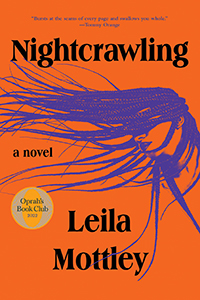
    Nightcrawling

    I recently returned from Asia and have been experiencing jetlag the last few days, so at four every morning, I’ve been obsessively listening to Nightcrawling by Leila Mottley. And wow! This is an incredibly powerful, thought-provoking and also beautifully narrated book (by Joniece Abbott-Pratt) about corruption in the Oakland police department, inspired by a true story. Leila Mottley just became the youngest person, at twenty, to be nominated for the Booker Prize. And what a talent she is! I can’t wait to read her next book.

    Summer reading by the pool

  • By Jonathan Rosenblum

    Liz Shuler

    Liz Shuler, president of the AFL-CIO. Photo credit: Seb Daly/Collision via Sportsfile

    This article appeared originally in The Nation.

    Surrounded by the vistas of western Montana, the generals of the war against Starbucks baristas will gather on August 3 at a swanky Rocky Mountain resort for three days of discussing labor-management relations. Big Sky Resort is hosting the confab, and when attendees aren’t meeting, they can avail themselves of golf, guided trout fishing, luxurious dining, and spa treatments before retiring to their $600-a-night hotel suites.

    Ostensibly called to bring together corporate, government, and union officials for “meaningful discussion about solutions to some of the challenges facing our country today in the labor and employment arena,” the privately organized Big Sky Labor and Employment Conference features three senior attorneys from Littler Mendelson, the country’s biggest and most notorious union-busting law firm. Also making an appearance: top executives at the US Chamber of Commerce, Verizon, Boeing, and Bank of America, as well as Supreme Court Justice Amy Coney Barrett, who has been, not coincidentally, one of Littler’s go-to judges for overturning worker protections.

    The conference is the brainchild of Roger King, a retired senior attorney from the Jones Day firm. King played a leading role in NLRB vs. Noel Canning, the most devastating court decision for workers and labor law enforcement of the Obama era.

    And for some reason, the president of the AFL–CIO, Liz Shuler, has agreed to open the conference alongside the Chamber of Commerce’s executive vice president.

    Shuler did not reply to my attempts to ask why she is attending before publication, but she apparently believes it’s OK for the head of the US union movement to hobnob with the country’s worst anti-union elements. Business executives are no doubt delighted that her presence confers legitimacy on their unsavory gathering. Shuler is sending precisely the wrong message to workers. While baristas, warehouse laborers, and others are fighting back against firings, harassment, and other forms of corporate retaliation, she is off to a posh resort with the workers’ very persecutors. We need a fighting labor movement in 2022, and Shuler’s appearance undercuts the solidarity that workers rightfully demand and urgently need.

    Starbucks CEO Howard Schultz may be the face of his company’s union busting, but Littler lawyers are the masterminds and the muscle behind the operation. With Littler consulting, Starbucks is firing union workersclosing union stores for “safety” reasons, forcing union workers to reapply for their jobs or be relocated, engaging in “captive audience” meetings (shamefully permitted under US labor law), and sending managers into stores to change schedules and issue write-ups and threats. Littler is blatantly running a campaign to intimidate workers.

    Hundreds of charges of unfair labor practice are piling up at the National Labor Relations Board (NLRB), but that’s not a problem for Littler. The firm intends to overwhelm the labor board, which is short-staffed after years of austerity under both Democratic and Republican administrations. It is dragging out elections and litigation, and hopes to prevail by prevent workers from accessing their rights until the union drives are dead.

    Littler’s war on workers also seeks to deter other baristas from organizing. Starbucks workers at more than 300 US stores have organized—but that’s just over 3 percent of the country’s Starbucks-operated stores. Littler’s scorched-earth approach aims to create a firebreak to prevent the spread of union shops.

    And when it comes to corporate America versus the labor board, it’s not a fair fight. Littler Mendelson—just one union-busting firm among many—has more than 1,000 lawyers in the US and an annual budget that is twice the budget of the NLRB.

    Schultz is willing to take a public bruising in the short term—and pay Littler a fortune—because, like the US Chamber of Commerce and the other corporate representatives at the Montana conference, he is playing the long game. The goal of big business is to marginalize workers who try to organize, overwhelm the labor board, and force cases to go before the Supreme Court, which will overturn what little remains of legal worker protections. It is to raze the entire labor movement, not just nip the growing power of baristas.

    Sadly, Shuler is not the only one who believes in fraternizing with the enemy. Also featured at the conference: former SEIU leader David Rolf and nurses association officials, speaking on a panel about “labor/management engagement and cooperation” alongside the legal minds behind union-busting at Providence Healthcare and Verizon. There’s also an official from the United Food and Commercial Workers union appearing with the senior vice president of the Chamber of Commerce and the CEO of the International Franchise Association to talk about “What’s being discussed in Washington?” (Spoiler alert: What the Chamber and the franchise association are plotting in Washington is to destroy UFCW members’ rights.)

    The corporate agenda is not a secret. When asked recently if he’d ever embrace a union, Schultz simply replied, “No.”

    How about we all crash this get-together? Think again. Shuler and the union officials were invited, as were various government officials, but Starbucks baristas and other workers are not welcome. After traveling to western Montana, you’d have to fork over $750 for conference registration, plus $1,000 and up for food and lodging. (I wrote to the conference asking if registration fees could be waived for workers. King, the Jones Day attorney and conference executive director, wrote back to say no.)

    The challenge that the Starbucks workers face is twofold: First, corporate executives and their attorneys are determined to break worker power. And second, union leaders are failing to mobilize the aggressive, all-union response that’s needed for workers to have a fighting chance.

    Remember the union slogan, “An injury to one is an injury to all”? A true labor leader would be mobilizing unions to join Starbucks workers in mass picket lines, organizing coast-to-coast demonstrations, demanding that anyone seeking public office and wanting labor support first stand with Starbucks workers, and urging large-scale disruptions any time a worker is fired or abused. A true labor leader would be marshaling the resources of our movement to fight back, not sashaying off to a summer junket to schmooze with the would-be architects of labor’s destruction.

    When Senator Bernie Sanders says, “For 45 years there has been a war in this country waged by the corporate elite against the working class of America,” he’s talking about the attacks orchestrated by Littler, Trump-appointed judges, and the Chamber of Commerce.

    Perhaps, when the union officials kick back at the Montana resort (their time paid for by their members), they will tell themselves some fantasy about a labor-management détente that’s just around the corner. But it should be obvious that there’s no labor peace in America. It’s bosses against workers, and Shuler needs to pick a side.

    Update: After publication, Liz Shuler responded with the statement: “I will go anywhere and talk to anyone—including non-traditional audiences and those who don’t agree with us—to raise the voices of the working people of America and our vision of an economy, a democracy, a country that works for us. That’s my job and my priority as president of the AFL-CIO.”


    About the Author 

    Jonathan Rosenblum is a union and community organizer based in Seattle. He is the author of Beyond $15: Immigrant Workers, Faith Activists, and the Revival of the Labor Movement and a member of the National Writers Union.

  • By Jon Hale

    School bus

    Photo credit: Jill Rose

    News of the projected 30,000-student enrollment drop in New York reveals, yet again, that public schools are suffering from long-term effects of the pandemic. Beyond this, however, insidious politics are at play. Dramatic student disenrollment also illustrates that privatization efforts through charters and homeschooling have benefitted from the pandemic.

    The net loss shows, rightfully, how our public schools continue to fail the students, families, and communities they serve. Yet public schools were already resting on a faulty foundation. Gutted by severe budget cuts, surveilled by police, and scorned by anti-intellectual and racist curriculum from extremists, public schools have suffered—by design.

    As I explain in this passage from The Choice We Face, school choice is not a fair, nor desirable, solution. Touted as silver bullets and a panacea prior to the pandemic, charter schools, private academies, virtual schools, and homeschooling all promised better choices. They became more appealing during the pandemic. Contrary to popular beliefs, the choices are not equal. The best options on the menu are limited by one’s access to make the best choice—which is limited by money, race, and access to schools.

    Rather than focus on creating more choice through public funding and taxpayers’ dollars, solutions begin with those still in public school, out of necessity or choice. There are still over 900,000 students in traditional New York public schools.

    History and a critical read on the research compel us to show up and serve students still enrolled in public schools, rather than cutting funding for the majority for the benefit of a few.

    ***

    Milton Friedman has won, even beyond the economic theory that earned him a Nobel Prize. His greatest legacy is advancing school choice and inspiring one of the most comprehensive reform movements in educational history. For the last ten years of his life, he and his wife, Rose, committed themselves to privatization and school choice. As he noted in their joint autobiography, “Rose and I feel so strongly about the importance of privatizing the school system that we have established the Milton and Rose D. Friedman Foundation with the sole mission of promoting public understanding and support of the measures necessary to achieve that objective.” With their foundation—now called EdChoice—the Friedmans worked to steer the school choice movement into the safe harbor we know today. As the conservative pundit Cal Thomas opined after Friedman’s passing in 2006, “If school choice becomes the norm in America, it will be Milton Friedman’s real legacy and every poor child who is liberated from a failed government school will owe him a lasting debt of gratitude.” The choice movement is forever indebted to its savior.

    Friedman’s ideas have eclipsed and surpassed in popularity the desegregation movement that defined the era of his first foray into school reform politics in the 1950s. Yet his ideas remain supported by an unchanging systemic racism that undercuts the righteous demands of advocates connected to a longer struggle like Howard Fuller and Sarah Carpenter. A structurally racist system will never give real power to historically marginalized communities and, therefore, a fair chance at success.

    Millions of families of color, as well as poor Whites, stand to lose, as they truly have no choice but to enroll their children in underfunded, segregated schools—public, private, or charter. Choice has provided a safety net for some, but the majority are in peril. Dave Dennis, a civil rights activist who led CORE in Mississippi during the 1960s, mobilizes communities to demand quality education as a constitutional right today. He employs the apt analogy that school choice provides a life raft for the few who can escape the sinking ship of public education. The remaining families—majority-Black, -Brown, and poor—are left on the ship as the nation watches, critiques, and largely refuses to extend a helping hand.

    ~~~

    The theoretical edifice of school choice crumbles under the crushing weight of racism in the United States. Race is the key to understanding how school choice has failed to deliver its promises in any equitable way. The forces of racism, which Friedman relegated to a footnote in his seminal essay, now dominate the implementation of school choice. Choice is essentially all about race. Historically, all of American public education has been shaped by race. In the antebellum era, since education for slaves was explicitly forbidden, Whites excluded Africans and African Americans at the advent of public education during the mid-nineteenth century. After the Civil War, education was racially segregated by law in the South through the 1950s. The tumultuous period of desegregation from the 1950s to the 1980s then shaped education policy, affecting the experiences of millions of students since then. If choice works according to Friedman’s economic theory, then race is not supposed to motivate decision-making. Yet it does. It also illustrates the toxicity of the very culture around choice.

    W. E. B. Du Bois’s argument from 1935—that our society does not permit the genuine integration necessary for a democratic education of all students, particularly Black students—remains painfully true. His observation that “race prejudice in the United States today is such that most Negroes cannot receive proper education in White institutions” is still experienced daily. Such institutional racism precludes what Du Bois called “that sort of public education which will create the intelligent basis of a real democracy.”

    The strict economic argument for choice is that competition, the market, and the “invisible hand” will improve schools, but one cannot assume that corporate interests seek to empower Black communities, communities of color, and people living in poverty. If society cannot integrate its schools, it cannot integrate the very institutions of capitalism founded on the backs of enslaved people and their descendants. Nor will the individual advocates and captains of industry willingly share decision-making power and wealth generated by that same system. A few families of color or families in poverty may benefit, to be sure. However, the masses of those dependent on public education will not be integrated into the for-profit governing system.

    Reports on resegregation in choice districts and schools illustrate the depths to which the system remains controlled by wealth and White supremacy. In essence, BIPOC families and families living in poverty remain segregated and excluded from the genuine privileges and benefits that choice is supposed to provide. In New York City, over 13 percent of the student population is enrolled in a charter school. Of this number over 90 percent are Black or Latinx students as compared to their being 68 percent of the total public-school population. Washington, DC—one of the first cities ordered to desegregate after the Brown decision—enrolls nearly 50 percent of its total student population in a charter school. At the same time, 70 percent of students of color attend segregated schools in which 90 to 100 percent of the student body is Black or Latinx. Chicago, the ideological birthplace of school choice, shows similar trends. Studies have reported that only 20 percent of traditional public schools and only 7 percent of charter schools are racially diverse. As education scholars Erica Frankenberg, Gary Orfield, and other researchers at the Civil Rights Project at UCLA concluded, “Charter schools are more racially isolated than traditional public schools in virtually every state and large metropolitan area in the nation.”

    There are situations where choice has in fact reversed desegregation trends. Duke University researchers found that North Carolina, after rolling back the busing mandate and implementing choice in the early 2000s, showed signs of White flight and resegregation. After fifteen years of choice, public schools became nearly 15 percent less White while the state’s charter enrollment grew to over 62 percent White. In Indianapolis, a city that embraced choice under Mike Pence’s 2013–17 tenure as Indiana governor, 80 percent of the student population is Black or Latinx, yet magnet schools there are over 80 percent White. In cases such as these, when choice is available, it is largely driven by the interests of White parents, not by Black demand. As Nikole Hannah-Jones noted, “White communities want neighborhood schools if their neighborhood school is White. . . . If their neighborhood school is Black, they want choice.”

    The inherent racism of the system is apparent in cases where choice has been leveraged as a way to improve public education, like in Memphis. Federal education officials and choice advocates alike viewed the city as a model site for reform. The ambitious plans to turn around schools in the Achievement School District there entailed many of the factors that attracted parents to choice—not just the right to choose a school but also new management, innovative ideas, and a promise of quick, transformative change.

    Whites, however, wanted nothing to do with it. In 2014, not even five years after Tennessee launched its ambitious takeover through choice policies—with hefty federal support under President Obama as well as investment from philanthropists like Bill and Melinda Gates—six outlying suburban towns seceded from the Memphis school district. With assistance from the state legislature, the suburban districts had begun to talk of secession at the same moment that the state merged the city school district with the surrounding suburbs. They seceded one year later. The move was clearly driven by race and class. The city district served a population that was overwhelmingly Black—over 90 percent of the students were people of color. Nearly one-third of families served by the city district lived below the poverty line, compared to only 11 percent of the areas that seceded. Segregation persisted, and economic fissures deepened. Memphis schools were forced to cut their budgets—a reported $90 million the first year after secession—as they lost tax revenue from the districts that seceded. They were also pressured to close dozens of schools, and they laid off or pushed out more than five hundred teachers. At the same time, one of the new suburban districts, Collierville, began charging tuition to families from outside the attendance zones to maintain a “neighborhood school.” The same district also approved $95 million in bonds to fund a new high school and athletic facilities.

    ~~~

    Dating from 2000, 128 communities across the country have attempted to secede from their public-school districts. Of these attempts, 73 have been successful, 27—including the case in Gardendale—have been defeated, 17 are ongoing, and 11 have become inactive. Though small in number, such attempts indicate dissatisfaction with education reform and also validate Du Bois’s assertion from a century ago: the system does not provide the equity and support needed for Black children and other children of color. The wave of attempts to secede from majority-Black and -Latinx school districts merely reifies the sanctity of the “suburban veto.”

    Some Black advocates like Howard Fuller have continued to argue that persistent segregation does not matter or it does not matter enough to shape educational reform initiatives—that it merely conforms to a racist, unchanging history. Yet, to many, integration is important. We know that integration promotes Black achievement, particularly if it is consciously incorporated into education policy. Despite fierce resistance to it, desegregation after the 1954 Brown decision cut the “achievement gap” by half across the nation, boosting the test scores of millions of students. Particularly when placed in a wider historical context that measures scores over time and through an intergenerational perspective, integration and the federal policies supporting it were effective in improving education for all students.


    About the Author 

    Jon Hale is a professor of educational history at the University of Illinois at Urbana-Champaign and an advocate for quality public education. Hale’s research in education has been published in The Atlantic, CNN.com, Education Week, the American Scholar, and the African American Intellectual History Series. His books include The Freedom Schools, To Write in the Light of Freedom, and The Choice We FaceFollow him on Twitter at @ed_organizer.

  • Redesigned Disability Pride flag by Ann Magill, 2021

    Redesigned Disability Pride flag by Ann Magill, 2021

    Nobody wanted long COVID on our collective pandemic Bingo card, but there it is. In her The Daily Show interview, OG disability rights badass Judy Heumann told Trevor Noah that his likelihood of acquiring a disability, temporary or permanent, was statistically high. He took her statement as a threat in jest, but there’s truth in that for us. For some, long COVID is speeding up that transition from nondisabled to disabled.

    Now, it can be a disability under the Americans with Disabilities Act. Don’t forget that we have Judy Heumann and everyone she worked with to thank for making the ADA a civil rights reality. Long COVID folks won’t be alone. The disabled community makes up twenty-six percent of the US population, our largest and most diverse minority.

    So in the name of Disability Pride Month, we’re serving up an inexhaustive handful of titles from our catalog centered on our favorite disabled s/heroes and on disability life, then and now.


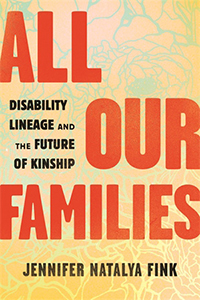
    All Our Families

    All Our Families: Disability Lineage and the Future of Kinship

    By reclaiming our personal disability lineage, we open up the possibility of connecting it to a larger communal ancestry, with powerful political and social implications for all our family and kinship systems . . . . Though not all disability lineages can be fully reclaimed, the very act of assuming that our families always included disabled people can be transformative. Every family story is a disability story, if you choose to so tell it.
    —Jennifer Natalya Fink 


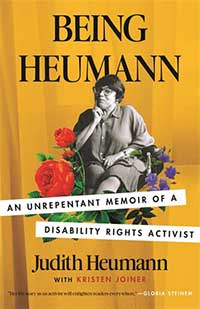
    Being Heumann pb

    Being Heumann: An Unrepentant Memoir of a Disability Rights Activist

    It didn’t occur to me then to think it unusual that I joined in all the kids’ games in my wheelchair. Because there was never a question of whether or not I would play, too—we all figured out a way for me to do whatever everyone was doing. Even when we jumped rope or roller-skated, we figured it out. We’d put roller skates over my shoes and I would pretend to be skating in my chair, or I’d turn the rope for the jumpers, or play in some other way. I didn’t know anything different. Now I know that this was the way it was because we were kids, and kids are problem solvers. But it taught me, at a very early age, that most things are possible when you assume problems can be solved.
    —Judith Heumann with Kristen Joiner 


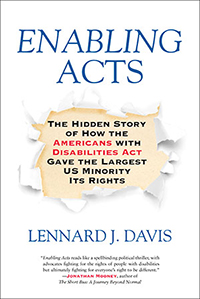
    Enabling Acts

    Enabling Acts: The Hidden Story of How the Americans with Disabilities Act Gave the Largest US Minority Its Rights

    After the ADA, never could anyone see disability as deserving charity. No longer could anyone see disability as a purely medical condition or a rehabilitation opportunity. Instead, disability would be seen now and forever as a civil rights issue in which aid and redress would not be focused on physical therapy or monetary benefits. Rather, it would be about the right of individuals to have access to the world that everyone else is part of.
    —Lennard J. Davis


    The Fearless Benjamin Lay pb

    The Fearless Benjamin Lay: The Quaker Dwarf Who Became the First Revolutionary Abolitionist

    Benjamin repeatedly dramatized what was wrong in both the Society of Friends and the world at large. For a quarter century he railed against slavery in one Quaker meeting after another, in and around Philadelphia, confronting slave owners and slave traders with a savage, most un-Quaker-like fury. Whenever he performed guerrilla theater, his fellow Quakers removed him by physical force as a “trouble-maker” or “disorderly person” as they had done in Burlington. He did not struggle against eviction, but back he came, again and again, undeterred, or rather more determined than ever. He began to stage his theater of apocalyptic outrage in public venues, including city streets and markets.
    —Marcus Rediker 


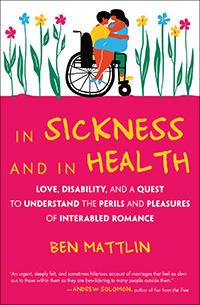
    In Sickness and In Health

    In Sickness and In Health: Love, Disability, and a Quest to Understand the Perils and Pleasures of Interabled Romance

    I really shouldn’t blame other people for misunderstanding us. We [my wife, M.L., and I] were unusual. We were inventing something new—or so we thought. There were few resources to draw on, so I assumed most people born with a severe disability like mine didn’t get married at all, let alone have children. (And those who did rarely managed to stay together, I conjectured.) Our problem was, nobody ever told us we couldn’t.
    —Ben Mattlin


    Intelligent Love

    Intelligent Love: The Story of Clara Park, Her Autistic Daughter, and the Myth of the Refrigerator Mother

    Clara and Jessy [Park] were affected by the ways in which experts on the human mind and behavior, from psychiatrists to psychoanalysts to psychologists to therapists, conceived of autism. But Clara and Jessy also contested some of their views. In the process, they actively helped shape the history of autism. Their story illustrates how science affects people and how people contribute to transforming science.
    —Marga Vicedo


    Mean Little deaf Queer

    Mean Little deaf Queer: A Memoir

    At school I couldn’t wait to make a commotion, and headed straight for drama club. I could be one scary little kid, damp and lisping with need until my teachers gave me the male roles the boys my age scorned, like dorky, pantaloon-wearing Wilbur in the series of plays that bore his name. No matter how they cast me, I’d find some excuse to fall flat on my butt violently enough to shake the stage, and if the stage directions read laugh or cry I’d guffaw myself into hiccups or wail until snot shot out of my nose . . . . All the world a stage, and I was hell-bent on using it as such.
    —Terry Galloway


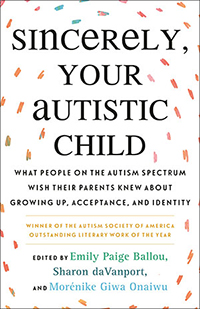
    Sincerely  Your Autistic Child

    Sincerely, Your Autistic Child: What People on the Autism Spectrum Wish Their Parents Knew About Growing Up, Acceptance, and Identity

    Eds. Emily Paige Ballou, Sharon DaVanport, Morénike Giwa Onaiwu

    The greatest thing that a parent can do is support their child. Let your child know how amazing they are and how much you believe in them. It really does seem so simple, but it makes a world of difference. I’ve met hundreds of people on the spectrum and hundreds more who are not. Most everyone I’ve met says they wish their parents were more supportive and loved them unconditionally. Most parents do love their children, but it is important to let them know verbally, because we don’t always pick up on nonverbal cues. Yes, as difficult as it is to say it, we sometimes do not know when people care about us or love us.
    —from Brigid Rankowski’s “It’s Us Against the World, Kid”


    Until I Am Free

    Until I Am Free: Fannie Lou Hamer’s Enduring Message to America

    In her televised speech before the 1964 Democratic National Convention, Hamer spoke candidly about her violent interaction with the police [in Winona, Mississippi]. She explained how the Winona beating left her with kidney damage, a blood clot in her eye, and a worsened physical limp from childhood she would carry for the rest of her life . . . . Unlike so many others, Hamer lived to tell her story. And she certainly told that story—over and over again to anyone who would listen. For Hamer, directly confronting racial and gendered inequalities was a key strategy to eradicate them.
    —Keisha N. Blain


    Woody Guthrie

    Woody Guthrie: An Intimate Life

    He came to understand the shaming and stigmatization of certain bodies as working to isolate people, to prevent them from assembling as a collective—a proven way for those lacking financial resources to empower themselves—to demand a better life. The origins of this viewpoint lay in Guthrie’s earlier life, in the tragedies that beset his family, all revolving around his mother’s mysterious condition, her undiagnosed Huntington’s disease.
    —Gustavus Stadler

    Visually_Safe_Disability_Pride_Flag

  • Seeing red from all the SCOTUS dread. Photo credit: Mark Thomas

    Seeing red from all the SCOTUS dread. Photo credit: Mark Thomas

    This is not the time warp we want to do again. Or ever. The conservative-majority SCOTUS wants to take us on a detour back in time when folks who aren’t straight white cis men didn’t have rights. A time when we thought of the planet as nothing more than an ashtray. A time when . . . you get the idea. Overturning Roe v Wade was the lowest of blows. Gutting the Clean Air Act stripped power from the EPA to curb greenhouse gas emissions. What’s next?

    Now Justice Clarence Thomas, emphasis on the Thom because he’s everyone’s favorite Uncle Tom, is coming for laws protecting contraception access, same-sex relationships, and marriage equality. Incoming Justice Ketanji Brown Jackson is walking into a dystopian case scenario so many writers warned us about.

    It’s easy to lose sight of the big picture when you’re righteously furious. And for that, we have our authors’ books to fall back on to understand how we got here, to make sense of the mess going on. More importantly, we can learn to resist. Because we won’t go back!

    Read up and resist!


    Keep Bans Off Our Bodies 

    Her Body Our Laws

    Her Body, Our Laws: On the Front Lines of the Abortion War from El Salvador to Oklahoma

    Our blinkered focus on whether abortion should be legal distracts us from the plight of the women and children most affected by our abortion laws. They are the most marginalized women in the country. Another child will thrust them deeper into poverty, but an abortion does little to lift them out of it. The war over abortion law draws our gaze away from them, relieving us of the obligation to notice, if not to reset, the odds against them.
    —Michelle Oberman 


    Trust Women

    Trust Women: A Progressive Christian Argument for Reproductive Justice

    Abortion, however, is never an abstract ethical question. It is, rather, a particular answer to a prior ethical question: “What should I do when faced with an unplanned, unwanted, or medically compromised pregnancy?” This question can only be addressed within the life of a particular woman at a given moment in time. When a woman is faced with this ethical question, her answer will vary depending on the individual and the many factors—social, economic, personal, religious—that define her life at any given point.
    —Rebecca Todd Peters


    We Don’t Want a Theocratic Takeover 

    Christians-Against-Christianity

    Christians Against Christianity: How Right-Wing Evangelicals Are Destroying Our Nation and Our Faith

    It is because of this spirit of antichrist that dominating American society is now more important to right-wing evangelicals than maintaining the integrity of the Christian Gospel, more important than honesty or love or care for those who look to them for truthful guidance and nurturance . . . Not only is their worldview not loving, not generous, not socially inclusive, but the notion of religious freedom they so extol extends no farther than their own ranks. They have so savaged the social justice legacy of their evangelical forebears that it is now unrecognizable.
    —Obery M. Hendricks, Jr. 


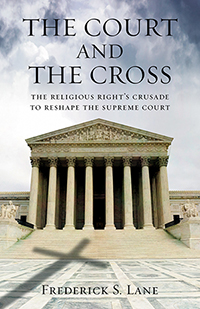
    The Court and the Cross

    The Court and the Cross: The Religious Right’s Crusade to Reshape the Supreme Court

    More than any other single interest group, the Christian Right has educated its supporters on the connection between political success and judicial change, and it has consistently and aggressively worked for the appointment of federal judges and Supreme Court justices who share its philosophical opposition to the Warren Court’s rulings. The time has come for the nation’s political left to remind voters that so many of the rights and privileges that people enjoy today were established more than a generation ago by a Supreme Court that viewed the Constitution as a tool for expanding and defending human dignity and independence.
    —Frederick S. Lane 


    Dangerous Religious Ideas

    Dangerous Religious Ideas: The Deep Roots of Self-Critical Faith in Judaism, Christianity, and Islam

    Religion has too much to contribute to be ignored, and it is too thickly woven through human existence to disappear. But its ongoing role in public life in the United States makes cultivating the deep roots of self-critical faith more urgent. Ultimately, we have to learn how to do this work together, subjecting other people’s religious ideas to rigorous scrutiny as well, without prejudice. Religious ideas cannot receive a pass without impairing the nation’s democratic culture. Given the transformative encounter with science, technology, and global culture, religious thought requires collective critical engagement in order to speak intelligently in the postmodern age.
    —Rachel S. Mikva


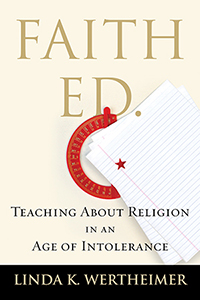
    Faith Ed

    Faith Ed.: Teaching About Religion in an Age of Intolerance

    Religious minorities have faced much worse than graffiti and prejudicial remarks, both inside and outside classrooms. Children have yanked off the turbans of young Sikhs as they waited to board a school bus, and they have taunted Muslim peers on anniversaries of the 9/11 attacks. Sikhs, Muslims, and Hindus live in my community and in nearby towns. So do atheists. All of those groups can easily be targets because their beliefs are rarely understood. Can education soften the divisions? What can schools do and what are they already doing to ensure the next generation will not need to hold forums to confront religious intolerance?
    —Linda K. Wertheimer


    There Is No Planet B

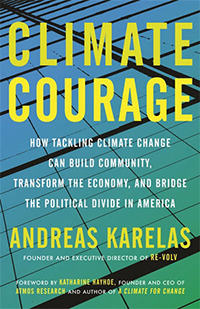
    Climate Courage

    Climate Courage: How Tackling Climate Change Can Build Community, Transform the Economy, and Bridge the Political Divide in America

    Community ties play an important role in any social movement, but when it comes to climate change, the value is even more pronounced. Climate change is a collective problem, caused by collective behavior. Therefore, the only way we can solve climate change is by activating groups of people to assign value to sustainability as part of their community identity . . . It’s critical that climate messaging be focused not so much on individuals and what they can do alone, but what groups can do collectively.
    —Andreas Karelas


    Is Science Enough

    Is Science Enough?: Forty Critical Questions About Climate Justice

    Science and technology will necessarily play an important role in the transition we need, as will specific policies like regulations, caps, and changes in the tax structures and subsidies that currently actively promote GHG-emitting industries and activities. But without larger institutional, political, and social change, new technologies will only reproduce the very arrangements that got us into the current crisis. If we continue to privilege the profits and consumption of the world’s elite, we will continue to abuse and exploit both humans and nature.
    —Aviva Chomsky


    When Time Is Short

    When Time Is Short: Finding Our Way in the Anthropocene

    I believe that there is something very deeply religious that drives this inability to see and understand our present and future reality: human exceptionalism. At the core of this understanding, this hermeneutic, is a belief in the unique godlikeness of humankind and our entitled dominion over the rest of the natural world—that humans are essentially and fundamentally exceptional to and set apart from nature and its ways, including, above all, death and extinction.6 This understanding of ourselves and our world serves to turn our attention away from the consequences of our actions.
    —Timothy Beal


    Trigger Warnings

    Stand Your Ground

    Stand Your Ground: A History of America’s Love Affair with Lethal Self-Defense

    Our nation boasts the highest per capita rate of gun deaths and deaths by mass shooting, defined as an episode in which four or more people are killed or wounded. In 2015 alone there were 372 mass shootings, resulting in 475 deaths. White men are disproportionately the shooters in these and other episodes of mass gun violence. The proliferation of shootings, particularly in our schools, amplifies a national sense of vulnerability, so that citizens who see themselves as law-abiding nevertheless feel the need to take matters into their own hands. But DIY-security citizenship is not just about gun ownership. Guns and their proliferation in the United States are only the tip of the iceberg of a much larger and more widespread belief system that frames lethal self-defense as a core ideal of good citizenship.—Caroline Light


    The Right’s Pearl Clutching Over Queer Rights 

    The Stranger Next Door

    The Stranger Next Door: The Story of a Small Community’s Battle of Sex, Faith, and Civil Rights; Or, How the Right Divides Us

    The culture wars were never simply about fighting gay and lesbian rights, or women’s rights, and they are not simply about fighting trans rights today. Gay and lesbian people constitute less than ten percent of the population, trans people comprise less than one percent. Some observers suggest that struggles against gender have emerged as the “symbolic glue” for a spectrum of authoritarian and ethno-nationalist forces. The battles against gay/lesbian rights in the 1990s and transgender rights today are symbolic struggles which seek to consolidate power on the right and undermine democracy.
    —Arlene Stein 


    The Big Picture

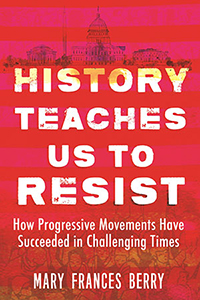
    History Teaches Us to Resist

    History Teaches Us to Resist: How Progressive Movements Have Succeeded in Challenging Times

    It’s crucial to recognize that resistance works even if it does not achieve all the movement’s goals, and that movements are always necessary, because major change will engender resistance, which must be addressed . . . . No time period or issue is exactly like what has come before; other factors will have significance. Still, I do believe that history teaches us to resist, and I hope this analysis of several US resistance movements may provide useful information and guidance for our time.
    —Mary Frances Berry

    Seeing red from all the SCOTUS dread.

  • Celebrating Helene Atwan’s retirement party in New York, NY. L to R: Amy Caldwell, Helene, Michael Reynolds (Europa Editions), Elinor Lipman, Pamela MacColl, Bridget Marmion

    Celebrating Helene Atwan’s retirement party in New York, NY. L to R: Amy Caldwell, Helene, Michael Reynolds (Europa Editions), Elinor Lipman, Pamela MacColl, Bridget Marmion. Photo credit: Mollie O’Mara

    The threshold is upon us. The end of our time with Helene Atwan as our director is coming up. We’re all wishing her the happiest retirement! It has been an amazing twenty-six years, and Beacon won’t be the same without her. So many amazing authors she brought into the fold! So many amazing books—including her love of poetry—she brought to the catalog! Several of our authors gathered here to congratulate her and to thank her. Along the way, we’ll take a trip down memory lane with photos.


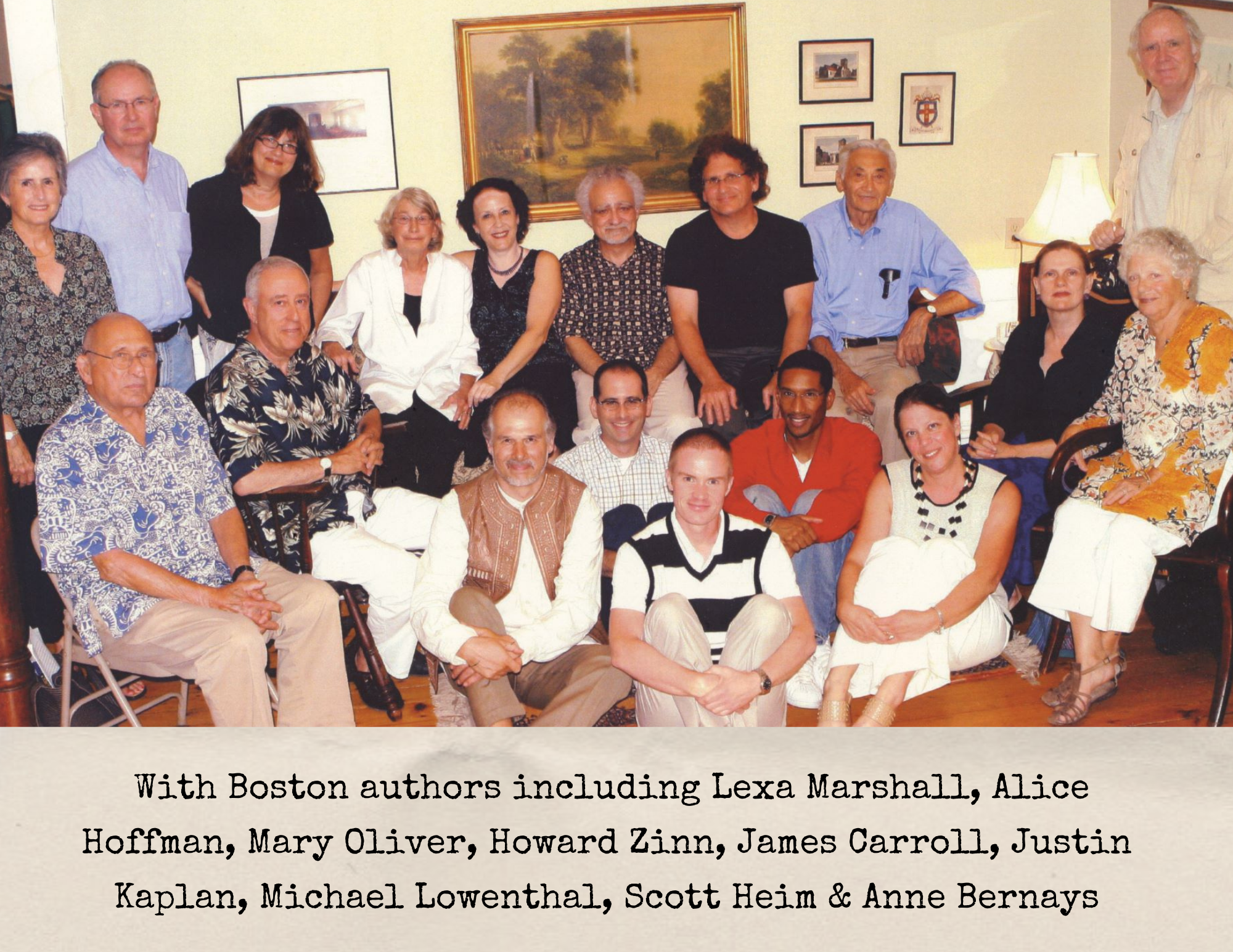
    With Boston authors


    Dear One!

    So sad to hear this. You’ve done such amazing work. And I will be forever grateful for how much you believed in the inaugural memoir.

    But SOOOO HAPPY that you will still be working with me on the new and selected.

    I don’t think I can do it without you.
    —Richard Blanco, How to Love a Country


    I’m so grateful that I got to work with you through the writing of the book. Thank you for believing in me and this project!
    —Jasmine Brown, Twice As Hard


    What sad and happy news! Sad for me, because I have loved working with you, and having a relationship with Beacon has been one of the most rewarding professional relationships. As you know, it was my first choice for my first book. From Baldwin to Gayl Jones to Robeson, to be part of a Boston house for my work has always been important, and that has only been exceeded by knowing you and being grateful for how well you’ve treated me and my work.

    And it’s happy news as well, because you have certainly earned after twenty-six years all the best time to be yours—in Boston, California, wherever you are. I’m very happy for you and I am raising a glass in your honor. Would love to do so in person one day. So, yes, you are never saying goodbye to me. And I look forward to seeing you in person when the time comes.
    —Howard Bryant, Full Dissidence


    HELENE ATWAN, you are amazing. Thank you for being such a strong supporter for my work.
    —Christopher Emdin, Ratchetdemic


    You’ve done such wonderful things at Beacon. I am so honored to be part of your legacy and that you took a chance on me. It is something that has held me up in very dark times.
    —Laila Halaby, Once in a Promised Land


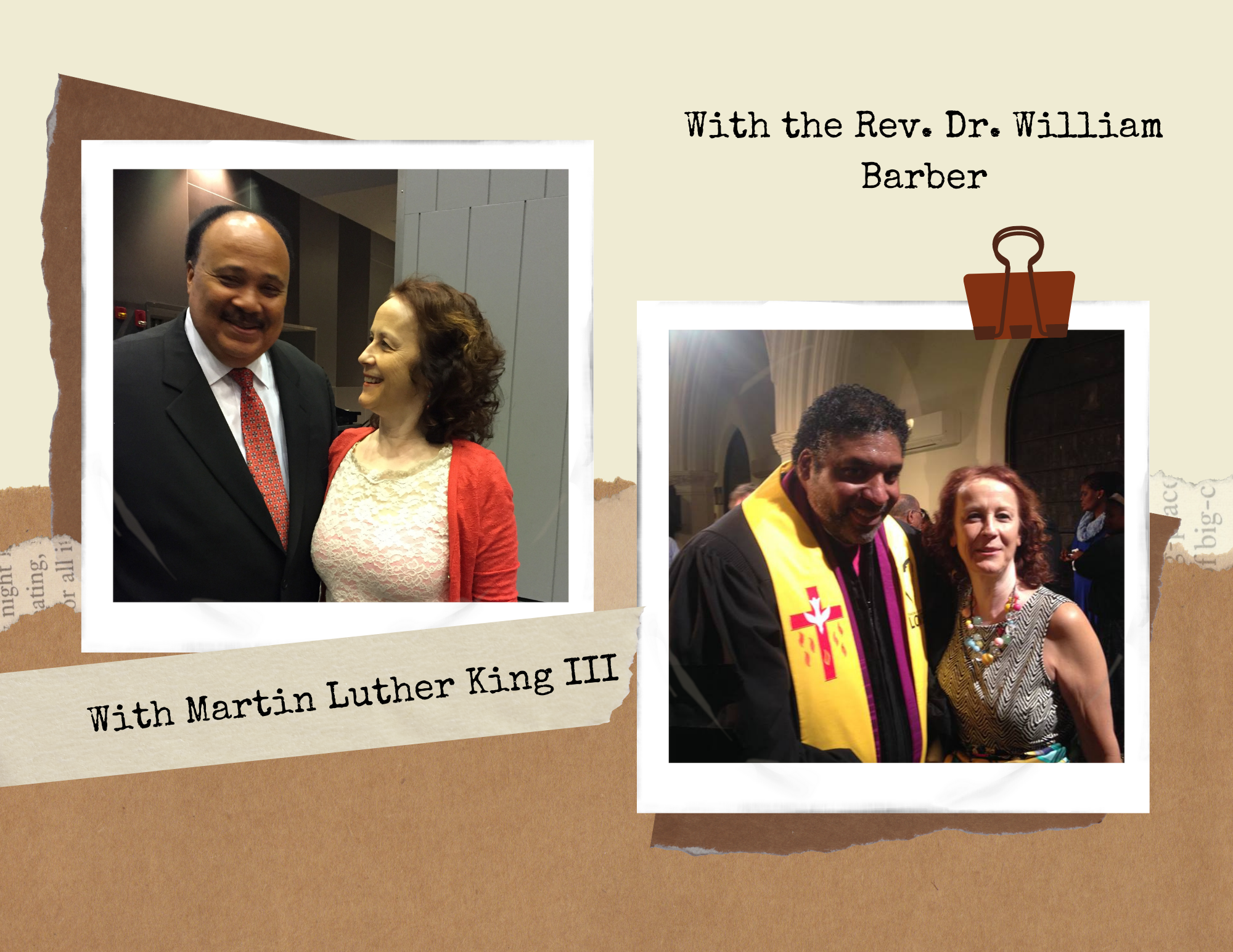
    With MLK III and Rev Barber


    Dear and beautiful Helene,

    I am of two feelings about this. One is to congratulate you for retiring. The other is being so sorry to see you leave, but after 26 years I know how much you deserve it, having published incredible books and worked very seriously to bring in your chosen authors.

    Of course, we will all miss you. I hope to remain in touch before that time and then after you leave.

    With my warmth,
    —Linda Hogan, The Radiant Lives of Animals


    You’ve really been so kind to me . . .

    If it weren’t for your own kindness! Let your kindness be known!

    Let your editorial expertise be known! I appreciate everything you’ve done.

    Crying out to you, dear Helene, was far better than to cry to anybody else, even those who claim they know and love me most.

    Love,
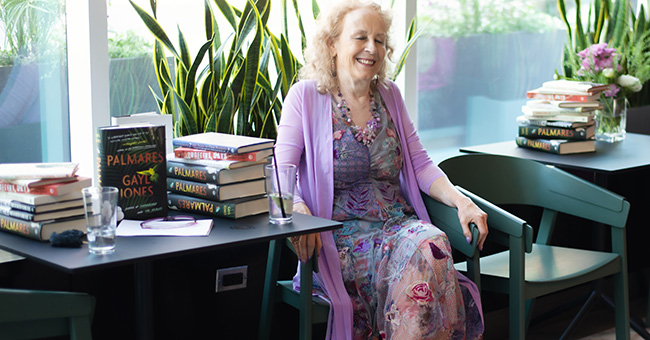
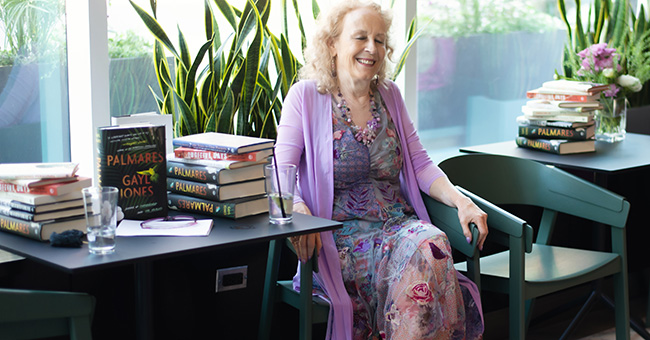
    —Gayl Jones, Palmares


    I will always remember with delight our collaboration on Ma Speaks Up! Thank you so much for that time. You have been such a force at Beacon. It’s hard to picture the place without you!
    —Marianne Leone, Ma Speaks Up


    I will forever be grateful for the opportunity to work with you on Pregnant Girl. You believed in me and in the project when so many others didn’t, and I can’t thank you enough.
    —Nicole Lynn Lewis, Pregnant Girl


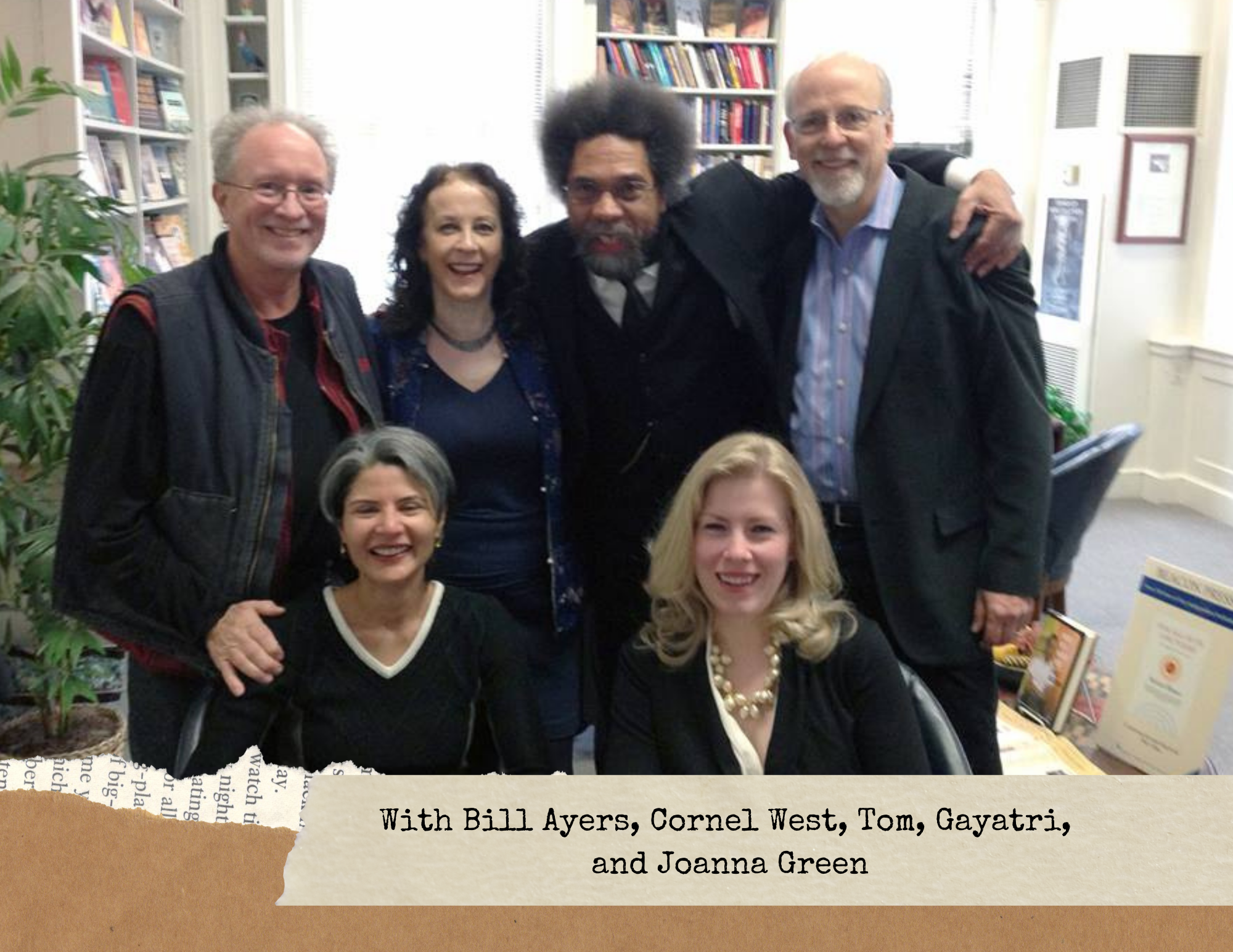
    With Bill Ayers and Cornel West


    First, a huge congratulations on a superb twenty-six years.

    You’ve taken Beacon Press to incredible heights. It’s going to take me some time to digest, because I have no template for book publishing without Helene.

    I’m so very touched by your words now, and the prodigious investment of your energy and enthusiasm over all the books.
    —Danielle Ofri, When We Do Harm


    Dear Helene,

    You have been so good for my “business,” but even more as a true friend. I hope we dance together for a long, long time.

    Much love,
    —Mary Oliver, New and Collected Poems: Volume One


    My dear sister,

    The Collected Poems could not ever have been done without you. Much love to you,
    —Sonia Sanchez, Collected Poems


    My dearest Helene,

    Truly delightful meeting, so good to see your beautiful, smiling countenance and that you were able to meet Karim. You’re a sweetheart, Helene. You’ve been so consistent in your thoughtfulness. Means so much.

    As always, my love and deep respect,
    —Gloria Karefa Smart (James Baldwin’s sister)


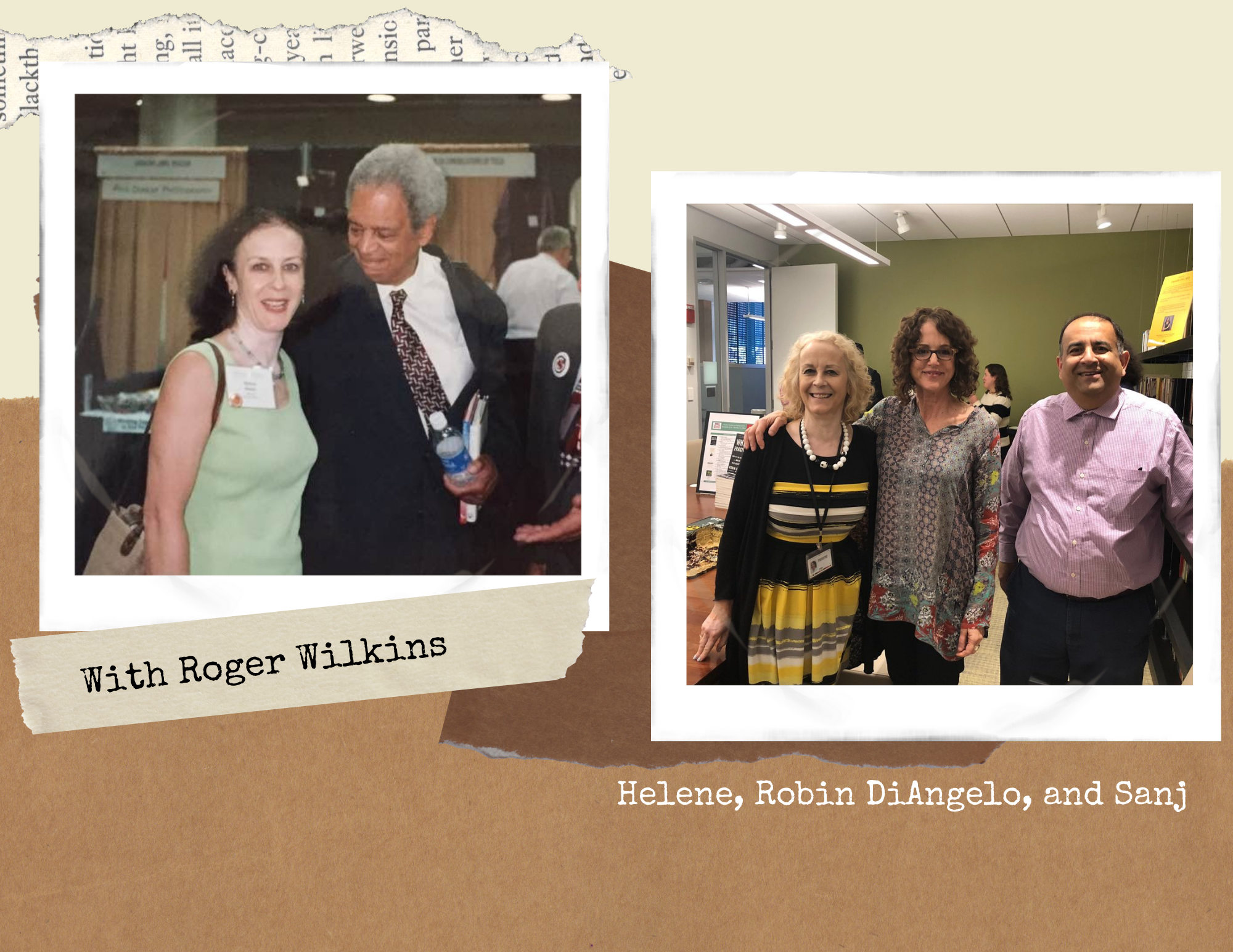
    With Roger Wilkens and Robin DiAngelo


    It is sad and shocking that you are moving on. I remember that conversation we had in New York at that poetry event what must be eight years ago.

    You were so kind and enthusiastic when I sent you the poems. It has been a pleasure and a privilege working with you.
    —Colm Tóibín, Vinegar Hill


    Congratulations, Helene! Wow, twenty-six years! What an achievement! Glad to hear that you’ll still be working with Beacon in some capacity. Thank you for truly making me feel like a part of the press. It’s been an honor to work with you and Beacon. This experience has changed my life.
    —Michael Torres, An Incomplete List of Names


    Wow! Congratulations!

    It’s an honor to be a bookend to your brilliant career, and I love the possibility of remaining in your orbit through other adoptee initiatives! I’m so grateful for you and all that you’ve built at Beacon Press. With immense gratitude,
    —Angela Tucker, “You Should Be Grateful” (forthcoming in Spring 2023)


    My dear sister,

    What a great force for good you are and have been at Beacon! I guess all good things must come to an end! My God, how blessed we all are to work with you!!!
    —Cornel West, Race Matters 


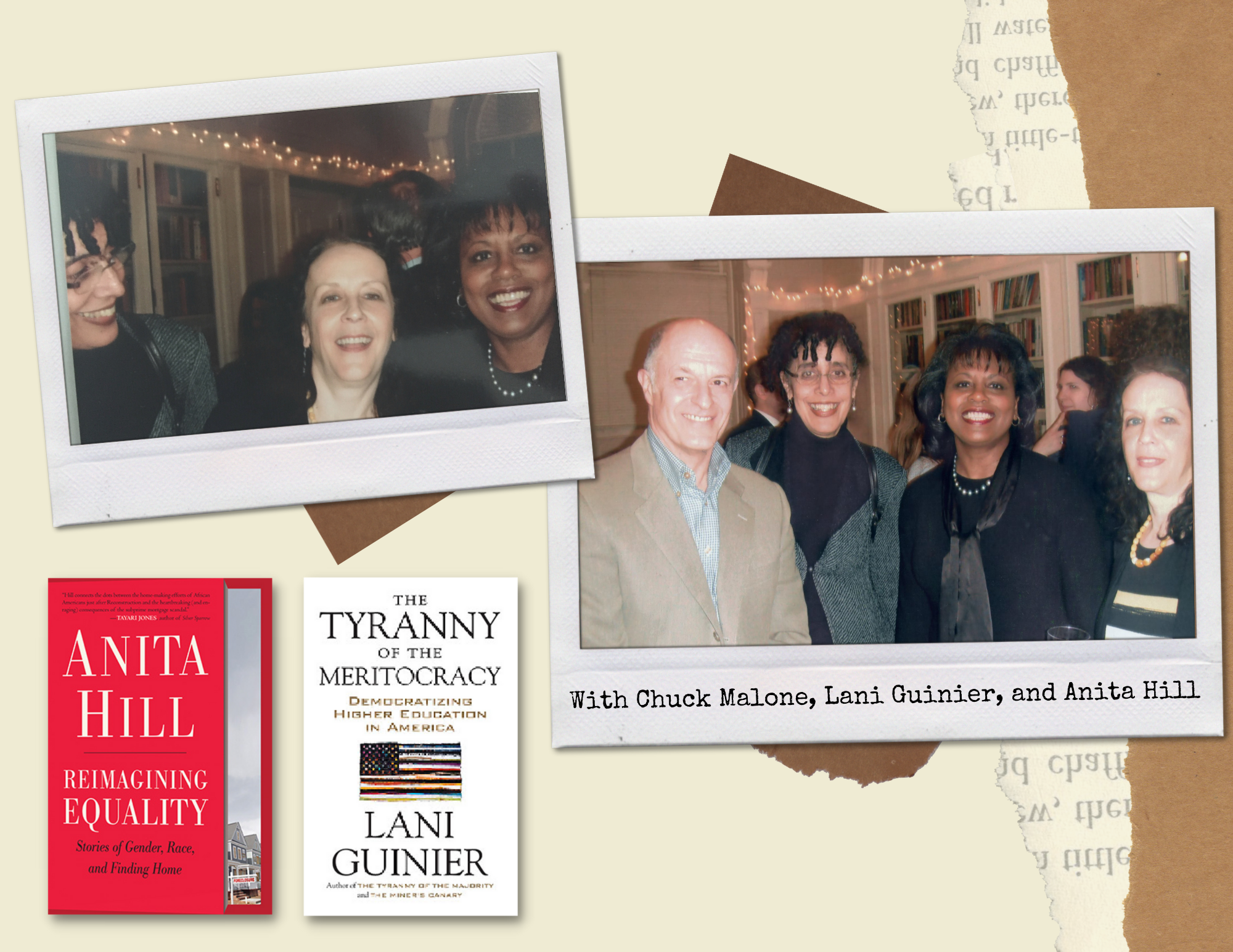
    With Anita Hill and Lani Guinier

    Celebrating Helene Atwan’s retirement party in New York, NY. L to R: Amy Caldwell, Helene, Michael Reynolds (Europa Editions), Elinor Lipman, Pamela MacColl, Bridget Marmion Mollie O’Mara

  • By Solomon Jones

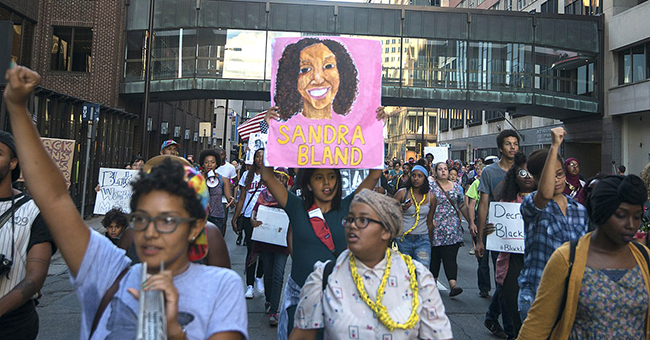
    March to honor Sandra Bland and protest deaths of Black women in police custody, Minneapolis, MN, 31 July 2015

    March to honor Sandra Bland and protest deaths of Black women in police custody, Minneapolis, MN, 31 July 2015. Photo credit: Fibonacci Blue

    Seven years have passed since the fateful day Sandra Bland was pulled over in Prairie View, Texas. On July 13, she was found hanged in a jail cell in Waller County, Texas. In this selection from Ten Lives, Ten Demands: Life-And-Death Stories, and a Black Activist’s Blueprint for Racial Justice, Solomon Jones honors and gives a portrait of the full life she had in front of her. The United States must write the eradication of racial profiling into law if it’s serious about racial justice.

    ***

    The first time I heard Geneva Reed-Veal speak of her late daughter, she did so with the passion of a preacher. Her voice rose and fell with righteous indignation and when she paused, I was anxious to hear more.

    Sandra Bland’s mother is a force to be reckoned with, and when I interviewed her for my radio program in 2016, she told me that her daughter was too. Sandra had shown as much while asserting her rights during her traffic stop arrest, and even through the pain of recalling what it was like to see that, Geneva made room for pride:

    As a mom I will tell you, to watch that tape, ’cause I saw the tape the same time everybody else did; I was so proud of her in that moment, because she was letting that officer know, “No sir, no, no no—I know my rights. You’re not just gonna pull me up out of this car, but I’m gonna get out, because I will wait to see you in court.” And as she got out, she was still taping. So, when you talk about a mother viewing her radical daughter who said, “No, I’m not taking this,” . . . [I felt] very proud of her. . . . And I will be championing for Sandy all of the rest of my days. The world will never forget.

    Indeed, we will not, because Sandra’s mother is a truth teller. There are no euphemisms. No feeble attempts to soft-pedal her beliefs. What happened to her daughter is simple, in her view. Authorities in Waller, Texas, lied about Sandra’s arrest, lied about monitoring her in detention, and lied about how Sandra died.
    Clearly, someone was going to pay a price for that, and if anyone could tilt the scales of justice in her daughter’s favor, it was Geneva Reed-Veal. First, though, we would have to know the Sandra who lived before the hashtag. We would have to see beyond the chaos that defined her final days.

    At twenty-eight, Sandra was searching for her purpose. A supporter of the Black Lives Matter movement who posted videos on police brutality and racial strife, Sandra wanted to fix what was wrong in the world. Much like other Black content creators who dare to speak up for Black lives, she was relentlessly trolled by racists. One person asked her if she was trying to use race to incite people rather than unite them. She posted a video in response.

    “Honestly, I feel that my goal is to racially unite,” Sandra said in the video, which she filmed in her car in April 2015. “In the process of doing that, some people will be racially incited, [or] upset.”

    Those who found her videos upsetting had the option not to watch, she said. But for white people who wanted to “get past” America’s history of racism, Sandra had a simple answer. First, they would have to acknowledge the hard truths of America’s racist past. Then they would have to admit that racism and white privilege persists in the present. She used policing as an example, and said that white people have a different relationship with police officers than Blacks do. For whites, she said, “the police don’t even suspect you of doing anything wrong, and that’s just how it is.”

    Like so many of us, Sandra had seen the reality of race and policing in America. Drivers of color, and Black people in particular, were racially profiled by white officers who disproportionately stopped them for traffic infractions in attempts to investigate other crimes. Then there were the videos—those terrible and violent viral snippets of Black people being killed by white police officers.

    One such video emerged just days before Sandra called for racial unity. In it, Walter Scott was shot in the back by Officer Michael Slager in South Carolina. The year before, a teen named Laquan McDonald was shot sixteen times by Officer Jason Van Dyke in Sandra’s hometown of Chicago. That same year, Tamir Rice was shot in Cleveland, Michael Brown was shot in Ferguson, Eric Garner was choked in New York, and Ezell Ford was shot three times, once in the back, in Los Angeles.

    Sandra was living through all of it in real time, and as she sought to find ways to make a difference in the lives of Black victims of brutality and discrimination, she was also trying to find a personal sense of purpose. That’s what she talked to her mother about during a trip to visit relatives in Tennessee. At least one of her goals was beginning to come into focus for her, and she shared it with her mother when they returned to Chicago.

    “Mom, my purpose—I know what my purpose is,” Geneva recalled her daughter saying. “My purpose is to go back to the South and stop all the injustices against Blacks in the South.”

    For Sandra, that meant returning to her alma mater, Prairie View A&M, and taking a job as a student ambassador. She had already talked about it a lot, Geneva said, so when the school called on a Tuesday and asked her to interview for the job, Sandra stepped out on faith, packed everything she owned into her car, and drove to Texas.
    By Thursday, after doing the interview, Sandra got the job, her mother said. She was well on her way to fulfilling the purpose they’d talked about. Then on Friday, Sandra called her mother and told her she was leaving the school to drive to Walmart.

    “She said, ‘Mom I’ll call you back when I get out of Walmart,’” Geneva said. “Well, of course that call never came because Sandy was pulled over at about 4:30 in the afternoon on a Friday. She was minding her own business. Officer Brian Encinia profiles her . . . U-turns the car, speeds up on her. So, she’s thinking, ‘Okay, this guy is in a hurry.’ She gets over without using her traffic signal. I do it all the time. There are a million people across the world who do it all the time. And she had no idea he was going to be pulling her over.”

    The Demand: Eradicate the national scourge of racial profiling by creating a federal Sandra Bland Act. Borrowing from the original intent of the Texas legislation, this new federal law must ban pretext or “investigative” stops based on race. It must create a national database that traces racial and ethnic disparities in police stops. Moreover, it must create protections that keep the indigent from being jailed for minor traffic violations, and it must create a national standard for the protections afforded to inmates in local jails.


    About the Author 

    Solomon Jones is an award-winning columnist for the Philadelphia Inquirer and morning host for WURD radio in Philadelphia. He is also a host for Classix 107.9 and a blogger for NPR affiliate WHYY. Jones is an Essence best-selling author who has been featured on NPR’s Morning EditionNightline, and CNN. In 2019, Jones formed the Rally for Justice Coalition with a multitude of civil rights organizations. The coalition’s efforts resulted in the firing of over a dozen Philadelphia police officers who espoused racist rhetoric online. Connect with him on Twitter @solomonjones1 or at solomonjones.com.

  • Helene in the moment as we celebrate her and her career at her retirement party. Yotel, Boston, MA, June 9, 2022. Photo credit: Corban Swain

    Helene in the moment as we celebrate her and her career at her retirement party. Yotel, Boston, MA, June 9, 2022. Photo credit: Corban Swain

    The threshold is upon us. The end of our time with Helene Atwan as our director is coming up. It has been an amazing twenty-six years, and Beacon won’t be the same without her. So many amazing authors she brought into the fold! So many amazing books—including her love of poetry—she brought to the catalog! As much as we’re sad to see her go, we’re so happy about the retirement she is looking forward to. We’re also excited about Gayatri Patnaik taking up the mantle as the next director on July 30. Here, she joins current and former staff and advisory board members to thank Helene for everything she has done for the press. Along the way, we’ll take a trip down memory lane with photos.


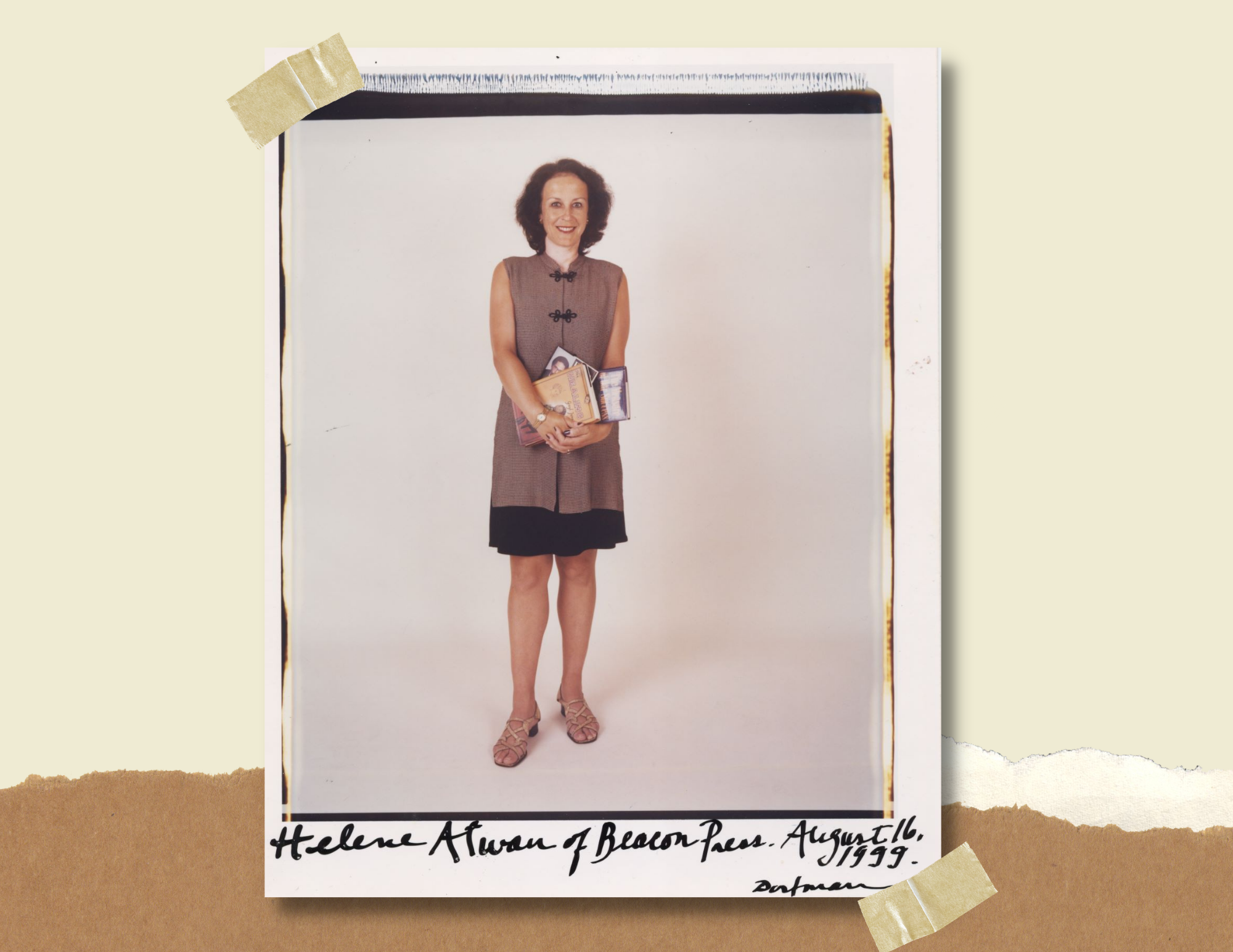
    Helene Atwan 1999


    Helene, thank you for bringing me into the Beacon fold oh those many years ago. Without you, I might very well still be on the outside looking in, hoping fighting praying for the kind of an opportunity I relished with the Beacon team. Your guidance, fierceness, and commitment to the work have been invaluable to me and so many others. I thank you. Gosh, how I thank you.
    —Rakia Clark, former senior editor 


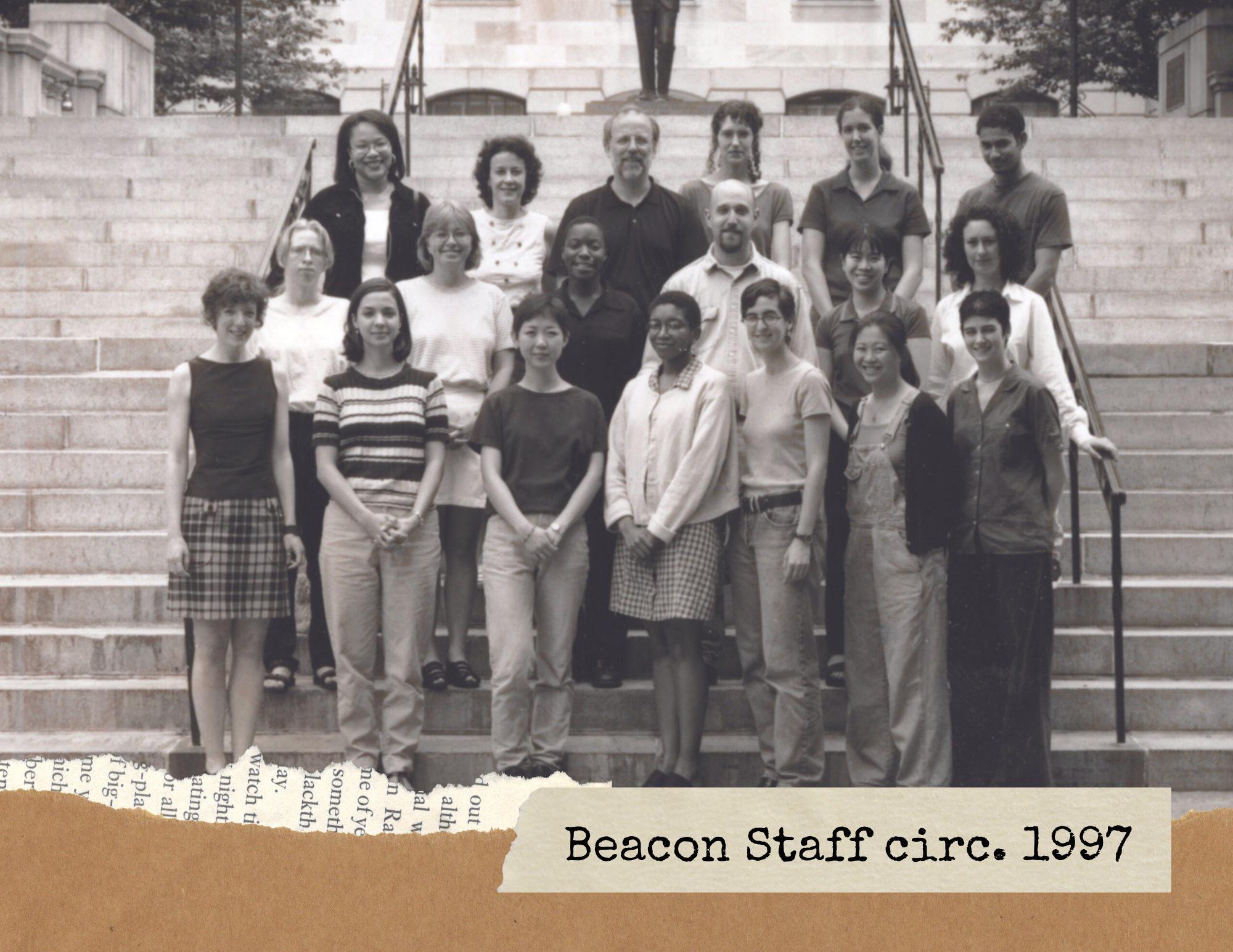
    Beacon staff circ. 1997


    Congratulations on a historic run as Beacon’s director!

    You led the press through a period of great political, cultural, technological, and industry change. During this time, Beacon did more than survive. It thrived and published books that spoke to all of it. I’m proud to have been part of it.

    Beacon gave the world meaningful books, and me meaningful work.

    Thank you!
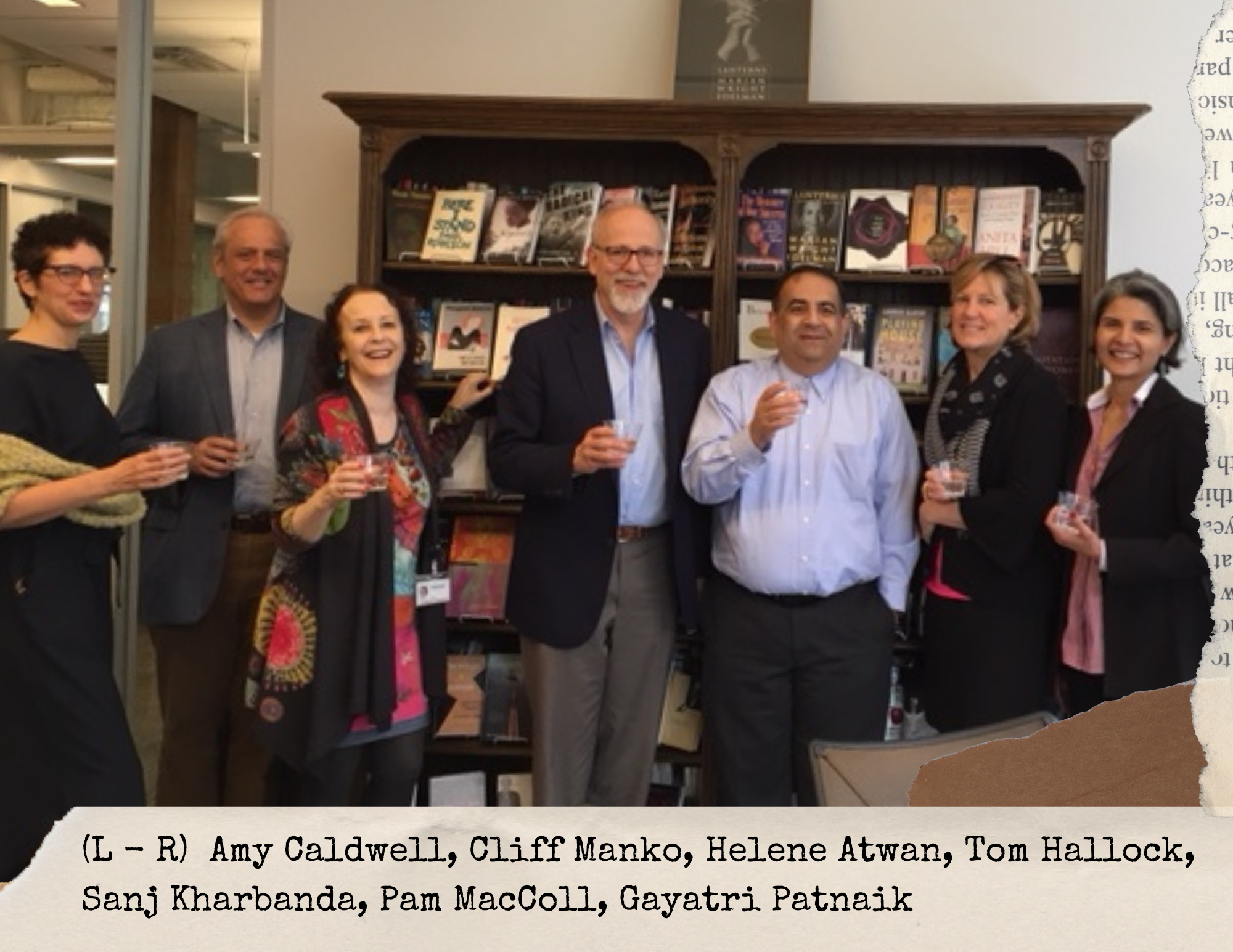
    —Tom Hallock, former publisher 


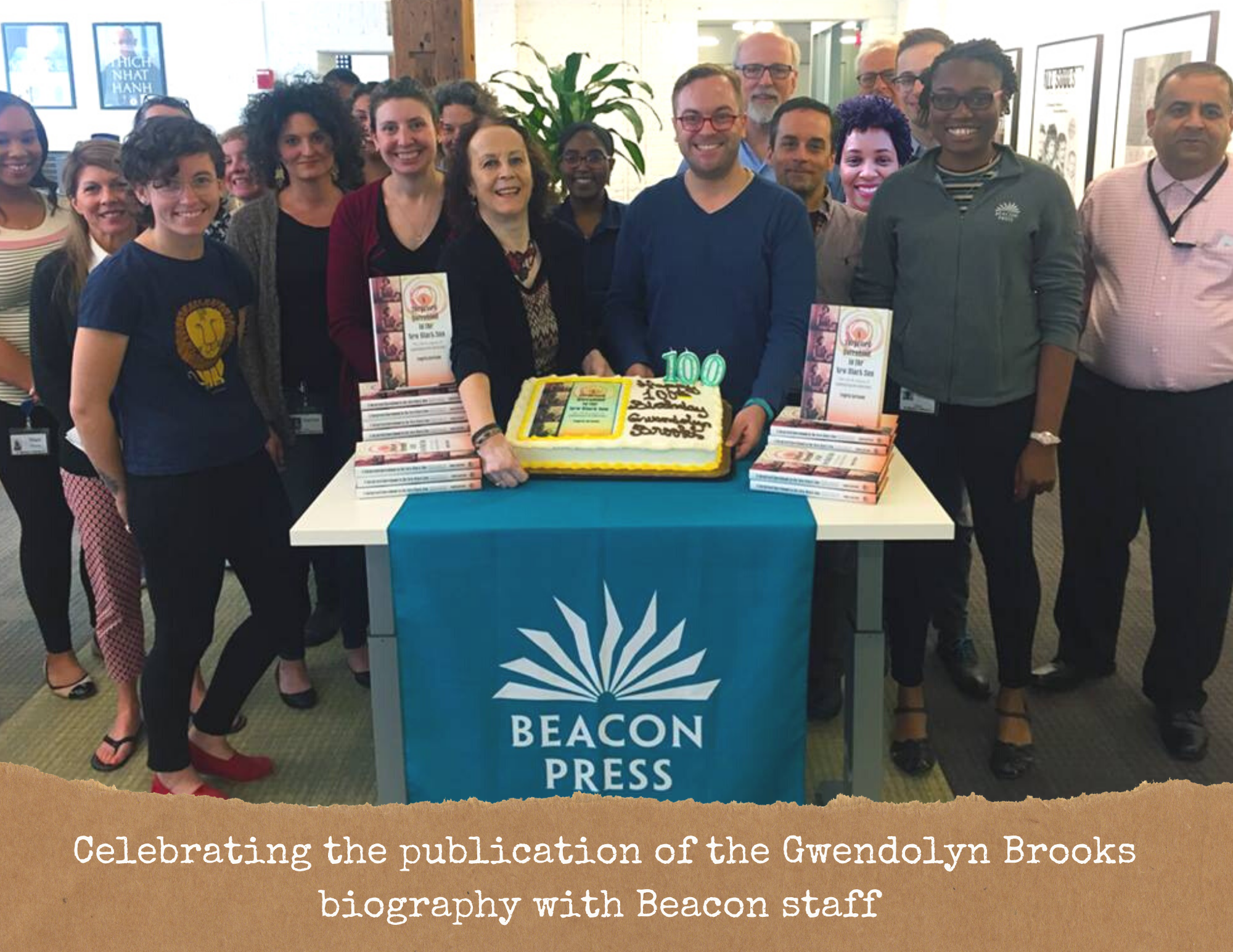
    Celebrating publication of Brooks bio with staff


    I’ve watched your achievements with great admiration from at least your Farrar, Straus and Giroux days, but without question, your years at Beacon are the capstone of a stunning career. Your dedication to Beacon’s mission, your championship of important books, and your ability to blend those with the practical know-how to keep the press financially sound and effectively run are rare talents. This has led, of course, to your standing in the industry, your name synonymous with publishing at its very finest. In my mind, the true mark of a great leader is the ability to attract and keep a brilliant team.

    From Gayatri, Sanj, and the current staff, to Tom and all their predecessors who have made Beacon the true light its name implies—you could not have done better. I’ve been proud to be on the Board of Advisors, and happy that it’s given me a chance to work with you. Every best wish for your future.
    —Carole Horne, Harvard Book Store 


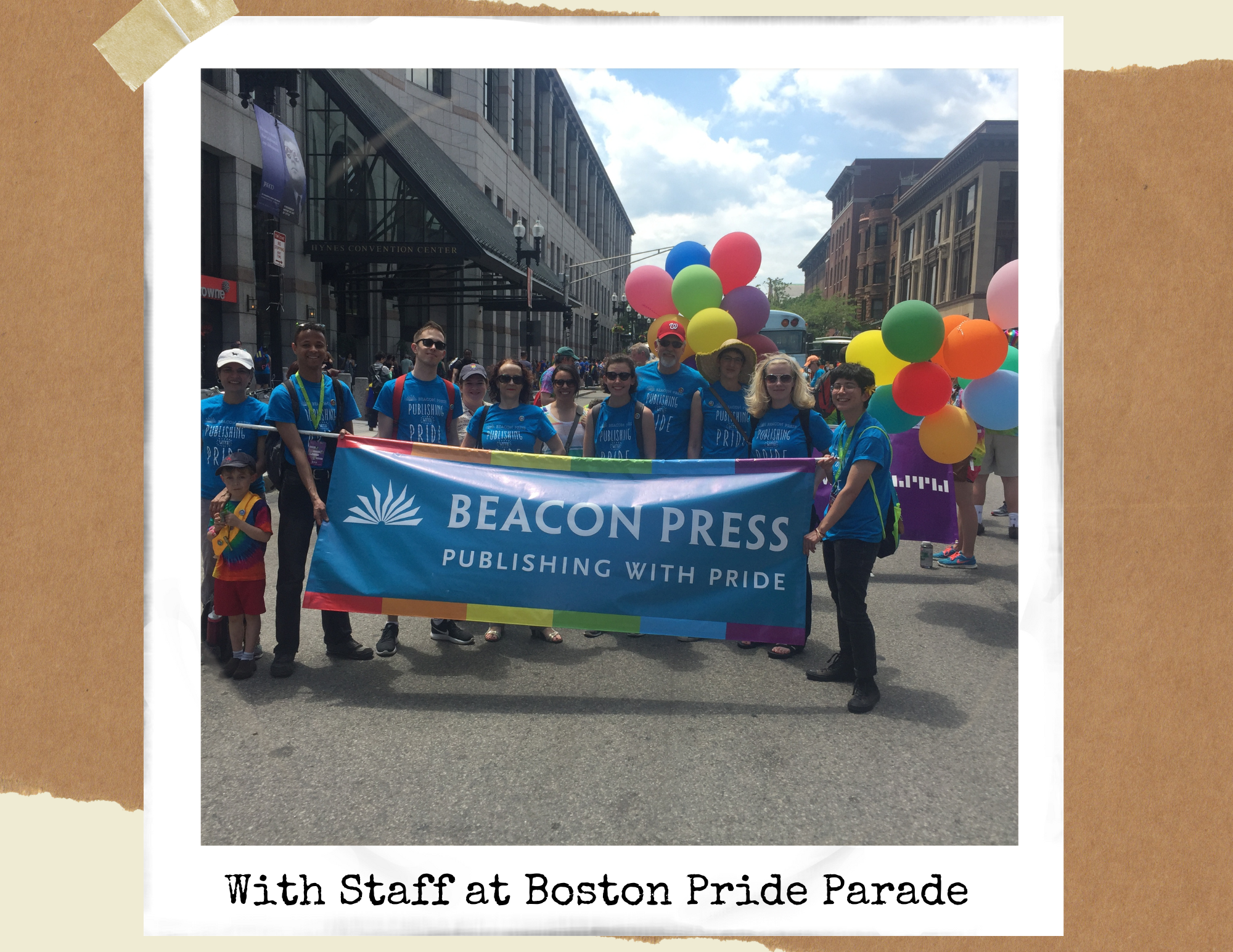
    With staff at Boston Pride Parade 2017


    Wow, what a ride! Thank you for your incredible stewardship of the press over the past twenty-six years, which have passed in the blink of an eye! I will always be grateful, too, for the amazing authors you brought to us that so enriched my work life: Mary Oliver, Lani Guinier, Anita Hill, Lillian Rubin, Bill Ayers among my favorites. Here’s wishing you all the best—rest, peace, health, happiness, and lots of good books—as you move into this new phase of your life.
    —Pamela MacColl, director of communications 


    In Helene's office


    Helene, the closer I get to being director, the more I realize just how lasting your legacy at Beacon will be! The vision, phenomenal energy, and passion you’ve brought to publishing, coupled with your commitment to personal evolution, has made a big impression on me. I am deeply grateful for your support through the years and have no doubt that I’ll be thinking to myself, “What would Helene do?!” numerous times as I try and fill some very big shoes! I know you’ll have an active and fulfilling retirement filled with family and friends, travel, tennis, and, of course, many good books.

    With warmth and gratitude,
    —Gayatri Patnaik 

    Helene in the moment as we celebrate her and her career at her retirement party. Yotel, Boston, MA, June 9, 2022. Photo credit: Corban Swain

  • By James Baldwin

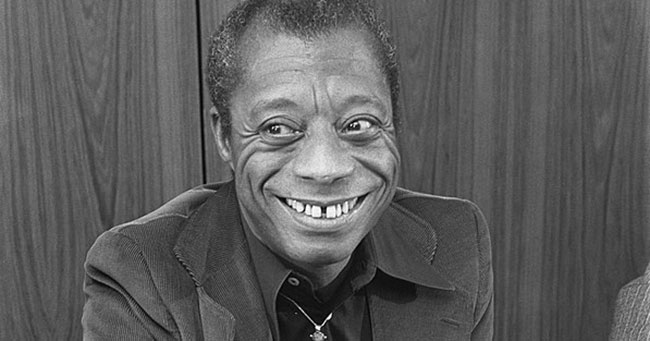
    James-Baldwin

    Photo credit: Rob Croes / Anefo

    Uncle Jimmy was never one to hold back in his essays, calling on us “to end the racial nightmare, and achieve our country.” That goes for his sharp critique of the American ideal of sexuality, which is so wrapped up in puerile delusions of masculinity. Race, of course, could never be absent from any discussion of gender in the US. There’s something about this excerpt from “Here Be Dragons,” collected in The Price of the Ticket, that makes you think he had the gloves all the way off. Because he also talks about his own sexuality, it gets personal.

    ***

    The American idea of sexuality appears to be rooted in the American idea of masculinity. Idea may not be the precise word, for the idea of one’s sexuality can only with great violence be divorced or distanced from the idea of the self. Yet something resembling this rupture has certainly occurred (and is occurring) in American life, and violence has been the American daily bread since we have heard of America. This violence, furthermore, is not merely literal and actual but appears to be admired and lusted after, and the key to the American imagination.

    All countries or groups make of their trials a legend or, as in the case of Europe, a dubious romance called “history.” But no other country has ever made so successful and glamorous a romance out of genocide and slavery; therefore, perhaps the word I am searching for is not idea but ideal.

    The American ideal, then, of sexuality appears to be rooted in the American ideal of masculinity. This ideal has created cowboys and Indians, good guys and bad guys, punks and studs, tough guys and softies, butch and faggot, black and white. It is an ideal so paralytically infantile that it is virtually forbidden—as an unpatriotic act—that the American boy evolve into the complexity of manhood.

    ~~~

    The American idea of masculinity: There are few things under heaven more difficult to understand or, when I was younger, to forgive.

    During the Second World War (the first one having failed to make the world safe for democracy) and some time after the Civil War (which had failed, unaccountably, to liberate the slave), life for niggers was fairly rough in Greenwich Village. There were only about three of us, if I remember correctly, when I first hit those streets, and I was the youngest, the most visible, and the most vulnerable.

    On every street corner, I was called a faggot. This meant that I was despised, and, however horrible this is, it is clear. What was not clear at that time of my life was what motivated the men and boys who mocked and chased me; for, if they found me when they were alone, they spoke to me very differently—frightening me, I must say, into a stunned and speechless paralysis. For when they were alone, they spoke very gently and wanted me to take them home and make love. (They could not take me home; they lived with their families.) The bafflement and the pain this caused in me remain beyond description. I was far too terrified to be able to accept their propositions, which could only result, it seemed to me, in making myself a candidate for gang rape. At the same time, I was moved by their loneliness, their halting, nearly speechless need. But I did not understand it.

    One evening, for example, I was standing at the bottom of the steps to the Waverly Place subway station, saying goodbye to some friends who were about to take the subway. A gang of boys stood at the top of the steps and cried, in high, feminine voices, “Is this where the fags meet?”

    Well. This meant that I certainly could not go back upstairs but would have to take the subway with my friends and get off at another station and maneuver my way home. But one of the gang saw me and, without missing a beat or saying a word to his friends, called my name and came down the steps, throwing one arm around me and asking where I’d been. He had let me know, some time before, that he wanted me to take him home—but I was surprised that he could be so open before his friends, who for their part seemed to find nothing astonishing in this encounter and disappeared, probably in search of other faggots.

    The boys who are left of that time and place are all my age or older. But many of them are dead, and I remember how some of them died—some in the streets, some in the Army, some on the needle, some in jail. Many years later, we managed, without ever becoming friends—it was too late for that—to be friendly with one another. One of these men and I had a very brief, intense affair shortly before he died. He was on drugs and knew that he could not live long. “What a waste,” he said, and he was right.

    One of them said, “My God, Jimmy, you were moving so fast in those years, you never stopped to talk to me.”

    I said, “That’s right, baby; I didn’t stop because I didn’t want you to think that I was trying to seduce you.”

    “Man,” he said, indescribably, “why didn’t you?”

    But the queer—not yet gay—world was an even more intimidating area of this hall of mirrors. I knew that I was in the hall and present at this company—but the mirrors threw back only brief and distorted fragments of myself.

    In the first place, as I have said, there were very few black people in the Village in those years, and of that handful, I was decidedly the most improbable. Perhaps, as they say in the theater, I was a hard type to cast; yet I was eager, vulnerable, and lonely. I was terribly shy, but boys are shy. I am saying that I don’t think I felt absolutely, irredeemably grotesque—nothing that a friendly wave of the wand couldn’t alter—but I was miserable. I moved through that world very quickly; I have described it as “my season in hell,” for I was never able to make my peace with it.

    It wasn’t only that I didn’t wish to seem or sound like a woman, for it was this detail that most harshly first struck my eye and ear. I am sure that I was afraid that I already seemed and sounded too much like a woman. In my childhood, at least until my adolescence, my playmates had called me a sissy. It seemed to me that many of the people I met were making fun of women, and I didn’t see why. I certainly needed all the friends I could get, male or female, and women had nothing to do with whatever my trouble might prove to be.

    At the same time, I had already been sexually involved with a couple of white women in the Village. There were virtually no black women there when I hit those streets, and none who needed or could have afforded to risk herself with an odd, raggedy-assed black boy who clearly had no future. (The first black girl I met who dug me I fell in love with, lived with and almost married. But I met her, though I was only twenty-two, many light-years too late.)

    The white girls I had known or been involved with—different categories—had paralyzed me, because I simply did not know what, apart from my sex, they wanted. Sometimes it was great, sometimes it was just moaning and groaning, but, ultimately, I found myself at the mercy of a double fear. The fear of the world was bearable until it entered the bedroom. But it sometimes entered the bedroom by means of the motives of the girl, who intended to civilize you into becoming an appendage or who had found a black boy to sleep with because she wanted to humiliate her parents. Not an easy scene to play, in any case, since it can bring out the worst in both parties, and more than one white girl had already made me know that her color was more powerful than my dick.

    Which had nothing to do with how I found myself in the gay world. I would have found myself there anyway, but perhaps the very last thing this black boy needed were clouds of imitation white women and speculations concerning the size of his organ: speculations sometimes accompanied by an attempt at the laying on of hands. “Ooo! Look at him! He’s cute—he doesn’t like you to touch him there!”

    In short, I was black in that world, and I was used that way, and by people who truly meant me no harm.

    And they could not have meant me any harm, because they did not see me. There were exceptions, of course, for I also met some beautiful people. Yet even today, it seems to me (possibly because I am black) very dangerous to model one’s opposition to the arbitrary definition, the imposed ordeal, merely on the example supplied by one’s oppressor.

    The object of one’s hatred is never, alas, conveniently outside but is seated in one’s lap, stirring in one’s bowels and dictating the beat of one’s heart. And if one does not know this, one risks becoming an imitation—and, therefore, a continuation—of principles one imagines oneself to despise.

    I, in any case, had endured far too much debasement willingly to debase myself. I had absolutely no fantasies about making love to the last cop or hoodlum who had beaten the shit out of me. I did not find it amusing, in any way whatever, to act out the role of the darky.

    So I moved on out of there.

    ~~~

    Freaks are called freaks and are treated as they are treated—in the main, abominably—because they are human beings who cause to echo, deep within us, our most profound terrors and desires.

    Most of us, however, do not appear to be freaks—though we are rarely what we appear to be. We are, for the most part, visibly male or female, our social roles defined by our sexual equipment.

    But we are all androgynous, not only because we are all born of a woman impregnated by the seed of a man but because each of us, helplessly and forever, contains the other—male in female, female in male, white in black and black in white. We are a part of each other. Many of my countrymen appear to find this fact exceedingly inconvenient and even unfair, and so, very often, do I. But none of us can do anything about it.

    Originally published as “Freaks and the American Ideal of Manhood” in Playboy, January 1985. Excerpted from The Price of the Ticket, published by Beacon Press, 2021. Copyright © 1985 by James Baldwin. Reprinted by arrangement with the James Baldwin Estate. All rights reserved.


    About the Author 

    James Baldwin (1924–1987) was a novelist, essayist, playwright, poet, and social critic, and one of America’s foremost writers. His writing explores palpable yet unspoken intricacies of racial, sexual, and class distinctions in Western societies, most notably in mid-20th-century America. A Harlem, New York, native, he lived periodically in exile in the south of France and in Turkey. He is the author of several novels and books of nonfiction, including Notes of a Native SonGo Tell It on the MountainGiovanni’s RoomAnother CountryTell Me How Long the Train’s Been GoneIf Beale Street Could TalkJust Above My HeadThe Fire Next TimeNo Name in the Street, and The Evidence of Things Not Seen, and of the poetry collection Jimmy’s Blues.