• Today’s post is a poem from Sonia Sanchez, which will be included in her forthcoming collection, Morning Haiku. Sanchez– a poet, activist, and scholar– is one of the most important writers of the Black Arts Movement, and was the Laura Carnell Professor of English and Women’s Studies at Temple University. She is the recipient of both the Robert Frost Medal for distinguished lifetime service to American poetry and the Langston Hughes Poetry Award. 


    haiku
    (for Maya Angelou)

    1.

    You have

    taught us how

    to pray

    2.

    your poems

    yellow tattoos on the

    morning dew

    3.

    we dance

    in the eye

    of your pores

    4.

    in a sudden

    pause of breath

    secrets unlock

    5.

    you show us

    how to arrange our

    worldly selves</p

    6.

    your poems

    a landscape of

    seabirds.

  • Today is the birthday of Anne Sullivan Macy, best known as the teacher of Helen Keller. She is the subject of Beyond the Miracle Worker: The Remarkable Life of Anne Sullivan Macy and Her Extraordinary Friendship with Helen Keller, by Kim E. Nielsen, who wrote today's post.

    Book Cover for Beyond the Miracle WorkerI was so sick of Helen Keller. She'd begun to annoy me tremendously. After two previous books on the famous deaf-blind woman I swore I would never again write anything even remotely related to her. I’d had enough. I started a project far removed and told everyone in my professional circle about that far-removed project in order to commit myself to it.

    Then I reread Anne Sullivan Macy's 1916 letters to Helen Keller. Macy had written them to her former student and then dear friend as she dealt with the illness that she thought would kill her. The letters reveal an introspective woman trying to understand her life. Vacillating between urgency and detachment, she reflected on pleasure, anger, complacency, and amazement. It struck me that her life embodied both contradictions and intensity: physical pain, emotional pain, isolation, friendship, joy, intellect, tenacity, success, and near constant self-doubt. Yet, as she thought about death, as she pondered her life, she took immense joy in the daily life of the Puerto Rican countryside where she was staying.

    Though born in 1866, Macy's life dilemmas are surprisingly modern. How does a smart, passionate, introspective woman find love, intellectual satisfaction, economic stability, and friendship? How do any of us do so? She called herself a "badly constructed human being" who "blunder[ed] into life through the back door." As far as I can tell, that is how most of us do it.

    As I reconsidered Macy, I became convinced that I, and nearly everyone else, had shortchanged the woman known only as the teacher of Helen Keller. I needed to do better– to do justice to her and to provide a peephole into Keller and Macy's multifaceted, and often surprising, friendship. Our cultural memory mythologizes and simplifies Macy as a straightforward educational superhero. She deserves more.

    (more…)

  • Susan Campbell, who previously described here her secular Christmases as a fundamentalist Christian kid, remembers her bunny- and egg-filled, but Jesus-free, Easters.

    How do you know when a coach is pushing a kid too far? Maybe when he sticks the child's arm in a freezer full of popsicles so that he can finish pitching the game?

    On Leonard Lopate, Lydia Denworth describes the lives of the two men who changed America's laws about lead.

    Obit Mag looks at two new books about genocide.

    Nancy Polikoff gushes about the Iowa gay marriage decision.

    An Italian-American "Jew by Choice" frets about eight days without Pasta, and decides that she has to take it slowly. But if you are trying to keep the chametz out of your diet for Passover, I'd avoid these.

    Are you ready to get planting? Or are you killing your seedlings indoors?

  • Today's post is from Tom Hallock, Associate Publisher at Beacon Press.

    The Indie Bound Red Box, The American Bookseller Association’s monthly In-store Action Kit, contained a flyer this month for a remarkable idea: Genocide Prevention Month. The ABA is teaming up with Genocide Prevention Month, a group of survivors and survivor advocates “to make sure history does not repeat itself.” Mitch Kaplan (owner of Books and Books in Coral Gables Florida), writing for the program, described his store's efforts to hold a commemoration event with genocide survivors in April and to organize a table display of books about genocide. A list of notable titles compiled by the ABA is available at www.bookweb.org/files/open/pdf/genocideprevention.pdf. The list includes general titles about genocide and others about Armenia, Bosnia, Cambodia, Darfur, Rwanda and the Holocaust.

    Beacon's list also includes titles that speak to these issues: Man's Search for Meaning, Rena’s Promise, Walls and Between Vengeance and Forgiveness: Facing History after Genocide and Mass Violence. The author of one of these titles, Heather Dun Macadam, just sent me an article about research in the UK where some schoolchildren believe Auschwitz is the name of a type of beer or a religious festival, rather than a concentration camp. It’s evidence of the ongoing need for a program like Genocide Prevention Month.

    Perhaps what's most remarkable is the underlying idea that independent booksellers have the power to bring a global concern to the attention of their communities– and to create the kind of awareness that might help prevent such things from happening again. When I taught English in Beijing China fifteen years ago, I met an extraordinary pair of booksellers who were survivors of the Cultural Revolution. They had been branded rightists, sent to prison and, when they were released, opened a bookstore. It was their response to the chaos that had engulfed their lives. They wanted to create a space in which Chinese readers could find books about the world and create a new culture in which such a destructive mass movement could never again take root. They called the store San Wei, three flavors, a term used in the Qing dynasty to identify the three most important categories of books: history, poetry, and philosophy.

    I thought it was a powerful and appropriate response. Genocide Prevention Month is a chance for all of us, as writers, publishers and booksellers, to exercise this same kind of power. It’s a chance to bring change to the world in one of the oldest ways– by the sharing of stories.

  • WinslowToday’s post is the first in a new Beacon Broadside series: Observation Post by journalist and foreign correspondent Philip C. Winslow. Over a career that has spanned more than twenty-five years, Winslow has reported on world events for the Christian Science Monitor, the Toronto Star, Maclean’s magazine, ABC radio news, CTV News, and CBC radio. He also served in two United Nations peacekeeping missions and worked for the UN in the West Bank for nearly three years. He is the author of Victory For Us Is to See You Suffer: In the West Bank with the Palestinians and the Israelis and Sowing the Dragon’s Teeth: Land Mines and the Global Legacy of War.


    Rebels with a stolen Nigerian anti-aircraft truck circling a tent where UN negotiators were talking with rebel commanders. From Philip C. Winslow: Sierra Leone photos

    The last time I talked with Sierra Leone’s war criminals in the terrorized West African country some years ago, they were swaggering, threatening, drunk or confused, and sometimes a mixture of those.

    This week in a sterile, glass-enclosed courtroom in Sierra Leone’s capital, Freetown, the swagger had gone out of three of them as they were sentenced to long prison terms for multiple war crimes and crimes against humanity. The sentences were welcomed by veteran human rights activists. “The deadly cycle of impunity is slowly being broken in Sierra Leone and West Africa,” Corinne Dufka, the senior researcher for Human Rights Watch in West Africa, told me from Dakar, Senegal.

    During Sierra Leone’s civil war from 1991 until 2002, armed groups such as the Revolutionary United Front (RUF) perpetrated a countrywide reign of brutal terror. The commanders of the RUF and various factions — Foday Sankoh, Johnny Paul Koroma, Sam Hinga Norman, Sam “Mosquito” Bockarie — planned and instigated serial atrocities in a nation already flat on its back. Their tools of terror included the mass rape of girls and women, forced marriage, child slavery, and mass amputations, all against a non-hostile people, their own people. The leaders fancied themselves rebels and revolutionaries, but in reality they were criminal mercenaries linked by diamond wealth to Liberia’s president Charles Taylor across the eastern border.

    Sankoh and his rivals in the Armed Forces Revolutionary Council (AFRC), the Civil Defense Forces (CDF), and the West Side Boys had no recognizable political ideology, and no moral restraints. Lesser figures down the terror chain became victims themselves, such as the child soldiers who were forced to kill their families and were bound to their captors with cocaine, amphetamines and more violence. At the hands of these gangs, tens of thousands of Sierra Leoneans were killed, more than two million were displaced, and many thousands more survived with appalling physical and mental wounds.

    (more…)

  • "It has all the hallmarks of suppression of speech: incitement of fear, intimidation of well-meaning folks, mob rule." So said Bill Ayers in response to the cancellation of a scheduled talk he was to give to high school students, whose parents would have been required to sign permission slips for them to attend, in Naperville, Ill. 

    Ayers, author of Fugitive Days: Memoirs of an Antiwar Activist, is Distinguished Professor of Education and Senior University Scholar at the University of Illinois at Chicago. His relationship with Barack Obama became a source of controversy during the Presidential campaign in what Ayers described as a “dishonest narrative.” 

    An event at Anderson's Bookshop in Naperville, scheduled for April 8 and tied to his new book from Third World Press, Race Course, was also cancelled. The bookshop cited security concerns. Similarly, an event at Brandeis University has been postponed due to the cost of security.

    And a Boston College engagement at which Ayers was to speak about education reform was first cancelled by the college, then moved off campus, and briefly reworked into an event by satellite before that, too, was blocked by the BC officials. A local radio personality incited the protests that prompted the College to cancel the event. The student group that had invited Ayers to campus instead sponsored a discussion of freedom of speech and academic freedom on campus which drew 300 students, staff and faculty members. 

    This is not the first time venues hosting speaking engagements featuring Ayers have come under fire. Officials at the University of Nebraska-Lincoln cancelled a lecture last fall, citing safety concerns. Countless events, however, have gone on in spite of attempts to suppress Ayers' speech. In October of 2001, when the late A. David Schwartz of Harry W. Schwartz Bookshops stood firm in the face of calls and letters urging him to cancel an event tied to the original release of Fugitive Days, he offered this eloquent defense to his critics: 

    "I myself grew up in Wisconsin during the McCarthy era and witnessed firsthand the attack on civil liberties and civic life that crippled America at that time. My father was accused of running a Communist bookshop by many people just because he thought it important to stock and promote books which were unpopular in the political climate of the time. I also was engaged in the movement against the Vietnam War and had some opportunities to view the Weathermen in action. I decided that I was politically and intellectually opposed to their positions on most matters.

    Now to the specific issue of whether or not Bill Ayers should be allowed to be one of the 26 authors who will visit our shops in October. It seems to me this is what America is about: listening to many freely expressed viewpoints so we can decide for ourselves the truth. America's brilliance and enormous distinction from other democracies is that it truly believes in the democratic process. Letting Bill Ayers speak is a part of that process. I hope customers who disagree with Bill Ayers and his views will attend this book reading so you can question him about this ideas. That's another part of the process."

    (Incidentally and on a sad note, Schwartz Bookshops very recently closed its doors for good after 82 years. Two of the chain's four locations will reopen soon under new names, and we wish the new owners all the best.)

    Helene Atwan, director of Beacon Press, offers these thoughts on the cancellations:

    "Like most of our colleagues in the publishing and media communities, we deplore a climate in which schools, universities and bookstores are made fearful of having any author–or indeed any one–speak in their venues.  As the management of Anderson's Bookshop put it:

    'Bookstores play an integral part in the process by which ideas are disseminated and debated. Debate is essential in our society, and we take seriously our responsibility to promote ideas, including those that we personally do not endorse or condone. This week freedom of speech was threatened.'

    For all of us involved in the work of publishing ideas, the suppression of speech is a blow to democracy. It impoverishes us all to live in a climate where ideas are suppressed rather than discussed and debated, where anger overtakes discourse.  We remain hopeful that the fear-mongering that led to these cancellations can be staunched by the many individuals and organizations dedicated to protecting the free speech rights so integral to our national health."

  • Today’s post is from Susan Campbell, author of Dating Jesus: A Story of Fundamentalism, Feminism, and the American Girl. Campbell’s writing has been recognized by the American Association of Sunday and Features Editors; National Women’s Political Caucus; the Sunday Magazine Editors Association, and the Connecticut chapter of Society of Professional Journalists. She was also a member of the Hartford Courant‘s 1999 Pulitzer Prize-winning team for breaking news. This post originally appeared at her Dating Jesus blog.
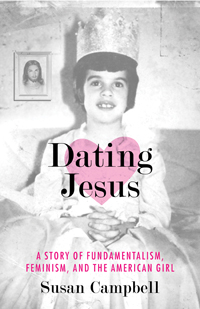
    Dating Jesus: link to Beacon Press page for the bookJust about every time I speak in public about Dating Jesus, someone asks a question about shame.

    Usually, that someone is a product of a fundamentalist church — often my own, which clung to a fear-and-shame-based theology.

    You feared going to hell.

    You feared God, naturally, and Jesus’s second coming because you probably weren’t going to measure up.

    You feared sinning — which meant you feared your very existence because of all the things you could count on, you could count on the fact that you would sin.

    You feared getting caught sinning. And if you weren’t actively sinning, you feared somehow falling short or missing  a rule or living your life in scriptural error.

    I don’t think the guilt and shame and fear is restricted to my own church, though. I’ve talked to Catholics and Baptists and Jews who feel if not the same thing, then something similar.

    So for years, for shame’s sake, I didn’t speak up and the words I held back burned like acid in my throat. For shame’s sake, I didn’t try for that scholarship, that job, that life partner because I didn’t think myself worthy. For shame’s sake, I sold myself short and settled into a life that was absolutely not of my choosing. For shame’s sake, I all but lived as a religious aesthete, and when I turned to my religion for my reward, my religion told me I still wasn’t worthy.

    For shame’s sake, I stopped going to church because I couldn’t stand that I wasn’t worthy. I couldn’t try harder than I already did. I couldn’t attend more services, teach more classes, be a nicer person than I already was. And I couldn’t understand why God couldn’t just love me for me, and not for what I could be.

    So I reopened my Bible and tried to find scriptural backing for how I was feeling, but for shame’s sake, I kept going back to those verses that (according to the interpretation handed to me by my church) reiterated that I, as a woman, could not walk directly to the throne, that I, as a woman, was to keep myself silent in the assembly and not usurp authority over men.

    For shame’s sake, I pulled a cloak around me and curled up into a ball.

    And then, I decided to read other verses, listen to other voices rather than the ones in my head that were put there years ago by (I assume) well-meaning people who wanted to guarantee (I assume) that I when I died, I would go to heaven.

    And the more I read, the more I realized that I don’t want to go to their heaven. They can have that heaven. I wanted a heaven that would accept me and love me and let me be as exalted as I needed to be, as I deserved to be, as a daughter of God. I wanted a heaven that would embrace men and women equally fiercely.

    For my own sake — and the sake of God who loves people like me, too — I let go of a lot of the shame because it no longer suited or served me. And you can’t make me pick it up again. It’s too heavy and I have more important things to hold.

    For my sake, I came to know and embrace this: Fear has nothing to do with love, nor love with fear. And shame is completely beside the point.

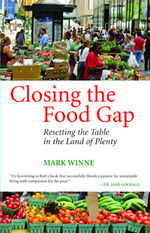
  • Today’s post is from Mark Winne, the author of Closing the Food Gap: Resetting the Table in the Land of Plenty. For 25 years, Winne was the Executive Director of the Hartford Food System, a private non-profit agency that works on food and hunger issues in the Hartford, Connecticut area. Winne now writes, speaks, and consults extensively on community food system topics including hunger and food insecurity, local and regional agriculture, community assessment, and food policy. For more information, go to http://www.markwinne.com.

    Book cover for Closing the Food Gap, links to Beacon Press page for bookLet me say from the outset that I eat well.

    Not well in a maternal, “please finish your broccoli, dear” sense. I mean very well. I cultivate a large organic garden, buy grass-fed beef from a local rancher, and when I’m feeling particularly flush with cash, frequent my local Whole Foods.

    I’ll even eat at one of those bastions of gastronomic elitism like the Stone Barns Restaurant in New York or that citadel of all things “foodie,” Chez Panisse in Berkeley. On one such occasion I celebrated my son’s college graduation with a dinner at Stone Barns, where the tab for the two of us came to a cool $325.

    It dawned on me as I was staggering out of the restaurant that I could have paid for 126 low-income children to eat school lunch that day at the current US Department of Agriculture reimbursement rate of $2.57 per meal. Better yet, 283 food stamp recipients might have had dinner on me that night at the average meal allotment of $1.15.

    Such disparities in the way that different classes of Americans eat are disconcerting.

    With our nation teetering on the brink of economic meltdown, a record 31.8 million of us are receiving help from the food stamp program, a thirteen percent increase over last year.

    Food banks and food pantries have been overrun as well. More than 25 million Americans use emergency food assistance annually. While demand for “free” food is reaching levels not seen since the Great Depression, at a cost to the taxpayer of $73 billion a year and climbing, it might seem odd that there is also an infatuation with higher-priced local and organic food.

    (more…)

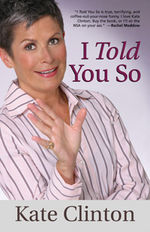
  • Today’s post is from Kate Clinton, author of I Told You So, forthcoming from Beacon Press. Clinton is a faith-based, tax-paying, America-loving political humorist and family entertainer. With a career spanning over 25 years, Kate Clinton has worked through economic booms and busts, Disneyfication and Walmartization, gay movements and gay markets, lesbian chic and queer eyes, and ten presidential inaugurals. She still believes that humor gets us through peacetime, wartime and scoundrel time. This post originally appeared on Clinton’s CommuniKate blog.

    Book Cover for I Told You So by Kate Clinton, links to Beacon Press page for bookIn a quiet ceremony held earlier this month, I celebrated my twenty-eighth year of performing. Please, no gifts.

    On the night of March 21, 1981, on a challenge from my best friend, I did my first show in my hometown Syracuse, New York at a woman’s club called Ms. Adventure. When my friend, Rita, started heckling me about five minutes in, I stopped. “Rita, what are you doing?” She was older, a photographer, always in black turtlenecks because she fancied herself a beatnik. “It’s comedy; we’re supposed to heckle.” Though I was three semesters retired from my teaching gig, I still had my study hall monitor mojo and shut her down expertly. “Cut it out.” She slumped.

    Many years and dry heaves later, I marvel at my career. It certainly was not one of the options on the jobs checklist on sixth grade career day. Other: lesbian comic.

    The same year I began my career, Pope John Paul and President Ronald Reagan began their careers. Together they were Forgive and Forget. It was also the year that gay men started dying from AIDS. Then it was called “the gay cancer.” Those three events and the thematic variations on them have been intertwined touchstones in my routines for 28 years.

    (more…)

  • Today’s post is from Alexis Rizzuto, an assistant editor at Beacon Press.

    As soon as we walked through the front doors of Boston Arts Academy, the energy and creativity were palpable. Earlier this month, a delegation of Beacon Press staff (Director Helene Atwan, Associate publisher Tom Hallock, Director of Publicity Pam MacColl, and myself) went to experience the BAA, a public arts high school under the direction of founding headmaster Linda Nathan, firsthand. All of us, having already read about the faculty, students, activities, and principles of the BAA, were thrilled to see them all in action.

    The BAA belongs to the Boston Public School system, but as a pilot school enjoys a more freedom than most public schools in curriculum and scheduling. Students from the city of Boston audition for the 140 spots available each year, and are selected for their passion and commitment to seriously pursuing their chosen art form (music, theater, dance, visual arts). The students are trained as scholars as well as artists, and an astounding 94% of them are accepted to college (compared to 50% on average district-wide). Linda writes that the secret to the school’s success lies in asking the right questions and listening as all players grapple with the answers. This process has led to practices such as developing a school-wide set of Shared Values, supporting the teachers by giving them time to discuss ideas in a professional learning community, opening doors to college through offering help with the application process, and being open about ethnic and economic differences in students’ backgrounds.

    These aspects of the school were all demonstrated as we walked through the hallways and into the classrooms and studios of the BAA. The hallway walls were covered not only with some impressive work from the visual arts students and stills from theater productions, but also a bulletin board filled with kudos to students “caught in the act of shared values”—in other words, those who had done good deeds in keeping with the school’s ideals of responsibility, integrity, and respect. Another wall displayed the photos of graduates with the names of the colleges to which they were accepted. In studios we saw dance students going through exercises at the barre and heard music students warming up their voices, and in classrooms we observed SAT prep, offered by the school to make sure students who might not otherwise have access to this instruction wouldn’t be at a disadvantage.

    (more…)