• By Jonathan Rosenblum

    Online shopping

    Image credit: Tumisu

    This article appeared originally in Jacobin Magazine.

    It seems eons ago, the youth-led climate strike of September 20, 2019 that brought four million people onto the streets worldwide. I was on the sidewalk outside Seattle City Hall, watching thousands of school-skippers march by. And then behind the teens came waves of exuberant people, no more than a decade or two older, their homemade signs held aloft: tech workers, including hundreds of Amazon workers who had stepped out of their comfortable cubicles and palatial glass towers to join the global walkout.

    They had every right to step lightly. Just a day earlier, the budding Amazon Employees for Climate Justice had forced CEO Jeff Bezos into an extraordinary concession, pledging to move the company to 100 percent renewable energy and net-zero carbon emissions. The tech workers were celebrating their power even though their numbers represented a minuscule fraction of the company’s fifty thousand Seattle workers. Imagine what power they would have if tech, logistics, and warehouse workers united and organized global majority unions at Amazon.

    That’s daunting to conceive. Amazon is huge. It plays the central role in American capitalism’s distribution and logistics web and also in technology and its control of the internet through Amazon Web Services. Amazon’s worldwide employee head count is 1.2 million and growing every day. Its market valuation exceeds the national GDPs of more than 90 percent of the world’s nations.

    In the last fifteen years, the company that began as an online bookseller has consolidated extraordinary monopolistic control over our daily lives, monetizing the activities of workers and consumers, honing surveillance systems inside and out of the workplace, driving economies, capturing governments around the world, and deploying vast resources to keep workers atomized, intimidated, permanently precarious, and disempowered.

    The challenge of how to organize at a company so vast and apparently omnipotent, whose CEO is on the way to becoming the world’s first trillionaire, can seem utterly overwhelming, a futile exercise. And yet any credible working-class theory of taking on late-stage monopoly capitalism in today’s Gilded Age must answer the question of how to organize worker power at Amazon.

    The Cost of Free Shipping: Amazon in the Global Economy doesn’t purport to provide a comprehensive road map for organizing. But in essays by the editors bookending seventeen curated articles from around the world, the book offers important insights into Amazon’s insidious nature, the challenges of organizing, and also some glimmers of organizing success at the local and national levels.

    The nuggets of wisdom don’t announce themselves; in a number of the essays, you have to wade through data and scholastic verbiage to find what matters. Some show how Amazon consumer products like Ring and its complicity with ICE, the military, and local police play a pivotal role in the modern police state; other sections, like those describing how the company monetizes “big data” and “user experience,” leave one hungry for more comprehensive description and analysis. Not surprisingly, the words and observations of Amazon workers, including several chapter authors, are the most clarifying and insightful.

    Monopoly Capitalism

    Organizing against the dominant monopoly is not a new challenge. A century ago, our predecessors faced the new, disruptive mass manufacturing sector. Carnegie Steel, US Steel, Ford Motor Company, General Motors, General Electric, and their ilk harnessed the latest in technologies to establish new scales of stealing value from workers’ labor, while employing the latest in psychology and coercive violence to keep workers divided and down.

    It took more than a generation of failed organizing, most notably the 1919 steel strike, before workers honed the strategic smarts and organizational unity to overcome the chokehold of corporate control. Workers learned how to win, mostly through defeat. Communist Party leader William Z. Foster’s “Organizing Methods in the Steel Industry,” drawing from lessons of the failed strike and beyond, laid out fundamental lessons about organizing ideology and union form and structure: leadership identification, recruitment, propaganda, inoculation, escalation and disruption, multiracial unity. Foster’s monograph became a road map not just for the CIO’s industrial organizing successes of the 1930s, but for leading contemporary organizing struggles.

    In auto, the 1930s sit-down strikers succeeded where their predecessors had failed, not just because of their increased militancy, but because they had developed a clear understanding of General Motors’ strengths and weaknesses, and from that built a strategy for exploiting production process choke points. Strikes at key factories allowed them to throttle production system-wide and force management to the bargaining table.

    Today, Amazon represents that pinnacle challenge to union organizers and socialists. Are we in a 1919 moment, still a generation of failures away from breakthrough success? Or closer to 1935, approaching that tipping point of worker power?

    Almost certainly the former. What’s evident from reading the essays in The Cost of Free Shipping is that rather than represent something entirely new, Amazon embodies the next iteration of monopoly capitalism, but presents a challenge a couple orders of magnitude greater than the mass production systems of the last century. As Kim Moody notes in the book, “Jeff Bezos and his crew of techies and quants simply did what robber barons have always done: raise, spend, and sometimes lose other people’s money, dodge taxes, swindle suppliers, and avoid unions.”

    Disrupting the Production Process 

    The company also transplanted Walmart’s predatory pricing strategies from Main Street to the internet to drive out competitors, build scale, and gain monopoly control. As Jason Struna and Ellen Reese describe in the book, Amazon upgraded the century-and-a-half-old Taylorist system of scientific management methods with modern electronic surveillance to drive old-school speedups in the warehouses and throttle incipient organizing efforts.

    But Amazon’s production process differs from its monopolistic forerunners in a fundamental way: redundancy is hardwired into its vast logistics and warehousing network. The prodigious throughput in General Motors’ production system drove corporate profits to astounding levels, but speed in a relatively linear, single-channel production process also proved to be the capitalists’ Achilles’ heel. As the sit-down strikers demonstrated, a single break in the chain, strategically located, could bring the whole operation to a crashing halt.

    Capitalists took that lesson to heart over the years, building redundancy into production systems to undercut worker industrial action. Boeing, struck by Washington State machinists and engineers nine times since World War II, paid out billions to develop a second—nonunion, of course—production line in South Carolina beginning in 2009. The company could have met production needs at much lower construction and logistical cost by building out its existing Washington State assembly plants. But the cross-country assembly line wasn’t about efficiency; it was about disciplining the unruly union workers. There hasn’t been a strike at the Washington State factory since South Carolina started rolling out jets.

    Amazon learned that lesson, from its inception incorporating supply chain redundancy that insulates the company from single-site or even single-country industrial actions. Too many Amazon warehouse job actions in recent years, while bravely fought by the workers, have been easily tamped down by the company.

    There are some hopeful examples in Jake Alimahomed-Wilson and Ellen Reese’s book. Jörn Boewe and Johannes Shulten describe how Polish workers resisted mandatory overtime that the company tried to impose in response to a strike four hundred miles away in a German warehouse. Notably, the German-Polish worker solidarity had been built through radical rank-and-file activists, not via established union institutional channels, according to the chapter authors.

    But the thorough redundancy that Amazon has built into distribution systems is harder to replicate throughout the giant. Herein lie tremendous possibilities for building worker power.

    Spencer Cox writes in the book about how, in March 2017, a large portion of the internet crashed for several hours as a result of a single keystroke error by an Amazon engineer, costing companies around the world hundreds of millions of dollars. Tech workers, Cox argues, “are uniquely positioned in today’s capitalist economy that depends on their labor to make industrial processes run. When they stop, so does everyone else.”

    Tech executives know that, too, so for the first decades of the industry’s bloom, they’ve aggressively steered engineers, programmers, and designers away from class politics with lavish stock options, hip workplaces, and a meritocratic ideology, all supplemented with PR philanthropy and a heavy dose of corporate blandishments about progressive values and mission-driven work.

    Those corporate strategies have worked so far to cloud class relations. But what I saw coming down the street in September 2019 gave me hope that the fog may be starting to dissipate.

    If tech workers can overcome the tempting siren call of co-optation and embrace their shared interests with logistics and warehouse workers, then the possibilities of worker power are astonishing.

    As Cox describes it,

    One could imagine strikes in key chokepoints that leverage the ability of engineers to shut down key aspects of the production process. Shutting down websites, access to the cloud, or monkeywrenching logistical systems can shut down not just the fulfillment logistics network, but the entire economy. Demands could link together the issues of warehouse, community organizations, and tech workers alike, using the structural power of tech workers to advance the interests of the working class as a whole.

    A powerful vision, indeed.

    Resistance Is Not Futile 

    Technology and the speed of global communications are core elements of Amazon’s financial success, but workers also can harness those advances to benefit the working class. New technology in the hands of workers doesn’t cancel out the disparity between capital and labor mobility, but it can blunt it. The millions of people who took to the streets in the walkouts of September 2019 attest to how technology can surmount obstacles of distance and language.

    If there’s any positive organizing news coming out of the COVID-19 era, it’s that workers have been compelled by dire circumstances to adapt technology for solidarity and collective action. Some three thousand union members from seventy different countries just concluded a six-session “Strike School,” hosted by the Rosa Luxemburg Stiftung and led by labor organizer Jane McAlevey. With physical distance and language no longer posing insurmountable barriers, we can begin to imagine building a true global Amazon workers’ organizing committee.

    In employing new technologies, organizers will have to work relentlessly to avoid the temptation of shortcuts. Instagram and Twitter are not substitutes for organizing work. One-on-one conversations, leadership identification and recruitment, democratic decision-making, political education and power analysis through discourse, and organizational structure-testing all remain fundamental ingredients to building successful mass industrial action and durable worker organization. The technological tools now available to workers can facilitate those organizing building blocks on a global scale.

    Then there’s the question of how to challenge Amazon in the political arena. The Cost of Free Shipping offers chapters with starkly different advice.

    Steve Lang and Filip Stabrowski recount how New York activists blocked Amazon’s 2018 bid to extract $3 billion in public subsidies in exchange for a second headquarters in the Big Apple. Grassroots activists held firm to the demand for no public subsidies, and three months after “awarding” New York their second HQ, Amazon abruptly pulled the plug. A year later, however, the company announced it would dramatically expand its footprint in New York City—with no subsidies—validating the movement charge that Amazon’s HQ-2 play was never about jobs but rather corporate extortion. Lang and Stabrowski conclude that “in dealing with an adversary of such size, power, and inflexibility as Amazon, it is vital that the opposition contain a kernel that is committed to no compromise and no negotiation.”

    Katie Wilson recites the 2018 Seattle battle to tax Amazon and other major corporations to fund housing and social services. The city council passed a modest tax on top businesses, only to swiftly and ignominiously repeal it in the face of a brutal, overwhelming counterattack from Amazon and the Chamber of Commerce.

    Wilson’s advice from that bruising battle is threefold: next time, “prevent or minimize” the antagonism of conservative union leaders, such as those in the building trades, by appealing to them at the beginning of the effort; run a stronger public relations campaign; and narrow the tax measure to affect fewer companies, thereby “cultivating more vocal business support.”

    But in fact, Seattle history bears out a very different lesson. This past July, doubtless after Wilson submitted her essay, the Seattle movement won a new tax on Amazon—this one more than four times the size of the repealed 2018 version. How did this happen, after such an epic defeat?

    The socialist-led Tax Amazon movement won not by toggling to the political center, moderating appeals, or refining its messaging, but by organizing a dogged, scrappy grassroots movement that issued bold demands, which they then backed up with a credible threat to take the matter to the ballot if the city council failed to act. (I was involved both as a volunteer in the Tax Amazon movement and as a community organizer for City Council member Kshama Sawant.)

    The lessons in both New York and Seattle are the same: Amazon can be beaten in the political arena, not with better public relations and by accommodating the center, but with big demands that inspire working people to engage, and with movement power demonstrated through collective action.

    Today’s Amazon activists, whether working in gleaming towers, laboring away in cavernous warehouses, driving panel vans through suburban neighborhoods, or defending communities against corporate extortion, are not going to tip over the giant tomorrow, or in any of the foreseeable tomorrows. But they also are demonstrating that resistance is not futile, and through struggle and experience are helping us all figure out how to build durable working-class power and effectively challenge capitalism.


    About the Author 

    Jonathan Rosenblum works as a community organizer for Seattle City Councilmember Kshama Sawant. He is the author of Beyond $15: Immigrant Workers, Faith Activists, and the Revival of the Labor Movement (Beacon Press, 2017), and a member of the National Writers Union/UAW 1981. Find him online at https://jonathanrosenblum.org/ or Twitter: @jonathan4212.

  • Kitten and book

    How could you get your read on without the company of this little one? (Disclaimer: Not a Beacon pet but just as cute.) Photo credit: Алексей Боярских

    The pet-less hiatus at 1600 Pennsylvania Avenue has gone on long enough. At last, four-legged friendos are coming back! In honor of President-elect Joe Biden bringing Champ and a future feline to the White House, we are sharing stories about our doggos, kitties, and other creature companions. Quality of life would suffer without them. Warning: the cuteness overload you are about to experience will cause uncontrollable squeeing. You may even try reaching through the screen to deliver boops to those faces.

    ***

    Kafka at Quincy Quarries

    Kafka at Quincy Quarries

    Our dog, Kafka, has been the patron saint of my sanity through this pandemic year. She makes sure I unplug from my work-from-home station and step outside for some fresh air every single day, whether we’re going for a quiet walk around the neighborhood or venturing further afield for a longer hike. I’m a homebody by nature, and without her, would surely have withered away and broken down long ago.
    —Daniel Barks, Print Planning and Digital Production Manager


    Timothy

    Timothy

    Timothy has always been a cat of big feelings, clearly expressed. He wants what he wants when he wants it, whether it’s love, food, playtime, brushing, or going outside. (I allow him brief jaunts in the backyard in the morning.) He has wide tonal range in his meows—I often think I understand exactly what’s he saying—and he’s good with the impatient paw tap should I ignore his clear verbal expressions of his needs. He’s also terrified of all strangers, so one of the pleasures of this year of spending way too much time at home has been his Zoom bombing. Usually, he finds my Zoom meetings noisy, annoying, and mildly frightening, and exits the room in exasperation, but every now and then, he marches straight to the lap top screen to stare at the people looking back and to rub his chin against the screen’s edge.  And my friends or colleagues smile widely, because he’s a gorgeous, ridiculous creature, and a welcome break. And because this we all know: the matter-of-fact presence of our animal companions, lounging in the background behind journalists on TV screens, or popping into work meetings and book talks with a tail wag, has had the great effect of humanizing our professional selves, and hinting at the bonds, to humans and animals alike, that matter most.
    —Amy Caldwell, Associate Editorial Director


    Miss Kitty

    Miss Kitty

    This is Miss Kitty. For most of her life, she enjoyed a healthy and carefree lifestyle. But all that easy living caught up with her three years ago when her only functioning kidney started to fail. Her situation was so dire that we had a living wake for her. Thanks to her vet and her zest for life and turkey, Miss Kitty made a miraculous recovery. But her health struggles continued. Over the next year, her little kidney sputtered and failed two more times. We had more wakes, but she rallied from the brink again and again. Fortunately, she has been healthy and sassy for the past two years. She celebrated her fifteenth birthday this summer with tuna juice and a nap. When it seems like the pandemic is never going to end, Miss Kitty is there to remind me that there is always room for hope when things seem bleak.
    —Beth Collins, Production Manager


    Dexter and Willow

    Dexter and Willow

    Meet our orange tabbies, Dexter (back) and Willow (front), named after famous ginger TV characters of course. We adopted the brother-sister pair a little over two years ago as kittens. One thing we learned is that orange tabbies are male something like eighty percent of the time, so everyone at the shelter was really excited to have a female there! And much like a famous orange tabby Garfield, they love eating, except replace lasagna with cardboard, sticks, string, and everything else and you’ve got our cats—especially Dexter—so we’ve learned to keep the floors really clean to avoid any more costly trips to the vet ER.
    —Alyssa Hassan, Associate Director of Marketing


    Sassypants

    Sassypants

    Nicole and Sassy:

    My partner and I adopted Sassy (full name: Sassypants. Trust us, it’s on her rescue papers!) during Boston’s lockdown in July 2020. We’d been scouring every pet rescue site for about six months and kept getting rejections (them: “Whoops, you’re too late!” me: “But the listing went up ten minutes ago!”). What’s made working from home, attending my night classes, and working on my graduate thesis all from my living room a little more bearable every day is having a friendly face to turn to when things get to be just a bit too much. No matter what, she’s always looking out for me—in exchange for some belly rubs and human hugs in return!
    —Nicole-Anne Keyton, Editorial Assistant


    King George

    King George

    Ode to King George

    We adopted our tuxedo cat, George, when he was a sweet little kitten, but by the time he was half-grown, he’d become the swaggering alpha of our neighborhood. Walking home from Thayer, we’d spot him stalking about on the Brown quad and, pointing, say to the kids, “Look, there’s the big man on campus.” Sometimes he’d return from a night prowl smelling of perfume, and we’d know he’d been next door at Tina’s, where he liked to stop for a snack on the way home. In the afternoons, he’d hang about until our middle son rounded the corner coming home from school, and together they’d race up the driveway. 

    One January, after a huge snowstorm, he went missing for six days. Just as I was looking at his bowls and thinking, Well, maybe he’s not going to make it home, Tina called, happily reporting that he was on her back porch.

    Another time, now getting advanced in years, he again went missing for days; we were miserable with worry. Then, there he was, crouched low on the back steps. He’d somehow made it home with his shoulder blade broken in three places. Eventually, he healed, but it was clear his prowling days were over. With resignation, he’d follow us to his leash in the back garden, where he could at least watch the squirrels and take one of his long naps in the sun. Observing him there, resting in his dotage, we’d tease him, saying, “Oh my, look how the mighty have fallen.” He even started napping on my lap in the winter, now content to settle by the warmth of the fire.

    At the end of June, when he was almost twenty years old, kidney failure caught up with George and, heartbroken, we had to put him down. Our neighbor’s cat, Alu, sensing the new order, started sashaying through our back yard, offering a mocking little wave with her tail. “Okay, Alu,” we’d say, “but our George will always be the king of Lloyd Avenue!”
    —Pamela MacColl, Director of Communications


    Norton

    Norton

    Norton and I have been through a lot together. As an eighth grader, I wanted a pet that would outlive me, so I made a pitch presentation for a Russian tortoise on a trifold foam board for my parents, complete with photos of Norton taken through the glass at Petco. Norton followed me to college (smuggled into my dorm in a blue bin), through multiple moves, and now resides in a large, reclaimed bookshelf in my Brighton apartment. She’s moody, but I’ve been trying to get on her good side with handfeeding—a new favorite pandemic pastime. She can feed herself (as pictured), but isn’t it so much nicer to perch on a rock and have someone feed you dandelions, clovers, Belgian endive, watercress, collards, and radicchio?
    —Melissa Nasson, Esq., Contracts Director 

    Kitten and book

  • Resist

    Image credit: Pete Linforth

    It was the breather from 2020 we were waiting for. The election is over, and the Biden/Harris ticket won, no matter how many petty lawsuits the defeated opponent files. But wreckage and repair work await us. As Vice President-elect Kamala Harris said in her acceptance speech, democracy “is only as strong as our willingness to fight for it. To guard it and never take it for granted. And protecting our democracy takes struggle. It takes sacrifice. But there is joy in it. And there is progress. Because we, the people, have the power to build a better future.” Yes, we do. And we will need to spend a lot of that power cleaning up after The Apprentice administration, too.

    There is no time to coast on the results of the election. We must gear up for 2021, and for that, we put together this list of books to stoke our commitment to liberation and abolition. Referring to issues covered in the debates and Biden and Harris’s acceptance speeches, these books are a reminder of the struggle that lies ahead—which may even come from the new admin—and the tools we have to face it.


    Race in America

    How To Be Less Stupid About Race

    How to Be Less Stupid About Race: On Racism, White Supremacy, and the Racial Divide
    Crystal M. Fleming

    “Dr. Fleming offers a straight-no-chaser critique of our collective complicit ignorance regarding the state of race in the United States . . . . This book will leave you thinking, offended, and transformed.”
    —Nina Turner, former Ohio state senator


    Proud Boys and the White Ethnostate

    Proud Boys and the White Ethnostate: How the Alt-Right Is Warping the American Imagination
    Alexandra Minna Stern

    “In this carefully researched book, the historian Alexandra Minna Stern studies a wide array of online web sites, documenting a rise in claims to whiteness as a basis of identity, as a claim to victimhood and as an argument for a ‘white ethnostate.’ Drawing ideas from films (‘red-pilling’ comes from The Matrix) and from the left (the need for ‘safe spaces’), the Alt-Right, she argues, is trying to normalize a frightening shift from talk of civic nationalism to talk of race-based nationalism. This is very important work we should all know about.”
    —Arlie Hochschild, author of Strangers in Their Own Land: Anger and Mourning on the American Right, finalist for the National Book Award


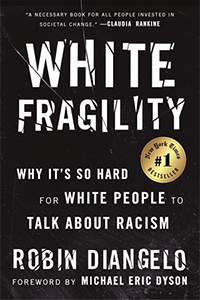
    White Fragility

    White Fragility: Why It’s So Hard for White People to Talk About Racism
    Robin DiAngelo

    “With clarity and compassion, DiAngelo allows us to understand racism as a practice not restricted to ‘bad people.’ In doing so, she moves our national discussions forward with new ‘rules of engagement.’ This is a necessary book for all people invested in societal change through productive social and intimate relationships.”
    —Claudia Rankine


    Climate Change

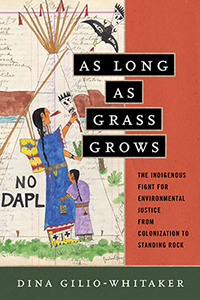
    As Long As Grass Grows

    As Long As Grass Grows: The Indigenous Fight for Environmental Justice, from Colonization to Standing Rock
    Dina Gilio-Whitaker

    As Long as Grass Grows is a hallmark book of our time. By confronting climate change from an Indigenous perspective, not only does Gilio-Whitaker look at the history of Indigenous resistance to environmental colonization, but she points to a way forward beyond Western conceptions of environmental justice—toward decolonization as the only viable solution.”
    —Nick Estes, assistant professor, University of New Mexico, and author of Our History Is the Future


    Climate Courage

    Climate Courage: How Tackling Climate Change Can Build Community, Transform the Economy, and Bridge the Political Divide in America
    Andreas Karelas

    “In the wake of the pandemic, nothing could help bring us out of this crisis in a more constructive way than working together to prevent the next one. Climate Courage offers a path towards getting back to something much better, and more united, than our old normal.”
    —Bill McKibben, cofounder of 350.org and author of Falter


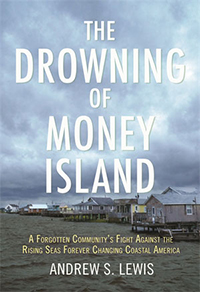
    The Drowning of Money Island

    The Drowning of Money Island: A Forgotten Community’s Fight Against the Rising Seas Forever Changing Coastal America
    Andrew S. Lewis

    “A must-read for anyone interested in how climate change is already deepening preexisting inequality. Meticulously and empathetically reported, The Drowning of Money Island invites readers to confront the difficult decisions that come with storm recovery in our era of higher tides and supercharged hurricanes. Stay or go, rebuild or retreat? The way we answer these questions will define who we become.”
    —Elizabeth Rush, author of Rising: Dispatches from the New American Shore


    Radical Leadership

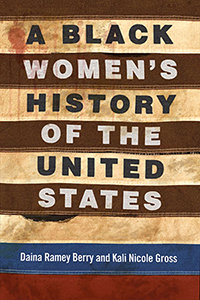
    A Black Women's History of the United States

    A Black Women’s History of the United States
    Daina Ramey Berry and Kali Nicole Gross

    “Black women have always been at the front line of change, and A Black Women’s History of the United States shows us in no uncertain terms that our DNA will have us here sculpting and writing the next chapters. Tell your sisters, mothers, and daughters to get this book for someone they love, because we owe it to ourselves, our daughters, our sons, and our future, to know the history that isn’t being taught in our schools. And it starts with us.”
    —Anika Noni Rose, actor, producer, and singer


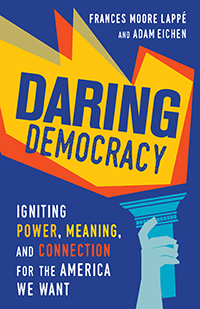
    Daring Democracy

    Daring Democracy: Igniting Power, Meaning, and Connection for the America We Want
    Frances Moore Lappé and Adam Eichen

    “It is all too easy to fall into despair, but instead we can join the many others who are ‘daring democracy’ in many ways, as we learn from this instructive account of hopeful prospects.”
    —Noam Chomsky


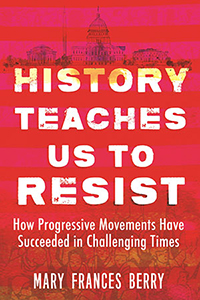
    History Teaches Us to Resist

    History Teaches Us to Resist: How Progressive Movements Have Succeeded in Challenging Times
    Mary Frances Berry

    “With a historian’s field of vision and a veteran activist’s understanding of tactics and strategy, Berry excavates how resistance to some of the most powerful men in modern America shaped the freedom struggles that have benefited us all—and in so doing provides a crucial road map for the work that lies ahead.”
    —Kimberlé Williams Crenshaw


    Faith in Action

    Dangerous Religious Ideas

    Dangerous Religious Ideas: The Deep Roots of Self-Critical Faith in Judaism, Christianity, and Islam
    Rachel S. Mikva

    “In Rachel Mikva’s telling, the very things that make religion a force for good are also what makes it so dangerous. As both a scholar and a rabbi, Mikva is unblinking in her self-critical examination of these dangerous religious ideas, offering believers and nonbelievers alike a new way to think about the enduring the power of faith.”
    —Reza Aslan, author of Zealot: The Life of and Times of Jesus of Nazareth


    Trust Women

    Trust Women: A Progressive Christian Argument for Reproductive Justice
    Rebecca Todd Peters

    “In Trust Women, Rebecca Todd Peters lays bare the real question underlying the abortion debate: whether or not women can be trusted to make their own decisions. She is compassionate and clear-eyed in constructing her faith-based case for abortion, and her voice cuts through the noise to affirm what we at Planned Parenthood have long believed: the best arbiter of a woman’s reproductive destiny is herself.”
    —Cecile Richards, president of the Planned Parenthood Federation of America and president of the Planned Parenthood Action Fund


    Remaking Society

    Defund Fear

    Defund Fear: Safety Without Policing, Prisons, and Punishment
    Zach Norris

    “A powerful book that is very much in the tradition of Ella Baker’s radical humanitarianism. Rejecting fear-based, revenge-based models of ‘justice,’ Norris’s work pays homage to an entire generation of activists who are not only clear about what they are against but who are collectively creating a vision and a practice of what the future could look like. A must-read.”
    —Barbara Ransby, author of Ella Baker and the Black Freedom Movement


    Marching Toward Coverage

    Marching Toward Coverage: How Women Can Lead the Fight for Universal Healthcare
    Rosemarie Day

    “Day offers a simpler remedy for fixing healthcare. If we want a healthcare system that’s more humane, more practical, and gets the important things right, turn to women. Read it and let’s get going.”
    —Andy Slavitt, former administrator of the Centers for Medicare and Medicaid Services


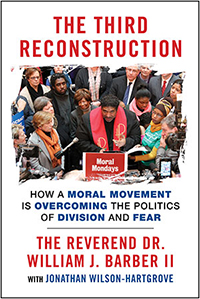
    The Third Reconstruction

    The Third Reconstruction: How a Moral Movement Is Overcoming the Politics of Division and Fear
    Rev. Dr. William J. Barber, II and Jonathan Wilson-Hartgrove

    “William Barber is the closest person we have to Martin Luther King, Jr. in our midst. His life and witness is shot through with spiritual maturity, subversive memory, and personal integrity. This book lays bare his prophetic vision, historical analysis, and courageous praxis.”
    —Cornel West, author of Black Prophetic Fire

    Resist

  • Christmas present

    We made it! We got through the hot mess of 2020 to December. Phew! Time to go on the hunt for gifts to inspire the loved ones in your life! And gifts for yourself, too. After surviving a pandemic this long, you’ve earned it. Save 30% on everything at beacon.org through December 31 using code HOLIDAY30.

    We laid out some selections below for you to look through for ideas—music biographies, inspirational lectures and speeches, and even some fiction and poetry. You can always check out our website to browse our whole catalog.

    Orders must be submitted by 1 pm, December 10 to be delivered before the holidays. USPS media mail takes 7-10 business days.

    Beacon Press will be closed Friday, December 18, 2020, through Friday, January 1, 2021. Orders placed during this time will be fulfilled when we are back in the office on Monday, January 4, 2021.

    And as always, we encourage you support your local independent bookstore this holiday season!

    Without further ado, let us entice you with these titles as we run past the finish line of 2020!


    Breathe

    Breathe: A Letter to My Sons
    Imani Perry

    “In Breathe, Perry offers a lyrical meditation that connects a painful, proud history of African American struggle with a clarion call for present-day action to protect, defend, and celebrate the promise of the next generation.”
    —Stacey Abrams, founder and chair of Fair Fight Action, Inc.


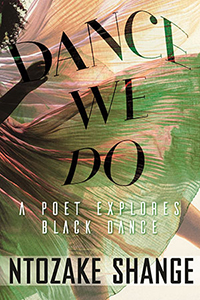
    Dance We Do

    Dance We Do: A Poet Explores Black Dance
    Ntozake Shange

    “Through Ntozake Shange’s personal memories of dance—what it has meant to her, how she came to know, understand, and feel it—we are taken on a journey that chronicles some of the greatest dancers and choreographers of the latter part of the twentieth century.”
    —Phylicia Rashad


    Eva's Man

    Eva’s Man
    Gayl Jones

    “A literary giant, and one of my absolute favorite writers.”
    —Tayari Jones, author of An American Marriage


    Kindred

    Kindred
    Octavia E. Butler

    “Truly terrifying . . . A book you’ll find hard to put down.”
    Essence


    The Miracle of Mindfulness

    The Miracle of Mindfulness: An Introduction to the Practice of Meditation
    Thich Nhat Hanh

    “Thich Nhat Hanh’s ideas for peace, if applied, would build a monument to ecumenism, to world brotherhood, to humanity.”
    —Martin Luther King Jr.


    Natural

    Natural: How Faith in Nature’s Goodness Leads to Harmful Fads, Unjust Laws, and Flawed Science
    Alan Levinovitz

    “Words have power—just look at the scrambles by ideological groups to own words like ‘right to life,’ ‘pro-choice,’ or ‘family values.’ In Natural, Alan Levinovitz explores the power of that word and the often highly consequential ways in which it has been appreciated, appropriated, distorted, hyped, commodified, consecrated, and weaponized. This is important stuff, as evidenced every time someone discusses the supposed naturalness and thus supposed inevitability of some appalling human behavior.”
    —Robert M. Sapolsky, John A. and Cynthia Fry Gunn Professor of Neurology and of Neurosurgery, Stanford University, and author of Behave: The Biology of Humans at Our Best and Worst


    Odetta

    Odetta: A Life in Music and Protest
    Ian Zack

    “An absorbing portrait of a seminal artist. Odetta was my Queen.”
    —Joan Baez, musician and activist


    The Radiant Lives of Animals

    The Radiant Lives of Animals
    Linda Hogan

    “Linda Hogan’s work is rooted in truth and mystery.”
    —Louise Erdrich


    Strength to Love

    Strength to Love
    Martin Luther King, Jr.

    “If there is one book Martin Luther King, Jr., has written that people consistently tell me has changed their lives, it is Strength to Love.”
    —Coretta Scott King, foreword


    A Treasury of African American Christmas Stories

    A Treasury of African American Christmas Stories
    Compiled and edited by Bettye Collier-Thomas

    “A book for all seasons, these stories are bound to amuse, educate, and inspire all kids, from one to ninety-two.”
    —Robin D. G. Kelley, author of Freedom Dreams


    Woody Guthrie

    Woody Guthrie: An Intimate Life
    Gustavus Stadler

    “Stadler’s gorgeous book is both a paean to the Guthrie we know . . . and a revealing look at the embodied Guthrie, who is vulnerable, playful, and lustful . . . . It opens up an important new window into not only Guthrie the man but the history of the twentieth-century American Left.”
    —Gayle Wald, author of Shout, Sister, Shout! The Untold Story of Rock-and-Roll Trailblazer Sister Rosetta Tharpe


    Yes to Life

    Yes to Life: In Spite of Everything
    Viktor E. Frankl

    “This slim, powerful collection from Austrian neurologist and psychiatrist Frankl (Man’s Search for Meaning) attests to life’s meaning, even in desperate circumstances…This lovely work transcends its original context, offering wisdom and guidance.”
    Publishers Weekly, Starred Review

    Christmas present

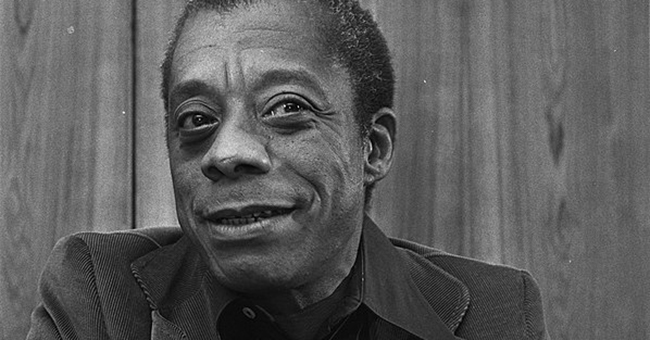
  • James Baldwin, 14 November 1974

    Photo credit: Rob Croes / Anefo

    It’s a kneejerk reaction to imagine what James Baldwin would say about the state of things in the US when the anniversary of his death comes every December 1. Especially now. Much like how the issues that folk legend Odetta sang about are still, sadly, relevant today, so it goes for the issues Baldwin wrote about in Notes of a Native Son. Which is why our director, Helene Atwan, says it remains so potent a text to go back to:

    Sixty-five years ago, Beacon Press had the honor and privilege to publish a landmark book: James Baldwin’s first collection of essays, Notes of a Native Son. It has never been out of print, and we have only witnessed the audience for Baldwin’s prophetic voice grow over the decades. But this spring and summer, and into this year of crisis and reckoning, James Baldwin’s writing is resonating more powerfully than ever.

    It was thirty-three years ago, on November 30, that his family received the news of his death. Today, their solace and ours is that he is very much alive in the hearts and souls of all those, in this nation and internationally, who care about human rights and racial justice. We are so thankful in the holiday season to have Jimmy’s work to inspire us.

    Noted Baldwin scholar Eddie S. Glaude, Jr. is also thankful for his shrewd insight. In fact, he recently published the much-praised biography Begin Again: James Baldwin’s America and Its Urgent Message for Our Own. When he talked to Trevor Noah about it on The Daily Show, he mapped out the connection between the US of Baldwin’s time to the US we live in today:

    The later Baldwin is a Baldwin who’s trying to come to terms with America’s betrayal. Most folks say he’s bitter, he’s angry, [that] his rage has overwhelmed his art. But Baldwin is trying to come to terms with the fact that the country has assassinated Martin Luther King, Jr. He’s collapsed. In 1969, he tries to commit suicide. [He has a] failed relationship. The country is on the road to not only electing Richard Nixon but is on the road to electing Ronald Reagan. Many people don’t understand that Ronald Reagan was as notorious as George Wallace for Black folk in this country.

    I was interested in [the] Baldwin who is trying to make sense of our trauma, our pain, our wound. Trying to pick up the pieces in the face of America’s betrayal. And here we are in our moment, after Barack Obama’s presidency, the vitriol of the Tea Party, voter suppression and voter ID laws. And then we vomited up Donald Trump. I was trying to deal with my own despair and disillusionment, so I turned to him in that moment.

    Baldwin’s observations of our nation’s societal struggles were also in conversation with the work of his dear friend and confidant Lorraine Hansberry, or Sweet Lorraine. Interdisciplinary scholar Imani Perry wrote about their radical friendship and the reverberating intention of his words in her biography Looking for Lorraine: The Radiant and Radical Life of Lorraine Hansberry:

    Jimmy called A Raisin in the Sun a play in which Lorraine served as a witness to black America. He did too. In perhaps his most famous book, the 1963 epistolary text The Fire Next Time, he answered Walter Lee’s climactic action. In Raisin, standing before his son, Walter Lee insists upon moving into the white neighborhood and rejects the offer of a lot of cash in exchange for maintaining segregation and abdicating his dignity. In The Fire Next Time, Baldwin testifies to his nephew about his late father. Jimmy wants his nephew to see how his father (like their father before him) had been crushed by the forces of white supremacy in his life. He issues an appeal to his nephew’s generation to make use of their righteous anger rather than be distorted by it. Jimmy, a former child preacher, preaches to the Walter Lees of the world and to the others. He makes plain the wages of white supremacy.

    In the second essay of the slim book, Jimmy echoes Beneatha, the character in Raisin whom Lorraine based upon herself. Beneatha, headstrong and sophomoric, questions Christianity and the existence of God. Mrs. Younger responds by slapping her across the face. As long as she is in Lena Younger’s house, Beneatha learns, she is required to believe. Jimmy, too, questions American Christianity and the way in which it inures people, black and white, to a vile order. Instead, he says, Americans ought to move beyond the status quo of their fears, beliefs, and oppressions. That was precisely what the young Beneatha, sometimes in a silly way, was trying to do. And what Lorraine and Jimmy tried to do in their lives also.

    Now, the forces of Perry and Glaude are joining in our latest Baldwin publication. We’re excited to release Nothing Personal, his famous 1964 essay on social isolation, race, police brutality—sounds a lot like what we’re living through during the pandemic, doesn’t it?—with a foreword by Perry and an afterword by Glaude. A trifecta of Black brilliance. Baldwin’s critique of American society at the height of the Civil Rights movement is as incisive as ever. He recounts his own encounter with police in a scene disturbingly similar to those we see today documented with ever increased immediacy as more activists and average citizens alike capture injustice on iPhones. Baldwin's documentation of his own troubled times cuts to the core of the issues we find ourselves in today as the Black Lives Matter movement fights for a more just world. This will be the first time it’s published as a stand-alone gift edition. We can’t wait until it comes out next June!

  • By Eileen Truax

    Los Angeles

    Mexico is a multicultural, multilingual country where seven million people speak Indigenous languages. Of those, more than a million speak only one of seventy-two Indigenous languages, and no Spanish. This population is concentrated in a few of Mexico’s thirty-one states. Oaxaca is one of the three poorest states in the country and is also the state with the largest Indigenous population, at over 1.5 million. Many Indigenous Oaxacans migrate to the United States for a better life, like interpreter Odilia Romero. But when it comes to finding translators and interpreters fluent in their languages, they don’t have as many resources as Spanish-speaking Mexicans do. Where can they turn for help in a new home where they face discrimination from the US and from fellow Mexicans? For Native American Heritage Month, this is Odilia’s story from Eileen Truax’s How Does It Feel to Be Unwanted?: Stories of Resistance and Resilience from Mexicans Living in the United States.

    *** 

    “Good afternoon, Senator Sanders. My name is Odilia Romero, Indigenous Bene Xhon.”

    Standing onstage at the Casa del Mexicano in Boyle Heights, a neighborhood in east Los Angeles, Odilia holds a microphone in one hand and in the other her speech for Bernie Sanders, then a candidate for the Democratic Party’s nomination for president. It was May 4, 2016, and in the auditorium beneath the fifty-foot-high domed ceiling, four hundred people had gathered, a mix of pro-immigrant organizations, young activists, and members of the Latina community.

    “I come from a sacred place where now very few people live; it’s a ghost town, because most of us now are here in Los Angeles,” Odilia says. She is dressed in a white skirt and blouse embroidered with brightly colored flowers, very typical of Zoogocho, the community she comes from. She explains that while Indigenous communities are rich in culture and natural resources, every day Indigenous peoples are forced to migrate north as a consequence of US agricultural policies.

    “When we stand up for our land and human rights, we’re threatened with death by the Mexican police and army,” she says. “We go from being landowners to becoming low-wage workers. But in the United States, we are in the same condition: we are over 20 percent of the agricultural labor force in California, but we face discrimination, structural racism, and labor exploitation, along with racism from our other Mexican brothers and sisters.”

    Sitting on a stool on the stage with one foot on the floor, wearing a light blue shirt with rolled-up sleeves, slightly hunched over, his hair a tousled mess as usual, Senator Sanders looks at Odilia and listens respectfully, sometimes looking surprised by what he hears.

    “What will you and your team do to build a broad, inclusive coalition that acknowledges our diverse community and create policies that recognize Indigenous peoples’ right to stay home and make immigration voluntary instead of a forced necessity?” Odilia asks. “Will you prohibit any future agreements like NAFTA that increase unemployment, low wages, poverty, and displacement of Indigenous people all over?

    “Thank you, and welcome to Oaxacalifornia.”

    ~~~

    Odilia is a Bene Xhon, which means “Zapotec people.” she was born in Zoogocho, in Oaxaca state’s northern mountains—“where we walk in the clouds”—in 1971, at the beginning of the decade that would bring the devaluation of the dollar and the decline of rural life in Mexico. Odilia clearly remembers the first wave of migration from her community. A flatbed truck would come every week on market days, and along with the market vendors, the truck would take people who were going away in search of opportunity. “A truck full of empty baskets, and empty men and women, hoping to fill their wallets they would leave behind their people, their language, their traditions, and their hearts to go over to ‘the other side of the fence’ for a few years,” Odilia once wrote, remembering those years.

    Eventually her day to climb aboard the truck came. She arrived in Los Angeles in 1981, where her family was already waiting. She does not remember the exact date, but she does recall “the ugly buildings I saw here on sixth and Union streets,” her first impression of the city. She was ten years old, and she was struck by the jarring change in her environment, going from living in a natural landscape, next to a river lined with trees, to spending her time inside in a room she rarely left, in a neighborhood where she was not allowed to go outside to play.

    “It was the worst thing that had ever happened to me. I think I suffered from depression, but I didn’t know it.”

    Like most children who come to the United States to live, Odilia learned English quickly. When she was only fourteen, she even acted as an interpreter for another native of Oaxaca preparing for a state exam to be licensed as a hairdresser: he did not speak English well, and knowing that Odilia could speak Zapotec and some Spanish, he asked her parents if she could help him. When he got his license, he offered to pay Odilia for her help, but her parents refused. At the time, Odilia couldn’t imagine that being an interpreter could actually be a professional career, but now she remembers that experience as her first real interpreting job.

    ~~~

    It’s Friday in Los Angeles, and the heat announcing summer’s arrival can be felt rising in the air. Odilia, who I have known for several years through my work writing on migration issues in Southern California, meets me at a café a half block from Children’s Hospital, where she is working as an interpreter. The hospital is full of stories of pain, and of hope. Founded as a nonprofit in 1901, it is now considered the best children’s hospital in California and one of the top ten in the United states. Children and their families who come to the hospital generally receive unwelcome news involving organ transplants or intensive treatments for diseases like cancer and leukemia, but they also get resources to support them. For families who do not speak English, one of those resources is an interpreter’s services.

    The hospital has a permanent staff of Spanish-English interpreters and hires freelancers such as Odilia when it needs additional people to translate the type of Zapotec she speaks (there are several variants of that language). Of the freelancers, Odilia is the only one who speaks an Indigenous language. She is often asked to try to find other interpreters through her networks. She has seen families at the hospital from Oaxaca and Guatemala who speak dialects of Zapotec that she does not understand, as well as Chinantecan, Mixe, Mam, Kanjobal, and Chibchan. If the patient and his or her family can communicate only in one of those six languages, no interpreters are available.

    As for courtrooms, recent months have seen rising numbers of Indigenous peoples from Guatemala: Zapotecs from the southern sierra who, Odilia tells me, started migrating because of mining concessions in their areas that made the fields no longer arable as a result of unplanned water exploitation and soil contamination, among other factors. another growing group is the Triqui, fleeing political conflicts in their region. For the Raramuris, from northwest Mexico, their problems stem from their location near the US border: narco-traffickers use them as drug mules, and when caught, they have been sentenced to prison, even though they could not understand anything that was said at their trials for lack of an interpreter.

    “Indigenous communities are faced with the structural racism of the justice, health-care, and education systems in the United States; with the language barrier on top of that, but also cultural issues, because in our communities, justice is not punitive,” Odilia explains. “The other day we were in a workshop for training new interpreters, and the instructor asked, ‘How would you say “judge”?’ There were Quichés, Zapotecs, and Mixtecs, and we thought it would be something like ‘the big man,’ or ‘the principal,’ or ‘the elderly man,’ because that’s who has authority—the role of judge does not exist in our communities. ‘and how would you say “court”?’ That would be ‘the big man’s house.’ ‘How would you say “prison”?’ Iron house, or metal house. ‘And how would you say “juvenile court”?’ Then that would be the house for children who do not walk straight, because you’re not going to say they did something bad or good. In our cosmic vision, when the child does not walk straight ahead, there is time to put him on the right path. It’s not like the punitive system in the United states that throws you in jail because you stole a pizza.”

    In addition to the differences in customs and word usage in Indigenous communities, the justice system in the United States is also quite different from the Mexican system. The team Odilia works with is currently developing a glossary to help people express ideas in Indigenous languages, because in both the medical and legal fields, complex terms that come up can be very challenging for interpreters.

    “In the hospitals, there are illnesses like muscular atrophy. What is that? Sometimes you don’t even know how to say it in Spanish. The cases that come to Children’s Hospital are sensitive.” Odilia reminds me that because of patient confidentiality, she cannot go into detail about specific patients. “And you realize there are people who don’t understand, they don’t even know what the diagnosis is. The worst thing that I’ve ever seen happen there was seeing how someone’s son died, and they never had an interpreter; they never knew why he died. They never knew why a resuscitation team of twenty doctors came into the room to try to revive him. No one could explain what they were doing to their child.”

    For years, the issue of interpreting for non-English-speaking parents has come up not only in hospitals and courts but also in schools and government offices. Often, children who grow up speaking English at school and Spanish at home act as interpreters for their parents, helping them fill out official forms, translating instructions from operating manuals, and sometimes serving as interpreters in their own cases at schools and hospitals, which can of course be problematic.

    When our conversation touches on this subject, Odilia recalls an incident from her own childhood. When she was in middle school, a boy was picking on her, and she responded by hitting him with a stapler, injuring him. The school suspended Odilia for a week and called her parents. But her parents did not speak English, and the school’s principal did not speak Spanish or Zapotec, so it fell to Odilia to translate for the principal. Instead of reporting her suspension, Odilia told her parents that because of her outstanding work, the school had given her a week’s vacation.

    “These things still happen today. I see it at the hospital; I see it [in] the courts; I see it at school: the child is the interpreter, and of course that is not the best person to ask to be your interpreter, especially at school!” Odilia says with a laugh, remembering her own example. “Imagine what can happen with doctors. You can’t say to a kid, ‘Tell your mother she has cancer and she’s got six months to live,’ but that is what is happening on a national level, in Spanish and even more with Indigenous languages, because there’s no alternative.”

    Paradoxically, the access these children have to bilingualism and even trilingualism, in Odilia’s case, as well as the level of responsibility they assume from a young age, means they have far greater academic and professional opportunities than their parents’ generation. During her speech to Bernie Sanders, Odilia underscored this point.

    “We have integrated into US culture. We vote. We have graduates from Berkeley, Harvard, Stanford, and UCLA, not only with bachelor’s degrees but also with master’s and PhDs. We contribute economically and culturally to the social fabric of the United States. We are proud to call ourselves Americans, because we are the original owners of the American continent, yet we are also proud to be a part of this great country. We also have the right to be treated equally.”


    About the Author 

    Originally from Mexico, Eileen Truax is a journalist and immigrant currently living in Los Angeles. She contributes regularly to Hoy Los Angeles and Unidos and writes for Latin American publications including Proceso, El Universal, and Gatopardo. Truax often speaks at colleges and universities about the Dreamer movement and immigration. Follow her on Twitter at @EileenTruax.

  • By Kyle T. Mays

    Portrait of Alexis de Tocqueville by Théodore Chassériau, 1850

    Portrait of Alexis de Tocqueville by Théodore Chassériau, 1850

    African Americans and Native Americans in urban districts and on reservations were major reasons why Joe Biden won the presidency. To be sure, Trump’s disastrous handling of the Coronavirus and racism were fundamental reasons why people voted him out. But the people in Detroit, Philadelphia, the Navajo Nation, and other locales put Biden in office. The importance of the Black and Indigenous vote underscores their importance to American democracy—a democracy that many, including French political philosopher Alexis de Tocqueville believed would never happen. He believed that Blacks, Natives, and whites would never live in the US on equal terms. In many ways, the ethnographer of white supremacy was correct. 

    Anti-Black racism and anti-Indigenous bigotry are as American as cherry pie. It is embedded in this society and has remained a core part of US democracy. For example, the Nikole Hannah-Jones-led 1619 Project avows two historical facts: that slavery was foundational to the US economy, and that the founders developed their democracy through who could and who could not be a citizen based upon one’s ownership of property. Citizenship was also based on who was property and who was not. Property ownership is a key feature of US democracy. However, the whole idea of property was constructed by two phenomenon: African enslavement and Native American dispossession.

    The bond between citizenship and property was the crucible of Americanism, a phenomenon that has placed Black and Native Americans outside the US democratic project. Anti-Black racism does not assert that it is more egregious than other forms of oppression, but it is foundational. Just as African American oppression is foundational, so, too, is the dispossession of Native Americans.   

    What does slavery and anti-Black racism have to do with Native Americans? A lot, actually. The founding fathers were simultaneously concerned with Native Americans as a threat to their political and social order. We can consult the founding documents. The term “Indian” shows up thirteen times in the Federalist Papers. In Federalist No. 24, Alexander Hamilton noted that acquiring land and maintaining a military against possible Native attacks were essential for the young nation’s development. Federalist No. 54 uses the term three times and further cements that Black folks had been transformed into property. If we don’t want to accept the relevance of anti-Blackness and anti-Nativeness within the Federalist Papers, we can rely on a more objective analysis: Alexis de Tocqueville’s Democracy in America.

    Tocqueville traveled throughout the US and was an ethnographer of the US democratic project. While some focus on his analysis of democracy, a key component of his series of essays is race.

    Tocqueville’s essay on the “Three Races” sheds light on at least a few things. First, Tocqueville claimed that little connects Africans and Native Americans in the US except their subjugated position in society. He was astute to understand that “if their wrongs are not the same, they originate, at any rate, with the same authors.” Who are the authors? The creators and ancestors of US democracy. Tocqueville concluded that Whites and African Americans would never “live in any country upon an equal footing,” but for him, this was especially true in the United States. For Native Americans, he contended that “the Indians will perish” and “from whichever side we consider the destinies of the aborigines of North America, their calamities appear to be irremediable.” Native dispossession and the subsequent anti-Native racism in the US has, like anti-Black racism, remained a comparable cog of US democracy.

    If Tocqueville were to return today, would he make the claims he made then? It’s likely. Native people did not fall into demise, but they are still under the yoke of US bondage. African Americans are hardly free.

    What can we learn from Tocqueville and democracy? First, American democracy is an unfinished project that will never reach its full potential until it makes right the problems it created with Black and Native peoples. Black and Native histories have always been connected. If anti-Black and anti-Native racisms are principal modules of US democracy, then there will never be peace until they gain their freedom. If we are ever going to have an interracial democracy rooted in equality, liberty, and sovereignty, we, as Martin Luther King Jr. stated, “as a nation must undergo a radical revolution of values.” If the liberation of Black and Indigenous peoples is ever going to happen, we need to think differently about how we include them in democratic practices, and maybe, just maybe, listen to those who are advancing the idea of abolition! Abolition might not only save this democracy, but radically transform it.


    About the Author 

    Kyle T. Mays, PhD, is an Assistant Professor in the Department of African American Studies, American Indian Studies, and History at UCLA. He is the author of the forthcoming An Afro-Indigenous History of the United States (Beacon Press, November 2021).

  • US Senator Kamala Harris speaking with attendees at the 2019 Iowa Democratic Wing Ding at Surf Ballroom in Clear Lake, Iowa.

    US Senator Kamala Harris speaking with attendees at the 2019 Iowa Democratic Wing Ding at Surf Ballroom in Clear Lake, Iowa. Photo credit: Gage Skidmore

    Senator Kamala Harris’s win in the 2020 presidential election is an intersectional triumph. As she expressed in her acceptance speech, she will be the first woman, first Black American, and first South Asian American to serve as vice president. She will also bring interfaith cred to the Oval Office, the likes of which we last saw when Obama was commander in chief. Her success means so much to so many people, and we are anxious to see how she and President-elect Joe Biden plan to undo the damage of the reality-TV administration. Here is what some of our authors had to say.

    ***

    Kavita DasWhen presidential candidate Biden chose Senator Harris as his running mate, it struck me that if we work hard enough to get out the vote, especially of disenfranchised voters, we might be able to have a Vice President with my mother’s name, Kamala. And when Harris talked about her “Chitti,” her mother’s younger sister, during her speech at the Democratic National Convention, as someone who is also half Tamilian American, it brought back childhood memories of summers spent with my own Chitti in Jamshedpur. I spent the weeks before the election phone banking South Asian American voters in Georgia and Pennsylvania and believe that Biden’s choice of a Black South Asian candidate helped bring more Black and South Asian voters to the polls, which ultimately helped to swing the election in his favor. But beyond identity politics and representation—which are certainly important—and visible milestones in our country’s evolution lie the more substantive issues of policy. And as someone who leans progressive, I’m most interested in if and how Harris brings her identity into championing policies that help her fellow Black and Brown Americans.
    —Kavita Das, Sparking Change on the Page: Lessons and Reflections on Writing About Social Issues (forthcoming in Fall 2022)


    Nimmi Gowrinathan

    I am drawn to the name in the middle, the one hidden in the Vice President-elect’s two formal names that stretch across continents in the Global South: Devi, my grandmother’s name. To hear Kamala Devi Harris draw on cultural touchstones embodied in her middle moniker, a ‘great goddess’, her offering of gratitude to her aunts, or “Chithis”, fostered the sudden recognition of “Tamil” as an identity in the racialized spectrum of America. It was an unexpected salve to those unsettled South Asian souls hovering between the subcontinent and American suburbs—a kind of proof of life.

    The political possibilities of a Vice President-elect in America who emerges from deep legacies of conscious resistance has awakened in me, and in many others, a cautious optimism for our collective future. As she assumes power, however, I am wary of the seductive promise of representation. I remember my grandmother, and the generations of Tamil women chronicled in Radicalizing Her, that fought against lived experiences of repression intimately intertwined with identifying as Tamil, a deeply marginalized ethnicity in Sri Lanka. Racial kinship aside, my hope is that Vice President-elect Harris, too, will be a contentious force inside a state whose violence falls disproportionately on Black and Brown bodies. My insistence will be that her platform, built on an appeal to shift the gender and racial composition of government, transform into a radical agenda, a proof of identity anchored in the politics of the oppressed—the intergenerational, transnational struggle that consumed her ancestors and mine.
    —Nimmi Gowrinathan, Radicalizing Her: Why Women Choose Violence


    Haroon Moghul

    Like many millions, I celebrated Joe Biden and Kamala Harris’ win, not just for what it promised but for what it warded off. But I approach the Vice President-elect’s rather more unique victory with pride, elation, satisfaction and, sadly, trepidation. Mr. Biden is nearly seventy-eight; it is possible that, in advance of 2024, he will decline a second term. Therefore, Ms. Harris will run, and possibly against Donald Trump or somebody who has inherited his mantle. Barack Obama’s two terms were followed by a seismic shift to the right, with a kind of unabashed racial supremacism we would have hoped had receded. What kind of vitriol and venom will accumulate during Ms. Harris’ term as Vice President, and thereafter amplified by the 2024 contest? We should never forget how some people in our country chose to respond to the Presidency of a Black man. We should be ready for how some people in our country will respond to the Vice Presidency of a Black and South Asian woman.
    —Haroon Moghul, How to Be a Muslim: An American Story


    Eboo Patel

    Joe Biden likes to say that his grandfather would tell him ‘Keep the faith’. And his grandmother would add, ‘No, spread it.’ With Kamala Harris and her family by his side, the new White House will have family traditions that include Catholicism (a deeply marginalized religion in America not so long ago), Hinduism, Judaism, and the Baptist variant of Protestant Christianity. Their new line should be: ‘Keep the interfaith – actually, spread it.’
    —Eboo Patel, Acts of Faith: The Story of an American Muslim, the Struggle for the Soul of a Generation


    Kamala Harris

  • Beyond NoDAPL March on Washington, DC. Native American speaker with his father and a drum. December 8, 2016.

    Beyond NoDAPL March on Washington, DC. Native American speaker with his father and a drum. December 8, 2016. Photo credit: Rob87438

    Two things come to mind this Native American Heritage Month. Compared to whites, Native Americans have been hit hard with a higher percentage of COVID cases, not to mention severe COVID outcomes. On the flip side, voters of Indigenous descent in states like Arizona helped swing the vote in favor of President-elect Joe Biden and Vice President-elect Kamala Harris. (You’re fired, despotic Cheeto!) Their perseverance and commitment to a democracy that frequently forgets them attest to this year’s theme—Resilient and Enduring: We Are Native People. These titles from our catalog attest to this year’s theme, too!

    Among the biggest takeaways—and there really should not be so many—from enduring an administration that enabled white supremacy and white-centric narratives about this nation is how important it is that today’s children learn to always talk about Native Americans in the present tense. Never in the past tense. And not just today’s children, but everyone. These books will make sure of that.


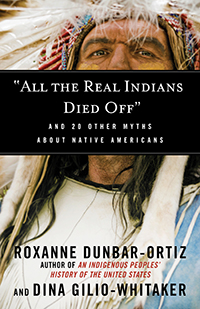
    All the Real Indians Died Off

    “All the Real Indians Died Off”: And 20 Other Myths About Native Americans
    Roxanne Dunbar-Ortiz and Dina Gilio-Whitaker

    ‘All the Real Indians Died Off’ And 20 Other Myths about Native Americans offers a much-needed and excellent introduction to American Indian history and contemporary life for a broad audience.”
    Against the Current


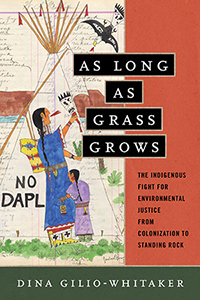
    As Long As Grass Grows

    As Long As Grass Grows: The Indigenous Fight for Environmental Justice, from Colonization to Standing Rock
    Dina Gilio-Whitaker

    As Long as Grass Grows is a hallmark book of our time. By confronting climate change from an Indigenous perspective, not only does Gilio-Whitaker look at the history of Indigenous resistance to environmental colonization, but she points to a way forward beyond Western conceptions of environmental justice—toward decolonization as the only viable solution.”
    —Nick Estes, author of Our History Is the Future


    The Broken Spears

    The Broken Spears: The Aztec Account of the Conquest of Mexico
    Edited by Miguel León-Portilla

    “A moving and powerful account, a unique reading experience which should not be missed by any reader interested in history.”
    Los Angeles Times


    How Does It Feel to Be Unwanted

    How Does It Feel to Be Unwanted?: Stories of Resistance and Resilience from Mexicans Living in the United States
    Eileen Truax

    “An urgent book for our times. When immigrant voices are being silenced, when immigrant families are being torn apart, when immigrant youth are being denied their right to dream of a better future, this book inspires us to see, to listen, and to understand.”
    —Reyna Grande, author of The Distance Between Us


    An Indigenous Peoples History of the United States

    An Indigenous Peoples’ History of the United States
    Roxanne Dunbar-Ortiz

    “This may well be the most important US history book you will read in your lifetime. . . . Dunbar-Ortiz radically reframes US history, destroying all foundation myths to reveal a brutal settler-colonial structure and ideology designed to cover its bloody tracks.  Here, rendered in honest, often poetic words, is the story of those tracks and the people who survived—bloodied but unbowed. Spoiler alert: the colonial era is still here, and so are the Indians.”
    Robin D. G. Kelley, author of Freedom Dreams


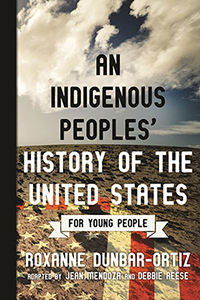
    An Indigenous Peoples History of the US for Young People

    An Indigenous Peoples’ History of the United States for Young People
    Roxanne Dunbar-Ortiz, adapted by Jean Mendoza and Debbie Reese

    “There is much to commend here: the lack of sugar-coating, the debunking of origin stories, the linking between ideology and actions, the well-placed connections between events past and present, the quotes from British colonizers and American presidents that leave no doubt as to their violent intentions . . . . The resistance continues, and this book urges all readers to consider their own roles, whether as bystanders or upstanders.”
    Booklist, Starred Review


    The Radiant Lives of Animals

    The Radiant Lives of Animals
    Linda Hogan

    “Words for healing.”
    —Joy Harjo


    The Water Defenders

    COMING SOON IN MARCH 2021! 
    The Water Defenders: How Ordinary People Saved a Country from Corporate Greed
    Robin Broad and John Cavanagh

    “When the story of the courageous Salvadoran people came to my ears, I was full of pride and hope. Indigenous peoples everywhere are fighting for their water, and enlightened governments are valuing water over foreign corporate control. Our work in the Great Lakes, home to a fifth of the world’s water, is a parallel struggle, and we are inspired by the people from the south—the Eagle and the Condor meet again. Water protectors are the heroes of all time, and this book honors those epic battles.”
    —Winona LaDuke, executive director, Honor the Earth, and author of To Be a Water Protector

    Beyond NoDAPL March on Washington DC

  • By Susan Katz Miller

    Lotus

    Photo credit: Susan Katz Miller

    With Kamala Harris as our new Vice President elect, interfaith families reach a new level of prominence in America. Harris is not only the first woman and the first Black person to be Vice President; she will also be the first interfaith kid and the first person in an interfaith marriage. Harris epitomizes Generation Interfaith: she represents a religious trifecta with a Christian parent, a Hindu parent, and a Jewish husband.

    “I grew up going to a black Baptist Church and a Hindu temple,” Harris told the Los Angeles Times, affirming that both religions were formative in her childhood. And at her wedding to her husband, attorney Douglas Emhoff, they included both a flower garland from the Hindu wedding tradition and breaking a glass from the Jewish tradition. So a self-identified Baptist with a Hindu mother and a Jewish husband is now a heartbeat away from the Presidency. We can only hope this helps to normalize the rich religious complexity many of us now embody personally and in our families.

    Harris’s mother, Shyamala Gopalan, a Tamil immigrant from India, met her father, Donald Harris, a Black immigrant from Jamaica, when they were both doctoral students at UC Berkeley. They gave both their daughters Sanskrit names to reenforce their connection to Hindu culture–Kamala means lotus and is a form of the goddess Lakshmi. Their mother took Kamala and her sister Maya back to Madras to spend time with their Hindu family. But the girls also attended church with a neighbor after their parents divorced. This was a mother who wanted her children to have bonds of affection with both family religions.

    Harris is close to her Jewish stepchildren and in-laws and does a hilarious but affectionate impression of her Jewish mother-in-law. She’s also close to her husband’s ex-wife, Kerstin, who hails from Minnesota. The stepkids call Kamala “Momala” (a Yiddishism), and Harris has written that, “We sometimes joke that our modern family is almost a little too functional.”

    It’s worth noting that another interfaith kid, Maya Rudolph, played Kamala Harris in an Emmy-nominated series of appearances in the Saturday Night Live primary campaign skits, and returned November 7 for the start of what should be four more years of playing Harris. Rudolph’s dad is an Ashkenazi Jew; her mother was Black singer Minnie Riperton. So here we have a Black interfaith kid with Jewish and Christian heritage playing a Black interfaith kid with Christian and Hindu heritage and a Jewish husband.

    With interfaith marriage at almost forty percent in the last decade in the US, and twenty-five percent of US adults now hailing from interfaith families, we should no longer be surprised when prominent people come from interfaith families. When I give lectures on Interfaith Families as Bridge-Builders, I put up a slide filled with headshots of activists and leaders with interfaith heritage. Kamala Harris was already on that slide, but this week, I added Mauree Turner, who just because the first Muslim elected to the Oklahoma state legislature. They have a Christian parent and a Muslim parent, and identify as nonbinary (using they/she pronouns). And they are the first out nonbinary person to be elected to any state legislature. Of her campaign, Turner said, “This was about drawing space—not fighting for a seat at the table, but creating a new table altogether.” For me, this kind of outside-the-boxes leadership is a hallmark of interfaith kids.

    When Joe Biden chose Kamala Harris as his running mate back in August, the New York Times described Harris with many of the phrases and images that were used for Barack Obama (another interfaith kid): “shaped by life in two worlds”; “without ever feeling entirely anchored to either”; “difficult to pin down”; and “by virtue of her identity, not like any other.” The language referred to insider/outsider political status, but also clearly echoes her complex racial and religious heritage.

    With Harris as our incoming Vice President, we are one step closer to the time when language that telegraphs discomfort with racial and religious ambiguity starts to wane. Generation Interfaith (that is to say, every post-boomer generation from now on), is starting to take up space, to tell our stories, and to rise to leadership. We need these leaders—people with rich and complex heritage and multiple religious claims and practices—to inspire us and to demonstrate the benefits, not just the challenges, of our experiences.


    About the Author 

    Journalist Susan Katz Miller is the author of Being Both: Embracing Two Religions in One Interfaith Family (2015), and The Interfaith Family Journal (2019). This piece was adapted from a piece she wrote in August for her blog, onbeingboth.com.