By Jeanne Theoharis
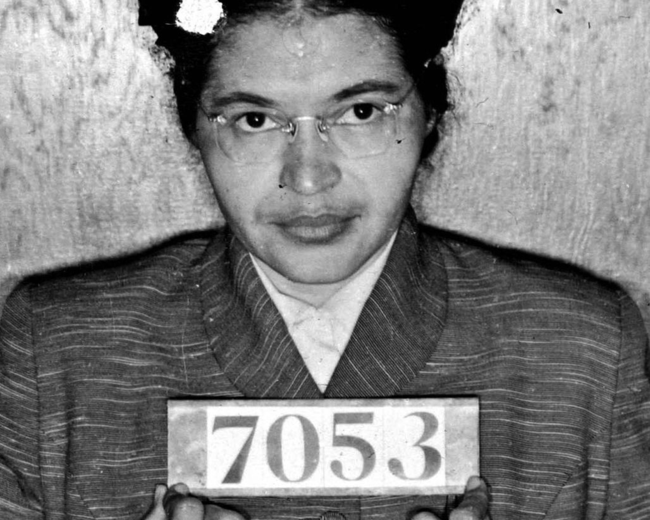
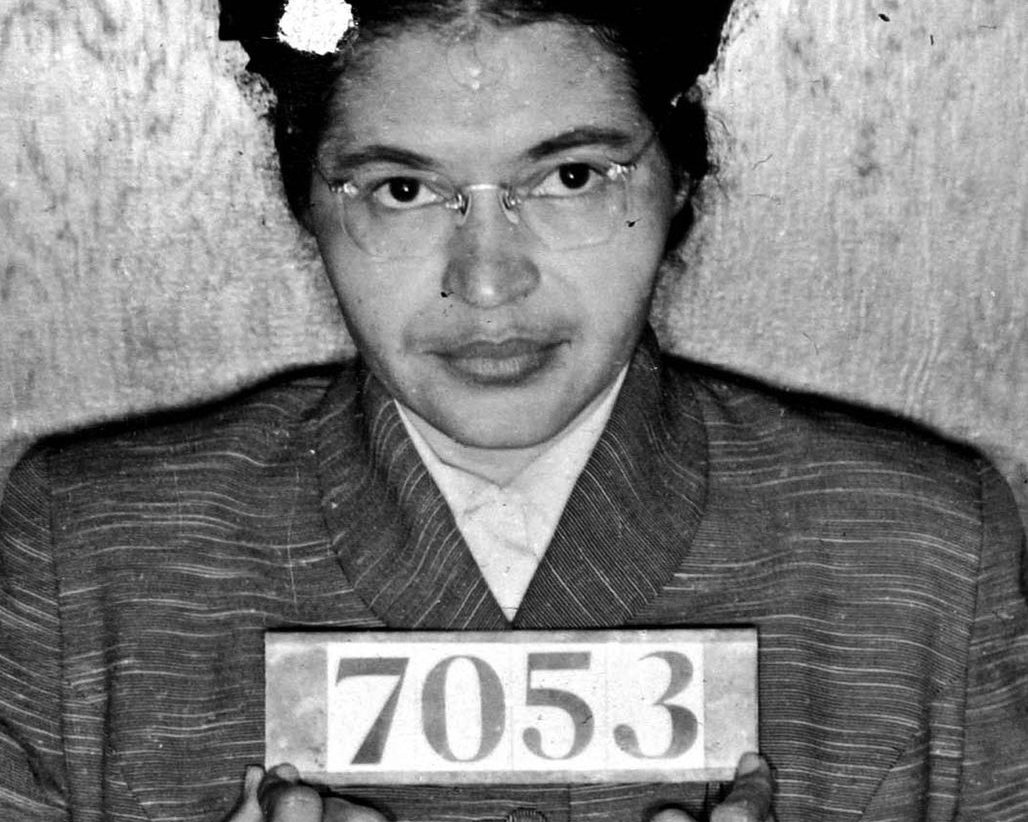
Rosa Parks was arrested on December 1, 1955, in Montgomery, Alabama, for refusing to surrender her seat on a bus to a white passenger. The incident sparked the Montgomery Bus Boycott, which, led by the young Reverend Martin Luther King, Jr., brought a renewed urgency to the civil rights struggle. In an excerpt from The Rebellious Life of Mrs. Rosa Parks, Jeanne Theoharis traces the aftermath of Parks’s arrest and the lead-up to the bus boycott, and shows exactly what was at stake for Parks as she made the decision to let her arrest be used as the rallying point for a new movement.
After being escorted into city hall, Parks laughed to herself. “Who would have thought that little Rosa McCauley—whose friends teased her for being such a goody Two-shoes in her dainty white gloves—would ever become a convicted criminal, much less a subversive worthy of police apprehension, in the eyes of the state of Alabama?” Upon getting to the jail, she requested her phone call. Thirsty, she asked for water but was refused; the water was “for whites only.” “Can you imagine how it feels to want a drink of water and be in hand’s reach of water and not be permitted to drink?” Parks wrote later. Finally, a policeman brought her some water.
They asked her if she was drunk. She was not. She recalled not being “happy at all” or particularly frightened but found the arrest “very much annoying to me” as she thought of all the NAACP work she had to do. That evening she didn’t feel like history was being made but felt profoundly irritated by her arrest, which seemed a detour from the week’s more pressing political tasks.
She repeatedly asked for a phone call. Finally, she was allowed to telephone her family. Her mother answered and upon hearing that Rosa had been arrested, worriedly inquired, “Did they beat you?” Both her mother and Raymond were horrified to learn she was in jail, but Rosa assured her mother she had not been beaten. She then asked to talk to Raymond who promised to “‘be there in a few minutes.’ He didn’t have a car, so I knew it would be longer.” Home making dinner, Raymond was angry that no one had informed him of Rosa’s arrest. According to Rosa, “There was one man who was on the bus, he lived next door to where we lived, and he could have if he’d wanted to, gotten off the bus to let my husband know that I was arrested. My husband thinks kind of hard of him for not at least telling him.”
While in jail, Parks struck up a conversation with her cellmate, who had been in jail for nearly two months. The woman had picked up a hatchet against a boyfriend who had struck her—and, with no money for bail, was unable to let her family know where she was. Parks promised to try to get in touch with the woman’s family. Then abruptly the warden came to get her, but she hadn’t taken the paper where her cellmate had written down the phone numbers. The woman threw the small paper down the stairs as Parks left, and she surreptitiously picked it up. “The first thing I did the morning after I went to jail was to call the number the woman in the cell with me had written down on that crumpled piece of paper.” Parks reached the woman’s brother. A few days later, she saw the woman on the street looking much better.
E. D. Nixon had gone down to the jail with Clifford and Virginia Durr. The Durrs had no money, and Nixon put up the $100 bail. But he wanted the white couple to go with him to ensure the police actually released Parks after taking the bail money. Around 9:30 p.m., Parks walked out of jail to greet her friends. Virginia was struck by her appearance: “It was terrible to see her coming down through the bars, because . . . she was an exceedingly fine-looking woman and very neatly dressed and such a lady in every way—so genteel and so extremely well-mannered and quiet. It was just awful to see her being led down by a matron.” With tears in her eyes, Durr embraced her and was struck by how Mrs. Parks was “calm as she could be, not cheerful, but extremely calm.” As they were leaving, Raymond appeared with a bail bondsman, so Rosa rode home with him.
Nixon, the Durrs, and the Parkses convened in the Parkses’ Cleveland Courts apartment to talk over the next step. They drank coffee and discussed matters until about eleven that night. Clifford Durr thought he could get the charges dismissed if she wanted him to, because there had not been an open seat for Parks to move to. But Nixon saw this as the bigger opportunity they had been waiting for to launch an attack on bus segregation. “Mr. Durr’s right,” Nixon explained, “it’ll be a long and hard struggle. It’ll cost a lot of money. But we’ll get the NAACP behind it, I promise you that. It won’t cost you and Mr. Parks anything but time and misery. But I think it will be worth all the time and misery.” Nixon talked and talked, answering questions and explaining what he saw as the possibilities. Parks knew she never would ride the segregated bus again but had to consider making a public case and step into the line of attack.
Raymond did not initially agree. He “was pretty angry,” Rosa recalled. “He thought it would be as difficult to get people to support me as a test case as it had been to develop a test case out of Claudette Colvin’s experience.” They discussed and debated the question for a while. After an hour or two, the Durrs left, but Nixon stayed for a while longer. “In the end, Parks, and my mother supported the idea. They were against segregation and were willing to fight it.” With decades of political experience, Raymond Parks understood the physical and economic dangers this stand entailed and the difficulties he, his wife, and other activists had faced in building a unified mass movement. The community had not stood together for long in previous cases, particularly in Colvin’s, so Raymond worried. The economic and physical violence unleashed on protesting blacks, along with class divisions within the black community, had made a mass movement near impossible in the past. There would certainly be a price to pay for that resistance, and Raymond worried for the safety, physical and emotional, of his wife.
Virginia later highlighted Raymond’s reluctance, casting it differently than Rosa did. “He kept saying over and over again, ‘Rosa, the white folks will kill you. Rosa, the white folks will kill you.’ It was like a background chorus, to hear the poor man, who was white as he could be himself, for a black man, saying ‘Rosa, the white folks will kill you.’ I don’t remember her being reluctant.” Historians have latched on to Virginia’s version of Raymond’s reluctance. But there is a certain racialized and gendered cast to Virginia’s explanation— something emasculating in her description of Raymond’s fear and the ways she explicitly marked his light skin. It is unlikely that the Durrs had ever visited the Parks apartment socially before, and they did not know Raymond. So the unusualness of the circumstances likely affected how Virginia experienced and remembered the evening. E. D. Nixon provided no such description of Raymond.
Rosa contextualized Raymond’s response: “He was concerned about the way I was treated like any husband would be.” Fifty-two years old on that December evening, Raymond had a long history of activism. He had known people, as had Rosa, who were killed for their stands against racial injustice— and was even more soul weary than Rosa. He had experienced the ways people grew uncertain and movements crumbled under the immense pressure of white backlash. Virginia did not acknowledge the ways Raymond’s own activist experience came to bear that evening, let alone the responsibility he likely felt in trying to protect Rosa from the hardship that pursuing the case publicly would entail. For Rosa, faced with the possibility of retaliation against the entire family, it needed to be a communal decision. Talking to a coworker the next day, Raymond continued to worry that he and Rosa would be killed because of her arrest.
Later that weekend, Rosa asked Virginia to speak at an NAACP meeting. She agreed to do so but “trembled at the thought of it being in the papers the next morning.” Even as a middle-class white woman, Durr feared public exposure of her beliefs. In interviews long after the boycott, Durr talked about how terrifying this period was. In 1954, she and Clifford had been red-baited for their civil rights beliefs and their connections to the Southern Conference Educational Fund (SCEF), and she had been called before Senator James Eastland’s Internal Security subcommittee and “expos[ed] . . . as a n____r-loving Communist.” She refused to answer questions—making national headlines as she stood silent before Eastland, occasionally powdering her nose. Despite their important contributions behind the scenes, the Durrs, in fact, often avoided situations where they would be publicly identified for their civil rights work. When Alabama State professor Lawrence Reddick decided to write a book on the boycott in 1956 and wanted to include description of the Durrs’ role, Virginia Durr said no. She explained her decision to a friend, “[Letting ourselves] be written up as having played a part, however it may seem to History, simply means that our tenuous hold here is lost for good. . . . I hated to have to tell him that History cannot feed your children or pay their school bills.” And yet, Virginia was unable to extrapolate her own fears about economic and physical retaliation to Raymond and rendered his fears for Rosa and his family’s safety unmanly.
Nixon knew Rosa Parks “wasn’t afraid” and that once she committed to things, she did not waver: “If Mrs. Parks says yes, hell could freeze but she wouldn’t change.” After talking with her mother and Raymond, who both came around to her taking this stand, Parks agreed. Later that evening, she called Fred Gray and asked him to provide her legal representation. Gray recalled that from that moment, “my days of having little to do in my fledgling law practice were over.”
BOYCOTT: A COMMUNITY RESPONDS
“God provided me with the strength I needed at the precise time when conditions were ripe for change,” Parks observed. This was not some lucky happenstance. Rosa Parks and her colleagues had labored for years to seed the ground for a movement to grow in Montgomery, and those efforts had made the conditions ripe for a movement. In Stride Toward Freedom, Dr. King observed that Parks had “been tracked down by the Zeitgeist.”
She wasn’t “planted” there by the NAACP, or any other organization; she was planted there by her personal sense of dignity and self-respect. She was anchored to that seat by the accumulated indignities of days gone and the boundless aspirations of generations yet unborn.
Parks’s arrest proved the last straw for many in Montgomery—the “rightness” of the moment created by the people of Montgomery in the years previous to Parks’s bus stand and over the next 382 days of the boycott.
As Parks herself would note, “Many people cannot relate to the feelings of frustration that we, as black people, felt in the 1950s. . . . But because we went along with it then did not mean that we would let it go on forever. . . . It was a long time coming, but finally, as a group, we demanded, ‘Let my people go.’” Her arrest would provide the impetus. Because she “had been active in the NAACP ever since she was grown,” Horton explained, Parks was “a perfect case . . . somebody whom everybody had confidence in, in Montgomery. Some person who people respected to provide the basis on which you could build a movement.”
According to WPC founder Mary Fair Burks, Rosa Parks “possessed sterling qualities” that those in the civil rights establishment “were forced to admire in spite of their usual indifference.” Initially Burks was surprised to hear that Parks had been arrested. Having attended Miss White’s school with Rosa, she remembered her as a “quiet, self-composed girl . . . [who] avoided confrontations and suspension.” Yet those same qualities had also enabled Parks to make this stand. After “reflect[ing] on what I knew about her,” Burks noted, “I decided it had not been out of character after all. No, Rosa as a rule did not defy authority, but once she had determined on a course of action, she would not retreat. She might ignore you, go around you, but never retreat.”
About the Author
Jeanne Theoharis is professor of political science at Brooklyn College of the City University of New York and the author of the award-winning book The Rebellious Life of Mrs. Rosa Parks, from which this piece is excerpted. She received an AB in Afro-American studies from Harvard College and a PhD in American culture from the University of Michigan. She is the author or coauthor of four books and articles on the black freedom struggle and the contemporary politics of race in the United States.