• By Fran Hawthorne

    It’s sadly undeniable that schools in low-income neighborhoods tend to have lower test scores, skimpier budgets, worse-prepared students, more drugs, and less-enthusiastic teachers than schools in wealthier zip codes. These neighborhoods also often have more crime, fewer farmers’ markets, more rundown housing, more single-parent households, and higher unemployment.

    So, according to Judge Rolf M. Treu of Los Angeles, the solution is to get rid of teacher tenure protection.

    Huh?

    (more…)

  • By Daniel Barks

    Rainbow flag photograph via Wikimedia Commons

    Growing up queer and a heavy reader, I can’t help but envy today’s teens the ever-growing number of books written for their demographic that feature central LGBT characters and themes. When I delve into these titles, I devour them. I read them gluttonously, vicariously re-imagining the trajectory of my own coming-of-age had these characters and their voices been available to me at the time. Because of this, I can—unlike some—fault no one for avidly reading young adult literature on into adulthood. It’s uplifting to see that not only does “it get better” as you grow up, but the very process of growing up seems to be getting better, too. Young readers have more role models and better access than ever to proof that they are not alone, and that’s a wonderful thing.

    So for June, for Pride Month, I’ve put together a short list of reading recommendations for LGBT youth, or those seeking some literary insight into their experience.

    (more…)

  • By James W. Russell

    TIAA-CREF CEO Roger W. Ferguson, Jr. speaks at the Standard & Poor's 29th Annual Insurance Conference in New York, U.S., on Wednesday, June 5, 2013. 

    TIAA-CREF, the retirement plan of many university professors and administrators as well as others, has escaped much of the increasing criticism of 401(k)-type plans. A number of academics with TIAA-CREF are even unaware that it is a 401(k)-type plan, thinking that the growing criticisms of 401(k)s don’t apply to their situation.

    TIAA-CREF has enjoyed relative immunity from criticism for two reasons. It is a nonprofit company that is presumed to operate exclusively in the best interests of its participants because it does not have shareholders. And precisely because it is the plan of so many highly-educated professors, it is presumed to be good because surely they must know what they are doing.

    Yet TIAA-CREF participants fare no better in retirement income than 401(k)-type plan participants with other financial services industry companies such as ING, Vanguard, and Valic. That in turn means that they fare much worse than employees with traditional defined benefit pension plans.

    (more…)

  • By Rob Arnold

    As Father’s Day approaches, I’ve been thinking of books I’d recommend to my own father. I have fond memories from childhood of sitting with my father while he watched “his shows,” the science and nature and history programming on public televison channels that my other siblings would spurn as too educational to be entertaining. My father, a former Navyman who’d traveled the world in his youth, loved pointing out places he had been to, and I loved discovering a sense of the world through his eyes. Later, after we moved to the Olympic Peninsula in Washington state, we would go on hikes together and stand at the summits, taking in the vastness. Or we would go fishing together, which seemed mainly an excuse to sit in inflatable rafts and read, or listen as nature filled in the quietness between us. I don’t know if I inherited my curiosity of the world from him, or if I was drawn to that part of him that intersected with my own sensibilities. In a way, it doesn't matter. It’s the commonality one cherishes.

    Here are five titles that, like my father, share a deep interest in the world, or that tell the story of fatherhood itself, with all its memories and complexities and sometime revelations. If your father is anything like mine, I’m sure he would take any of these books, find a quiet place to sit, and then read every word.

    (more…)

  • By Fran Hawthorne

    Of all the problems the world confronts today, climate change undoubtedly affects more people, with more potentially dire consequences, than any other single issue.

    Yet most people, looking at the EPA regulation that President Obama just proposed for cutting carbon emissions in order to combat climate change, are probably saying: “I don’t own a coal plant. This has nothing to do with me.”

    In fact, the proposal has plenty to do with all of us. And there’s a whole list of things we can do to help make the carbon-cutting goals a reality.

    (Of course, if you do happen to own a coal plant, or if you are a member of Congress or a state legislature, or an aide to a politician—well, there’s even more that you can do.)

    (more…)

  • By Robin Beaudoin

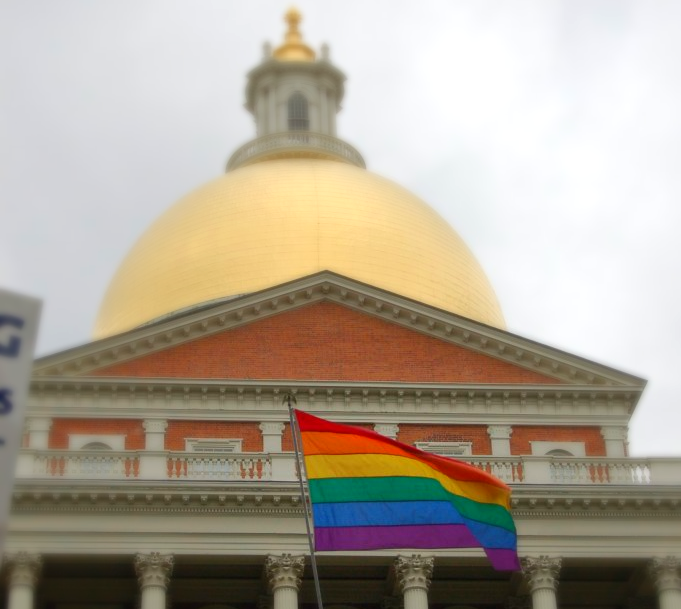
    A rainbow flag flying in front of the Massachusetts State House on June 14, 2007, the day that the state legislature voted to end the constitutional convention and allow same-sex marriage to remain law. (by user Twp via Wikimedia Commons)

    We in Massachusetts have had an illustrious history of progressiveness, justice, and pride. It was the first individual state to write a constitution declaring universal rights; Horace Mann led education reform here; we have the Kennedys and the Red Sox and Emily Dickinson. And we were the first state, ten years ago last month, to legalize same-sex marriage.

    This is the real reason I am proud to be from Massachusetts. Same-sex marriage is now legal in sixteen countries and nineteen US states, including all of New England. National support for marriage equality is at 59%, an all-time high. And we helped elect a president who vocally endorses same-sex marriage. It might be bold to say, but from the looks of it, our progressiveness and acceptance are making international rounds.

    (more…)

  • By Louise Steinman

    Maciej Ziembinski and the author (photo by Tomasz Cebulski)

    Maciej Ziembinski and the author (photo by Tomasz Cebulski)

    My dear friend Maciej Ziembinski, a pioneering journalist and editor (and a central figure in my book The Crooked Mirror), recently passed away in Radomsko, in central Poland. Maciej was fiercely devoted to this little town, where my mother’s family lived for generations. When poet Adam Zagajewski wrote of those Poles imbued with “the ecstasy of the provinces,” he must have had Maciej in mind.

    Before World War II, Jews made up approximately 40% of Radomsko’s population. Very few survived the war and most who did survive left the country. Under Communist rule, there was but one sanctioned narrative of the recent past—the patriotic war against the German Fascists. Discussion of the town’s vanished Jews, of local rescuers or those who betrayed—was taboo. Maciej’s father, who’d rescued a Jewish woman to whom he’d been secretly engaged, raised his son to have an open mind. Even as a young man, Maciej was determined that the history of Radomsko’s Jewish population must be told, too. He understood it was an essential part of the town’s story. 

    He carried on, he told me, “his own private war with town hall.” When Poland transitioned to democratic rule, he established Radomko’s first alternative weekly. Until then, newspapers were the mouthpiece of the state. He named his paper, most appropriately, Komu i Czemu (“For whom and what for?”). As its editor, he wrote and published over sixty articles about Radomsko’s Jewish history. He oversaw the translation of the Radomsko Yizkor, the Jewish memorial book, from Yiddish to Polish and published it in his paper. He was a principled man. A scrapper, a gadfly.

    (more…)
  • 'Love & Fury' by Richard Hoffman

    Richard Hoffman’s elegaic new memoir, Love & Fury, is a powerful investigation into the impacts of race and class, boyhood and fatherhood, family pressures and pain, and how the mistakes of the past can haunt the present. Hoffman writes beautifully of his upbringing in a working-class Pennsylvania town where abuse, racism, sexism, and other toxic values seemed his inheritance. Hoffman was, in his own words, “a boy made of coal and steel and violence and trucks and shame,” filled with a yearning to escape but also a longing to connect with and understand his enigmatic, difficult father. A father who, Hoffman would come to understand later, carried a different kind of class shame, as he reveals in this passage:

    I had tripped a switch and plunged my father from the safety of his lyric, humorous, emblematic scene into deep shame and remembered desperation, the very emotions that his ritual telling, with its shrug and goofball smile, its cavalier “fuck ’em” attitude, was meant to exorcise. I was of course the one who didn’t get it, sitting there on my elbow with a shine-ola-eating grin on my face. I was not the one who had stood against a wall at six in the morning for the shape-up, hoping to get picked to work like a donkey for the next twelve hours. I was not the one who’d had to go down to the PP&L office with money made from cleaning out somebody’s suburban garage just to get the lights turned back on. I was not the one who felt humiliated the year our Christmas presents came from the Salvation Army, complete with tags that said, Boy, 6–8 years old. My father had taken all those years and all that shame and locked them in a little box of a story, and just when he was clicking it shut again, as he had so many times before, I propped the lid open a moment longer with my fatuous cleverness, and a monstrous cloud, a genie of shame, escaped.

    (more…)

  • By Carole Joffe

    What is there to say, five years after the tragic murder of Dr. George Tiller, about the legacy of this remarkable man? The polarization—around Tiller specifically, and abortion in general—that occurred in Kansas during his lifetime has in no way abated. The abortion situation in Kansas in the post-Tiller era can be best understood as a series of both skirmishes and high-profile battles between the two sides of the endless abortion war.

    (more…)

  • By Fran Hawthorne

    Why are prescription drug prices so high in the U.S.? Pfizer’s attempt to acquire the giant British drug company AstraZeneca—which finally collapsed in late May—pinpoints several reasons in a nutshell. (Or should I say, in a once-a-day pill?)

    Not by coincidence, this would-be merger also reveals some of the ways pharmaceutical companies bend their ethics.

    Pfizer, which was already the largest drug maker on the planet, had hoped to puff itself up even more by buying AstraZeneca, which ranks Number 2 in the U.K. Even when the bid reached $119 billion, AZ’s board had the gumption to refuse, and Pfizer gave in.

    Such an attempt is hardly new for either Pfizer or the pharma industry: Over the past 15 years, a lot of premier names in the business have disappeared, several of them swallowed by Pfizer.

    (Try to find a phone number for Wyeth, Pharmacia, Warner-Lambert, Schering-Plough, Genzyme, Hoechst, Ciba-Geigy, Burroughs Welcome, Sandoz, or Searle.)

    (more…)