For
the Indigenous Nations of the Western Hemisphere "Columbus Day" is a
day of mourning. The year 1492 is an abomination. But, October 12 arrives every
year to torture the open sore of genocide, not as a reflective day of mourning
and solidarity with Indigenous Peoples, as it should be. It is celebrated with gusto throughout the
Americas, but no place as enthusiastically as the United States, where it is
one of the ten official federal holidays when all federal offices and banks are
closed. Columbus Day parades and fireworks are the main fare in towns and
cities throughout the country. Counterintuitively, in the liberal city of San
Francisco where I live it is the occasion of the gathering of U.S. warships and
two days of low aerial strafing by war planes (the Blue Angels), a whole week
of mass participation in martial events and patriotic gore called Fleet Week. The
only good thing about the Sequester is that Fleet Week has been canceled this
year.
-
We talked with Michael Bronski, Anne Pellegrini, and Michael Amico before a recent event at Brookline Booksmith about whether it’s easier to come out today than it used to be. This and 20 other myths are unpacked in their new book “You Can Tell Just by Looking”.
-
By Philip Warburg. This post originally appeared on his blog.
In the October 5th edition of the New York Times,
columnist Joe Nocera—a self-avowed fracking enthusiast—seeks to
allay environmental concerns about the greenhouse gas emissions from
natural gas fracking operations. He cites a study released last month
by a group of scientists at the University of Texas that found on-site
methane leakage at fracking wells to be lower than previous studies had
assumed. According to this study, only 0.42% of the gas produced by
fracking ends up in the air as "upstream" methane emissions—i.e. gas
releases at and around the wellhead. -
By Michael Lanza. This post originally appeared on The Big Outside.
I’ve woken up every morning this week thinking about where my family would be in Utah’s Zion National Park at that moment, instead of where we were: at home. I had secured a hard-to-get permit to backpack The Narrows, the 16-mile-long, 2,000-foot-deep, red-rock gorge whose walls close in to just thirty feet apart. We also planned to hike other trails in Zion Canyon and descend a slot canyon that involves eight rappels of up to 120 feet.
Then, on the very eve of our trip, the government of the most powerful nation in the world went off the tracks.
-
About 10 percent of people are gay or
lesbian. Homosexuals are born that way. All religions condemn homosexuality. There’s no such thing as a gay or trans child. All bisexual men are actually gay; all bisexual women are
actually straight. Coming out today is easier than ever
before. Hate crime laws prevent
violence against LGBT people. We’ve all heard (and repeated) statements like these
before. But, are any of them actually true? According to Michael Bronski, Ann Pellegrini, and Michael Amico, these are common myths and misconceptions about lesbian, gay,
bisexual, and transgender life and people. And in their new book, "You Can Tell Just by
Looking”: And 20 Other Myths about LGBT Life and People they take us through some of the most enduring myths, providing historical background and examining the
social and political factors that gave rise to and inform each myth. The myths covered here aren't just those that have been used to justify discrimination against and
oppression of LGBT people, but the authors also examine those that have been embraced by the LGBT community and their allies. We hope the book will challenge readers to question their own beliefs and dispel some of the false assumptions many of
us (even some of us at Beacon) have been carrying around for years.Read on to see what the authors have to say about ten of the myths covered in "You Can Tell Just by Looking."
-
Here's a roundup of what we've been reading and listening to online this week:
—On Salon, Edward McClellan says we're slipping back into a two-class society made up of aristocrats and peasants and argues that we can't sustain a middle class without government regulation.
—In this past Sunday's New York Times, Kathryn Joyce looks at the business of transnational adoptions particularly in Evangelical communities.
—Danielle Ofri has an MD and a PhD, but despite her many years of medical training, even her faith in science evaporated and and she feared everything would not be ok when her son had to have minor surgery.
—Get ready for the return of Wonder Bread to grocery store shelves.
-
Every year in September, people across the country celebrate Banned Books Week to raise awareness about the problem of censorship. In 2012 alone, there were 464 challenges to books reported to the American Library Association's Office of for Intellectual Freedom. Common complaints include content being unsuitable for an age group, the use of offensive language, sexually explicit material, violence, homosexuality, and religious viewpoints. At Beacon, we support the freedom to read, so we asked staff to recommend some of their favorite banned and challenged books. Read on to find out how they were influenced by these books. Happy Banned Books Week!

-
Here's some recommended reading around the web from this past week:
—Richard Blanco delivered the manuscript for his memoir, For All of Us, One Today, last month. We're fast-tracking it, so it comes out in November.
—In other Richard Blanco news, his Inaugural poem "One Today" is being turned into a children's book with Dav Pilkey as the illustrator.
—Details named Chris Stedman one of five "next-gen gurus who are distrupting religion's status quo."
—Last week's devastating molasses spill in
Hawai'i killed thousands of fish, but there is some "good" news. Grieg
Steward, associate professor of oceanography at the University of
Hawai'i at Manoa says, "a molasses spill can be cleaned up faster by
natural processes, not only because molasses dissolves in water, but
because so many bacteria can digest sugars. Only specialized types of
bacteria can break down oil." -
By Tom Hallock
 Last
Last
week, in the midst of sorting out some business matters, I emailed one of the
sisters in Thich Nhat Hanh’s community, Plum Village, and asked if we could
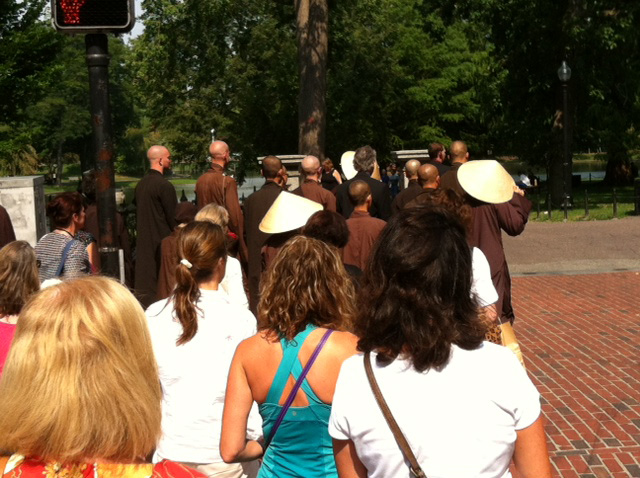
have a quick call. She emailed back that the sangha (community of practice) had just landed in Boston
and suggested I join them the following day. So, I found myself at the Park
Plaza Hotel in downtown Boston with over a thousand people who had come to hear
Thich Nhat Hanh (called Thây by his students) talk about “Healing the Heart with Mindfulness.” Afterwards, he led us on a silent walking meditation
out of the hotel, down Hadassah Street, across Boylston Street, and into the Public
Garden. We sat under trees near the swan boats on an exquisitely clear
day and meditated. I was struck by how Thây kept his eyes open, and seemed to
be drinking in the beauty of the trees and their gentle movement in the wind.
It was powerful to sit peacefully in this familiar place and find serenity in
the heart of the city. One of Thây’s great teachings is that the present moment
is the only one we have.At
the event, the Harvard School of Medicine honored Thây for his great
contributions to public health. One of the graphs in the program book showed that
the number of publications that mentioned mindfulness grew from a handful in
the early 1980s to almost 500 last year. Clearly a new idea has found its way deep into
our culture.
 In
In
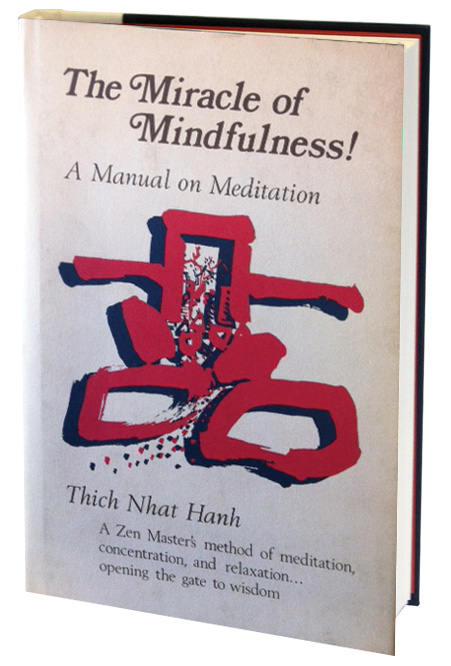
1976 Beacon Press published the book in which these ideas were first fully
articulated, The Miracle of Mindfulness: A
Manual on Meditation*. As part of its mission “to
affirm and promote world community with peace, liberty, and
justice for all,” Beacon was publishing other
books on Buddhism at the time including Philip Kapleau’s Three Pillars of Zen, as
well as books that grew out of the anti-war movement on which Thây
had such impact. These included Howard Zinn’s Vietnam: The Logic of Withdrawal and,
of course, The Pentagon Papers. In this spirit, Beacon also published Dr. Martin
Luther King, Jr.s’ Where Do We Go from Here: Chaos or Community?
-
By David Chura. This post originally appeared on Esteem.
He was a big man, a presence to be reckoned with on any football
team. Dressed in a pressed shirt and colorful tie, he spread his arms
out and gestured around the room. “I’m a new teacher here. How do I do
this?” he asked.I knew what “this” was—a room with only a few windows, thick-paned
and laced with heavy gauge wire, designed to keep what’s in, in; a
locked industrial metal door; the squawk of walkie-talkies in the
hallways. It was a classroom much like the one in the county jail where I
taught high school students for ten years. But this classroom was in
the Judge Connelly Center Education Program in the Greater Boston area, a
residential adolescent treatment program for adjudicated young
offenders, kids who had been in and out of the child welfare and justice
systems, some for much of their young lives. I was there to talk with
teachers and support staff about my own experiences working in
incarcerated education.I could have answered by talking about curriculum and the importance
of choosing materials that were culturally relevant. As an English
teacher, I was always looking for readings with characters and situations
that the young guys I taught could identify with. I could have
explained how I pushed them to go beyond cultural relevance and to begin
to develop the critical skills they needed to tackle state mandated
tests.