• This post originally appeared at Huffington Post.
    Rosa parks

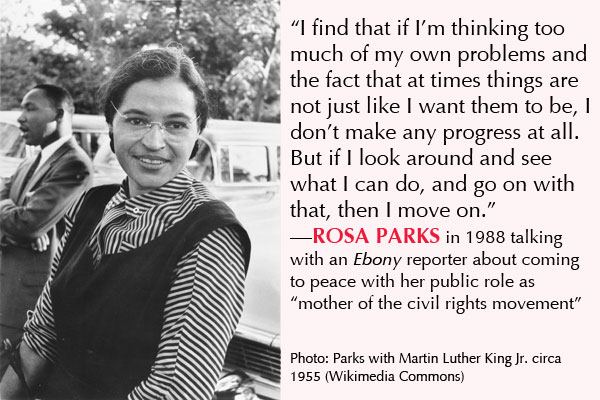
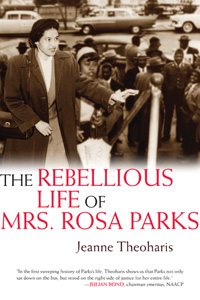
    Today would have been the 100th birthday of Rosa Parks. To honor the day, we share these Ten Things You Didn't Know About Rosa Parks, compiled by Jeanne Theoharis, author of The Rebellious Life of Mrs. Rosa Parks.
    5047

    1. Parks had been thrown off the bus a decade earlier by the same bus driver – for refusing to pay in the front and go around to the back to board. She had avoided that driver's bus for twelve years because she knew well the risks of angering drivers, all of whom were white and carried guns. Her own mother had been threatened with physical violence by a bus driver, in front of Parks who was a child at the time. Parks' neighbor had been killed for his bus stand, and teenage protester Claudette Colvin, among others, had recently been badly manhandled by the police.

    2. Parks was a lifelong believer in self-defense. Malcolm X was her personal hero. Her family kept a gun in the house, including during the boycott, because of the daily terror of white violence. As a child, when pushed by a white boy, she pushed back. His mother threatened to kill her, but Parks stood her ground. Another time, she held a brick up to a white bully, daring him to follow through on his threat to hit her. He went away. When the Klu Klux Klan went on rampages through her childhood town, Pine Level, Ala., her grandfather would sit on the porch all night with his rifle. Rosa stayed awake some nights, keeping vigil with him.

    3. Her husband was her political partner. Parks said Raymond was "the first real activist I ever met." Initially she wasn't romantically interested because Raymond was more light-skinned than she preferred, but she became impressed with his boldness and "that he refused to be intimidated by white people." When they met he was working to free the nine Scottsboro boys and she joined these efforts after they were married. At Raymond's urging, Parks, who had to drop out in the eleventh grade to care for her sick grandmother, returned to high school and got her diploma. Raymond's input was crucial to Parks' political development and their partnership sustained her political work over many decades.

    4. Many of Parks' ancestors were Indians. She noted this to a friend who was surprised when in private Parks removed her hairpins and revealed thick braids of wavy hair that fell below her waist. Her husband, she said, liked her hair long and she kept it that way for many years after his death, although she never wore it down in public. Aware of the racial politics of hair and appearance, she tucked it away in a series of braids and buns — maintaining a clear division between her public presentation and private person.

    5. Parks' arrest had grave consequences for her family's health and economic well-being.After her arrest, Parks was continually threatened, such that her mother talked for hours on the phone to keep the line busy from constant death threats. Parks and her husband lost their jobs after her stand and didn't find full employment for nearly ten years. Even as she made fundraising appearances across the country, Parks and her family were at times nearly destitute. She developed painful stomach ulcers and a heart condition, and suffered from chronic insomnia. Raymond, unnerved by the relentless harassment and death threats, began drinking heavily and suffered two nervous breakdowns. The black press, culminating in JET magazine's July 1960 story on "the bus boycott's forgotten woman," exposed the depth of Parks' financial need, leading civil rights groups to finally provide some assistance.

    6. Parks spent more than half of her life in the North. The Parks family had to leave Montgomery eight months after the boycott ended. She lived for most of that time in Detroit in the heart of the ghetto, just a mile from the epicenter of the 1967 Detroit riot. There, she spent nearly five decades organizing and protesting racial inequality in "the promised land that wasn't."

    7. In 1965 Parks got her first paid political position, after over two decades of political work. After volunteering for Congressman John Conyers's long shot political campaign,

    Parks helped secure his primary victory by convincing Martin Luther King, Jr. to come to Detroit on Conyers's behalf. He later hired her to work with constituents as an administrative assistant in his Detroit office. For the first time since her bus stand, Parks finally had a salary, access to health insurance, and a pension — and the restoration of dignity that a formal paid position allowed.

    8. Parks was far more radical than has been understood. She worked alongside the Black Power movement, particularly around issues such as reparations, black history, anti-police brutality, freedom for black political prisoners, independent black political power, and economic justice. She attended the Black Political Convention in Gary and the Black Power conference in Philadelphia. She journeyed to Lowndes County, Alabama to support the movement there, spoke at the Poor People's Campaign, helped organize support committees on behalf of black political prisoners such as the Wilmington 10 and Imari Obadele of the Republic of New Africa, and paid a visit of support to the Black Panther school in Oakland, CA.

    9. Parks was an internationalist. She was an early opponent of the Vietnam War in the early 1960s, a member of The Women's International League for Peace and Freedom, and a supporter of the Winter Soldier hearings in Detroit and the Jeannette Rankin Brigade protest in D.C. In the 1980s, she protested apartheid and U.S. complicity, joining a picket outside the South African embassy and opposed U.S. policy in Central America. Eight days after 9/11, she joined other activists in a letter calling on the United States to work with the international community and no retaliation or war.

    10. Parks was a lifelong activist and a hero to many, including Nelson Mandela. After his release from prison, he told her, "You sustained me while I was in prison all those years."
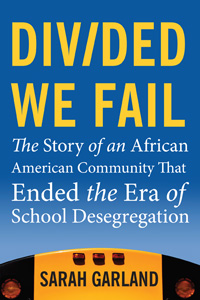

  • 0177Examines why school desegregation, despite its success in closing the achievement gap, was never embraced wholeheartedly in the black community as a remedy for racial inequality

    In 2007, a court case originally filed in Louisville, Kentucky, was argued before the Supreme Court and officially ended the era of school desegregation, changing how schools across America handle race and undermining the most important civil rights cases of the last century. This was not the first federal lawsuit that challenged school desegregation, but it was the first-and only-brought by African Americans.

    In this unique in-depth examination of the Louisville case, journalist Sarah Garland returns to her hometown to understand why black families in the most racially integrated school system in America led the charge against desegregation. Weaving together the voices of parents, students, and teachers who fought for and against desegregation, Garland's eye-opening narrative upends assumptions about the history of busing and its aftermath.

    Desegregation corresponded with unprecedented gains in black achievement and economic progress, but in Louisville, those gains often came at a cost: traditionally black schools that had been bastions of community identity and pride faced closure; hundreds of black teachers lost their jobs; parents were helpless as their children's futures were dictated by racial quotas. In illuminating the often overlooked human stories behind this fraught legal struggle, Garland reveals the difficult compromises forced on the black community in the wake of the landmark Brown v. Board of Education decision. 

    Divided We Fail is a nuanced and gripping account of one community's struggle that has important lessons for the next generation of education reformers. By taking a close look at where desegregation went wrong, Garland uncovers problems with a new set of education ideas, including school choice, charter schools, and test-based accountability systems. But she also reminds us not to forget desegregation's many successes as we look for ways to close the achievement gap for minority students. 

    About the author

    Garlandheadshot1Sarah Garland is a staff writer at the Hechinger Report. She has written for the New York Times, Washington Post, Philadelphia Inquirer, Chicago Tribune, American Prospect, New York Sun, Newsweek, Washington Monthly, Newsday, New York, and Marie Claire, among other publications. She was a 2009 recipient of the Spencer Fellowship in Education Reporting at Columbia University Graduate School of Journalism. Originally from Louisville, Kentucky, Garland now lives in Brooklyn, New York. Follow her on Twitter at @s_garl.

    Media

    Watch Sarah Garland on The Melissa Harris-Perry Show (MSNBC) as part of a panel on recent school closings.

    Listen to Garland on Louisville, Kentucky's NPR station, WFPL.

    Reviews

    Kirkus: “A useful journalistic examination of a troubling societal phenomenon.”

    Publishers Weekly: “…a nuanced and thoroughly researched look at the complicated history of school desegregation in the United States…Garland is unafraid to grapple with hard truths and intimate portraits of the families behind the statistics.”

    Booklist: “a compelling look at the complexities of race and class in the continued struggle for racial parity and high-quality education.”

    Seattle Times: 

    Journalist Sarah Garland grew up in Louisville. Day after day, she left her mostly Caucasian suburban neighborhood on a school bus taking her to a mostly African-American neighborhood, where she became a student in a racial minority. Her experience long ago played a role in her decision to write “Divided We Fail,” which covers the case that found its way to the U.S. Supreme Court. So did the experience of Garland’s grandmother, an Oklahoma teacher who volunteered to join the initial group of Caucasian educators transferred to an all African-American school, where she remained until retirement. Garland relates how her own mother became a social worker splitting time between a mostly African-American school and a mostly Caucasian school in Louisville. Garland’s mother “witnessed firsthand the upheaval and violence that busing wrought in its early years.”

    Read an excerpt from Divided We Fail: The Story of an African American Community that Ended the Era of School Desegregation

    Related articles

    Books: What Reformers Can Learn From Integrationists
    Roe v. Wade at 40: Carole Joffe looks back on "A New Day for Abortion Providers"
    'Divided We Fail': The limits of desegregation
    Book Excerpt: Today's Reforms Could Suffer Integration's Fate
    Desegregation of the South, and Mildred Taylor
  • By Howard Bryant 

    JrobinsonJackie Robinson was already fatalistic about the tryout. He didn’t believe the Red Sox were serious about integration and wasn’t especially thrilled about his own situation. He had only played for the Negro League’s Kansas City Monarchs for a few weeks and was already disappointed by the league’s air of gambling and disorganization, the very type of lowbrow behavior that made white baseball people hesitant about allowing blacks into the big leagues. Robinson was fastidious in his adherence to his own personal code, and seeing the chaos of the Negro leagues only frustrated him further. It was the stereotypes of corruption and anarchy that not only plagued black baseball, thought historian Edmund G. White, but also gave whites a secure excuse to keep blacks out of the major leagues:

    When the Negro Leagues had come within the consciousness of those within organized baseball, they had been seen as a reverse mirror image. If Organized baseball was free from gambling and corruption, the Negro Leagues were run by racketeers. If Organized baseball was premised on the roster stability of the reserve clause, the Negro Leagues were the province of contract jumpers. If Organized baseball was structured around the permanent franchise cities and regular schedules, the Negro Leagues were a kaleidoscope of changing franchises and whimsical scheduling. If Organized baseball was a clean, wholesome, upwardly mobile sport, Negro League games were the scenes of rowdy, disorderly, vulgar behavior. By being the opposite of Organized baseball’s idealized image, the Negro Leagues served as their own justification for the exclusion of blacks from the major leagues. They appeared to demonstrate just how “contaminated” major league baseball would become if blacks were allowed to play it.

    When Robinson arrived in Boston, the tryout was delayed for two more days in the wake of Franklin Roosevelt’s death. He told Smith of his disappointment during the days of delay. “Listen, Smith, it really burns me up to come fifteen hundred miles for them to give me the runaround.”

    Nearly fifty-five years after Cap Anson engineered the removal of the last black major leaguers in the late nineteenth century, the tryout finally took place at Fenway Park at eleven on the morning of April 16, 1945. Two above-average Negro leaguers, Sam Jethroe and Marvin Williams, joined Jackie Robinson. The Red Sox players were white and were mostly minor league pitchers. Starting the season the following day in New York, the big league roster was given the day off by Joe Cronin. The routine was mundane. The players fielded, threw, and took batting practice. Hugh Duffy, the former great Red Sox out- fielder, ran the tryout and took notes on index cards. Cronin sat, according to one account, “stone-faced.” Another depicted Cronin barely watching at all. Muchnick marveled at the hitting ability of Robinson, whose mood apparently darkened. When it ended, he, Williams, and Jethroe received platitudes from Duffy. Joe Cashman of the Boston Record sat with Cronin that day and reported that the manager was impressed with Robinson. He wrote cryptically, with virtually little comprehension, that he could have been witnessing a historic moment. “Before departing, Joe and his coaches spent some 90 minutes in the stands at Fenway surveying three Negro candidates. . . . Why they came from such distant spots to work out for the Red Sox was not learned.” The Boston Globe did not cover the tryout.

    Robinson himself was satisfied with his performance, although by the time he left Fenway he was smoldering about what he felt to be a humiliating charade. As the three players departed, Eddie Collins told them they would hear from the Red Sox in the near future. None of them ever heard from the Red Sox again.

    0979Eighteen months later, the Dodgers signed Robinson, who would begin a legendary career a year and half later. Jethroe, at age thirty-three, integrated Boston pro baseball with the Braves in 1950 and would become the National League Rookie of the Year. Williams would stay in the Negro leagues, never again coming so close to the majors.

    The remaining details of that morning are completely speculative. Robinson never spoke in real detail about the tryout. Joe Cronin, who next to Collins and was the most powerful member of the Red Sox next to Yawkey, also never offered a complete account about the tryout except to say that he remem- bered that it occurred, although he and Robinson would never speak.

    Thirty-four years later, Cronin would discuss the tryout; he explained the Red Sox position as well as the game’s:

    I remember the tryout very well. But after it, we told them our only farm club available was in Louisville, Kentucky, and we didn’t think they’d be interested in going there because of the racial feelings at the time. Besides, this was after the season had started and we didn’t sign players off tryouts in those days to play in the big leagues. I was in no position to offer them a job. The general manager did the hiring and there was an unwritten rule at that time against hiring black players. I was just the manager.

    It was a great mistake by us. He [Robinson] turned out to be a great player. But no feeling existed about it. We just accepted things the way they were. I recall talking to some players and they felt that they didn’t want us to break up their league. We all thought because of the times, it was good to have separate leagues.

    Clif Keane would give the day its historical significance. A reporter for the Globe, Keane said he heard a person yell from the stands during the tryout. The words—“Get those niggers off the field”—were never attributed to one person, but they have haunted the Red Sox as much as Pinky Higgins’ proclamation a decade and a half later. Numerous Red Sox officials, from Joe Cronin to Eddie Collins to Tom Yawkey himself, have been credited with the taunt, if it was ever said at all. Keane has always believed it was Yawkey.

    What cannot be disputed about the events of that April day are the final results and the consequences that followed. It was an episode from which the reputation and perception of the franchise have never recovered.

    About the Author

    Howard Bryant is a senior writer for ESPN the Magazine and the author of The Heritage: Black Athletes, a Divided America, and the Politics of Patriotism (May 2018); Shut Out: A Story of Race and Baseball in Boston, Juicing the Game: Drugs, Power and the Fight for the Soul of Major League Baseball, and The Last Hero: A Life of Henry Aaron. He is the editor of The Best American Sports Writing 2017. He appears regularly on ESPN’s The Sports Reporters, ESPN First Take, Outside the Lines, and serves as sports correspondent for NPR’s Weekend Edition Saturday.

  • Fred Pearce is a freelance author and journalist based in the UK. He serves as environmental consultant for New Scientist magazine and contributes regularly to Yale Environment 360. He is the author of numerous books, including The Land Grabbers: The New Fight over Who Owns the Earth, The Coming Population Crash, and Confessions of an Eco-Sinner.

    This post orginally appeared on New Scientist.

    6320925130_a4e69bd388_b
    Faced with rising anger from environmentalists last year over his plans for a transcontinental pipeline to deliver treacly Canadian tar sands to Texas oil refineries on the Gulf of Mexico, the CEO of TransCanada, Russ Girling, expressed surprise. After all, his company had laid 300,000 kilometers of such pipes across North America. "The pipeline is routine. Something we do every day," he told Canadian journalists.

    But that's the point. It is routine. The oil industry does do it every day. And if it carries on, it will wreck the world.

    We need not rely on climate-changing fossil fuels. Alternative energy technologies are available. But fossil fuels, and the pipelines and other 20th-century infrastructure that underpin them, have created what John Schellnhuber, director of Germany's Potsdam Institute for Climate Impact Research, describes in a new paper as "lock-in dominance" (PNAS, DOI: 10.1073/pnas.1219791110). Even though we know how harmful it is, the "largest business on Earth" has ossified and is proving immovable, he says.

    The question is how to break the lock and let in alternatives. Schellnhuber, a wily and worldly climate scientist, has an idea, to which I will return. But first the tar-sands pipeline, known as Keystone XL in the parlance of outsize clothing. Proponents say it would create jobs and improve US energy security. But for environmentalists in the US, the decision—due any time— on whether it should go ahead is a touchstone for Barack Obama's willingness to confront climate change in his second term.

    Superficially, Keystone XL doesn't look like a huge deal. Since 2010, there has been a cross-border pipe bringing oil from tar sands in northern Alberta to the US Midwest. But this second link would double capacity and deliver oil to the refineries of the Gulf for global export. It looks like the key to a planned doubling of output from one of the world's largest deposits of one of the world's dirtiest fuels. And because the pipe would cross the US border, it requires state department and presidential sign-off.

    Environmentalists are up in arms. They fear leaks. No matter what its sponsors suggest, this is no ordinary pipeline. The tar-sands oil— essentially diluted bitumen— is more acidic than regular oil and contains more sediment and moves at higher pressures. Critics say it risks corroding and grinding away the insides of the pipes. The US National Academy of Sciences has just begun a study on this, but its findings will probably be too late to influence Obama.

    If there is a leak, clean-up will be difficult, as shown by the messy, protracted and acrimonious attempt to cleanse the Kalamazoo river in Michigan after tar-sands oil oozed into it in 2010.

    To make matters worse, the pipeline would cross almost the entire length of the Ogallala aquifer, one of the world's largest underground water reserves, from South Dakota to Texas. Ogallala is a lifeline for the dust-bowl states of the Midwest. While TransCanada has agreed to bypass the ecologically important Sand Hills of Nebraska, where the water table is only 6 metres below the surface in places, a big unseen spill could still be disastrous.

    Climate change is still the biggest deal. Extracting and processing tar sands creates a carbon footprint three times that of conventional crude. Obama would rightly lose all environmental credibility if he were to approve a scheme to double his country's imports of this fossil-fuel basket case. Yet he may do it. Why? Because of fossil-fuel lock-in. Changing course is hard. Really hard.

    Part of the reason for the lock-in is the vast infrastructure dedicated to sustaining the supply of coal, oil and gas. There is no better symbol of that than a new pipeline. Partly it is political. Nobody has more political muscle than the fossil fuel industry, especially in Washington. And partly it is commercial. As Schellnhuber puts it: "Heavy investments in fossil fuels have led to big profits for shareholders, which in turn leads to greater investments in technologies that have proven to be profitable."

    The result is domination by an outdated energy system that stifles alternatives. The potential for a renewable energy revolution is often compared to that of the IT revolution 30 years ago. But IT had little to fight except armies of clerks. Schellnhuber compares this lock-in to the synapses of an ageing human brain so exposed to repetitious thought that it "becomes addicted to specific observations and impressions to the exclusion of alternatives". Or, as Girling puts it, new pipelines become "routine".

    What might free us from this addiction? With politicians weak, an obvious answer is to hold companies more financially accountable for environmental damage, including climate change. But Schellnhuber says this won't be enough unless individual shareholders become personally liable, too.

    Here, he says, the problem is the public limited company (PLC), or publicly traded company in the US, which insulates shareholders from the consequences of decisions taken in their name. Even if their company goes bankrupt with huge debts, all they lose is the value of their shares. The PLC was invented to promote risk-taking in business. But it can also be an environmental menace, massively reducing incentives for industries to clean up their acts.

    "If shareholders were held liable," he says, "then next time they might consider the risk before investing or reinvesting." More importantly, it could prevent us being locked into 20th century technologies that are quite incapable of solving 21st century problems. Fat chance, many might say. But just maybe Keystone XL and its uncanny ability to draw global attention will help catalyze growing anger at the environmental immunity of corporate shareholders.

    Photo by tarsandsaction on Flickr. Used under Creative Commons. 

    Related articles

    Beacon Buzz: Gather at the Table, Faitheist, and more!
    Senators backing Keystone XL pipeline got lots of campaign cash from fossil fuel donors
    Keystone's Tar Sands Waste Said to Warm Climate More Than Coal – Bloomberg
    New Video Explains Climate Threat from Keystone XL Tar Sands Pipeline
    Prairie Silence
    Tar Sands Action Leads to Change
  • Susie Bright, in addition to being a best-selling author, activist, and podcast host, is editor at large for Audible. Susie's blog, The Bright List, keeps readers and listeners apprised of new audiobooks.

    Today's post is a cross-post Aretha Bright's Bright List review of Outlaw Marriages: The Hidden Histories of Fifteen Extraordinary Same-Sex Couples by Rodger Streitmatter


    0334
    Imagine a time when gay/lesbian couples weren't a hot-button issue— a time when same-sex celebrity couples flourished— what a novel idea! 

    In Outlaw Marriages, cultural historian Rodger Streitmatter reveals that gay marriage is not a 21st century idea— and that in fact, there have always been numerous well-known gay couples who lived an "outlaw" life together, despite conventional mores.

    Some of the notables profiled are playwright Tennessee Williams, literary icon Gertrude Stein, and movie legend Greta Garbo. 

    Who had the long-lasting relationships— and who had a tumultuous love life? Whose lover ended up being their muse for their most famous work? 

    Outlaw Marriages gives a delicious look behind the curtain.  You’ll be surprised at some of the answers! 

    Narrated by Christopher Hurt

    Couples featured: Walt Whitman & Peter Doyle, Martha Carey Thomas & Mamie Gwinn, John Marshall & Ned Warren, Jane Addams & Mary Rozet Smith, Bessie Marbury & Elsie de Wolfe, J. C. Leyendecker & Charles Beach, Gertrude Stein & Alice B. Toklas, Janet Flanner & Solita Solano, Greta Garbo & Mercedes de Acosta, Aaron Copland & Victor Kraft, Tennessee Williams & Frank Merlo, James Baldwin & Lucien Happersberger, Jasper Johns & Robert Rauschenberg, James Ivory & Ismail Merchant, Audre Lorde & Frances Clayton 

    Related articles

    OUTLAW MARRIAGES: The Hidden Histories of Fifteen Extraordinary Same-Sex Couples
    Beacon Books at Audible: Mama's Boy, Preacher's Son by Kevin Jennings
    Beacon Books at Audible: Transgender Books for Transgender Awareness Week
    Beacon Books at Audible: The $60,000 Dog by Lauren Slater
    Outlaw Marriages: The Hidden Histories of Fifteen Extraordinary Same-Sex Couples

  • 5047The definitive political biography of Rosa Parks examines her six decades of activism, challenging perceptions of her as an accidental actor in the civil rights movement.
     

    "In the first sweeping history of Parks's life, Theoharis shows us . . . [that] Parks not only sat down on the bus; she stood on the right side of justice for her entire life." —Julian Bond, chairman emeritus, NAACP 

    "At last, Jeanne Theoharis answers the question, who was Rosa Parks? The Rebellious Life of Mrs. Rosa Parks will undoubtedly be hailed as one of the most important scholarly contributions to Civil Rights history ever written. Theoharis details Parks as a radical, independent, careful and lifelong activist who has been unfairly frozen in a single time and place: 1955 Montgomery. Theoharis liberates Parks from this singular moment and finally asks the questions that previous journalists and scholars seemed insufficiently curious to ask. And the answers will surprise readers. I can't wait to assign this book in every class I teach.” —Melissa Harris-Perry, Host, MSNBC's Melissa Harris-Perry Show 

    "Jeanne Theoharis brings all of her talents as a political scientist and historian of the Civil Rights Movement to bear on this illuminating biography of the great Rosa Parks, whose symbolic act in 1955 made her an icon of the movement and whose lifelong commitment to social justice made her something even more profound: a multidimensional political actor in the hard-fought (and ongoing) battle for equality and full citizenship." —Henry Louis Gates, Jr. 

    "Charisma is not a word often used to describe Rosa Parks yet we have to recognize her star. The Rosa Parks challenge to the political system was deep and lasting even while she never raised her voice. The first female Speaker of the House of Representatives once said, 'You can get a lot done if you don't need to take credit for it.' She took a page from the book of Parks. Theoharis' scholarship brings forth a woman whom many followed without ever realizing they were. She was courageous and strong. She also had a wonderful sense of humor. And an awesome sense of responsibility. This is a much needed book on the woman who is, arguably, the most important person in the last half of the twentieth century. Just as the Lincoln Memorial needs a statue of Frederick Douglass gently bending over with a pen in his hand for Lincoln to sign the Emancipation Proclamation, the statue of Martin Luther King, Jr. needs a statue of Rosa Parks just one or two steps ahead mouthing the words: 'Come on, Dr. King. We've got work to do.'" —Nikki Giovanni, Poet

    When Rosa Parks died in October 2005, she became the first woman and second African American to lie in honor at the nation's capital. Yet much of the memorialization reduced her historical contribution to a single act on a bus on a long-ago December evening. In this revealing and comprehensive biography-the first critical treatment of Parks's life-historian Jeanne Theoharis shows that the standard portrayal of Rosa Parks as a quiet and demure accidental actor is far from true. 

    Presenting a powerful corrective to the popular iconography of Rosa Parks as the quiet seamstress who with a single act birthed the modern civil rights movement, Theoharis excavates Parks's political philosophy and six decades of political work to reveal a woman whose existence demonstrated-in her own words-a "life history of being rebellious." From her family's support of Marcus Garvey to her service with the NAACP in Alabama in the 1940s and 1950s, and from her courageous bus arrest and steadfast efforts on behalf of the Montgomery bus boycott to her work in Detroit challenging Northern racial inequality on behalf of a newly elected Congressman John Conyers and alongside Black Power advocates, Parks's contributions to the civil rights movement go far beyond a single day. Even as economic hardship and constant death threats exacted a steep toll on Rosa and her husband, Raymond, she remained committed to exposing and eradicating racial inequality in jobs, schools, public services, and the criminal justice system. 
    In The Rebellious Life of Mrs. Rosa Parks, Theoharis masterfully details the political depth of a national heroine who dedicated her life to fighting American inequality and, in the process, resurrects an inspiring civil rights movement radical who has been hidden in plain sight far too long. 

    Buy this book from: Beacon Press | Amazon | Barnes and Noble | Indiebound

    What Reviewers are saying about The Rebellious LIfe of Mrs. Rosa Parks:

    Kirkus Reviews: “How Theoharis learned the true nature of this woman is a story in itself. Parks always stood in the background, never volunteered information about herself and eschewed fame. There were no letters to consult; even her autobiography exposed little of the woman’s personality. She hid her light under a bushel, and it has taken an astute author to find the real Parks. Even though her refusal to give up her bus seat sparked a revolution, Rosa Parks was no accidental heroine. She was born to it, and Theoharis ably shows us how and why.”

    Booklist: “Historian Theoharis offers a complex portrait of a forceful, determined woman who had long been active before the boycott she inspired and who had an even longer career in civil rights afterward.”

    Publishers Weekly: "Theoharis submits a lavishly well-documented study of Parks’s life and career as an activist.”

    Library Journal: "Verdict: This meticulously researched book is for everyone; advanced middle school and beyond."

    Introduction to The Rebellious Life of Mrs. Rosa Parks by

    Related articles

    The Rebellious Life of Mrs. Rosa Parks by Jeanne Theoharis
    Beacon Buzz: "A writer of uncommon, bracing eloquence."
    Beacon Buzz: Praise for Prairie Silence
    Rosa Parks…today – Blog: What Would Muhammad Do?
    Rosa Parks Stamp to Be Unveiled on Her 100th Birthday
  • Notable Mentions

    HOFFERT-PrairieSilencePrairie Silence: A Memoir by Melanie Hoffert

    An essay by Melanie Hoffert in Huffington Post Religion: "The Reason Nice Wyoming Knights of Columbus Members Terrify Me"

    "Grandpa wants you honey." This is my mom now, coming up the stairs and repeating his wish. I take a deep breath, grab a coffee pot and descend slowly. When I hit the bottom stair, Grandpa motions me near and uses all of his energy to force, in a barely audible voice, these words: "This is my granddaughter, the one who wrote a book."

    The book. My book. My soon-to-be published memoir. I become light headed as I feel the eyes of the praying, faithful, God-centered men on me. And while I should beam from Grandpa's pride, I don't. Instead, I pretend I don't hear him. I move into the circle of men, pour coffee and speak loudly about nothing before they can ask me questions. I do this because my book is about the thing I have learned does not go with religion: me. And to talk about my book would reveal what I believe they will reject: gay. In his weakened state Grandpa can't compete with my flurry of distraction, so he closes his eyes and fades away. 

    A feature in the Grand Forks Herald explores Hoffert's life in North Dakota, her writing process, and coming out in a small town. 

    Listen to the author on Hear It Now/Prairie Public Radio.


    6149The Lonely Soldier: The Private War of Women Serving in Iraq
    by Helen Benedict

    Helen Benedict wrote this op-ed about the end of the ban on women in ground combat:

    The Pentagon's announcement this week that it will lift the ban on women in ground combat positions is welcome news to many of those who value equal rights. But it is also an urgent reminder that sexual assault remains a blight on our armed forces that only constant, sincere efforts will erase.

    As a writer who has been interviewing female veterans for many years, I have long argued that lifting the ground combat ban would help military women win the respect they deserve. As long as women were officially prohibited from engaging in that essential act of a soldier – fighting – they were seen as second-class. And that has contributed to the violence, predation, and harassment so many military women endure.

    The ground combat barrier is gone now, but the attitudes that sprung from it will not disappear so easily. Plenty of military men will decry this decision and resent the women who wish to fight by their sides. Some will be angered, insisting that their female comrades endanger them – an assertion often made but never demonstrated. And some will express their anger with violence. [Read the rest here]

    Helen Benedict was also quoted in these articles about the lifting of the combat ban and ROTC on campus at Columbia, and she was the recipient of the Ida B. Wells award for Bravery in Journalism. 

    Benedict appears in the Oscar-nominated documentary The Invisible War. 


    0177Divided we Fail:
    The Story of an African American Community that Ended the Era of School Desegregation by Sarah Garland

    Seattle Times review:

    Journalist Sarah Garland grew up in Louisville. Day after day, she left her mostly Caucasian suburban neighborhood on a school bus taking her to a mostly African-American neighborhood, where she became a student in a racial minority. Her experience long ago played a role in her decision to write “Divided We Fail,” which covers the case that found its way to the U.S. Supreme Court. So did the experience of Garland’s grandmother, an Oklahoma teacher who volunteered to join the initial group of Caucasian educators transferred to an all African-American school, where she remained until retirement. Garland relates how her own mother became a social worker splitting time between a mostly African-American school and a mostly Caucasian school in Louisville. Garland’s mother “witnessed firsthand the upheaval and violence that busing wrought in its early years.”


    Family Pride: What LGBT Families Should Know about Navigating Home, School, and Safety in Their Neighborhoods by Michael Shelton

    Philadelphia Weekly blog PhillyNow Q&A with author Michael Shelton


    Faitheist: How an Atheist Found Common Ground with the Religious
     by Chris Stedman

    “Commentary” by Chris posted on Advocate.com

    Interview with NPR's Interfaith Voices

    Montana State University's newspaper, Exponent, produced a video about Stedman’s recent visit to the school


    Related articles

    Beacon Books at Audible: Prairie Silence by Melanie Hoffert
    E-Book Suggestions: Our Most Popular of 2012
    The Allure Of Grain Trucks
    Beacon Buzz: "A writer of uncommon, bracing eloquence."
    Beacon Buzz: Moral Injury, Faitheist, and the Get Bitten blog tour
    Interview with a Faitheist
  • Susie Bright, in addition to being a best-selling author, activist, and podcast host, is editor at large for Audible. Susie's blog, The Bright List, keeps readers and listeners apprised of new audiobooks.

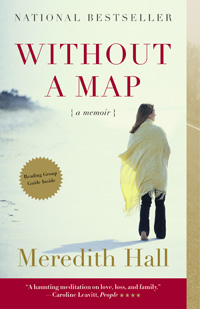
    Today's post is a cross-post of Susie and Aretha Bright's Bright List review of Without a Map: A Memoir by Meredith Hall.


    7274

    This is not your average 16 & Pregnant life story.

    Without A Map is Meredith Hall's outstanding debut as an author, and it's a story that starts when she gets pregnant by mistake in 1965. 

    Kicked out by her mother, and shunned by her small town community in New Hampshire— it's a rocky start. Hall’s life doesn't end up on People magazine— there's no plastic surgery/makeover ending. 

    Meredith moves to the Middle East, first on a whim, but it’s a decision that changes her life. She sells every one of her possessions, and yet arrives on the other side of her adventure with something much more precious, as well as a relationship she never dreamed she’d have. 

    Narrated by one of my favorite actresses on audio, Kathe Mazur. I discovered her while I  was first recording the Best American Erotica series, and I'd ask for her, again and again.


    Related articles

    Beacon Books at Audible: Mama's Boy, Preacher's Son by Kevin Jennings
    Beacon Books at Audible: Transgender Books for Transgender Awareness Week
    Beacon Books at Audible: The $60,000 Dog by Lauren Slater
  • In honor of the 40th anniversary of Roe v. Wade, today's post is from Carole Joffe, author of Dispatches from the Abortion Wars: The Costs of Fanaticism to Doctors, Patients, and the Rest of Us and Doctors of Conscience: The Struggle to Provide Abortion Before and After Roe V. Wade. Joffe is a professor in the Bixby Center for Global Reproductive Health at the University of California, San Francisco (however, the views and opinions expressed here do not necessarily state or reflect those of the Regents of the University of California, UCSF, or the UCSF Medical Center). This post originally appeared at RHRealityCheck.

    “…the news came over the radio.  It was just an overwhelming feeling.  I got tears in my eyes…at last it was all over, finally…never again the fear, the threat of going to prison…the fear of the woman not being able to get service.  It was a new day.”

    0128These words were spoken to me several years ago by a doctor I call David Bennett. I was interviewing Dr. Bennett for a book on abortion provision before Roe v Wade and had asked Bennett what his memories were of January 22, 1973. His thoughts were of particular interest to me. Unlike many of the other doctors active before Roe, who, understandably afraid of detection, quietly offered abortions only to a select few, Bennett had made the decision, as a matter of conscience, to offer abortions to all women who sought them.  

    Dr. Bennett worked closely with the Clergy Consultation Services, an organization of ministers and rabbis started in 1967, which established a referral list of medically competent and ethical physicians to whom these clergy could send distraught women facing unwanted pregnancies. In the years leading up to Roe, thousands of women, either referred by the CCS or who had heard of him through word of mouth, came to his small Southwestern city for abortions. The flood of abortion patients soon overwhelmed the rest of his medical practice, brought considerable strain to his family life, and, as his quote above suggests, led to a constant worry about criminal charges.

    Despite his elation upon hearing of the Roe v Wade decision, the decision, of course, did not prove to be a “new day” —or more precisely, a problem-free new era — for Bennett and his abortion providing colleagues at all. (In contrast, it was was a new day for American women, as the death and injury rate from abortions fell dramatically after legalization. Not all those seeking abortions before Roe had managed to find safe providers like Bennett; many women attempted self-abortion or fell into the hands of the notoriously inept “butchers” of pre-Roe days).

    The rapid rise of an anti-abortion movement after the Roe decision, including the eventual development of a violent wing of this movement, meant that Bennett and others went from fearing legal authorities to fearing the actions of terrorists. In the 40 years since Roe, eight members of the abortion providing community have been brutally murdered — including Bennett’s close friend, George Tiller of Kansas — and thousands more have been stalked, seen their clinics firebombed and vandalized, and have experienced aggressive picketers showing up at their homes, places of worship, and their children’s schools as well as their workplaces. Bennett himself, over the years, has several times had to rebuild his offices because of the serious damage caused by arsonists.

    It’s not just — or even, primarily — episodic violence, however, that has made abortion provision extremely difficult in many places in the years since Roe. Abortion has been regulated like no other branch of American medicine. Since legalization, state legislatures have passed hundreds of laws, with a record number of these occurring in 2011 and 2012.  Many of these laws, especially those dealing with the physical requirements of abortion providing facilities, are widely acknowledged to have nothing to do with patient safety and everything to do with making it financially impossible for these clinics to remain open. In more than 20 states, doctors are put in the ethically untenable position of being required by state mandate to impart to patients information that is scientifically invalid, such as the alleged links between abortion and breast cancer, infertility and suicide.

    Today, in his seventies, David Bennett continues as an abortion provider, one of the last of the veterans of the pre-Roe era to do so. Encouragingly, a new generation of young physicians — mainly women — have sought training in abortion procedure, ready to carry on with this work. But in order for abortion access to be a reality anywhere other than the two coasts and a handful of other metropolitan areas, there have to exist the conditions under which this medical service can be delivered. Americans may be torn about abortion, but consistently, a majority have made clear their preference that abortion remains legal, as was strongly reaffirmed in the 2012 election. The “new day” that David Bennett dreamed of on January 22, 1973 can only happen if there is a forceful stand by this majority in support of these doctors and against both the violence and legislative persecution that has characterized abortion care in the United States.

    Related articles

    What Gun Control Advocates Can Learn from the Anti-Choice Movement
    "Roe v Wade" – Should women have to travel for abortions?
    Roe v. Wade at 40: Six questions about the state of abortion rights today
    Poll: On Roe v. Wade anniversary, majority think abortion should be legal
  • 0066At today's Inauguration, President Obama will be using the Rev. Dr. Martin Luther King's bible. The symbolism of the president's choice is striking. King was of course profoundly religious, although this is sometimes lost in our thinking of him as a leader in the Civil Rights Movement. In reality, however, these two aspects of King's character–the religious man and the secular leader–were intertwined, as is illustrated in the story behind the collection of his best-known homilies.

    As Dr. King prepared for the Birmingham campaign in early 1963, he drafted the final sermons for Strength to Love. King had begun working on the sermons during a fortnight in jail in July 1962. Having been arrested for holding a prayer vigil outside Albany City Hall, King and Ralph Abernathy shared a jail cell for fifteen days that was, according to King, ‘‘dirty, filthy, and ill-equipped’’ and “the worse I have ever seen.” While behind bars, he spent uninterrupted time preparing the drafts for classic sermons such as “Loving Your Enemies,” “Love in Action,” and “Shattered Dreams,” and continued to work on the volume after his release.

    Beacon Press recently brought out, as part of the King Legacy Series, a new version of this book. A Gift of Love includes these classic sermons, along with two new preachings. Collectively they present King’s fusion of Christian teachings and social consciousness, and promote his prescient vision of love as a social and political force for change.

    The following passage, "Loving Your Enemies," is an apt meditation for today. The inauguration puts to rest a combative campaign season even as we watch our leaders, having narrowly avoided the fiscal cliff, square off for battles over the debt ceiling and gun control on Capitol Hill. Perhaps if they could take to heart King's exhortation to "discover the meaning of this command and seek passionately to live it out in our daily lives," we might enter an era of more civil, productive discourse in Washington.

    From "Loving Your Enemies" 

    Ye have heard that it hath been said,
    Thou shalt love thy neighbor, and hate

    thine enemy. But I say unto you, Love

    your enemies, bless them that curse you,

    do good to them that hate you, and pray

    for them which despitefully use you, and

    persecute you; that ye may be children

    of your Father which is in heaven.

    matthew 5:43–45

    Probably no admonition of Jesus has been more difficult to follow than the command to “love your enemies.” Some men have sincerely felt that its actual practice is not possible. It is easy, they say, to love those who love you, but how can one love those who openly and insidiously seek to defeat you? Others, like the philosopher Nietzsche, contend that Jesus’ exhortation to love one’s enemies is testimony to the fact that the Christian ethic is designed for the weak and cowardly, and not for the strong and courageous. Jesus, they say, was an impractical idealist.

    In spite of these insistent questions and persistent objections, this command of Jesus challenges us with new urgency.

    Upheaval after upheaval has reminded us that modern man is traveling along a road called hate, in a journey that will bring us to destruction and damnation. Far from being the pious injunction of a Utopian dreamer, the command to love one’s enemy is an absolute necessity for our survival. Love even for enemies is the key to the solution of the problems of our world. Jesus is not an impractical idealist: he is the practical realist.

    I am certain that Jesus understood the difficulty inherent in the act of loving one’s enemy. He never joined the ranks of those who talk glibly about the easiness of the moral life. He realized that every genuine expression of love grows out of a consistent and total surrender to God. So when Jesus said “Love your enemy,” he was not unmindful of its stringent qualities. Yet he meant every word of it. Our responsibility as Christians is to discover the meaning of this command and seek passionately to live it out in our daily lives.

    I

    Let us be practical and ask the question, How do we love our enemies?

    First, we must develop and maintain the capacity to forgive. He who is devoid of the power to forgive is devoid of the power to love. It is impossible even to begin the act of loving one’s enemies without the prior acceptance of the necessity, over and over again, of forgiving those who inflict evil and injury upon us. It is also necessary to realize that the forgiving act must always be initiated by the person who has been wronged, the victim of some great hurt, the recipient of some tortuous injustice, the absorber of some terrible act of oppression. The wrongdoer may request forgiveness. He may come to himself, and, like the prodigal son, move up some dusty road, his heart palpitating with the desire for forgiveness. But only the injured neighbor, the loving father back home, can really pour out the warm waters of forgiveness.

    Forgiveness does not mean ignoring what has been done or putting a false label on an evil act. It means, rather, that the evil act no longer remains as a barrier to the relationship. Forgiveness is a catalyst creating the atmosphere necessary for a fresh start and a new beginning. It is the lifting of a burden or the cancelling of a debt. The words “I will forgive you, but I’ll never forget what you’ve done” never explain the real nature of forgiveness. Certainly one can never forget, if that means erasing it totally from his mind. But when we forgive, we forget in the sense that the evil deed is no longer a mental block impeding a new relationship. Likewise, we can never say, “I will forgive you, but I won’t have anything further to do with you.” Forgiveness means reconciliation, a coming together again. Without this, no man can love his enemies. The degree to which we are able to forgive determines the degree to which we are able to love our enemies.

    Click here to read the rest of the chapter.


    http://s7.scribdassets.com/javascripts/doc_widget/v1.1.js
    // <![CDATA[
    // &lt;![CDATA[
    // &amp;lt;![CDATA[
    ScribdX.DocWidget.BASE_URL = &amp;quot;http://www.scribd.com&amp;quot;;
    ScribdX.DocWidget.ASSETS_BASE_URL = &amp;quot;http://s7.scribdassets.com&amp;quot;;
    (new ScribdX.DocWidget({
    type:&amp;quot;public_document_collections&amp;quot;,
    resource_id: 3208502,
    show_resource_owner: true,
    show_doc_thumbnail: true,
    show_doc_owner: true,
    show_doc_reads: true,
    colors: {primary: &amp;quot;#1982AB&amp;quot;, secondary: &amp;quot;#302523&amp;quot;, label:&amp;quot;#888888&amp;quot;, background: &amp;quot;#FFFFFF&amp;quot;},
    height: &amp;quot;400px&amp;quot;,
    width: &amp;quot;500px&amp;quot;,
    document_order: &amp;quot;ascending&amp;quot;
    })).asyncGET();
    // ]]&amp;gt;
    // ]]&gt;
    // ]]>
    Related articles

    On King's Birthday, His Global Vision of Justice
    Nation to honor MLK Jr. as Obama is inaugurated
    Martin Luther King Jr. Speeches Still Hold Significance Today (VIDEO)
    Resisting the Myth of Guns and Power
    Dr. Martin Luther King Jr. and freedom for all races