"It was heartbreaking, but we couldn't give up. I just said, 'Well, I've got to get in and do it.'"-Phil Harris, eight-decade-long resident of Hollygrove
As floodwaters drained in the weeks following Hurricane Katrina, New Orleans residents came to a difficult realization. Their city was about to undertake the largest disaster recovery in American history, yet they faced a profound leadership vacuum: members of every tier of government, from the municipal to the federal level, had fallen down on the job. We Shall Not Be Moved tells the absorbing story of the community leaders who stepped into this void to rebuild the city they loved.
From a Vietnamese Catholic priest who immediately knows when two of his six thousand parishioners go missing to a single mother from the Lower Ninth Ward who instructs the likes of Jimmy Carter and Brad Pitt, these intrepid local organizers show that a city's fate rests on the backs of its citizens. On their watch, New Orleans neighborhoods become small governments. These leaders organize their neighbors to ward off demolition threats, write comprehensive recovery plans, found community schools, open volunteer centers, raise funds to rebuild fire stations and libraries, and convince tens of thousands of skeptical residents to return home. Focusing on recovery efforts in five New Orleans neighborhoods-Broadmoor, Hollygrove, Lakeview, the Lower Ninth Ward, and Village de l'Est-Tom Wooten presents vivid narratives through the eyes and voices of residents rebuilding their homes, telling a story of resilience as entertaining as it is instructive.
The unprecedented community mobilization underway in New Orleans is a silver lining of Hurricane Katrina's legacy. By shedding light on this rebirth, We Shall Not Be Moved shows how residents, remarkably, turned a profound national failure into a story of hope.
“Compelling beyond belief, deserving the broadest possible readership, and mandatory reading for urban planners and community organizers, this is a tour-de-force about one American city and what it means to fight for the survival of your hometown.” Booklist
"Mr. Wooten meticulously tracks the work of civic groups in five parts of New Orleans as they labored to prove that their neighborhoods were worth saving, underscoring the importance of fostering such groups long before a catastrophe hits." The Wall Street Journal
“Few disasters are ever truly ‘natural,’ and, as Tom Wooten shows, reconstruction after catastrophes like Hurricane Katrina is shaped heavily by individuals, their communities, and the structural barriers they face. Portraying a diverse range of community leaders, Wooten spins a compelling tale based on deep knowledge of local worlds, linked to an understanding of the large-scale social forces that affect these worlds in ways too often invisible to journalists and other chroniclers of events like Katrina. The stories in We Shall Not Be Moved show the essential role of local knowledge in long-term recovery and reconstruction.”—Paul Farmer, author of Haiti After the Earthquake
“A moving portrait of a city’s struggle to rebuild. It is not an account of Katrina per se. . . . Rather, it is a story of the arduous endeavor residents have undertaken in New Orleans. . . . Every bit as gripping and important as tales from the storm itself.” Walter Issacson, from the Foreword
“In this moving book, Tom Wooten narrates the daily struggles of residents of five neighborhoods in New Orleans to overcome the devastating effects of Hurricane Katrina. We Shall Not Be Moved brilliantly weaves together the stories of community residents, including accounts of their unprecedented organizing and rebuilding efforts. Wooten’s revealing nonfiction narrative is a must-read.”—William Julius Wilson, author of More Than Just Race
About the Author:
Tom Wooten is coauthor of No One Had a Tongue to Speak. Since graduating from Harvard in 2008 and moving to New Orleans, he has worked as a researcher at Harvard's Kennedy School, as a neighborhood volunteer coordinator, and as a fifth- and sixth-grade writing teacher. In 2011, Wooten was featured as a Forbes 30 under 30 in Law & Policy.
Read more about Tom Wooten and his work at tomwooten.com.
The United States Olympic team comprises 529 athletes, and it’s difficult to generalize about who they are. They represent 25 sports. They come from 44 states. The tallest is 7-foot-1. The shortest is 4-foot-11. There’s a 15-year-old swimmer and an equestrian athlete who could be her grandmother.
The parents of these athletes are equally diverse. No doubt, many are perfectly wonderful. For years, they’ve shouldered the responsibilities of sports parenthood without complaint or expectation. Some go to Olympic venues where their children are competing and hold their emotions completely in check. Others like Lynn and Rick Raisman, parents of the gymnast Aly Raisman, don’t even try. The last time I checked, video of the Raismans’ synchronized squirming had passed 100,000 views on YouTube.
Exuberant parents aren’t the problem in youth sports. Overzealous, overly ambitious parents are. Undoubtedly, they are part of the U.S. delegation too. As parents, we make a horrible mistake when we confuse our ambitions with what kids truly want and need from sports. I’ve been writing about the issue for years yet I’m still taken aback by some of the stories. A noted orthopedic surgeon in Los Angeles who operates on the damaged elbows and shoulders of youth pitchers once told me of a recurring conversation he has with patients. A young person confides that he does not want an operation and would prefer to quit his sport. But he’s stuck. “I don’t know what to do because I don’t want to disappoint my parents. It’s so important to my dad.”
Extreme Olympic parenting has been well documented. In her classic book "Little Girls in Pretty Boxes," Joan Ryan exposed the culture of excessive, often abusive, training including the story of a 14-year-old gymnast who suffered a broken wrist in the gym. Rather than take a break, she dulled the pain each day with prescription drugs and a dozen Advil. Subtract the parallel bars and it sounds like child abuse.
All the more reason to celebrate parents who keep things in perspective — even if they don’t always stay in their seats.
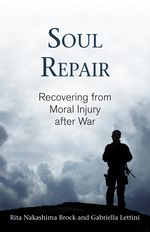
Rita Nakashima Brock is Founding Co-Director of the Soul Repair Center at Brite Divinity School. She was a professor for twenty years, directed the Fellowship Program at the Radcliffe Institute for Advanced Study, Harvard University, a prominent advanced research institute, and from 2001-2002, was a Fellow at the Harvard Divinity School Center for Values in Public Life. This piece was co-authored by Col. Herman Keizer, Jr. (ret.), Co-Director of the Soul Repair Center, who served for 34 years as a military chaplain, and Dr. Gabriella Lettini, co-author with Brock of Soul Repair: Recovering from Moral Injury After War.
The article presents the suicides of two officers—a helicopter pilot who served in Iraq and a medical doctor who did not serve in Iraq or Afghanistan. This example skews the article in two ways. First, in focusing on officers, it selects a group that tends to see less direct combat than the enlisted men who both do more direct fighting and commit suicide at higher rates than officers. Second, in contrasting the two officers' deaths, it suggests that suicide rates are the same for those who serve and those who do not serve in combat. However, the medical doctor first was an enlisted soldier who worked on a bomb squad and served in Bosnia. He was also in Oklahoma City just after the federal building was attacked—years before he decided to become a doctor. It's likely he saw war conditions during his earlier service. We need to remember that the U.S. has sent its forces into violent conflicts every year since World War II, except one, so Iraq and Afghanistan are not the only ways a soldier may have experienced combat.
The most serious blind spot in the reporting on military suicides is an absence of discussions about the moral impact of military training and its implementation in combat. Soldiers are trained to kill, which is regarded as criminal behavior in civilian life, and they are trained to be lethal without even thinking about it, a method of training called reflexive fire training.
We suggest that moral injury is likely one of the most important factors in military suicide rates.
Moral injury is not PTSD. The latter is a dysfunction of brain areas that suppress fear and integrate feeling with coherent memory; symptoms include flashbacks, nightmares, dissociative episodes and hyper-vigilance. PTSD is an immediate injury of trauma.
Moral injury has a slow burn quality that often takes time to sink in. To be morally injured requires a healthy brain that can experience empathy, create a coherent memory narrative, understand moral reasoning and evaluate behavior. Moral injury is a negative self-judgment based on having transgressed core moral beliefs and values or on feeling betrayed by authorities. It is reflected in the destruction of a moral identity and loss of meaning. Its symptoms include shame, survivor guilt, depression, despair, addiction, distrust, anger, a need to make amends and the loss of a desire to live.
While the Army has long provided protective training for soldiers sent to war, this is clearly now inadequate. Battles with insurgencies make violence against civilians commonplace and acceptable in ways that violate international standards for the conduct of war and the moral code of conduct for soldiers. For example, "Sniper Wonderland," a military drill chant says:
See the little girl with the puppy; Lock and load a hollow pointed round… Take the shot and maybe if you're lucky; You'll watch their lifeless bodies hit the ground….
The most recent Army attempt to prepare troops for battle appears to have failed miserably. Its "Comprehensive Soldier Fitness" (CSF) program, begun in 2009 with a $125 million investment and lauded in a New York Times Magazine article in March 2012, has been widely criticized. It bypasses the difficult ethical questions that many healthy human beings ask about war, and its spiritual fitness component has no moral content. It suggests that a soldier's commitment to a higher purpose—mission first—makes for resiliency. But most people capable of such a commitment also have empathy for others and deep moral values.
The Army's "spiritual fitness" encourages soldiers to see events in a neutral light, rather than labeling them as good or bad, and to create a nightly list of positive things that happened that day. The lack of awareness is startling regarding what it might mean to ask someone to think of killing a child, losing a close friend or torturing detainees as neutral or positive.
Proving a direct cause-effect relationship between such training and suicides is difficult, of course. However, there are certain moral reactions to war and the experience of combat training that indicate a violation of moral conscience in war can have devastating inner consequences in soldiers. A larger proportion of soldiers and veterans who serve in combat seek the counseling help of a chaplain over the help of a clinician. This choice has two likely reasons. First, speaking to a chaplain does not create a negative psychological record in a military career. Second, psychological training does not require knowledge of theological issues, moral discussions of good and evil, or religious meaning. In fact, when soldiers raise moral questions about conscience in therapy, they are often referred to clergy.
The reporting on military and veteran suicides mostly fails to explore the role of moral injury. When a suicide occurs years after a soldier returns from war, combat experience is often disregarded as a primary cause of the suicide. Yet, as Karl Marlantes, a Vietnam veteran, reports in "What It Is Like to Go to War," he was fine for a decade, and then, he crashed. Often, such delays are used to deny VA services or are regarded as a family problem, rather than as a consequence of service in combat.
The alarming rates of reported suicides are squishy statistics and do not reflect the true numbers of soldiers who take their own lives. Many combat veterans tell stories of comrades who shot themselves, but who were reported as "non-combat" or "accidental" casualties. Soldiers who deliberately place themselves in harm's way in hopes of dying are reported as casualties, not suicides. Since many life-insurance policies will not pay benefits to families if suicide is the cause of death, the need to disguise suicide may mean some apparently accidental deaths were, in actuality, planned. We will never know the true suicide numbers, but we do know moral injury causes intense inner anguish.
Moral injury is not a clinical condition that can be medicated or cured by psychology. It requires the reconstruction of a moral identity and meaning system with the support of a caring, nonjudgmental community that can provide a way for veterans to learn to forgive themselves. But any community that wants to offer such support must have the moral courage to examine its own responsibility for war. With such a small percentage of Americans (1 percent) serving in the military, and the escalating unpopularity of the wars in Iraq and Afghanistan, too few people or communities remember the initial popularity of the wars or care about the cost to the men and women we send to fight on our behalf.
We care, and we believe our whole society bears responsibility for addressing moral injury. Whether or not we supported the wars, they do not end when soldiers come home. Instead, they continue in the souls of those who fought and in their families and communities when they return to civilian life. That is why we believe one right response of moral conscience to military and veteran suicides is to study and address moral injury as a hidden wound of war.
"Mr. Caulfield muses at amusing and instructive length on the exact definition of fitness — the bizarre, science-free equivalency the modern aesthetic has established between fitness and sexy abs — and the depressingly well-validated fact that the older you get, the more running it takes to stay in exactly the same place."
“Smart. Funny. Heartening. Inspiring. Faitheist is the perfect book for those seeking a middle path between the firm, opposing certainties of religious fundamentalism and intolerant atheism.”—Reza Aslan, author of No God but God and Beyond Fundamentalism
"Tanya Erzen’s Fanpire provides a much-needed portrait of the girls and women who love Twilight. From how the series appeals to girl's and women's ideas of pleasure, power, and romance, to the ways in which the love of these books has forged communities and friendships among women, Erzen's window into these subjects is both sympathetic and critical. Fanpire is sure to fascinate and, at times, trouble, anyone interested in the lives of girls and women today."—Donna Freitas, author of Sex and the Soul: Juggling Sexuality, Spirituality, Romance and Religion on America's College Campuses
Today's post is from Tom Hallock, Associate Publisher of Beacon Press.
I was thrilled when I realized that our family’s annual White Mountains High Huts trip would coincide with one by Beacon author Michael Lanza and his family. We made plans to hike together on the Webster Jackson trail and exchanged cell phone numbers. Michael and his family arrived first and, with Nate and Alix eager to start their climb, set off. Michael texted to say that they we were just a few minutes ahead of us, assuming that two adults would be able to catch up with hikers going at a “family pace.” It never happened (see trail photo). My brother-in-law and I had a great hike at our own pace and met other family and friends at Appalachian Mountain Club's Mizpah Hut, hiking to Lake of the Clouds the following day. Our own “Before They’re Gone” moment came when the hut naturalist told us that the entire White Mountains alpine zone, the largest one east of the Rockies, could be gone in 25 years, as a result of acid rain. Hiking in the alpine zones of the Whites is an incredible experience, whether you’re in a cloud (which you are half the time) or making the trip on a clear day. I always return feeling gratitude to the AMC staff and volunteers for all they do to protect this environment and make it possible for us to experience it.
Liberals seem to get all the attention for investing and shopping according to their ethical values, perhaps because the Civil Rights movement began with a boycott of the Woolworth’s lunch counter in Greensboro, NC. And since then, the most famous consumer actions have tended to tilt leftward—against Dow Chemical for making napalm during the Vietnam War, or against Nike and now Apple for dreadful working conditions at overseas factories.
So it’s only fair that it’s finally the conservatives’ turn.
Accordingly, gay rights groups have called for a boycott, while Christian conservatives promised to eat more chicken than ever and declared a “Chick-fil-A Appreciation Day.” Conservative politicians like the former presidential candidates Mike Huckabee and Rick Santorum are leading the charge.
Rare though it might seem to be, Chick-fil-A isn’t the first right-wing consumer cause. For instance, there are socially responsible investment vehicles from all sides of the values spectrum. Some religious-based funds avoid companies in the business of selling alcohol, tobacco, and military equipment—seemingly liberal causes—but others shun anything to do with abortion or birth control. The Republican state treasurer of Missouri launched a “terror-free fund” a few years back, to bam companies that have a financial relationship with countries on the federal government’s list of state sponsors of terrorism.
Years ago, Pepsi was known as the “Republican” cola, and Coke was the “Democratic” alternative, because of the political campaigns to which each manufacturer supposedly donated.
As it happens, I’ve never eaten at Chick-fil-A. Until this controversy, I was only vaguely aware of the company, and there are no outlets near me.
On the other hand, I also don’t live near any In-N-Out Burger sites—I’m in New York, and the chain is located only in the West—but my family makes a beeline whenever we are within 10 miles of an In-N-Out restaurant, because we love the high-quality beef and secret sauce. Never mind that this brand, too, could be considered a fundamentalist Christian company, because the late president, a born-again Christian, instituted a practice of referencing Biblical chapters and verses on its paper cups. (Who even looks at the bottom of the cups?)
It’s too soon to tell which side will win the current chicken war. As a liberal, of course I hope the pro-Chick-fil-A movement flounders. I am troubled by the intolerance—indeed, the avid and self-satisfied intolerance—of the chain’s owner. If I ever stumble across an outlet, I will stay away.
Yet in a weird way, I’m glad to see the concept of ethical shopping gaining favor among conservatives.
True, right-wing activism will probably lead to more union-busting or anti-gay bias in the short run, if consumers flock to companies that engage in those practices. Chick-fil-A would undoubtedly rake in less profit if people like Huckabee and Santorum weren’t making such a concerted effort to dine there.
However, in the longer run, this trend could mean a chance for dialogue. With both sides now talking the language of ethical consumption and activism, maybe we can change some minds or find common ground.
We all win when consumers realize that every dollar has a larger meaning.
Imagine a military health issue that affects almost every woman who enlists. Imagine that this same problem affects a smaller proportion, but a large number, of men. This problem seriously impacts a soldier's ability to serve, often causes mental and physical health issues, and can even lead to suicide.
And imagine that those who face this issue are likely to find themselves further traumatized by any attempt to address the problem. According to Invisible No More, since 2006 more than 95,000 service members have been sexually assaulted in the military. While most victims do not report their crimes, the few that have the courage to come forward are often ostracized, further harassed, and sometimes even punished more harshly than their perpetrators. They can see their dreams of serving their country in the military shattered, their careers derailed by something for which they are not to blame.
On July 6th at the Coolidge Corner Theatre, I saw The Invisible War, a film that investigates the epidemic of rape in the U. S. military. This wasn't a topic that was news to me: I am old enough to remember the Tailhook scandal and the assaults at Aberdeen Proving Ground. And in 2009, Beacon published Helen Benedict's book The Lonely Soldier: The Private War of Women Serving in Iraq, which tells the story of five women soldiers who bravely served in Iraq but were faced with a culture of misogyny, homophobia, and sexual violence so pervasive, as one female soldier put it, "I ended up waging my own war against an enemy dressed in the same uniform as mine."
I've followed Benedict's work since the book was published, and through it I've had an education in the lives of women in the military. I've learned about organizations such as the Service Women's Action Network and Protect Our Defenders, and about the work being done by Massachusetts Representative Niki Tsongas (who introduced the movie when I saw it at the Coolidge) and others in Congress to investigate the problem of military sexual assault and encourage positive changes in military culture. The men and women who have come forward to share their stories–with Benedict, with the filmmakers, before Congress–to call them brave is an understatement. They speak for countless others who suffer in silence.
After seeing the film, I interviewed Helen Benedict via email. —Jessica Bennett, Blog Editor, Beacon Broadside
The women profiled in the film and in your book were different and their stories were each unique, but the similarities are striking: harassment, assault, retaliation, threats, and a lack of accountability. The Lonely Soldier focuses on women from one war, in one branch of the military, but it seems that this is a problem that has been persistent in all branches of service, and one that manifests itself both stateside and overseas. How pervasive is sexual assault and harassment in the military and how does it affect soldiers—both women and men?
The latest Department of Defense figures are showing that 20 percent of military women are sexually assaulted while serving, while for men, the number is one percent. Because men outnumber women in the military, this means that many more men than women are assaulted, but proportionally the vast number of victims are women. Other studies I cite in my book show an even higher rate – 33 percent of women sexually assaulted – and a 90 percent rate of sexual harassment. These numbers are of epidemic proportions and affect women on home bases and at war.
The stories of abuse in the movie and in your book are harrowing, but it seems that a good deal of the damage inflicted upon victims comes from the way they were treated by the military after they are assaulted. How does military leadership fail assault and harassment victims?
The military is a blame-the-victim culture, thus many victims are met with skepticism, disbelief or outright blame when they report an assault. They are often treated as liars trying to get attention or bring down the career of a man, or blamed for drinking, flirting or otherwise “inviting” the assault. (No one invites a brutal attack, ever.) Furthermore, even for those cases that are taken seriously and prosecuted, the conviction and punishment rates are shockingly low–much lower than they are in civilian courts. This sends the message that assailants will be protected by the military, whereas their victims will be vilified.
The most recent scandal–which has received surprisingly little media attention–involves twelve instructors and at least 31 female trainees at Lackland Air Force Base. One instructor, Staff Sgt. Peter Vega-Maldonado, was allowed to plead guilty to "having sex with a female trainee" and received 90 days confinement before he acknowledged being involved with a total of ten trainees. The most serious charges, which will be addressed in a court-martial trial beginning this week, are leveled against Staff Sgt. Luis Walker. The leadership at Lackland has taken great pains to stress the personal responsibility of the perpetrators for their crimes, emphasizing that the great majority of instructors are ethical in their treatment of trainees. While this is certainly the case, does this PR tactic sound familiar?
Well, in all fairness, most men in the military are not sexual predators. Many too many are, but not most, so in a way the military is justified in saying most of their leaders behave correctly. We should be careful not to paint all military men as rapists, for this is terribly unfair to the majority who would never behave like that and are as appalled by it as women are. Sexual predators are repeat offenders, so one man can cause an egregious amount of harm.
That said, the military must take more responsibility for this huge problem in its ranks and its culture. It has been denying and covering up the problem for decade after decade, thus perpetuating and even supporting what is essentially a rape culture. No organization in the U.S. gives individuals as much power as the military does: with that power must come ethical behavior and anyone who abuses the power should meet with the proper justice.
Sexual "predators" or repeat sexual offenders like Jerry Sandusky at Penn State, Catholic Priests accused of abusing parishioners, and military serial abusers thrive in an environment where they have power imbalances and institutional secrecy on their side. Predators also feel empowered by "getting away with it," something that happens in an overwhelming number of sexual assault cases in the military. What does the military do to screen out or identify sexual predators?
As far as I understand, the military does almost nothing to screen out or identify sexual predators. Under President Bush, many criminal records were waived for recruits because the military was too short-staffed to run two wars. No one with a criminal record, especially one that entails abuse of women, should be allowed to serve.
At the moment, one in four veterans in prison is there for a sexual assault. Furthermore, if a sexual predator is expelled from the military, the civilian community to which he returns is not informed of his record.
In a postscript at the end of the Invisible War, the filmmakers note that Defense Secretary Leon Panetta took steps this past April to assist victims, clarify sexual assault policies, and elevate investigations of assault beyond the local unit commanders. When I saw the film, Representative Niki Tsongas of Massachusetts spoke to the audience about how she has worked in Congress to affect positive change in the military. The military has promised change before—do you think that we are finally moving in the right direction?
I do. We need to take sexual assault cases out of the chain of command and military justice system because it is too closed a system to be fair to victims. For example, some 25 percent of victims must report their assault to the very man who assaulted them; whereas 33 or so percent must report to someone who knows the assailant. This results in a system in which friends and those in command can close ranks and protect one another, shutting out all justice for the victim.
Carl Elliott is the author of White Coat, Black Hat: Adventures on the Dark Side of Medicine. Elliott is a professor at the Center for Bioethics at the University of Minnesota. His work has appeared in The New Yorker, Atlantic Monthly, the Believer, Slate, the London Review of Books, and theAmerican Prospect. His six previous books include Better Than Well, Prozac As a Way of Life, Rules of Insanity, and A Philosophical Disease.
Another spectacular winter morning in Dunedin, New Zealand. Clear blue sky, frost on the ground, lush green hills plunging into the South Pacific. It is hard to complain about the setting, still less about the kindness and decency of the inhabitants. It has been nearly 22 years since my wife and I first landed in Dunedin, in August of 1990, when I began a postdoctoral fellowship at the newly established Bioethics Centre at the University of Otago. I still wonder why we ever left.
It was an extraordinary time for bioethics in New Zealand. In 1990, the country was still reeling from the shock of a medical research scandal—the “unfortunate experiment” at the National Women’s Hospital in Auckland. In that study, which had begun in 1966 and continued for another two decades, Dr. Herbert Green, an obstetrician-gynecologist, deliberately withheld treatment of 160 women with abnormal cervical smears in an effort to prove his misguided hypothesis that the cervical abnormalities would not lead to cervical cancer. Green enrolled women in the study without their knowledge or consent. Three of Green’s colleagues at Auckland University, Bill McIndoe, Jock McLean, and Ron Jones, tried to put a halt to the experiment for years, but they were ignored until they published a 1984 article in Obstetrics and Gynecology showing that the untreated women were 25 times more likely to develop invasive cancer. According to the Cartright Inquiry, the governmental commission set up to investigate the scandal, this amounted to a total of approximately 40 women developing invasive cancer, many of whom died.
The Medical Council of New Zealand eventually brought disciplinary action against Green and his superior, Dr. Denis Bonham. While the charges against Green were dropped because of Green’s poor health, the Council found Bonham guilty of disgraceful conduct. More importantly, the results of the Cartwright Inquiry led to dramatic changes in the oversight of medical research in New Zealand—among them the establishment of regional ethics committees, the creation of an Office of Health and Disability Commissioner, a code of rights for health consumers, and the appointment of an independent patient advocate at Auckland Women’s Hospital. Many of my friends and colleagues at the University of Otago were involved in the Cartwright Inquiry and its aftermath, perhaps most notably Dr. Charlotte Paul, who served as a medical adviser.
Two decades later, it is hard for me to avoid contrasting the ”unfortunate experiment” in Auckland to the psychiatric research scandal at the University of Minnesota, where I work now. The circumstances surrounding the suicide of Dan Markingson in an AstraZeneca-sponsored clinical trial of Seroquel were very different from those in Auckland, yet they were no less shocking: a floridly psychotic young man under a commitment order, who had been repeatedly judged incompetent to make his own medical decisions, was coerced into a highly profitable, scientifically dubious clinical trial over the objections of his mother, whose desperate warnings were subsequently ignored until the young man finally stabbed himself to death.
The two scandals have some similarities. In both cases, the wrongdoing was brought to public attention not by regulators or oversight bodies, but by journalists. The “unfortunate experiment” in Auckland was brought to light by Sandra Coney and Phillida Bunkle in Metro magazine, while Paul Tosto and Jeremy Olson exposed the Markingson scandal in the St. Paul Pioneer Press. Also, in both cases, the scandals were symptomatic of deeper ethical pathology. At the National Women’s Hospital, medical students had been performing vaginal examinations on anesthetized women without their knowledge, and house staff had practiced inserting and removing IUDs on anesthetized women before their hysterectomies. At the University of Minnesota, administrators have repeatedly covered up or minimized questionable financial dealings and conflicts of interest, even in the face of sustained public scrutiny. (See this, this, this, this, and this.)
Most importantly, administrators at both institutions downplayed or ignored the warnings of their own faculty members. In late 2010, after my article about the Markingson case appeared in Mother Jones, several University of Minnesota faculty members and I wrote a public letter to the board of regents asking for an external investigation. In February 2011, when the regents refused our request, Dr. Aaron Friedman, the Dean of the Medical School and Vice-President for Health Sciences, sent an email to the faculty making it clear where he stood on the matter. “As a result of this case, our department of psychiatry has experienced significant scrutiny and withering criticism over the past five years, and through it all, the faculty of the department have performed remarkably well in fulfilling its mission,” Friedman wrote. He went on to praise the psychiatrists behind the trial in which Markingson died, Dr. Stephen Olson and Dr. Charles Schulz, and to voice his strong support for industry-funded research. As for the death of Markingson, Friedman wrote, “I see the Regents’ statement as the end of the University’s review of this specific patient’s case.”
Here is where the responses to the Markingson case and to the “unfortunate experiment” differ. In Auckland, the Metro article by Coney and Bunkle set off a national debate, and eventually, sweeping reforms. These reforms came about in part due to the refusal of many New Zealand academics, physicians, and feminist activists to let the matter die. But at Minnesota, the forceful responses by Friedman and the general counsel, Mark Rotenberg have successfully silenced internal dissent at the university.
This silence is understandable, but unfortunate. The issues at stake go well beyond the death of Dan Markingson. If more research deaths are uncovered, will the faculty at the University of Minnesota be able to say, “We did all we could to prevent them”?
In a New York Times interview, Dave Eggers mentions Malcolm Garcia: “there’s a writer named J. Malcolm Garcia who continually astounds me with his energy and empathy…I’ve been following him wherever he goes.”; New York Times
“One of the wonders of coming back to NOTES after such a long time is how “current” Baldwin is. That might sound like a cliché but in so many instances in our lives we learn that some clichés are built on things solid and familiar and timeless. “Journey to Atlanta” is but one of a hundred examples in NOTES. What also comes across, again, is how optimistic James Baldwin was about himself, his world, black people. Even when he describes the awfulness of being black in American, he presents us with an optimism that is sometimes like subtle background music, and sometimes like an insistent drumbeat. But through it all, with each word– perhaps as evidence of a man certain of his message – he never shouts.” From the new introduction by Edward P. Jones (Pulitzer Prize The Known World)
Sherrilyn Ifill is Professor of Law at the University of Maryland Francis King Carey School of Law. She is the author of On the Courthouse Lawn: Confronting the Legacy of Lynching in the 21st Century. Professor Ifill is nationally recognized as an advocate in the areas of civil rights, voting rights, judicial diversity and judicial decision-making.
I am genuinely pleased by the announcement that Anne Marie Slaughter has scored a book deal following her hugely popular essay in The Atlantic, “Why Women Still Can’t Have It All.” Slaughter’s piece has been appropriately praised for opening a robust and dynamic conversation about the very real difficulties women at the top face in trying to have families while pursuing elite professional careers. Critics have pointed out that Slaughter’s essay addresses only women at the top—the 1%, so to speak. But Slaughter concedes this herself in the piece, and fully recognizes that women like her operate from a position of economic and educational privilege.
The problem with Slaughter’s piece—and now planned book—is not that she doesn’t speak for most women, but that she and other women in the 1% fail to recognize how their failure to exercise power in support of women at the economic bottom hurts all of us. Take a fictionalized, working-class black woman named Crystal living in a city like Baltimore, a town blessed with a large number of highly-ranked hospital systems. Jobs in health care are plentiful and a woman with only a high school education and who is, say, a practical nurse may be able to find employment as a home health care worker or as an aide in a hospital. If she lives in West Baltimore and has no car, she will have to leave her home early—most likely while it’s still dark to get to work at 7 or 8am when her shift begins. Baltimore has one of the most limited subway systems for a major American city. Thus, Crystal will have to wait at a bus stop and take a ride that will last about hour or more before she makes it to her job. When she leaves home in the morning, she must leave her children—ages 12, 9 and 7—to get ready for school. This means that the 12 year old will have responsibility for waking and organizing the two younger children, and ensuring that they make it to school on time. This includes seeing to it that her siblings have their notebooks and homework in their backpacks, locking the door to the home, and navigating bullies (her siblings’ and her own) on the walk to school.
If her shift at work is 12 hours, Crystal will make it home by 8pm or 9pm. Perhaps she has a neighbor or sister or cousin look in on her children in the afternoon. Maybe not. If she has a normal 8 hour shift, she will make it home, physically exhausted, by 7 or 8, with precious little time, or perhaps even inclination, to read with her children or to spend “quality” time asking about their day and getting familiar with the names of their teachers and friends.
So what do the women of the 1% percent, who’ve just discovered that they can’t have it all, have to do with Crystal? The women in the 1% have the power to take the lead in changing the conditions that make it nearly impossible for Crystal to work and parent effectively. They are regular voters. Perhaps they work in city or state government, or they are doctors, professors or partners at a major law firm in town. Perhaps they work in the federal government like Slaughter did, taking the Amtrak Northeast Corridor train to their job at a federal agency in D.C.
Despite Slaughter’s accurate portrayal of the difficulties these women face in balancing their home and work lives, these women actually have power. But the failure of the transportation system in Baltimore to meet the needs of working class people is not a priority for them. They drive or take the commuter train to work. They have a nanny or regular babysitter who meets their children at the bus stop and brings them home. So they did not seek to ensure that the billions of dollars in stimulus money were allocated for construction projects would go to projects that would benefit working women—like inner city transportation improvements—rather than highway construction projects more likely to benefit those at the top.
Women of the 1% vigorously supported the Lily Ledbetter Act, and are mindful at their own workplace of pay equity between men and women. But these same women are not at the forefront of efforts to increase the minimum wage, which stands at a pitiful $7.25/hr. That would give Crystal less than $300/week before taxes on which to raise her 3 children.
What role have elite women played in seeking to change oppressive criminal justice policies like stop-and-frisk, California’s “3 strikes you’re out” sentencing law or the proliferation of long criminal sentences for non-violent drug offenses that might be responsible for landing Crystal’s husband in jail for years, without the ability to contribute to the well-being and support of his children and wife? Isn’t the emotional stability of Crystal’s son—who if he lived in New York City might be stopped and frisked by police a dozen times during his teen years—just as important as that of Slaughter’s son? What choices does the working-class mom of a black, teen stop-and-frisk victim have to help her son through the emotional fallout of police harassment?
And let’s be real. Many women in the top 1% employ women at the economic bottom. All over Manhattan one sees the startling visual of black and Latina women pushing white babies in carriages and strollers. What worker protections do these women enjoy? Many of these domestic workers leave their own children all day in the care of others to take care of the children of economically elite women. Organizations like the National Domestic Workers Alliance have worked for years to organize and obtain basic labor protections for domestic workers. Where do 1% women stand on the efforts to afford labor rights and benefits to the women who care for their children and clean their homes?
Finally, we should remember that Crystal and women like her are not without ambition. Like Slaughter and other economically elite women, they have a strong desire to elevate their educational and professional status. Crystal enjoys working with patients and also knows that if she were able to get her degree as a registered nurse, she would make considerably more money than she is able to make now. Having children should not mean the end of education or professional development for women. How can we support the ability of working class women to move up the ladder?
Slaughter’s piece fails to recognize that women in the 1% have real power to transform the work/family reality for women at the economic bottom, who are seeking the luxury of the kind of choices about which Slaughter and I wring our hands.
As a weekly rider on the Amtrak ACELA train on the run from Washington, D.C., to Baltimore, it’s been hard not to notice over the past two years how many high-powered white women on the evening train seem to unwind by reading Kathryn Stockett’s The Help. With briefcases tucked behind their knees and power lipstick faded after the day’s meetings, exhausted 1% women on the evening train ride seem to find a kind of perverse relaxation in reading a romanticized account about the bonds that might develop between privileged white women and their black maids. But we needn’t rely on fanciful, retro fables that elevate personal friendship over economic, educational and social transformation. Change for women in the workplace will happen from the bottom up, and will take hold when powerful women expend their capital on behalf of women in the 99%. But I suspect that we shall wait a long time before there is a book deal that tells this story.

 As floodwaters drained in the weeks following Hurricane Katrina, New Orleans residents came to a difficult realization. Their city was about to undertake the largest disaster recovery in American history, yet they faced a profound leadership vacuum: members of every tier of government, from the municipal to the federal level, had fallen down on the job. We Shall Not Be Moved tells the absorbing story of the community leaders who stepped into this void to rebuild the city they loved.
 About the Author: