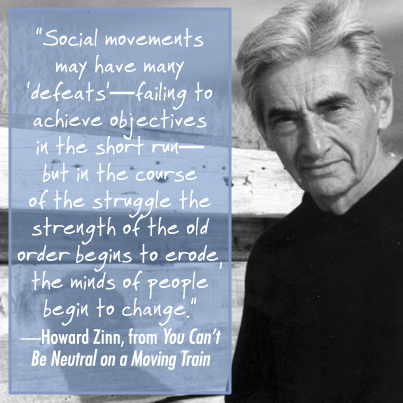
• ZiinnQuote1Today marks the 90th birthday of historian, playwright, and activist Howard Zinn (1912-2010). A former bombardier in WWII, Zinn became active in the civil rights movement while teaching at Spelman. After being fired for supporting student protestors, he became a professor at Boston University, where he taught until his retirement in 1988. He is the author of many books, including his landmark work, A People’s History of the United States (Harper Perennial), and his memoir, You Can’t be Neutral on a Moving Train (Beacon Press).

    Read an excerpt of You Can't Be Neutral on a Moving Train at Scribd.

    Read a post from the Zinn Education Project about how Howard Zinn "did not merely record history, he made it."

    Watch a tribute to Howard Zinn on Democracy Now.

    Photo by Rosyln Zinn.

  • Award-winning journalist Fran Hawthorne has been a writer or editor at Fortune, BusinessWeek, Institutional Investor, and other publications. She is the author of Ethical Chic: The Inside Story of the Companies We Think We Love, The Overloaded Liberal: Shopping, Investing, Parenting,and Other Daily Dilemmas in an Age of Political Activism, and books on health care and investing.

    Bigstock-Rip-Steve-Jobs-24089315Because Apple fans love their iProducts so ardently, they have often attributed to Steve Jobs and Apple almost every positive quality they want to see in a CEO and a company, whether deserved or not. Thus, they have assumed that Apple reduces its energy use, recycles its electronic waste, treats its workers well, and generally is a socially responsible corporation.

    Toward the end of Jobs’ reign, fans gradually and grudgingly began to realize that their heroes didn’t deserve all those haloes.

    Now, ironically, Jobs’ successor, Timothy Cook, may turn out to be the real hero of the myth.

    This week marks one year since Jobs stepped down as CEO. He would die just six weeks later. During the transition to the Cook era, customers and investors have, understandably, focused on the products and stock price.

    But quietly, Cook has made some important changes in the area of corporate social responsibility.

    While he was still the heir-apparent, Cook visited the major Chinese factory that manufactures iPhones, iPads, and other devices, after a series of suicides there by workers protesting the long hours and low pay.  Jobs never bothered to check in person.  Early this year, Cook brought in an outside monitor to follow up on the complaints and again inspected the site himself. 

    Even more amazing, Cook publicly identified 156 Apple subcontractors and published the monitor’s report. This, from the company that never talks to the press?

    True, Cook has continued the tradition of shunning reporters. However, he showed up at a big meeting to speak with financial analysts—which Jobs rarely did—and has schmoozed with members of Congress.

    Such outreach is important, because social responsibility is simply impossible without open communication. Transparency enables customers, neighbors, suppliers, employees, investors, and social activists to see exactly what the company is doing and, in turn, push the company on their own goals.

    0094

    And Apple employees have started to relax. It’s no longer the case—as Jeffrey S. Young and William L. Simon famously wrote in their 2005 book iCon—that “You didn’t want to encounter him [Jobs] in a hallway, because he might not like an answer you gave… And you sure as hell didn’t want to get trapped on an elevator with him, because by the time the doors opened, you might not have a job.”

    The new CEO is—well—a normal person, not a demigod. He is private but not obsessive and mercurial.

    Of course these changes haven’t transformed Apple into the ideal of a socially responsible company. There are still serious problems in the factories in China and far too much wasted packaging and planned obsolescence for the products.

    Nor does the praise of Cook diminish Jobs’ incredible talents and achievements. Probably only an obsessive and mercurial creative genius could have had the vision and persistence to transform the floundering concept of a portable music player into the iPod or to revive a cartoon shop called Pixar—to name just two of Jobs’ successes. 

    Cook may never invent or inspire the invention of a better product.

    But he may well reinvent Apple as a better corporate citizen.

    IPad photo from Bigstock.

  • Notable Mentions:

    7748 (1)Sacred Ground: Pluralism, Prejudice, and the Promise of America by Eboo Patel

    Opinion piece on the CNN Belief Blog: "How Evangelicals Could Grow to Love Muslims"

    It is easy to draw a straight line between the evangelical anti-Catholic prejudice of previous generations and the Islamophobia of today, essentially saying that “evangelicals have to hate someone.”

    But that’s too cynical a take for me. The more interesting – and certainly more hopeful – storyline is the one about change.

    Evangelical attitudes changed markedly towards Catholics in the past generation, and they are changing towards Muslims now.

    Column in USA Today: "The Dilemma of Religious Diversity"

    My point is that in this era, the question of age when it comes to engaging religious diversity is moot. We are literally born into a condition of interfaith interaction. Our children will be raised in an environment of religious diversity — from a Mormon presidential hopeful, to Olympic athletes competing in Islamic head scarfs, to the images of a Wisconsin Sikh community mourning after a terrible attack.


    Overdiagnosed:Making People Sick in the Pursuit of Health by H. Gilbert Welch, Lisa Schwartz and Steve Woloshin

    Op-ed by Dr. Welch in the New York Times
    Aug 20: "Testing What We Think We Know"

    The truth is that for a large part of medical practice, we don’t know what works. But we pay for it anyway. Our annual per capita health care expenditure is now over $8,000. Many countries pay half that — and enjoy similar, often better, outcomes. Isn’t it time to learn which practices, in fact, improve our health, and which ones don’t?


    Harvest
    the Wind: America’s Journey to Jobs, Energy Independence, and Climate Stability
    by Philip
    Warburg

    Author letter to the editor in the New
    York Times

    According to a report released by the National Renewable Energy Laboratory in June, America could supply nearly half our total power needs from wind and solar energy by 2050, using technology that is commercially available today. Imagine what that would do to our country’s carbon footprint.

    To move America toward a more sustainable energy future, we need national leadership that will check the excesses of well-entrenched fossil fuel interests while encouraging cleaner alternatives like wind.


    The Land Grabbers: The
    New Fight over Who Owns the Earth
     by Fred Pearce

    Read an excerpt online at Utne.com: "The Price of Food"


    A Queer and Pleasant Danger by Kate Bornstein

    Santa Cruz Sentinel interview:

    The Village Voice featured Bornstein in the piece “The Top 25 People Crippling Scientology–2012 Edition!”


    Dispatches from the Abortion Wars by Carole Joffe

    Opinion piece at RH Reality Check examining the differences in rhetoric and life choices by some pro-life candidates.

    Appearance on Boston Public Radio at WGBH discussing Rep. Todd Akin's comments on abortion and rape. 


    Author Events:


    LIPMAN-TweetLandofLibertyTweet Land of Liberty: Irreverent Rhymes from the Political Circus
    by Elinor Lipman

    September 6th, 2012: Corner Bookstore (NYC)

    September 23rd, 2012: Writers for Obama and Elizabeth Warren at the Hotel Northampton (Northhampton, MA)

    September 24th, 2012: Broadside Books at 7 PM

    September 27th, 2012: Women & Children First (Chicago, IL)

    September 28th-29th, 2012: Ragdale Foundation, Lake Forest, IL

    October 2nd, 2012: Port Washington Public Library (Port Washington, NY)

    October 10th, 2012: Brookline Booksmith (Brookline, MA)

    October 11th, 2012: Worcester Public Library

    October 17th, 2012: Hewlett Woodmere Public Library (Long Island)

    October 30th, 2012: Porter Square Books (Cambridge, MA)
     

    1441

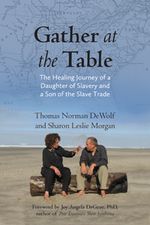
    Gather at the Table: The Healing Journey of a Daughter of Slavery and a Son of the Slave Trade, Thomas N. Dewolf and Sharon Morgan (October)

    October 9: Gather at the Table book launch — 6:00pm, Martin Chapel; Eastern Mennonite University, 1200 Park Road, Harrisonburg, Virginia

    October 14: Davies Memorial Unitarian Universalist Church — 10:30am, 7400 Temple Hills Rd. Camp Springs, MD

    October 17: Bloomsburg University — schedule pending, 400 East Second Street Bloomsburg, PA

    October 24: Trinity Church Boston — 7:00pm, 206 Clarendon Street, Boston, MA 02116

    October 25: Harriet Beecher Stowe Center — 5:00pm, 77 Forest Street, Hartford, CT

    November 9: African American Jazz Caucus event– schedule & location pending, Indianapolis, Indiana

    November 10-12: Southwest Michigan Black Heritage Society – multiple events in multiple venues, details to come, Kalamazoo, Michigan


    Mary Oliver (award-winning author of numerous books of poetry, including twelve available from Beacon Press.)

    October 15, 2012 New York, NY: 92nd Street Y

    Wednesday & Thursday, October 24 & 25, 2012 Boston, MA: Boston Museum of Fine Arts 

    Sunday, October 28, 2012  Bethesda, MD:  The Strathmore PAC.  Evening Joint Reading with Mary Oliver & Billy Collins

    Monday, November 12, 2012 Milwaukee, WI: Marquette University  
  • 6912
    Buy from Beacon Press
    Qty:

    Available in hardcover and ebook wherever books are sold.

    "This book is a must-read for anyone who wants to understand the historical reality of the slave experiences. Carbado and Weise have diligently selected narratives that will challenge readers' presumptions and cut against the mythology that slaves were passive, that mostly men (and not women) ran away, that slaves typically ran North (not South), and that gender and racial passing were rare occurrences. A landmark achievement, The Long Walk to Freedom allows fugitive slaves to speak for themselves—on their own terms and in their own voices." —Dr. Mary Frances Berry, Geraldine R. Segal Professor of American Social Thought and professor of history at the University of Pennsylvania

    "The editors step aside and let these remarkable men and women tell their own stories." —Kirkus Reviews

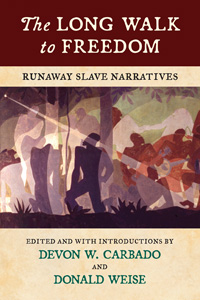
    In this groundbreaking compilation of first-person accounts of the runaway slave phenomenon, editors Devon W. Carbado and Donald Weise have recovered twelve narratives spanning eight decades-more than half of which have been long out of print. Told in the voices of the runaway slaves themselves, these narratives reveal the extraordinary and often innovative ways that these men and women sought freedom and demanded citizenship. Also included is an essay by UCLA history professor Brenda Stevenson that contextualizes these narratives, providing a brief yet comprehensive history of slavery, as well as a look into the daily life of a slave. Divided into four categories-running away for family, running inspired by religion, running by any means necessary, and running to be free-these stories are a testament to the indelible spirit of these remarkable survivors.

    The Long Walk to Freedom presents excerpts from the narratives of well-known runaway slaves, like Frederick Douglass and Harriet Jacobs, as well as from the narratives of lesser-known and virtually unknown people. Several of these excerpts have not been published for more than a hundred years. But they all portray the courageous and sometimes shocking ways that these men and women sought their freedom and asserted power, often challenging many of the common assumptions about slaves' lack of agency.

    Among the remarkable and inspiring stories is the tense but triumphant tale of Henry Box Brown, who, with a white abolitionist's help, shipped himself in a box-over a twenty-seven-hour train ride, part of which he spent standing on his head-to freedom in Philadelphia. And there's the story of William and Ellen Craft, who fled across thousands of miles, with Ellen, who was light-skinned, disguised as a white male slave-owner so she and her husband could achieve their dream of raising their children as free people.

    Gripping, inspiring, and captivating, The Long Walk to Freedom is a remarkable collection that celebrates those who risked their lives in pursuit of basic human rights. 

    Read the Introduction at Scribd.

    About the Editors
    Devon W. Carbado
     is professor of law and African American studies at the University of California at Los Angeles and the coeditor of several books, including Race Law Stories (with Rachel Moran) and Time on Two Crosses: The Collected Writings of Bayard Rustin (with Donald Weise). Donald Weise is an independent scholar in African American history and coeditor of The Huey Newton Reader (with David Hilliard). He lives in New York.

  • By Chris Stedman

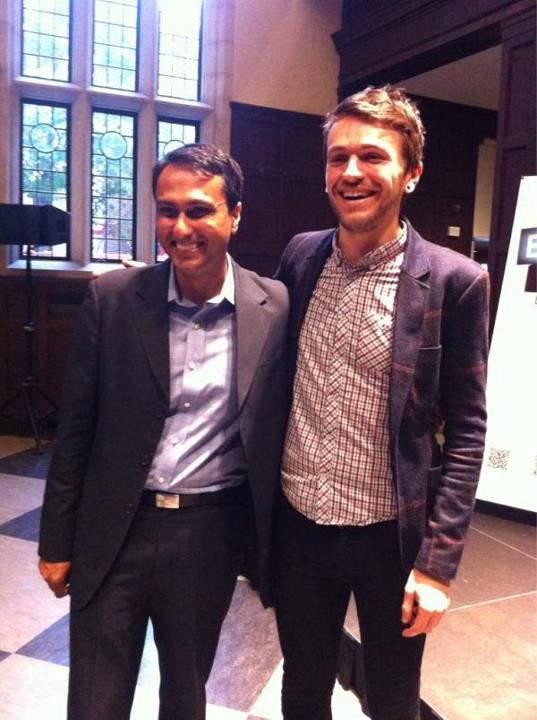
    Eboo Patel and Chris Stedman

    Eboo Patel and Chris Stedman (Photo courtesy of the author)

    On my last day of work at Interfaith Youth Core, I had lunch with its founder, Eboo Patel. As we ate I told him that, inspired by his book Acts of Faith, I was going to write a book of my own about atheism and interfaith work.

    “Yeah?” he replied, grinning and taking a bite of his sandwich. “When?”

    “Oh,” I offered, realizing I hadn't actually thought about details. “Someday…”

    “When?” he said again.

    “In five years? Maybe 10?”

    He thought for a second, then said, “Why not start now?”

    I chewed on my sub, and on his question. Why not now? I came up with several reasons immediately: I'm young; I like to write but have little formal training; I'm really young. But I swallowed those thoughts and said: “Sure. Why not? I'll start writing and see what happens.”

    As soon as I started writing, I couldn't stop. Before I knew it I had a book contract, and then a finished book.

    While I was writing, so was Eboo. I got a copy of his excellent new book, Sacred Ground—a vital, urgent exploration of America's dark history of both prejudice toward religious minorities but also its principled promise of religious liberty—a few weeks ago. When I read the chapter on interfaith leadership, where he describes some of the journey I share in Faitheist, I was moved.

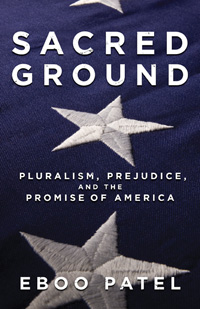
    Sacred Ground by Eboo PatelA story about an atheist in a book like Sacred Ground is good for atheists; it demonstrates that we have a unique contribution to make to America's diverse religious landscape. And it will promote the idea of atheists as largely goodhearted people who want the same things most Americans do to people who might believe otherwise—people whose perceptions of atheists are based on caricature rather than meaningful relationships.

    Storytelling can do that. It can connect and inspire us to new ways of thinking, to greater empathy and to increased familiarity with different experiences, identities and values.

    I thought more about the power of narrative as I followed the news cycle last Sunday with a broken heart, when a white gunman stalked into a Sikh temple in Wisconsin and shot and killed six people and wounded several others. I surveyed reactions to the shooting and found they were significantly more muted than the response to the Aurora tragedy several weeks before. Perhaps people are becoming more accustomed to awful, violent outbursts such as this, but I wonder if the reactions don't say something about the way we see “others” in this country.

    Upon hearing news of the shooting in a Colorado movie theater, many people likely conjured an image in their mind. They could imagine what it was like there, and they could imagine themselves in it. But how many Americans can envision a Sikh gurdwara and what goes on inside? Many people can imagine themselves in a movie theater, but how many can picture themselves, or people they love, in a gurdwara? How many people know about American Sikhs' sacred ground?

    This is just one reason why Sacred Ground is such an important book—and why it is so important for people to share their stories. The day after the horror in Wisconsin, my dear friend Valarie Kaur, a longtime Sikh activist, shared her story on CNN. We tell these stories—stories of being Muslim, of being Sikh, of being an atheist and of finding common ground—with the hope that they will accomplish what Sacred Ground suggests: that familiarity with diversity changes how we think about it.

    1439My hope is that Sacred Ground, Faitheist, Valarie's words and work, and the cumulative efforts of everyone who promotes pluralism will build a world where tragedies like the one in Oak Creek, Wisconsin, never happen again. We all—Muslims, atheists, Sikhs and everyone else—have stories to tell, and sharing them with others will help make the world a place where everyone is free to proclaim their beliefs with pride and without fear of violent recourse.

    I'm happy to say that we are building that world—in the last week alone, atheist friends donated to rebuild a mosque destroyed by arson in Joplin, Missouri; Muslim friends petitioned to free Alexander Aan, an atheist jailed in Indonesia; religious friends decried Pat Robertson's statement blaming atheists for the shooting in Wisconsin (following a trend of blaming atheists for tragedies such as this, an issue I explore in Faitheist); people of all different beliefs (atheists, Muslims, Sikhs, Zoroastrians, Pagans, Christians and others) joined me at a Sikh gurdwara for a memorial where we shed tears of mourning and of happiness. When a mosque in Illinois was shot at on Friday—just two days after Rep. Joe Walsh said at a town hall meeting just 15 minutes away that there are Muslims in Illinois towns “trying to kill Americans every week”—atheist and religious friends reached out to him and asked him to condemn this act as awful and un-American. So when naysayers claim that building bridges between different communities is impossible or a waste of time—that it is not possible for atheists to be in solidarity with those who believe in sacred ground—I am encouraged by the reality that we are improving the world through the stories and values we share and the actions we take together.

    So to you, reader, I ask the question Eboo posed to me over a set of sandwiches: You have a story, and sharing it will help build a better world. Why not start now?

    About the Author

    Chris Stedman is the Assistant Humanist Chaplain at Harvard
    University and the author of Faitheist: How an Atheist Found Common Ground with the Religious. He writes for CNN.com, MSNBC.com, Huffington Post,
    and Religion Dispatches.

  • Notable Mentions:

    4463We Shall Not be Moved: Rebuilding Home in the Wake of Katrina by Tom Wooten 

    Review in the Wall Street Journalwhich calls the book a: “moving portrait.” 

    UTNE online excerpt: “In We Shall Not Be Moved, Tom Wooten presents vivid narratives through the eyes and voices of residents rebuilding their homes after Hurricane Katrina, telling a story of resilience as entertaining as it is instructive and how citizens, remarkably, turned a profound national failure into a story of hope.” 

    Sacred Ground: Pluralism, Prejudice, and the Promise of America by Eboo Patel

    Publishers Weekly:“…an accessible and inspiring introduction to the meaning and practice of pluralism.”

    Excerpt published on Huffington Post

    A Queer and Pleasant Danger: The true story of a nice Jewish boy who joins the Church of Scientology and leaves twelve years later to become the lovely lady she is today by Kate Bornstein

    Review in The Gay and Lesbian Review July-August issue: “There are a number of adjectives that one could use to describe A Queer and Pleasant Danger: snarky, funny, anguished, frightening, heartbreaking, brave, honest…this is a book that is dangerously appealing.” (Subscriber only access)


    Coming Soon:

    0331

    Remembering the Music, Forgetting the Words: Travels with Mom in the Land of Dementia by Kate Whouley (Paperback out September 25)

    • October 2012 Indie Next List "Now in Paperback" pick

    Rare Birds: The Extraordinary Tale of the Bermuda Petrel and the Man Who Brought It Back from Extinction by Elizabeth Gehrman (October)

     “Vanishing species these days are a dime a dozen. The truly rarer bird is the human being whose life stands between a creature and its permanent oblivion. David Wingate is a truly pivotal person on whom the fate of a whole species turned. It’s a remarkable seabird whose existence depended on this rare man. And this book, rendered with style and grace, is his story.”

    —Carl Safina, author of Song for the Blue Ocean and The View From Lazy Point; A Natural Year in an Unnatural World 


    Author Events:

    Photo (2)
    Kate Bornstein (A Queer and Pleasant Danger)

    A packed house at Powell's Books the other night, and marquee billing!

    August 15, 7pm Oakland, Diesel Books

    August 16, 7:30pm Santa Cruz, Bookshop Santa Cruz


    1441Gather at the Table: The Healing Journey of a Daughter of Slavery and a Son of the Slave Trade, Thomas N. Dewolf and Sharon Morgan (October)

    October 9: Gather at the Table book launch — 6:00pm, Martin Chapel; Eastern Mennonite University, 1200 Park Road, Harrisonburg, Virginia
    October 14: Davies Memorial Unitarian Universalist Church — 10:30am, 7400 Temple Hills Rd. Camp Springs, MD
    October 17: Bloomsburg University — schedule pending, 400 East Second Street Bloomsburg, PA
    October 24: Trinity Church Boston — 7:00pm, 206 Clarendon Street, Boston, MA 02116
    October 25: Harriet Beecher Stowe Center — 5:00pm, 77 Forest Street, Hartford, CT
    November 9: African American Jazz Caucus event– schedule & location pending, Indianapolis, Indiana
    November 10-12: Southwest Michigan Black Heritage Society – multiple events in multiple venues, details to come, Kalamazoo, Michigan


    Mary Oliver (award-winning author of numerous books of poetry, including twelve available from Beacon Press.)

    October 15, 2012 New York, NY: 92nd Street Y

    Wednesday & Thursday, October 24 & 25, 2012 Boston, MA: Boston Museum of Fine Arts 

    Sunday, October 28, 2012  Bethesda, MD:  The Strathmore PAC.  Evening Joint Reading with Mary Oliver & Billy Collins

    Monday, November 12, 2012 Milwaukee, WI: Marquette University  

  • 7748An inspiring call for Americans to defend the values of inclusiveness and pluralism by one of our best-known American Muslim leaders 

    There is no better time to stand up for your values than when they are under attack.

    In the decade following the attacks of 9/11, suspicion and animosity toward American Muslims has increased rather than subsided. Alarmist, hateful rhetoric once relegated to the fringes of political discourse has now become frighteningly mainstream, with pundits and politicians routinely invoking the specter of Islam as a menacing, deeply anti-American force.

    In Sacred Ground, author and renowned interfaith leader Eboo Patel says this prejudice is not just a problem for Muslims but a challenge to the very idea of America. Patel shows us that Americans from George Washington to Martin Luther King Jr. have been "interfaith leaders," illustrating how the forces of pluralism in America have time and again defeated the forces of prejudice. And now a new generation needs to rise up and confront the anti-Muslim prejudice of our era. To this end, Patel offers a primer in the art and science of interfaith work, bringing to life the growing body of research on how faith can be a bridge of cooperation rather than a barrier of division and sharing stories from the frontlines of interfaith activism.

    Patel asks us to share in his vision of a better America—a robustly pluralistic country in which our commonalities are more important than our differences, and in which difference enriches, rather than threatens, our religious traditions. Pluralism, Patel boldly argues, is at the heart of the American project, and this visionary book will inspire Americans of all faiths to make this country a place where diverse traditions can thrive side by side.

    Buy Sacred Ground from Beacon Press
    Amazon (Kindle) | BN.com (Nook) | Indiebound | Apple iBookstore | Google Play

    Read a selection from the book at Scribd.

    Read Eboo Patel's posts at Beacon Broadside. 

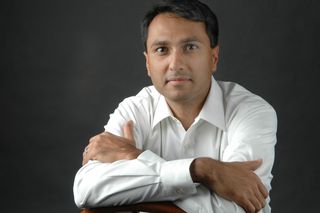
    Eboo_Patel_Color_PhotoAbout the author: Eboo Patel is the founder and president of Interfaith Youth Core and the author of Acts of Faith. He was a member of President Obama’s inaugural faith council, is a regular contributor to the Washington Post, Huffington Post, CNN, and public radio, and speaks frequently about interfaith cooperation on college campuses. He lives in Chicago with his wife and two boys.

    “Interfaith cooperation is one of America’s founding ideals. It still sets us apart from much of the world. Eboo Patel has lived that value and, in this book, spreads that good word. Uplifting and invaluable, Sacred Ground is essential reading for our polarized era.”—Walter Isaacson, author of Steve Jobs and Benjamin Franklin

    “At a time when ignorance and suspicion are holding us back from building true community with our neighbors, Eboo Patel offers a light in the darkness. He challenges the bigotry and intolerance that is seeping into our political rhetoric, reminding us that America is a country built on the pillars of pluralism and tolerance. In both Sacred Ground and his wonderful interfaith work, Eboo offers an opportunity for us to move to higher ground in our relationships with our Muslim brothers and sisters, and to play our part in building a ‘beloved community for all people,’ both in the United States, and around the world.”—Rev. Jim Wallis, author of God’s Politics

    “Eboo Patel is a remarkable young man with the wisdom to seek truth and the courage to speak it. One of America’s foremost advocates and practitioners of interfaith understanding, he has written a book that combines timely social commentary with compelling history and a wealth of personal anecdotes. Sacred Ground is a refreshing, thought-provoking, myth-smashing, and deeply patriotic exploration of American identity and ideals.”—Former Secretary of State Madeleine Albright

    “Sacred Ground is simultaneously a chronicle of religious tensions in post–9/11 America and an account of how to create, through trial and error and critical self-reflection, the most successful interfaith movement in the country. Patel probes like a professor, inspires like a preacher, and writes like a poet. I really loved this book; it is a tale that is truly hard to put down.”—Robert D. Putnam, author of American Grace

    “Eboo Patel has been a transformative force in our young and tumultuous century. And he has an utterly original experience of what robust religious identity can mean in modern lives. With this book, he opens the idea of "inter-faith" into a vision of America that is practically informative, refreshingly challenging, and full of hope.”—Krista Tippett, host of NPR’s On Being

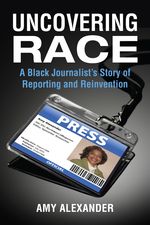
  • Amy Alexander is the author of  Uncovering Race: A Black Journalist's Story of Reporting and Reinvention and is co-author, with Alvin F. Pouissant, of Lay My Burden Down: Suicide and the Mental Health Crisis Among African-Americans. This post originally appeared at her blog.

    Baldwin2Last week a silly “debate” over Olympic champion gymnast Gabby Douglas’ hair dominated social media. Fortunately, by the weekend, the same social media network that so often exasperates me coughed up an unexpected jewel:

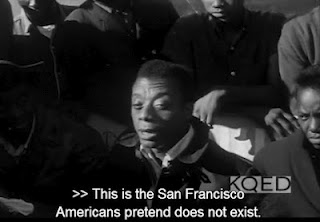
    A 1963 documentary, Take This Hammer, featuring James Baldwin in San Francisco.

    A Facebook friend, Darryl Cox, put the link on my Wall after I’d posted a story on gang violence in SF that I’d read in The San Francisco Chronicle. Cox, who had worked in city government in San Francisco decades ago, is an excellent source of contemporary black history on “the Paris of the West.”

    Cox told me that Take This Hammer had only aired once in San Francisco, in 1963, and that it had upset the powers that be in my hometown. I watched it for the first time last week, on August 3—coincidentally, one day after what would have been Baldwin’s 88th birthday. It was produced by KQED on behalf of National Education Television, predecessor of WNET in New York.

    In it, Baldwin is an expert interrogator of his subjects, black residents of San Francisco. He is physically small but armed with an alarmingly direct gaze, a fearsome intellect, and a sharp way of drawing out his subjects. The producer or director also made the wise decision to cut in excerpts of Baldwin talking directly to the camera, seated in what appears to be a tidy apartment, smoking, wearing a natty white shirt and neck-kerchief, and succinctly, somewhat dispassionately deconstructing his findings.

    ALEXANDER-UncoveringRaceAmong several pungent comments and observations by Baldwin, during the 44-minute long documentary:

    —”There will be a Negro president of this country, but he won’t be president of the same nation we are sitting in now.”

    —”The Liberal can’t be safe and heroic too.”

    —“You cannot pretend you’re not despised if you are.”

    I am greatly moved by this documentary. For starters, Baldwin is a literary and journalistic hero of mine. Second, as anyone who has read my opinion-writing during the past decade probably knows, I was born in San Francisco in 1963.

    Growing up there, I felt a thrill of endless possibilities—much as the techie-hipsters and financiers who currently throng its streets likely experience—a pervasive sense of optimism aided in no small part by the city’s spectacular vistas, cozy layout, sophisticated understatement. (Though a journalist friend, Tim Golden, once told me that he found the city and some of its denizens a mite ‘precious’ for his liking.)

    My family was middle-class, we lived for a time in subsidized housing on Potrero Hill, then Bernal Heights, then in a tidy house on the West or ‘ocean’ side of the city, which my Mom bought. I attended well-funded public schools in the Sunset District and went to church camp in Sonoma County every summer. Only when I reached my mid-20s and entered the workforce in earnest did it occur to me that my race or gender might be features that could slow my professional development and possibly dampen my chances for a successful career. As a 1963 resident tells Baldwin in “Take this Hammer,” no blacks had to fear a Bull Connor or a Klansman chasing them down the city’s hilly inclines. But one might just be “killed with a pencil,” instead, in the city’s corporate or retail workforce. My adult family-members all worked in government agencies, which offered job security and enforced meritocracy. There were few immediate role models for me as I made my entree to private industry—the news business—during and after college.

    I outline that dynamic in greater detail in my current book, and acknowledge that the media business in the Bay Area—such as it was in the 1980s when I came of age—was and is a unique animal within the overall workforce in San Francisco. And now, of course, the media industry has been all but subsumed by the tech industry, and the population of black residents has been diminishing steadily since the early 1980s. Are native blacks who remain being employed at these shiny new enterprises? What do you think?

    The sentiments expressed by the city’s black residents who were interviewed by Baldwin in ‘63—particularly the young adult males who are frustrated over being shut out of the workforce—are devastating… and familiar. I have watched this documentary three times since Darryl Cox shared it with me.

    I am still processing Take this Hammer and will probably write about it again.

    625693_10151156302933854_2008718330_nFor now, I hope you find the time to watch it in full: I love my hometown but I hope you can forgive me if I am also a bit cynical about its legendary reputation as a citadel of social and economic egalitarianism.

    Take This Hammer lives, by the way, at the San Francisco Bay Area Television Archive, which is housed at my alma mater, San Francisco State University. I believe it deserves a home, too, at the Paley Center in New York. Then again, as a black SF native and a Baldwin adherent, I am not exactly impartial about its historic significance.

    (Oh, and a viewing tip: Unless you need them, disable the captioning feature before watching.)

  • David Chura is the author of I Don’t Wish Nobody to Have a Life Like Mine: Tales of Kids in Adult Lockup. He has worked with at-risk teenagers for the past 40 years. For 26 of those years, he taught English and creative writing in community based alternative schools and in a county penitentiary. His writings have appeared in the New York Times as well as other scholarly and literary journals. He blogs at kidsinthesystem.wordpress.com.

    This post originally appeared at Juvenile Justice Information Exchange. 

    Bigstock-Dictionary-Series--Law-Justi-4092167“You don’t care about the victims. All you care about are those kids.”

    It was a comment I’ve heard in one form or another at book events, at juvenile justice talks I’ve given, or in response to pieces I’d written about our national policy of retribution towards troubled kids. I have to admit, though, this guy was a bit more, shall I say, challenging, as he stood up after my reading and made his comment.

    I’d read several advice articles for authors on giving readings suggesting you have “pat answers” ready for the Q & A. It keeps things moving. It may be good advice, but I’ve found it doesn’t work for me. Juvenile justice is too potent a topic be “pat answered” away. Besides, I wrote I Don’t Wish Nobody to Have a Life Like Mine: Tales of Kids in Adult Lockup about the young offenders I taught for 10 years in the adult county prison to get people thinking about this much-neglected issue. So I do my best to address each concern sincerely.

    Fielding the man’s rather angry question, I talked about my belief that kids should indeed be held accountable for their actions; that they should learn that what they did affected not only their victims and their families and communities but also the young offenders themselves and their families and communities. What I couldn’t support was the punitive quality of that accountability as it is now practiced in our prison system.

    I could tell that evening’s questioner was pretty disgusted. I was one more bleeding heart, one more knee jerk liberal, one more sucker taken in by “those kids.” He was gracious about it. He didn’t say any of that out loud. He didn’t have to. I’d heard it all before.

    But his comment stayed with me long after the event: What did I feel about the victims?

    I talk a lot about victims in my book. But the victims in this case are the locked up high school students I worked with for those 10 years. In telling their stories — stories of childhood neglect and abandonment; of sexual abuse; of violence in the home and on the streets; of parental addiction and disease — I wanted readers to at least be aware of the fertile ground of mistreatment in which these children grew up. From my challenger’s point of view I’m sure I do go on too much about “those kids” and not about the people who suffered because of their crimes. (It’s important to note, however, that many of the teens I came across in jail — and this holds true for prisons nationally — were serving time for victimless, nonviolent offences.) I was beginning to wonder if maybe the guy was right. Maybe I didn’t care about crime victims?

    Like all good questions, this one stayed with me well afterwards. Yet despite the doubts he raised for me I knew that I did care deeply about the people hurt by crime; that, in an odd twist on the title of my book, “I don’t wish nobody” to have their lives damaged by the irresponsible acts of others, young or old. I turned the question over and over until finally I understood more clearly where I stood: the only way to protect society from youthful offenders and to prevent more crime was to protect the offenders themselves.

    Study after study has shown that the harsh treatment of young people locked up in our nation’s jails has not only failed to reduce recidivism but has also created angrier, more bitter, more violent juvenile offenders. Lock a 14- or 15- year-old up in an adult prison with its toxic environment of noise and dirt; of abuse, intimidation and paranoia; of violence and aggression, and that kid will not leave jail with a heightened sense of responsibility towards society, ready to re-examine and change his or her behavior.

    ChuraI know that my reasoning wouldn’t convince those who feel that any punishment for criminal actions is not harsh enough to give victims the justice they seek. But the more I think about it the more convinced I am of the wisdom — and commonsense, which wisdom often is — behind it: if we truly care about victims, if we want to shield people from the hurt of crime we must look at and change the way we bring juvenile offenders — all offenders, really — to true justice.

    During my tenure as a jailhouse teacher and while I was writing my book, I always thought of the kids I taught as children of disappointment, children let down time and time again by the world of adults — parents, teachers, clergy, neighbors. Prison breeds disappointment, and as I did my own 10-year jail bid I watched many of my students come in as children of disappointment and leave young adults of disappointment.

    That’s a transformation no one truly wants and protects no one.

  • Our Authors Weigh In:

    7748 (1)Eboo Patel (Sacred Ground: Pluralism, Prejudice, and the Promise of America, out August 8) on the shootings at a Sikh temple in Oak Creek, Wisconsin:

    The shooting in Oak Creek reminds us that the forces of prejudice are loud. They sling bigoted slurs and occasionally bring 9mm guns to places of worship. But we are not a country of Wade Michael Pages.

    We are a country whose first president, George Washington, told a Jewish community leader that “The Government of the United States…gives to bigotry no sanction, to persecution no assistance.”

    We are a country where Jane Addams welcomed Jewish and Catholic immigrants streaming in from Eastern Europe in the 19th century as citizens, not as strangers.

    We are a country where a young black preacher, Martin Luther King, Jr., learned nonviolence not only from Jesus Christ, but also from an Indian Hindu named Gandhi and from a Buddhist monk named Thich Nhat Hanh.

    And we must be a country where a new generation of leaders rises up to write the next chapter in the glorious story of American pluralism, or else we will forfeit the territory to those who would shoot at our neighbors while they worship.

    Eboo Patel and Hana Suckstorff at Sojourners

    Mark Hyman (The Most Expensive Game in Town: The Rising Cost of Youth Sports and the Toll on Today’s Families) answering the question: Are Olympic Parents Supportive or Overbearing?

    Exuberant parents aren’t the problem in youth sports. Overzealous, overly ambitious parents are. Undoubtedly, they are part of the U.S. delegation too. As parents, we make a horrible mistake when we confuse our ambitions with what kids truly want and need from sports. 

    The New York Times  “Room for Debate”


    Notable Mentions:

    0324The Land Grabbers: The New Fight over Who Owns the Earth by Fred Pearce

    Washington Post review: “In The Land Grabbers, Pearce has produced a powerful piece of journalism that illuminates how the drive for expanded food production is transforming the planet. Anyone who cares where her next meal is coming from should read it.” (Amen!)


    A Twist of Faith: An American Christian's Quest to Help Orphans in Africa by John Donnelly

    Review at Humanosphere, a blog attached to Seattle’s KPLU: “A rousing good read and cautionary tale of one man’s mission to help AIDS orphans in Africa — and how good intentions can pave the road to hell…”


    The Cure for Everything: Untangling Twisted Messages about Health, Fitness, and Happiness by Tim Caulfield

    Reviews at the New York Times ("though he may write with the cheerful self-deprecation of the slacker dude, he thinks with an academic’s rigor and precision and knows the health maintenance territory inside out"), Health Affairs ("he also discovered that finding the cure for anything is maddeningly elusive"), and Science-Based Medicine ("You’re never left wondering what the science says, but it’s distilled with his own particular perspective").


    Coming Soon:

    0187

    The $60,000 Dog: My Life With Animals by Lauren Slater (November)

    Kirkus Reviews in print (Aug 15) and online (now): “Slater continually surprises with connections she makes. Beautifully written, and not just for animal lovers.”


    Rare Birds: The Extraordinary Tale of the Bermuda Petrel and the Man Who Brought It Back from Extinction by Elizabeth Gehrman (October)

    Publishers Weekly review July 23


    Faitheist: How an Atheist Found Common Ground with the Religious by Chris Stedman (November)

    “Chris Stedman’s remarkable work has spanned from advocating for LGBTQ rights among Evangelical Christians to, in his current role at Harvard, founding the first-ever atheist-led interfaith initiative — and he's only twenty-five. Part memoir and part blueprint, Faitheist not only recounts his personal journey (which would be a riveting story on its own), but also shows — sensitively and humorously — how Humanists can live out our values with both empathy and honesty. This book represents the growing secular movement at its very best.” —Greg M. Epstein, Humanist Chaplain at Harvard University, author of Good Without God: What a Billion Nonreligious People Do Believe

    “If Chris Stedman had become a pastor, he’d have a big, big church. Instead, he’s a humanist hero, a compelling writer whose efforts to build bridges between non-believers and the faithful will leave a lasting mark. Faitheist should be required reading in Sunday schools and Richard Dawkins’s house alike.” —Kevin Roose, author of The Unlikely Disciple


    Author Events:

    Kate Bornstein (A Queer and Pleasant Danger)

    August 9, 12:30pm Seattle: Amazon.com Meet the Author/Glamazonians Q&A and interview for Omnivoracious blog

    August 11, 7pm  Seattle, Elliott Bay Book Co.

    August 13, 7:30pm Portland, Powell's Books

    August 14, 7:30pm San Francisco, Books Inc. in the Castro

    August 15, 7pm Oakland, Diesel Books

    August 16, 7:30pm Santa Cruz, Bookshop Santa Cruz


    Mary Oliver (award-winning author of numerous books of poetry, including twelve available from Beacon Press.)

    October 15, 2012 New York, NY: 92nd Street Y

    Wednesday & Thursday, October 24 & 25, 2012 Boston, MA: Boston Museum of Fine Arts 

    Sunday, October 28, 2012  Bethesda, MD:  The Strathmore PAC.  Evening Joint Reading with Mary Oliver & Billy Collins

    Monday, November 12, 2012 Milwaukee, WI: Marquette University