• On this day eleven years ago, life in America was altered in ways we still grapple with today. Most of us have vivid memories of the day–the phone calls urging us to turn on the television, the shock of realizing the deliberateness of what at first we imagined could only be a horrible accident, the concern for loved ones and strangers that flooded our emotional circuits. For those among us who survived the attacks, who witnessed them directly, and who lost family and friends, we hold you in our thoughts today. 

    In honor of the day, here are links to the thoughts of several of our authors on remembering the attacks, how they found comfort in the aftermath, and how we can move forward in ways that heal divisions forged out of anger and prejudice. 

    "Ground Zero," an excerpt from Sacred Ground by Eboo Patel (You can also listen to Eboo Patel on the Brian Lehrer show and, later today, watch him speak with Christiane Amanpour on CNN at 3pm.)

    Joan Murray on writing her poem "Survivors–Found" (read the poem here)

    Eboo Patel on making sense of the day through the words of Rumi and Walt Whitman 

    Danielle Ofri: A Bellevue Doctor Remembers 9/11

    Kate Whouley: Eating Cake on 9/11

    Susan Katz Miller: Raising My Interfaith Children With Hope

    An excerpt from We Are All Suspects Now: Untold Stories from Immigrant Communities after 9/11 by Tram Nguyen 

  • The Perfect Complement to the Conventions


    LIPMAN-TweetLandofLibertyTweet Land of Liberty: Irreverent
    Rhymes from the Political Circus
     by @ElinorLipman

    Elinor Lipman spoke with Here and Now about tweeting political poetry.

    Shelf Awareness for Readers author interview.

    Shelf Awareness Book Trade book trailer of the day.

    Be sure to watch and share the Elinor Lipman for Tweet Laureate Campaign Video.


    Listen and Watch:

    7748 (1)
    Sacred Ground: Pluralism, Prejudice, and the Promise of America by Eboo Patel

    Listen to Eboo speaking with Wisconsin Public Radio's Joy Cardin Show.

    Upcoming: Patel interview on
    Christine Amanpour's show, "Amanpour," on CNN International
    September 11

    Iowa
    Public Radio/River to River; September 07.

    Melissa
    Harris-Perry Show/MSNBC; September 09.

    WNYC
    Radio/Brian Lehrer Show; September 11.

    Watch Eboo Patel give the convocation lecture at Concordia College, where he discusses the journey of college life. 


    Notable Mentions:


    BOBROW-STRAIN-WhiteBreadWhite Bread: A Social History of the Store-Bought Loaf
     by Aaron
    Bobrow-Strain

    Interviewed in a feature about white
    bread in Boston
    Globe

    Mother Earth News review in the Aug/Sept issue:  “A really good read.”

    Interview on KCRW (Southern
    California NPR) “The Lunch Show.”

    The Most Expensive Game in
    Town: The Rising Cost of Youth
    Sports and the Toll on Today's Families
     
    by Mark Hyman

    Boston Globe review in sports book round-up.

    Remembering the Music, Forgetting the Words: Travels with Mom in the Land of Dementia by Kate Whouley

    Boston Globe author and book mention

    Coming Soon:

    Fast Future: How the Millennial Generation Is Shaping
    Our World
    by David Burstein (Forthcoming February 2013)

    “The millennials are a unique generation with a
    strong entrepreneurial streak that has seen them create some of the most
    impactful businesses of this century. As a millennial entrepreneur, I found Fast
    Future
    to be an inspiring and powerful account of the world we live and
    work in every day.” —Ben Lerer, Founder & CEO, Thrillist

    The Rebellious Life of Mrs.
    Rosa Parks
     by Jeanne Theoharis (Forthcoming January 2013)

    "Charisma is not a word often
    used to describe Rosa Parks yet we have to recognize her star. The Rosa Parks
    challenge to the political system was deep and lasting even while she never
    raised her voice. The first female Speaker of the House of Representatives once
    said, 'You can get a lot done if you don’t need to take credit for it.' She
    took a page from the book of Parks. Theoharis’ scholarship brings forth a woman
    whom many followed without ever realizing they were. She was courageous and
    strong. She also had a wonderful sense of humor. And an awesome sense of
    responsibility. This is a much needed book on the woman who is, arguably, the
    most important person in the last half of the twentieth century. Just as the
    Lincoln Memorial needs a statue of Frederick Douglass gently bending over with
    a pen in his hand for Lincoln to sign the Emancipation Proclamation, the statue
    of Martin Luther King, Jr. needs a statue of Rosa Parks just one or two steps
    ahead mouthing the words: 'Come on, Dr. King. We’ve got work to do.'"
    –Nikki Giovanni, Poet 


    Upcoming Author Events:

    Sacred Ground: Pluralism, Prejudice, and the Promise of America by Eboo Patel 

    Eboo-sacredground

    September 10th, 2012: Union Theological Seminary, New York, NY

    September 17th, 2012: Augsburg College, Minneapolis, MN

    October 9th, 2012: College of St. Scholastica, Duluth, MN

    October 11th, 2012: : Chicago Ideas Week, Chicago, IL

    Upcoming media appearances: MSNBC/Melissa Harris-Perry Show, Sunday, September 9th

    WNYC Radio/Brian Lehrer Show (NPR New York), Tuesday, September 11th


    Tweet Land of Liberty: Irreverent Rhymes from the Political Circus
    by Elinor Lipman


    Lipman-TweetlandTONIGHT! September 6th, 2012: Corner Bookstore (NYC)

    September 23rd, 2012: Writers for Obama and Elizabeth Warren at the Hotel Northampton (Northhampton, MA)

    September 24th, 2012: Broadside Books at 7 PM

    September 27th, 2012: Women & Children First (Chicago, IL)

    September 28th-29th, 2012: Ragdale Foundation, Lake Forest, IL

    October 2nd, 2012: Port Washington Public Library (Port Washington, NY)

    October 10th, 2012: Brookline Booksmith (Brookline, MA)

    October 11th, 2012: Worcester Public Library

    October 17th, 2012: Hewlett Woodmere Public Library (Long Island)

    October 30th, 2012: Porter Square Books (Cambridge, MA)


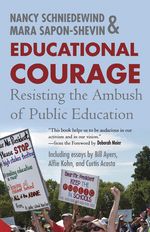
  • SAPON-SHEVIN-EducationalCourageA collection of empowering stories bringing together the voices of teachers, parents, and educational activists fighting market-driven educational policies
     

    Lost amid the debate over educational policies are the stories of the educators, parents, and students who are most affected by legislation such as No Child Left Behind and Race to the Top. In Educational Courage, veteran educators and activists Nancy Schniedewind and Mara Sapon-Shevin bring together the voices of those who are resisting market-driven initiatives such as high-stakes testing, charter schools, mayoral control, and merit pay. The diverse narrators who write in this volume confront the educational agendas that undermine teachers' judgment and knowledge, ignore the different backgrounds of students and parents, and debase the learning process. Yet these educators, parents, and activists also offer stories of resistance and hope as they fight to uphold the ideals of democratic public education. 

    Educational Courage includes four sections:

    1. "Is This What We Call 'Education'?"
    2. "I Won't Be a Part of This!"-Educators, Parents, Students, and Community Members Resist
    3. Resisting by "Working in the Cracks"-Creating Spaces to Teach Authentically
    4. "Not My Voice Alone"-Organizing to Reclaim Public Education

    View the table of contents.

    Read the introduction on Scribd.

    Additional Resources

    Readings not included in the book can be found on the Educational Courage website. 

  • Glenn Branch is Deputy Director of the National Center for Science Education. Branch is co-editor, with Eugenie Scott, of Not in Our Classrooms: Why Intelligent Design Is Wrong for Our Schools, and the author or coauthor of numerous articles on creationism and evolution in such publications as Scientific American, The American Biology Teacher, and Annual Review of Genomics and Human Genetics. This post originally appeared on the NCSE blog.

    3278A two-and-a-half-minute video with Bill Nye discussing the creationism/evolution controversy went viral, garnering over 2.5 million views in its first week on-line. Posted on August 23, 2012, on the YouTube channel of Big Think, under the title "Creationism is not appropriate for children," the video reiterates the centrality of evolution to the life sciences and laments the prevalence of evolution denial in the United States. In it, Nye remarked, "And I say to the grownups, if you want to deny evolution and live in your world, in your world that's completely inconsistent with everything we observe in the universe, that's fine, but don't make your kids do it because we need them. We need scientifically literate voters and taxpayers for the future."

    Nye later told CBS This Morning (August 28, 2012), "My concern is you don't want people growing up not believing in radioactivity, not believing in geology and deep time. You don't want people in the United States growing up without the expectation that we can land spacecraft on Mars. You want people to believe in science, this process, this great idea that humans had to discover more about the universe and our place in it, our place in space. And I really want to emphasize, I'm not attacking anybody's religion, but science, if you go to a museum and you see fossil dinosaur bones, they came from somewhere, and we have by diligent investigation have determined that the earth is 4.54 billion years old."

    NCSE's Steven Newton was interviewed on KPCC (August 29, 2012) for its story about Nye's video. Nye's remarks were fully in step with the views of the scientific community, Newton explained, adding, "Science teachers around the country are pretty much in sync with scientists around this country in understanding that evolution is the foundation of the biological sciences, and as such, it should be part of the curriculum and it should be taught," citing the courageous teachers in Dover, Pennsylvania, who in 2005 refused to read the evolution disclaimer mandated by the school board there. "Intelligent design or overtly biblical Creationism — all of them have the same root [in] a denial of evolution and how science works," Newton commented.

    A Supporter of NCSE, Bill Nye "The Science Guy" was the host of the popular science education television programs Bill Nye the Science Guy— which won eighteen Emmys — and The Eyes of Nye; he is currently the executive director of the Planetary Society, the world's large space interest organization. The video was by no means Nye's first excursion into defending the teaching of evolution: in 2011, for example, he told Popular Mechanics, "it's fine if you as an adult want to run around pretending or claiming that you don't believe in evolution, but if we educate a generation of people who don't believe in science, that's a recipe for disaster. … the main idea in all of biology is evolution. To not teach it to our young people is wrong."

  • David Bacon is a writer and photojournalist based in Oakland and Berkeley, California. He is the author of Illegal People: How Globalization Creates Migration and Criminalizes Immigrants, and his new bookbook about migration and work will be published by Beacon Press in 2013. 

    Bacon writes about labor, immigration, and international politics for The Nation, In These Times, American Prospect, TruthOut, among other publications, and he regularly appears on KPFA and KQED radio. The East Bay Express described his work: "As the US labor movement has come under near constant attack in recent years, the Oakland journalist is one of the last of his breed in the country." 

    For Labor Day, we've collected some of Bacon's stories about labor as a snapshot of a year in workers' rights. 

    All photos copyright David Bacon, used by permission of the author.


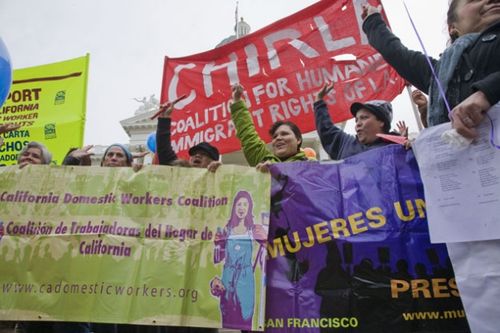
    Bacon_domestic_march_big_615_410

    UpFront on KPFA: (August 22) David Bacon interviews a house cleaner about California's Domestic Workers' Bill of Rights (which passed the California Assembly this past week). Interview starts at 18:15.

    UpFront – Drones, Castlewood, Vote Suppression – August 22, 2012 at 7:00am
    http://kpfaweb.kpfa.org/misc/utilities/players/1pixelout/player.swf
    Click to listen (or download)


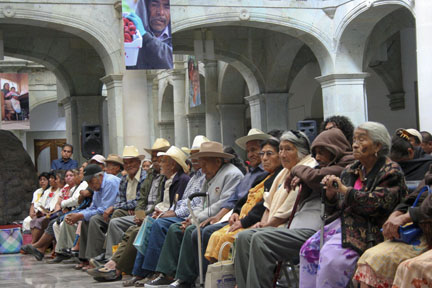
    DavidBacon_Mississippi

    "In early April, an anti-immigrant bill like those that swept through legislatures in Alabama, Georgia and South Carolina was stopped cold in Mississippi." How Mississippi's Black/Brown Strategy Beat the South's Anti-Immigrant Wave The Nation, April 20.


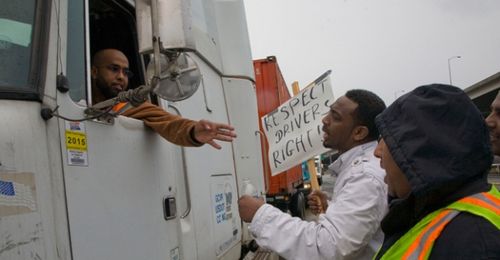
    Seattledriversprotest_615_320_s_c1

    "Employers say they’re 'independent contractors.' Drivers call that a legal trick to deny them their rights–a nice-sounding label obscuring an ugly reality." Seattle Port Strike Challenges "Independent Contractor" Lie In These Times, February 21.


    Dnbdiadelmigranteoax02

    "Migrant rights activists, artisans and public officials spoke about the important role migration continues to play in Oaxaca's economic, social, political and family life. The state in southern Mexico is the source of one of the largest waves of migration from Mexico to the United States." "Oaxaca's New Government Calls for Migrant Rights," TruthOut, January 5.


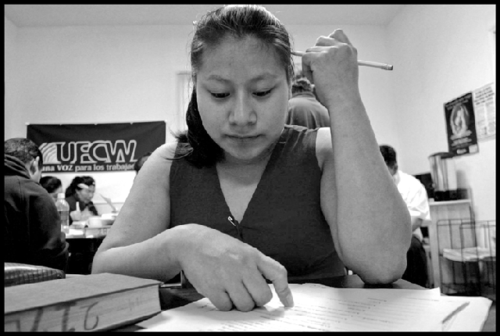
    Woman-pencil

    "A bruising 16-year battle, the fight brought together African American, white, and Mexican immigrant workers, who were able to find common ground despite the company’s attempts to use racial division and immigration enforcement to try to defeat them." "Common Ground on the Kill Floor: Organizing Smithfield," Labor Notes, April 20.

  • In honor of Labor Day, online orders at Beacon.org are 20% off with the code LaborDay12. Offer ends Sept. 4, so shop now!

    Bill Fletcher Jr. is the author of "They're Bankrupting Us!": And 20 Other Myths about Unions. Fletcher is a long-time racial-justice, labor, and international activist, scholar, and author. He has been involved in the labor movement for decades, and is a widely known speaker and writer in print and on radio, television, and the Web. He has served in leadership positions with many prominent union and labor organizations, including the AFL-CIO and the Service Employees International Union. Fletcher is currently the director of field services for the American Federation of Government Employees. We conducted this Q&A with him via email in honor of the Labor Day holiday.

    0332

    How have attitudes toward
    labor unions changed in the United States over the past few decades?

    Attitudes towards unions have fluctuated depending, in part, on what
    segment of society you are talking about. More than half of non-union workers
    would like to be in a union or an association of workers. This has been fairly
    consistent. What has changed is that unions, particularly public sector unions,
    have become punching bags for politicians. This might be the result of trying
    to find ways of saving money that do not depend on raising taxes on the
    wealthy, or there might be very ideological reasons. In either cases, the elite
    in this society has turned on unions with ferocity. As unions have weakened, so
    too has their presence in the media. As regular people know less and less about
    unions, their opinions can be shaped and reshaped by anti-union forces in and
    outside of the media.

    Was there ever a time that
    unions were viewed more favorably by the public and the media?

    Absolutely. Here the answer depends, in part, on what part of the USA,
    but in general in the 1930s-the late 1960s, unions were viewed very favorably. In
    the 1930s and 1940s they were seen as being at the leadership of a movement for
    social and economic justice. This became less true after the Cold War
    devastated the unions and frightened them away from anything that was perceived
    as being left-wing. But that said, unions were seen as helping to raise all
    boats.

    What are some of the greatest
    difficulties that public unions face today?

    State, county and municipal budgets rely to a great degree on
    regressive taxes. As these bodies have allowed the wealthy and the corporations
    to pay less in taxes (and/or get tremendous tax breaks) the revenue had to be
    obtained elsewhere. Politicians began looking at public sector workers as a
    convenient target. Additionally, as private sector workers have found
    themselves to be victims of concessionary demands and, as a result, lose many hard-won
    gains, they have often found themselves focusing their anger and resentment on
    the public sector workers. Also, public sector unions face the constant threat
    of privatization of jobs, so there is a regular defensive battle to protect
    what they have. Public sector unions, in too many cases, stopped organizing,
    whether that was with regard to other public sector workers or organizing
    workers who worked in privatized facilities. In some respects, and quite
    ironically, one of the greatest challenges facing public sector unions is to
    figure out how to support the re-organizing of the private sector workforce. Federal
    workers face many of the same threats as state, county and municipal workers,
    and, as we have seen over the last few years, have been made scapegoats for
    budget deficits.

    What do you see as the
    biggest benefit of unionizing a workplace?

    It provides workers with an opportunity to gain a voice in the
    workplace; a possibility for raising their wages and benefits; and a means to
    begin to democratize the workplace such that the workers end up having real
    rights rather than being the subject of arbitrary treatment by employers.

    What advice do you have for
    workers interested in unionizing?

    First, make sure that there is not, already, a
    union at your workplace. If there is, speak with a representative of the union
    about it. Second, go to www.aflcio.org
    and read up on unions. Contact the central labor council—a body of unions from
    across the board who meet regularly and attempt to coordinate their work
    (central labor councils are usually at the county or municipal level)—and ask
    them which union would be most appropriate for the type of the job in which you
    work. Get some of your co-workers together and meet with a representative from
    the union. Even if there is no union that covers your sort of job, put together
    an informal committee of workers in your workplace who commit to working
    together for justice in your workplace…and then call me.

  • Labor Day Sale:

    In honor of Labor Day, online orders at Beacon.org are 20% off with the code LaborDay12. Offer ends Sept. 4. Some suggested titles that will help you brush up on your knowledge of the holiday:

    0332
    "They're Bankrupting Us!" And 20 Other Myths about Unions by
    Bill Fletcher Jr.

    From Wisconsin to Washington, DC, the claims are made: unions are responsible for budget deficits, and their members are overpaid and enjoy cushy benefits. The only way to save the American economy, pundits claim, is to weaken the labor movement, strip workers of collective bargaining rights, and champion private industry. In "They're Bankrupting Us!": And 20 Other Myths about Unions, labor leader Bill Fletcher Jr. makes sense of this debate as he unpacks the twenty-one myths most often cited by anti-union propagandists. Drawing on his experiences as a longtime labor activist and organizer, Fletcher traces the historical roots of these myths and provides an honest assessment of the missteps of the labor movement. He reveals many of labor's significant contributions, such as establishing the forty-hour work week and minimum wage, guaranteeing safe workplaces, and fighting for equity within the workforce. This timely, accessible, "warts and all" book argues, ultimately, that unions are necessary for democracy and ensure economic and social justice for all people.

    Read a review at Labor Notes.
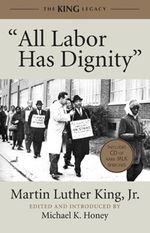
     

    Book cover for All Labor Has Dignity by Martin Luther King Jr.“All Labor Has Dignity” by Martin Luther King, Jr. Edited and introduction by Michael K. Honey

    People forget that Dr. King was every bit as committed to economic justice as he was to ending racial segregation. He fought throughout his life to connect the labor and civil rights movements, envisioning them as twin pillars for social reform. As we struggle with massive unemployment, a staggering racial wealth gap, and the near collapse of a financial system that puts profits before people, King's prophetic writings and speeches underscore his relevance for today. They help us imagine King anew: as a human rights leader whose commitment to unions and an end to poverty was a crucial part of his civil rights agenda.

    Covering all the civil rights movement highlights-Montgomery, Albany, Birmingham, Selma, Chicago, and Memphis-award-winning historian Michael K. Honey introduces and traces King's dream of economic equality. Gathered in one volume for the first time, the majority of these speeches will be new to most readers. The collection begins with King's lectures to unions in the 1960s and includes his addresses during his Poor People's Campaign, culminating with his momentous "Mountaintop" speech, delivered in support of striking black sanitation workers in Memphis. Unprecedented and timely, "All Labor Has Dignity" will more fully restore our understanding of King's lasting vision of economic justice, bringing his demand for equality right into the present.
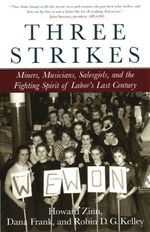
     

    5013Three Strikes: Miners, Musicians, Salesgirls, and the Fighting Spirit of Labor's Last Century by Dana Frank, Robin D. G. Kelly, and Howard Zinn

    Three renowned historians present stirring tales of labor: Howard Zinn tells the grim tale of the Ludlow Massacre, a drama of beleaguered immigrant workers, Mother Jones, and the politics of corporate power in the age of the robber barons. Dana Frank brings to light the little-known story of a successful sit-in conducted by the 'counter girls' at the Detroit Woolworth's during the Great Depression. Robin D. G. Kelley's story of a movie theater musicians' strike in New York asks what defines work in times of changing technology.

    "Three Strikes brings to life the heroic men and women who put their jobs, bodies, and lives on the line to win a better life for all working Americans. Zinn, Frank, and Kelley show us that while the country and the union movement have changed greatly in the last hundred years, our struggle to close the divide between rich and poor remains the same."-John Sweeney, president, AFL-CIO

    "Provocative analysis of still relevant issues, as the passionate, sometimes violent demonstrations at international meetings of the global economy demonstrate."-Mary Carroll, Booklist

    "Highly readable, well-researched narratives of dramatic action"-Leon Fink, Chicago Tribune


    "Political" News:


    LIPMAN-TweetLandofLibertyTweet Land of Liberty: Irreverent
    Rhymes from the Political Circus
     by @ElinorLipman

    Featured on Amazon's Omnivoracious Blog with an original poem by Lipman.

    Beacon launched a new “campaign” to name Elinor Lipman Tweet Laureate of the United States (would this be TLOTUS?).

    The campaign includes a Twitter-based giveaway for a free copy of Tweet Land of Liberty and a limited edition campaign button. To enter,

    this text:

    I support a funnier America! @ElinorLipman for #TweetLaureate: http://goo.gl/Bjnjp  #TweetLandofLiberty

    Be sure to watch and share the Campaign Video.

    Notable Mentions:


    6912The Long Walk to Freedom: Runaway Slave Narratives
     edited by Devon W. Carbado and Donald Weise

    Wall Street Journal review Aug 22: “Readers will learn more about slavery in the American South from these autobiographical accounts than they could from any textbook.” 


    Faitheist: How an Atheist Found Common Ground with the Religious by Chris Stedman

    Kirkus Reviews online August 29 and in print September 15: “The searching, intelligent account of a gay man's experiences growing away from God and into a thoughtful and humane atheist… Brave and refreshingly open-minded.”


    Upcoming Author Events:

    Sacred Ground: Pluralism, Prejudice, and the Promise of America by Eboo Patel 

    Eboo-sacredground

    August 30th-31st, 2012: Concordia College, Moorhead, MN/Fargo,ND (Live Webcast available of this event!)

    September 10th, 2012: Union Theological Seminary, New York, NY

    September 17th, 2012: Augsburg College, Minneapolis, MN

    October 9th, 2012: College of St. Scholastica, Duluth, MN

    October 11th, 2012: : Chicago Ideas Week, Chicago, IL

    Upcoming media appearances: MSNBC/Melissa Harris-Perry Show, Sunday, September 9th

    WNYC Radio/Brian Lehrer Show (NPR New York), Tuesday, September 11th


    Tweet Land of Liberty: Irreverent Rhymes from the Political Circus
    by Elinor Lipman


    Lipman-TweetlandSeptember 6th, 2012: Corner Bookstore (NYC)

    September 23rd, 2012: Writers for Obama and Elizabeth Warren at the Hotel Northampton (Northhampton, MA)

    September 24th, 2012: Broadside Books at 7 PM

    September 27th, 2012: Women & Children First (Chicago, IL)

    September 28th-29th, 2012: Ragdale Foundation, Lake Forest, IL

    October 2nd, 2012: Port Washington Public Library (Port Washington, NY)

    October 10th, 2012: Brookline Booksmith (Brookline, MA)

    October 11th, 2012: Worcester Public Library

    October 17th, 2012: Hewlett Woodmere Public Library (Long Island)

    October 30th, 2012: Porter Square Books (Cambridge, MA)

  • In honor of Labor Day, online orders at Beacon.org are 20% off with the code LaborDay12. Offer ends Sept. 4, so shop now!


    0332

    This highly readable and accessible book unpacks the twenty-one most common myths and misconceptions about labor in the United States. 

    From Wisconsin to Washington, DC, the claims are made: unions are responsible for budget deficits, and their members are overpaid and enjoy cushy benefits. The only way to save the American economy, pundits claim, is to weaken the labor movement, strip workers of collective bargaining rights, and champion private industry. In "They're Bankrupting Us!": And 20 Other Myths about Unions, labor leader Bill Fletcher Jr. makes sense of this debate as he unpacks the twenty-one myths most often cited by anti-union propagandists. Drawing on his experiences as a longtime labor activist and organizer, Fletcher traces the historical roots of these myths and provides an honest assessment of the missteps of the labor movement. He reveals many of labor's significant contributions, such as establishing the forty-hour work week and minimum wage, guaranteeing safe workplaces, and fighting for equity within the workforce. This timely, accessible, "warts and all" book argues, ultimately, that unions are necessary for democracy and ensure economic and social justice for all people.

    About the Author

    Bill Fletcher Jr. is a long-time racial-justice, labor, and international activist, scholar, and author. He has been involved in the labor movement for decades, and is a widely known speaker and writer in print and on radio, television, and the Web. He has served in leadership positions with many prominent union and labor organizations, including the AFL-CIO and the Service Employees International Union. Fletcher is currently the director of field services for the American Federation of Government Employees.

    Read "What is a Union?" from “They're Bankrupting Us!” on Scribd.

    Watch Bill Fletcher Jr. on Moyers and Company


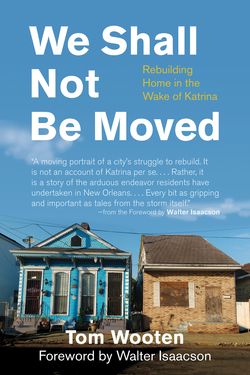
  • Our thoughts today are with those on the Gulf Coast threatened with flooding and storm surge as Hurricane Isaac brings its deluge ashore. It is seven years to the day since Hurricane Katrina hit this same area, and I had scheduled this blog post in honor of the anniversary weeks ago: an interview with Tom Wooten, author of We Shall Not Be Moved: Rebuilding Home in the Wake of Katrina. Wooten's book tells the story of the community leaders and neighborhood groups who led the recovery efforts in New Orleans. In running it today, we wish to honor the strength and resilience of this uniquely wonderful city. —Jessie Bennett, Blog Editor of Beacon Broadside

    WOOTEN-WeShallNotBeMoved

    You were a student at Harvard when you decided to write this book. How did you come to be interested in the story of New Orleans' recovery?

    I had a longstanding interest in disaster recovery as a
    result of research project I was undertaking with my college roommate. That
    project was about a flood that occurred in western India in 1979 that was the
    deadliest dam collapse in human history. His mother's family survived the
    disaster, and we wrote a comprehensive history of the events surrounding that
    flood. One of the big questions that came out of our research in India was
    related to ideas of community agency in the wake of a disaster. Many of the
    people who survived that flood felt as if the government had been very
    heavy-handed in coming in and dictated the way that the city that was destroyed
    would be rebuilt. I became very interested in what a recovery would look like
    that was being driven largely by neighborhoods themselves. It turned out that
    in New Orleans, there were answers to many of my questions. 

    When I was a junior in college, I traveled to New Orleans
    for the first time, and began to get a sense of the neighborhood-based nature
    of the recovery taking place there. All levels of government—the city
    government, the state government, and the federal government—had largely fallen
    down on the job. As a result, often out of desperation, neighborhood groups
    were stepping in to fill the void. They were doing things like opening their
    own charter schools, passing self-taxing initiatives, running their own police
    forces, providing very comprehensive social services to members of their
    communities, in order to spur recovery. Many of these things are things we
    expect larger nonprofits to do or expect city government to do, but
    neighborhoods were doing this instead.

    Do you think that there is something unique about this
    particular disaster recovery? Is there something particular to the character of
    the city of New Orleans that shaped this recovery?

    New Orleans is a unique place. Among large cities in
    America, New Orleans before Katrina had the lowest rate of people who were born
    there leaving the city. People fall in love with New Orleans, and it is because
    it is like nowhere else in the United States. And so people across the city
    were incredibly invested in bringing the city back. The disaster was also
    unprecedented because it was tremendously large—the biggest landscape scale
    disaster to hit an American city. The destruction within New Orleans itself
    stretches for more than twenty miles, from end to end of the city. Eighty
    percent of the city was under water, and hundreds of thousands of people were
    affected and still are today.

    Another unique feature of the recovery in New Orleans is
    that it has been largely driven by neighborhood groups. It is not a recovery
    that is being led by the city government or the state government or the federal
    government. Neighborhoods like Broadmoor, Lakeview, the Vietnamese community
    New Orleans East, have really taken leadership in all aspects of their
    recoveries. A number of New Orleans neighborhoods have made innovative
    partnerships with larger nonprofits, with universities, with corporations, to
    help resource those neighborhood based recovery efforts. A number of
    organizations have partnered with groups in the Lower Ninth Ward, to rebuild
    houses, to spearhead greening initiatives in the neighborhood, and many
    residents have returned to the neighborhood as a result of those partnerships.
    Similarly, Hollygrove has a tremendous partnership with the AARP which provided
    a comprehensive set of consulting services for the neighborhood to help them
    with crime prevention, education, health care, commercial development, and a number
    of other issues facing the neighborhood.

    We watched the government fail on many levels in the wake of
    Katrina. Does this show that the government is a less effective actor in the
    face of a disaster? Should we rely on private organizations and neighborhood groups to provide these
    services?

    Stories from the New Orleans recovery can be uplifting when
    you consider what neighborhoods have managed to accomplish, both on their own
    and through partnerships with private entities. That said, there are a number
    of things that we can take from this disaster that show us ways to do recovery
    better. A lot of that has to do with partnerships that should exist between
    communities that are struggling to survive after a disaster and higher levels
    of government. Neighborhoods in urban environments post-disaster should not
    have to open schools on their own. They should not have to self-tax to fix
    streets or provide extra police coverage. There are things that we expect
    different levels of government to do, and whether you're liberal or conservative,
    I believe that we all want government to work well at the tasks that we assign
    it. We saw that this didn't work well in New Orleans.

    In the future, there will
    be more landscape-scale disasters of the type that we saw in New Orleans. We
    have a number of coastal cities, and we have climate change that is raising sea
    levels and changing weather patterns. We have cities that are in places that
    are prone to wild fires; we have cities that are prone to tremendous
    earthquakes. We don't want what happened in New Orleans to happen again in
    another American city. And government reforms are key to making sure that we
    respond better in the future.

    Quite simply, there is tremendous potential for partnerships
    between communities and neighborhoods on the one hand, and higher levels of
    government on the other. We should work hard to make sure that potential is
    reached.

    One of the problems seems to be that FEMA is set up to help
    during isolated incidents, to help small communities recover, but when
    something happens that is this vast, it has a more difficult time responding.

    Historically, FEMA has been set up to respond very well to
    small disasters that are contained to an area–perhaps a tornado that destroys
    300 homes. They can respond very quickly and very well to that. But we as a
    nation have proven through the experience of New Orleans have proven that we
    are not able to handle a landscape-scale disaster very effectively. In the
    future, the federal government needs to think about what role it will play when
    other landscape-scale disasters take place.

    Who were some of the people and groups that you encountered
    who were instrumental in New Orleans' recovery?

    In Broadmoor, the neighborhood association president is
    LaToya Cantrell, and she is a tremendously powerful individual. Even before the
    storm, she could command a large crowd's attention just by her presence. She's
    a good listener and empathetic, and she has an amazing and broad base of
    support across the neighborhood.

    Many of the leaders I've interviewed, including LaToya, have
    put themselves on the line for their neighborhoods, have spent years upon years
    working harder than any person should have to work to make their communities
    come back. There's a lot of burnout that's taking place right now, but it's
    exciting to see that as progress becomes clear, it's exciting to see some of
    these leaders getting to kick back a little bit.

    Terry Miranda the Bike GuideTerry Miranda, who is from Lakeview, his contribution to the
    book is that he is able to narrate New Orleans history and make sense of many
    nonsensical things very well and even poetically. He always rides around the
    city on a bike, and he'll give me insights into city history, neighborhood
    history, and he seems to know everybody. Very often a Sunday afternoon bicycle
    ride will involve dozens of conversations with people on porches and lots of
    funny stories about the people and the city. [Photo at right, courtesy of Tom Wooten, is of one of those bike rides led by Terry Miranda.]

    I love New Orleans, and many of the young people who have
    come in since the storm have adopted the city as their own. It's a city that,
    very rightly actually, is very skeptical of outsiders coming in. There have
    been a number of outside agendas in the wake of Katrina that have not panned
    out very well for the city. So if you come in with an idea of how things should
    be and how you're going to fix things, you're probably not doing the city any
    favors. If you come in open to how the city works and ready to contribute to
    things that the residents are already undertaking, the city will really embrace
    you. 

  • While the Republican National Convention gets underway in Tampa, Beacon Press announces our own campaign: 

    Elinor Lipman for Tweet Laureate!*

    *This campaign is intended for parody only. Beacon Press does not endorse any one candidate, especially Tweet Laureate, since it doesn't exist. The book, however, is real, and you can win a copy!

    In June 2011, much-loved novelist Elinor Lipman made a pledge to post one political tweet poem a day until the presidential election. For over a year, she has risen early to read the headlines and track the latest political debacles, then brought the tumult of the election season to the Twittersphere in the form of one 140-character rhyming poem every day.

    And now, the best of these gems has been collected in a book: Tweet Land of Liberty: Irreverent Rhymes from the Political Circus. (Available wherever books are sold, in paperback and for Kindle, Nook, iPad, or Google ebook.) 


    LIPMAN-TweetLandofLibertyElinor Lipman's proven track record of providing a daily dose of much-needed humor in verse makes her the best (and, as far as we know, only) candidate for Tweet Laureate. Tweet your support and be entered to win a campaign button and a copy of Tweet Land of Liberty!

    To enter,

    // <![CDATA[
    // &lt;![CDATA[
    // &amp;lt;![CDATA[
    !function(d,s,id){var js,fjs=d.getElementsByTagName(s)[0];if(!d.getElementById(id)){js=d.createElement(s);js.id=id;js.src=&amp;quot;//platform.twitter.com/widgets.js&amp;quot;;fjs.parentNode.insertBefore(js,fjs);}}(document,&amp;quot;script&amp;quot;,&amp;quot;twitter-wjs&amp;quot;);
    // ]]&amp;gt;
    // ]]&gt;
    // ]]>
    this text:

    I support a funnier America! @ElinorLipman for #TweetLaureate: http://goo.gl/Bjnjp #TweetLandofLiberty


    Lipman has already gathered endorsements (if not generous financial contributions to a shady Super PAC) from a wide range of supporters:

    "First I laughed my way through Elinor Lipman's book of political tweets. Then I put my ear to the ground and listened to Molly Ivins guffawing from the grave. Lipman is a piquant poetic rock star! " —Wally Lamb 

    "This year, has there any better way to revel in the political process than to pour a cup of coffee, log into Twitter, and read one of Elinor Lipman's clever, catchy tweets about the race for the presidency? With humor, wit, and no small share of brilliance, Lipman has cataloged the 2012 election in delectable sound bytes that manage to capture what we're all secretly thinking—in rhyme, and in less than 140 characters." —Jodi Picoult, New York Times bestselling author of Lone Wolf and Sing You Home 

    "If brevity be The soul of wit/ Then Elinor has A surefire hit." —Alex Beam 

    "Devilishly and deliciously witty. We could all use a laugh a day and Elinor Lipman has given me that." —Judy Blume 

    "It's nice to see that Lipman's wit has escaped the hell of Twitter and collected itself in a book." —Jonathan Franzen, author of Freedom 

    LIPMAN-campaignbutton"A devotion of fearless, sassy, sublime insights, that should be carried into the voting booth of our daily lives—each poem read again and again—before any lever is pulled." —Nikky Finney, winner of the 2011 National Book Award for Poetry 

    "So it has come to this! Of thee I zing. I love it." —Lois Lowry 

    "The only sane, smart and witty thing to come out of the Republican primaries." —Stephen McCauley 

    "Jon Stewart in 140 characters — and in the morning. What could be better?" —Stacy Schiff 

    "Winsome, witty and winning! I don't know how she does it!! " —Anita Shreve 

    "Elinor Lipman tweets like a nightingale with an eagle eye." —Cathleen Schine 

    "Dorothy Parker, Ogden Nash, Calvin Trillin, and Elinor Lipman!!" —Mameve Medwed 

    "Elinor Lipman is to tweets what Shakespeare is to sonnets." —Firoozeh Dumas 

    "There once was a Lipman on Twitter, who made every liberal titter." —Michael Lowenthal 

    "I'm beset with Lipmania." —Henry Alford 

    "Wise and sassy and too fun to miss!" —Jill McCorkle