• Beacon Press Authors on the Issues:
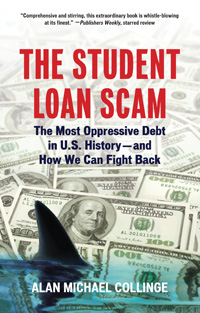
    Book Cover for The Student Loan Scam by Alan Michael CollingeThe Student Loan Scam: The Most Oppressive Debt in U.S. History and How We Can Fight Back by Alan Michael Collinge

    “Romney
    Ryan On Student Loans – Crony Capitalism?”
    Forbes
    interview with Alan Collinge

    "The true, conservative move for higher education would be to
    return standard bankruptcy to all student loans, thereby forcing the government
    to freeze, or even lower the federal lending ceilings for these loans.
    This would quickly, and surely compel a significant decrease in the price that
    the colleges could charge for their product. It would also decrease
    government spending. It would also show average Americans how the
    “invisible hand” can actually work for them, instead of against them." Forbes

    Billionaires' Ball: Gluttony and Hubris in an Age of Epic Inequality by Linda McQuaig and Neil Brooks

    "Mitt Romney Blurts out the Truth About Neoconservatism." Linda McQuaig in The Star

    "Once upon a time, 'conservative' could be used to describe people — Winston Churchill, Dwight Eisenhower, Robert Stanfield, Joe Clark — who had a vision of society in which a privileged elite dominated but also had a responsibility to less fortunate citizens and to the broader 'public good.'

    "But about 30 years ago, a new breed of 'conservative' slithered onto the political scene. Stealing the moniker of conservatism, this new breed embraced the inequality of traditional conservatism (driving it skyward) while unburdening itself of the responsibility for others and the public good.

    "This new breed has proved itself to be self-centred, greedy and indifferent to the public good." The Star

    The Odd Clauses: Understanding the Constitution Through Ten of Its Most Curious Provisions and Holy Hullabaloos: A Roadtrip to the Battlegrounds of the Church/State Wars by Jay Wexler

    Contribution to "We Represent the 47 Percent" blog.

    "I now pay a shitload of taxes. Hell, I even got slammed with the alternative minimum tax last year, which I think is something that was actually designed for guys like you. But whatever. The point is that I didn’t always pay so much. Like twenty zillion or so other people who had to take out student loans to get through college and/or graduate school, I spent much of my early adult life in debt. I did the things that most of us have to do before getting into the 53%–scouring liquor stores for the absolute cheapest possible beer (Blatz Light? Lucky Beer?), paying rent with a Discover Card, living in apartments teeming with rats (rats, mind you, not mice), selling used CDs for a bit of pocket change, living in an apartment in China which only sometimes had running water (okay, that’s a bit idiosyncratic, perhaps, but you get the idea). Indeed, it wasn’t all that long ago that my wife and I lived in a slummy apartment where the sink fell off the wall when I leaned on it and where the bathroom was so small and close to the kitchen that I could flip pancakes while taking a shower."


    Notable Mentions:

    Fanpire: The Twilight Saga and the Women Who Love it by Tanya Erzen

    An excerpt is running in the print and online editions of The Chronicle Review (subscription required)

    The Springs of Namje: A Ten-Year Journey from the Villages of Nepal to the Halls of Congress by Rajeev Goyal

    National Geographic Traveler’s “Trip Lit” section: an “engaging account of his failures and successes in both countries is an edifying and inspiring triumph.”

    Dosed: The Medication Generation Grows Up Kaitlin
    Bell Barnett

    Interview in Ladies Home Journal for the article “The Scary Truth About Sharing Pills.”

    Interview on website, Bliss Tree.


    Watch and Listen:

    Tweet Land of Liberty: Irreverent
    Rhymes from the Political Circus
    by Elinor Lipman

    Elinor Lipman was on Word of Mouth/NHPR Sept 25

    Gaga Feminism: Sex, Gender, and the End of Normal by J. Jack Halberstam

    Three video interviews on YouTube:

    J. Jack Halberstam Goes Gaga

    Gaga Families

    Is Feminism Going Gaga?

    Gather at the Table: The Healing Journey of a Daughter of
    Slavery and a Son of the Slave Trade
    by Thomas Norman DeWolf and Sharon Leslie Morgan

    New book trailer; http://youtu.be/_IDNNMXddHY

    Coming Soon:

    Into Great Silence by Eva Saulitis, Jan. 15 2013

    Kirkus Reviews in print October 15 and online Sept 23: “A vivid, moving depiction of a way of life tragically becoming increasingly endangered.”

    “There's great tenderness in this book, and great
    pathos—sometimes one wonders if it's worth the pain to pay attention amidst
    the gathering storm, but this powerful account shows us that it's precisely by
    keeping track of the world around us that we stay human.”—Bill McKibben, author Eaarth: Making a Life on a Tough New Planet

    Divided we Fail: The
    Story of an African American Community that Ended the Era of School
    Desegregation
    by Sarah Garland, January 29, 2013

    Kirkus Reviews October 15 print and online beginning September 23: “A useful
    journalistic examination of a troubling societal phenomenon.”

    "With all
    the noise about failing schools, standardized tests, teacher accountability,
    and America’s educational decline, only the courageous are willing to
    acknowledge the persistence of racism—let alone, address the problem in a
    serious, clear-eyed way. Sarah Garland has written a courageous book,
    documenting the struggles of courageous community activists, educators,
    parents, and children who continued to fight for equity and racial justice long
    after our nation declared victory over segregation. In telling this
    gripping, often tragic, often inspirational story, Garland reveals that
    integrating a classroom is not the same as dismantling racism. Divided
    We Fail
    is one of those rare books that will move even the most cynical to
    act. And act we must." —Robin D. G. Kelley, author of Freedom
    Dreams: The Black Radical Imagination

    Fast Future: How the Millennial Generation Is Shaping
    Our World
    by David Burstein

    “David Burstein’s generation—a diverse,
    connected, and entrepreneurial lot that came of age around the Millennium—has
    already changed the face of politics from Washington to Cairo and
    beyond. Millennials are distinct and powerful, though scholarship
    about them has been slapdash and haphazard. Enter David
    Burstein. With Fast Future, Burstein cements his reputation as the
    millennial generation’s most thoughtful and insightful public intellectual.”—David King, Harvard University

    “In Fast Future, David Burstein provides a
    personal and compelling picture of his generation. Millennials are pragmatic
    idealists and the first digitals, able to handle the fast pace of today’s world
    while they remake our economic and democratic political systems. Read this book
    not only to understand the future but also how the millennials are poised to shape
    it.” —Michael D. Hais and Morley Winograd, authors of Millennial
    Momentum

    Now in Paperback:

    Remembering the
    Music, Forgetting the Words: Travels with Mom in the
    Land of Dementia
    by Kate Whouley

    Upcoming author events:

    Coffee with the Authors –
    Buttonwood Books and Toys (Cohasset, MA); Oct 09
    National Reading Group Month Panel
    – Boston; Oct 18
    Reading and Talk – Uxbridge Public
    Library (MA); Oct 20
    Reading and Talk – Hanson Public
    Library (MA); Oct 25
    Writers Day at Baypath College –
    Longmeadow, MA; Oct 27

    The Odd Clauses: Understanding the Constitution through Ten of Its Most Curious Provisions by Jay Wexler

    Read Chapter 6: "The Twenty-First Amendment" at Scribd.

    Also check out Wexler's new collection of short fiction: The Adventures of Ed Tuttle, Associate Justice and Other Stories, available from Quid Pro Books.
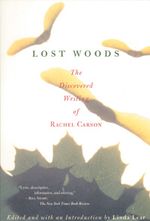

  • Fifty years ago today, Houghton Mifflin published Rachel Carson’s revolutionary book Silent Spring. In honor of the anniversary, we share this excerpt from Lost Woods: The Discovered Writing of Rachel Carson, a collection edited by Linda Lear and published by Beacon in 1998. 

    Linda Lear is a biographer and historian. She is the author of the acclaimed biography of Rachel Carson, Rachel Carson: Witness for Nature. Lear’s research papers and adjunct collections dealing with Carson’s life, Carson’s friends and colleagues, and the controversy over Silent Spring form the core of the Lear/Carson Collection at The Linda Lear Center for Archives and Special Collections at Connecticut College. Find out more about Carson, Linda Lear, and upcoming events at RachelCarson.org.

    This address to the Women’s National Press Club (December 1962) stands as one of Carson’s most important statements following publication of Silent Spring and the beginning of the ferocious industry backlash against her. Like Silent Spring, her speech can be read as a democratic manifesto in the long tradition from Thoreau, Harriet Beecher Stowe through Martin Luther King Jr. Carson dares to suggest here that “profit and production” might be motives that would make industry and government officials lie to the public about what was being done to the environment and to the whole fabric of life. This was an astonishing idea in the Cold War. Like those who came before her, Carson as an individual was pushing back to power and in doing so she was declaring that environmental rights were also human rights.—Linda Lear, September 2012

    8547My text this afternoon is taken from the Globe
    Times
    of Bethlehem, Pa., a news item in the issue of October 12. After
    describing in detail the adverse reactions to Silent Spring of the farm
    bureaus in two Pennsylvania counties, the reporter continued: “No one in either
    county farm office who was talked to today had read the book, but all
    disapproved of it heartily.”

    This sums up very neatly the background of much of
    the noisier comment that has been heard in this unquiet autumn following the
    publication of Silent Spring. In the words of an editorial in the Bennington
    Banner,
    “The anguished reaction to Silent Spring has been to refute
    statements that were never made.” Whether this kind of refutation comes from
    people who actually have not read the book or from those who find it convenient
    to misrepresent my position I leave it to others to judge.

    Early in the summer–as soon as the first
    installment of the book appeared in the New Yorker–public reaction to Silent
    Spring
    was reflected in a tidal wave of letters–letters to Congressmen, to
    newspapers, to Government agencies, to the author. These letters continue to
    come and I am sure represent the most important and lasting reaction.

    Even before the book was published, editorials and
    columns by the hundreds had discussed it all over the country. Early reaction
    in the chemical press was somewhat moderate, and in fact I have had fine
    support from some segments of both chemical and agricultural press. But in
    general, as was to be expected, the industry press was not happy. By late
    summer the printing presses of the pesticide industry and their trade
    associations had begun to pour out the first of a growing stream of booklets
    designed to protect and repair the somewhat battered image of pesticides. Plans
    are announced for quarterly mailings to opinion leaders and for monthly news
    stories to newspapers, magazines, radio, and television. Speakers are
    addressing audiences everywhere.

    It is clear that we are all to receive heavy doses
    of tranquilizing information, designed to lull the public into the sleep from
    which Silent Spring so rudely awakened it. Some definite gains toward a
    saner policy of pest control have been made in recent months. The important
    issue now is whether we are to hold and extend those gains.

    The attack is now falling into a definite pattern
    and all the well-known devices are being used. One obvious way to try to weaken
    a cause is to discredit the person who champions it. So the masters of
    invective and insinuation have been busy: I am a “bird lover – a cat lover – a
    fish lover”– a priestess of nature – a devotee of a mystical cult having to do
    with laws of the universe which my critics consider themselves immune to.

    Another piece in the pattern of attack largely
    ignores Silent Spring and concentrates on what I suppose would be called
    the soft sell, the soothing reassurances to the public. Some of these
    acknowledge the correctness of my facts, but say that the incidents I reported
    occurred some time in the past, that industry and Government are well aware of
    them and have long since taken steps to prevent their recurrence. It must be
    assumed that the people who read these comforting reports read nothing else in
    their newspapers. Actually, pesticides have figured rather prominently in the
    news in recent months: some items trivial, some almost humorous, some
    definitely serious.

    These reports do not differ in any important way
    from the examples I cited in Silent Spring, so if the situation is under
    better control there is little evidence of it.

    […]

    We are told also that chemicals are never used
    unless tests have shown them to be safe. This, of course, is not an accurate
    statement. I am happy to see that the Department of Agriculture plans to ask
    the Congress to amend the FIFRA to do away with the provision that now permits
    a company to register a pesticide under protest, even though a question of
    health or safety has been raised by the Department.

    We have other reminders that unsafe chemicals get
    into use – County Agents frequently have to amend or rescind earlier advices on
    the use of pesticides. For example, a letter was recently sent out to farmers
    recalling stocks of a chemical in use as a cattle spray. In September,
    “unexplained losses” occurred following its use. Several suspected production
    lots were recalled but the losses continued. All outstanding lots of the
    chemical have now had to be recalled.

    Inaccurate statements in reviews of Silent
    Spring
    are a dime a dozen, and I shall only mention one or two examples. Time,
    in its discussion of Silent Spring, described accidental poisonings
    from pesticides as very rare. Let’s look at a few figures. California,
    the only state that keeps accurate and complete records, reports from 900 to
    1000 cases of poisoning from agricultural chemicals per year. About 200 of these
    are from parathion alone. Florida has experienced so many poisonings recently
    that this state has attempted to control the use of the more dangerous
    chemicals in residential areas. As a sample of conditions in other countries,
    parathion was responsible for 100 deaths in India in 1958 and takes an average
    of 336 deaths a year in Japan.

    It is also worthy of note that during the years
    1959, 1960, and 1961, airplane crashes involving crop-dusting planes totaled
    873. In these accidents 135 pilots lost their lives. This very fact has led to
    some significant research by the Federal Aviation Agency through its Civil
    Aeromedical Unit – research designed to find out why so many of these
    planes crashed. These medical investigators took as their basic premise the
    assumption that spray poisons accumulate in the pilot’s body – inside the
    cells, where they are difficult to detect.

    These researchers recently reported that they had
    confirmed two very significant facts: 1. That there is a causal relation
    between the build-up of toxins in the cell and the onset of sugar diabetes. 2.
    That the build-up of poisons within the cell interferes with the rate of energy
    production in the human body.

    I am, of course, happy to have this confirmation
    that cellular processes are not so “irrelevant” as a certain scientific
    reviewer of Silent Spring has declared them to be.

    This same reviewer, writing in a chemical journal,
    was much annoyed with me for giving the sources of my information. To identify
    the person whose views you are quoting is, according to this reviewer, name-dropping.
    Well, times have certainly changed since I received my training in the
    scientific method at Johns Hopkins! My critic also profoundly disapproved of
    my bibliography. The very fact that it gave complete and specific references
    for each important statement was extremely distasteful to him. This was padding
    to impress the uninitiated with its length.

    Now I would like to say that in Silent Spring I
    have never asked the reader to take my word. I have given him a very clear
    indication of my sources. I make it possible for him – indeed I invite him – to
    go beyond what I report and get the full picture. This is the reason for the 55
    pages of references. You cannot do this if you are trying to conceal or distort
    or to present half truths.

    Another reviewer was offended because I made the
    statement that it is customary for pesticide manufacturers to support research
    on chemicals in the universities. Now, this is just common knowledge and I can
    scarcely believe the reviewer is unaware of it, because his own university is
    among those receiving such grants.

    […]

    A penetrating observer of social problems has
    pointed out recently that whereas wealthy families once were the chief
    benefactors of the Universities, now industry has taken over this role. Support
    of education is something no one quarrels with – but this need not blind us to
    the fact that research supported by pesticide manufacturers is not likely to be
    directed at discovering facts indicating unfavorable effects of pesticides.

    Such a liaison between science and industry is a
    growing phenomenon, seen in other areas as well. The AMA, through its
    newspaper, has just referred physicians to a pesticide trade association for
    information to help them answer patients’ questions about the effects of
    pesticides on man. I am sure physicians have a need for information on this
    subject. But I would like to see them referred to authoritative scientific or
    medical literature – not to a trade organization whose business it is to
    promote the sale of pesticides.

    We see scientific societies acknowledging as
    “sustaining associates” a dozen or more giants of a related industry. When the
    scientific organization speaks, whose voice do we hear–that of science? or of
    the sustaining industry? It might be a less serious situation if this voice
    were always clearly identified, but the public assumes it is hearing the voice
    of science.

    What does it mean when we see a committee set up to
    make a supposedly impartial review of a situation, and then discover that the
    committee is affiliated with the very industry whose profits are at stake? I
    have this week read two reviews of the recent reports of a National Academy of
    Sciences Committee on the relations of pesticides to wildlife. These reviews
    raise disturbing questions. It is important to understand just what this
    committee is. The two sections of its report that have now been published are
    frequently cited by the pesticide industry in attempts to refute my statements.
    The public, I believe, assumes that the Committee is actually part of the
    Academy. Although appointed by the Academy, its members come from outside. Some
    are scientists of distinction in their fields. One would suppose the way to get
    an impartial evaluation of the impact of pesticides on wildlife would be to set
    up a committee of completely disinterested individuals. But the review
    appearing this week in The Atlantic Naturalist described the composition
    of the Committee as follows: “A very significant role in this committee is
    played by the Liaison Representatives. These are of three categories. A.)
    Supporting Agencies. B.) Government Agencies. C.) Scientific Societies. The
    supporting agencies are presumably those who supply the hard cash. Forty-three
    such agencies are listed, including 19 chemical companies comprising the massed
    might of the chemical industry. In addition, there are at least four trade
    organizations such as the National Agricultural Chemical Association and the
    National Aviation Trades Association.”

    The Committee reports begin with a firm statement
    in support of the use of chemical pesticides. From this predetermined position,
    it is not surprising to find it mentioning only some damage to some wildlife.
    Since, in the modern manner, there is no documentation, one can neither confirm
    or deny its findings. The Atlantic Naturalist reviewer described the
    reports as “written in the style of a trained public relations official of
    industry out to placate some segments of the public that are causing trouble.”

    All of these things raise the question of the
    communication of scientific knowledge to the public. Is industry becoming a
    screen through which facts must be filtered, so that the hard, uncomfortable
    truths are kept back and only the harmless morsels allowed to filter through? I
    know that many thoughtful scientists are deeply disturbed that their
    organizations are becoming fronts for industry. More than one scientist
    has raised a disturbing question – whether a spirit of lysenkoism may be
    developing in America today – the philosophy that perverted and destroyed the
    science of genetics in Russia and even infiltrated all of that nation’s
    agricultural sciences. But here the tailoring, the screening of basic truth, is
    done, not to suit a party line, but to accommodate to the short-term gain, to serve
    the gods of profit and production.

  • Eboo Patel is the author of Acts of Faith: The Story of an American Muslim, the Struggle for the Soul of a Generation and Sacred Ground: Pluralism, Prejudice, and the Promise of America. He is founder and Executive Director of the Interfaith Youth Core, an international nonprofit building the interfaith youth movement.

    This post originally appeared at Huffington Post.

    PATEL-SacredGround“So which side are they on?” The question was part of a
    conversation I overheard on the street the other day, and it was in reference
    to people like me—American Muslims.

    As several of my country's embassies
    have been violently threatened by people of my faith, this seems as good a time
    as any to be clear about my answer: I am on the side of all those who seek a
    common life together. I believe America's founding creed, E
    Pluribus Unum
    , makes us humanity's best chance to achieve that
    possibility. I believe that Muslim values—just like Jewish, Christian, Hindu
    and humanist ones—can contribute to that spirit. And I believe, as the violence
    and ugliness demonstrate, that building societies where people from different
    identities live in equal dignity and mutual loyalty is one of the great
    challenges of our times.

    We find ourselves in a terrible situation. The evening news in
    America is full of Muslims burning American flags and trying to breach
    embassies. The evening news in Arab countries is full of stories of Americans
    defiling the Prophet Muhammad. And the actions of a thuggish few are
    increasingly viewed as representing the sentiments of entire nations and
    religions.

    The sad part is that those thuggish few are not just skewed
    representations of the broader whole, they actually stand in violation of their
    traditions. I believe as a Muslim that the mob violence we are witnessing does
    a greater dishonor to the Prophet Muhammad than the original offense. Muslims
    are meant to act in the tradition of the Prophet, who dealt with insults during
    his entire mission, responded unfailingly with mercy and commanded his
    followers to do the same: “You do not do evil to those who do evil to you, but
    you deal with them with forgiveness and kindness…”

    Moreover, Islam is a tradition that protected pluralism from its
    beginnings. One of the Prophet Muhammad's earliest acts in his adopted city of
    Medina was to enact a Constitution that created a single political community—barring
    tribal violence, establishing basic freedoms and assuring collective security—between
    his growing number of Muslim followers and the various Christian, Jewish and
    pagan groups already present in the city. During Islam's expansion, the Caliph
    Ali sent his governor in Egypt a letter that said, “All people there are your
    equals in faith or your brothers in creation.” The Quran affirms the holiness
    of this pluralistic view: “God made you different nations and tribes that you
    may come to know one another.”

    America, contrary to the strain of ugly Islamophobia that has
    become more prominent since 9/11, has a long and positive history of respect
    for Islam and Muslims. The Flushing Remonstrance, a 17th century document which
    established the precedent of religious freedom and goodwill between different
    faiths, explicitly includes Muslims: “The law of love, peace and liberty in the
    states extending to Jews, Turks and Egyptians, as they are considered sons of
    Adam.” Thomas Jefferson famously owned a Quran and hosted an iftar dinner for a
    Muslim diplomat. Benjamin Franklin started a hall in Philadelphia and said that
    the pulpit would be open to all preachers, including a Muslim from
    Constantinople. An envoy appointed by President George Washington negotiated
    the Treaty of Tripoli with a majority-Muslim nation, a document which stated
    that “no pretext arising from religious opinions shall ever produce an
    interruption of the harmony existing between the two countries.” The treaty was
    later signed by President John Adams.

    Current events highlight a harsh reality of globalization. That
    people on one side of the world can create something that incites violence on
    the other side of the world. But there is a silver lining here: just as ugliness
    begets ugliness, so might beauty inspire beauty. Let's not let the handful of
    people who seek to spread hatred between faith communities pattern interfaith
    relations across the world. Now more than ever, we need to lift up those
    stories within Islam and America that speak to the power of pluralism. And we
    need to act on those stories, by working together to apply the values of mercy,
    compassion and hospitality that are shared across all traditions. I remember
    President Obama telling his Inaugural Faith Council, of which I was a proud
    member, that he hoped Americans of all faith backgrounds would participate in
    interfaith service projects together. This was not just as a way of
    strengthening our own nation, it was also an example of diversity leading to
    harmony in a world that is increasingly convinced of the inevitability of
    conflict.

    In an interconnected world, the only chance we have is a common
    life together. If we are to build it, we must insure the bridges between us are
    strong enough to withstand the bombs of the extremists. As the American poet
    William Stafford wrote, “The signals we give must be clear now … the darkness
    around us is deep.”

  • J. Jack Halberstam is Professor of American Studies and Ethnicity, Gender Studies and Comparative Literature at the University of Southern California. Halberstam is the author of five books, including Gaga Feminism: Sex, Gender, and the End of Normal. This post originally appeared on Halberstam's blog. 

    HALBERSTAM-GagaFeminismEvery few weeks, I get an email from a colleague, a friend or a student asking me what pronoun I prefer. I mostly go by “Jack” nowadays, although people who have known me for a really long time and some family members still call me Judith. Then there are a few people, my sister included, who call me “Jude.” I have debated switching out Jack for Jude to try to compress the name ambiguity into a more clear opposition between Judith and Jude. But then again–and contrary to my personality or my politics—when it comes to names and pronouns, I am a bit of a free floater. This goes against my instincts and my general demeanor—I don’t hang in the middle ground on much, not politically, not socially, not in terms of culture, queer issues, feminism or masculinity. I am a person of strong opinions so why, oh why, do I insist on being loosey goosey about pronouns?

    Well, a few reasons: first, I have not transitioned in any formal sense and there certainly many differences between my gender and those of transgender men on hormones. Second, the back and forth between he and she sort of captures the form that my gender takes nowadays. Not that I am often an unambiguous “she” but nor am I often an unambiguous he. Third, I think my floating gender pronouns capture well the refusal to resolve my gender ambiguity that has become a kind of identity for me.

    I watch friends, one after the other, transition, mostly from butch to TG male and I wonder whether I am just sitting on a fence and not wanting to jump. But actually, as a real medi-phobe, I don’t see taking hormones, even in small doses as right for me for any extended amount of time. Top surgery? Well, yes please, but then again, would this make it even harder for me to use the women’s locker room when I swim or work out (and I do one or the other almost every day so that would really be something to think about). So, while I could “transition” and still live in the ever-evolving, improvised territory of transgenderism…well, I prefer not to.

    Yes, like Bartleby, that wonderful and doleful example of a refusenik who declined to explain his refusal to work, to comply, to communicate even, I prefer not to transition. I prefer not to clarify what must categorically remain murky. I prefer not to help people out in their gender quandaries and yet, I appreciate you asking.

    GagablogtourI still use women’s restrooms, and I avoid any and all contact on going in or coming out. If someone looks frightened when they see me, I say “excuse me” and allow my “fluty” voice to gender me. If someone looks angry, I turn away, but mostly I just ignore what is going on around me in the restroom and do what I am there to do.

    I wish more people would behave like my partner’s son (he’s 9 years old) and simply ask, politely and without judgement, what pronoun anyone prefers—he rarely presumes and often asks. I also wish more people would adapt to a pronoun system based on gender and not on sex, based on comfort rather than biology, based on the presumption that there are many gendered bodies in the world and “male” and “female” does not even begin the hard work of classifying them.

    So, if you are wondering about my pronoun use and would like it resolved once and for all, I cannot help you there. But if, like the UK in the 1980′s, you are ready to give up on the “imperial” systems of measurements in favor of new metrics, then consider my gender improvised at best, uncertain and mispronounced more often than not, irresolvable and ever shifting.

    And ps: grouping me with someone else who seems to have a female embodiment and then calling us LADIES, is never, ever ok!

    Visit the other stops on the Going Gaga Blog Tour

    My Husband Betty
    Where Jack wonders, "When did 'vagina' suddenly become a fashionable term?"

    Queer Fat Femme 
    "Feminism is as much about naming one’s desires with precision and care as it is about expressing desire in more amorphous ways."

    Sugarbutch Chronicles
    "Heterosexual mainstream conversations about desire love to depict women as the ones who create an environment for love and romance and men as the ones who set the whole thing on fire."

    The Qu 
     "For the Gaga feminist, in fact, the end of the normal is in sight and we don’t want the same old norms packaged back up for us and sold to us again as new norms!"


  • Award-winning journalist Fran Hawthorne has been a writer or editor at Fortune, BusinessWeek, Institutional Investor, and other publications. She is the author of Ethical Chic: The Inside Story of the Companies We Think We Love, The Overloaded Liberal: Shopping, Investing, Parenting,and Other Daily Dilemmas in an Age of Political Activism, and books on health care and investing.

    Bigstock-Girl-With-Mobile-Smart-Phone-31396442Another new
    iPhone. Could you try to yawn?

    Could you
    actually not buy it?

    Or at
    least, before you pull out your wallet, think about the forced student
    labor, the warlords who
    benefit from mineral smuggling, the children exposed to toxic waste from old phones, and the pile of useless accessories you'll throw
    out.

    With its constant pitching of the
    newest cool thing to replace its previous newest cool thing, Apple has always been
    one of the worst violators of the environmentalist credo “reduce, reuse,
    recycle.” It barely gives customers a chance to use its toys, let alone reuse,
    before making the toy obsolete and unfashionable.

    But with the
    iPhone 5, Apple has really outdone
    itself.

    For
    instance, customers have recently become aware that iPhones and other Apple
    gizmos are made in crowded and unsafe Chinese factories where people toil 15
    hours a day for barely $50 a month. That’s
    bad enough. Then, just a week before the iPhone 5 went on sale, it was revealed
    that the factories had dragooned students onto the assembly lines in a rush to
    get the phones made on time, threatening to kick them out of school if they
    demurred.

    Nor has anything been done to ameliorate
    the environmental problems. As with any product, making an iPhone uses up resources
    for the components, ingredients, packaging, and marketing, and also uses fuel
    and creates carbon emissions in the manufacturing and shipping processes. Again,
    iPhones are worse than the average, because their components include dangerous
    metals and ores like coltan
    , which is found only in endangered gorilla habitats
    or in African war zones where the profits get siphoned by warlords.

    0094Moreover,
    when you throw out your old iPhone 4—even if you think you’re recycling it—most likely it will end up in a dump where little kids will poke  through dangerous metals with their bare
    hands
    , breathing in toxic fumes, to scavenge a few pennies’ worth of metal they
    can sell.

    And with the
    iPhone 5, Apple has added to its garbage pileup and waste by redesigning the
    connector on the phone’s base
    precisely so that most of your old charging
    cords, docks, iPhone-compatible clock radios, and other add-ons will no longer
    fit. Into the garbage go all that rubber, metal, and plastic. Out of your
    wallet comes $30 for a special Apple adapter
    plus money to replace the
    accessories that still won’t work on the adapter.

    Okay then,
    here’s an idea: Your iPhone 4S is less
    than a year old. How about sticking with it just one more year—until the
    iPhone 6 comes out?

    Photo of iPhone from Bigstock.

    Related articles

    A Visit to Havana: A Book That Takes on Immigration Myths Makes its Cuban Debut
    Mexico denies Apple rights to the 'iPhone' name
    Review: The Musubo Retro's unique two-layer design should keep your iPhone 5 safe
    Apple Continues Android Offensive, Launches 'Why iPhone' Webpage – PC Magazine
    Happy 100th Birthday to Rosa Parks
  • David Chura is the author of I Don’t Wish Nobody to Have a Life Like Mine: Tales of Kids in Adult Lockup. He has worked with at-risk teenagers for the past 40 years. For 26 of those years, he taught English and creative writing in community based alternative schools and in a county penitentiary. His writings have appeared in the New York Times as well as other scholarly and literary journals. He blogs at kidsinthesystem.wordpress.com.

    This post originally appeared at Reclaiming Futures. 

    Bigstock-Milk-and-cookies-7750028I met Amber at a tutoring program for inner city children. It was 1966, my senior year in high school, and the war on poverty was on, a war we’ve failed to win.

    At nine years old Amber looked like a scarecrow, an old scarecrow at that, bird-picked, weather beaten. She was stick thin. None of her clothes fit, hand-me-downs from her sister Bunny who quickly outgrew her clothes while her younger sister didn’t seem to grow at all. Her eyes were dark circled; her hair, straw and falling out.

    Saturday mornings she was one of the first kids through the church basement doors. My friends and I weren’t naïve. We knew that that gaggle of children who showed up each week wasn’t there for the mandatory hour of instruction. They put up with our drilling them on the timestables or helping them parse a paragraph. They were really there for the cookies and milk, and the tables spread with art supplies and games. It wasn’t until years later that I realized that they may have been just as eager for our attention, our reliability, and perhaps even our youthful faith in the future as for those treats.

    I worked with Amber all that year. She didn’t progress much. But that didn’t seem to matter. She was always there. Besides, there was something else going on: I was being tutored in what poverty was really all about.

    Walking Amber home several times I got to see where she lived—a cramped, drafty tenement—and to meet the rest of her family. Her mother, Mrs. Laurel, was as frail and battered looking as Amber. She had a nervous tic that twitched her head, a purple bruise on her cheekbone, a baby on her hip and a toddler pulling at her housecoat. Peter, a year older than Amber, dervished through the apartment while Bunny, a twelve year old with a fifteen year old’s body, refused to say hello.

    There were no secrets in the Laurel family. Sitting at their kitchen table I heard how Bunny was boy-crazy, how Peter ate paste in school, and how they all loved margarine and sugar sandwiches. Amber, I was told, shared the bed of whatever brother or sister let her: she was a bed wetter. Pointing to the toddler pulling a waste basket over and the baby on her lap, Mrs. Laurel told me how “Mr. Laurel” was in and out of the house. “That’s what these two are all about,” she laughed ruefully then touched her cheekbone.

    ChuraI lost track of the Laurels when I went off to college and got involved in another war—the war against the war, the Vietnam War. I didn’t think about them until Ronald Reagan in the 1980s started talking about the “deserving poor.” By then I was teaching kids in an alternative high school that very well could’ve been the children of an Amber or a Peter or a Bunny. I remember at the time wondering if the Laurels would’ve fit Reagan’s criteria for “deserving.” What would he have made of that bubble bath that tumbled out of the grocery bag Mrs. Laurel plopped down on the table one day when I was there? Or the endless packages of Lick-a-maid her kids lapped up from their grimy palms instead of lunch.

    And now, years later, census figures show that the US poverty rate has hit its highest levels since President Johnson declared war on it, and that child poverty has increased from its 2010 twenty-two percent level.

    This is especially bad news in these high stakes, high pressure days of “educational reform.” How will the Ambers of this world fare with so much depending on a student’s test performance especially when “education reformers” continue to refuse to acknowledge the crippling role that economic disparity plays in academic performance? Yet the stakes have gotten higher. According to a recent Council on Foreign Relations report, “US Education Reform and National Security,” (a report Diane Ravitch called the latest education “jeremiad”) educational failures are indeed a threat to national security. Another burden put on young shoulders.

    In 1962 Michael Harrington showed America the face of “the invisible poor.” Now that the ranks of the Ambers among us are growing will we finally be able to look squarely into those faces and help the children of poverty achieve true academic parity? Or do we—and they—have to wait another 50 years? 

    Milk and cookies photo from Bigstock.


  • HALBERSTAM-GagaFeminismWhy are so many women single, so many men resisting marriage, and so many gays and lesbians having babies?

    In Gaga Feminism: Sex, Gender, and the End of Normal, J. Jack Halberstam answers these questions while attempting to make sense of the tectonic cultural shifts that have transformed gender and sexual politics in the last few decades. This colorful landscape is populated by symbols and phenomena as varied as pregnant men, late-life lesbians, SpongeBob SquarePants, and queer families. So how do we understand the dissonance between these real lived experiences and the heteronormative narratives that dominate popular media? We can embrace the chaos! With equal parts edge and wit, Halberstam reveals how these symbolic ruptures open a critical space to embrace new ways of conceptualizing sex, love, and marriage.

    Using Lady Gaga as a symbol for a new era, Halberstam deftly unpacks what the pop superstar symbolizes, to whom and why. The result is a provocative manifesto of creative mayhem, a roadmap to sex and gender for the twenty-first century, that holds Lady Gaga as an exemplar of a new kind of feminism that privileges gender and sexual fluidity.

    Part handbook, part guidebook, and part sex manual, Gaga Feminism is the first book to take seriously the collapse of heterosexuality and find signposts in the wreckage to a new and different way of doing sex and gender.

    About the Author

    Halberstam-Jack-flap-Assaf-Evron-226x300

    Jack Halberstam is Professor of American Studies and Ethnicity, Gender Studies and Comparative Literature at the University of Southern California. Halberstam is the author of five books including: Skin Shows: othic Horror and the Technology of Monsters (Duke UP, 1995),Female Masculinity (Duke UP, 1998), In A Queer Time and Place (NYU Press, 2005), The Queer Art of Failure (Duke UP, 2011) and Gaga Feminism: Sex, Gender, and the End of Normal (Beacon Press, 2012) and has written articles that have appeared in numerous journals, magazines and collections. Halberstam is currently working on several projects including a book on Fascism and (homo)sexuality.

    Halberstam has co-edited a number of anthologies including Posthuman Bodies with Ira Livingston (Indiana University Press, 1995) and a special issue of Social Text with Jose Munoz and David Eng titled “What’s Queer About Queer Studies Now?” Jack is a popular speaker and gives lectures around the country and internationally every year. Lecture topics include: queer failure, sex and media, subcultures, visual culture, gender variance, popular film, animation.

    Photo by Assaf Evron.


    GagablogtourFollow the Going Gaga! Blog Tour

    My Husband Betty
    Where Jack wonders, "When did 'vagina' suddenly become a fashionable term?"

    Queer Fat Femme "Feminism is as much about naming one’s desires with precision and care as it is about expressing desire in more amorphous ways."

    Sugarbutch Chronicles "Heterosexual mainstream conversations about desire love to depict women as the ones who create an environment for love and romance and men as the ones who set the whole thing on fire."

    The Qu  Coming soon!


    Watch J. Jack Halberstam discussing Lady Gaga, Gaga Families, and Gaga Feminism


  • Watch and Listen:

    Eboo-sacredgroundSacred Ground: Pluralism, Prejudice, and the Promise of America by Eboo Patel

    Melissa Harris-Perry Show on MSNBC

    WNYC
    Radio/Brian Lehrer Show

    Interview on
    Christine Amanpour's show, "Amanpour" on CNN International


    Tweet Land of Liberty: Irreverent Rhymes from the Political Circus by Elinor
    Lipman

    Lipman was a guest on WBUR's "Here and Now"


    Review and Interview in Shelf Awareness for Readers, and Book Trailer of the Day in Shelf Awareness for the Book Trade


    Notable Mentions:

    GOYAL-TheSpringsOfNamjeThe Springs of Namje: A Ten-Year Journey from the Villages of Nepal to the Halls of Congress by Rajeev Goyal

    Booklist review, in print Sept 15: “An honest and inspiring
    look at the hard work and reward of development efforts.”

    Write-up
    and author interview in The Island Now, Sept. 06; The
    Island Now


    When the World Calls: The Inside Story
    of the Peace Corps and Its First Fifty Years
     by Stanley Meisler

    Stanley Meisler wins a
    Peace Corps Writers Award: 2011
    Publisher’s Special Award, Peace
    Corps Worldwide


    Coming Soon:

    Defiant Brides: The Untold Story of Two Revolutionary-Era Women and the
    Radical Men They Married
     by Nancy Rubin Stuart (April 09, 2013) 

    "In this lively double-biography, Nancy
    Rubin Stuart reveals the resilient lives of a leading Patriot and a notorious
    Loyalist: both of them women.  Lucy Flucker Knox and Peggy Shippen Arnold
    deftly performed the parlor politics that helped to shape the American
    Revolution in surprising ways."

    –Alan Taylor, author of The Civil War of
    1812: American Citizens, British Subjects, Irish Rebels, & Indian Allies

  • David L. Hudson, Jr. is a First Amendment Scholar with the First Amendment Center at Vanderbilt University. He teaches at Vanderbilt University Law School and Nashville School of Law. He is the author of Let the Students Speak!: A History of the Fight For Free Expression in American Schools.

    HudsonSchool officials need to be wary when punishing students for inappropriate off-campus, online speech or forcing students to disclose social-media passwords. Such conduct could violate students’ First Amendment right to free speech and Fourth Amendment right to be free from unreasonable searches and seizures.

    That appears to be the lesson from a recent federal court decision in Minnesota. Earlier this month, a federal judge refused to dismiss a lawsuit arising from a middle school’s punishment of an eighth-grader for her Facebook posts.

    In early 2011, a student at Minnewaska Area Middle School known in court papers as “R.S.” got mad at a school monitor and posted on Facebook that she “hated” the school monitor. After receiving a detention and being forced to apologize to the monitor, the student posted a second message containing profanity and inquiring who told school administrators about her initial post. She was subsequently punished for this post.

    Later, in March 2011, school officials learned that R.S. apparently had engaged in sex talk that was initiated by a boy in her class. According to R.S., school officials, including a school resource officer, took her out of class and forced her to disclose her Facebook username and password and then read her public postings and private messages.

    R.S. then sued in federal court, contending that school officials violated her First Amendment free-speech rights by punishing her for her off-campus, online postings. She also alleged that school officials violated her Fourth Amendment right to be free from unreasonable searches and seizures when they forced her to disclose her passwords and then searched her online content.

    The school defendants filed a motion to dismiss the lawsuit. On Sept. 6, U.S. District Judge Michael J. Davis denied the defendants’ motion with respect to the First and Fourth Amendment claims in R.S. v. Minnewaska Area School District.

    On the First Amendment claim, Davis ruled that public school officials can punish students for off-campus, online speech only if the speech constitutes a true threat or “pose[s] a substantial disruptive effect.” The judge characterized R.S.’s statements about the school monitor as merely “inappropriate” and a far cry from a true threat or speech that caused a substantial disruption.

    Even more significant perhaps to the ultimate outcome of the case, Davis ruled that there is “clearly established” law that school officials cannot punish students merely for “inappropriate” online speech. This finding caused Davis to deny the defendants’ request for qualified immunity, a defense available for government officials if they don’t violate clearly established law.

    On the Fourth Amendment claim, Davis emphasized that R.S. “had a reasonable expectation of privacy to her private Facebook information and messages.” He also reasoned that this principle was clearly established law.

    Davis stressed, however, that “this case is still in its infancy” and that the school officials “may reveal facts which change the Court’s analysis of the school defendants’ qualified immunity claims or of the ultimate merits of [R.S.’s] claims.”


  • GOYAL-TheSpringsOfNamjeA Peace Corps volunteer's inspirational story about the power of small change 

    In 2001, Peace Corps volunteer Rajeev Goyal was sent to Namje, a remote village in the eastern hills of Nepal. Brimming with idealism, he expected to find people living in conditions of misery and suffering; instead, he discovered a village full of happy, compassionate people. After organizing the villagers to build a water-pumping system in the midst of the dangerous Maoist war that had gripped the country, Goyal learned how complex rural development truly is. He also witnessed how the seemingly lowliest villager can hold profound power to influence not only his or her own village but also the highest rungs of government.

    Years after this experience, Goyal applied the lessons he learned in Namje to his work on Capitol Hill. Approaching Congress as if it were a Nepalese caste system, Goyal led a grassroots campaign to double the size of the Peace Corps. His unique approach to advocacy included strategically positioning himself outside the men's room of the capitol building waiting for lawmakers to walk out. As a result of his determined bird-dogging, Goyal managed to make allies of more than a hundred members of Congress and in the process, he ruffled the feathers of some of the most powerful figures in Washington. But due to his efforts, the Peace Corps was granted a $60-million increase in funding, the largest dollar-amount increase in the organizations history.

    On this path to victory Goyal endured a number of missteps along the way, and, as he reveals, his idealism at times faded into fear, anger, and frustration. In this honest and inspirational account of his life as an activist, Goyal offers daring ideas for how the Peace Corps and other organizations can be even more relevant to our rapidly changing world. He urges environmentalists, educators, farmers, artists, and designers to come together and contribute their talents. Filled with history, international politics, personal anecdotes, and colorful characters, The Springs of Namje is a unique and inspiring book about the power of small change.

    Buy The Springs of Namje at Beacon.org.

    Read an excerpt at Scribd.


    Rajeev_Goyal-by_Priyash_BistaAbout the Author

    Rajeev Goyal, a graduate of Brown University and the New York University School of Law, is a lawyer, activist, rural-development worker, and former Peace Corp volunteer. Since 2008, he has served as the national coordinator for the Push for Peace Corps Campaign. He leads environmental and sustainable agriculture initiatives in eastern Nepal through several NGOs.

    Read Peter Hessler's profile of Rajeev Goyal at the New Yorker. 

    Watch a New Yorker video about Rajeev Goyal and his work in Nepal.