• Watch This


    DEWOLF-MORGAN-GatherAtTheTableGather at the Table: The Healing Journey of a Daughter of
    Slavery and a Son of the Slave Trade
    by Thomas Norman DeWolf and Sharon Leslie Morgan

    The authors appeared on the Melissa Harris-Perry Show on MSNBC where they discussed "Healing wounds of America's Past" and "A National 'Amnesia' of Slavery".

    Visit the Gather at the Table website or Like Gather at the Table on Facebook for details on the authors' appearances and for more information about the book. 

    Upcoming Appearances:

    TONIGHT: Wednesday, October 24th at Trinity Church, Boston. Event begins at 7pm. More info…

    Thursday, October 25 at Harriet Beecher Stowe Center, Hartford, CT.
    Salons at Stowe: Can We Talk About Slavery? 5-7pm. More info… 

    Saturday, November 3 at DuSable Museum of African American History, Chicago. More info…

    Wednesday, November 7 at First Community Church, Columbus, Ohio.

    http://www.msnbc.msn.com/id/32545640

    Visit NBCNews.com for breaking news, world news, and news about the economy


    Tweet Land of Liberty: Irreverent Rhymes from the Political
    Circus
    by Elinor Lipman

    If you couldn't be there, the next best thing is to watch our video of the Elinor Lipman and Friends event at the Brookline
    Booksmith
    featuring Anita Shreve, Wally Lamb, Stephen McCauley, Chris
    Castellani
    , Mameve Medwed, Suzanne Strempek Shea, Alexandra Marshall, Michael
    Lowenthal
    , & Joan Wickersham.


    Notable Mentions


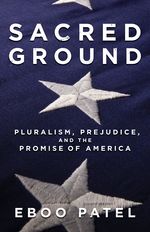
    PATEL-SacredGroundSacred Ground: Pluralism, Prejudice, and the Promise of
    America
    by Eboo Patel

    Wall Street Journal's “India Real Time” blog:

    Interfaith cooperation played a key role in everything from the American civil rights movement, to the swaraj movement in India, to the struggle against apartheid in South Africa. I believe that if religious communities worked together to apply shared values like compassion and hospitality we would be able to go a long way to solving many of the great problems in our world today, everything from poverty to malaria.

    Interview on Religion and
    Politics.org
    :

    Continue to partake of the banquet of your religious tradition. But all of our traditions have what I call a “theology of interfaith cooperation.” So it’s not just an American thing to be involved in interfaith cooperation. It’s also a very Christian thing to do. One of the wonderful things about religion is that it’s wide, it contains multitudes, including seeming contradictions. As my evangelicals like to say, within the Christian tradition there is both the “Great Commission,” as well as the “Great Cooperation.” In the Sacred Ground, I write about Bob Roberts [evangelical pastor of NorthWood Church], who’s very happy to remind me that he wants to convert me, but he’s also very happy to run big events in Dallas with IFYC methodology.


    Coming Very Soon


    STEDMAN-FaitheistFaitheist: How an Atheist Found Common Ground with the
    Religious
    by Chris Stedman (Release date November 06, 2012—available for
    preorder)

    An excerpt from Faitheist on Salon.com received over 4,000 Facebook
    “likes” in 24 hours:

    I fear that some atheists are doing what I used to do in my antireligious days: engaging in monologue instead of dialogue. After years of dismissing religious people outright, I realized that I was so busy talking that I wasn’t listening. I was treating religion as a concept instead of talking to people who actually lived religious lives. When I started listening, something interesting happened:

    I saw that my approach to religion had been distorted. I’d been thinking narrowly about the texts, not about some of their positive applications; of the one-sided stereotypes, not the diverse spectrum of beliefs and practices. It was only after I observed the actual actions of religious communities — and, more importantly, engaged with religious people and their stories — that I was able to see the benefits of working across lines of religious difference.

    Author events:

    Book release party at Harvard Divinity School, Cambridge,
    MA on Nov 02

    Lecture at Tufts University, Medford, MA on Nov 15

    Lecture, reception, and signing at Yale Divinity School, New
    Haven, CT on Nov 27

    Assembly lecture at Lincoln School for Girls,
    Providence, RI on Nov 28

    Bookstore event at Subtext, St. Paul, MN on Nov 29

    Bookstore event at Magers & Quinn, Minneapolis, MN on
    Nov 30

    University of Minnesota, Minneapolis, MN on Dec 03

    Lecture at Oberlin College, Oberlin, OH on Dec 06

    Lecture at Center For Inquiry Transnational Headquarters,
    Amherst, NY on Dec 14


    Have We Got Blurbs for You! 

    My Mother’s Wars by Lillian Faderman (Release date March 05,
    2013—available for preorder)

    “Faderman's story of her immigrant mother is so vividly
    imagined that you can taste the borscht Mary eats, squirm at the claustrophobia
    of her tiny rented room, and be swept up in the sensual delight that will
    betray her.”—Janice Steinberg, The Tin Horse 

    Raising Global IQ: Preparing Our Students for a Shrinking
    Planet
    by Carl Hobert (Release date February 12, 2013—available for preorder)

    “Brilliant, original, engaging, and hugely important
    book!”—Edward M. Hallowell, author of Driven to Distraction

    Defiant Brides: The Untold Story of Two Revolutionary-Era
    Women and the Radical Men They Married
    by Nancy Rubin Stuart (Release date April
    09, 2013—available for preorder)

    “An ingenious means of bringing new life to the oldest story
    in our nation’s past: the American Revolution from the perspective of the young
    and clear-sighted wives of generals Benedict Arnold and Henry Knox. 
    Tracing the parallel lives of two couples with conflicting loyalties, Nancy
    Rubin Stuart achieves a you-are-there verisimilitude in Defiant Brides that is
    rare and not to be missed.”—Megan Marshall, author of The Peabody Sisters:
    Three Women Who Ignited American Romanticism 

    Fast Future: How the Millennial Generation Is Shaping Our
    World
    by David D. Burstein (Release date February 12, 2013—available for
    preorder)

    “As young social entrepreneurs, Fast Future spoke to our
    core by telling the story of an exciting turning point that will change the
    course of history. That is, if we can channel this energy.  David Burstein
    takes a deep and nuanced look at the potential young people have and the
    terrible missed opportunity of not capitalizing on the innovation of the
    millennial generation. David himself represents the savvy impatience, the
    industriousness, and the possibilities of the millennial generation: this book
    is not to be missed or ignored. And, in Fast Future, he presents us with the
    opportunity to re-imagine how generations can work together to create a more
    innovative, equitable world—today.”—Jessica Posner Odede and Kennedy Odede,
    Co-Founders, Shining Hope for Communities

  • Alan Michael Collinge is the author of The Student Loan Scam: The Most Oppressive Debt in U.S. History—and How We Can Fight Back. He is the founder of StudentLoanJustice.Org.

    4229As I was finishing the manuscript for my
    book, The Student Loan Scam, in early 2008, Americans
    collectively owed roughly $650 billion in student loan debt—an incredibly large
    number at the time. Today, however, that amount has grown to surpass $1
    trillion and continues to increase at a rate faster than historical debt growth
    prior to the financial crisis. Defaults, too, have skyrocketed, and nearly all
    of the failures in the lending system I call attention to in the book have
    continued unabated. This issue has grown, I would say, from a significant
    problem to a major crisis. This has greatly strengthened the book’s core
    argument: the need for a return of standard consumer protections (like
    bankruptcy) to all student loans. 

    Since the book’s publication, student loan
    debt surpassed credit card debt as the largest category of consumer debt (excluding real
    estate). While the banking crisis compelled banks to tighten lending and
    reduced borrowing across all other lending categories, student loan borrowing
    actually accelerated significantly. Colleges and universities, to their discredit, have not exactly
    adjusted their prices in deference to the hard economic times, but have instead
    increased tuitions and fees at an even faster rate.

    Defaults, unsurprisingly, have surged. The
    cohort default rate (the percentage of loans defaulting within the first two
    fiscal years of repayment) has grown from less than 5% to over 9%. In 2010,
    however, this metric was found to be vastly lower than the actual, lifetime default rate (supporting a
    controversial claim I made in the book). Specifically, government data showed
    that for 1995 graduates the default rate was about 20%. So while it is impossible to say what the true default rate is
    currently, we can say confidently that for years it was comparable to the
    subprime home mortgage default rate of 25%.

    Another controversial claim made in the book was
    that the government may actually be making, not losing money on defaults. Initially, the Department of
    Education and Beltway analysts disputed this claim vigorously. Since then,
    however, a leading financial aid expert has publicly confirmed the claim.

    Importantly, the public is speaking out about
    this problem, most notably through the Occupy movement that started last year.
    Student demonstrations, too, are occurring with some frequency in the U.S.
    These citizen actions have, however, been largely ineffective for various
    reasons. The Occupy protests, of course, were shut down rather abruptly and
    haven’t yet re-emerged. The student demonstrations have usually consisted of
    simple, reactionary protests against tuition hikes. Such strategies have been
    stymied or co-opted by the universities, who have become quite good at shifting
    the blame to state or federal cuts. This has left most student groups
    conflicted in purpose or changing their protests to calls for more funding.
    Going forward, it is key that the students become more knowledgeable on the
    issue so that they can pursue more informed and effective courses of action.

    It is also important to note that real,
    investigative journalism on this issue evaporated in the wake of the financial
    crisis. From roughly 2009-2011 media coverage of student loans focused almost
    exclusively on for-profit colleges and the private student loan industry, and
    ignored other issues, such as those mentioned above, the cost of college, and
    the lack of disclosure to students and their families about the absence of
    consumer protections. That has begun to change somewhat as the shear magnitude
    of outstanding student loan debt and related public protest have become
    impossible to ignore, but to this day it remains extremely difficult to convince reporters, producers, and others to ask the tough
    questions outside of this non-starting, “non-profit vs. for-profit” narrative.

    Much has happened over the past three years that
    cannot be conveyed in this piece. For example, I’ve left out much about our
    experiences in Washington, D.C., the interesting middle-ground that this issue sits on (drawing from both liberal and
    conservative principles), and the resulting mixed bag of support and attention
    we have received. The impact of President Obama’s overhaul of the lending
    system and the post-crisis response of the student lending industry, colleges,
    advocates, and other key players are also important but not covered here.
    Finally, the increasing harm that is being done to real people as a result of
    living under the weight of this debt is critically important, but goes
    unaddressed here.

    I believe that, with increased pressure from
    those affected by the high costs of college (this includes both borrowers and
    those who pay out-of-pocket), Congress can move forward on this issue, and StudentLoanJustice.Org is devoting its grassroots efforts towards that end. The most
    important element in this fight is the level of action by citizens. Students,
    who will likely prove to be the most important group in this fight, need to see
    why returning consumer protections to student loans is key to getting prices
    and default rates down, making student loan debt manageable, and fixing a
    plethora of systemic problems that have arisen in their absence. Their actions
    today will not only affect their future financial well-being—but also the
    economic health of the entire country.

  • An environmental attorney, Philip Warburg served as president of the Conservation Law Foundation from 2003 to 2009. He is the author of Harvest the Wind: America’s Journey to Jobs, Energy Independence, and Climate Stability. Visit his website at www.philipwarburg.com.   

    0107“Ruin and Revival” is the theme of this
    season’s Terrain.org: A
    Journal of the Built & Natural Environments
    . Tapping into the
    happier half of this theme, the journal includes an updated version of the
    first chapter of Harvest the Wind under the title, “Cloud
    County Revival: Wind Power’s Ascent in Rural Kansas
    .”

    In late July, I had the chance to revisit
    Cloud County with my wife Tamar. This remote corner of north-central Kansas was
    the starting point for my wind power research back in 2009, and I have
    maintained close ties with people in the community ever since.

    The occasion for our visit was a book talk hosted by EDP Renewables North America, owner of a
    201-megawatt wind farm that was built in 2008, and Cloud County Community College, home to one of
    the nation’s leading wind energy technology training programs. A good-sized
    crowd gathered for the talk, undaunted by the 105-degree mid-afternoon heat
    during a drought that tested the nerves and strained the budgets of many Cloud
    County farmers and ranchers.

    Income from the Meridian Way Wind Farm offers a much-valued
    hedge against turbulence in the Cloud County farm economy. In summers like this
    past one, crops may wither and cattle may need to be shipped out to feedlots
    earlier than planned, but wind farm hosts can rely on the continuity of lease
    payments for wind turbines and access roads on their property. These annuities
    amount to tens of thousands of dollars for many landowners.

    In addition, Cloud County benefits from a voluntary contribution
    made each year by EDP Renewables, to be used for economic development projects.
    During the past few years this payment has amounted to $200,000, and it is expected
    to rise to $300,000 next year.

    Beyond these economic gains, wind power development has brought
    a renewed sense of pride to Cloud County Community College. The college’s wind
    energy program is now in its fifth year, with over a hundred students enrolled
    today. In addition to kids coming straight out of high school, the program has
    trained retired Army careerists, former schoolteachers and office
    administrators, and many from the construction trades that were hit so hard by
    the recession.

    In the article that appears in Terrain.org, readers can look
    more closely at the lives of Cloud County farmers, ranchers, educators, and
    wind farm operators – all beneficiaries of the boost that wind power has
    brought to their community.


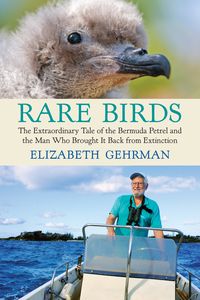
  • GEHRMAN-RareBirdsThe inspiring story of David Wingate, a living legend among birders, who brought the Bermuda petrel back from presumed extinction
     

    Rare Birds is a tale of obsession, of hope, of fighting for redemption against incredible odds. It is the story of how Bermuda's David Wingate changed the world-or at least a little slice of it-despite the many voices telling him he was crazy to try. 

    This tiny island in the middle of the North Atlantic was once the breeding ground for millions of Bermuda petrels. Also known as cahows, the graceful and acrobatic birds fly almost nonstop most of their lives, drinking seawater and sleeping on the wing. But shortly after humans arrived here, more than three centuries ago, the cahows had vanished, eaten into extinction by the country's first settlers. 

    Then, in the early 1900s, tantalizing hints of the cahows' continued existence began to emerge. In 1951, an American ornithologist and a Bermudian naturalist mounted a last-ditch effort to find the birds that had come to seem little more than a legend, bringing a teenage Wingate-already a noted birder-along for the ride. When the stunned scientists pulled a blinking, docile cahow from deep within a rocky cliffside, it made headlines around the world-and told Wingate what he was put on this earth to do. 

    Starting with just seven nesting pairs of the birds, Wingate would devote his life to giving the cahows the chance they needed in their centuries-long struggle for survival – battling hurricanes, invasive species, DDT, the American military, and personal tragedy along the way. 

    It took six decades of obsessive dedication, but the cahow, still among the rarest of seabirds, has reached the hundred-pair mark and continues its nail-biting climb to repopulation. And Wingate has seen his dream fulfilled as the birds returned to Nonsuch, an island habitat he hand-restored for them plant-by-plant in anticipation of this day. His passion for resuscitating this "Lazarus species" has made him an icon among birders, and his story is an inspiring celebration of the resilience of nature, the power of persistence, and the value of going your own way. 

    Read an article about Rare Birds in the Royal Gazette of Bermuda.

    Read an excerpt on Scribd.

    About the Author

    Elizabeth Gehrman is a frequent contributor to the Boston Globe Magazine and has written for the New York Times, Archaeology, More, and This Old House. She lives in Boston and upstate New York.

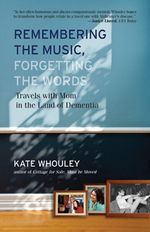
  • Last week, author Kate Whouley was honored by the New England Independent Booksellers Association (NEIBA) with the New England Book Award for Nonfiction for her memoir, Remembering the Music, Forgetting the Words: Travels with Mom in the Land of Dementia. Below is an adaptation of her acceptance speech, given before an audience of enthusiastic booksellers at last week's NEIBA Fall Conference in Providence. 

    0331I have
    always been a reader. I love to lose myself deep inside the pages—and the
    worlds—of books.

    Still—my
    capacity for observation and my ability to imagine alternate realities has not
    always served me well. In the first standardized test I was given, I performed
    badly. I was asked to circle the image that should come next in a series of
    illustrations. In every scenario, I could imagine too many possibilities. There’s
    one I remember: a girl has dropped a bottle of milk on the floor. What would
    happen next? Would she clean up the spill? Summon her mother for help? Enjoy
    her after-school snack? It seemed to me so much would depend on the character
    of that girl. And the plot line of her life. What if her mother wasn’t there
    when she got home from school? Did she have a cat who might lap up the milk? Was
    she easy-going or a worrier? Is it possible that she dropped the bottle on
    purpose because she didn’t like the taste of milk?

    You can see
    why I had trouble with this test. My results made me a Cub, a member of the
    lowest, slowest reading group. Within weeks, I was a Bluebird. And I have still
    never forgiven that first grade teacher—her name was Mrs. Cunningham—for
    telling the rest of the class—that my climb from Cub to Squirrel to Rabbit to
    Bluebird was a result of hard work.

    But no
    matter, I kept on reading. Anything that was around the house—and there were
    plenty of books. My mother was an English teacher and drama coach. I read books
    that were not age-appropriate, and when I tired of the plays and novels on my
    mother’s bookshelves, I read my way through my grandmother’s Book-of-the-Month
    selections and her library of Reader’s Digest Condensed editions.

    Reading, I
    was in training to become a writer. It’s true I wrote along the way; in fact,
    when I was in fourth-grade, Mrs. Cunningham retired, and I was asked to write
    and recite a poem in her honor. It was my first unpublished fiction.

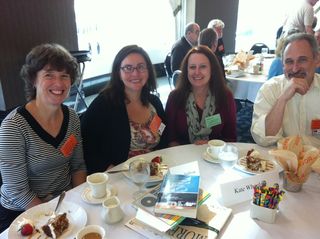
    Photo (4)
    Vicky Titcomb (Titcomb's Bookshop), Lisa Sullivan (Bartleby's Books), Kate Whouley and Michael Herrmann (Gibson's Bookstore) at the NEIBA Awards Lunch.

    In, junior
    high, I was published in a magazine called, Insulators,
    Crown Jewels of the Wire
    . I was too busy practicing my flute to do much
    extra-curricular writing in high school or college. After graduation, I taught
    flute lessons, waited tables, wrote greeting cards for Hallmark, and landed a
    part-time job in a bookstore. As a bookseller—and later as a consultant to
    booksellers—I wrote ad copy, radio commercials, blurbs for catalogues, features
    and a column for American Bookseller.

    I was
    writing. But I was not—in my mind—a
    writer
    .

    Except in
    my dreams. That’s where I met Woody Allen.

    At the
    time, I had seen just two Woody Allen movies—Crimes and Misdemeanors and Hannah
    and Her Sisters
    . I did not love either one. Also—in case it is
    relevant—this dream occurred before Mr. Allen began dating his sort-of
    stepdaughter, now-wife of twenty years.

    In the
    dream, I am one of maybe ten or fifteen students in a classroom. The teacher is
    Woody Allen. Then the scene changes; we’re walking in the park—just me and Mr.
    Allen. It’s fall; the leaves have color: a few are on the ground. The
    temperature is chilly enough for my companion to be wearing a light overcoat.

     Woody Allen turns to me, and says, “You know,
    we share the same interests—as writers.” He elaborates: “We’re both fascinated
    by relationships. We write from character. We want to know what motivates
    people. Also, we wonder why we’re here.”

    I
    cannot tell you why my subconscious chose Woody Allen as my writing mentor. (Why
    can’t I have Tolstoy?)

    I can tell you that when I woke up, I thought
    about what Mr. Allen had called me: a writer.
    And how he’d treated me as an equal. How quickly I’d advanced from back of the
    classroom to walking by his side. And in some strange way, dream-Woody Allen
    got me thinking that I might be able to move from writing to writer.

    It
    turns out that the man whose movies I had not yet seen was pretty much right-on
    about my interests as a writer. I do write from character. That’s not so
    typical in a nonfiction writer. In the case of Cottage for Sale: the characters who led me to write were the leading
    men of my house-moving adventure—a lot of guys with tool belts and a bossy gray
    cat named Egypt.

    When
    I started writing Remembering the Music,
    I thought I was writing a book about all the intriguing personalities in the
    community band I’ve played in for almost twenty years. But my mother—who is
    what might be called, in writerly terms, a strong character—seemed to be
    showing up on every page. I realized I wasn’t writing a book about the band
    with some bits about my mother in it, but rather that I needed to write a book
    about my mother with some bits about the band in it.  

    Remembering the Music is often mistaken
    for a book about Alzheimer’s. In fact, it’s a book about all the things that
    interest me as a writer: people, relationships, what motivates us, and why we
    are here. It’s about choices we make, the journeys we take, and the families we
    create from friends. It’s about learning to forgive, and most of all—about
    finding the willingness to forget. It’s also about the bridge and consolation
    we find in music. And it’s about the things my mother taught me—not only in her
    vibrant youth, but in her debilitated and forgetful aging. Not the least of
    which was to sit still, be present and know that every moment—remembered or
    forgotten—matters to the person sitting next to us.

    For
    readers who prefer plot to theme: this is a book about two women, alone in the
    world. Both of them just a bit eccentric, odd in their own ways. Both of them
    fighters who don’t give up or give in. Though they aren’t so different, they
    aren’t so much the same either. And they don’t really get along for most of
    their lives. And then—well something horrible happens. Which makes something
    miraculous occur.

    After
    all that character and theme and plot, if someone still insists that Remembering the Music is about Alzheimer’s—well,
    it’s about the upside of Alzheimer’s. This
    is not a book about an illness. It’s a book about a healing.

    Some
    have suggested writing this book must have been a cathartic process, but
    catharsis was not my motivation or my practice. I wrote this book because I
    realized that I had to. That my mother—the version of her showing up on every
    page of that band book—wasn’t going away. That she wanted this book—and that
    she knew I would learn something in the writing.

    Because
    we write for the same reasons that we read. To uncover the truth about
    something; to learn. Sometimes as readers—and especially as writers—we need to
    stand back from a story before we can understand its lessons. From the distance
    of the writer, I can tell you what this story taught me: healing comes in most
    mysterious ways; we grow through challenge and adversity; life is precious,
    relationships—fragile, love—undiscriminating, and hope—never-ending. 


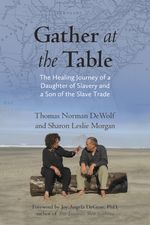
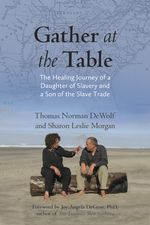
  • DEWOLF-MORGAN-GatherAtTheTableTwo people—a black woman and a white man—confront the legacy of slavery and racism head-on.

    Thomas DeWolf—a descendent of slaveholders—and Sharon Morgan—a descendent of slaves—come together to openly discuss how the legacy of slavery and racism has impacted their lives. Together, they disclose the various difficulties and rewards they experience as individuals striving to heal. Gather at the Table is a timely, candid, and deeply relevant book that offers an engaging model of restorative justice.

    Visit the Gather at the Table website to learn more about the authors, their writing, and upcoming appearances.  

    Follow Tom DeWolf on Twitter, or like Gather at the Table on Facebook. 

    In the Media

    Read an excerpt in the Harvard Kennedy School Magazine.

    Read an excerpt of Gather at the Table that appeared in Catalyst: A Social Justice Forum.


    Watch the Book Trailer on YouTube


    Praise for Gather at the Table


    “I could not put this book down.

    Gather at the Tableis an extraordinary story of an honest, meaningful conversation across the racial divide. At times it hurts to read. And well it should. Centuries of injustice and trauma that face us every day in this country have no place for half-truths. Sharon and Tom took the harder road-searching for healing, they literally walked together into painful histories and found authentic friendship.”—John Paul Lederach, co-author of When Blood and Bones Cry Out: Journeys through the Soundscape of Healing and Reconciliation

    “Sharon and Tom take us on a heart-opening journey of awakening. As a nation, we owe them a deep bow of gratitude as they help us navigate the deep divides of race and otherness.”—Belvie Rooks, Co-Founder, Growing A Global Heart

    “Gather at the Table is an honest exploration into the deep social wounds left by racism, violence and injustice, as the authors work through their own prejudices in search of reconciliation–and ultimately find friendship.” —Leymah Gbowee, 2011 Nobel Peace Laureate

    “What a courageous journey—communicated in an engaging, readable style, with candor, humor, and deep feeling. This book shed light on the thoughts, questions, and feelings I have about race, society, culture, historical, generational and structurally-induced trauma—and the human ability to transcend. In reading it, I realized there are questions I'm still afraid to ask about race, things I'm afraid to say, and yet I realized anew the power of acknowledgment, mercy, justice, and conflict transformation. I'm grateful to DeWolf and Morgan for not just taking the journey, but for sharing their story with us.”—Carolyn Yoder, Founding Director of STAR: Strategies for Trauma Awareness & Resilience and author of The Little Book of Trauma Healing: When Violence Strikes and Community is Threatened

    “The authors’ accomplishment stands on its own, but their book also serves as a great introduction to a shared past that ought to be better known.”—Kirkus Reviews


  • Indigenous Peoples Day is a reimagination of Columbus Day that "changes a celebration of colonialism into an opportunity to reveal historical truths about the genocide and oppression of indigenous peoples in the Americas, to organize against current injustices, and to celebrate indigenous resistance." In 2012, in honor of the holiday, we interviewed author Kim E. Nielsen, author of A Disability History of the United States, about the history of disability in North American Indigenous culture. 

    2202You said to me that the first chapter—about Indigenous peoples in North America before European colonization—was the hardest for you to write. Why was that?

    I think that there were two reasons. One was that, as a historian, I'm used to dealing with traditional historical evidence, like letters and court records and maps and tombstones—the tangible things. And they don't really exist for the period prior to European arrival. So the evidence was all the kind of stuff I'm not used to dealing with. I had to look to archaeologists, linguists, contemporary oral culture, elder memory, elder knowledge. It was so different from the types of material I am used to that I didn't even know how to do the research at the beginning. So that was hard, but I also think it was the hardest because it was the furthest away from the reality we live in in 2012. If I argue that disability is impacted by culture—experiences, definitions, are impacted by culture. Of course, it's logical that it will be different in different time periods and different cultures, but the period prior to European arrival is so different from what I am accustomed to that I think it was both really important but also harder for me to understand.

    In the first chapter, you say that there's a history of disability among Native Americans but that disability also really doesn't have a history among North American indigenous peoples before European arrival. 

    I thought it was really funny to do a history of something that in some ways didn't exist because the cultural understandings were so different. If you had no concept of disability as we understand it, how are you going to do that in a history? But I also think it's important in that we're showing that it does change over time, radically. I think that we consider disability to be a certain set of bodily, intellectual, emotional differences, and we think we know what that means. "I know it when I hear it, or see it, or whatever." And people have always had bodily differences, we've always had different skill sets. Some of those we don't pay any attention to, some are highly stigmatized, some are sort of "charming" and "cute." But how we understand disability today didn't exist. I'm coming to the conclusion that disability in most of those indigenous contexts meant someone who was lacking social connections and relationships of reciprocity, that was considered the difference that was most stigmatized. That was most remarked upon, that most put you outside of the larger community. 

    So people who were born without the full use of a limb, or somebody that was born with what we might now consider a psychological impairment to their fully functioning in our society might not necessarily be set aside as being different or as not being part of their community. 

    I think they would have been integrated far more into the community, and there would have been efforts to figure out what they could do, how they fit in. But also, simply, there was so much greater bodily differences and intellectual differences that were expected and simply part of the community and what people were. Part of that was simply medical and terrain differences and what it meant to live then. I live in Ohio and I have heating and air conditioning and that has an impact on my skin. And I have antibiotics to help me when I fell down yesterday and scraped my knee. When you live in cultures where that doesn't exist, it impacts your body. So there would simply be greater bodily differences—that would be the norm, that would be expected.

    Can you talk about the ideas of integration of body, mind, and spirit? Do you think that affected how people affected these bodily differences.

    The words that I kept running across were words like "unwell" or "unbalanced." In many indigenous cultures, they didn't separate out mind, body, spirit the way that Western cultures have, and so the idea was to have an overall wellness. But I could have significant bodily differences and cognitive differences and still be considered balanced and well. And the ideal goal would be to reach a state where one was balanced and well. My bodily differences or mental differences still could exist and be significant, but we would want to return to the wellness or achieve the wellness that may have been upset by a conflict or going near a tree that had been hit by lightning—something that was considered stigmatized or a sign of evil or a sign of an evil spirit or violating a taboo. 

    The members of the community would be more concerned, then, with helping someone achieve that balance than with "fixing" this thing that happened to them.

    Yes—the ill health or the unease was not grounded in the body in the way that we tend to do this in Western medicine, but instead was dependent upon relationships with other people and with the world—the general overall balance of using my gifts, respecting others' gifts. 

    We have these ideas—these weird ideas of what Native Americas are and were like—that are shaped by popular culture. And I remember watching movies with offensive and unrealistic portrayals of Native Americans where they would speak with their hands. But people really did speak with their hands! And that was a real advantage, wasn't it? 

    It was! Not in the awkward gestures of old Hollywood movies by any means. But with a relatively sophisticated language. When we think of Indians with a capital "I" as one group, but there were something like 2,500 languages in North America. North America is a big place. And there were lots of different communities and they spoke different languages, and thus it was to their economic advantage, their social advantage, flirting advantage, to have a kind of shared signed language. Linguists have figured out that there was a commonly shared signed language across much of North America that people who spoke different verbal languages could use in trading, or whatever they needed to do. That meant that for anyone who had hearing loss or became deaf, people in their communities knew how to sign. Hearing loss or being deaf did not set you apart as it has historically in Western cultures. 

    Speaking to those differences between groups… Did you encounter differences that made you think that in certain groups people would have had it easier to integrate with differences in physical abilities?

    Yes. I think in cultures that emphasize the warrior role, I think it would have been harder to have certain physical differences. Or cultures that may have been highly mobile, it would have been harder. In some ways, it varied from impairment to impairment, and then it varied by community. In cultures due to the terrain or due to spiritual expression—it's fascinating how many cultures there are. 

    In the book you discuss the Hopi, and how if you were living according to the Hopi way of life, then you should be perfect. You should have perfect health. 

    And there's a recognition that no one can do that, and that our bodies change over time, and that's simply the way it is. But yet, one should try to seek the ideal. 

    I really struggled in this chapter about not wanting to romanticize indigenous cultures too much, and to think about what ideas were versus the reality, and I think that fits in with the understandings of balance. Trying to recognize ideals, trying to recognize people's daily efforts to live up to those ideals. I think that there is in most indigenous cultures an effort to recognize people's skills. I may not be able to speak well, but if I can make baskets that hold water, that is something that can be of immense use to the community. In some ways disability was defined as lacking or still seeking out what those skills were. 

    European contact obviously disrupted life in numerous ways. Can you talk about how this might have created problems for people living with bodily differences?

    I think it's impossible to exaggerate how much of an impact European diseases had. For one, the astronomically high death rate. In some places, a sixty to one hundred percent death rate. If you're left with ten percent, five percent, thirty percent of your community alive, you've disrupted all of those social relationships, those relationships of reciprocity and skill sets. So, I think that what we consider disability today had much more impact after European contact because of the limited communities, but also because people who survived things like small pox, chicken pox, some of the influenza waves, they were more likely to have significantly weakened bodies, to have a loss of sight that was not there before. And they wouldn't have had the community there to rely on that they had before.

    At the beginning of the twentieth century, the stigmatization of mental illness and an increased governmental push to assimilate Native Americans into white culture combined harrowingly into the Hiawatha Asylum for Insane Indians. Can you talk about this institution?

    The U.S. created a lot of institutions at the turn of the twentieth century. Native boarding schools were one, but then there was also a federal asylum for the "insane Indians," as it was called, in Canton, South Dakota. And just as at Indian boarding schools, people were highly discouraged from speaking their indigenous languages, "insanity" was defined in a way that was pretty complicated. That is, historians are beginning to figure out that people who steadfastly maintained their own traditional religious practices were more likely to be institutionalized as insane. People who resisted the authority of the Bureau of Indian Affairs agents, who frustrated the agents, were more likely to be interred as insane. People who maintained traditional gender roles within indigenous cultures were more likely to be determined insane. And institutionalization was a way to threaten and push people into European modes of thinking. 

    The Hiawatha Asylum was just a horrendous place to be as well, away from family, sometimes with few people who spoke your language. There was not good traditional food, it was a very unpleasant place. The cemetery was right near the asylum, as it was at other institutions and asylums across the United States, but for many indigenous cultures, being so close to one's dead was very taboo, and it was also taboo to not provide them with the proper burial practices so that they could go on their way in their lives happily. So being so close to that and not being able to do death properly was profoundly disturbing to the people institutionalized there. 

    There are records of European community members considering them to make "insane" noises that proved their insanity. Well, we look back at that and that may have been death mourning practices. They were trying to say goodbye to people properly.

  • Beacon Authors in the Media:


    SacredgroundSacred Ground: Pluralism, Prejudice,
    and the Promise of America
    by Eboo Patel

    Eboo Patel asks colleges, "Do your students learn everything they know about Islam from their Facebook news feed?" Inside
    Higher Ed


    Overdiagnosed:Making People Sick in the Pursuit of Health by H. Gilbert Welch, Lisa Schwartz and Steve Woloshin

    Author appearance on PBS "Money & Medicine" (Reading List)


    White Bread: A Social History of the Store-Bought Loaf by Aaron Bobrow-Strain

    Fox Foodie Column column on FoxNews.com looking at the history and healthfulness of white bread.


    Coming Soon:

    The
    $60,000 Dog: My Life With Animals
    by Lauren Slater, November 20, 2012

    Booklist
    review Oct 15: “A thoughtful examination of a sometimes difficult life,
    ameliorated and often alleviated by connections with nature and animals. . .
    .Dogs, wasps, and bats also figure in a poetic narrative that gives the reader
    a melodic look into a deeply considered life."


    My Mother’s Wars by
    Lillian Faderman, Mar. 05, 2013

    “Lillian Faderman is an extraordinary storyteller, one of the few who can tell a painful story,
    with a complex ending—and imbue it with humor, sensuality and earthy grace, in
    every sentence.”—Amy Bloom,
    author of Away


    The Rebellious Life of Mrs.
    Rosa Parks
    by Jeanne Theoharis, Jan. 29, 2013

    Jeanne Theoharis, author of The Rebellious Mrs. Rosa Parks has
    been  selected to keynote MLK Sunrise Celebration the
    Mid-Winter Meeting of  ALA. 6:30-7:45am on Monday, January 28 in
    Seattle, WA


    What Doctors Feel: How Emotions Affect the Practice of Medicine by Danielle Ofri, June 04, 2013

    Essay
    in the New
    York Times
    : 
    “Women
    Still Missing from Medicine's Top Ranks.”


    Author Events:


    AnitahillReimagining
    Equality: Stories of Gender, Race, and Finding Home
    by
    Anita Hill

    Author events include:
    Oct 11 at
    Tufts Medical Center (Boston, MA)
    Oct 18 at
    Brandeis House (New York)
    Oct 23 at
    Harriet Tubman House (Boston)
    Oct 27 at
    Boston Book Festival (Boston Public Library)
    Oct 31 at
    Claremont McKenna College (Claremont, CA)
    Nov 07 at
    USTA Serves (White Plain, NY)
    Dec 06 at
    National Archives Records Center (Waltham, MA)


    A Queer and Pleasant Danger: The
    true story of a nice Jewish boy who joins the Church of Scientology and leaves
    twelve years later to become the lovely lady she is today
    by Kate Bornstein

    Brooklyn
    Book Fair on Sept 23
    Twin
    Cities Book Festival Oct 13
    Miami
    Book Fair Nov 16-18


  • Nancy Schniedewind is a Professor at SUNY New Paltz and co-editor with Mara Sapon-Shevin of Educational Courage: Resisting the Ambush of Public Education. Julie Woestehoff is a contributor to Educational Courage. This piece originally appeared at Huffington Post.

    SAPON-SHEVIN-EducationalCourageWalden Media's Won't Back Down portrays the heroism of one parent and one teacher fighting harmful educational practices by taking over their school. Their victory is as mythic as it is misleading. Those who should be celebrated by such media attention are the real-life heroes at the grassroots who have been fighting for meaningful educational change day-to-day, year-to-year.

    Won't Back Down claims it is "inspired by real events" — two unsuccessful attempts in California to implement "parent trigger laws" (called "Fail Safe" in the movie) by replacing traditional schools with charter schools. Unlike the movie, teachers had no voice or vote in the California efforts. And, while the movie shows Maggie Gyllenhaal, the mom, and Viola Davis, the teacher, valiantly going door to door by themselves, many of the parent petition signatures in the California campaign were gathered by organizers trained and paid by Parent Revolution, a group that is generously funded by Bill Gates and the Walton Foundation and created by Green Dot, a charter company vying to take over schools.

    While it is imperative that we improve failing schools, that is not the goal of parent trigger laws. Pushed by ALEC, the Parent Trigger is simply one more attempt to divert public money into private pockets, empowering entrepreneurs, not parents.

    Fortunately, there are true stories of courageous parents, students and educators whose lives don't make it into a Hollywood movie, but who persistently work to improve public education. Many of them challenge the policies of these same entrepreneurs who, along with charter schools, push excessive high-stakes testing, merit pay and the closing of under-resourced schools deemed failing based on student test scores.

    Why not make a film about the bravery of South Texas student Marcario Guajardo who, when 11 years old, told his parents, "I want to protest the TAKS test. I don't want to take it. I don't like what the test is doing to my school." Marcario stayed home on the day of the test. His protest, an honest act of courage, motivated teachers and school leaders to alter their practices.

    A film about the twenty five-year legacy of Chicago-based Parents United for Responsible Education (PURE), now a base of the national organization Parents Across America, would tell the real story of audacious parents fighting for quality education. PURE parents would be seen organizing a 2004 major protest of school closings, camping out all night on the sidewalk outside the school district's loop headquarters in order to testify at Board of Education morning hearings.

    WontbackdownThey would be portrayed investigating then-district-CEO Arne Duncan's impressive news that a school "turned over" to a private management company had nearly doubled the achievement growth of the students who had been at the closed school. PURE's discovery that claims of this great success were based on only 12 of the 336 former students still enrolled in the re-opened school two years later highlighted that this and other Duncan-lauded "miracles" seem more about changing the student body than improving education.

    Sam Coleman, elementary teacher of English Language Learners in Brooklyn, would challenge the stereotype of the self-serving teacher if cast as the lead in a film grounded in reality. Sam knew a district proposal for a merit-pay system based on standardized test scores would hurt students and teachers alike. Though the proposal could cost him and his colleagues bonuses of $1,500, Sam still encouraged his peers to consider how the plan: 1. assumed that the most reliable measure of a school's success is student test scores; 2. encouraged teachers to teach to the test; 3. assumed the problem in schools is that teachers are not working hard enough, rather than the larger issues that affect student success. Ultimately, Sam's faculty rejected the "bonus plan," challenging a business-based model of education and standing up together for children.

    These and other local heroes deserve attention in the daily media as well as Hollywood films. They are among the thousands of others at the grassroots fighting for more equitable and democratic schools and whose stories can truly empower others because they are real.


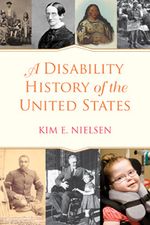
  • 2202The first book to cover the entirety of disability history, from pre-1492 to the present

    Disability is not just the story of someone we love or the story of whom we may become; rather it is undoubtedly the story of our nation. Covering the entirety of US history from pre-1492 to the present,A Disability History of the United States is the first book to place the experiences of people with disabilities at the center of the American narrative. In many ways, it's a familiar telling. In other ways, however, it is a radical repositioning of US history. By doing so, the book casts new light on familiar stories, such as slavery and immigration, while breaking ground about the ties between nativism and oralism in the late nineteenth century and the role of ableism in the development of democracy. 

    A Disability History of the United States pulls from primary-source documents and social histories to retell American history through the eyes, words, and impressions of the people who lived it. As historian and disability scholar Nielsen argues, to understand disability history isn't to narrowly focus on a series of individual triumphs but rather to examine mass movements and pivotal daily events through the lens of varied experiences. Throughout the book, Nielsen deftly illustrates how concepts of disability have deeply shaped the American experience-from deciding who was allowed to immigrate to establishing labor laws and justifying slavery and gender discrimination. Included are absorbing-at times horrific-narratives of blinded slaves being thrown overboard and women being involuntarily sterilized, as well as triumphant accounts of disabled miners organizing strikes and disability rights activists picketing Washington. 

    Read the introduction at Scribd.

    Read a review at Inside Higher Ed.
    "By displacing the able-bodied, self-subsisting individual citizen as the basic unit (and implied beneficiary) of the American experience, she compels the reader to reconsider how we understand personal dignity, public life, and the common good."

    About the Author

    Kim E. Nielsen is professor of history and women’s studies at the University of Wisconsin-Green Bay. She has published multiple books and articles, advised several film documentaries, and won numerous academic and teaching awards, including a National Endowment for the Humanities Research Stipend and a Fulbright Scholar Award to the University of Iceland. Read her posts at Beacon Broadside.