• Susie Bright, in addition to being a best-selling author, activist, and podcast host, is editor at large for Audible. This past spring, she approached Beacon with the goal of bringing out some of our titles in audiobook format on Audible, and we couldn't be more excited to announce that the first few books are now available. 

    Susie's blog, The Bright List, keeps readers and listeners apprised of new audiobooks, with Aretha Bright reviewing new titles. Here is a cross-post of Aretha's review of Mama’s Boy, Preacher’s Son: A Memoir of Growing Up, Coming Out, and Changing America’s Schools by Kevin Jennings.

    Mamas boyKevin Jennings needed an “It Gets Better” video when he was growing up, but there was no such thing in the 1960s.  It was a serious matter to appear “manly” and “Christian” in his home town. Baseball and touch football were expected, and no crying allowed, ever.

    Even when his father died at his 8th birthday party, Jennings knew he couldn’t show tears.

    The teasing and awkwardness of Jennings’ childhood will make you cringe, but it’s a triumphant feeling when he leaves his trailer park home in North Carolina and heads off to Harvard. But even more surprising is when Kevin decides to go back home and teach, after coming out of the closet. He ends up rocking the whole town and has nail-biting standoffs with the townies. Jennings’s story as a Lone Star gay activist in the south didn’t end in his hometown, though. Today, he’s best known as the founder of the Gay Lesbian Straight Education Network (GLSEN), which works in schools nationwide to make sure that things do get better for LGBT youth. 

  • Lipman-Tweetland

    With Barack Obama's victory over Mitt Romney yesterday, Tweet Laureate Elinor Lipman has concluded her own campaign to bring one political poem a day to her Twitter constituency. Today's tweet, number 500, expresses her joy at seeing her chosen Presidential candidate prevail:

    //platform.twitter.com/widgets.js

    You can read a selection of her tweets, along with commentary and context from the poet, in Tweet Land of Liberty: Irreverent Rhymes from the Political Circus. Ron Charles interviewed her about the project for the Washington Post. My personal favorite Q and its A:

    What’s been your favorite response from a reader?

    The day that Barney Frank announced that he would not be running again, I got an e-mail from him saying that he was proud to be evoked in the style of Ogden Nash.

    The Corner Bookstore offered their gratitude on their Twitter feed:

    //platform.twitter.com/widgets.js

    Novelist Joan Wickersham (whose book The News From Spain was just published and who helped to celebrate the publication of Tweet Land of Liberty) sent Lipman this celebratory poem:

    Dear Elinor, it must be sweet
    To wake and not be sworn to tweet,
    So bask today. Cavort. Have fun.
    You did your job. Your race is won.  

    Everyone here at Beacon has had a delightful time working with Elinor and following her verse-a-day project. To her we offer our own poetic thanks:

    //platform.twitter.com/widgets.js


    Notable Mentions


    FaitheistFaitheist: How an Atheist Found Common
    Ground with the Religious
    by Chris Stedman

    The just-released and already much-praised memoir received a starred review in the November 15th issue of Booklist:

    “Enter Stedman,
    avowed atheist, former Fundamentalist Christian, and current interfaith
    activist whose heartfelt and thought-provoking account of his struggle
    with God and religion serves as a call to arms for those seeking to bridge
    the gap between the religious and the secular… To that end he paints an
    intimate and deeply affecting portrait of his own life, one characterized
    by the sort of staggering dissonances—gay Christian teen,
    religion-degree-seeking atheist—that could cripple a person. But Stedman
    is nothing if not determined, and his resulting journey toward personal
    reconciliation through service work and interfaith dialogue is inspiring.
    Stedman’s story is motivational, his thoughts on interreligious dialogue
    insightful, and in this short memoir, he proves himself an activist in the
    truest sense and one to watch.” 

    The Land Grabbers: The New Fight Over Who
    Owns the Earth
    by Fred
    Pearce

    Environmental journalist Fred Pearce wrote a piece for Yale e360 that's been getting lots of attention around the blogosphere. "Why Are Environmentalists Taking Anti-Science Positions?"

    On issues ranging from ocean acidification and tipping points in the Arctic to the dangers of nanotechnology, the scientists have always gotten there first — and the environmentalists have followed.

    And yet, recently, the environment movement seems to have been turning up on the wrong side of the scientific argument. We have been making claims that simply do not stand up. We are accused of being anti-science — and not without reason. A few, even close friends, have begun to compare this casual contempt for science with the tactics of climate contrarians. [Read the rest here.]

    Reactions to the post include:

    Huffington Post Oct 31; HuffPo
    Cold Air Currents (blog) Oct 22; Cold
    Air Currents
    Houston Chronicle SciGuy blog Oct
    23; Houston
    Chronicle
    MuckRack Oct 24 includes Twitter
    feed of journalists tweeting the link, like Erin Ailworth at the Globe; Muckrack.com
    Tomorrow’s Table (blog) Oct 26; Tomorrow's
    Table
    World.edu on Oct 26; World.edu
    OverpopulationAwareness.org on Oct
    28; Overpopulation
    Awareness
    Environmental Health & Safety
    News blog Oct 28; EHS
    News
    Living Green mag Oct 29; Living
    Green
    Terra.com (Mexico) Oct 29; Terra.com
    Science20.com; Science20
    Current.com; Current.com


    Do It Anyway: The New Generation of Activists by Courtney Martin

    Courtney Martin and her book Do
    It Anyway
    were featured in the New York Times Sunday business section
    on Oct. 28. 


    Notable Mentions

    The Rebellious Life of Mrs. Rosa Parks by Jeanne Theoharis, Jan. 29,
    2013

    Starred review in Kirkus Reviews print (Nov 15) and
    online (Nov 04): “How Theoharis learned the true nature of this woman is a
    story in itself. Parks always stood in the background, never volunteered
    information about herself and eschewed fame. There were no letters to consult;
    even her autobiography exposed little of the woman’s personality. She hid
    her light under a bushel, and it has taken an astute author to find the
    real Parks. Even though her refusal to give up her bus seat sparked a
    revolution, Rosa Parks was no accidental heroine. She was born to it, and
    Theoharis ably shows us how and why.”

    Booklist
    review Nov 15: “Historian Theoharis offers a complex portrait of a forceful,
    determined woman who had long been active before the boycott she inspired and
    who had an even longer career in civil rights afterward.”

    The $60,000 Dog: My Life With Animals by Lauren Slater, November 20,
    2012

    More magazine (Nov issue) review, Pam
    Houston calls The $60,000 Dog: “assumption-busting,
    gut–wrenching, life-affirming.” 

    Light Without Fire: The Making of America's First Muslim College by Scott Korb, April 16,
    2013

    “Will
    Islam become an American religion or remain permanently estranged? Will Muslims
    in America develop an identity that contributes to their country or one that
    emphasizes isolation and opposition? Scott Korb knows just how crucial these
    questions are, and in Light Without Fire tells the story of the leaders
    and animating ideas behind America’s first Muslim liberal arts college—an
    institution seeking to build an American Islam—in all its fits and starts, and
    in prose that is both clear and compelling. I for one could not put it down—it
    is essential and riveting reading.”

    —Eboo
    Patel, Founder and President, Interfaith Youth Core, author of Sacred
    Ground: Pluralism, Prejudice and the Promise of America

  • Today's post is from Jay Michaelson, author of God vs. Gay? The Religious Case for Equality. Michaelson is a writer, scholar, and activist whose work addresses the intersections of religion, sexuality, spirituality, and law. 

    This post originally appeared at Huffington Post. 

    7992928939_388ff82622Recently
    I visited Minnesota to meet folks involved in the same-sex marriage debate. I
    was inspired by the amount of energy that people were devoting to the cause,
    and to emphasizing dialogue and conversation instead of shouting and slogans.

    One
    thing we’ve learned is that a lot of Minnesotans (and Marylanders,
    Washingtonians and Mainers) are sincere in supporting equal rights for gays and
    lesbians and simultaneously sincere in their misgivings about same-sex
    marriage. Yes, there are absolutely-sure people on both sides, but there are
    also a lot of people sincerely in the middle. If you’re one of those people, I’d
    like to share some of what I’ve learned as someone involved in this issue for
    several years now—and as someone who married my same-sex partner in New York a
    year ago.

    First, I want to say that I get it. I
    know many people in the gay community who say that if you don’t support
    marriage equality, then you must be a bigot or a homophobe, but I know that
    that isn’t true. I know plenty of people who are sincerely concerned about the
    consequences of same-sex marriage for their communities and their values—and
    some of them are my friends. So this is not about bashing people who disagree.
    (Of course, it’s also true that there are some
    bigots and homophobes out there, too. But I’m not really speaking to them,
    because they’re not interested in what I have to say anyway!)
    0147To those sincerely wrestling with this
    issue, I offer four points to consider.

    1. Your church
    will never have to hold any kind of wedding it doesn’t want to.

    Polls have told us that the number-one
    concern of “undecideds” is that their church, pastor, minister or rabbi would
    have to officiate a gay wedding if marriage equality passed. Let me be clear as
    a lawyer and a religious leader: This is absolutely 100-percent false. In every
    state with same-sex marriage, there are “ministerial exemptions” and other
    protections that ensure that this will never, ever happen.

    There’s also the U.S. Constitution. The
    exact boundaries of the First Amendment have been debated since it was passed
    223 years ago, but every justice on the Supreme Court, and every judge on every
    federal court, agrees that no church can be compelled to solemnize a wedding
    (or baptism, or funeral) that it finds religiously objectionable. It’s way, way
    beyond the pale of the law.

    Unfortunately, anti-gay zealots have
    deliberately distorted this issue. They have taken a small handful of
    borderline cases and twisted them beyond their meaning, or warned of a “coming
    storm” that will happen in the future. This is misleading, and it’s led to
    confusion. But it is a fact that no church will ever have to perform a same-sex
    wedding if it doesn’t want to. Period.

    2. You’re right
    to be stuck on the word “marriage.”

    Another thing we’ve learned in Minnesota
    is that a lot of folks support civil unions for gay couples but not marriage.
    Why? Because the truth is that “marriage” is a religious term. The state has
    taken it over, but the word, the concept, is religious. It’s true that this
    debate is about civil marriage, not religious marriage, but it’s also true that
    the word “marriage” itself is derived from religious concepts.

    The real problem here isn’t same-sex
    marriage; it’s the state deciding what marriage is in the first place. Many
    people, religious and secular, liberal and conservative, have argued that the
    state has no business deciding what “marriage” is. The state should just issue
    a civil union license to everyone and leave it to churches and other
    institutions to solemnize marriages.

    In my opinion this is a good point. The
    trouble is that “marriage” is the word we use right now. It’s how the state,
    and our communities, recognizes families. It’s how we decide who gets to visit
    their lifelong partners in the hospital or leave their property to their loved
    ones. More importantly, this is the word we use to decide which families count
    and which don’t.

    If we as a society want to change that,
    fine. But in the meantime, there’s a group of people—around 5 percent of people—who
    are excluded from being counted as families because of this definition. Unless
    we’re going to change the whole system, that isn’t fair.

    So if you’re stuck on the word “marriage,”
    you’re right. It is a word that comes from religious traditions. But words take
    on new meanings all the time, and this is one of them. That’s what we’re voting
    on now: not the original, religious meaning but this new, secular one. It
    really is a different question.

    3. Marriage has
    always evolved.

    I know that two men getting married may
    seem like a huge, radical break from a tradition as old as the Bible, but it
    isn’t. In fact, the tradition has always changed.

    For a start, let’s look at the Bible
    itself. Biblical marriage wasn’t monogamy; it was polygamy. Abraham had two
    wives; King Solomon had a whole harem. And that’s just the beginning. In
    biblical societies, when you conquered another group, the victorious men would “win”
    their defeated foes’ wives as part of the spoils. Is this “traditional marriage”?

    But let’s not stop there. Right up
    until the 20th century women were considered the property of their husbands—something
    the Bible explicitly states. Until the 19th century girls were married off at
    the age of 12. Is that “traditional marriage”?

    Of course, let’s also remember that in
    some places, interracial marriage was seen as a “crime against nature” up until
    the 1960s. In the 19th century African Americans weren’t even considered fully
    human. As revolting as it is to even remember this fact today, some people at
    that time would have considered interracial marriage a marriage between a human
    and an animal. Is that the “tradition” we’re protecting here?

    Thank God we have come a long way. Our
    society doesn’t treat women as property. All people are seen as fully human,
    equal in the eyes of God and the state alike. But getting from point A to point
    B was a radical change—no less, I submit, than including gay couples in the
    institution of marriage today.

    Gays and lesbians aren’t trying to
    change marriage. We’re trying to join it. And marriage itself has grown and
    changed as long as the institution has been around. Yes, this can seem like a
    big step, but look where we’d be if we hadn’t taken such steps in the past.

    4. It really is
    about “separate but equal.”

    Finally (and I think this point will
    probably be the one that carries the day in Minnesota), this really is about “separate
    but equal.” Slice it, dice it, see it from every perspective, but at the end of
    the day this question is about whether your gay uncle or the lesbian in your
    church is a real person, to be treated fairly or not.

    Let me speak from my own experience.
    When our families and friends gathered to celebrate our wedding a year ago, and
    when the state recognized it, they were affirming us as human beings. We are
    people, and our love is real. The joy in my mother’s face revealed the pride
    any mother would feel at her son’s wedding. And yes, it mattered that it was
    legal.

    Civil unions fulfill the legal
    technicalities of marriage, but we all know that separate can never be equal.
    Anything less than marriage tells gay people that they’re second-class
    citizens.

    I really do understand the complicated
    religious questions that same-sex marriage brings up, but make no mistake: A
    vote for so-called “traditional marriage” is a vote against the dignity of gay
    and lesbian people. It is deeply hurtful and deeply unfair. And unfortunately,
    there’s just no getting around that.

    A person’s sexuality isn’t some kind of
    choice, a vice or a psychological defect. It’s a part of who they are, and the
    diversity of sexualities is part of the incredible diversity of nature. The
    question now is whether we can open our hearts to those who are different from
    us, and whether we can see them not only as God’s children but as God’s adults:
    fully human, deserving of respect and thankfully blessed with love.

    Photo by Tony Webster on Flickr. Used under Creative Commons. 

  • Patricia Harman is a nurse midwife and a Beacon author of two acclaimed memoirs, The Blue Cotton Gown and Arms Wide Open: A Midwife’s Journey. Her first work of historical fiction, The Midwife of Hope River, is a Southern Independent Book Seller’s First Pick. 

    The final episode of Call the Midwife can be seen on most PBS channels tonight. The series can be viewed in its entirety or purchased on DVD at PBS.org.  

    TVSevenMirandaTWO_2108773bThe PBS premiere of the widely popular British
    mini series, Call The Midwife, was
    something that, as a nurse-midwife, I was determined not to miss. I rushed back
    home to West Virginia from Washington, DC—where I was attending an independent
    book sellers convention to promote my Beacon Press memoirs and my new novel—and
    plunked down in front of the TV just as the show started. I wasn’t
    disappointed.
    Based on the best selling memoir of Jennifer Worth, a district nurse in the
    East End of London in the 1950s, the first episode of the six-part series rang
    with authenticity. Having delivered thousands of babies here in West Virginia,
    having visited the homes of the rural poor, none of the poverty, misery and
    squalor of the East End docks seemed strange to me. Even the births were
    surprisingly realistic.

    The second episode offered a scene
    that markedly echoed my own experiences. One of the new midwives, Chummy Brown,
    is called to her first home birth. It’s a busy night in the East End, no one is
    available to come with her, and when she gets to the three-story walk up, she
    finds the baby is breech. The same thing happened to me—only this was in rural
    West Virginia back when I did home births in the 1980s.
    I remember it as if it was yesterday… the dilapidated farmhouse, the brave
    mother in labor having her first child. I had checked her just that morning and
    thought the baby was head down, but when called to her house 12 hours later I
    found a baby’s bottom presenting.

    13508021Breech births are difficult. The
    cord can be trapped and slow the heart beat or the head can get stuck after the
    rest of the body is already born. My patient was ready to push. We were an hour
    from the hospital on gravel roads. Did I really want to deliver my first breech
    baby in the front seat of a pick-up truck by flashlight? No—I did what Chummy
    did. I delivered the baby in the mother’s bed, and everything went fine.

    Now I’m an author of books about women’s health and midwifery, and part of the
    job of being an author is promoting your books. The interesting thing about
    traveling from bookstore to book convention is that, invariably, I end up
    talking more about midwifery than about my writing.

    “Do all midwives deliver in the
    home?” a man, in the back row of an independent bookstore, asks. 

    “No,” I explain, “They can if they want to, but most of the 13,000 certified
    nurse-midwives, (who are RNs with graduate degrees), work in hospitals or in
    free standing birth centers. There’s also another kind of midwife, the direct
    entry midwife, who’s not a nurse. They do apprenticeships and are called CPMs
    or Certified Professional Midwives. These midwives only do out of hospital
    deliveries and cannot do gyn care or write scripts for medication, like
    nurse-midwives can.”

    The fellow nods as if he understands, but I think he’s still confused. I don’t
    blame him. That’s one of the problems in the U.S.; laws vary state by state,
    and all these titles—CNMs, CPMs, Direct Entry Midwives—how can the ordinary
    person keep them straight?

    0138“My daughter is pregnant and told me she
    wants to go to a midwife. That’s why I came here tonight,” a grandmotherly type
    admits. “I hate to say it, but I was shocked. I always assumed she’d go to an
    OB/Gyn. Don’t you think they’re the experts? It’s her first baby. Anything
    could happen. I’m afraid for her.”

    “You know, 80% of babies in the world
    are delivered into the hands of midwives. Pregnant women are doing their
    research. They know that the Cesarean Section rate in the US is 33%. That means
    that one in three mothers have their baby by major surgery! If the women want
    to avoid a C- Section, they look for a provider who has the lowest rate.
    Because midwives aren’t surgeons, we get very good at getting babies out the regular way.”

    “So why, then, do people like me think there’s
    something wrong about midwifery?” another woman asks. 

    I have to explain the history of modern midwifery in the United States, which
    dates back to the 1930s when the first schools for midwives were established (in
    Europe and Great Britain training programs began over 100 years earlier). Before that, in the early part of the
    twentieth century, our country was still very rural, and 95% of deliveries were
    in the home with midwives who were self-taught. Then a campaign began by the
    medical establishment to present midwives as dirty and unclean—a real marketing
    blitz. Hospitals were put forward as modern, sanitary and safe, with supposedly
    better-trained professionals. What makes this ironic is that doctors in those
    days received no hands-on training in obstetrics at all.

    The attacks against midwives continued for 30 years, despite the statistical
    proof that midwife-assisted births were safer than those conducted in
    hospitals. By 1955 only 1% of babies were delivered by midwives, and it’s taken
    all these years for the profession to recover. Now midwives are back up to
    doing 10% of the births in the United States, and guess what? We now have our own publicity campaign… not to show that
    midwives are better, but that we are a safe alternative and that we believe in
    the strength of women and their ability to give birth naturally.  

    “Show,
    don’t tell,”
    a writing teacher once instructed me. “Show, don’t tell.”

    7291That’s what’s great about the
    mini-series, Call the Midwife. It shows us why a midwife makes a
    difference. And that’s what my books are meant to accomplish, show what
    midwives do, show their courage and their love for their patients.

    “So do you want to hear about my new book?” I finally get around to asking the
    audience. Heads nod, yes. 

    “Patience Murphy, is the Midwife of Hope
    River” I explain. “She’s a transplant from Pittsburgh during the Great
    Depression, hiding out in the mountains of West Virginia, and she tells you in
    the first chapter that she’s 36, too old and too obstinate for courting, and
    besides that…” (Here I pause for dramatic effect) “…she’s wanted in two
    states!” Eyebrows shoot up. The man in back laughs out loud and I laugh with
    him.

    “Now you have to read the book…
    to find out why.”

    Photo: BBC

  • Today's post is from Carole Joffe, author of Dispatches from the Abortion Wars: The Costs of Fanaticism to Doctors, Patients, and the Rest of Us. Joffe is a professor in the Bixby Center for Global Reproductive Health at the University of California, San Francisco (however, the views and opinions expressed here do not necessarily state or reflect those of the Regents of the University of California, UCSF, or the UCSF Medical Center). This post originally appeared at RHRealityCheck.

    0128

    “So
    we got in around 5:30 a.m., there is two inches of water in the surgery room,
    water on the carpets, two offices totally soaked, water leaking in from our
    large windows…we put out hundreds of towels and started mopping up… we started
    seeing patients at ten a.m.”

    Rose
    Codding, director of Falls Church Healthcare Center, a Virginia clinic that
    provides abortions and other reproductive health care services, is calmly
    telling me about her and her staff’s response in the immediate aftermath of
    Hurricane Sandy. These efforts were successful—the clinic did not close at all,
    a tribute both to very careful planning and to the extraordinary dedication of
    those who work in the abortion field.

    FCHC was able to see patients on both
    Monday and Tuesday, the days of the greatest disruption by Sandy in Virginia.
    Of her staff of 11, all but two were able to make it to the clinic on those
    days, despite quite challenging driving conditions. And half of that day’s
    patients were able to reach the clinic as well on Monday and somewhat more on
    Tuesday. (Those unable to keep their appointments were mainly women who
    depended on public transportation, which was suspended).

    Patients, according to Codding, were
    surprised and grateful that the clinic was opened. Ironically, the storm in one
    sense provided a benefit to the clinic’s patients—given that most workplaces
    were shut down, these women did not have to take time off from work. The only
    disgruntled patients were those scheduled for Tuesday abortions who had to make
    their way to the clinic on Monday for their sonograms, mandated by the state to
    take place at least 24 hours in advance of their procedure. “I can’t believe I
    had to drive through the rain just for this!” was a not uncommon refrain.

    It has finally stopped raining in
    Virginia, and while things are getting somewhat easier, they are still not back
    to normal. Codding, for example, has been dealing with the aftermath of soaked
    carpets and the need to eliminate mold, which can cause a special risk to staff
    and patients with asthma. And of course, she and her staff, who heroically rose
    to the occasion for several days running and had to add heavy-duty cleanup to
    their already crowded work lives, are tired.

    The willingness of Rose Codding and the
    staff of FCHC to go to such lengths to keep open in the face of natural
    disasters mirrors other stories I have heard over the years—stories which speak
    both to women’s determination to get their abortions, no matter what, and the
    abortion-providing community’s attempt to accommodate these women. I recall
    being told by the staff of a clinic in the Seattle area that when a rare earthquake in
    the region destroyed half the clinic
    , women still showed up for their
    scheduled abortions. I think of the efforts made by Southern abortion providers
    to offer free procedures to victims of Hurricane Katrina who had to flee New
    Orleans and thus miss their scheduled abortions. The willingness of FCHC staff
    to rise at dawn and deal with their water-logged facility (when most other
    workplaces in the region remained closed) reminds me of the efforts of the staff
    some years ago at a West Palm Beach abortion clinic
     who worked
    furiously at cleanup efforts after a firebombing, and who were able to reopen
    the clinic in a remarkably short time.

    Codding is of course proud of her
    staff, and by extension, her field. “We always rise to the occasion. We are
    dedicated to the profession, and to the women we serve. We just keep on keeping
    on.” But she also puts the natural disaster of Hurricane Sandy in perspective,
    and makes clear that she, as an abortion provider, faces greater challenges. “It’s
    never been easy for the 30 years I have been doing this. A natural disaster at
    least is something we can cope with and then it’s over.”

    FCHC as a Virginia-based clinic has
    been subject not only to protestors, but to relentless attacks by the Virginia
    legislature, and is currently facing uncertainty over the fate of the notorious Ambulatory
    Surgery Center measure passed
     by that body—which would require her
    facility, which provides only first trimester procedures, to be regulated like
    a hospital. Should the current version of the law be upheld, it is widely
    agreed, FCHC and nearly all of Virginia’s other freestanding clinics would
    close. The Virginia Health Commissioner has resigned
    in protest
     against this blatant politicization of health-care
    regulation. It speaks volumes about the current status of abortion care in the
    United States that Hurricane Sandy’s impact is trivial next to that of a red
    state legislature.

  • Susan
    Katz Miller
    is both an interfaith child and an interfaith parent. Her book on raising children with two religions, based on hundreds of survey responses and interviews, will be published by Beacon Press in 2013. You can find her interfaith essays at interfaithfamily.com and on NPR’s All Things Considered. She served as an expert on interfaith children at national conferences, and has chaired the Board of the Interfaith Families Project of Greater Washington DC, the interfaith group with the largest religious education program in the country. She is a former reporter for Newsweek and New Scientist magazines, and her work has also appeared in The New York Times, The Christian Science Monitor, Discover, Science, and many other publications.

    This post originally appeared at her blog, On Being Both.

    Bigstock-Saint-Francis-of-Assisi-21623831Though
    the East Coast is still reeling from Hurricane Sandy, I could not let the
    season of All Saints and All Souls go
    by without note. And I wanted to describe how our community of interfaith families celebrated
    the life of Saint Francis of Assisi, who had his feast day recently.

    Neither our rabbi nor our minister (who
    was raised as a Baptist) grew up celebrating the lives of the saints, and yet
    they co-officiated at this recent Gathering. About half
    of the Christians in our interfaith families community were raised Catholic,
    and we embrace Saint Francis as an interfaith peacemaker.

    On the morning of our celebration, a
    simple wooden statue of the saint, with a bird balanced in his palm, stood at
    the front of the room. So, before a word was even uttered, some of us were
    working through interfaith issues. Such “graven images” present a challenge for some
    Jews
    (and Muslims) who grew up with only abstract religious art, based
    on Biblical and Qur’anic injunctions against idolatry. But for me,
    contemplating an image of a saint, while learning about his or her life and
    spiritual practice, is not the same thing as praying “to” or worshipping a
    saint.

    As patron saint of animals and the
    environment, and as a man born wealthy who gave up all his worldly goods, Saint
    Francis holds tremendous appeal across the religious divides. Both Catholics
    and Anglicans (and thus Episcopalians) celebrate his feast day with a blessing
    of the animals, when parishioners actually bring animals to church. I find this
    idea tremendously appealing, perhaps because it breaches the usual human/animal
    divide, inviting nature into the sanctuary.

    The life of Saint Francis has inspired
    many popular works of music and art. Franco Zefferelli’s 1972 film Brother
    Sun, Sister Moon
    depicted Francis as a sort of flower
    child, with a soundtrack of sweet songs by Donovan.
    My favorite Saint Francis film is the less sentimental and rather surreal and
    even inscrutable Pier Paolo Pasolini’s Uccellacci
    e uccellini
    (or The
    Hawks and the Sparrows
    ) a mystical political fable with a talking
    crow.

    While many people associate Saint
    Francis with nature, not as many know the story of his voyage to the Muslim
    world as a peacemaker. At our gathering, an interfaith father raised Catholic
    told the story of the journey of Saint Francis in 1219, during the Fifth
    Crusade, to seek our the sultan of Egypt, Malik al-Kamil. Two books devoted to
    this story came out in the wake of 9/11: The Saint and the
    Sultan: The Crusades, Islam, and Francis of Assisi’s Mission of Peace
    by
    journalist Peter Moses, and Saint Francis and the
    Sultan: The Curious History of a Christian-Muslim Encounter
    by
    religious historian John Tolan.

    Apparently, Francis and the Sultan
    developed deep respect for each other during days of intense dialogue in the
    midst of war. The Sultan treated Francis as a guest rather than an enemy.
    And Francis
    arrived home urging Christians to take inspiration from Muslims
    , and live
    peacefully beside them.

    At our celebration, we sang the
    Catholic hymn “Make Me an Instrument of Peace,” based on the Prayer of Saint
    Francis
    . The prayer has inspired many composers and has many tunes. I love
    this version by a
    rabbi and a Franciscan monk who harmonize
    . As our group sang (a different
    tune), I noticed that our house interfaith band that week included a Jewish
    keyboard player from England, a Jewish doumbek player from Morocco, and two
    Jewish singers. It’s not that we’re converting to Catholicism. All of us feel
    inspired by Francis, and enriched as members of interfaith families, and as
    individuals who yearn for peace, by spending a morning devoted to learning
    about his life.

    St. Francis of Assisi picture from Bigstock.

  • Susie Bright, in addition to being a best-selling author, activist, and podcast host, is editor at large for Audible. This past spring, she approached Beacon with the goal of bringing out some of our titles in audiobook format on Audible, and we couldn't be more excited to announce that the first few books are now available. 

    Susie's blog, The Bright List, keeps readers and listeners apprised of new audiobooks, with Aretha Bright reviewing new titles. Here is a cross-post of Aretha's review of Kate Whouley's Remembering the Music, Forgetting the Words: Travels With Mom in the Land of Dementia. 


    WHOULEY-RememberingTheMusic-PBRemembering the Music, Forgetting the Words
     is a cry, then laugh, then cry again memoir. Stock up on tissues! 

    My heart goes out to the author, Kate Whouley,  who tells the story of taking care of her mother with dementia against mind-boggling odds. 

    It's not always “fun,” as in the Rescue Me TV episode when the chief's wife develops Alzheimer's and throws a disco party for her gay son, despite her husband’s homophobia. The reality is unlike anything seen on TV. At one point,  Whouley's mother has stopped bathing, and the author has to go through elaborate manipulations just to give her a sponge bath. Anyone’s who’s been there knows what it’s like to be brought to your knees.

    Kate is at peace with what eventually happened—but her journey to get there is a tremendous insight into anyone dealing with end-of-life family care. 

    Listen to a sample at Audible.com. 


  • ERZEN-Fanpire-revAn author immerses herself in the frenzied fandom of Twilight, the young-adult vampire romance series that has captivated women of all ages
     

    Twilight, Stephenie Meyer’s young-adult vampire romance series, has captivated women of all ages, from teenagers who swoon over the film adaptations to college-educated women who devour the novels as a guilty pleasure. All told, over 110 million copies of the books have been sold worldwide, with translations into 37 languages, and the movies are some of the highest-grossing of all time. Twilight is a bona fide cultural phenomenon that has inspired a vast and unimaginably fertile fan subculture-the “fanpire,” as the members describe it. 

    Just what is it about Twilight that has enchanted so many women? Tanya Erzen-herself no stranger to the allure of the series-sets out to explore the irresistible pull of Twilight by immersing herself in the vibrant and diverse world of “Twi-hards,” from Edward-addition groups and “Twi-rock” music to Cullenism, a religion based on the values of Edward’s family of vegetarian vampires. Erzen interviews hundreds of fans online and in person, attends thousand-strong conventions, and watches the film premiere of New Moon with Twilight moms in Utah. Along the way, she joins a tour bus on a pilgrimage to Twilight-inspired sites, struggles through a Bella self-defense class, and surveys the sub-universe of Twilight fan-fiction (including E. L. James’s enormously popular “Master of the Universe” story, the basis for her erotic novel Fifty Shades of Grey). 

    Erzen also takes a deeper look at the appeal of traditional gender roles in a postfeminist era saturated with narratives of girl power. If Twilight’s fantasies of romance and power reflect the fears, insecurities, and longings of the women who love it, the fanpire itself, Erzen shows, offers a space for meaningful bonding, mutual understanding, and friendship. 

    Part journalistic investigation and part cultural analysis, Fanpire will appeal to obsessed fans, Twilight haters, and bemused onlookers alike. 

    Read an excerpt from Fanpire on Scribd.

  • Nancy D. Polikoff is the author of Beyond (Straight and Gay) Marriage: Valuing All Families under the Law. She is professor of law at American University. This post originally appeared on her Beyond Straight and Gay Marriage blog.

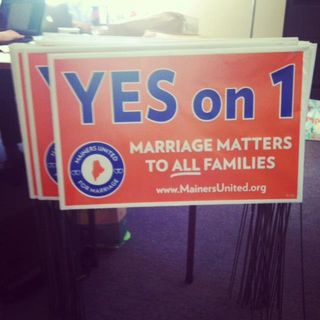
    MainersformarriageBy now everyone knows there are four same-sex
    marriage ballot initiatives coming up next month. Minnesota’s is the
    old-fashioned kind—a constitutional amendment to ban same-sex marriage. Maryland
    and Washington will vote on whether to keep from going into effect legislation
    passed last term allowing same-sex couples to marry. In Maine, voters will
    decide whether to enact marriage equality by popular vote; if it passes, it
    will be the first state to grant marriage equality this way. Three years ago,
    Maine voters rejected a marriage equality law passed by the legislature.

    Of course I hope the Maine initiative is
    successful (and that the other measures fail). But I am deeply troubled by an
    apparent switch in focus by the campaign for marriage equality. According to
    Thursday’s Los Angeles Times, the
    campaign manager of Mainers United for Marriage, Matt McTighe, reports that
    campaign volunteers going door-to-door talking to voters “talk less about gay
    rights and more about marriage as a stabilizing force in society.” In other
    words, this fight for marriage equality is less about equality and more about
    marriage.

    But what does it mean to sell same-sex
    marriage because marriage is a stabilizing force? If we denominate
    those who marry the virtuous ones, then those who don’t marry must be
    de-stabilizing. I have never understood how this can be a pro-gay message, when
    up until recently there have been no same-sex marriages but there have been a
    whole lot of long-term same-sex relationships, with and without children,
    contributing to civic life and their communities. The gay rights message can’t
    be that we think those families were a de-stabilizing force on society because
    they weren’t married. So the message must be a dig at heterosexuals who don’t
    marry, and that’s the same message right wing organizations use when they blame
    single mothers for all our social problems, thereby displacing responsibility
    from the income inequality, inadequate education system, race and sex
    discrimination, and lack of public support for childrearing that really cause
    our nation’s problems. (For more on this, read one of my early blog posts here.)

    4433
    Long-time marriage equality opponent David
    Blankenhorn got a lot of attention this past summer for his conversion to
    marriage equality supporter. In a recent video opposing
    Minnesota’s constitutional amendment, Blankenhorn explains that he dropped
    his opposition because opposing gay marriage was not helping achieve his goals
    of having “society renew its commitment to the marital institution” and having
    more children grow up in stable two parent homes. In his New York Times
    piece
     explaining his conversion, he called
    for a coalition of gay and straight people who want to “strengthen marriage.” And
    he tells us what that means. His agenda is: people should
    marry before having children and should marry rather than “cohabit.” He
    also hopes this coalition will agree that children born from assisted
    reproduction should have a “right to know and be known by” those who donated
    the semen or eggs that resulted in their birth. (He calls those people “their
    biological parents,” but I am more critical of using the word “parent” in this
    context.) So by his account, same-sex couples should not live together until
    they marry; should not have children unless and until they marry; and should
    not use anonymous sperm or egg donors to procreate. With friends like that….

    I’m not saying that Mainers United for
    Marriage believes those things. But consider its name. Not Mainers United
    for Marriage Equality, or even Mainers United for the Freedom to Marry. Mainers
    United for Marriage. If you didn’t know otherwise, that could be the name of a
    group opposing marriage for same-sex couples, because, after
    all, those groups say they are for marriage. I, on the other
    hand, am for equality. And proud of it.

  • Christopher Finan is president of American Booksellers Foundation for Free Expression, which was established by the American Booksellers Association in 1990 to defend the First Amendment rights of booksellers and their customers. He is the author of From the Palmer Raids to the PATRIOT Act: A History of the Fight for Free Speech in America, the winner of the American Library Association’s Eli M. Oboler Award for the best work on intellectual freedom published in 2006 and 2007. 

    BBW12_VirtualReadout_logo3_SMBanned Books Week turned 30 this year, but this was not your
    grandmother’s celebration of the freedom to read.

    Since its founding, the centerpiece of Banned Books Week has
    been the display of banned and challenged titles on tables in bookstores and
    libraries around country. This year the celebration began on the Internet with
    a tremendously creative two-minute video produced by Bookmans, an independent
    bookstore with six locations in Arizona.  

    The Bookmans video was a contribution to a read-out of
    banned books that was launched on the Internet last year. Most of the more than
    1,000 videos that have been posted on YouTube feature people reading passages
    from their favorite books. The Bookmans video shows a series of customers and
    staff members reading a single line from different censored books. Each line
    was carefully chosen to celebrate the importance of books, reading and free
    speech.

    The moving message of the video, combined with skillful
    editing by Harrison Kressler, Bookmans’ video producer, helped it become the
    hit of Banned Books Week. More than 17,000 people watched it on YouTube, making
    it our most popular video to date.

    City Lights Bookstore in San Francisco also joined the
    read-out, producing a series of wonderful readings by writers and leading
    members of the literary community, including Lawrence Ferlinghetti, the store’s founder. Director John Waters read from Lady Chatterley’s Lover.

    Other bookstores who contributed to the read-out include
    Chapter One Book Store, UConn Co-op, Vintage Books, Poor Richard’s Bookshoppe,
    the King’s English Bookshop, the Book House and Bookmamas. The videos may be viewed here. (Some are exhibited on playlists.)

    But the Internet read-out is only one of many new things
    about Banned Books Week. The sponsors of Banned Books Week—the American
    Booksellers Foundation for Free Expression, the American Library Association,
    the Association of American Publishers, the National Association of College
    Stores and the American Society of Journalists and Authors—have created a
    steering committee to plan for the event throughout the year. The Internet
    read-out was one of our first ideas.

    4429The committee has also invited new groups to become sponsors,
    including the National Coalition Against Censorship, the National Council of
    Teachers of English, the Comic Book Legal Defense Fund and Project Censored.

     As a result of these
    organizational changes, Banned Books Week has grown. Press coverage of the
    event doubled last year. We don’t have statistics for this year yet, but it
    appears that coverage continues to increase. In the past, we have had trouble
    placing opinion pieces in newspapers during Banned Books Week, but this year
    the Louisville Courier-Journal approached us for a column. KPFA,
    a radio station in San Francisco, devoted a full hour to Banned Books Week.

    This doesn’t mean that displays of banned books are old hat. They
    remain the most effective means of delivering our message that even in America
    censorship is a problem. The “ah-ha!” moment occurs when bookstore customers
    and library patrons see that some of their most beloved books have been
    challenged.

    Banned Books Week continues to give booksellers a great
    opportunity to bring customers into their stores. I saw this for myself this
    year when I spent Banned Books Week in Durango, Colorado, at the invitation of
    Maria’s Bookshop.

    Peter Schertz and Andrea Avantaggio, the owners of Maria’s,
    have been expanding their celebration of Banned Books Week for several years. It
    happened that this year Banned Books Week coincided with the Durango Literary
    Festival, and festival organizers were planning a program on censorship. Peter
    invited me to join the panel, which included Ellen Hopkins, whose books are
    frequently challenged. It seemed like a long way to go for one appearance, so I
    asked him to see if anyone else might want to hear about banned books.

    I was surprised when Libby Cowles, Maria’s community
    relations manager, lined up three classroom talks at Ft. Lewis College, a radio
    interview and a breakfast speech to the town’s booksellers and librarians. From
    the first day in Durango, my visit got great coverage in the local newspaper,
    which published a column I wrote on the front page of the Sunday
    opinion section. The publisher even invited me to address his editors at their
    daily meeting.

    While I want to believe that the warm reception in Durango
    was a response to my rugged good looks, it was largely the result of Libby’s
    efforts and Maria’s excellent relations with community leaders.

    There was something else at work as well. The message of
    Banned Books Week is that we only possess free speech as long as we are willing
    to fight for it. When people are made aware of censorship, they are grateful to
    the booksellers, librarians, teachers, parents and kids who are fighting back.

    There is no danger that Banned Books Week will grow old
    anytime soon. Our challenge is to continue to find new ways to carry the
    message.